


Piazza del Popolo
Get FREE email communications from Fodor's Travel, covering must-see travel destinations, expert trip planning advice, and travel inspiration to fuel your passion.

We've compiled the best of the best in Italy - browse our top choices for the top things to see or do during your stay.
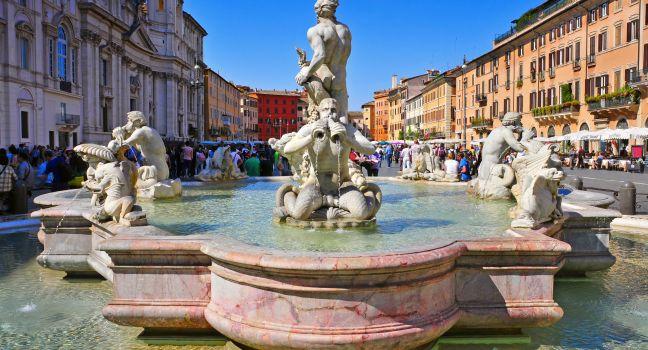
The piazza took on its current look during the 17th century, after Pope Innocent X of the Pamphilj family decided to make over his family palace (now the Brazilian embassy and an ultraluxe hotel) and its surroundings. Center stage is the Fontana dei Quattro Fiumi, created for Innocent by Bernini in 1651. Bernini's powerful figures of the four rivers represent the longest rivers of the known continents at the time: the Nile (his head covered because the source was unknown); the Ganges; the Danube; and the Plata (the length of the Amazon was then unknown). Popular legend has it that the figure of the Plata—the figure closest to Sant'Agnese in Agone—raises his hand before his eyes because he can't bear to look upon the church's "inferior" facade designed by Francesco Borromini, Bernini's rival.
If you want to sip a coffee with one of the most beautiful, if pricey, views in Rome, grab a seat at Piazza Navona. Just be aware that all the restaurants here are heavily geared toward tourists, so while it's a beautiful place for a drink, you can find cheaper, more authentic, and far better meals elsewhere.
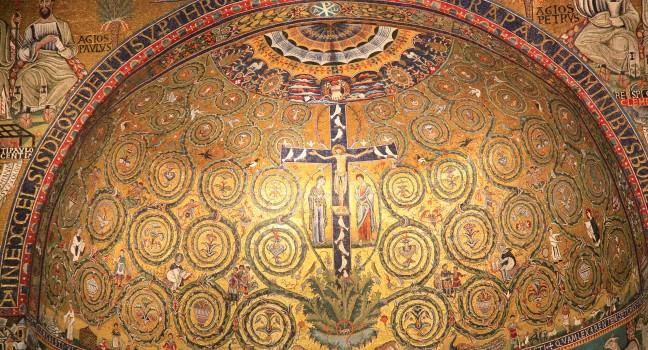
The upper church (at street level) is a gem in its own right. In the apse, a glittering 12th-century mosaic shows Jesus on a cross that turns into a living tree. Green acanthus leaves swirl and teem with small scenes of everyday life. Early Christian symbols, including doves, vines, and fish, decorate the 4th-century marble choir screens. In the left nave, the Castiglioni chapel holds frescoes painted around 1400 by the Florentine artist Masolino da Panicale (1383–1440), a key figure in the introduction of realism and one-point perspective into Renaissance painting. Note the large Crucifixion and scenes from the lives of saints Catherine, Ambrose, and Christopher, plus the Annunciation (over the entrance).
To the right of the sacristy (and bookshop), descend the stairs to the 4th-century church, used until 1084, when it was damaged beyond repair during a siege of the area by the Norman prince Robert Guiscard. Still intact are some vibrant 11th-century frescoes depicting stories from the life of St. Clement. Don't miss the last fresco on the left, in what used to be the central nave. It includes a particularly colorful quote—including "Go on, you sons of harlots, pull!"—that's not only unusual for a religious painting, but also one of the earliest examples of written vernacular Italian.
Descend an additional set of stairs to the Mithraeum, a shrine dedicated to the god Mithras. His cult spread from Persia and gained a foothold in Rome during the 2nd and 3rd centuries AD. Mithras was believed to have been born in a cave and was thus worshipped in cavernous, underground chambers, where initiates into the all-male cult would share a meal while reclining on stone couches, some visible here along with the altar block. Most such pagan shrines in Rome were destroyed by Christians, who often built churches over their remains, as happened here.
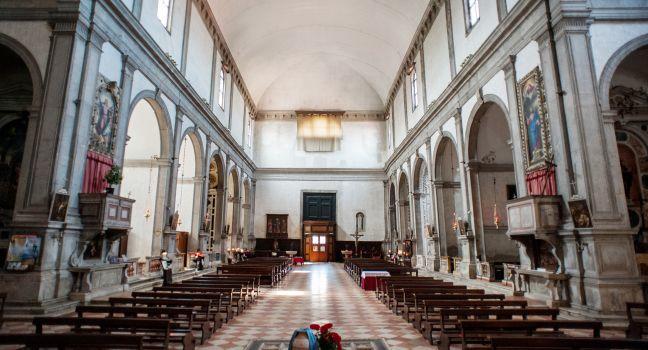

There's been a church on this island since the 8th century, with the addition of a Benedictine monastery in the 10th. Today's refreshingly airy and simply decorated church of brick and white marble was begun in 1566 by Palladio and displays his architectural hallmarks of mathematical harmony and classical influence. The Last Supper and the Gathering of Manna, two of Tintoretto's later works, line the chancel. To the right of the entrance hangs The Adoration of the Shepherds by Jacopo Bassano (1517–92); affection for his home in the foothills, Bassano del Grappa, is evident in the bucolic subjects and terra-firma colors. Book ahead for a tour of the private rooms to view Carpaccio's St. George and the Dragon (1516) and what is considered to be Tintoretto's final work, The Entombment of Christ (1594). The campanile (bell tower) dates from 1791, the previous structures having collapsed twice. Take an elevator to the top of the campanile for unparalleled 360-degree views of the lagoon, islands, and Venice itself.
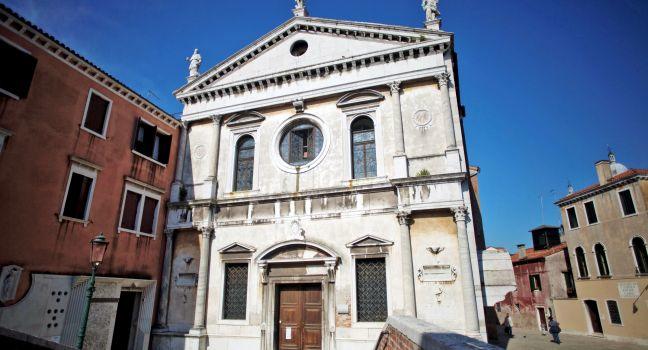
Paolo Veronese (1528–88), though still in his twenties, was already the official painter of the Republic when he began the ceiling oil panels and wall frescoes at San Sebastiano in 1555. For decades he continued to embellish the church with very beautiful illusionistic scenes. The cycles of scenes in San Sebastiano are considered to be his supreme accomplishment. His three oil paintings in the center of the ceiling depict scenes from the life of Esther, a rare theme in Venice. Veronese is buried beneath his bust near the organ.

More a museum than a church, San Zaccaria has a striking Renaissance facade, with central and upper portions representing some of Mauro Codussi's best work. The lower portion of the facade and the interior were designed by Antonio Gambello. The original structure of the church was 14th-century Gothic, with its facade completed in 1515, some years after Codussi's death in 1504, and it retains the proportions of the rest of the essentially Gothic structure. Inside is one of the great treasures of Venice, Giovanni Bellini's celebrated altarpiece, La Sacra Conversazione, easily recognizable in the left nave. Completed in 1505, when the artist was 75, it shows Bellini's ability to incorporate the aesthetics of the High Renaissance into his work.
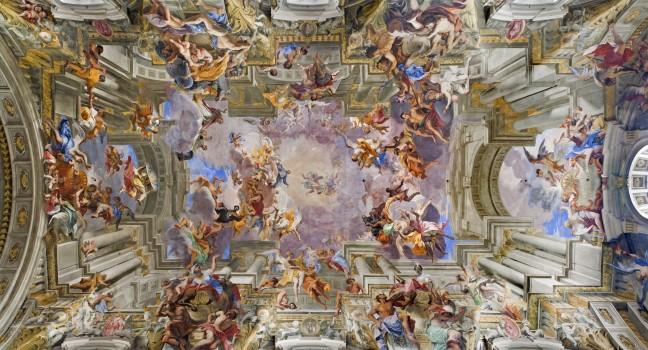
Rome's second Jesuit church, this 17th-century landmark set on a Rococo piazza harbors some of the city's most magnificent trompe l'oeils. To get the full effect of the illusionistic ceiling by priest-artist Andrea Pozzo, stand on the small yellow disk set into the floor of the nave. The heavenly vision that seems to extend upward almost indefinitely represents the Allegory of the Missionary Work of the Jesuits. It's part of Pozzo's cycle of works in this church exalting the early history of the Jesuit order, whose founder was the reformer Ignatius of Loyola. The saint soars heavenward, supported by a cast of thousands, creating a jaw-dropping effect that was fully intended to rival that of the glorious ceiling by Baciccia in the nearby mother church of Il Gesù. Be sure to have coins handy for the machine that switches on the lights so you can marvel at the false dome, which is actually a flat canvas—a trompe l'oeil trick Pozzo used when the architectural budget drained dry.
Scattered around the nave are several awe-inspiring altars; their soaring columns, gold-on-gold decoration, and gilded statues are pure splendor. Splendid, too, are the occasional sacred music concerts performed by choirs from all over the world. Look for posters by the main doors, or check the website for more information.
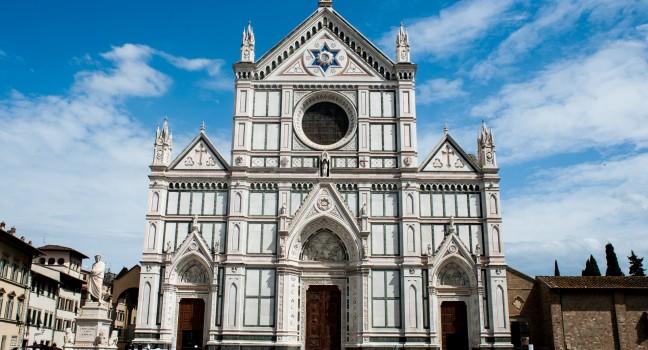
This Gothic church, whose facade dates from the 19th century, contains the skeletons of many Renaissance celebrities. The tomb of Michelangelo (1475–1564) is on the right at the front of the basilica, a location he is said to have chosen so that the first thing he would see on Judgment Day, when the graves of the dead fly open, would be Brunelleschi's dome through Santa Croce's open doors. The tomb of Galileo Galilei (1564–1642) is on the left wall. He was not granted a Christian burial until 100 years after his death because of his controversial contention that Earth was not the center of the universe. The tomb of Niccolò Machiavelli (1469–1527), the political theoretician whose brutally pragmatic philosophy so influenced the Medici, is halfway down the nave on the right. The grave of Lorenzo Ghiberti (1378–1455), creator of the Baptistery doors, is halfway down the nave on the left. Composer Gioachino Rossini (1792–1868) is buried at the end of the nave on the right. The monument to Dante Alighieri (1265–1321), the greatest Italian poet, is a memorial rather than a tomb (he is buried in Ravenna); it's on the right wall near the tomb of Michelangelo.
The complex's collection of art is by far the most important of any church in Florence. The most famous works are the Giotto frescoes in the two chapels immediately to the right of the high altar. They illustrate scenes from the lives of St. John the Evangelist and St. John the Baptist (in the right-hand chapel), as well as those from the life of St. Francis (in the left-hand chapel). Time has not been kind to these frescoes; through the centuries, wall tombs were placed in the middle of them, they were whitewashed and plastered over, and they suffered a clumsy 19th-century restoration. But the reality that Giotto introduced into painting can still be seen. He did not paint beautifully stylized religious icons, as the Byzantine style that preceded him prescribed. Instead, he painted drama—St. Francis surrounded by grieving friars at the very moment of his death. This was a radical shift in emphasis: before Giotto, painting's role was to symbolize the attributes of God; after him, it was to imitate life. His work is indeed primitive compared with later painting, but in the early 14th century it caused a sensation that was not equaled for another 100 years. He was, for his time, the equal of both Masaccio and Michelangelo.
Other highlights are Donatello's Annunciation, a moving expression of surprise (on the right wall two-thirds of the way down the nave); 14th-century frescoes by Taddeo Gaddi (circa 1300–66) illustrating scenes from the life of the Virgin Mary, clearly showing the influence of Giotto (in the chapel at the end of the right transept); and Donatello's Crucifix, criticized by Brunelleschi for making Christ look like a peasant (in the chapel at the end of the left transept). Outside the church proper, in the Museo dell'Opera di Santa Croce off the cloister, is the 13th-century Crucifix by Cimabue (circa 1240–1302), badly damaged by the flood of 1966. A model of architectural geometry, the Cappella Pazzi, at the end of the cloister, is the work of Brunelleschi.
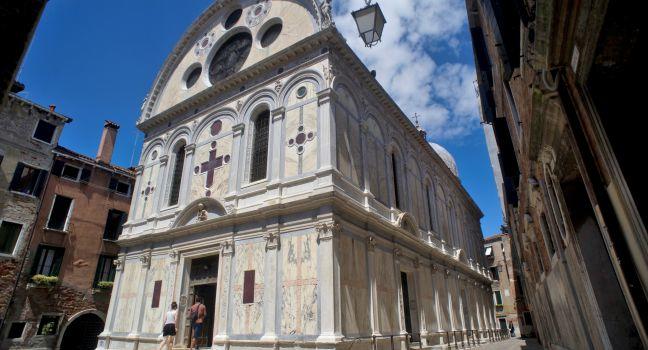
Tiny yet harmoniously proportioned, this Renaissance gem, built between 1481 and 1489, is sheathed in marble and decorated inside with exquisite marble reliefs. Architect Pietro Lombardo (circa 1435–1515) miraculously compressed the building to fit its lot, then created the illusion of greater size by varying the color of the exterior, adding extra pilasters on the building's canal side, and offsetting the arcade windows to make the arches appear deeper. The church was built to house I Miracoli, an image of the Virgin Mary by Niccolò di Pietro (1394–1440) that is said to have performed miracles—look for it on the high altar.
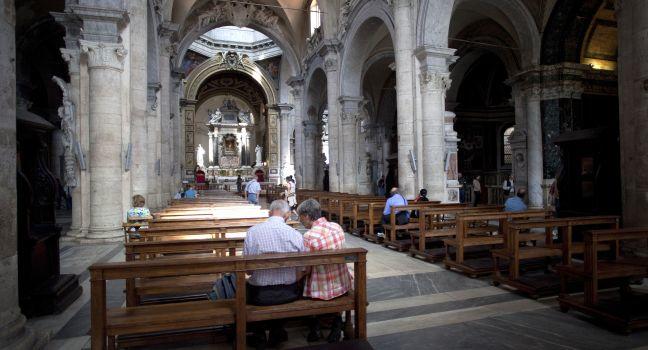
Raphael designed the famous Chigi Chapel, the second on the left, with vault mosaics—showing God the Father in Benediction—as well as statues of Jonah and Elijah. More than a century later, Bernini added the oval medallions on the tombs and the statues of Daniel and Habakkuk. Finally, the Cerasi Chapel, to the left of the high altar, holds two Caravaggios: The Crucifixion of St. Peter and The Conversion of St. Paul. Exuding drama and realism, both are key early Baroque works that show how "modern" 17th-century art can appear. Compare their style with the much more restrained and classically "pure" Assumption of the Virgin by Annibale Carracci, which hangs over the altar of the chapel.
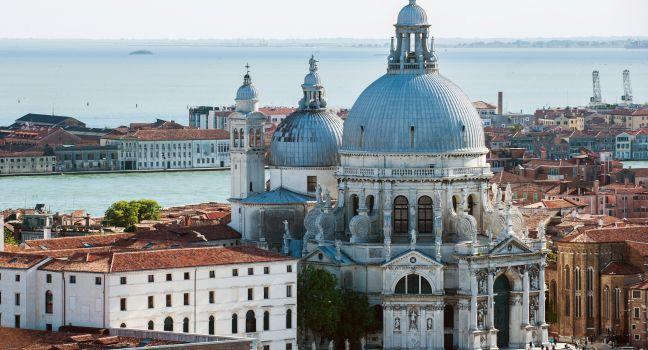
The most iconic landmark of the Grand Canal, "La Salute" (as this church is commonly called) is most unforgettably viewed from the Riva degli Schiavoni at sunset, or from the Accademia Bridge by moonlight. En route to becoming Venice's most important baroque architect, 32-year-old Baldassare Longhena won a competition in 1631 to design a shrine honoring the Virgin Mary for saving Venice from a plague that in the space of two years (1629–31) killed 47,000 residents, or one-third of the city's population, including the doge. It was not completed, however, until 1687—five years after Longhena's death.
Outside, this ornate white Istrian stone octagon is topped by a colossal cupola with snail-like ornamental buttresses—in truth, piers encircled by finely carved "ropes," an allusion to the sail-making industry of the city (or so say today's art historians). Inside, a white-and-gray color scheme is complemented by a polychrome marble floor and the six chapels. The Byzantine icon above the main altar has been venerated as the Madonna della Salute (Madonna of Health) since 1670, when Francesco Morosini brought it here from Crete. Above it is a dramatic marble sculpture by Giusto Le Court showing Venice on her knees before the Madonna as she implores aid and a cherub drives the plague from the city.
Do not leave the church without visiting the Sacrestia Maggiore, which contains a dozen works by Titian, including his San Marco Enthroned with Saints altarpiece. You'll also see Tintoretto's Wedding at Cana. For the Festa della Salute, held November 21, a votive bridge is constructed across the Grand Canal from Campo Santa Maria del Giglio to San Gregorio, and Venetians make a pilgrimage here to light candles in prayer for another year's health. Check the website for information on guided tours.
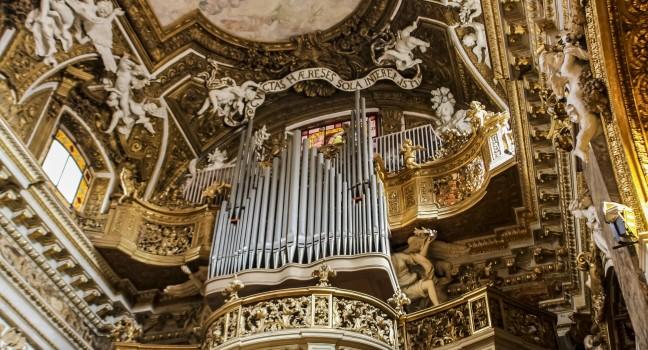
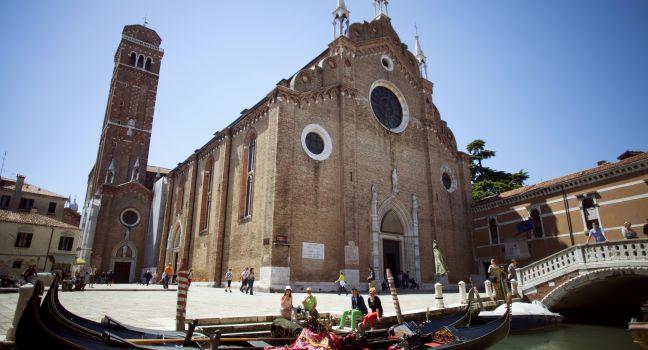
Completed in 1442, this immense Gothic church of russet-color brick, known locally as “I Frari,” is famous worldwide for its array of spectacular Venetian paintings and historic tombs. It is also noteworthy for being the only important church in Italy that has preserved its elaborately carved, freestanding wooden choir in front of the high altar, a common feature in the medieval period (for the use of the monks in the attached monastery, still active today).
Visit the sacristy first, to see Giovanni Bellini's 1488 triptych Madonna and Child with Saints in all its mellow luminosity, painted for precisely this spot. The Corner Chapel on the other side of the chancel is graced by Bartolomeo Vivarini's (1415–84) 1474 altarpiece St. Mark Enthroned and Saints John the Baptist, Jerome, Peter, and Nicholas, which is much more conservative, displaying an attention to detail generally associated with late medieval painting. In the first south chapel of the choir, there is a fine sculpture of St. John the Baptist by Donatello, dated 1438 (perhaps created before the artist came to Venice), which conveys a psychological intensity rare for early Renaissance sculpture. You can see the rapid development of Venetian Renaissance painting by contrasting Bellini with the heroic energy of Titian's Assumption, over the main altar, unveiled in 1518. It was the artist's first public commission and, after causing a bit of controversy, did much to establish his reputation. Upon viewing this painting at the far end of the nave, you'll first think it has been specially spotlit: up close, however, you'll discover this impression is due to the painter's unrivaled use of light and color.
Titian's masterpiece, the Madonna di Ca' Pesaro, is in the left aisle. The painting took seven years to complete (finished in 1526), and in it Titian disregarded the conventions of his time by moving the Virgin out of center and making the saints active participants. The composition, built on diagonals, anticipates structural principals of Baroque painting in the following century. The work is brought to life by the unconventional gaze of young Leonardo Pesaro, who seems to look directly at the viewer.
The Frari also holds a Sansovino sculpture of St. John the Baptist and Longhena's impressive Baroque tomb designed for Doge Giovanni Pesaro. Titian, who died during the plague of 1576, is buried near his luminous Madonna di Ca' Pesaro; the massive marble monument to him near the main entrance was commissioned by the emperor of Austria in 1838 in recognition of the artist who had worked at the court of his forefathers. The black marble tomb of musician Claudio Monteverdi, one of the greatest composers of the 17th century, is in the chapel of the Milanese to the left of the high altar. There are always roses lying on it, left by anonymous admirers.
The Bocca della Verità (Mouth of Truth) is in reality nothing more than an ancient drain cover, unearthed during the Middle Ages. Legend has it, however, that the teeth will clamp down on a liar's hand if they dare to tell a fib while holding their fingers up to the fearsome mouth. Hordes of tourists line up to take the test every day (kids especially get a kick out of it).
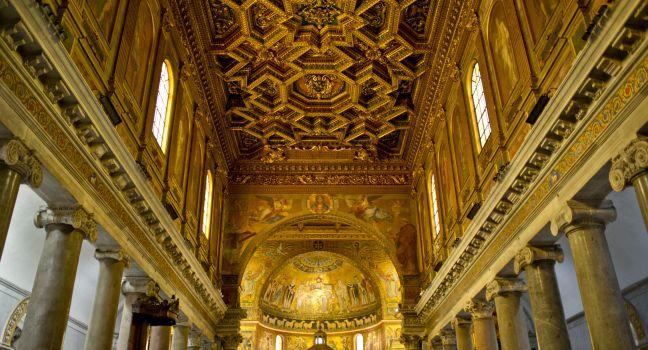
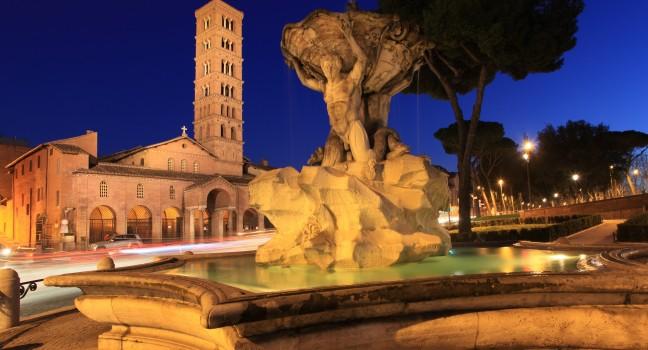
Built during the 4th century and rebuilt in the 12th century, this is one of Rome's oldest and grandest churches. It is also the earliest foundation of any Roman church to be dedicated to the Virgin Mary. The 18th-century portico draws attention to the facade's 800-year-old mosaics, which represent the parable of the Wise and Foolish Virgins. They enhance the whole piazza, especially at night, when the church front and bell tower are illuminated.
With a nave framed by a processional of two rows of gigantic columns (22 in total) taken from the ancient Baths of Caracalla and an apse studded with gilded mosaics, the interior conjures the splendor of ancient Rome. Overhead is Domenichino's gilded ceiling (1617). The church's most important mosaics, Pietro Cavallini's six panels of the Life of the Virgin, cover the semicircular apse. Note the building labeled "Taberna Meritoria" just under the figure of the Virgin in the Nativity scene, with a stream of oil flowing from it; it recalls the legend that a fountain of oil appeared on this spot, prophesying the birth of Christ. Off the piazza's northern side is a street called Via delle Fonte dell'Olio in honor of this miracle.
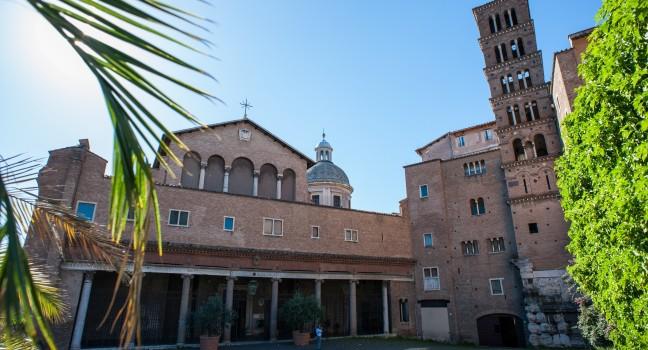
Perched up the incline of the Clivio di Scauro—a magical time-machine of a street, where the dial seems to be stuck somewhere in the 13th century—Santi Giovanni e Paolo is an image that would tempt most landscape painters. Marked by one of Rome's finest Romanesque bell towers, it looms over a picturesque piazza. Underneath, however, are other treasures, whose excavations can be seen in the Case Romane del Celio museum.
A basilica erected on the spot was, like San Clemente, destroyed in 1084 by attacking Normans. Its half-buried columns, near the current church entrance, are visible through misty glass. The current church's origins date to the start of the 12th century, but most of the interior dates to the 17th century and later. The lovely, incongruous chandeliers are hand-me-downs from New York's Waldorf-Astoria hotel, a gift arranged by the late Cardinal Francis Spellman of New York, whose titular church this was. Spellman also initiated the excavations here in 1949.

This gorgeous church looms over one of the most picturesque squares in Venice: the Campo Giovanni e Paolo, centered on the magnificent 15th-century equestrian statue of Bartolomeo Colleoni by the Florentine Andrea del Verrocchio. Also note the beautiful facade of the Scuola Grande di San Marco (now the municipal hospital), begun by Pietro Lombardo and completed after the turn of the 16th century by Mauro Codussi. The massive Italian Gothic church itself is of the Dominican order and was consecrated in 1430. Bartolomeo Bon's portal, combining Gothic and classical elements, was added between 1458 and 1462, using columns salvaged from Torcello. The 15th-century stained-glass window near the side entrance is breathtaking for its brilliant colors and beautiful figures; it was made in Murano from drawings by Bartolomeo Vivarini and Girolamo Mocetto (circa 1458–1531). The second official church of the Republic after San Marco, San Zanipolo (as it's known in Venetian) is Venice's equivalent of London's Westminster Abbey, with a great number of important people, including 25 doges, buried here.
Artistic highlights include an early (1465) polyptych by Giovanni Bellini (right aisle, second altar) where the influence of Mantegna is still very evident, Alvise Vivarini's Christ Carrying the Cross (sacristy), and Lorenzo Lotto's Charity of St. Antonino (right transept). Don't miss the Cappella del Rosario (Rosary Chapel), off the left transept, built in the 16th century to commemorate the 1571 victory of Lepanto in western Greece, when Venice led a combined European fleet to defeat the Turkish navy. The chapel was devastated by a fire in 1867 and restored in the early years of the 20th century with works from other churches, among them the sumptuous Veronese ceiling paintings. However quick your visit, don't miss the Pietro Mocenigo tomb to the right of the main entrance, by Pietro Lombardo and his sons. Note also Tullio Lombardo's tomb of Andrea Vendramin, the original home of Tullio's Adam, now belonging to New York City's Metropolitan Museum of Art.
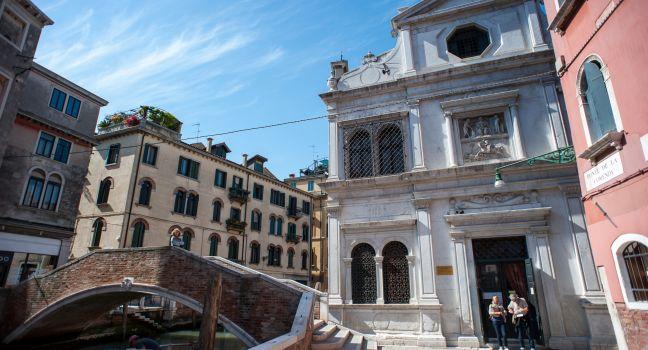
Founded in 1451 by the Dalmatian community, this small scuola, or confraternity, was, and still is, a social and cultural center for migrants from what is now Croatia. It contains one of Italy's most beautiful rooms, harmoniously decorated between 1502 and 1507 by Vittore Carpaccio. Although Carpaccio generally painted legendary and religious figures against backgrounds of contemporary Venetian architecture, here is perhaps one of the first instances of "Orientalism" in Western painting. Opening hours are quite flexible. Since this is a must-see site, book in advance so you won't be disappointed.
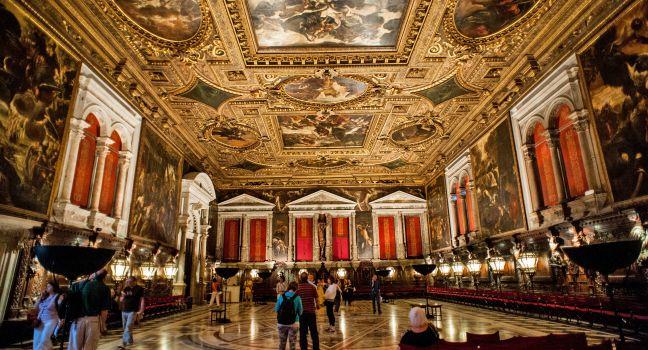
This elegant example of Venetian Renaissance architecture was built between 1516 and 1549 for the essentially secular charitable confraternity bearing the saint's name (one of the six "Great Scuole" and the only one that Napoléon did not expunge). The Venetian scuole were organizations that sometimes had loose religious affiliations, through which the artisan class could exercise some influence upon civic life. San Rocco was venerated as a protector against the plague, and his scuola was one of the city's most magnificent. While the building is bold and dramatic outside, its contents are even more stunning—a series of more than 60 paintings by Tintoretto. In 1564, Tintoretto edged out competition for a commission to decorate a ceiling by submitting not a sketch but a finished work, which he moreover offered free of charge, calculating correctly that a gift could not be rejected. Moses Striking Water from the Rock, The Brazen Serpent, and The Fall of Manna represent three afflictions—thirst, disease, and hunger—that San Rocco, and later his brotherhood, sought to relieve.
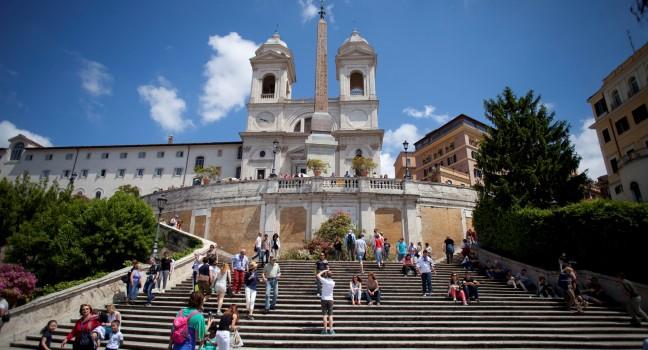
In an allusion to the church, the staircase is divided by three landings (beautifully lined with potted azaleas from mid-April to mid-May). Bookending the bottom of the steps are beloved holdovers from the 18th century, when the area was known as the "English Ghetto": to the right, the Keats-Shelley House and to the left, Babington's Tea Rooms—both beautifully redolent of the era of the Grand Tour.
For weary sightseers who find the 135 steps too daunting, there is an elevator at Vicolo del Bottino 8, next to the Metro entrance. (Those with mobility problems should be aware that there is still a small flight of stairs after, however, and that the elevator is sporadically closed for repair.) At the bottom of the steps, Pietro Bernini's splendid 17th-century Barcaccia Fountain still spouts drinking water from the ancient aqueduct known as the Acqua Vergine.
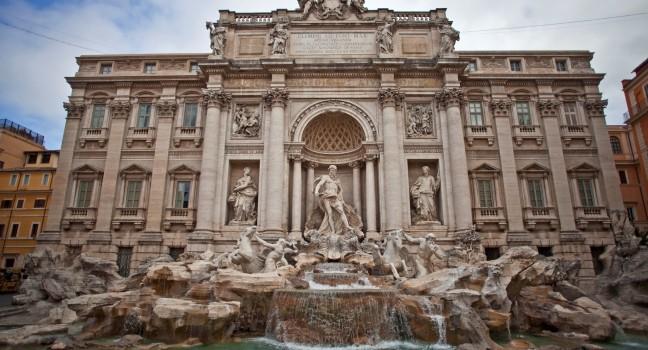
The dream of a fountain emerging full force from a palace was first envisioned by Bernini and Pietro da Cortona from Pope Urban VIII's plan to rebuild an older fountain, which had earlier marked the end point of the Acqua Vergine, an aqueduct created in 18 BC by Agrippa. Three popes later, under Pope Clement XIII, Nicola Salvi finally broke ground with his winning design. Unfortunately, Salvi did not live to see his masterpiece of sculpted seashells, roaring sea beasts, and diva-like mermaids completed; he caught a cold and died while working in the culverts of the aqueduct 11 years before the fountain was finished in 1762.
Everyone knows the famous legend that if you throw a coin into the Trevi Fountain you will ensure a return trip to the Eternal City, but not everyone knows how to do it the right way. You must toss a coin with your right hand over your left shoulder, with your back to the fountain. One coin means you'll return to Rome; two, you'll return and fall in love; three, you'll return, find love, and marry. The fountain grosses some €1,500,000 a year, with every cent going to the Catholic charity Caritas, which is why Fendi was willing to fully fund the Trevi's recent restoration.
Tucked away in a little nearby alley is the Vicus Caprarius ( Vicolo del Puttarello, 25), a small museum where visitors can pay €8 for a guided tour that descends into a subterranean area that gives a glimpse at the water source that keeps the fountain running.
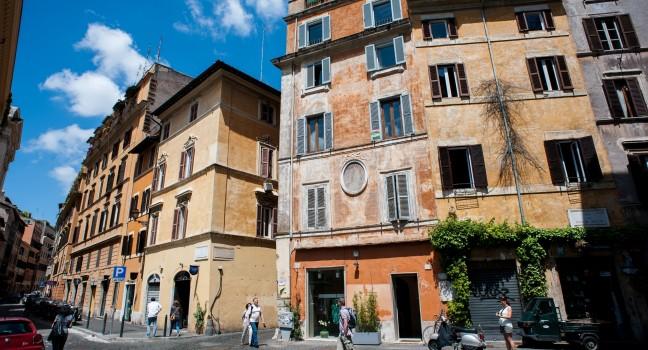
Straight as a die and still something of a Renaissance-era diorama, Via Giulia was the first street in Rome since ancient times to be deliberately planned. It was named for Pope Julius II (of Sistine Chapel fame), who commissioned it in the early 1500s as part of a scheme to open up a grandiose approach to St. Peter's Basilica. Although the pope's plans were only partially completed, Via Giulia became an important thoroughfare in Renaissance Rome. It's still, after more than four centuries, the address of choice for Roman aristocrats, despite a recent, controversial addition: a large parking lot along one side of the street (creating it meant steamrolling through ancient and medieval ruins underneath).
A stroll around and along Via Giulia reveals elegant palaces and churches, including one, San Eligio, on the little side street Via di Sant'Eligio, that was designed by Raphael himself. Note also the Palazzo Sacchetti ( Via Giulia, 66), with an imposing stone portal and an interior containing some of Rome's grandest staterooms; it remains, after 300 years, the private quarters of the Marchesi Sacchetti. The forbidding brick building that housed the Carceri Nuove (New Prison) ( Via Giulia, 52), Rome's prison for more than two centuries, now contains the offices of the Direzione Nazionale Antimafia. Near the bridge that arches over Via Giulia's southern end is the church of Santa Maria dell'Orazione e Morte (Holy Mary of Prayer and Death), with stone skulls on its door. These are a symbol of a confraternity that was charged with burying the bodies of the unidentified dead found in the city streets.
Designed by Borromini and home, since 1927, to the Hungarian Academy, the Palazzo Falconieri ( Via Giulia, 1 06/68896700) has Borromini-designed salons and loggia that are sporadically open as part of guided tours; call for information. The falcon statues atop its belvedere are best viewed from around the block, along the Tiber embankment. Remnant of a master plan by Michelangelo, the arch over the street was meant to link massive Palazzo Farnese, on the east side of Via Giulia, with the building across the street and a bridge to the Villa Farnesina, directly across the river. Finally, on the right and rather green with age, dribbles that star of many a postcard, the Fontana del Mascherone.
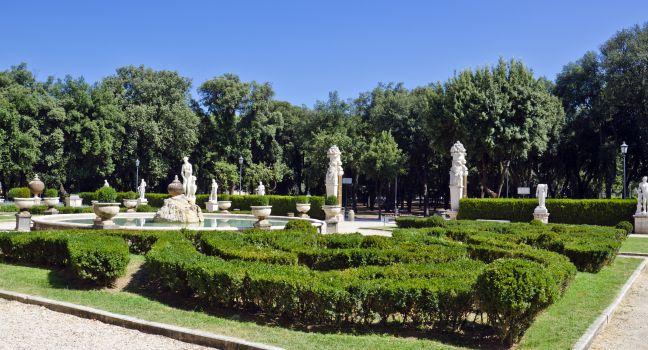
Rome's Central Park, the Villa Borghese was originally laid out as a recreational garden in the early 17th century by Cardinal Scipione Borghese. The word "villa" was used to mean suburban estate, of the type developed by the ancient Romans and adopted by Renaissance nobles. Today's gardens cover a much smaller area—by 1630, the perimeter wall was almost 5 km (3 miles) long. At the end of the 18th century, Scottish painter Jacob More remodeled the gardens into the English style popular at the time. In addition to the gloriously restored Galleria Borghese, the highlights of the park are Piazza di Siena, a graceful amphitheater, and the botanical garden on Via Canonica, where there is a pretty little lake as well as the neoclassical faux–Temple of Aesculapius, the Biopark zoo, Rome's own replica of London's Globe Theatre, and the Villa Giulia museum.
The Carlo Bilotti Museum ( www.museocarlobilotti.it) is particularly attractive for Giorgio de Chirico fans, and there is more modern art in the nearby Galleria Nazionale d'Arte Moderna e Contemporanea. The 63-seat children's movie theater, Cinema dei Piccoli, shows films for adults in the evening. There's also Casa del Cinema, where film buffs can screen films or sit at the sleek, cherry-red, indoor-outdoor caffè (you can find a schedule of events at www.casadelcinema.it).
This abbey was founded in 1313 by Giovanni Tolomei, a rich Sienese lawyer who, after miraculously regaining his sight, changed his name to Bernardo in homage to St. Bernard of Clairvaux. Bernardo then established a monastic order dedicated to the restoration of Benedictine principles. The name of the order—the White Benedictines—refers to a vision that Bernardo had in which Christ, Mary, and his own mother were all clad in white. The monks are also referred to as Olivetans (the name of the hill where the monastery was built).
In the abbey's main cloister, frescoes by Luca Signorelli and Sodoma depict scenes from the life of St. Benedict. Signorelli began the cycle by painting scenes from the saint's adult life as narrated by St. Gregory the Great. Though these nine scenes are badly worn, the individual expressions pack some punch. Later, Sodoma completed scenes from the saint's youth and the last years of his life. Note the detailed landscapes, the rich costumes, and the animals (similar to those Sodoma was known to keep as pets).
The exterior and interior sculpture of this Romanesque abbey, dating from the 12th century, is outstanding, particularly the nave capitals, a combination of French, Lombard, and even Spanish influences. The sacristy (seldom open) forms part of the primitive Carolingian church (founded in AD 781), its entrance flanked by 9th-century pilasters. The small vaulted crypt dates from the same period.
A tortuous road leads up to Anacapri, the island's "second city," about 3 km (2 miles) from Capri Town. Crowds are thick down Via Capodimonte leading to Villa San Michele and around Piazza Vittoria, the square where you catch the chairlift to the top of Monte Solaro. Via Finestrale leads to the noted Le Boffe quarter, centered on the Piazza Diaz. Elsewhere, Anacapri is quietly appealing. It's a good starting point for walks, such as the 80-minute round-trip journey to the Migliara Belvedere, on the island's southern coast.
Explore the ruins by the terrace of Marcus Nonius Balbus, where the town's great benefactor is buried, and the Suburban Baths (undergoing restoration). Directly below, on the onetime seafront, in the barrel arches, which were once storage for boats, 300 skeletons of escaping residents were found in 1980.
An imposing bishop's palace holds this unique museum of Etruscan objects. Although there are many beautiful pieces displayed in an intelligent and well-documented fashion, the almost complete roof and pediment from a 5th-century BC Etruscan house stand out as rare and precious. The so-called Cowboy of Murlo, a large-hatted figure from the same roof, is the star of the collection but anyone interested in ancient Etruscan culture will be well rewarded by a visit here. The museum is named after the nearby site from which most of the artifacts were excavated.


