32 Best Sights in Italy

Background Illustration for Sights

We've compiled the best of the best in Italy - browse our top choices for the top things to see or do during your stay.

Pantheon

Piazza Navona Fodor's Choice
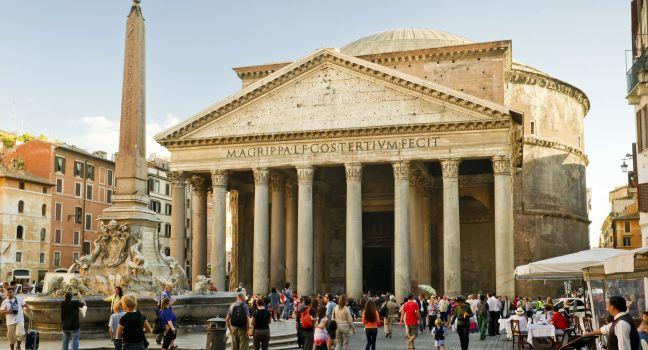
ROME - OCTOBER 2: Tourists visit the Pantheon on October 2, 2012 in Rome, Italy. Pantheon is a famous monument of ancient Roman culture, the temple of all the gods, built in the 2nd century.;
Viacheslav Lopatin/Shutterstock

The city's best-preserved ancient building, this former Roman temple is a marvel of architectural harmony and proportion. It was entirely rebuilt by the emperor Hadrian around AD 120 on the site of a Pantheon (from the Greek: pan, all, and theon, gods) erected in 27 BC by Augustus's right-hand man and son-in-law, Agrippa.

The most striking thing about the Pantheon is not its size, immense though it is, nor even the phenomenal technical difficulties posed by so massive a construction; rather, it's the remarkable unity of the building. The diameter described by the dome is exactly equal to its height. It's the use of such simple mathematical balance that gives classical architecture its characteristic sense of proportion and its nobility. The opening at the apex of the dome, the oculus, is nearly 30 feet in diameter and was intended to symbolize the "all-seeing eye of the heavens." On a practical note, this means when it rains, it rains inside: look out for the drainage holes in the floor.

Although little is known for sure about the Pantheon's origins or purpose, it's worth noting that the five levels of trapezoidal coffers (sunken panels in the ceiling) represent the course of the five then-known planets and their concentric spheres. Ruling over them is the sun, represented symbolically and literally by the 30-foot-wide eye at the top. The heavenly symmetry is further paralleled by the coffers: 28 to each row, the number of lunar cycles. In the center of each would have shone a small bronze star. Down below, the seven large niches were occupied not by saints, but, it's thought, by statues of Mars, Venus, the deified Caesar, and the other "astral deities," including the moon and sun, the "sol invictus." (Academics still argue, however, about which gods were most probably worshipped here.)

One of the reasons the Pantheon is so well preserved is that it was consecrated as a church in AD 608. (It's still a working church today.) No building, church or not, though, escaped some degree of plundering through the turbulent centuries of Rome's history after the fall of the empire. In 655, for example, the gilded bronze covering the dome was stripped. The Pantheon is also one of the city's important burial places. Its most famous tomb is that of Raphael (between the second and third chapels on the left as you enter). Mass takes place on Sunday and on religious holidays at 10:30; it's open to the public, but you are expected to arrive before the beginning and stay until the end. General access usually resumes at about 11:30.

You can buy tickets in person via cash or credit card, or online (which requires registering for an account). If you plan on purchasing tickets in person, coming prepared with both cash and a credit card will allow you to select the faster-moving line that day.  On the first Sunday of every month, visitors can enter for free.
Abbazia di Monte Oliveto Maggiore

Fodor's Choice

This abbey was founded in 1313 by Giovanni Tolomei, a rich Sienese lawyer who, after miraculously regaining his sight, changed his name to Bernardo in homage to St. Bernard of Clairvaux. Bernardo then established a monastic order dedicated to the restoration of Benedictine principles. The name of the order—the White Benedictines—refers to a vision that Bernardo had in which Christ, Mary, and his own mother were all clad in white. The monks are also referred to as Olivetans (the name of the hill where the monastery was built).

In the abbey's main cloister, frescoes by Luca Signorelli and Sodoma depict scenes from the life of St. Benedict. Signorelli began the cycle by painting scenes from the saint's adult life as narrated by St. Gregory the Great. Though these nine scenes are badly worn, the individual expressions pack some punch. Later, Sodoma completed scenes from the saint's youth and the last years of his life. Note the detailed landscapes, the rich costumes, and the animals (similar to those Sodoma was known to keep as pets).

Battistero

Duomo Fodor's Choice

The octagonal Baptistery is one of the supreme monuments of the Italian Romanesque style and one of Florence's oldest structures. Local legend has it that it was once a Roman temple dedicated to Mars (it wasn't), and modern excavations suggest that its foundations date from the 1st century AD. The round Romanesque arches on the exterior date from the 11th century, and the interior dome mosaics from the beginning of the mid-13th century are justly renowned, but—glittering beauties though they are—they could never outshine the building's famed bronze Renaissance doors decorated with panels crafted by Lorenzo Ghiberti. Copies of the doors on which Ghiberti worked (1403–52) most of his adult life are on the north and east sides of the Baptistery (to protect them from pollution and acid rain, the original doors were moved to the Museo dell'Opera del Duomo, where they're now on display). The Gothic panels on the south door were designed by Andrea Pisano (circa 1290–1348) in 1330.

Ghiberti's north doors depict scenes from the life of Christ; his later east doors (1425–52), facing the Duomo facade, render scenes from the Old Testament. Both merit close examination, for they are very different in style and illustrate the artistic changes that marked the beginning of the Renaissance. Look at the far right panel of the middle row on the earlier (1403–24) north doors (Jesus Calming the Waters). Here, Ghiberti captured the chaos of a storm at sea with great skill and economy. The artistic conventions he used, however, are basically pre-Renaissance: Jesus is the most important figure, so he is the largest; the disciples are next in size, being next in importance; the ship on which they founder looks like a mere toy.

The exquisitely rendered panels on the east doors are larger, more expansive, more sweeping—and more convincing. The middle panel on the left-hand door tells the story of Jacob and Esau, and the various episodes of the story—the selling of the birthright, Isaac ordering Esau to go hunting, the blessing of Jacob, and so forth—have been merged into a single beautifully realized street scene. Ghiberti's use of perspective suggests depth: the background architecture looks credible, the figures in the foreground are grouped realistically, and the naturalism and grace of the poses (look at Esau's left leg and the dog next to him) have nothing to do with the sacred message being conveyed. Although the religious content remains, the figures and their place in the natural world are given new prominence and are portrayed with a realism not seen in art since the fall of the Roman Empire nearly a thousand years before.

As a footnote to Ghiberti's panels, one small detail of the east doors is worth a special look. To the lower left of the Jacob and Esau panel, Ghiberti placed a tiny self-portrait bust. From either side, the portrait is extremely appealing—Ghiberti looks like everyone's favorite uncle—but the bust is carefully placed so that you can make direct eye contact with the tiny head from a single spot. When that contact is made, the impression of intelligent life—of modern intelligent life—is astonishing. It's no wonder that these doors received one of the most famous compliments in the history of art from an artist known to be notoriously stingy with praise: Michelangelo declared them so beautiful that they could serve as the Gates of Paradise.

Piazza del Duomo, Florence, 50122, Italy
055-2645789
Sight Details
Admission is via one of 3 combo tickets, each valid for 3 days: €30 Brunelleschi Pass (with Campanile, Cupola of the Duomo, Museo dell'Opera del Duomo, and Santa Reparata Basilica Cripta); €20 Giotto Pass (with Campanile, Museo dell'Opera, and Cripta); €15 Ghiberti Pass (with Museo dell'Opera and Cripta)

Something incorrect in this review?

Recommended Fodor's Video

Certosa e Museo di San Martino

Vomero Fodor's Choice

Atop a rocky promontory with a fabulous view of the entire city and majestic salons that would please any monarch, this monastery seems more like a palace. The certosa, or charter house, had been started in 1325, but, by the 18th century, it had grown so sumptuous that Ferdinand IV threatened to halt the religious order's government subsidy. Although the Angevin heritage can be seen in the pointed arches and cross-vaulted ceiling of the Certosa Church, over the years dour Gothic was traded in for varicolored Neapolitan Baroque.

The sacristy leads into the Cappella del Tesoro, with Luca Giordano's ceiling fresco of Judith holding aloft Holofernes's head and paintings by Jusepe de Ribera (the Pietà over the altar is one of his masterpieces). The polychrome marble work of the architect and sculptor Cosimo Fanzago (1591–1678) is at its finest here, and he displays a gamut of sculptural skills in the Chiostro Grande (Great Cloister). Fanzago's ceremonial portals at each corner of the cloister are among the most spectacular of all Baroque creations, aswirl with Michelangelo-esque ornament.

The nearby Museo dell’Opera, which isn't always open, contains sociology-theme rooms that add up to a chronological tour of the city. One room has 13 gouaches of Vesuvius, and another has paintings depicting the Plague. The Quarto del Priore (Prior's Quarters), the residence of the only monk allowed contact with the outside world, is an extravaganza of salons filled with frescoes, majolica-tile floors, and paintings, plus extensive gardens where scenic pergolati (roofed balconies) overlook the bay.

Entering from the Quarto del Priore side, you come upon two splendid gilded coaches and then the "Vessels of the King" naval museum, with a 20-meter (65-foot) boat occupying a whole room. Beyond this lie two rooms with Early Renaissance masterpieces; subsequent rooms hold works by later artists, including the tireless Giordano. Past the library, with its heavenly majolica-tile floor, comes the Sezione Presepiale, the world’s greatest collection of Christmas cribs. Pride of place goes to the Presepe (Nativity scene) of Michele Cuciniello. Equally amazing in its own way is a crib inside an eggshell.

Gran Priorato di Roma dell'Ordine di Malta

Aventino Fodor's Choice

Although the line to peek through the keyhole of a nondescript green door in the Gran Priorato, the walled compound of the Knights of Malta, sometimes snakes around Piazza dei Cavalieri di Malta, the enchanting view is worth the wait. Far across the city, you'll see the dome of St. Peter's Basilica flawlessly framed by the keyhole and tidily trimmed hedges that lie just beyond the locked door. The priory and the square are the work of Giovanni Battista Piranesi, an 18th-century engraver who is more famous for etching Roman views than for orchestrating them, but he fancied himself a bit of an architect and did not disappoint.

Founded in the Holy Land during the Crusades, the Knights of Malta is the world's oldest and most exclusive order of chivalry. The knights amassed huge tracts of land in the Middle East and were based on the Mediterranean island of Malta from 1530 until 1798, when Napoléon expelled them. In 1834, they established themselves in Rome, where ministering to the sick became thelr raison d'être.

Pio Monte della Misericordia

Centro Storico Fodor's Choice

One of the Centro Storico's defining sites, this octagonal church was built around the corner from the Duomo for a charitable institution seven noblemen founded in 1601. The institution's aim was to carry out acts of Christian charity like feeding the hungry, clothing the poor, nursing the sick, sheltering pilgrims, visiting prisoners, and burying the indigent dead—acts immortalized in the history of art by Caravaggio's famous altarpiece depicting the Sette Opere della Misericordia (Seven Acts of Mercy). Pride of place is given to the great Caravaggio above the altar.

San Lorenzo Maggiore

Centro Storico Fodor's Choice

The church of San Lorenzo features a very unmedieval facade of 18th-century splendor. Due to the effects and threats of earthquakes, the church was reinforced and reshaped along Baroque lines in the 17th and 18th centuries. Begun by Robert d'Anjou in 1270 on the site of a previous 6th-century church, the church has a single, barnlike nave that reflects the Franciscans' desire for simple spaces. Also found here is the church's most important monument: the tomb of Catherine of Austria (circa 1323), by Tino da Camaino.

Santa Chiara

Centro Storico Fodor's Choice

Offering a stark and telling contrast to the opulence of the nearby Gesù Nuovo, Santa Chiara is the leading Angevin Gothic monument in Naples. The fashionable house of worship for the 14th-century nobility and a favorite Angevin church from the start, the church of St. Clare was intended to be a great dynastic monument by Robert d'Anjou. His second wife, Sancia di Majorca, added the adjoining convent for the Poor Clares to a monastery of the Franciscan Minors so she could vicariously satisfy a lifelong desire for the cloistered seclusion of a convent. This was the first time the two sexes were combined in a single complex.

Built in a Provençal Gothic style between 1310 and 1328 (probably by Gagliardo Primario) and dedicated in 1340, the church had its aspect radically altered, as did so many others, in the baroque period. A six-day fire started by Allied bombs on August 4, 1943, put an end to all that, as well as to what might have been left of the important cycle of frescoes by Giotto and his Neapolitan workshop. The church's most important tomb towers behind the altar. Sculpted by Giovanni and Pacio Bertini of Florence (1343–45), it is, fittingly, the tomb of the founding king: the great Robert d'Anjou, known as the Wise. Nearby are the tombs of Carlo, duke of Calabria, and his wife, Marie de Valois, both by Tino da Camaino.

Around the left side of the church is the Chiostro delle Clarisse, the most famous cloister in Naples. Complemented by citrus trees, the benches and octagonal columns comprise a light-handed masterpiece of painted majolica designed by Domenico Antonio Vaccaro, with a delightful profusion of landscapes and light yellow, azure, and green floral motifs realized by Donato and Giuseppe Massa and their studio (1742).

Santa Maria a Cetrella

Fodor's Choice

Scenically perched on the slopes of Monte Solaro, this small sanctuary in late-Gothic style—with its older parts dating to the late 14th century—offers a truly picturesque frame for a panorama that takes in much of the island. It also marks the top of the second access route (Il Passetiello) used in ancient times, which linked Capri Town with Anacapri. Steep, slippery, and in spots still dangerous, this is the pathway that the Carthusian monks of San Giacomo would have used to reach their properties in the upper part of the island. Congregants were mainly fisherfolk whose boats were moored in the Marina Piccola directly below; they also used this clifftop aerie as a lookout against Saracen pirates. The church was substantially rebuilt by Franciscan monks in the early 17th century, when a sacristy was added. To reach Santa Maria, you can climb a path leading off Viale Axel Munthe (an hour-long walk); an alternative is to descend a path leading from the Monte Solaro chairlift for 20 minutes. The church is usually open on Saturday (10–3), but check at the chairlift. Mass is celebrated at dawn every Sunday in September, but the site remains unforgettable year-round.

Scala Santa

San Giovanni Fodor's Choice

According to tradition, the Scala Santa was the staircase from Pilate's palace in Jerusalem—and, therefore, the one trod by Christ himself. St. Helena, Emperor Constantine's mother, brought the 28 marble steps to Rome in 326. As they have for centuries, pilgrims still come to climb the steps on their knees. At the top, they can glimpse the Sancta Sanctorum (Holy of Holies)—the pope's richly decorated private chapel (long before the Sistine Chapel), which contains an image of Christ "not made by human hands." You can sneak a peek, too, by taking one of the (nonsanctified) staircases on either side.

Piazza di San Giovanni in Laterano, 14, Rome, 00184, Italy
06-7726641
Sight Details
Scala Santa free, Sancta Sanctorum €3.50
Sancta Sanctorum closed Sun.

Something incorrect in this review?

Santa Maria Formosa

Castello
Santa Maria Formosa; Castello, Venice, Italy.
© Zach Nelson / Fodors Travel

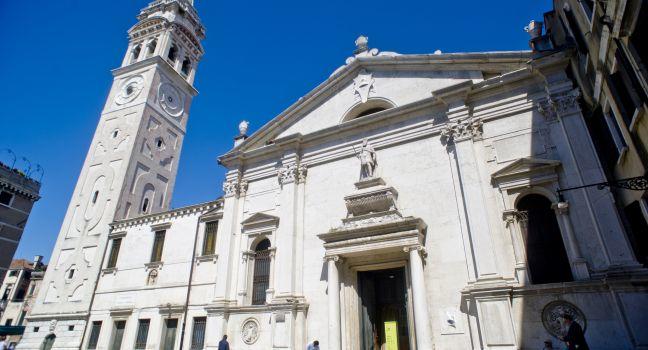
Guided by his vision of a beautiful Madonna, 7th-century St. Magno is said to have followed a small white cloud and built a church where it settled. Gracefully white, the marble building you see today dates from 1492, built by Mauro Codussi on an older foundation. Codussi's harmonious Renaissance design is best understood by visiting the interior; the Renaissance facade facing the canal was added later, in 1542, and the baroque facade facing the campo was added in 1604. Of interest are three fine paintings: Our Lady of Mercy by Bartolomeo Vivarini, Santa Barbara by Palma Vecchio, and Madonna with St. Domenic by Gianbattista Tiepolo. The surrounding square bustles with sidewalk cafés and a produce market on weekday mornings.

Castello 5267, Venice, 30122, Italy
041-2750462-Chorus Foundation
Sight Details
€3.50 (free with Chorus Pass)

Something incorrect in this review?

Abbazia di San Michele

Within Terra Murata is the Abbazia di San Michele. San Michele (St. Michael) is the island's patron saint and a key figure in its history and traditions. Legend has it that in 1535, when the sultan of Algeria's admiral laid siege to the island, San Michele appeared above the pirate force and put them to flight (the 17th-century painting depicting the scene is in the choir of the abbey's 17th-century church; one of the invaders' anchors can also be viewed). On the wall close to the church's richly coffered ceiling is another depiction of San Michele, attributed to the Tuscan Luigi Garzi (1699). As you walk around the church, note that the floor's marble flagstones have holes, which were, in effect, trapdoors through which bodies could be lowered to the underground crypt. The maze of catacombs (closed indefinitely) lead to a secret chapel. Mass is held every Sunday at 9:30 am, and the cultural association Millennium offers free guided tours by request.

Badia a Passignano

The dining hall of the towering 11th-century Abbey of Passignano houses a stunningly massive, 21-foot-wide Last Supper (1476) by Domenico and Davide Ghirlandaio, and the monastery's church has a 13th-century sculpture of St. Michael slaying the dragon.

Battistero

Città

The Duomo's 14th-century Gothic Baptistery was built to prop up the apse of the cathedral. There are frescoes throughout, but the highlight is a large bronze 15th-century baptismal font designed by Jacopo della Quercia. It's adorned with bas-reliefs by various artists, including two by Renaissance masters: the Baptism of Christ by Lorenzo Ghiberti (1378–1455) and the Feast of Herod by Donatello.

Piazza San Giovanni, Siena, 53100, Italy
0577-286300
Sight Details
From €14 combined ticket includes the Duomo, Cripta, and Museo dell'Opera

Something incorrect in this review?

Chiesa della Pietà

Castello

Unwanted babies were left on the steps of this religious institute, founded by a Franciscan friar in 1346. The adjoining orphanage provided the children with a musical education. The quality of the performances here reached continental fame—the in-house conductor was none other than Antonio Vivaldi (1678–1741), who wrote some of his best compositions here for the hospice. The present church was designed in the 18th century by Giorgio Massari, but the facade was completed only in the early 20th century. The main reason for a visit is to view the magnificent ceiling fresco by Gianbattista Tiepolo. In a room to the left of the entrance is a tiny collection of baroque instruments, including the violin played by Vivaldi. There are guided tours Tuesday through Sunday.

Castello 3701, Venice, 30122, Italy
041-5222171
Sight Details
€3 church; €7 museum by appointment
No guided tours Mon.

Something incorrect in this review?

Chiostro dello Scalzo

San Marco

Often overlooked, this small, peaceful 16th-century cloister was frescoed in grisaille by Andrea del Sarto (1486–1530) and Franciabigio with scenes from the life of St. John the Baptist, Florence's patron saint. Note that temporary closures are a possibility at this site, so check on accessibility before visiting.

Via Cavour 69, Florence, 50129, Italy
055-294883
Sight Details
Free
Check ahead on temporary closures and possible opening days and times

Something incorrect in this review?

Chiostro di Sant'Apollonia

Castello

Within this Benedictine monastery is a peacefully shady 12th-century cloister that has been modified over the centuries. It remains the only surviving example of a Romanesque cloister in Venice. The brick pavement is original, and the many inscriptions and fragments on display (some from the 9th century) are all that remain of the first Basilica di San Marco.

Cloister of Santa Maria La Nuova

The lovely Benedictine cloister of the abbey adjacent to the Duomo was built at the same time as the church but enlarged in the 14th century. The enclosure is surrounded by 216 intricately carved double columns, every other one decorated in a unique glass mosaic pattern. Afterward, don't forget to walk behind the cloister to the belvedere, with stunning panoramic views over the Conca d'Oro (Golden Conch) plain toward Palermo. If you wish to visit, reserve a tour online at least a week in advance.

Piazza del Duomo, Monreale, 90044, Italy
Sight Details
€8; €13 including entire monumental complex (Duomo, Diocesan Museum)

Something incorrect in this review?

Complesso Museale Santa Maria delle Anime del Purgatorio ad Arco

Centro Storico

Once a tavern, this building was rebuilt by the Monte di Pietà charity in 1616 as a church, and its two stories are fascinatingly complementary. As bare as the upper Church is lavish, the altar below-stairs is a stark black cross against a peeling gray wall. The nave covers what was a 1656 plague pit now set off by chains with four lamps to represent the flames of Purgatory. As the pit filled up, to accommodate more recent dead the skulls of earlier plague victims were placed on the central floor. So was born the cult of le anime pezzentelle (wretched souls). By praying for them, the living could accelerate these souls' way to Heaven, at which point the pezzentelle could intercede on behalf of the living.

During the 20th century, World War II left many Neapolitans with missing relatives. Some families found consolation by adopting a skull in their loved ones’ stead. The skulls would be cleaned, polished, and then given a box-type altarino.

If all this verges on the pagan, the Catholic Church thought likewise, and in 1969 the practice was banned. The altarini were blocked off and eventually abandoned. In 1992 the church reopened and most of the skulls were taken to Cimitero delle Fontanelle. Some still remain, like that of one Lucia, princess of skulls and patron of amore infelice (unhappy love).

Via Tribunali 39, Naples, 80138, Italy
081-440438
Sight Details
€6, upper church free
Closed Sun. and afternoons

Something incorrect in this review?

Eremo delle Carceri

About 4 km (2½ miles) east of Assisi is a monastery set in a dense wood against Monte Subasio: the Hermitage of Prisons. This was the place where St. Francis and his followers went to "imprison" themselves in prayer. The only site in Assisi that remains essentially unchanged since St. Francis's time, the church and monastery are the kinds of tranquil places that St. Francis would have appreciated. The walk out from town is very pleasant, and many trails lead from here across the wooded hillside of Monte Subasio.

Monumento Nazionale dei Girolamini

Centro Storico

I Girolamini is another name for the Oratorians, followers of St. Philip Neri, to whom the splendid church I Girolamini is dedicated. The church is part of a larger complex managed as the Monumento Nazionale dei Girolamini. The Florentine architect Giovanni Antonio Dosio designed I Girolamini, which was erected between 1592 and 1619; the dome and facade were rebuilt (circa 1780) in the most elegant neoclassical style after a design by Ferdinando Fuga. Inside the entrance wall is Luca Giordano's grandiose fresco (1684) of Christ chasing the money changers from the temple. The intricate carved-wood ceiling, damaged by Allied bombs in 1943, has now been restored to its original magnificence.

Museo Diocesano d'Arte Sacra

This cathedral museum is housed in a 13th-century church designed in the Catalan Gothic style. The usual assortment of religious treasures—paintings, wooden sculptures, and bronze statues—is on display; look for the masterful 16th-century Catalan silverware, forged with intricate ancient motifs. Call ahead to check opening times.

Via Maiorca 1, Alghero, 07041, Italy
079-9733041
Sight Details
€5

Something incorrect in this review?

Museo Diocesano Napoli

Centro Storico

This impressive museum exhibits brilliantly restored works by late-Gothic, Renaissance, and Neapolitan Baroque masters. It incorporates the Baroque church of Santa Maria Donnaregina Nuova, which was started in 1617 and consecrated 50 years later for Franciscan nuns (les Clarisses), and the Gothic Donnaregina Vecchia, which was damaged by an earthquake. In more modern times the building was used as legal offices before being closed completely, and becoming prey to the occasional theft as well as bomb damage during World War II. In 2008 the space was officially reborn as a museum.

The last two works of Luca Giordano, The Wedding at Cana and The Multiplication of Loaves, both from 1705, are displayed on either side of the church's altar, which was moved from the original church. The central painting focuses on the life of the Virgin Mary, while the first chapel on the left houses French painter Charles Mellin's beautiful Immaculate Conception (1646). To the left of the nave is a space rich in Gothic and Renaissance statuary from the former church. Take the elevator upstairs to where the nuns once attended Mass, concealed from the congregation by screens. The works on display there follow the theme of life as an Imitation of Christ. There is also the chance to see Francesco Solimena's 17th-century roof frescoes up close, with floodlights showing off their restoration to maximum effect.

Oratorio dei Buonomini di San Martino

Bargello

Founded in 1441 by Antoninus, Bishop of Florence, to offer alms to the poveri vergognosi (ashamed poor), this one-room oratory is decorated with 15th-century frescoes by the school of Ghirlandaio that vividly depict the confraternity's activities. More than 500 years later, the Compagnia dei Buonomini, or Confraternity of the Good Men, continues to perform charitable works, linking Renaissance notions of charity to the 21st century.

Sacro Eremo e Monastero di Camaldoli

An important requirement at this hermitage, founded by St. Romualdo in the 11th century for the reformed Benedictine order, was preserving an ascetic atmosphere: "If the hermits are to be true devotees of solitude, they must take the greatest care of the woods." When the flow of pilgrims began to threaten that solitude, Romualdo had a monastery and hospital built down the mountain to create some distance.

Today, you can view the hermitage—where the monks live in complete silence in 20 separate little cottages, each with its own walled garden—through gates and visit the church and original cell of Romualdo, the model for all the others. The church, rebuilt in the 13th century and transformed in the 18th to its present appearance, strikes an odd note in connection with such an austere order and the simplicity of the hermits' cells, because it's done up in gaudy baroque style, complete with gilt cherubs and a frescoed vault. Its most appealing artwork is the glazed terra-cotta relief Madonna and Child with Saints (including a large figure of Romualdo and a medallion depicting his fight with the devil) by Andrea della Robbia. The main entrance to the hermitage, the bronze Porta Speciosa (Beautiful Door) of 2013, by Claudio Parmiggiani (born in 1943), has an inscription on its inner side that likens the monks' spirits to the trees that they tend.

Within the Monastero di Camaldoli, 3 km (1 mile) away, is a church (repeatedly restructured) containing 14th-century frescoes by Spinello Aretino, seven 16th-century panel paintings by Giorgio Vasari, and a quietly lovely monastic choir. The choir has 18th-century walnut stalls, more Vasari paintings, and a serene fresco (by Santi Pacini) of St. Romualdo instructing his white-robed disciples. In a hospital built for sick villagers in 1046, the 1543 Antica Farmacia (Old Pharmacy) contains original carved walnut cabinets. Here you can buy herbal teas and infusions, liqueurs, honey products, and toiletries made by the monks from centuries-old recipes as part of their daily routine balancing prayer, work, and study (the monastery is entirely self-supporting). In the back room is an exhibit of the early pharmacy's alembics, mortars, and other equipment with which the monks made herbs into medicines. You can attend short spiritual retreats organized by the monks throughout the year; contact the foresteria (visitors lodge) for details.

San Domenico Maggiore

Centro Storico

One of the Centro Storico's largest churches, this Dominican house of worship was originally constructed by Charles I of Anjou in 1238. Legend has it that a painting of the crucifixion spoke to St. Thomas Aquinas when he was at prayer here. Three centuries later, a fire destroyed most of this early structure, and in 1850 a neo-Gothic edifice rose in its place, complete with a nave of awe-inspiring dimensions.

In the second chapel on the right (if you enter through the north door) are remnants of the earlier church—14th-century frescoes by Pietro Cavallini, a Roman predecessor of Giotto. Note the depiction of Mary Magdalene dressed in her own hair, and, in front, the crucifixion of Andrew as a devil strangles his judge, the Prefect Aegeas, just below. Along the side are some noted funerary monuments, including those of the Carafa family, whose chapel, to the left of Cosimo Fanzago's 17th-century altar, is a beautiful Renaissance-era set-piece.

The San Carlo Borromeo chapel features an excellent Baptism of Christ (1564), by Marco Pino, a Michelangelo protégé. Other interesting works are the unusual Madonna di Latte, in the Cappella di S. Maria Maddalena, and a beautiful Madonna by Agostino Tesauro in the Cappella San Giovanni. A Ribera painting in the San Bartolomeo chapel depicts the saint's martyrdom. Near the back of the church, looking like a giant gold peacock's tail, is the so-called Machine of 40 Hours, a devotional area that was, starting on Holy Thursday, brightly lit by candles for 40 hours, representing the time between Christ's burial and resurrection.

Adjacent to the church is its brilliantly restored Dominican monastery, where Saint Thomas Aquinas studied and taught. It now houses the Doma museum, for which you can buy tickets inside the church. Virtual photographs outside the Chapter Hall show how the monastery, parts of which date to the 13th century, would have looked before the suppression of monasteries under Napoleon. The hall itself contains a significant fresco of the Crucifixion by the late 17th-century Sicilian painter Michele Ragolia, and the ubiquitous Baroque master Fanzago is responsible for the stuccowork. Note the false windows, a work of optical illusion common to the period.

The standout work in the nearby Grand Refectory is Domenico Vaccaro's Last Supper mural, in which Christ comforts John while Judas, clutching a moneybag, glares at something else. Another mural in the Refectory depicts a famous incident from Saint Thomas Aquinas's life here. Christ is shown directing at Thomas the words “Bravo Tommaso che parlasti bene di me” (“Well done, Thomas, for speaking well of me”). Visible in the Refectory are the remains of the stations where the monks would wash their hands before eating, but more recently it served as a law court. Two Camorra bosses—Raffaele Cutolo and Pupetta Maresca—were sentenced here as late as the 1990s.

Also of note are the cloisters, originally for about a hundred monks; now less than five remain. It was here that Thomas Aquinas lived and studied and taught from 1272 to 1274. A magnificent doorway by Marco Bottiglieri marks his cell, now a chapel that can be visited as part of the guided tour.

Piazza San Domenico Maggiore 8, Naples, 80134, Italy
081-459188
Sight Details
Church free, museum from €6

Something incorrect in this review?

San Francesco

Alghero's cathedral on Via Manno hosts most of the town's official religious functions, but this 15th–16th-century church built in the Catalan-Gothic style is closest to the hearts of the algheresi and where you might come across the local dialect, used in some of the masses here. The simple interior holds a particularly emaciated-looking wooden Christ, while the crypt and cloister have an atmospheric charm, but the highlight of a visit is to climb the hexagonal bell tower—not too arduous—for some great views of the Old Town (open mornings: April and May, Tuesday, Friday, and Saturday; June–October, daily; November–March, Tuesday and Friday). Evening concerts are held in the cloister in the summer months.

Via Carlo Alberto 46, Alghero, 07041, Italy
351-6428081-mobile
Sight Details
€6, €3 church and cloister only, €4 tower only
Closed Mon. morning, Thurs. afternoon, and Sun.

Something incorrect in this review?

San Paolo Maggiore

Centro Storico

Like the nearby Santi Apostoli, this church was erected for the Theatin fathers in the late 16th century (from 1524), the period of their order's rapid expansion. This was another instance where Francesco Grimaldi, the (ordained) house architect, erected a church on the ruins of an ancient Roman temple, then transformed it into a Christian basilica. Spoils from the temple survive in the present incarnation, especially the two monumental Corinthian columns on the facade.

An earthquake knocked down the original facade in 1688, and damage during World War II, coupled with decades of neglect, led to further deterioration that has since been reversed. Two large murals by Francesco Solimena in the sacristy have been restored. In the first, Simon Magus is depicted flying headlong down to Earth as biblical and Neapolitan figures ignore him. Similarly spectacular is the fresco depicting the imminent conversion of Saul: illuminated by a light-projecting cloud, the future Saint Paul tumbles off a horse in the picture's center. The richly decorated Santuario di San Gaetano is below the church, housing Saint Gaetano's remains.

Piazza San Gaetano, Naples, 80138, Italy
081-454048

Something incorrect in this review?

Santuario della Verna

After a 40-day fast in 1224, St. Francis of Assisi had a vision of Christ crucified and received the stigmata, the signs of Christ's wounds, on his hands, feet, and chest. A stone in the floor of the 1263 Chapel of the Stigmata marks the spot.

A covered corridor through which the monks pass, chanting in a solemn procession each day at 3 pm on the way to Mass, is lined with simple frescoes of the Life of St. Francis by a late-17th-century Franciscan artist. The true artistic treasures of the place, though, are 15 della Robbia glazed terra-cottas. Most, like a heartbreakingly beautiful Annunciation, are in the 14th- to 15th-century basilica, which has a 5,000-pipe organ that sings out joyously at Masses.

Several chapels, each with its own story, can be visited, and some natural and spiritual wonders can also be seen. A walkway along the 230-foot-high cliff leads to an indentation where the rock is said to have miraculously melted away to protect St. Francis when the devil tried to push him off the edge. Most touching is the enormous Sasso Spicco (Projecting Rock), detached on three sides and surrounded with mossy rocks and trees, where St. Francis meditated. You can also view the Letto di San Francesco (St. Francis's Bed), a slab of rock in a cold, damp cave with an iron grate on which he prayed, did penance, and sometimes slept.

A 40-minute walk through the woods to the top of Mt. Penna passes some religious sites and ends in panoramic views of the Arno Valley, but those from the wide, cliff-edge terrace are equally impressive, including the tower of the castle in Poppi, the Prato Magno (great meadow), and the olive groves and vineyards on the lower slopes. Santuario della Verna's foresteria also has simple but comfortable rooms with or without bath. A restaurant with basic fare is open to the public, and a shop sells souvenirs and the handiwork of the monks.

As you leave La Verna, be glad you needn't do it as Edith Wharton (1862–1937) did on a 1912 visit during a drive across the Casentino. As she wrote, her car "had to be let down on ropes to a point about ¾ mile below the monastery, Cook [her chauffeur] steering down the vertical descent, and twenty men hanging on to a funa [rope] that, thank the Lord, didn't break."

Via del Santuario 45, La Verna, 52010, Italy
0575-5341
Sight Details
Museum closed Mon.–Sat. and Sun. afternoon Sept.–May

Something incorrect in this review?

Santuario dell’Annunziata

This sanctuary dedicated to the Virgin Mary and local saints is one of Sicily's most revered religious sites, visited by devout pilgrims from all over the country. The complex was originally built for the Carmelite religious order in 1332, and its most treasured object is the life-size statue of the Madonna di Trapani, serenely smiling and holding the infant Jesus, thought to be the work of Nino Pisano or his studio. The importance of the sanctuary to the local fishing community is shown in the chapel dedicated to sailors, displaying scallop-shell motifs over every window as well as over the altar itself, and in one chapel dedicated to fishermen, dating from the 16th century. A separate room holds numerous ex-voto paintings of sailing vessels beset by stormy waters.