423 Best Sights in Italy

Background Illustration for Sights

We've compiled the best of the best in Italy - browse our top choices for the top things to see or do during your stay.

Necropoli di Pantalica

Fodor's Choice

You'll need to hire a guide to explore the over 5,000 tombs covering the limestone cliffs that make up this Iron and Bronze Age burial site. On a huge plateau over the Anapo River, the necropolis dates to between the 13th and 8th centuries BC. If you decide not to hire a guide, you'll need to drive to get here. There are two main entrances: one near the town of Sortino and the other from the town of Ferla. The entrance by Sortino involves a good walk down the sides of the gorge while the Ferla entrance is more of a gentle stroll along a well-beaten path. Set aside a minimum of two hours for your visit, but it is better to allocate at least half a day; be sure to wear a good pair of walking shoes and bring plenty of water.

Basilica di San Pietro

Vatican Fodor's Choice
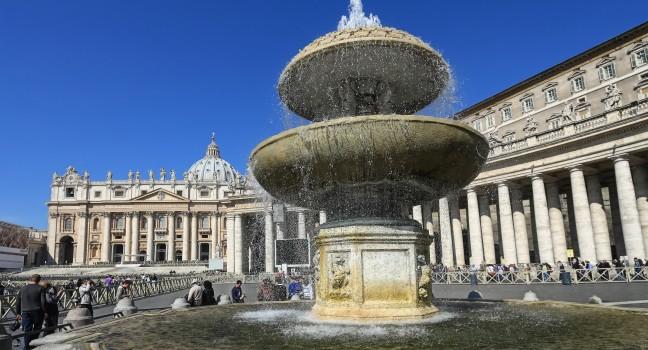
Vatican fountain.
WDG Photo / Shutterstock

The world's largest church, built over the tomb of St. Peter, is the most imposing and breathtaking architectural achievement of the Renaissance (although much of the lavish interior dates to the Baroque period). No fewer than five of Italy's greatest artists—Bramante, Raphael, Peruzzi, Antonio da Sangallo the Younger, and Michelangelo—died while striving to erect this new St. Peter's.

The history of the original St. Peter's goes back to AD 326, when the emperor Constantine completed a basilica over the site of the tomb of St. Peter, the Church's first pope. The original church stood for more than 1,000 years, undergoing a number of restorations and alterations, until, toward the middle of the 15th century, it was on the verge of collapse. In 1452, a reconstruction job began but was abandoned for lack of money.

In 1503, Pope Julius II instructed the architect Bramante to raze all the existing buildings and build a new basilica, one that would surpass even Constantine's for grandeur. It wasn't until 1626 that the new basilica was completed and consecrated.

Highlights include the Loggia delle Benedizioni (Benediction Loggia), the balcony where newly elected popes are proclaimed; Michelangelo's Pietà; and Bernini's great bronze baldacchino, a huge, spiral-columned canopy—at 100,000 pounds, perhaps the largest bronze object in the world—as well as many other Bernini masterpieces. There are also collections of Vatican treasures in the Museo Storico-Artistico e Tesoro and the Grotte Vaticane crypt.

For views of both the dome above and the piazza below, take the elevator or stairs to the roof. Those with more stamina (and without claustrophobia) can then head up more stairs to the apex of the dome.

 The basilica is free to visit, but a security check at the entrance can create very long lines. Arrive before 8:30 or after 5:30 to minimize the wait and avoid the crowds.

Piazza San Pietro, Rome, 00120, Italy
Sight Details
Free
Closed during Papal General Audience (Wed. until 1 pm) and during other ceremonies in piazza

Something incorrect in this review?

The Campidoglio

Piazza Venezia Fodor's Choice
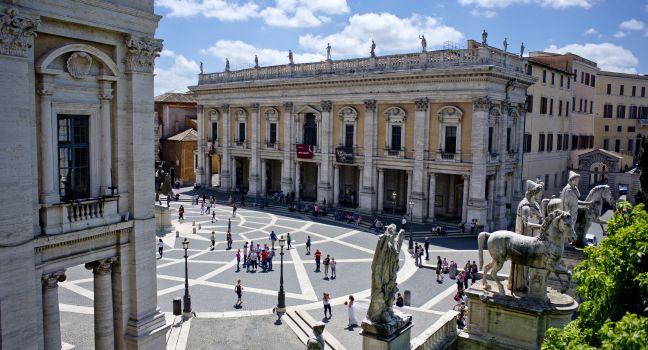
The Campidoglio, Campidoglio, Ancient Rome, Italy.
© Zach Nelson / Fodors Travel

Spectacularly transformed by Michelangelo's late-Renaissance designs, the Campidoglio was once the epicenter of the Roman Empire, the place where the city's first shrines stood, including its most sacred, the Temple of Jupiter. The Capitoline Hill originally consisted of two peaks: the Capitolium and the Arx (where Santa Maria in Aracoeli now stands). The hollow between them was known as the Asylum. Here, prospective settlers once came to seek the protection of Romulus, legendary first king of Rome—hence the term "asylum." Later, during the Republic, in 78 BC, the Tabularium, or Hall of Records, was erected here.

By the Middle Ages, however, the Capitoline had become an unkempt hill strewn with ancient rubble. In preparation for the impending visit of Charles V in 1536, triumphant after the empire's victory over the Moors, his host, Pope Paul III Farnese, decided that the Holy Roman Emperor should follow the route of the emperors, finishing triumphantly at the Campidoglio. The pope was embarrassed by the decrepit goat pasture the hill had become and so commissioned Michelangelo to restore the site to glory. The resulting design added a third palace along with Renaissance-style facades and a grand paved piazza. Newly excavated ancient sculptures, designed to impress the visiting emperor, were installed in the palaces, and the piazza was ornamented with the giant stone figures of the Discouri and the ancient Roman equestrian statue of Emperor Marcus Aurelius. A copy of this extraordinary statue is still the piazza's centerpiece (the 2nd-century original has been housed in the neighbouring Musei Capitolini since 1999).

While there are great views of the Roman Forum from the terrace balconies to either side of the Palazzo Senatorio, the best view is from the 1st century BC Tabularium, now part of the Musei Capitolini. The museum café is on the Terrazza Caffarelli, with a magical view toward Trastevere and St. Peter's, and is accessible without a museum ticket.

Recommended Fodor's Video

Piazza Navona

Piazza Navona Fodor's Choice
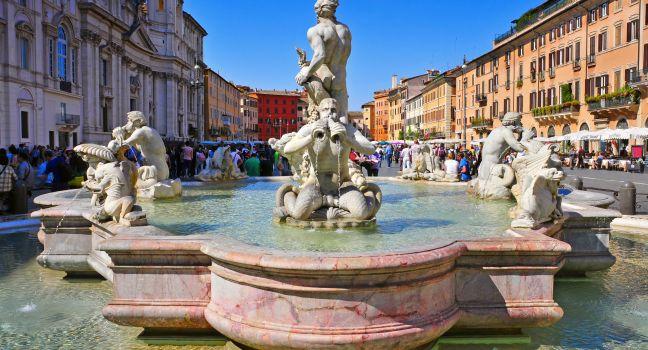
ROME, ITALY - APRIL 18: View of Fontana del Moro, in Piazza Navona, looking northwards on April 18, 2013 in Rome, Italy. This popular city square is the largest in Rome; Shutterstock ID 137683064; Project/Title: Fodor's Essential Europe insert; Downloader:
nito/Shutterstock

Always camera-ready, this beautiful plaza has Bernini sculptures, three gorgeous fountains, and a magnificently Baroque church (Sant'Agnese in Agone), all built atop the remains of a Roman athletics track. Pieces of the arena are still visible near the adjacent Piazza Sant'Apollinare, and the ancient spirit of entertainment lives on in the buskers and artists who populate the piazza today.

The piazza took on its current look during the 17th century, after Pope Innocent X of the Pamphilj family decided to make over his family palace (now the Brazilian embassy and an ultraluxe hotel) and its surroundings. Center stage is the Fontana dei Quattro Fiumi, created for Innocent by Bernini in 1651. Bernini's powerful figures of the four rivers represent the longest rivers of the known continents at the time: the Nile (his head covered because the source was unknown); the Ganges; the Danube; and the Plata (the length of the Amazon was then unknown). Popular legend has it that the figure of the Plata—the figure closest to Sant'Agnese in Agone—raises his hand before his eyes because he can't bear to look upon the church's "inferior" facade designed by Francesco Borromini, Bernini's rival.

If you want to sip a coffee with one of the most beautiful, if pricey, views in Rome, grab a seat at Piazza Navona. Just be aware that all the restaurants here are heavily geared toward tourists, so while it's a beautiful place for a drink, you can find cheaper, more authentic, and far better meals elsewhere. 

Santa Maria del Popolo

Piazza del Popolo Fodor's Choice
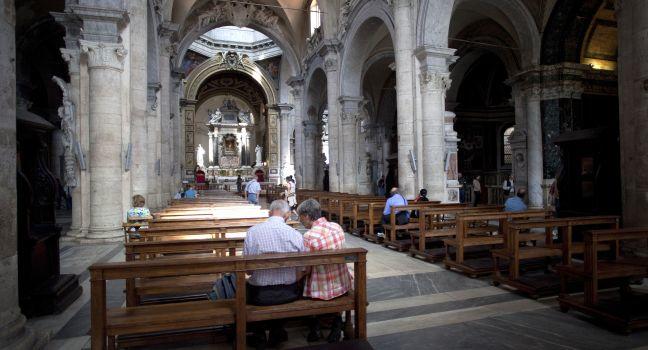
The Basilica of Santa Maria del Popolo
© Halie Cousineau/ Fodors Travel

Standing inconspicuously in a corner of the vast Piazza del Popolo, this church often goes unnoticed, but the treasures inside make it a must for art lovers. Bramante enlarged the apse, which was rebuilt in the 15th century on the site of a much older place of worship. Inside, in the first chapel on the right, you'll see some frescoes by Pinturicchio from the mid-15th century; the adjacent Cybo Chapel is a 17th-century exercise in decorative marble.

Raphael designed the famous Chigi Chapel, the second on the left, with vault mosaics—showing God the Father in Benediction—as well as statues of Jonah and Elijah. More than a century later, Bernini added the oval medallions on the tombs and the statues of Daniel and Habakkuk. Finally, the Cerasi Chapel, to the left of the high altar, holds two Caravaggios: The Crucifixion of St. Peter and The Conversion of St. Paul. Exuding drama and realism, both are key early Baroque works that show how "modern" 17th-century art can appear. Compare their style with the much more restrained and classically "pure" Assumption of the Virgin by Annibale Carracci, which hangs over the altar of the chapel.

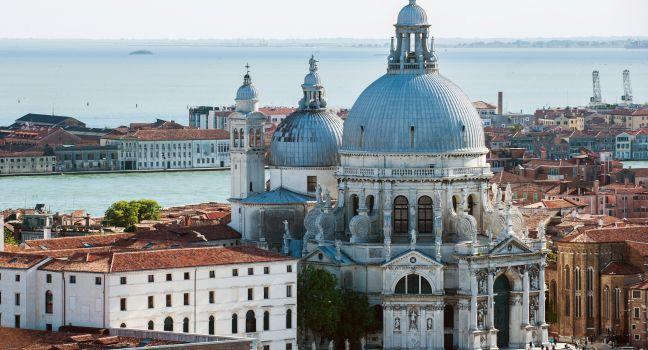
Santa Maria della Salute

Dorsoduro Fodor's Choice
Santa Maria della Salute; Dorsoduro, Venice, Italy.
© Ross Brinkerhoff / Fodors Travel

The most iconic landmark of the Grand Canal, "La Salute" (as this church is commonly called) is most unforgettably viewed from the Riva degli Schiavoni at sunset, or from the Accademia Bridge by moonlight. En route to becoming Venice's most important baroque architect, 32-year-old Baldassare Longhena won a competition in 1631 to design a shrine honoring the Virgin Mary for saving Venice from a plague that in the space of two years (1629–31) killed 47,000 residents, or one-third of the city's population, including the doge. It was not completed, however, until 1687—five years after Longhena's death.

Outside, this ornate white Istrian stone octagon is topped by a colossal cupola with snail-like ornamental buttresses—in truth, piers encircled by finely carved "ropes," an allusion to the sail-making industry of the city (or so say today's art historians). Inside, a white-and-gray color scheme is complemented by a polychrome marble floor and the six chapels. The Byzantine icon above the main altar has been venerated as the Madonna della Salute (Madonna of Health) since 1670, when Francesco Morosini brought it here from Crete. Above it is a dramatic marble sculpture by Giusto Le Court showing Venice on her knees before the Madonna as she implores aid and a cherub drives the plague from the city.

Do not leave the church without visiting the Sacrestia Maggiore, which contains a dozen works by Titian, including his San Marco Enthroned with Saints altarpiece. You'll also see Tintoretto's Wedding at Cana. For the Festa della Salute, held November 21, a votive bridge is constructed across the Grand Canal from Campo Santa Maria del Giglio to San Gregorio, and Venetians make a pilgrimage here to light candles in prayer for another year's health. Check the website for information on guided tours.

Punta della Dogana, Venice, 30123, Italy
041-2743928
Sight Details
Church free, sacristy €6, sacristy and art gallery €10, balustrade of the prophets €5, dome €8

Something incorrect in this review?

Santa Maria della Vittoria

Repubblica Fodor's Choice
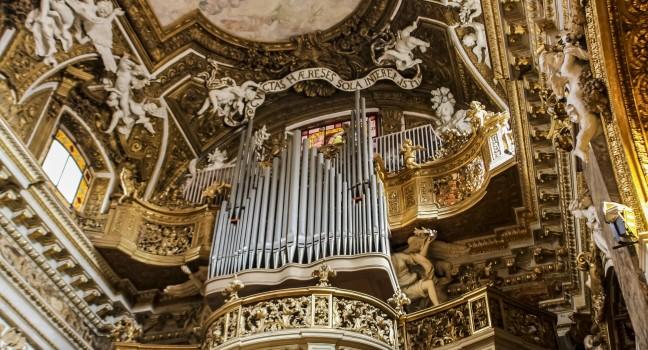
ROME, ITALY - JUNE 4: Cantoria of the Santa Maria della Vittoria church in Rome, Italy at June 4, 2012. Church was opened at 1620 and cantoria was decorated by Mattia de Rossi.
Goran Bogicevic/Shutterstock

Designed by Carlo Maderno, this church is best known for Bernini's sumptuous Baroque decoration of the Cappella Cornaro (Cornaro Chapel, the last on the left as you face the altar), which houses his interpretation of divine love in the Ecstasy of St. Teresa. Bernini's masterly fusion of sculpture, light, architecture, painting, and relief is a multimedia extravaganza, with the chapel modeled as a theater, and one of the key examples of the Roman High Baroque. The members of the Cornaro family meditate on the communal vision of the great moment of divine love before them: the swooning saint's robes appear to be on fire, quivering with life, and the white marble group seems suspended in the heavens as golden rays illuminate the scene. An angel assists as Teresa abandons herself to the joys of heavenly love. To modern eyes, Bernini's representation of the saint's experience may seem more earthly than mystical. As the visiting French dignitary Charles de Brosses put it in the 18th century, "If this is divine love, I know all about it." 

Via XX Settembre, 17, Rome, 00187, Italy
06-42740571

Something incorrect in this review?

Santa Maria in Trastevere

Trastevere Fodor's Choice
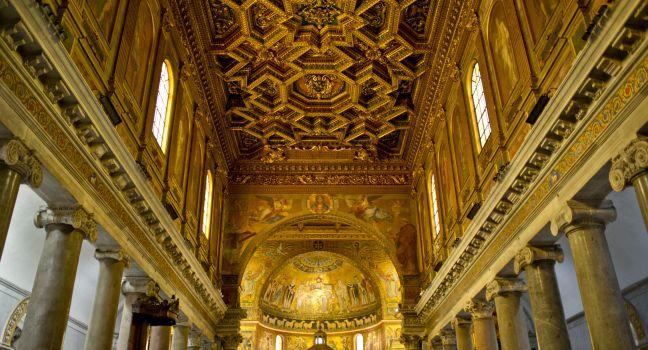
Santa Maria in Trastevere, Trastevere, Rome, Italy.
© Zach Nelson / Fodors Travel

Built during the 4th century and rebuilt in the 12th century, this is one of Rome's oldest and grandest churches. It is also the earliest foundation of any Roman church to be dedicated to the Virgin Mary. The 18th-century portico draws attention to the facade's 800-year-old mosaics, which represent the parable of the Wise and Foolish Virgins. They enhance the whole piazza, especially at night, when the church front and bell tower are illuminated.

With a nave framed by a processional of two rows of gigantic columns (22 in total) taken from the ancient Baths of Caracalla and an apse studded with gilded mosaics, the interior conjures the splendor of ancient Rome. Overhead is Domenichino's gilded ceiling (1617). The church's most important mosaics, Pietro Cavallini's six panels of the Life of the Virgin, cover the semicircular apse. Note the building labeled "Taberna Meritoria" just under the figure of the Virgin in the Nativity scene, with a stream of oil flowing from it; it recalls the legend that a fountain of oil appeared on this spot, prophesying the birth of Christ. Off the piazza's northern side is a street called Via delle Fonte dell'Olio in honor of this miracle.

Santi Giovanni e Paolo

Celio Fodor's Choice
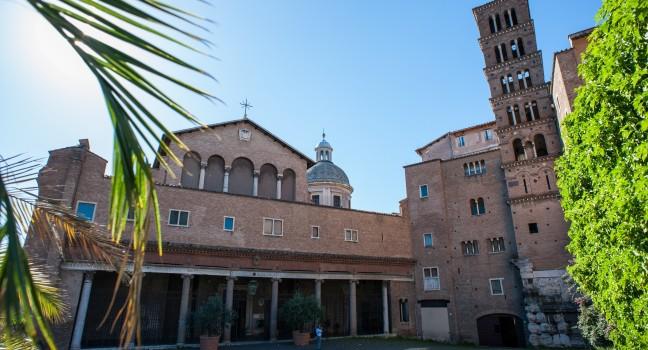
Santi Giovanni e Paolo, Rome, Italy
© Ross Brinkerhoff / Fodors Travel

Perched up the incline of the Clivio di Scauro—a magical time-machine of a street, where the dial seems to be stuck somewhere in the 13th century—Santi Giovanni e Paolo is an image that would tempt most landscape painters. Marked by one of Rome's finest Romanesque bell towers, it looms over a picturesque piazza. Underneath, however, are other treasures, whose excavations can be seen in the Case Romane del Celio museum.

A basilica erected on the spot was, like San Clemente, destroyed in 1084 by attacking Normans. Its half-buried columns, near the current church entrance, are visible through misty glass. The current church's origins date to the start of the 12th century, but most of the interior dates to the 17th century and later. The lovely, incongruous chandeliers are hand-me-downs from New York's Waldorf-Astoria hotel, a gift arranged by the late Cardinal Francis Spellman of New York, whose titular church this was. Spellman also initiated the excavations here in 1949.

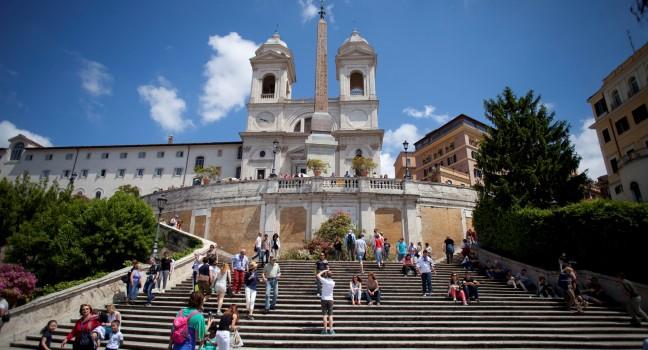
The Spanish Steps

Piazza di Spagna Fodor's Choice
The Spanish Steps, Trinita Dei Monti, Rome, Italy
© Halie Cousineau/ Fodors Travel

The iconic Spanish Steps (often called simply la scalinata, or "the staircase," by Italians) and the Piazza di Spagna from which they ascend both get their names from the Spanish Embassy to the Vatican on the piazza—even though the staircase was built with French funds by an Italian in 1723. In honor of a diplomatic visit by the King of Spain, the hillside was transformed by architect Francesco de Sanctis with a spectacular piece of urban planning to link the church of Trinità dei Monti at the top with the Via Condotti below.

In an allusion to the church, the staircase is divided by three landings (beautifully lined with potted azaleas from mid-April to mid-May). Bookending the bottom of the steps are beloved holdovers from the 18th century, when the area was known as the "English Ghetto": to the right, the Keats-Shelley House and to the left, Babington's Tea Rooms—both beautifully redolent of the era of the Grand Tour.

For weary sightseers who find the 135 steps too daunting, there is an elevator at Vicolo del Bottino 8, next to the Metro entrance. (Those with mobility problems should be aware that there is still a small flight of stairs after, however, and that the elevator is sporadically closed for repair.) At the bottom of the steps, Pietro Bernini's splendid 17th-century Barcaccia Fountain still spouts drinking water from the ancient aqueduct known as the Acqua Vergine.

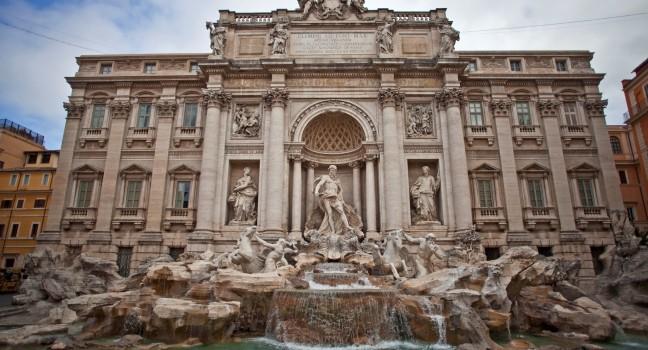
Trevi Fountain

Trevi Fodor's Choice
Trevi fountain
© Halie Cousineau/ Fodors Travel

Alive with rushing waters commanded by an imperious sculpture of Oceanus, the Fontana di Trevi has been all about theatrical effects from the start; it is an aquatic marvel in a city filled with them. The fountain's unique drama is largely due to its location: its vast basin is squeezed into the tight confluence of three little streets (the tre vie, which may give the fountain its name), with cascades emerging as if from the wall of Palazzo Poli.

The dream of a fountain emerging full force from a palace was first envisioned by Bernini and Pietro da Cortona from Pope Urban VIII's plan to rebuild an older fountain, which had earlier marked the end point of the Acqua Vergine, an aqueduct created in 18 BC by Agrippa. Three popes later, under Pope Clement XIII, Nicola Salvi finally broke ground with his winning design. Unfortunately, Salvi did not live to see his masterpiece of sculpted seashells, roaring sea beasts, and diva-like mermaids completed; he caught a cold and died while working in the culverts of the aqueduct 11 years before the fountain was finished in 1762.

Everyone knows the famous legend that if you throw a coin into the Trevi Fountain you will ensure a return trip to the Eternal City, but not everyone knows how to do it the right way. You must toss a coin with your right hand over your left shoulder, with your back to the fountain. One coin means you'll return to Rome; two, you'll return and fall in love; three, you'll return, find love, and marry. The fountain grosses some €1,500,000 a year, with every cent going to the Catholic charity Caritas, which is why Fendi was willing to fully fund the Trevi's recent restoration.

Tucked away in a little nearby alley is the Vicus Caprarius ( Vicolo del Puttarello, 25), a small museum where visitors can pay €8 for a guided tour that descends into a subterranean area that gives a glimpse at the water source that keeps the fountain running.

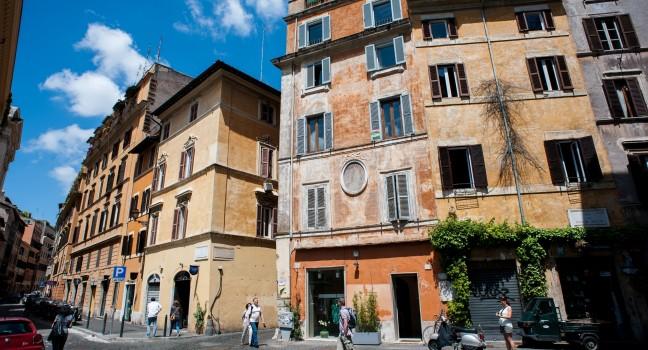
Via Giulia

Campo de' Fiori Fodor's Choice
Street, Via Giulia, Rome, Italy
© Ross Brinkerhoff / Fodors Travel

Straight as a die and still something of a Renaissance-era diorama, Via Giulia was the first street in Rome since ancient times to be deliberately planned. It was named for Pope Julius II (of Sistine Chapel fame), who commissioned it in the early 1500s as part of a scheme to open up a grandiose approach to St. Peter's Basilica. Although the pope's plans were only partially completed, Via Giulia became an important thoroughfare in Renaissance Rome. It's still, after more than four centuries, the address of choice for Roman aristocrats, despite a recent, controversial addition: a large parking lot along one side of the street (creating it meant steamrolling through ancient and medieval ruins underneath).

A stroll around and along Via Giulia reveals elegant palaces and churches, including one, San Eligio, on the little side street Via di Sant'Eligio, that was designed by Raphael himself. Note also the Palazzo Sacchetti ( Via Giulia, 66), with an imposing stone portal and an interior containing some of Rome's grandest staterooms; it remains, after 300 years, the private quarters of the Marchesi Sacchetti. The forbidding brick building that housed the Carceri Nuove (New Prison) ( Via Giulia, 52), Rome's prison for more than two centuries, now contains the offices of the Direzione Nazionale Antimafia. Near the bridge that arches over Via Giulia's southern end is the church of Santa Maria dell'Orazione e Morte (Holy Mary of Prayer and Death), with stone skulls on its door. These are a symbol of a confraternity that was charged with burying the bodies of the unidentified dead found in the city streets.

Designed by Borromini and home, since 1927, to the Hungarian Academy, the Palazzo Falconieri ( Via Giulia, 1 06/68896700) has Borromini-designed salons and loggia that are sporadically open as part of guided tours; call for information. The falcon statues atop its belvedere are best viewed from around the block, along the Tiber embankment. Remnant of a master plan by Michelangelo, the arch over the street was meant to link massive Palazzo Farnese, on the east side of Via Giulia, with the building across the street and a bridge to the Villa Farnesina, directly across the river. Finally, on the right and rather green with age, dribbles that star of many a postcard, the Fontana del Mascherone.

Via Giulia, Rome, 00186, Italy

Something incorrect in this review?

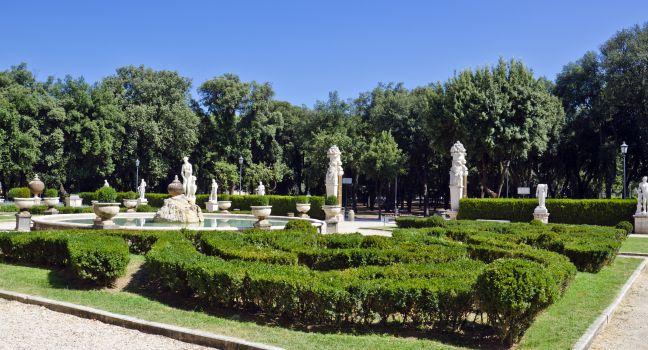
Villa Borghese

Villa Borghese Fodor's Choice
The Garden of Venus, In Villa Borghese, Rome, Italy.
Preisler | Dreamstime.com

Rome's Central Park, the Villa Borghese was originally laid out as a recreational garden in the early 17th century by Cardinal Scipione Borghese. The word "villa" was used to mean suburban estate, of the type developed by the ancient Romans and adopted by Renaissance nobles. Today's gardens cover a much smaller area—by 1630, the perimeter wall was almost 5 km (3 miles) long. At the end of the 18th century, Scottish painter Jacob More remodeled the gardens into the English style popular at the time. In addition to the gloriously restored Galleria Borghese, the highlights of the park are Piazza di Siena, a graceful amphitheater, and the botanical garden on Via Canonica, where there is a pretty little lake as well as the neoclassical faux–Temple of Aesculapius, the Biopark zoo, Rome's own replica of London's Globe Theatre, and the Villa Giulia museum.

The Carlo Bilotti Museum ( www.museocarlobilotti.it) is particularly attractive for Giorgio de Chirico fans, and there is more modern art in the nearby Galleria Nazionale d'Arte Moderna e Contemporanea. The 63-seat children's movie theater, Cinema dei Piccoli, shows films for adults in the evening. There's also Casa del Cinema, where film buffs can screen films or sit at the sleek, cherry-red, indoor-outdoor caffè (you can find a schedule of events at  www.casadelcinema.it).

Abbazia di Sant'Antimo

Fodor's Choice

The exterior and interior sculpture of this Romanesque abbey, dating from the 12th century, is outstanding, particularly the nave capitals, a combination of French, Lombard, and even Spanish influences. The sacristy (seldom open) forms part of the primitive Carolingian church (founded in AD 781), its entrance flanked by 9th-century pilasters. The small vaulted crypt dates from the same period.

Localita' S. Antimo 222, Castelnuovo dell'Abate, 53020, Italy
0577-286300
Sight Details
Closed for mass on Sun. and religious holidays until 11 am

Something incorrect in this review?

Arcibasilica di San Giovanni in Laterano

San Giovanni Fodor's Choice

The cathedral of Rome is San Giovanni in Laterano, not St. Peter's. The church was built here by Emperor Constantine 10 years before he built the church dedicated to Peter, making it the ecclesiastical seat of the Bishop of Rome (the pope). But thanks to vandals, earthquakes, and fires, today's building owes most of its form to 16th- and 17th-century restorations, including an interior designed by Baroque genius Borromini. Colossal statues stand watch over the towering facade: the 12 apostles plus Christ, John the Baptist, and the Virgin Mary.

Some earlier fragments do remain: under the portico on the left stands an ancient statue of Constantine, while the central portal's ancient bronze doors were brought here from the Forum's Curia. The altar's rich Gothic tabernacle, holding what the faithful believe are the heads of saints Peter and Paul, dates from 1367. The last chapel on the left aisle houses the cloister, which is encrusted with 12th-century cosmatesque mosaics. Around the corner stands one of the oldest Christian structures in Rome: Emperor Constantine's octagonal baptistery. Despite several restorations, a 17th-century interior redecoration, and even a 1993 Mafia-related car bombing, the baptistery from AD 315 remains true to its ancient form.

Basilica della Santa Casa

Fodor's Choice

Loreto is famous for one of the best-loved shrines in the world: the Santuario della Santa Casa (House of the Virgin Mary), within the Basilica della Santa Casa. Legend has it that angels moved the house from Nazareth, where the Virgin Mary was living at the time of the Annunciation, to this hilltop in 1295. The reason for this sudden and divinely inspired move was that Nazareth had fallen into the hands of Muslim invaders, who the angelic hosts viewed as unsuitable keepers of this important shrine.

The house itself consists of three rough stone walls contained within an elaborate marble tabernacle. Built around this centerpiece is the giant Basilica of the Holy House, which dominates the town. Millions of pilgrims come to the site every year (particularly at Easter and on the December 10 Feast of the Translation of the Holy House), and the little town of Loreto can become uncomfortably crowded.

Many great Italian architects—including Bramante, Antonio da Sangallo the Younger (1483–1546), Giuliano da Sangallo (circa 1445–1516), and Sansovino (1467–1529)—contributed to the design of the basilica. It was begun in the Gothic style in 1468 and continued in Renaissance style through the late Renaissance.

Basilica di San Francesco

Fodor's Choice

The basilica isn't one church but two: the Gothic church on the upper level, and the Romanesque church on the lower level. Work on this two-tiered monolith was begun in 1228. Both churches are magnificently decorated artistic treasure houses, covered floor to ceiling with some of Europe's finest frescoes: the Lower Basilica is dim and full of candlelight shadows, while the Upper Basilica is bright and airy.

In the Upper Church, the magnificent frescoes from 13th-century Italian painter Giotto, painted when he was only in his twenties, show that he was a pivotal artist in the development of Western painting. The Lower Church features frescoes by celebrated Sienese painters Simone Martini and Pietro Lorenzetti, as well as by Giotto (or his assistants).

Basilica di San Nicola

Fodor's Choice

The 11th-century Basilica di San Nicola, overlooking the sea in the città vecchia (old city), houses the bones of St. Nicholas, the inspiration for Santa Claus. His relics were stolen from Myra, in present-day Turkey, by a band of sailors from Bari and are now buried in the crypt. Because St. Nicholas is also the patron saint of Russia, the church draws both Roman Catholic and Russian Orthodox pilgrims; souvenir shops in the area display miniatures of the Western saint and his Eastern counterpart side by side.

Basilica di Sant'Antonio

Fodor's Choice

Thousands of faithful make the pilgrimage here each year to pray at the tomb of St. Anthony, while others come to admire works by the 15th-century Florentine master Donatello. His equestrian statue (1453) of the condottiere Erasmo da Narni, known as Gattamelata, in front of the church is one of the great masterpieces of Italian Renaissance sculpture. The huge church, which combines elements of Byzantine, Romanesque, and Gothic styles, was probably begun around 1238, seven years after the death of the Portuguese-born saint. The Cappella del Santo (housing the tomb of the saint) dates from the 16th century.

Piazza del Santo, Padua, 35123, Italy
049-8225652
Sight Details
Basilica free, museum complex €10
Museum complex closed Mon.

Something incorrect in this review?

Bosco Gabbara

Fodor's Choice

When visitors think of classic Sicilian landscapes, they often think of arid, desertlike lands. However, as you head to the island's center, the views you see may encompass much greener rolling hills, frondous trees, and carpets of wildflowers, confirming the island's biodiversity, especially if you are traveling in the spring. West of Caltanissetta is Bosco Gabbara, a natural reserve known for its hiking trails, which are especially popular among locals during the spring and fall. Pack lunch and snacks because there are no restaurants or stops with food along the trails. You may consider hiring a guide who knows the ins and outs of the area.

Castello di Mola

Fodor's Choice

In all of Sicily there may be no spot more scenic than atop this crumbling hilltop fortification reached by a set of steep staircases rising out of the town center. From here you can gaze upon two coastlines, smoking Mount Etna, and the town spilling down the mountainside. Mention of its foundations go back to the 4th-century Hellenistic Siceliote inhabitants; it was remodeled by 9th-century Byzantines and then the Normans, but all that stands today are remains of the 16th-century castle walls. Come during daylight hours to take full advantage of the vista.

Cattedrale di San Nicolò

Fodor's Choice

Noto's domed cathedral is an undisputed highlight of the extraordinary Baroque architecture for which the town is world-famous. Climb the monumental staircase to get a glimpse of the interior—restored over a 10-year period after the dome collapsed in 1996—which is simple and unloved by some (its newness and painting style may appear strange at first) compared to the magnificent exterior, but still worth a look. Indeed, it's become so popular that an entrance fee has been introduced, mainly to help the informative volunteers to cope with the foot flow.

Cattedrale di San Sabino

Fodor's Choice

Bari's 12th-century Romanesque cathedral is the seat of the local bishop and was the scene of many significant political marriages between important families in the Middle Ages. The cathedral is dedicated to San Sabino, a 6th-century bishop who apparently lived to be 105. The main draw is the subterranean Museo del Succorpo della Cattedrale with ancient basilica, a Byzantine church and Roman remains, including mosaic-tiled flooring swirling with fish, octopi, and plants. 

Chiesa Madre Santa Maria Maggiore

Fodor's Choice

Polizzi is full of churches, each one filled to the brim with fascinating artworks, but this one is probably the most gorgeous of all. Its Norman-era foundations have been built upon several times since, including Gothic-era additions by the Ventimiglia dynasty. The centerpiece is an astonishing Renaissance triptych of the Madonna and Child (late 1400s)  by an anonymous, though possibly Flemish, artist. It's sometimes attributed to (though more likely influenced by) the celebrated Flemish painter Rogier Van Der Weyden (1399--1464). As astonishing as it is to see this priceless work of art from northern Europe housed in a church in Polizzi Generosa, its presence gives you a sense of how much wealth was brought to the town thanks to its royal patrons.

Via Roma 1, 90028, Italy
0921-649094
Sight Details
Free

Something incorrect in this review?

Cimitero di San Michele (San Michele Cemetery)

Fodor's Choice

It's no surprise that serenity prevails on San Michele in Venice’s northern lagoon. The city's island cemetery is surrounded by ocher brick walls and laced with cypress-lined pathways amid plots filled with thousands of graves; there's also a modern extension completed by British architect David Chipperfield in 2017. Among those who have made this distinctive island their final resting place are such international arts and science luminaries as Igor Stravinsky, Sergei Diaghilev, Ezra Pound, and the Austrian mathematician Christian Doppler (of the Doppler effect). You're welcome to explore the grounds if you dress respectfully and adhere to a solemn code of conduct. Photography and picnicking are not permitted.

Crateri Silvestri

Fodor's Choice

For a walk on the moonlike surface of Etna, visit the Silvestri craters on the southern side of the volcano, near Nicolosi. Located at an altitude of roughly 6,200 feet, these five extinct craters formed during the 1892 eruption. Just a few meters away, across from Rifugio Sapienza, you'll find the Funivia dell'Etna (€50 round-trip), a cable car that carries you 8,000 feet up to Monte Montagnola, where you can hike further with a guide or go skiing in winter. 

Duomo

Fodor's Choice

The reconstruction of Messina's Norman and Romanesque cathedral, originally built by the Norman king Roger II and consecrated in 1197, has retained much of the original plan—including a handsome crown of Norman battlements, an enormous apse containing glittering mosaics, and a splendid wood-beamed ceiling. The adjoining bell tower contains one of the largest and most complex mechanical clocks in the world: constructed in 1933, it has a host of gilded automatons (a roaring lion and crowing rooster among them) that spring into action every day at the stroke of noon, lasting for 12 minutes. Don't miss the chance to climb the bell tower itself. As you head up the internal stairs, you'll see the system of levers and counterweights that operates the movements of the gilded bronze statues that parade through the open facade high over the Duomo's square. At the top, an open-air terrace offers 360-degree views of Messina and the strait.

Duomo

Fodor's Choice

Dominating a vast square concealed by a maze of alleyways, Lecce's magnificent cathedral of Santa Maria Assunta never fails to take visitors by surprise. The goal when building the 17th-century structure was to stun the faithful with a vision of opulence and power. Constructed in rosy local stone, the church is flanked by the ornate Bishops' Palace (1694), the seminary, whose first-floor Museum of Sacred Art (MuDAS) displays papier-mâché sculptures alongside brooding Caravaggio-esque paintings. Adding to this melodious architectural scene is the under-restoration 236-foot-high campanile (bell tower), which dominates the centro storico skyline.

Piazza Duomo, Lecce, 73100, Italy
0832-308557
Sight Details
Duomo free; LeccEcclesiae ticket museum and religious sites €11; ticket "completo," including campanile €21

Something incorrect in this review?

Duomo

Fodor's Choice

Begun by the architect Lanfranco in 1099 and consecrated in 1184, the 12th-century Romanesque cathedral has sculptured facade reliefs by Wiligelmo depicting scenes from Genesis. Look over the main portal to enter a medieval world of intricately carved plant shoots teeming with human, heavenly and demonic life, flanked by two column-bearing Roman lions. Walk around to the Piazza Grande side to see graceful arcading and loggias, a rare example of a cathedral having various aspects and four grand entrances. The interior, completely clad in brick, creates a sober ambience and is filled with intricate stonework by generations of the Maestri Campionesi. The tomb of San Geminiano, Modena's patron saint  is in the crypt. The white-marble bell tower is known as La Torre Ghirlandina (the Little Garland Tower) because of its distinctive weather vane.

Duomo

Fodor's Choice

Matera's splendidly restored cathedral, dedicated to the Madonna della Bruna and Sant'Eustachio, was built in the late 13th century and occupies a prominent position between the two Sassi. Lavishly decorated, it has a typical Puglian Romanesque flavor; inside, there's a recovered fresco, probably painted in the 14th century, showing scenes from the Last Judgment. On the Duomo's facade the figures of Sts. Peter and Paul stand on either side of a sculpture of Matera's patron, the Madonna della Bruna.

Piazza Duomo, Matera, 75100, Italy
0835-332012
Sight Details
Museo €3.50

Something incorrect in this review?