337 Best Sights in Italy

Background Illustration for Sights

We've compiled the best of the best in Italy - browse our top choices for the top things to see or do during your stay.

Basilica di San Marco

San Marco Fodor's Choice
Saint Mark's Basilica, San Marco, Venice, Italy.
© Halie Cousineau/ Fodors Travel

The Basilica di San Marco is not only the religious center of a great city, but also an expression of the political, intellectual, and economic aspiration and accomplishments of a place that, for centuries, was at the forefront of European culture. It is a monument not just to the glory of God, but also to the glory of Venice. The basilica was the doges' personal chapel, linking its religious function to the political life of the city, and was endowed with all the riches the Republic's admirals and merchants could carry off from the Orient (as the Byzantine Empire was then known), earning it the nickname “Chiesa d'Oro” (Golden Church). When the present church was begun in the 11th century, rare colored marbles and gold-leaf mosaics were used in its decoration. The 12th and 13th centuries were a period of intense military expansion, and by the early 13th century, the facades began to bear testimony to Venice's conquests, including gilt-bronze ancient Roman horses taken from Constantinople in 1204.

The glory of the basilica is, of course, its medieval mosaic work; about 30% of the mosaics survive in something close to their original form. The earliest date from the late 12th century, but the great majority date from the 13th century. The taking of Constantinople in 1204 was a deciding moment for the mosaic decoration of the basilica. Large amounts of mosaic material were brought in, and a Venetian school of mosaic decoration began to develop. Moreover, a 4th- or 5th-century treasure—the Cotton Genesis, the earliest illustrated Bible—was brought from Constantinople and supplied the designs for the exquisite mosaics of the Creation and the stories of Abraham, Joseph, and Moses that adorn the narthex (entrance hall). They are among the most beautiful and best preserved in all the basilica.

Remember that this is a sacred place: guards may deny admission to people in shorts, sleeveless dresses, and tank tops.
San Marco 328, Venice, 30124, Italy
041-2708311
Sight Details
Basilica €6; Basilica and Pala d'Oro €12; Basilica and museum €15; museum and Loggia dei Cavalli €10; Basilica, Pala d'Oro, museum, and Loggia dei Cavalli €20; bell tower €10
Basilica and Pala d'Oro closed for tourist visits (church services only) Sun. till 2 pm

Something incorrect in this review?

Basilica di San Pietro

Vatican Fodor's Choice
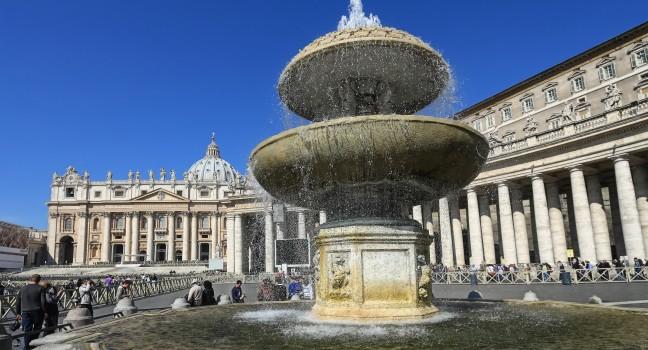
Vatican fountain.
WDG Photo / Shutterstock

The world's largest church, built over the tomb of St. Peter, is the most imposing and breathtaking architectural achievement of the Renaissance (although much of the lavish interior dates to the Baroque period). No fewer than five of Italy's greatest artists—Bramante, Raphael, Peruzzi, Antonio da Sangallo the Younger, and Michelangelo—died while striving to erect this new St. Peter's.

The history of the original St. Peter's goes back to AD 326, when the emperor Constantine completed a basilica over the site of the tomb of St. Peter, the Church's first pope. The original church stood for more than 1,000 years, undergoing a number of restorations and alterations, until, toward the middle of the 15th century, it was on the verge of collapse. In 1452, a reconstruction job began but was abandoned for lack of money.

In 1503, Pope Julius II instructed the architect Bramante to raze all the existing buildings and build a new basilica, one that would surpass even Constantine's for grandeur. It wasn't until 1626 that the new basilica was completed and consecrated.

Highlights include the Loggia delle Benedizioni (Benediction Loggia), the balcony where newly elected popes are proclaimed; Michelangelo's Pietà; and Bernini's great bronze baldacchino, a huge, spiral-columned canopy—at 100,000 pounds, perhaps the largest bronze object in the world—as well as many other Bernini masterpieces. There are also collections of Vatican treasures in the Museo Storico-Artistico e Tesoro and the Grotte Vaticane crypt.

For views of both the dome above and the piazza below, take the elevator or stairs to the roof. Those with more stamina (and without claustrophobia) can then head up more stairs to the apex of the dome.

 The basilica is free to visit, but a security check at the entrance can create very long lines. Arrive before 8:30 or after 5:30 to minimize the wait and avoid the crowds.

Piazza San Pietro, Rome, 00120, Italy
Sight Details
Free
Closed during Papal General Audience (Wed. until 1 pm) and during other ceremonies in piazza

Something incorrect in this review?

Basilica di Santa Maria Assunta

Fodor's Choice
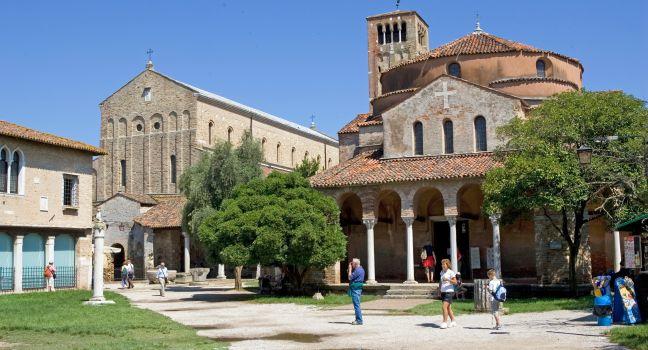
Torcello, Venice Italy, is a quiet and sparsely populated island at the northern end of the Venetian Lagoon. Today's main attraction is the Cathedral of Santa Maria Assunta, founded in 639 and with much 11th and 12th century Byzantine work, including mosai
(c) Antonella865 | Dreamstime.com

The hallowed centerpiece of Torcello, Santa Maria Assunta was built in the 11th century, and the island's wealth at the time is evident in the church's high-quality mosaics. The mosaics show the gradually increasing cultural independence of Venice from Byzantium. The magnificent late-12th-century mosaic of the Last Judgment shows the transition from the stiffer Byzantine style on the left to the more fluid Venetian style on the right. The Virgin in the main apse dates possibly from about 1185 and is of a distinctly Byzantine type, with her right hand pointing to the Christ child held with her left arm. The depictions of the 12 Apostles below her are possibly the oldest mosaics in the church and date from the early 12th century. Note that restoration of the mosaics is ongoing. The adjacent Santa Fosca church, built when the body of the saint arrived in 1011, is still used for religious services.

Torcello, 30175, Italy
041-730119
Sight Details
Santa Maria Assunta €5, Santa Fosca free

Something incorrect in this review?

Recommended Fodor's Video

Duomo

Duomo Fodor's Choice
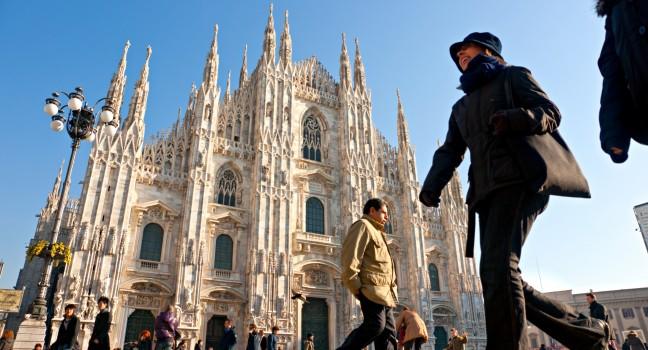
MILAN - DECEMBER 11: Tourists at Piazza Duomo on December 11, 2009 in Milan, Italy. As of 2006, Milan was the 42nd most visited city worldwide, with 1.9 million annual international visitors
Luciano Mortula / Shutterstock

There is no denying that for sheer size and complexity, the Duomo is unrivaled in Italy. It is the second-largest church in the country—the largest being St. Peter's in Rome. This intricate Gothic structure has been fascinating and exasperating visitors and conquerors alike since it was begun by Gian Galeazzo Visconti III (1351–1402), first duke of Milan, in 1386. Consecrated in the 15th or 16th century, it was not completed until just before the coronation of Napoléon as king of Italy in 1809.

The building is adorned with 135 marble spires and 2,245 marble statues. The Duomo's most famous sculpture is the gruesome but anatomically instructive figure of San Bartolomeo (St. Bartholomew), who was flayed alive. As you enter the apse to admire those splendid windows, glance at the sacristy doors to the right and left of the altar. The lunette on the right dates from 1393 and was decorated by Hans von Fernach.

Piazza del Duomo, Milan, 20122, Italy
02-72023375
Sight Details
Cathedral, museum, and archaeological area €14; stairs to roof €14; elevator €16; fast-track skip the line with elevator €26

Something incorrect in this review?

Gesuiti

Cannaregio Fodor's Choice
venice
© Zach Nelson / Fodors Travel

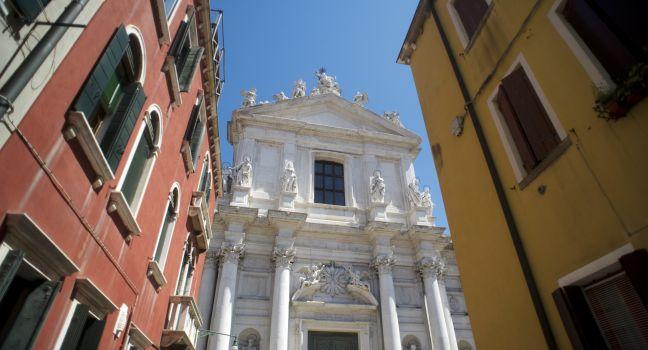
The interior walls of this early-18th-century church (1715–30) resemble brocade drapery, and only touching them will convince skeptics that rather than embroidered cloth, the green-and-white walls are inlaid marble. This trompe-l'oeil decor is typical of the late Baroque's fascination with optical illusion. Toward the end of his life, Titian tended to paint scenes of suffering and sorrow in a nocturnal ambience. A dramatic example of this is on display above the first altar to the left: Titian's daring Martyrdom of St. Lawrence (1578), taken from an earlier church that stood on this site. Tintoretto's Assumption (1555), originally commissioned for the destroyed Crociferi church, demands reverence. The Crociferi's surviving oratory, or prayer hall (Oratorio dei Crociferi), located across from the church, features some of Palma Giovane's best work, painted between 1583 and 1591. The oratory can be visited only with reservations at least three days in advance requested on the website or by email.

Campo dei Gesuiti, Venice, 30131, Italy
041-3096605-oratory
Sight Details
Gesuiti €1; Oratorio dei Crociferi €3 plus €60 per group with guided tour and €40 per group without guided tour
Reservations needed to visit oratory

Something incorrect in this review?

Madonna dell'Orto

Cannaregio Fodor's Choice
venice
© Zach Nelson / Fodors Travel

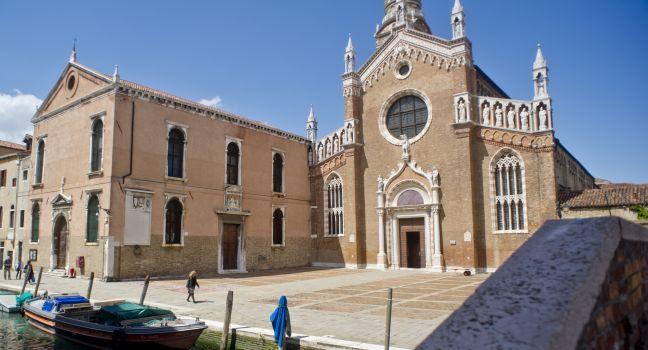
Though built toward the middle of the 14th century, this church takes its character from its beautiful late-Gothic facade, added between 1460 and 1464; it's one of the most beautiful Gothic churches in Venice. Tintoretto lived nearby, and this, his parish church, contains some of his most powerful work. Lining the chancel are two huge (45 feet by 20 feet) canvases, Adoration of the Golden Calf and Last Judgment. In glowing contrast to this awesome spectacle is Tintoretto's Presentation of the Virgin at the Temple and the simple chapel where he and his children, Marietta and Domenico, are buried. Paintings by Domenico, Cima da Conegliano, Palma Giovane, Palma Vecchio, and Titian also hang in the church. A chapel displays a photographic reproduction of a precious Madonna and Child by Giovanni Bellini. The original was stolen one night in 1993. Don't miss the beautifully austere, late-Gothic cloister (1460), which you enter through the small door to the right of the church; it is frequently used for exhibitions but may be open at other times as well.

Campo della Madonna dell'Orto, Venice, 30121, Italy
041-719933-church office
Sight Details
€3.50 (free with Chorus Pass)
Closed Sun.

Something incorrect in this review?

San Clemente

Celio Fodor's Choice
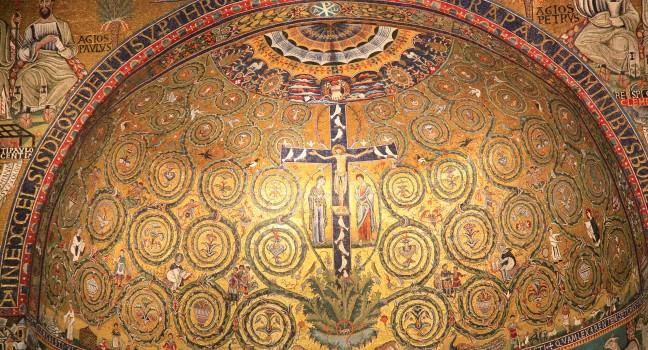
San Clemente church mosaic, Rome, Italy.
Vlad G/Shutterstock

One of the most impressive archaeological sites in Rome, San Clemente is a historical triple-decker. A 12th-century church was built on top of a 4th-century church, which had been built over a 2nd-century pagan temple to the god Mithras and 1st-century Roman apartments. The layers were uncovered in 1857, when a curious prior, Friar Joseph Mullooly, started excavations beneath the present basilica. Today, you can descend to explore all three.

The upper church (at street level) is a gem in its own right. In the apse, a glittering 12th-century mosaic shows Jesus on a cross that turns into a living tree. Green acanthus leaves swirl and teem with small scenes of everyday life. Early Christian symbols, including doves, vines, and fish, decorate the 4th-century marble choir screens. In the left nave, the Castiglioni chapel holds frescoes painted around 1400 by the Florentine artist Masolino da Panicale (1383–1440), a key figure in the introduction of realism and one-point perspective into Renaissance painting. Note the large Crucifixion and scenes from the lives of saints Catherine, Ambrose, and Christopher, plus the Annunciation (over the entrance).

To the right of the sacristy (and bookshop), descend the stairs to the 4th-century church, used until 1084, when it was damaged beyond repair during a siege of the area by the Norman prince Robert Guiscard. Still intact are some vibrant 11th-century frescoes depicting stories from the life of St. Clement. Don't miss the last fresco on the left, in what used to be the central nave. It includes a particularly colorful quote—including "Go on, you sons of harlots, pull!"—that's not only unusual for a religious painting, but also one of the earliest examples of written vernacular Italian.

Descend an additional set of stairs to the Mithraeum, a shrine dedicated to the god Mithras. His cult spread from Persia and gained a foothold in Rome during the 2nd and 3rd centuries AD. Mithras was believed to have been born in a cave and was thus worshipped in cavernous, underground chambers, where initiates into the all-male cult would share a meal while reclining on stone couches, some visible here along with the altar block. Most such pagan shrines in Rome were destroyed by Christians, who often built churches over their remains, as happened here.

Via Labicana, 95, Rome, 00184, Italy
06-7740021
Sight Details
Archaeological area €10
Reservations required

Something incorrect in this review?

San Francesco della Vigna

Castello Fodor's Choice
San Francesco della Vigna; Castello, Venice, Italy.
© Ross Brinkerhoff / Fodors Travel

Although this church contains some interesting and beautiful paintings and sculptures, it's the architecture that makes it worth the hike through a lively, middle-class residential neighborhood. The Franciscan church was enlarged and rebuilt by Jacopo Sansovino in 1534, giving it the first Renaissance interior in Venice; its proportions are said to reflect the mystic significance of the numbers three and seven dictated by Renaissance neo-Platonic numerology. The soaring but harmonious facade was added in 1562 by Palladio. The church represents a unique combination of the work of the two great stars of 16th-century Veneto architecture. The complex contains three cloisters that house vegetable plots and the city's oldest vineyard.

San Giorgio Maggiore

San Giorgio Maggiore Fodor's Choice
venice
© Zach Nelson / Fodor’s Travel

There's been a church on this island since the 8th century, with the addition of a Benedictine monastery in the 10th. Today's refreshingly airy and simply decorated church of brick and white marble was begun in 1566 by Palladio and displays his architectural hallmarks of mathematical harmony and classical influence. The Last Supper and the Gathering of Manna, two of Tintoretto's later works, line the chancel. To the right of the entrance hangs The Adoration of the Shepherds by Jacopo Bassano (1517–92); affection for his home in the foothills, Bassano del Grappa, is evident in the bucolic subjects and terra-firma colors. Book ahead for a tour of the private rooms to view Carpaccio's St. George and the Dragon (1516) and what is considered to be Tintoretto's final work, The Entombment of Christ (1594). The campanile (bell tower) dates from 1791, the previous structures having collapsed twice. Take an elevator to the top of the campanile for unparalleled 360-degree views of the lagoon, islands, and Venice itself.

Isola di San Giorgio Maggiore, Venice, 30133, Italy
0375-6323595
Sight Details
Church free, campanile €6

Something incorrect in this review?

San Sebastiano

Dorsoduro Fodor's Choice
Church of Saint Sebastian
© Halie Cousineau / Fodors Travel

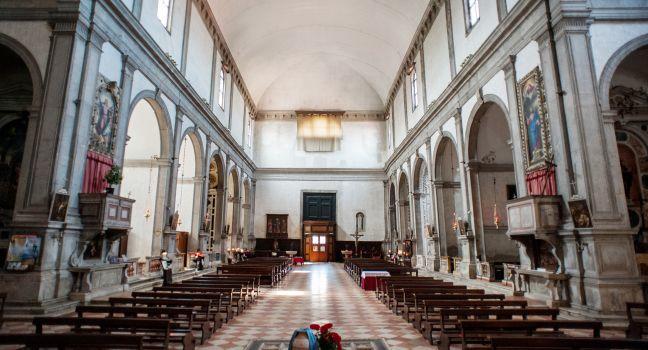
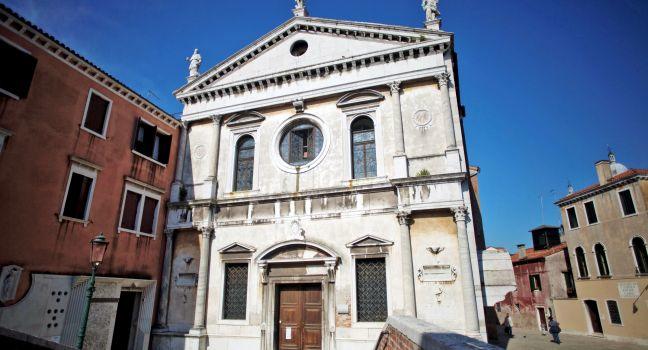
Paolo Veronese (1528–88), though still in his twenties, was already the official painter of the Republic when he began the ceiling oil panels and wall frescoes at San Sebastiano in 1555. For decades he continued to embellish the church with very beautiful illusionistic scenes. The cycles of scenes in San Sebastiano are considered to be his supreme accomplishment. His three oil paintings in the center of the ceiling depict scenes from the life of Esther, a rare theme in Venice. Veronese is buried beneath his bust near the organ.

Campazzo San Sebastiano, Venice, 30123, Italy
041-2750462
Sight Details
€3.50 (free with Chorus Pass)
Closed Sun.

Something incorrect in this review?

San Zaccaria

Castello Fodor's Choice
San Zaccaria, Castello, Venice, Italy.
© Zach Nelson / Fodors Travel

More a museum than a church, San Zaccaria has a striking Renaissance facade, with central and upper portions representing some of Mauro Codussi's best work. The lower portion of the facade and the interior were designed by Antonio Gambello. The original structure of the church was 14th-century Gothic, with its facade completed in 1515, some years after Codussi's death in 1504, and it retains the proportions of the rest of the essentially Gothic structure. Inside is one of the great treasures of Venice, Giovanni Bellini's celebrated altarpiece, La Sacra Conversazione, easily recognizable in the left nave. Completed in 1505, when the artist was 75, it shows Bellini's ability to incorporate the aesthetics of the High Renaissance into his work.

4693 Castello, Venice, 30122, Italy
041-2750462
Sight Details
Church free, chapels and crypt €3.50 (free with Chorus Pass)
Closed Sun. morning

Something incorrect in this review?

Sant'Ignazio

Trevi Fodor's Choice
Rome - ceiling of Chiesa Sant Ignazio di Loyola - fresco
(c) Sedmak | Dreamstime.com

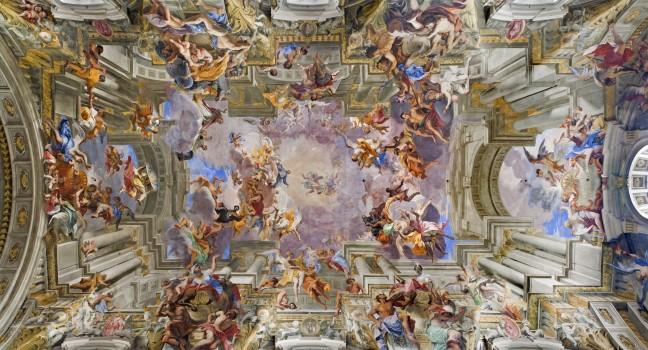
Rome's second Jesuit church, this 17th-century landmark set on a Rococo piazza harbors some of the city's most magnificent trompe l'oeils. To get the full effect of the illusionistic ceiling by priest-artist Andrea Pozzo, stand on the small yellow disk set into the floor of the nave. The heavenly vision that seems to extend upward almost indefinitely represents the Allegory of the Missionary Work of the Jesuits. It's part of Pozzo's cycle of works in this church exalting the early history of the Jesuit order, whose founder was the reformer Ignatius of Loyola. The saint soars heavenward, supported by a cast of thousands, creating a jaw-dropping effect that was fully intended to rival that of the glorious ceiling by Baciccia in the nearby mother church of Il Gesù. Be sure to have coins handy for the machine that switches on the lights so you can marvel at the false dome, which is actually a flat canvas—a trompe l'oeil trick Pozzo used when the architectural budget drained dry.

Scattered around the nave are several awe-inspiring altars; their soaring columns, gold-on-gold decoration, and gilded statues are pure splendor. Splendid, too, are the occasional sacred music concerts performed by choirs from all over the world. Look for posters by the main doors, or check the website for more information.

Santa Croce

Santa Croce Fodor's Choice
Santa Croce, Florence, Italy
Ross Brinkerhoff / Fodors Travel

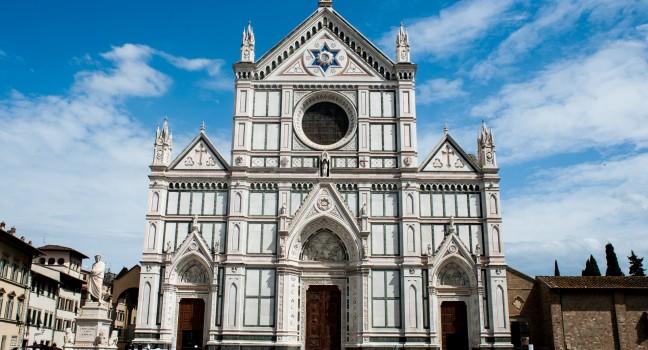
This Gothic church, whose facade dates from the 19th century, contains the skeletons of many Renaissance celebrities. The tomb of Michelangelo (1475–1564) is on the right at the front of the basilica, a location he is said to have chosen so that the first thing he would see on Judgment Day, when the graves of the dead fly open, would be Brunelleschi's dome through Santa Croce's open doors. The tomb of Galileo Galilei (1564–1642) is on the left wall. He was not granted a Christian burial until 100 years after his death because of his controversial contention that Earth was not the center of the universe. The tomb of Niccolò Machiavelli (1469–1527), the political theoretician whose brutally pragmatic philosophy so influenced the Medici, is halfway down the nave on the right. The grave of Lorenzo Ghiberti (1378–1455), creator of the Baptistery doors, is halfway down the nave on the left. Composer Gioachino Rossini (1792–1868) is buried at the end of the nave on the right. The monument to Dante Alighieri (1265–1321), the greatest Italian poet, is a memorial rather than a tomb (he is buried in Ravenna); it's on the right wall near the tomb of Michelangelo.

The complex's collection of art is by far the most important of any church in Florence. The most famous works are the Giotto frescoes in the two chapels immediately to the right of the high altar. They illustrate scenes from the lives of St. John the Evangelist and St. John the Baptist (in the right-hand chapel), as well as those from the life of St. Francis (in the left-hand chapel). Time has not been kind to these frescoes; through the centuries, wall tombs were placed in the middle of them, they were whitewashed and plastered over, and they suffered a clumsy 19th-century restoration. But the reality that Giotto introduced into painting can still be seen. He did not paint beautifully stylized religious icons, as the Byzantine style that preceded him prescribed. Instead, he painted drama—St. Francis surrounded by grieving friars at the very moment of his death. This was a radical shift in emphasis: before Giotto, painting's role was to symbolize the attributes of God; after him, it was to imitate life. His work is indeed primitive compared with later painting, but in the early 14th century it caused a sensation that was not equaled for another 100 years. He was, for his time, the equal of both Masaccio and Michelangelo.

Other highlights are Donatello's Annunciation, a moving expression of surprise (on the right wall two-thirds of the way down the nave); 14th-century frescoes by Taddeo Gaddi (circa 1300–66) illustrating scenes from the life of the Virgin Mary, clearly showing the influence of Giotto (in the chapel at the end of the right transept); and Donatello's Crucifix, criticized by Brunelleschi for making Christ look like a peasant (in the chapel at the end of the left transept). Outside the church proper, in the Museo dell'Opera di Santa Croce off the cloister, is the 13th-century Crucifix by Cimabue (circa 1240–1302), badly damaged by the flood of 1966. A model of architectural geometry, the Cappella Pazzi, at the end of the cloister, is the work of Brunelleschi.

Santa Maria dei Miracoli

Cannaregio Fodor's Choice
venice
© Zach Nelson / Fodors Travel

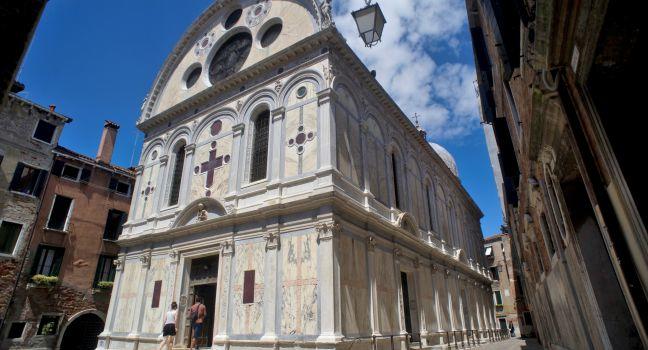
Tiny yet harmoniously proportioned, this Renaissance gem, built between 1481 and 1489, is sheathed in marble and decorated inside with exquisite marble reliefs. Architect Pietro Lombardo (circa 1435–1515) miraculously compressed the building to fit its lot, then created the illusion of greater size by varying the color of the exterior, adding extra pilasters on the building's canal side, and offsetting the arcade windows to make the arches appear deeper. The church was built to house I Miracoli, an image of the Virgin Mary by Niccolò di Pietro (1394–1440) that is said to have performed miracles—look for it on the high altar.

Campo Santa Maria Nova, Venice, 30121, Italy
041-2750462
Sight Details
€3.50 (free with Chorus Pass)
Closed Sun.

Something incorrect in this review?

Santa Maria del Popolo

Piazza del Popolo Fodor's Choice
The Basilica of Santa Maria del Popolo
© Halie Cousineau/ Fodors Travel

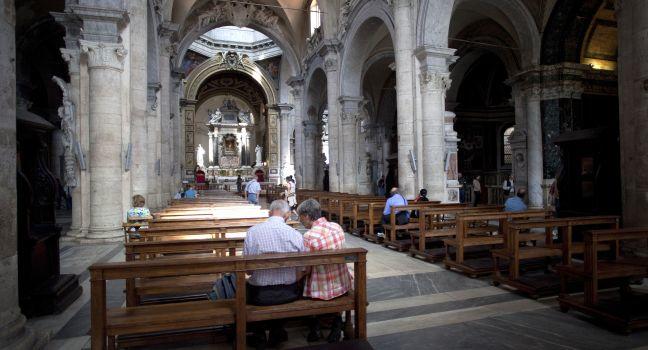
Standing inconspicuously in a corner of the vast Piazza del Popolo, this church often goes unnoticed, but the treasures inside make it a must for art lovers. Bramante enlarged the apse, which was rebuilt in the 15th century on the site of a much older place of worship. Inside, in the first chapel on the right, you'll see some frescoes by Pinturicchio from the mid-15th century; the adjacent Cybo Chapel is a 17th-century exercise in decorative marble.

Raphael designed the famous Chigi Chapel, the second on the left, with vault mosaics—showing God the Father in Benediction—as well as statues of Jonah and Elijah. More than a century later, Bernini added the oval medallions on the tombs and the statues of Daniel and Habakkuk. Finally, the Cerasi Chapel, to the left of the high altar, holds two Caravaggios: The Crucifixion of St. Peter and The Conversion of St. Paul. Exuding drama and realism, both are key early Baroque works that show how "modern" 17th-century art can appear. Compare their style with the much more restrained and classically "pure" Assumption of the Virgin by Annibale Carracci, which hangs over the altar of the chapel.

Santa Maria della Salute

Dorsoduro Fodor's Choice
Santa Maria della Salute; Dorsoduro, Venice, Italy.
© Ross Brinkerhoff / Fodors Travel

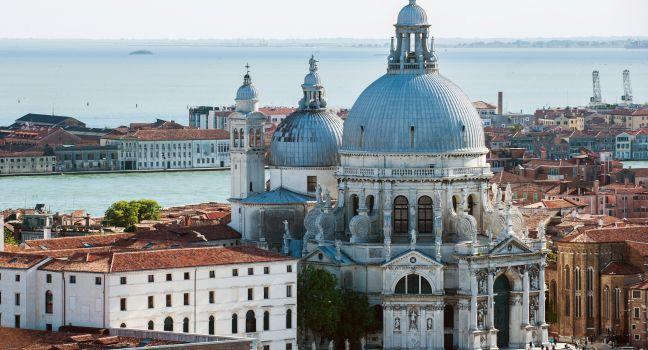
The most iconic landmark of the Grand Canal, "La Salute" (as this church is commonly called) is most unforgettably viewed from the Riva degli Schiavoni at sunset, or from the Accademia Bridge by moonlight. En route to becoming Venice's most important baroque architect, 32-year-old Baldassare Longhena won a competition in 1631 to design a shrine honoring the Virgin Mary for saving Venice from a plague that in the space of two years (1629–31) killed 47,000 residents, or one-third of the city's population, including the doge. It was not completed, however, until 1687—five years after Longhena's death.

Outside, this ornate white Istrian stone octagon is topped by a colossal cupola with snail-like ornamental buttresses—in truth, piers encircled by finely carved "ropes," an allusion to the sail-making industry of the city (or so say today's art historians). Inside, a white-and-gray color scheme is complemented by a polychrome marble floor and the six chapels. The Byzantine icon above the main altar has been venerated as the Madonna della Salute (Madonna of Health) since 1670, when Francesco Morosini brought it here from Crete. Above it is a dramatic marble sculpture by Giusto Le Court showing Venice on her knees before the Madonna as she implores aid and a cherub drives the plague from the city.

Do not leave the church without visiting the Sacrestia Maggiore, which contains a dozen works by Titian, including his San Marco Enthroned with Saints altarpiece. You'll also see Tintoretto's Wedding at Cana. For the Festa della Salute, held November 21, a votive bridge is constructed across the Grand Canal from Campo Santa Maria del Giglio to San Gregorio, and Venetians make a pilgrimage here to light candles in prayer for another year's health. Check the website for information on guided tours.

Punta della Dogana, Venice, 30123, Italy
041-2743928
Sight Details
Church free, sacristy €6, sacristy and art gallery €10, balustrade of the prophets €5, dome €8

Something incorrect in this review?

Santa Maria della Vittoria

Repubblica Fodor's Choice
ROME, ITALY - JUNE 4: Cantoria of the Santa Maria della Vittoria church in Rome, Italy at June 4, 2012. Church was opened at 1620 and cantoria was decorated by Mattia de Rossi.
Goran Bogicevic/Shutterstock

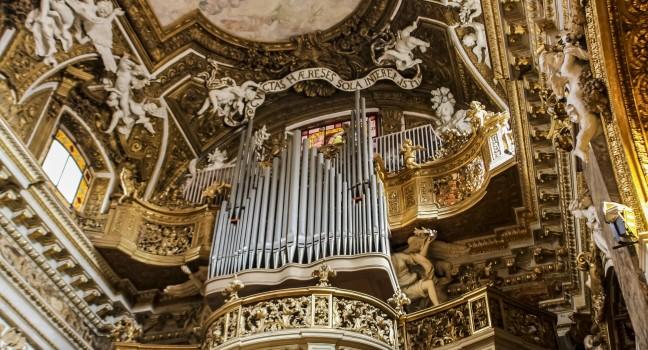
Designed by Carlo Maderno, this church is best known for Bernini's sumptuous Baroque decoration of the Cappella Cornaro (Cornaro Chapel, the last on the left as you face the altar), which houses his interpretation of divine love in the Ecstasy of St. Teresa. Bernini's masterly fusion of sculpture, light, architecture, painting, and relief is a multimedia extravaganza, with the chapel modeled as a theater, and one of the key examples of the Roman High Baroque. The members of the Cornaro family meditate on the communal vision of the great moment of divine love before them: the swooning saint's robes appear to be on fire, quivering with life, and the white marble group seems suspended in the heavens as golden rays illuminate the scene. An angel assists as Teresa abandons herself to the joys of heavenly love. To modern eyes, Bernini's representation of the saint's experience may seem more earthly than mystical. As the visiting French dignitary Charles de Brosses put it in the 18th century, "If this is divine love, I know all about it." 

Via XX Settembre, 17, Rome, 00187, Italy
06-42740571

Something incorrect in this review?

Santa Maria Gloriosa dei Frari

Fodor's Choice
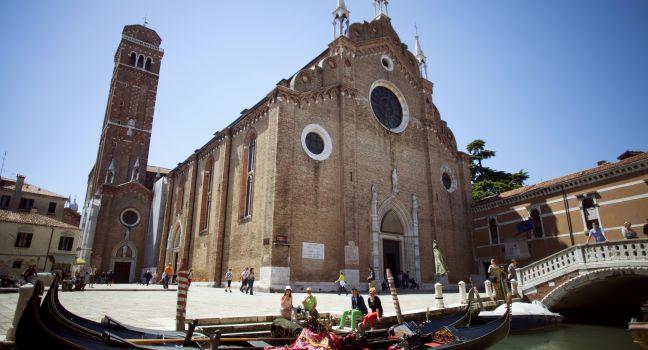
Santa Maria Gloriosa dei Frari, San Polo, Venice, Italy.
© Halie Cousineau/ Fodors Travel

Completed in 1442, this immense Gothic church of russet-color brick, known locally as “I Frari,” is famous worldwide for its array of spectacular Venetian paintings and historic tombs. It is also noteworthy for being the only important church in Italy that has preserved its elaborately carved, freestanding wooden choir in front of the high altar, a common feature in the medieval period (for the use of the monks in the attached monastery, still active today).

Visit the sacristy first, to see Giovanni Bellini's 1488 triptych Madonna and Child with Saints in all its mellow luminosity, painted for precisely this spot. The Corner Chapel on the other side of the chancel is graced by Bartolomeo Vivarini's (1415–84) 1474 altarpiece St. Mark Enthroned and Saints John the Baptist, Jerome, Peter, and Nicholas, which is much more conservative, displaying an attention to detail generally associated with late medieval painting. In the first south chapel of the choir, there is a fine sculpture of St. John the Baptist by Donatello, dated 1438 (perhaps created before the artist came to Venice), which conveys a psychological intensity rare for early Renaissance sculpture. You can see the rapid development of Venetian Renaissance painting by contrasting Bellini with the heroic energy of Titian's Assumption, over the main altar, unveiled in 1518. It was the artist's first public commission and, after causing a bit of controversy, did much to establish his reputation. Upon viewing this painting at the far end of the nave, you'll first think it has been specially spotlit: up close, however, you'll discover this impression is due to the painter's unrivaled use of light and color.

Titian's masterpiece, the Madonna di Ca' Pesaro, is in the left aisle. The painting took seven years to complete (finished in 1526), and in it Titian disregarded the conventions of his time by moving the Virgin out of center and making the saints active participants. The composition, built on diagonals, anticipates structural principals of Baroque painting in the following century. The work is brought to life by the unconventional gaze of young Leonardo Pesaro, who seems to look directly at the viewer.

The Frari also holds a Sansovino sculpture of St. John the Baptist and Longhena's impressive Baroque tomb designed for Doge Giovanni Pesaro. Titian, who died during the plague of 1576, is buried near his luminous Madonna di Ca' Pesaro; the massive marble monument to him near the main entrance was commissioned by the emperor of Austria in 1838 in recognition of the artist who had worked at the court of his forefathers. The black marble tomb of musician Claudio Monteverdi, one of the greatest composers of the 17th century, is in the chapel of the Milanese to the left of the high altar. There are always roses lying on it, left by anonymous admirers.

Santa Maria in Cosmedin

Aventino Fodor's Choice
Fountain, Santa Maria in Cosmedin, Rome, Italy
(c) Kpapaioanno | Dreamstime.com

One of Rome's oldest churches—built in the 6th century and restored in the late 19th century—is on the Piazza della Bocca della Verità, originally the location of the Forum Boarium, ancient Rome's cattle market and later the site of public executions. Although the church has a haunting interior and contains the flower-crowned skull of St. Valentine, who is celebrated every February 14th, it plays second fiddle to the renowned artifact installed out in its portico.

The Bocca della Verità (Mouth of Truth) is in reality nothing more than an ancient drain cover, unearthed during the Middle Ages. Legend has it, however, that the teeth will clamp down on a liar's hand if they dare to tell a fib while holding their fingers up to the fearsome mouth. Hordes of tourists line up to take the test every day (kids especially get a kick out of it).

Santa Maria in Trastevere

Trastevere Fodor's Choice
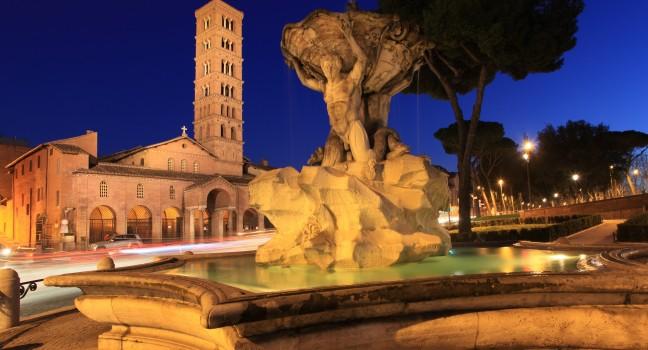
Santa Maria in Trastevere, Trastevere, Rome, Italy.
© Zach Nelson / Fodors Travel

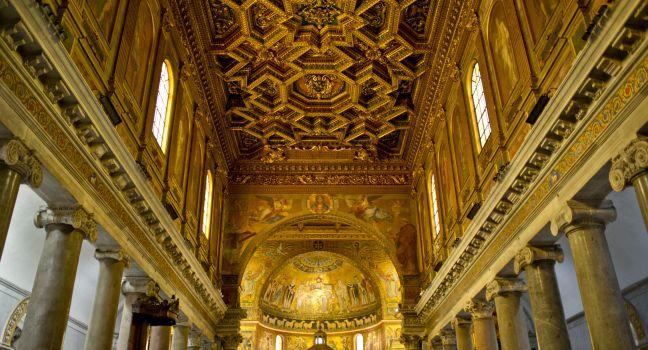
Built during the 4th century and rebuilt in the 12th century, this is one of Rome's oldest and grandest churches. It is also the earliest foundation of any Roman church to be dedicated to the Virgin Mary. The 18th-century portico draws attention to the facade's 800-year-old mosaics, which represent the parable of the Wise and Foolish Virgins. They enhance the whole piazza, especially at night, when the church front and bell tower are illuminated.

With a nave framed by a processional of two rows of gigantic columns (22 in total) taken from the ancient Baths of Caracalla and an apse studded with gilded mosaics, the interior conjures the splendor of ancient Rome. Overhead is Domenichino's gilded ceiling (1617). The church's most important mosaics, Pietro Cavallini's six panels of the Life of the Virgin, cover the semicircular apse. Note the building labeled "Taberna Meritoria" just under the figure of the Virgin in the Nativity scene, with a stream of oil flowing from it; it recalls the legend that a fountain of oil appeared on this spot, prophesying the birth of Christ. Off the piazza's northern side is a street called Via delle Fonte dell'Olio in honor of this miracle.

Santi Giovanni e Paolo

Celio Fodor's Choice
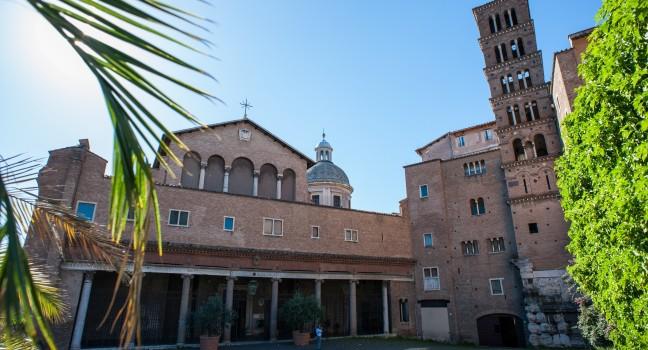
Santi Giovanni e Paolo, Rome, Italy
© Ross Brinkerhoff / Fodors Travel

Perched up the incline of the Clivio di Scauro—a magical time-machine of a street, where the dial seems to be stuck somewhere in the 13th century—Santi Giovanni e Paolo is an image that would tempt most landscape painters. Marked by one of Rome's finest Romanesque bell towers, it looms over a picturesque piazza. Underneath, however, are other treasures, whose excavations can be seen in the Case Romane del Celio museum.

A basilica erected on the spot was, like San Clemente, destroyed in 1084 by attacking Normans. Its half-buried columns, near the current church entrance, are visible through misty glass. The current church's origins date to the start of the 12th century, but most of the interior dates to the 17th century and later. The lovely, incongruous chandeliers are hand-me-downs from New York's Waldorf-Astoria hotel, a gift arranged by the late Cardinal Francis Spellman of New York, whose titular church this was. Spellman also initiated the excavations here in 1949.

Santi Giovanni e Paolo

Castello Fodor's Choice
VENICE, ITALY - MARCH 12, 2014: Interior of Basilica di san Giovanni e Paolo church. Look across the nave to Saint Dominic chapel.
Renata Sedmakova/Shutterstock

This gorgeous church looms over one of the most picturesque squares in Venice: the Campo Giovanni e Paolo, centered on the magnificent 15th-century equestrian statue of Bartolomeo Colleoni by the Florentine Andrea del Verrocchio. Also note the beautiful facade of the Scuola Grande di San Marco (now the municipal hospital), begun by Pietro Lombardo and completed after the turn of the 16th century by Mauro Codussi. The massive Italian Gothic church itself is of the Dominican order and was consecrated in 1430. Bartolomeo Bon's portal, combining Gothic and classical elements, was added between 1458 and 1462, using columns salvaged from Torcello. The 15th-century stained-glass window near the side entrance is breathtaking for its brilliant colors and beautiful figures; it was made in Murano from drawings by Bartolomeo Vivarini and Girolamo Mocetto (circa 1458–1531). The second official church of the Republic after San Marco, San Zanipolo (as it's known in Venetian) is Venice's equivalent of London's Westminster Abbey, with a great number of important people, including 25 doges, buried here.

Artistic highlights include an early (1465) polyptych by Giovanni Bellini (right aisle, second altar) where the influence of Mantegna is still very evident, Alvise Vivarini's Christ Carrying the Cross (sacristy), and Lorenzo Lotto's Charity of St. Antonino (right transept). Don't miss the Cappella del Rosario (Rosary Chapel), off the left transept, built in the 16th century to commemorate the 1571 victory of Lepanto in western Greece, when Venice led a combined European fleet to defeat the Turkish navy. The chapel was devastated by a fire in 1867 and restored in the early years of the 20th century with works from other churches, among them the sumptuous Veronese ceiling paintings. However quick your visit, don't miss the Pietro Mocenigo tomb to the right of the main entrance, by Pietro Lombardo and his sons. Note also Tullio Lombardo's tomb of Andrea Vendramin, the original home of Tullio's Adam, now belonging to New York City's Metropolitan Museum of Art.

Abbazia di Sant'Antimo

Fodor's Choice

The exterior and interior sculpture of this Romanesque abbey, dating from the 12th century, is outstanding, particularly the nave capitals, a combination of French, Lombard, and even Spanish influences. The sacristy (seldom open) forms part of the primitive Carolingian church (founded in AD 781), its entrance flanked by 9th-century pilasters. The small vaulted crypt dates from the same period.

Localita' S. Antimo 222, Castelnuovo dell'Abate, 53020, Italy
0577-286300
Sight Details
Closed for mass on Sun. and religious holidays until 11 am

Something incorrect in this review?

Arcibasilica di San Giovanni in Laterano

San Giovanni Fodor's Choice

The cathedral of Rome is San Giovanni in Laterano, not St. Peter's. The church was built here by Emperor Constantine 10 years before he built the church dedicated to Peter, making it the ecclesiastical seat of the Bishop of Rome (the pope). But thanks to vandals, earthquakes, and fires, today's building owes most of its form to 16th- and 17th-century restorations, including an interior designed by Baroque genius Borromini. Colossal statues stand watch over the towering facade: the 12 apostles plus Christ, John the Baptist, and the Virgin Mary.

Some earlier fragments do remain: under the portico on the left stands an ancient statue of Constantine, while the central portal's ancient bronze doors were brought here from the Forum's Curia. The altar's rich Gothic tabernacle, holding what the faithful believe are the heads of saints Peter and Paul, dates from 1367. The last chapel on the left aisle houses the cloister, which is encrusted with 12th-century cosmatesque mosaics. Around the corner stands one of the oldest Christian structures in Rome: Emperor Constantine's octagonal baptistery. Despite several restorations, a 17th-century interior redecoration, and even a 1993 Mafia-related car bombing, the baptistery from AD 315 remains true to its ancient form.

Basilica della Santa Casa

Fodor's Choice

Loreto is famous for one of the best-loved shrines in the world: the Santuario della Santa Casa (House of the Virgin Mary), within the Basilica della Santa Casa. Legend has it that angels moved the house from Nazareth, where the Virgin Mary was living at the time of the Annunciation, to this hilltop in 1295. The reason for this sudden and divinely inspired move was that Nazareth had fallen into the hands of Muslim invaders, who the angelic hosts viewed as unsuitable keepers of this important shrine.

The house itself consists of three rough stone walls contained within an elaborate marble tabernacle. Built around this centerpiece is the giant Basilica of the Holy House, which dominates the town. Millions of pilgrims come to the site every year (particularly at Easter and on the December 10 Feast of the Translation of the Holy House), and the little town of Loreto can become uncomfortably crowded.

Many great Italian architects—including Bramante, Antonio da Sangallo the Younger (1483–1546), Giuliano da Sangallo (circa 1445–1516), and Sansovino (1467–1529)—contributed to the design of the basilica. It was begun in the Gothic style in 1468 and continued in Renaissance style through the late Renaissance.

Basilica di San Francesco

Fodor's Choice

The famous Piero della Francesca frescoes depicting The Legend of the True Cross (1452–66) were executed on the three walls of the Capella Bacci, the apse of this 14th-century church. What Sir Kenneth Clark called "the most perfect morning light in all Renaissance painting" may be seen in the lowest section of the right wall, where the troops of Emperor Maxentius flee before the sign of the cross. Reservations are required and can be made online.

Piazza San Francesco 2, Arezzo, 52100, Italy
0575-1696258
Sight Details
€9
Closed Wed. and Sun. morning

Something incorrect in this review?

Basilica di San Francesco

Fodor's Choice

The basilica isn't one church but two: the Gothic church on the upper level, and the Romanesque church on the lower level. Work on this two-tiered monolith was begun in 1228. Both churches are magnificently decorated artistic treasure houses, covered floor to ceiling with some of Europe's finest frescoes: the Lower Basilica is dim and full of candlelight shadows, while the Upper Basilica is bright and airy.

In the Upper Church, the magnificent frescoes from 13th-century Italian painter Giotto, painted when he was only in his twenties, show that he was a pivotal artist in the development of Western painting. The Lower Church features frescoes by celebrated Sienese painters Simone Martini and Pietro Lorenzetti, as well as by Giotto (or his assistants).

Basilica di San Nicola

Fodor's Choice

The 11th-century Basilica di San Nicola, overlooking the sea in the città vecchia (old city), houses the bones of St. Nicholas, the inspiration for Santa Claus. His relics were stolen from Myra, in present-day Turkey, by a band of sailors from Bari and are now buried in the crypt. Because St. Nicholas is also the patron saint of Russia, the church draws both Roman Catholic and Russian Orthodox pilgrims; souvenir shops in the area display miniatures of the Western saint and his Eastern counterpart side by side.

Basilica di San Paolo

Fodor's Choice

Locals consider this the most important church in Palazzolo Acreide, rebuilt and repaired after the 1693 earthquake. When you enter, usually a volunteer will be available to take you on a brief tour. The main focal points are the relics and the statue of St. Paul paraded annually through the town with alternate moments of piety and raucous pyrotechnics, between June 26 and June 29.

Piazza San Paolo 4, Palazzolo Arceide, 96010, Italy
0931-871213
Sight Details
Free; donation encouraged after tour

Something incorrect in this review?

Basilica di San Vitale

Fodor's Choice

The octagonal church of San Vitale was built in AD 547, after the Byzantines conquered the city, and its interior shows a strong Byzantine influence. The area behind the altar contains the most famous works, depicting Emperor Justinian and his retinue on one wall, and his wife, Empress Theodora, with her retinue, on the opposite one. Notice how the mosaics seamlessly wrap around the columns and curved arches on the upper sides of the altar area. School groups can sometimes swamp the site from March through mid-June.

Via San Vitale, Ravenna, 48121, Italy
0544-541688
Sight Details
€11 combination ticket, includes other diocesan monuments

Something incorrect in this review?