34 Best Sights in Italy

Background Illustration for Sights

We've compiled the best of the best in Italy - browse our top choices for the top things to see or do during your stay.

Villa Borghese

Villa Borghese Fodor's Choice
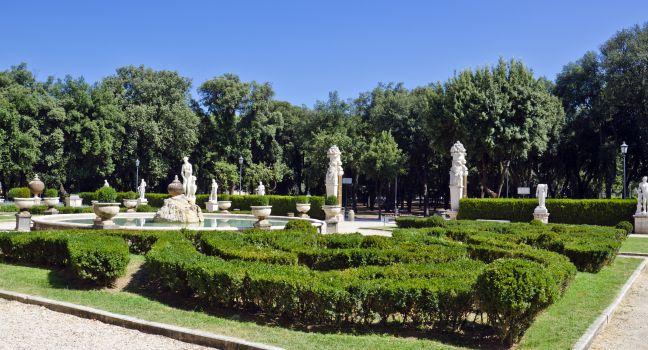
The Garden of Venus, In Villa Borghese, Rome, Italy.
Preisler | Dreamstime.com

Rome's Central Park, the Villa Borghese was originally laid out as a recreational garden in the early 17th century by Cardinal Scipione Borghese. The word "villa" was used to mean suburban estate, of the type developed by the ancient Romans and adopted by Renaissance nobles. Today's gardens cover a much smaller area—by 1630, the perimeter wall was almost 5 km (3 miles) long. At the end of the 18th century, Scottish painter Jacob More remodeled the gardens into the English style popular at the time. In addition to the gloriously restored Galleria Borghese, the highlights of the park are Piazza di Siena, a graceful amphitheater, and the botanical garden on Via Canonica, where there is a pretty little lake as well as the neoclassical faux–Temple of Aesculapius, the Biopark zoo, Rome's own replica of London's Globe Theatre, and the Villa Giulia museum.

The Carlo Bilotti Museum ( www.museocarlobilotti.it) is particularly attractive for Giorgio de Chirico fans, and there is more modern art in the nearby Galleria Nazionale d'Arte Moderna e Contemporanea. The 63-seat children's movie theater, Cinema dei Piccoli, shows films for adults in the evening. There's also Casa del Cinema, where film buffs can screen films or sit at the sleek, cherry-red, indoor-outdoor caffè (you can find a schedule of events at  www.casadelcinema.it).

Castello di Caccamo

Fodor's Choice

A visit to this fantastic castle, the biggest in Sicily and one of the grandest in all of Italy, is like stepping into the Middle Ages, complete with a well-stocked medieval armory, creepy dungeon prison, and elegant upper-level rooms decorated with detailed woodwork carving and majolica ceramic floors. The castle was the property of the Chiaramontes, once a powerful Sicilian aristocratic family. The views of the Rosamarina artificial lake and valley below are breathtaking.

Castello di Verrazzano

Fodor's Choice

Tours here take you down to the cellars and through the Renaissance gardens, and end with a wine tasting. You can also have a delicious crostino on a terrace with latticed grape leaves forming a beautiful bower above; the view from the terrace stretches for miles. Lunch and dinner are also available, and all the food pairs beautifully with their wines—which they've been making since 1170.

Recommended Fodor's Video

Mercato Storico Albinelli

Fodor's Choice

Locals and visitors flock to this fruit, vegetable, meat, and fish market with good reason. Ingredients are of the finest and of the freshest, and visually the place is a glorious sight to behold. It's been around in this current incarnation since 1931, and it's pretty easy to see why.

Parco degli Acquedotti

Via Appia Antica Fodor's Choice

This massive park, technically part of the Parco dell'Appia Antica, was named for the six remaining aqueducts that formed part of the famously elaborate system that carried water to ancient Rome. The park has some serious film cred: it was featured in the opening scene of La Dolce Vita and in a rather memorable scene depicting some avant-garde performance art in La Grande Bellezza. On weekends, it's a popular place for locals to picnic, exercise, and generally enjoy a day out with their kids or dogs.

Passeggiata delle Mura

Fodor's Choice

On nice days, the citizens of Lucca cycle, jog, stroll, or kick a soccer ball in this green, beautiful, and very large circular park. It's neither inside nor outside the city but rather right atop and around the ring of ramparts that defines Lucca. Sunlight streams through two rows of tall plane trees to dapple the passeggiata delle mura (walk on the walls), which is 4 km (2½ miles) long. Ten bulwarks are topped with lawns, many with picnic tables and some with play equipment for children. Be aware at all times of where the edge is—there are no railings, and the drop to the ground outside the city is a precipitous 40 feet.

Piazza della Signoria

Piazza della Signoria Fodor's Choice

Here, in 1497 and 1498, the famous "bonfire of the vanities" took place, when the fanatical Dominican friar Savonarola induced his followers to hurl their worldly goods into the flames. It was also here, a year later, that he was hanged as a heretic and, ironically, burned. A plaque in the piazza pavement marks the spot of his execution.

Cellini's famous bronze Perseus, shown holding the severed head of Medusa, is among the most important sculptures in the Loggia dei Lanzi. Also noteworthy are The Rape of the Sabine Women and Hercules and the Centaur, both late-16th-century works by Giambologna (1529–1608). But it's the Neptune Fountain, created between 1550 and 1575 by Bartolomeo Ammannati, that dominates the square. The Florentines call it "il Biancone," which may be translated as "the big white man" or "the big white lump." Giambologna's equestrian statue, to the left of the fountain, portrays Grand Duke Cosimo I. Occupying the steps of the Palazzo Vecchio is a copy of Michelangelo's David, as well as Baccio Bandinelli's Hercules.

Piazza Santa Croce

Santa Croce Fodor's Choice

Originally outside the city's 12th-century walls, this piazza grew with the Franciscans, who used it for public preaching. During the Renaissance, it hosted giostre (jousts), including one sponsored by Lorenzo de' Medici. Lined with many palazzi dating from the 15th and 16th centuries, the square remains one of Florence's loveliest and is a great place to people-watch.

Piazzale Michelangelo

San Niccolò Fodor's Choice

From this lookout you have a marvelous view of Florence and the hills around it, rivaling the vista from the Forte di Belvedere. A copy of Michelangelo's David overlooks outdoor cafés packed with tourists during the day and evening. In May, the Giardino dell'Iris (Iris Garden) off the piazza is abloom with more than 2,500 varieties of the flower. The Giardino delle Rose (Rose Garden) on the terraces below the piazza is also in full bloom in May and June.

Ponte Vecchio

Duomo Fodor's Choice

This charmingly simple bridge was built in 1345 to replace an earlier one that was swept away by a flood. Its shops first housed butchers, then grocers, blacksmiths, and other merchants. But, in 1593, the Medici grand duke Ferdinand I (1549–1609), whose private corridor linking the Medici palace (Palazzo Pitti) with the Medici offices (the Uffizi) crossed the bridge atop the shops, decided that all this plebeian commerce under his feet was unseemly. So he threw out the butchers and blacksmiths and installed 41 goldsmiths and eight jewelers. The bridge has been devoted solely to these two trades ever since.

Take a moment to study the Ponte Santa Trinita, the next bridge downriver. It was designed by Bartolomeo Ammannati in 1567 (probably from sketches by Michelangelo), blown up by the retreating Germans during World War II, and painstakingly reconstructed after the war. The view from the Ponte Santa Trinita is also beautiful, which might explain why so many young lovers hang out there.

Promenades

Fodor's Choice

A stroll along one of Merano's well-marked, impossibly pleasant promenades may yield even better relaxation than time in its famous spa. Passeggiata Tappeiner (Tappeiner's Promenade) is a 3-km (2-mile) path with panoramic views from the hills north of the Duomo and diverse botanical pleasures along the way. Passeggiata d'Estate (Summer Promenade) runs along the shaded south bank of the Passirio River, and the Passeggiata d'Inverno (Winter Promenade), on the exposed north bank, provides more warmth and the Wandelhalle—a sunny area decorated with idyllic paintings of surrounding villages. The popular Austrian empress Sissi (Elisabeth of Wittelsbach, 1837–98) put Merano on the map as a spa destination; a trail named in her honor, the Sentiero di Sissi (Sissi's Walk), follows a path from Castel Trauttmansdorff to the heart of Merano.

Torre Salsa Nature Reserve

Fodor's Choice

The seemingly endless pristine sands of Torre Salsa, overlooked by cliffs of crystal selenite, are one of the best-kept secrets of coastal Sicily. This is in part because they are easily reached only in summer. The rest of the year underground springs make the several dirt tracks to the sands inaccessible, not only by car but also on foot except for those intrepid enough not to be put off by knee-deep mud. If the sea is calm, those prepared to paddle can usually walk along the sands from the beaches at either end: Bovo Marina to the north and Siculiana Marina to the south. Bring plenty to eat and drink, as there are no facilities. If approaching by car in the dry months, the easiest access is via the Pantano entrance towards the northern end of the reserve.

Università di Bologna

University area Fodor's Choice

Take a stroll through the streets of the university area: a jumble of buildings, some dating as far back as the 15th century and most to the 17th and 18th. The neighborhood, as befits a college town, is full of bookshops, coffee bars, and inexpensive restaurants. Political slogans and sentiments are scrawled on walls all around the university and tend to be ferociously leftist, sometimes juvenile, and often entertaining. Among the 15 university museums, the most interesting is the Museo di Palazzo Poggi, which displays scientific instruments plus paleontological and botanical artifacts.

Fondamenta delle Zattere

This broad, bustling waterfront promenade is one of Venice's prime stretches for strolling; thanks to its southern orientation along the Giudecca Canal, it is full of families, students, children, and dogs whenever there is the slightest ray of sunshine. Come in spring or winter to warm up a little, or in the summer to cool off under café umbrellas with drinks or gelato. Restaurant terraces over the water lure diners until late. The name Zattere means "rafts," and this was the area designated by the Venetian government for storing the vast platforms of tree trunks that were floated down rivers from the nearby Alps destined to become pilings, beams, ships, or any other item made of wood.

Fontana del Nettuno

Piazza Maggiore

Sculptor Giambologna's elaborate 1563–66 Baroque fountain and monument to Neptune occupying Piazza Nettuno has been aptly nicknamed "Il Gigante" (The Giant). Its exuberantly sensual mermaids and undraped god of the sea drew fire when it was constructed—but not enough, apparently, to dissuade the populace from using the fountain as a public washing stall for centuries.

Piazza del Nettuno, Bologna, 40125, Italy

Something incorrect in this review?

Foresta Umbra

In the middle of the Gargano Promontory is the majestic Foresta Umbra (Shady Forest), a dense growth of beech, maple, pine, and oak generally found in more northerly climates, thriving here because of the altitude, which reaches 3,200 feet above sea level. Between the trees in this national park are occasional dramatic vistas opening out over the Golfo di Manfredonia. There are nature trails and picnic areas easily reached from Vieste, Peschici, and Mattinata. A seasonal lakeside visitor center (bike hire and guide hikes available) and Museo Naturalistico della Foresta Umbra, offers information, a small natural history exhibition and family-friendly deer-feeding area.  

Giardini Papadopoli

Located just across the Grand Canal between Piazzale Roma and the train station, this lush oasis was created in the 1830s by demolishing the former monastery of Santa Croce. A tranquil place to sit in the shade, the gardens feature flowers, large, leafy trees, and a small playground for children. Pause to admire the marble statue of civil engineer Pietro Paleòcapa; not a Venetian, but one of the great 19th-century hydraulic engineers modifying rivers and swamps in Italy and Europe. He served in Venice as Director of Public Works and crowned his career by collaborating with Luigi Negrelli in the planning of the Suez Canal.

30135 Sestriere Santa Croce, Italy
041-2748111

Something incorrect in this review?

Il Ponte della Maddalena

Il Ponte della Maddalena is, oddly, also known as the Devil's Bridge. Commissioned in all likelihood by Matilde di Canossa (1046–1115), it was restructured by the petty despot Castruccio Castracani in the early 14th century. It's worth the climb to the middle—the bridge is narrow, steep, and pedestrians-only—to check out the view. Despite 1836 flood damage and early-20th-century alterations, it seems little changed from the Middle Ages. If you're heading north along the Serchio from Lucca to Bagni di Lucca, you will see the bridge on your left.

La Pigna

San Remo's steep and labyrinthine old town climbs upward to Piazza Castello, which offers a splendid view of the town and sea below. Some lovely old palazzi and squares have been restored, and the neighborhood gives you a sense of what it was like to live in San Remo centuries ago.

Old Town, San Remo, 18038, Italy

Something incorrect in this review?

Le Cascine

Santa Maria Novella

In the 16th century, this vast park belonged to the Medici, who used it for hunting, one of their favorite pastimes. It was opened to the public in the 19th century. The park runs for nearly 3 km (2 miles) along the Arno and has roughly 291 acres. It's ideal for strolling on sunny days, and there are paths for jogging, allées perfect for biking, grassy fields for picnicking, and lots of space for rollerblading (as well as a place to rent skates). At the northern tip of the park is the Monumento all'Indiano, an oddly moving monument dedicated to Rajaram Cuttraputti, Marajah of Kolepoor, who died in Florence in 1870. The park hosts sports enthusiasts, a weekly open-air market, and discotheques. But be warned: at night there's a booming sex-for-sale trade.

Main entrance: Piazza Vittorio Veneto, Viale Fratelli Roselli (at Ponte della Vittoria), Florence, 50100, Italy

Something incorrect in this review?

Mercato Nuovo

Piazza della Repubblica

The open-air loggia, built in 1551, teems with souvenir stands, but the real attraction is a copy of Pietro Tacca's bronze Porcellino (which translates as "little pig" despite the fact the animal is, in fact, a wild boar). The sculpture is Florence's equivalent of the Trevi Fountain: put a coin in his mouth, and if it falls through the grate below (according to one interpretation), it means you'll return to Florence someday. What you're seeing is a copy of a copy: Tacca's original version, in the Museo Bardini, is actually a copy of an ancient Greek work.

Piazza del Duomo

The impressive cobblestone piazza scene contains the cathedral and the Battistero, plus the Palazzo del Vescovado (Bishop's Palace). Behind the Duomo is the Baroque church of San Giovanni Evangelista.

Piazza del Popolo

The town's main square teems with cafés and bars. It's an excellent spot for people-watching; in the evening and on weekends it seems like everyone is out walking, seeing, and being seen.

Piazza dell'Anfiteatro

Here's where the ancient Roman amphitheater once stood. Some of the medieval buildings built over the amphitheater retain its original oval shape and brick arches.

Piazza della Repubblica

Piazza della Repubblica

The square marks the site of an ancient forum, which was the core of the original Roman settlement and which was replaced in the Middle Ages by the Mercato Vecchio (Old Market). The current piazza, constructed between 1885 and 1895 as a neoclassical showpiece, is lined with cafés that are the perfect spots from which to people-watch.

Piazza della Repubblica, Florence, Italy

Something incorrect in this review?

Piazza Garibaldi

This piazza is the heart of Parma, where people gather to pass the time of day, start their passeggiata (constitutional), or simply hang out; the square and nearby Piazza del Duomo make up one of the loveliest historic centers in Italy. Strada Cavour, leading off the piazza, is Parma's prime shopping street. It's also crammed with wine bars teeming with locals, so it's a perfect place to stop for a snack or light lunch or a drink.

Piazza Matteotti

Greve's gently sloping and asymmetrical central piazza is surrounded by an attractive arcade with shops of all kinds. In the center stands a statue of the discoverer of New York harbor, Giovanni da Verrazzano (circa 1480–1527). Check out the lively market held here on Saturday morning.

Porto Azzurro

The waters of the port at Elba's eastern end are noticeably azzurro (sky-blue). It's worth a stop for a walk and gelato along the rows of yachts harbored here.

Portoferraio

The lively port town where Victor Hugo (1802–85) spent his boyhood makes a good base for visiting Elba. Head right when you get off the ferry to get to the centro storico, fortified in the 16th century by the Medici grand duke Cosimo I (1519–74). Most of the pretty, multicolor buildings that line the old harbor date from the 18th and 19th centuries when the boats in the port were full of mineral exports rather than tourists.

Rio Marina

Elba's quietest town is an old-fashioned port on the northeastern edge of the island. Here you'll find a pebble beach, an old mine, a leafy public park, and ferry service to Piombino.