16 Best Sights in Italy

Background Illustration for Sights

We've compiled the best of the best in Italy - browse our top choices for the top things to see or do during your stay.

Necropoli di Pantalica

Fodor's Choice

You'll need to hire a guide to explore the over 5,000 tombs covering the limestone cliffs that make up this Iron and Bronze Age burial site. On a huge plateau over the Anapo River, the necropolis dates to between the 13th and 8th centuries BC. If you decide not to hire a guide, you'll need to drive to get here. There are two main entrances: one near the town of Sortino and the other from the town of Ferla. The entrance by Sortino involves a good walk down the sides of the gorge while the Ferla entrance is more of a gentle stroll along a well-beaten path. Set aside a minimum of two hours for your visit, but it is better to allocate at least half a day; be sure to wear a good pair of walking shoes and bring plenty of water.
Catacombe di San Sebastiano

Via Appia Antica Fodor's Choice

The 4th-century church at this site was named after the saint who was buried in its catacomb, which burrows underground on four different levels. This was the only early Christian cemetery to remain accessible during the Middle Ages, and it was from here that the term "catacomb" is derived—it's in a spot where the road dips into a hollow, known to the Romans as a catacumba (Greek for "near the hollow").

Via Appia Antica, 136, Rome, 00179, Italy
06-7850350
Sight Details
€10
Closed Mon. and Dec.

Something incorrect in this review?

Cimitero Acattolico

Testaccio Fodor's Choice

Built up against the ancient Aurelian Walls, this famed cemetery was intended for the interment of non-Catholics who were barred from burial within the city walls. Poetic souls seek out the tomb of John Keats, who tragically died in Rome after succumbing to consumption at age 25 in 1821. The headstone is famously inscribed, "Here lies one whose name was writ in water" (the poet requested that no name or dates should appear). Nearby is the place where Shelley's heart was buried, as well as the tombs of Goethe's son, the founder of the Italian Communist Party and vehement anti-Fascist Antonio Gramsci, and America's famed beat poet Gregory Corso.

The cemetery's quiet paths are lined with fruit trees and prowled by shy cats from a nearby animal sanctuary. The tranquil spot is far from morbid and quite easy to find: simply catch the Metro B from Termini station to the Piramide stop, which is just around the corner from the entrance to the cemetery.

Recommended Fodor's Video

Cimitero di San Michele (San Michele Cemetery)

Fodor's Choice

It's no surprise that serenity prevails on San Michele in Venice’s northern lagoon. The city's island cemetery is surrounded by ocher brick walls and laced with cypress-lined pathways amid plots filled with thousands of graves; there's also a modern extension completed by British architect David Chipperfield in 2017. Among those who have made this distinctive island their final resting place are such international arts and science luminaries as Igor Stravinsky, Sergei Diaghilev, Ezra Pound, and the Austrian mathematician Christian Doppler (of the Doppler effect). You're welcome to explore the grounds if you dress respectfully and adhere to a solemn code of conduct. Photography and picnicking are not permitted.

Cripta

Città Fodor's Choice

Routine excavation work revealed this crypt, which had been hidden for centuries under the grand pavimento (floor) of the Duomo and was opened to the public in 2003. In the late 13th century, an unknown master executed the crypt's breathtaking frescoes, which have sustained remarkably little damage and have retained their original colors. The Deposition/Lamentation proves that the Sienese school could paint emotion just as well as the Florentine school—and that it did so some 20 years before Giotto.

Scale di San Giovanni, Siena, 53100, Italy
0577-286300
Sight Details
€16 combined ticket includes the Duomo, Battistero, roof terrace, and Museo dell'Opera

Something incorrect in this review?

Capuchin Museum

Quirinale
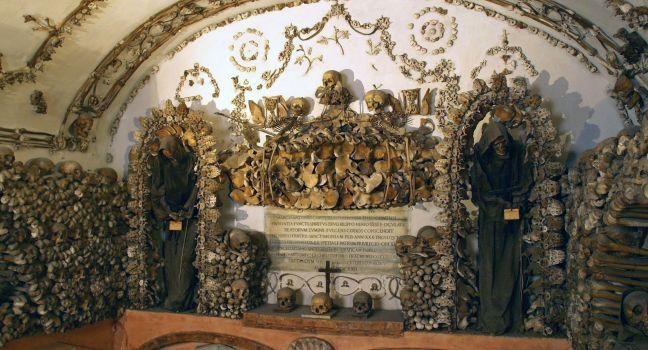
The Capuchin Crypt is a small space comprising several tiny chapels located beneath the church of Santa Maria della Concezione dei Cappuccini on the Via Veneto near Piazza Barberini in Rome, Italy. It contains the skeletal remains of 4,000 bodies believed
Luigi Roscia | Dreamstime.com

Devoted to teaching visitors about the Capuchin order, this museum is mainly notable for its strangely touching and beautiful crypt under the church of Santa Maria della Concezione. The bones of some 4,000 friars are arranged in odd decorative designs around the shriveled and decayed remains of their kinsmen, a macabre reminder of the impermanence of earthly life. As one sign proclaims: "What you are, we once were. What we are, you someday will be."

Upstairs in the church, the first chapel on the right contains Guido Reni's mid-17th-century Archangel St. Michael Trampling the Devil. The painting caused great scandal after an astute contemporary observer remarked that the face of the devil bore a surprising resemblance to Pope Innocent X, archenemy of Reni's Barberini patrons. Compare the devil with the bust of the pope that you saw in the Palazzo Doria Pamphilj and judge for yourself.

Mausoleo di Cecilia Metella

Via Appia Antica
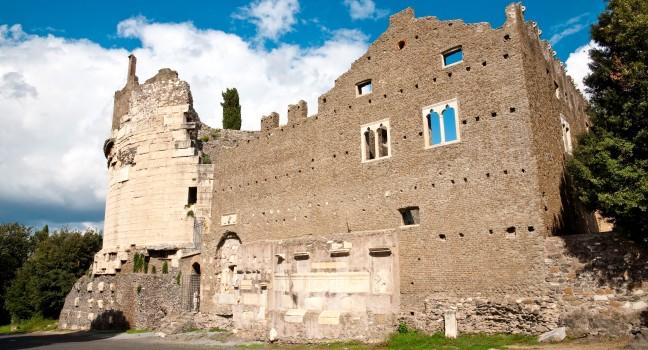
Mausoleo di Cecelia Metella Fachade in Via Appia antica at Rome - Italy.
Pablo Debat/Shutterstocik

For centuries, sightseers have flocked to this famous landmark, one of the most complete surviving tombs of ancient Rome. Of the many round mausoleums that once lined the Appian Way, this tomb is a smaller version of the Mausoleum of Augustus but impressive nonetheless. It was the burial place of a Roman noblewoman: the wife of the son of Crassus, who was one of Julius Caesar's rivals and known as the richest man in the Roman Empire (infamously entering the English language as "crass").

The original decoration includes a frieze of bulls' skulls near the top. The travertine stone walls were made higher, and the medieval-style crenellations were added when the tomb was transformed into a fortress by the Caetani family in the 14th century. An adjacent chamber houses a small museum with exhibits on the area's geological phases. Entrance to this site also includes access to the splendid Villa dei Quintili.

Via Appia Antica, 161, Rome, 00178, Italy
06-7886254
Sight Details
€8, includes 4 sites in the Parco dell'Appia Antica (Mausoleo di Cecilia Metella, Villa dei Quintili, Antiquarium di Lucrezia Romana, Complesso di Capo di Bove)
Closed Mon.

Something incorrect in this review?

Antico Cimitero Ebraico

You might complete your circuit of Jewish Venice with a visit to the Antico Cimitero Ebraico, full of fascinating old tombstones half hidden by ivy and grass. The earliest grave dates from 1389; the cemetery remained in use until the late 18th century. You can book guided tours through the Jewish Museum of Venice; see their website ( www.ghettovenezia.com) for details, as it's sometimes not accessible to the public.

Lido, 30126, Italy
041-715359-Jewish Museum
Sight Details
€10 for guided tour
Closed Sat.

Something incorrect in this review?

Camposanto

According to legend, the cemetery—a walled structure on the western side of the Piazza dei Miracoli—is filled with earth that returning Crusaders brought back from the Holy Land. Contained within are numerous frescoes, notably The Drunkenness of Noah, by Renaissance artist Benozzo Gozzoli (1422–97), and the disturbing Triumph of Death (14th century; artist uncertain), whose subject matter shows what was on people's minds in a century that saw the ravages of the Black Death.

Piazza del Duomo, Pisa, 56126, Italy
050-835011
Sight Details
From €8

Something incorrect in this review?

Catacombe dei Cappuccini

The spookiest sight in all of Sicily, this 16th-century catacomb houses more than 8,000 corpses of men, women, and young children—some in tombs but many mummified, preserved, and hanging in rows on the walls, divided by social caste, age, or gender. Most wear signs indicating their names and the years they lived, and many are Capuchin friars, who were founders and proprietors of this bizarre establishment from 1599 to 1911. The site is still managed by the nearby Capuchin church, but was closed to new corpses when an adjacent cemetery was opened, making the catacombs redundant. Though memorable, this is not a spot for the faint of heart; children might be frightened or disturbed.

Piazza Cappuccini 1, Palermo, 90129, Italy
091-6527389
Sight Details
€5

Something incorrect in this review?

Catacombe di San Callisto

Via Appia Antica

Burial place of several very early popes, this is Rome's oldest and best-preserved underground cemetery. One of the (English-speaking) friars who acts as custodian of the catacomb will guide you through its crypts and galleries, some adorned with early Christian frescoes. Watch out for wrong turns: this catacomb is five stories deep!  This site has a large parking area and is favored by big groups; it can get busy.

Via Appia Antica, 110, Rome, 00179, Italy
06-5130151
Sight Details
€10
Closed Wed. and mid-Jan.–Feb.
reservations required

Something incorrect in this review?

Catacombs

Nobles of the 17th and 18th centuries in this area opted to have their corpses mummified. You can visit the somewhat creepy crypt, located beneath a 17th-century Capuchin monastery, to see their preserved remains and handwoven silk garments. The catacombs are usually open daily from April to October and on weekends the rest of the year, but it's advised to call ahead to be sure that someone is actually on-site to let you in.

Via Cappuccini 10, Savoca, 98038, Italy
333-1221102
Sight Details
Free

Something incorrect in this review?

Cimitero degli Inglesi

Santa Croce

The final resting place for some 1,400 souls was designed in 1828 by Carlo Reishammer and originally intended for the Swiss community in Florence. Just outside the city's 14th-century walls (no longer visible), the cemetery grew to accommodate other foreigners living here, and thus earned another of its names, the Protestant Cemetery. It's also referred to as the "Island of the Dead." Indeed, Swiss painter Arnold Böcklin (1827–1901) used the cemetery as inspiration for his haunting painting of that name.

Perhaps its most famous resident is Elizabeth Barrett Browning (1809–61), who spent the last 15 years of her life in the city. Other noteworthy expats buried here include the English poets Arthur Clough and Walter Savage Landor, Frances Trollope (mother of Anthony), and the American preacher Theodore Parker.

Piazzale Donatello 38, Florence, 50121, Italy
055-582608
Sight Details
Free; suggested €3 per person for large groups
Closed weekends, Mon. afternoon, and Tues.–Fri. morning

Something incorrect in this review?

Cimitero Monumentale di Staglieno

One of the most famous of Genovese landmarks is this bizarrely beautiful cemetery; its fanciful marble and bronze sculptures sprawl haphazardly across a hillside on the outskirts of town. A pantheon holds indoor tombs and some remarkable works like an 1878 Eve by Villa. Don't miss Rovelli's 1896 Tomba Raggio, which shoots Gothic spires out of the hillside forest. The cemetery began operation in 1851 and has been lauded by such visitors as Mark Twain and Evelyn Waugh. It covers a good deal of ground (allow at least half a day to explore). Take Bus Nos. 13 or 14 from the Stazione Genova Brignole, Bus No. 34 from Stazione Principe, or a taxi.

Florence American Cemetery

About 8 km (5 miles) south of Florence on the road to Siena is one of the country's two American cemeteries (the other is in Nettuno). It contains 4,392 bodies of Americans who died in Italy during World War II. Spread across a gently rolling hill, the simple crosses and Stars of David bearing only name, date of death, and state seem to stretch endlessly. Atop the hill is a place for reflection and large mosaic maps depicting the Allied assault in 1943. The two fronts—called the Gothic Line and the Gustav Line—are vividly rendered. So, too, is the list containing 1,409 names of those missing in action.

Necropoli Vaticana

Vatican

With advance notice you can take a one-hour guided tour in English of the Vatican Necropolis, under the Basilica di San Pietro, which gives a rare glimpse of early Christian Roman burial customs and a closer look at the tomb of St. Peter. Apply via the contact form online, specifying the number of people in the group (all must be age 10 or older), preferred language, preferred time, available dates, and your contact information in Rome. Each group will have about 12 participants. Visits are not recommended for those with mobility issues or who are claustrophobic.

Ufficio Scavi, Rome, 00120, Italy
06-69885318
Sight Details
€20
Closed Sun. and Roman Catholic holidays
Reservations required

Something incorrect in this review?