12 Best Sights in Italy

Background Illustration for Sights

We've compiled the best of the best in Italy - browse our top choices for the top things to see or do during your stay.

The Spanish Steps

Piazza di Spagna Fodor's Choice
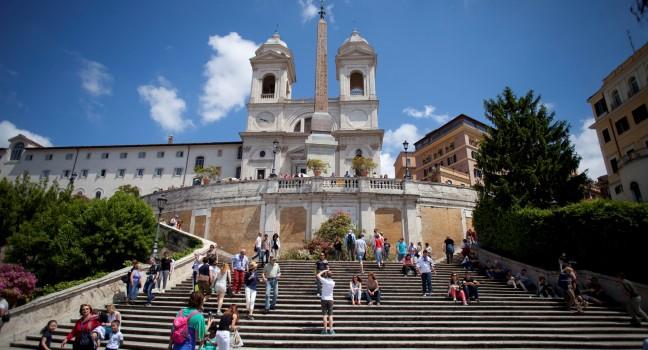
The Spanish Steps, Trinita Dei Monti, Rome, Italy
© Halie Cousineau/ Fodors Travel

The iconic Spanish Steps (often called simply la scalinata, or "the staircase," by Italians) and the Piazza di Spagna from which they ascend both get their names from the Spanish Embassy to the Vatican on the piazza—even though the staircase was built with French funds by an Italian in 1723. In honor of a diplomatic visit by the King of Spain, the hillside was transformed by architect Francesco de Sanctis with a spectacular piece of urban planning to link the church of Trinità dei Monti at the top with the Via Condotti below.

In an allusion to the church, the staircase is divided by three landings (beautifully lined with potted azaleas from mid-April to mid-May). Bookending the bottom of the steps are beloved holdovers from the 18th century, when the area was known as the "English Ghetto": to the right, the Keats-Shelley House and to the left, Babington's Tea Rooms—both beautifully redolent of the era of the Grand Tour.

For weary sightseers who find the 135 steps too daunting, there is an elevator at Vicolo del Bottino 8, next to the Metro entrance. (Those with mobility problems should be aware that there is still a small flight of stairs after, however, and that the elevator is sporadically closed for repair.) At the bottom of the steps, Pietro Bernini's splendid 17th-century Barcaccia Fountain still spouts drinking water from the ancient aqueduct known as the Acqua Vergine.

Marsala Salt Pans

Fodor's Choice

Driving along the flat and winding coast road north of Marsala, you'll soon come across the extraordinary series of salt pans glistening in the shallows of Sicily's largest lagoon, the Stagnone di Marsala. The shallow depth of the lagoon, ranging from 2 to 6 feet, has made it perfect for the production of salt, and it has been put to this purpose since Phoenician times. The sheer flatness of the scene is varied only by the conical heaps of salt and a scattering of the disused windmills once used to supply power. The scene is still and quiet most of the time, but you'll sometimes see pockets of activity, with full wheelbarrows of salt being hauled to the conveyor belts that create the mounds. The stacks of earthenware tiles you'll see everywhere are used to weigh down the salt to prevent it being from blown away by gusts of wind. It's an extremely photogenic tableau, with the light changing through the day, the occasional presence of spindly pink flamingos in the lagoon, and Mozia and the Egadi archipelago looming through the haze. The narrow coastal road is one-way for much of its length, and the cycle track running alongside it enables the area to be comfortably toured on two wheels.

There's a small museum dedicated to the salt extraction industry in a restored windmill at the Ettore e Infersa embarcation point, where souvenir samples of salt can be purchased. You'll also find the Mamma Caura bar-restaurant here ( www.seisaline.it  Closed Tues. Oct.–May), with outdoor tables and a rooftop terrace.

Scala Santa Maria del Monte

Fodor's Choice

While you can see examples of Caltagirone's long ceramic tradition throughout the city, the most impressive display can be found in the 142 individually decorated tiled steps of this monumental staircase leading up to the neglected Santa Maria del Monte church. On July 25 (the feast of San Giacomo, the city's patron saint) and again on August 15th (the feast of the Assumption), the stairs form a tapestry design with illuminated candles. Months of work go into preparing the 4,000 coppi, or cylinders of colored paper, that hold oil lamps—then, at 9:30 pm on the nights of July 24, July 25, August 14, and August 15, a squad of hundreds of youngsters (tourists are welcome to participate) spring into action to light the lamps, so that the staircase flares up all at once.

Recommended Fodor's Video

Sea Turtles First Aid Center

Fodor's Choice

The nonprofit Filicudi WildLife Conservation is dedicated to research and conservation of Aeolian sea life, particularly dolphins, sperm whales, and sea turtles. You can join one of their naturalistic excursions to go snorkeling with a marine biologist, go out on a boat at dawn to watch for cetaceans and turtles, or have a guided visit to the Sea Turtles First Aid Center. If you'd like to become more involved, you can join a one-week research camp on dolphins and turtles as a volunteer.  

Via del Ghiaccio

Fodor's Choice

In the 19th and 20th centuries, the twin hill towns of Cammerata and San Giovanni Gemini were famous throughout Sicily for their traveling ice cream and granita makers. The key to this ice-cream industry was the collection and preservation of snow, and a local family of ice-cream makers has restored several of the neviere, circular buildings resembling stone igloos, strewn over the forested slopes above the towns. Snow was shoveled into the neviere, trodden down until it turned to a thick layer of ice, then covered with a mat of rushes and straw before another layer of snow was added on top. Stored like this, the snow would keep frozen for months, and with the giant blocks of ice fetching the equivalent of €3,000, it had to be carefully guarded. The best way to see the neviere, learn how to make Sicilian granita, and visit a small private ice museum, is on a guided tour, which can include a lunch of cold cuts, local cheeses, and grilled meat and vegetables in a pretty, family-run café.

Consorzio Liguria Via Mare

Porto Vecchio

Boat tours of the harbor, operated by the Consorzio Liguria Via Mare, launch from the aquarium pier and last about an hour. The tours include a visit to the breakwater outside the harbor, the Bacino delle Grazie, and the Molo Vecchio (Old Port). There are also daily excursions down the coast as far as Portofino and San Fruttuoso.

The Harbor

Porto Vecchio

A boat tour (with Consorzio Liguria Via Mare, for example) gives you a good perspective on the layout of the harbor, which dates to Roman times. The Genoa inlet, the largest along the Italian Riviera, was also used by the Phoenicians and Greeks as a harbor and a staging area from which they could penetrate inland to form settlements and to trade. The port is guarded by the Diga Foranea, a striking 5-km-long (3-mile-long) wall built into the ocean. The Lanterna, a lighthouse more than 360 feet tall, was built in 1544; it's one of Italy's oldest lighthouses and a traditional emblem of Genoa.

Genoa, Italy

Something incorrect in this review?

Parco Avventura Madonie

This adventure park is located inside the Parco delle Madonie and offers several activities, including archery and obstacle courses, through the forest and above the trees on rope ladders. There are different levels of varying difficulty, which are designed for children and adults alike. You can also rent a tree house or glamping accommodations to spend the night suspended 20 feet above the ground.

Contrada Gorgonero, Petralia Sottana, 90027, Italy
339-7655551
Sight Details
Multi-activity ticket €30
Closed over the winter months; refer to website

Something incorrect in this review?

Pylon of Torre Faro

One of a pair of pylons (the other is across the strait in Villa San Giovanni, Calabria) that carried electricity across the strait from 1955 to 1994, this steel tower stands 761 feet over the most northeastern point of Sicily. Though the pylons are no longer officially in use, they do have protected historic monument status and are used to gather meteorological data. Access to the 1,000-odd steps to the top is closed to the public. 

Pilone di Torre Faro, Punta del Faro, Italy

Something incorrect in this review?

Sagra della Castagna

During two weekends in mid-October, Caprese Michelangelo's very lively Sagra della Castagna takes place. Among the many other chestnut-based delights that feature in the fair, the freshly made castagnaccia (a typically Tuscan dessert made with chestnut flour, pine nuts, olive oil, and rosemary) is a must-try.

Zecca-Righi Funicular

A seven-stop commuter funicular begins just off of Piazza della Nunziata and ends at a high lookout on the fortified gates in the 17th-century city walls. Ringed around the circumference of the city are a number of huge fortresses; this gate was part of the city's system of defenses. From Righi you can undertake scenic all-day hikes from one fortress to the next.

Piazza della Nunziata, Genoa, 16122, Italy
010-5582414
Sight Details
€2 (ticket valid 110 minutes)

Something incorrect in this review?

Lungomare degli Artisti

Albisola Marina has a centuries-old tradition of ceramics making. Numerous shops here sell the distinctive wares, and a whole sidewalk, Lungomare degli Artisti, which runs along the beachfront, has been transformed by the colorful ceramic works of well-known artists.

Albisola Marina, Italy

Something incorrect in this review?