423 Best Sights in Italy

Background Illustration for Sights

We've compiled the best of the best in Italy - browse our top choices for the top things to see or do during your stay.

Villa Comunale

Fodor's Choice

Stroll down Via Bagnoli Croce from the main Corso Umberto to the Villa Comunale to enjoy the stunning views from the seaside city's best terrace walkways. Also known as the Parco Duca di Cesarò, the lovely public gardens were designed by Florence Trevelyan Cacciola, a Scottish lady "invited" to leave England following a romantic liaison with the future Edward VII (1841–1910). Arriving in Taormina in 1889, she married a local professor and devoted herself to the gardens, filling them with native Mediterranean and exotic plants, ornamental pavilions, and fountains.

Via Bagnoli Croce, Taormina, 98039, Italy

Something incorrect in this review?

Villa Comunale

Fodor's Choice

The largest public park in Sorrento sits on a cliff top overlooking the entire Bay of Naples. It offers benches, flowers, palms, and people/sunset watching, plus a seamless vista that stretches from Capri to Vesuvius. From here steps lead down to Sorrento's main harbor, the Marina Piccola.

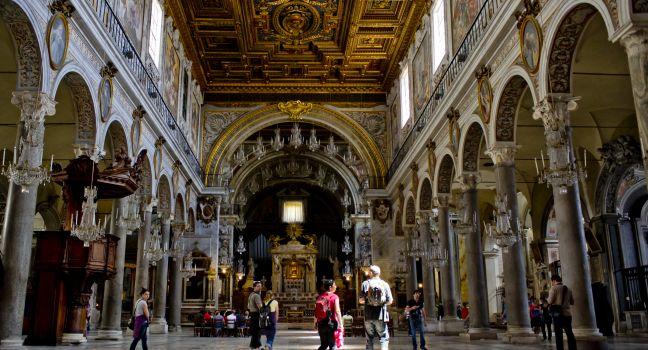
Basilica di Santa Maria in Aracoeli

Campitelli
Santa Maria di Aracoeli, Campidoglio, Ancient Rome, Rome, Italy.
© Zach Nelson / Fodors Travel

Perched atop 124 steps, on the north slope of the Capitoline Hill, Santa Maria in Aracoeli occupies the site of the temple of Juno Moneta (Admonishing Juno), which also housed the Roman mint. According to legend, it was here that the Sibyl, a prophetess, predicted to Augustus the coming of a Redeemer. Augustus responded by erecting an altar, the Ara Coeli (Altar of Heaven). This was eventually replaced by a Benedictine monastery and then by a church, which was passed in 1250 to the Franciscans, who restored and enlarged it in Romanesque-Gothic style.

Today, the Aracoeli is best known for the Santo Bambino, a much-revered olivewood figure of the Christ Child (a copy of the 15th-century original, which was stolen in 1994). At Christmas, everyone pays homage to the "Bambinello" as children recite poems from a miniature pulpit. In true Roman style, the church interior is a historical hodgepodge, with classical columns and large marble fragments from pagan buildings, as well as a 13th-century cosmatesque pavement. The richly gilded Renaissance ceiling commemorates the naval victory at Lepanto in 1571 over the Turks. The first chapel on the right is noteworthy for Pinturicchio's frescoes of St. Bernardino of Siena (1486).

Scala dell'Arce Capitolina 14, Rome, 00186, Italy
06-69763839

Something incorrect in this review?

Recommended Fodor's Video

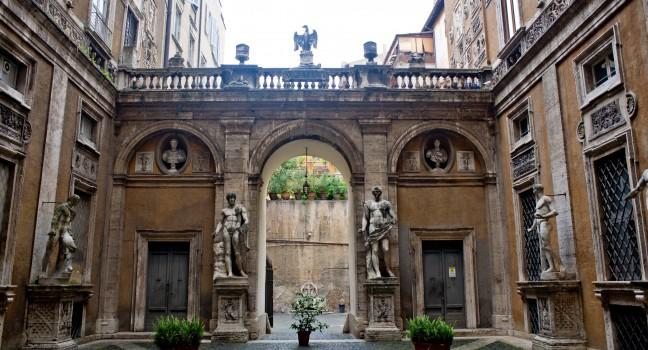
Palazzo Mattei di Giove

Jewish Ghetto
Palazzo Mattei di Giove, Rome, Italy
© Zach Nelson / Fodors Travel

Graceful and opulent, the arcaded, multistory courtyard of this palazzo is a masterpiece of turn-of-the-17th-century style. Designed by Carlo Maderno, it is a veritable panoply of sculpted busts, heroic statues, sculpted reliefs, and Paleo-Christian epigrams, all collected by Marchese Asdrubale Mattei. Inside are various scholarly institutes, including the Centro Studi Americani (Center for American Studies), which also contains a library of American books. Salons in the palace (not usually open to visitors) are decorated with frescoes by Cortona, Lanfranco, and Domenichino.

Via Michelangelo Caetani, 32, Rome, 00186, Italy
06-68801613-Centro Studi Americani
Sight Details
Closed weekends

Something incorrect in this review?

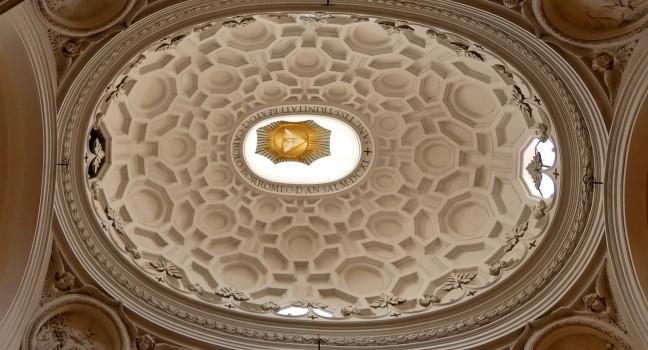
San Carlo alle Quattro Fontane

Quirinale
Elliptic dome of San Carlo alle Quattro Fontane (1638-1641) in Rome, designed by Francesco Borromini.
Marie-Lan Nguyen [public domain], via Wikimedia Commons

Sometimes known as San Carlino because of its tiny size, this is one of Borromini's masterpieces. In a space no larger than the base of one of the piers of St. Peter's Basilica, he created a church that is an intricate exercise in geometric perfection, with a coffered dome that seems to float above the curves of the walls. Borromini's work is often bizarre, definitely intellectual, and intensely concerned with pure form. In San Carlo, he invented an original treatment of space that creates an effect of rippling movement, especially evident in the double-S curves of the facade. Characteristically, the interior decoration is subdued, in white stucco with no more than a few touches of gilding, so as not to distract from the form. Don't miss the cloister: a tiny, understated Baroque jewel, with a graceful portico and loggia above, echoing the lines of the church.

Via del Quirinale, 23, Rome, 00187, Italy
06-48907729
Sight Details
Closed Sun.

Something incorrect in this review?

Santa Pudenziana

Monti
Santa Pudenziana, Rome, Italy
© Halie Cousineau/ Fodors Travel

Apart from Ravenna, Rome has some of Italy's most opulent mosaics, and this church has the earliest example. Commissioned during the papacy of Innocent I, its early 5th-century apse mosaic, depicting Christ teaching the apostles, sits above a Baroque altarpiece surrounded by a bevy of florid 18th-century paintings. The mosaic is remarkable for its iconography; at the center sits Christ Enthroned, shown as an emperor or as a philosopher holding court, surrounded by his apostles. Each apostle faces the spectator, literally rubbing shoulders with his companion (unlike later hieratic styles in which each figure is isolated) and bears an individualized expression. Above these figures and a landscape symbolizing Heavenly Jerusalem float the signs of the four evangelists in a blue sky flecked with the orange of sunset, made from thousands of tesserae (mosaic tiles).

To either side of Christ, saints Praxedes and Pudentiana hold wreaths over the heads of saints Peter and Paul. These two women were actually daughters of the Roman senator Pudens (probably the one mentioned in 2 Timothy 4:21), whose family befriended both apostles. During the persecutions of Nero, both sisters collected the blood of many martyrs before suffering their fate. Pudentiana transformed her house into a church, but her namesake church was constructed over a 2nd-century bathhouse. Beyond the sheer beauty of the mosaic work, the size, rich detail, and number of figures make this both the last gasp of ancient Roman art and one of the first major works of Early Christian art.

Via Urbana, 160, Rome, 00184, Italy
06-4817292
Sight Details
Closed Sun.

Something incorrect in this review?

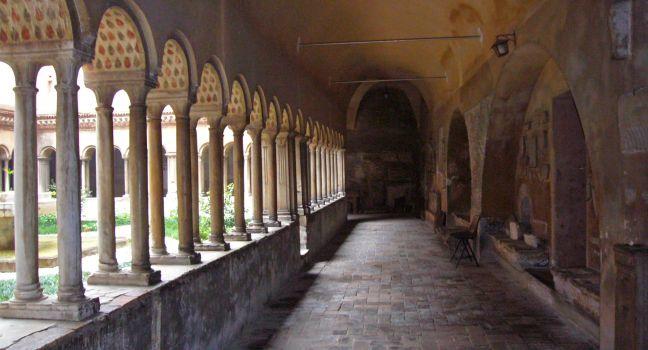
Santi Quattro Coronati

Celio
Roma, Santi Quattro Coronati: chiostro
Lalupa (CC BY-SA 3.0), via Wikimedia Commons

Situated on one of those evocative cul-de-sacs in Rome where history seems to be holding its breath, this quiet citadel has resisted the tides of time and traffic. The church—which is both strongly imbued with the sanctity of the Romanesque era and marvelously redolent of the Middle Ages—dates from the 4th century and honors the Four Crowned Saints: the four brothers Severus, Severianus, Carpophorus, and Victorinus, all Roman officials who were whipped to death for their faith by Emperor Diocletian (284–305).

After its 9th-century reconstruction, the church was twice as large as it is now; the abbey was partially destroyed during the Normans' sack of Rome in 1084 but reconstructed about 30 years later. This explains the inordinate size of the apse in relation to the small nave. Don't miss the cloister, with its well-tended gardens and 12th-century fountain. The entrance is the door in the left nave; ring the bell if it's not open.

There's another medieval gem hidden away off the courtyard at the church entrance: the Chapel of San Silvestro. The chapel has remained, for the most part, as it was when consecrated in 1246. Some of the best-preserved medieval frescoes in Rome decorate the walls, telling the story of the Christian emperor Constantine's recovery from leprosy thanks to Pope Sylvester I. Note, too, the delightful Last Judgment fresco above the door, in which the angel on the left neatly rolls up sky and stars like a backdrop, signaling the end of the world.

Abbadia San Salvatore

This 1,000-year-old village is worth a stop—skip the nondescript new town and head straight to the centro storico to explore winding stone streets with tiny churches around every corner. The abbey for which the town was named was founded in 743; its current appearance reflects an 11th-century renovation, but the original crypt remains intact. The tourist office in town has hiking-trail maps for Monte Amiata.

Abbey of San Nilo Grottaferrata

In Grottaferrata, a busy village a couple of miles from Frascati, the main attraction is a walled citadel founded by St. Nilo, who brought his group of Basilian monks here in 1004, when he was 90. The order is unique in that it's Roman Catholic but observes Greek Orthodox rites. It is the last surviving Byzantine-Greek monastery in Italy and has a distinctive blend of art and architecture.

The fortified abbey with its soaring bell tower, considered a masterpiece of martial architecture, was restructured in the 15th century by Antonio da Sangallo for the future Pope Julius II. The abbey church, inside the second courtyard, has glittering Byzantine mosaics and a revered icon of Mary with child set into a marble tabernacle designed by Bernini. The Farnese chapel, leading from the right nave, contains a series of frescoes by Domenichino.

If you make arrangements in advance, you can visit the library, which is one of the oldest in Italy. The abbey also has a famous laboratory for the restoration of antique books and manuscripts, where Leonardo's Codex Atlanticus was restored in 1962 and more than a thousand precious volumes were saved after the disastrous Florence flood in 1966.

Corso del Popolo, 128, Grottaferrata, 00046, Italy
06-9459309
Sight Details
Free

Something incorrect in this review?

Aci Castello and Aci Trezza

These two gems on the Riviera dei Ciclopi (Cyclops Riviera), the coastline between Acireale and Catania, fill with city dwellers in summer. Heading south from Acireale on the litoranea (coastal) road, you'll first reach Aci Trezza, said to be the land of the one-eyed Cyclops in Homer's Odyssey. Aci Castello has its own fish houses plus the imposing Castello Normanno (Norman Castle), which sits right on the water. The castle was built in the 11th century with volcanic rock from Mt. Etna.

Acireale, Italy

Something incorrect in this review?

Aquileia Archaeological Site

Roman remains of the forum, houses, cemetery, and port are surrounded by cypresses here, and the little stream was once an important waterway extending to Grado. Unfortunately, many of the excavations of Roman Aquileia could not be left exposed, because of the extremely high water table under the site, and had to be reburied after archaeological studies had been conducted; nevertheless, what remains aboveground, along with the monuments in the archaeological museum, gives an idea of the grandeur of this ancient city. The area is well signposted.

Near basilica, Aquileia, 33051, Italy
0431-917619
Sight Details
Free

Something incorrect in this review?

Arche Scaligere

On a little square off Piazza dei Signori are the fantastically sculpted Gothic tombs of the della Scala family, who ruled Verona during the late Middle Ages. The 19th-century English traveler and critic John Ruskin described the tombs as graceful places where people who have fallen asleep live. The tomb of Cangrande I (1291–1329) hangs over the portal of the adjacent church and is the work of the Maestro di Sant'Anastasia. The tomb of Mastino II, begun in 1345, has an elaborate baldachin, originally painted and gilded, and is surrounded by an iron grillwork fence and topped by an equestrian statue. The latest and most elaborate tomb is that of Cansignorio (1375), the work principally of Bonino da Campione. Visitors with a Verona civic sight ticket can enter the compact gated grounds for a closer view, although all the major tombs are visible from the street.

Via Arche Scaligere, Verona, 37121, Italy
Sight Details
Free entrance only to those with a current day ticket for any civic museum/monument or Verona Card

Something incorrect in this review?

Arco d'Augusto

Rimini's oldest monument is the Arco d'Augusto, now stranded in the middle of a square just inside the city ramparts. It was erected in 27 BC, making it among the oldest surviving ancient Roman arches.

Largo Giulio Cesare at Corso d'Augusto, Rimini, 47923, Italy

Something incorrect in this review?

Arco dei Gavi

This stunning structure is simpler and less imposing, but also more graceful, than the triumphal arches in Rome. Built in the 1st century by the architect Lucius Vitruvius Cerdo to celebrate the accomplishments of the patrician Gavia family, it was highly esteemed by several Renaissance architects, including Palladio.

Corso Cavour, Verona, 37121, Italy

Something incorrect in this review?

Arco di Augusto

At the eastern entrance to town, and commanding a fine view over Aosta and the mountains, stands the Arco di Augusto (Arch of Augustus), built in 25 BC to mark Rome's victory over the Celtic Salassi tribe. (The sloping roof was added in 1716 in an attempt to keep rain from seeping between the stones.)

Piazza Arco d'Augusto, Aosta, Italy
Sight Details
Free

Something incorrect in this review?

Arco di Costantino

Colosseo

This majestic arch was erected in AD 315 to commemorate Constantine's victory over Maxentius at the Milvian Bridge. It was just before this battle, in AD 312, that Constantine—the emperor who converted Rome to Christianity—legendarily had a vision of a cross and heard the words "In this sign thou shalt conquer." Many of the costly marble decorations for the arch were scavenged from earlier monuments, both saving money and placing Constantine in line with the great emperors of the past. It is easy to picture ranks of Roman centurions marching under the great barrel vault.

Piazza del Colosseo, Rome, 00184, Italy

Something incorrect in this review?

Assumption of Our Lady Cathedral

A lacy spire looks down on the mosaic-like roof tiles of the city's Gothic cathedral, built between the 12th and 14th centuries. Inside are 14th- and 15th-century frescoes and an intricately carved stone pulpit dating from 1514. Outside, don't miss the Porta del Vino (Wine Gate) on the northeast side facing the square; decorative carvings of grapes and harvest workers attest to the long-standing importance of wine to this region.

Piazza della Parrocchia 27, Bolzano, 39100, Italy
0471-978676
Sight Details
Free
Closed Sat.

Something incorrect in this review?

Badia a Passignano

The dining hall of the towering 11th-century Abbey of Passignano houses a stunningly massive, 21-foot-wide Last Supper (1476) by Domenico and Davide Ghirlandaio, and the monastery's church has a 13th-century sculpture of St. Michael slaying the dragon.

Badia Fiesolana

From the church of San Domenico it's a five-minute walk northwest to Fiesole's original cathedral. Dating from the 11th century, it was first the home of the Camaldolese monks. Thanks to Cosimo il Vecchio de' Medici, the complex was substantially restructured. The facade, never completed owing to Cosimo's death, contains elements of its original Romanesque decoration.

Badia Fiorentina

Bargello

Originally endowed by Willa, Marquess of Tuscany, in 978, this ancient church is an interesting mélange of 13th-century, Renaissance, baroque, and 18th-century architectural refurbishing. Its graceful bell tower, best seen from the interior courtyard, is beautiful for its unusual construction—a hexagonal tower built on a quadrangular base.

The interior of the church was halfheartedly remodeled in the baroque style during the 17th century. Three tombs by Mino da Fiesole (circa 1430–84) line the walls, including the monumento funebre di Conte Ugo (tomb sculpture of Count Ugo), widely regarded as Mino's masterpiece. Executed in 1469–81, it shows Mino at his most lyrical: the faces seem to be lit from within—no small feat in marble.

The best-known work of art here is the delicate Vision of St. Bernard, by Filippino Lippi (circa 1457–1504), on the left as you enter. The painting—one of Filippino's finest—is in superb condition; note the Virgin Mary's hands, perhaps the most beautifully rendered in the city. On the right side of the church, above the cappella di San Mauro, is a monumental organ dating from 1558. Constructed by Onofrio Zeffirini da Cortona (1510–86), it's largely intact but is missing its 16th-century keyboard.

Via Dante Alighieri 1, Florence, 50122, Italy
055-264402
Sight Details
Free
Closed Sun.

Something incorrect in this review?

Baia del Silenzio

The Bay of Silence is a sandy cove east of the pedestrian-only street in the old town, with pastel-color bars and restaurants edging the sand and bobbing boats dotting the horizon. It's a picture-postcard public beach and an idyllic setting for a dip in the Mediterranean, frequented mostly by locals and some visiting crowds in summer. You can also take a short walk up to the Convento dei Cappuccini, a church dedicated to the Virgin Mary. The monastery was built at the end of the 17th century and offers a spectacular panoramic view. Amenities: food and drink; parking (free). Best for: views; walking. 

Baia del Silenzio, Sestri Levante, 16039, Italy
0185-478530

Something incorrect in this review?

Barone Beneventano della Corte

Located between Monte Gorna and Monte Ilice, Pierluca Beneventano guides visitors up the steep slopes of his vineyard for a tasting (featuring red, white, and rosé) among the vines. From there, you can see the other ancient craters of the southeast and all the way down to the Ionian Sea. In addition to traditional Etna grapes, Pierluca is working to recultivate grape relics, varieties that were historically found on Etna, such as Moscatella dell’Etna, Muscatetuni, and Terribbile. Young and endlessly energetic, he’s embracing the wine-making traditions of the volcano while forging his own path. Keep an eye on his Nubivago wine, a white made with Carricante, Catarratto, and Moscatella dell’Etna in which he freezes the grapes before pressing them. Reservations are required.

Via Salto del Corvo 62, Zafferana Etnea, 95029, Italy
393-8825479
Sight Details
Tours and tastings from €15

Something incorrect in this review?

Basilica di San Petronio

Piazza Maggiore

Construction on this vast cathedral began in 1390, and the work still isn't finished more than 600 years later. Above the center of the door is a Madonna and Child flanked by Saints Ambrose and Petronius, the city's patrons. Michelangelo, Giulio Romano, and Andrea Palladio (among others), submitted designs for the facade, which were all eventually rejected. The Bolognesi had planned an even bigger church but had to tone down construction when the university seat was established next door in 1561. The most important art in the church is in the fourth chapel on the left: these frescoes by Giovanni di Modena date to 1410–15.

Basilica di San Saba

Aventino

A former monastery, founded in the 7th century by monks fleeing Jerusalem following the Arab invasion, this is a major monument of Rome, though it takes on a subdued air thanks to its modern quiet surroundings in the upscale San Saba district. The serene but rustic interior harbors 10th-century frescoes, a famed Cosmatesque mosaic floor, and a hodgepodge of ancient marble pieces.

Piazza Gian Lorenzo Bernini, 20, Rome, 00153, Italy
06-64580140

Something incorrect in this review?

Basilica di San Sebastiano

The ornate facade of this 18th-century Baroque church—a UNESCO World Heritage site—dominates Piazza del Popolo. The interior is worth a visit for its towering marble main altar, carved wooden sacristy, and numerous statuary and artworks, including some dedicated to the cult of Madonna Odigitria, traditionally venerated by the residents of the upper part of town with a music-and-flower-filled annual May procession. 

Piazza del Popolo, Palazzolo Arceide, 96010, Italy
095-601313
Sight Details
Free

Something incorrect in this review?

Basilica di Sant'Ambrogio

Sant'Ambrogio

Milan's bishop, St. Ambrose (one of the original Doctors of the Catholic Church), consecrated this church in AD 387. St. Ambroeus, as he is known in Milanese dialect, is the city's patron saint, and his remains—dressed in elegant religious robes, a miter, and gloves—can be viewed inside a glass case in the crypt below the altar. Until the construction of the more imposing Duomo, this was Milan's most important church. Much restored and reworked over the centuries (the gold-and-gem-encrusted altar dates from the 9th century), Sant'Ambrogio still preserves its Romanesque characteristics, including 5th-century mosaics. The church is often closed for weddings on Saturday.

Basilica di Sant'Andrea delle Fratte

Piazza di Spagna

Two of Bernini's original angels that decorated the Ponte Sant'Angelo are found here, on either side of the high altar. The door in the right aisle leads into one of Rome's hidden gardens, where orange trees bloom in the cloister. Borromini's fantastic contributions—the dome and a curious bell tower with its droop-winged angels looking out over the city—are best seen from Via di Capo le Case, across Via dei Due Macelli.

Basilica di Sant'Ubaldo

Gubbio's famous ceri—three 16-foot-tall pillars crowned with statues of Saints Ubaldo, George, and Anthony—are housed in this basilica atop Monte Ingino. The pillars are transported to the Palazzo dei Consoli on the first Sunday of May, in preparation for the Festa dei Ceri, one of central Italy's most spectacular festivals.

Via Monte Ingino 5, Gubbio, 06024, Italy
075-9273872
Sight Details
Free

Something incorrect in this review?

Basilica di Santa Chiara

The lovely, wide piazza in front of this church is reason enough to visit. The red-and-white-striped facade frames the piazza's panoramic view over the Umbrian plains. Santa Chiara is dedicated to St. Clare, one of the earliest and most fervent of St. Francis's followers and the founder of the order of the Poor Ladies—or Poor Clares—which was based on the Franciscan monastic order. The church contains Clare's body, and in the Cappella del Crocifisso (on the right) is the cross that spoke to St. Francis. A heavily veiled nun of the Poor Clares order is usually stationed before the cross in adoration of the image.

Piazza Santa Chiara, Assisi, 06081, Italy
075-812216
Sight Details
Free

Something incorrect in this review?

Basilica San Simplicio

Olbia's little basilica, a short walk from the main Corso Umberto I, is the city's unmissable sight. The simple granite structure dates from the 11th century, part of the great Pisan church-building program, using pillars and columns recycled from Roman buildings. The basilica has a bare, somewhat somber interior; its three naves are separated by a series of Romanesque arches, and fragments of frescoes are visible behind the altar. Recent renovations of the monument have unearthed the remains of a Greek and Roman necropolis, which is now open to the public (the entrance is in the car park beneath the piazza).