Ruinart
After your guided tour and tasting, you can take a stroll in the gardens, designed by landscape artist Christophe Gautrand and featuring an exhibition of 20 works by international contemporary artists.
We've compiled the best of the best in France - browse our top choices for the top things to see or do during your stay.
After your guided tour and tasting, you can take a stroll in the gardens, designed by landscape artist Christophe Gautrand and featuring an exhibition of 20 works by international contemporary artists.
The English-language bookstore Shakespeare and Company is one of Paris's most eccentric and lovable literary institutions. Founded by George Whitman, the maze of new and used books has offered a sense of community (and often a bed) to wandering writers since the 1950s. The store takes its name from Sylvia Beach's original Shakespeare & Co., which opened in 1919 at 12 rue d'Odéon, welcoming the likes of Ernest Hemingway, James Baldwin, and James Joyce. Beach famously bucked the system when she published Joyce's Ulysses in 1922, but her original store closed in 1941. After the war, Whitman picked up the gauntlet, naming his own bookstore after its famous predecessor.
When Whitman passed away in 2011, heavy-hearted locals left candles and flowers in front of his iconic storefront. He is buried in the literati-laden Père-Lachaise cemetery; however, his legacy lives on through his daughter Sylvia, who runs the shop and welcomes a new generation of Paris dreamers. Walk up the almost impossibly narrow stairs to the second floor and you'll still see laptops and sleeping bags tucked between the aging volumes and under dusty daybeds; it's sort of like a hippie commune. A revolving cast of characters helps out in the shop or cooks meals for fellow residents. They're in good company; Henry Miller, Samuel Beckett, and William Burroughs are among the famous writers to benefit from the Whitman family hospitality.
Today, you can still count on a couple of characters lurking in the stacks, a sometimes spacey staff, the latest titles from British presses, and hidden secondhand treasures in the odd corners and crannies. Check the website for readings and workshops throughout the week.
Like Chartres Cathedral, the church of Saint-Pierre, near the Eure River, is considered a masterpiece of Gothic architecture, and its magnificent 13th- and 14th-century windows are from a medieval period not represented at the cathedral. The oldest stained glass here, portraying Old Testament worthies, is to the right of the choir and dates to the late 13th century.
Set on the slopes of Mont Valérien, this is one of 11 American Cemeteries in France. Established in 1917 as a World War I cemetery, these 7½ pristine acres of sweeping, perfectly manicured lawn now harbor the remains of 1,559 American men and women who perished in World War I and 23 unknown soldiers from World War II. At the top center of the grounds, classic white marble loggias have bronze tablets that bear the names of 974 missing World World I soldiers, with rosettes beside the names of those who have since been identified. Marble figures stand in memory of all Americans who lost their lives in the two World Wars. Panoramic views of Paris and the Eiffel Tower from the loggia and the entire grounds add to the immense feeling of grandeur. Along with the views, the beauty, quiet, and stillness of this place, with its sea of immaculate white marble crosses, is a moving experience indeed. The cemetery is a quick uphill walk from the Suresnes Mont Valérien regional train station (and about a 20- to 25-minute train ride from St-Lazare station in central Paris), indicated by signs. If you're unsure, just head uphill from the station.
Measuring 143 yards across, the Théâtre Romain is one of the largest in Gaul. It held 13,000 spectators and is only slightly smaller than Rome's Theater of Marcellus. Rubble buried Vienne's theater until 1922; excavation has uncovered 46 rows of seats, some marble flooring, and the frieze on the stage.
For centuries, this 170-foot bell tower guided pilgrims to a starting point of the Chemin de St-Jacques (Way of Saint James). Built in 1508 in the Flamboyant Gothic style, it's all that remains of the Église St-Jacques-de-la-Boucherie, which was destroyed in the French Revolution. Purchased by the city in 1836, the tower languished until a three-year renovation, completed in 2009, restored 660 tons of stone and statues, including the gargoyles hanging from the upper reaches and the figure of Saint James gracing the top. Blaise Pascal was among the medieval scientists who conducted experiments here (his involved gravity), which is why his statue sits at the base. If you wish to enter the tower, guided tours are occasionally offered in spring, summer, and early fall by reservation only.
Considered at the time a radical experiment in collective living, Le Corbusier's masterpiece "habitat system" was completed in 1952. The mammoth building, set in the middle of a green park with unobstructed views of the sea, contains 337 apartments with 23 different floor plans that were groundbreaking in their simplicity, functionality, and practicality. Each came with views; light; and on-site access to a restaurant, a bar, shops, childcare, a rooftop jogging track, a playground, and a stage. The tourist office's guided tours (reservations can be made online) of the UNESCO World Heritage site take you to a model apartment, the rooftop, and several common areas. The Cité also now houses a restaurant, bar, hotel, and the MaMO arts center—all open to the public.
Between the Place des Ormeaux next to the cathedral, and Rue Madier de Montjau and the Boulevards Maurice Clerc et Boulevard Bancel, the winding medieval streets of Valence's Old Town are a delight to explore. Along with its leafy squares, welcoming cafés, and gastronomic restaurants, there are several sights to spot. On the Grand Rue you can't miss the Renaissance confection Maison des Têtes (1452) and the Moorish-style Maison Mauresque (1858), at 1 rue Gaston Rey. Closer to the cathedral, an open square funerary chapel called the Pendentif (1545) was one of the first French edifices to be listed as a historic monument, in 1834. The Valence outdoor market, held on several different tree-shaded squares depending on the day (it's worth picking up a schedule at the tourist office or checking online), is particularly picturesque. The Marché Producteurs (local farmers' and organic market) is held from 5 pm to 8 pm every Tuesday under a historic halle on the Place Saint-Jean. The old town is the perfect spot to seek out the Valence specialty called the Suisse, a delicious buttery pastry, somewhere between a brioche and a cookie, that's perfumed with orange flower and flavored with orange rind and rum.
Set amid gardens, vineyards, olive groves, and woods, this stunning outpost of a Paris-based foundation has a world-class art collection that would be right at home in any major city. The foundation is in a renovated farmhouse, whose historic status necessitated creating a separate space to house the art. The result was a 20,000-square-foot, belowground gallery, whose rooms are ingeniously illuminated via a ground-floor pool that doubles as a glass ceiling. You can also see dozens of site-specific works on a stroll through the property. Afterward, sip a glass of local wine at the on-site café.
Le Sentier du Littoral passes along the beach at the Villa Eilenroc (designed by Charles Garnier, who created the Paris Opéra), which commands the tip of the peninsula from a grand garden. The site has a café and an eco-museum, as well as a scented garden at the entrance to La Rosaerie (Rose Garden). You can also catch glimpses of the distant Château de la Cröe, another legendary villa. On Wednesdays, September through June, you can wander through the villa's reception salons. Highlights include the Winter Salon's 1,001 Nights ceiling mural painted by famed Art Deco designer Jean Dunand, display cases filled with memorabilia donated by Caroline Groult-Flaubert (Antibes resident and goddaughter of the great author), and a boudoir with boiseries (decorative wooden features) from the Marquis de Sévigné's Paris mansion. Note that the villa is sometimes closed for private events; check the Antibes tourist office's website before you visit.
Between the port and the mainland, the floridly beautiful Villa Ephrussi de Rothschild attests to the wealth and worldly flair of the baroness who had it built. Constructed in 1905 in neo-Venetian style (its flamingo-pink facade was thought not to be in the best of taste by the local gentry), the house was baptized "Île-de-France" in homage to the Baroness Béatrice de Rothschild's favorite ocean liner. In keeping with that theme, her staff wore sailing costumes, and her ship travel kit is on display in her bedroom. Precious artworks, tapestries, and furniture adorn the salons—in typical Rothschildian fashion, each is given over to a different "époque."
The grounds are landscaped with no fewer than nine gardens and topped off with a Temple of Diana. Spectacular fountain displays set to music spring up like a grand aquatic ballet. Be sure to allow yourself time to wander here, as this is one of the few places on the coast where you'll be allowed to experience the lavish pleasures characteristic of the Belle Époque Côte d'Azur. Tea and light lunches, served in a glassed-in porch overlooking the grounds and spectacular coastline, encourage you to linger.
Designed by Paris architect Henri Sauvage as a showcase for Art Nouveau, this stunning 1902 villa was built for furniture designer Louis Majorelle. Its sinuous metal supports seem to sneak up on the unsuspecting balcony like swaying cobras. The two grand windows are by Jacques Gruber: one lights the staircase (visible from the street), and the other is set in the dining room on the south side of the villa. Visitor numbers are limited (it's open to individual visits on afternoons only), so it's worth pre-booking online to explore the interior of the Majorelle's family villa, decorated with more than 100 pieces of sublime furniture, paintings, and ornaments—all mostly original.
Sitting in the middle of Concarneau's harbor, topped by a cupola–clock tower, and entered by way of a quaint drawbridge, the fortress-islet of the Ville Close is a particularly photogenic relic of medieval days. Its fortifications were further strengthened by the English under John de Montfort during the Breton War of Succession (1341–64). Three hundred years later Sébastien de Vauban remodeled the ramparts into what you see today: a kilometer-long (half-mile) expanse, with splendid views across the two harbors on either side. The Fête des Filets Bleus (Blue Net Festival), a weeklong folk celebration in which costumed Bretons whirl and dance to the wail of bagpipes, is held here in the middle of August. It is also home to the Musée de la Pêche (Maritime Museum).
Put yourself in the hands of an expert under the arched ceilings of this state-of-the-art tasting room—part of the Vinadéa–Maison des Vins—set in an ancient wine cave. Sample five of the region's majestic reds or dazzling whites side by side (€25 for regular tasting, €40 for prestige bottles), or custom-design your own flight from the 250 wines offered by the 150 estates represented here. All of the wines can be purchased at the Vinadéa boutique, just above the Vinothèque.
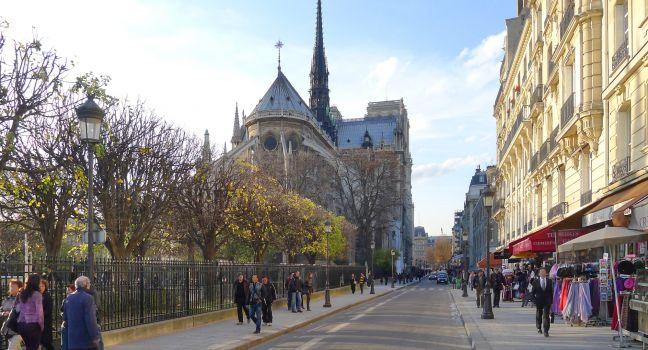
Hidden in the shadows of Notre-Dame is an evocative, often-overlooked tangle of medieval streets. Through the years lucky folks, including Ludwig Bemelmans (who created the beloved Madeleine books) and the Aga Khan, have called this area home, but back in the Middle Ages it was the domain of cathedral seminary students. One of them was the celebrated Peter Abélard (1079–1142)—philosopher, questioner of the faith, and renowned declaimer of love poems. Abélard boarded with Notre-Dame's clergyman, Fulbert, whose 17-year-old niece, Héloïse, was seduced by the compelling Abélard, 39 years her senior. She became pregnant, and the vengeful clergyman had Abélard castrated; amazingly, he survived and fled to a monastery, while Héloïse took refuge in a nunnery. The poetic, passionate letters between the two cemented their fame as thwarted lovers, and their story inspired a devoted following during the romantic 19th century. They still draw admirers to the Père-Lachaise Cemetery, where they're interred ensemble. The clergyman's house at 10 rue Chanoinesse was redone in 1849; a plaque at the back of the building at 9–11 quai aux Fleurs commemorates the lovers.
A short walk from the neighborhood's namesake St-Germain church, this lively crossroads (carrefour means "intersection") was once a notorious Rive Gauche landmark. During the French Revolution, the army enrolled its first volunteers here. It was also here that thousands of royalists and priests lost their heads during the 10-month wave of public executions known as the Reign of Terror. There's certainly nothing sinister about the area today, though: popular outdoor cafés brim with tourists and locals alike, and colorful coffee-table books are sold alongside take-out ice cream and other gourmet treats. Devotees of the superb, traditional bakery Carton ( 6 rue de Buci) line up for fresh breads and pastries (try the pain aux raisins, tuiles cookies, and tarte au citron).
It's a shame you can't go inside this house, which is considered the city's first Art Nouveau structure. Dreamed up in 1898 by Hector Guimard, the wild combination of materials and the grimacing grillwork led neighbors to call it Castle Dérangé (Deranged). Yet the project catapulted the 27-year-old Guimard into the public eye, leading to his famous métro commission. After ogling the sea-inspired front entrance, go partway down the alley to admire the inventive treatment of the traditional Parisian courtyard, complete with a melting water fountain. A few blocks up the road at No. 60 is the Hotel Mezzara, designed by Guimard in 1911 for textile designer Paul Mezzara. You can trace Guimard's evolution by walking to the subtler Agar complex at the end of the block. Tucked beside the stone entrance at the corner of Rue Jean de la Fontaine and Rue Gros is a tiny café-bar with an Art Nouveau glass front and furnishings.
Tastings and tours at the renowned Château Latour are typically free, but very selective—you have to be a serious taster, accompanied by a guide or professional in the wine trade, and you will be expected to make a purchase. Reservations are also required, and these must sometimes be made a month in advance.
Like an 18th-century engraving come to life, this charming street arcade is a remnant of ancien Paris, with its uneven cobblestones, antique roofs, and old-world facades. Famed for its rabble-rousing inhabitants—journalist Jean-Paul Marat ran the Revolutionary newspaper L'Ami du Peuple at No. 8, and the agitator Georges Danton lived at No. 20—it is also home to Le Procope, Paris's oldest restaurant (which may seem like a tourist trap, but the food and service are very good). The passageway contains a turret from the 12th-century wall of Philippe-Auguste.
Founded in 1060 by William the Conqueror's wife, Matilda, the Abbaye aux Dames was rebuilt in the 18th century; it then served as a hospital and nursing home before being fully restored in the 1980s by the Regional Council of Lower Normandy, which promptly requisitioned it for office space. The abbey’s elegant arcaded courtyard and ground-floor reception rooms can, however, still be admired during free guided tours. You can also visit the squat Église de la Trinité (Trinity Church), a fine example of 11th-century Romanesque architecture, though its original spires were replaced by timid balustrades in the early 18th century. Note the intricate carvings on columns and arches in the chapel; the 11th-century crypt; and, in the choir, the marble slab commemorating Queen Matilda, who was buried here in 1083.
Possibly founded by Charlemagne in the 8th century, Abbaye Bénédictine has none of its original buildings left, but its bell tower has been hanging on since the 11th century (the secret of its success is that it's attached to the cliff rather than the abbey, and thus it withstood waves of invaders). Fifth-century hermits carved out much of the abbey, and some rooms have astonishing 16th-century sculpted reliefs of the Last Judgment. Also here is a small museum devoted to the 19th-century painter Fernand-Desmoulin. At night the abbey is romantically floodlighted.
Robert de Molesmes founded the austere Cistercian order at this abbey near Clos de Vougeot in 1098, and the complex has housed monks ever since. Destroyed and rebuilt over the centuries, it is, understandably, a mix of styles and epochs: 13th-century cloisters, a 16th-century library, and a large, imposing 18th-century main building form an eclectic ensemble. From D996, follow signs pointing the way along a short country road that breaks off from the road to Château de Gilly, a four-star hotel. Call ahead for a guided tour.
The ancient cod-fishing port of Fécamp was once a major pilgrimage site, and this magnificent abbey church bears witness to its religious past. Founded by the duke of Normandy in the 11th century, the Benedictine abbey became the home of the monastic order of the Précieux Sang de la Trinité (Precious Blood of the Trinity—referring to Christ's blood, which supposedly arrived here in the 7th century in a reliquary from the Holy Land).
North of Place des Cordeliers is the former Abbaye de St-Germain, which stands parallel to the cathedral some 300 yards away. The church's earliest aboveground section is the 12th-century Romanesque bell tower, but the extensive underground crypt was inaugurated by Charles the Bald in 859 and contains its original Carolingian frescoes and Ionic capitals. It's the only monument of its kind in Europe—a layout retaining the plan of the long-gone church built above it—and was a place of pilgrimage until Huguenots burned the remains of its namesake, a Gallo-Roman governor and bishop of Auxerre, in the 16th century.
One of the gems of the Pyrénées, this medieval abbey's sturdy, crenellated bell tower is visible from afar. The remains of its cloisters are divine in every sense of the word—if they seem familiar, it may be because you’ve seen the missing pieces in New York City's Cloisters museum. The 10th-century pre-Romanesque church (France’s largest) has superb acoustics that make it an unforgettable concert venue.
Don't miss the formal Italianate gardens of Fort St-André, littered with remains of the abbey that preceded the fortifications. The gardens are now privately owned.
Next to the imposing neoclassical City Hall, this stupendous example of high Gothic architecture is noted for its stained glass windows, dating from the 14th to 16th centuries. They are the most spectacular grace notes of the spare interior, along with the 19th-century pipe organ, and are among the finest in France.
Founded in the 4th century by St-Cassien, who sailed into Marseille full of fresh ideas on monasticism that he acquired in Palestine and Egypt, this church grew to formidable proportions. With a Romanesque design, the structure would be as much at home in the Middle East as its founder was. The crypt, St-Cassien's original, is preserved beneath the medieval church, and in the evocative nooks and crannies you can find the 5th-century sarcophagus that allegedly holds the martyr's remains. Upstairs, a reliquary contains what's left of St-Victor, who was ground to death between millstones, probably by Romans. There's also a passage into tiny catacombs where early Christians worshipped St-Lazarus and Mary Magdalene, said to have washed ashore at Stes-Maries-de-la-Mer, in the Camargue.