46 Best Sights in France

Background Illustration for Sights

We've compiled the best of the best in France - browse our top choices for the top things to see or do during your stay.

Villa Kerylos

Fodor's Choice
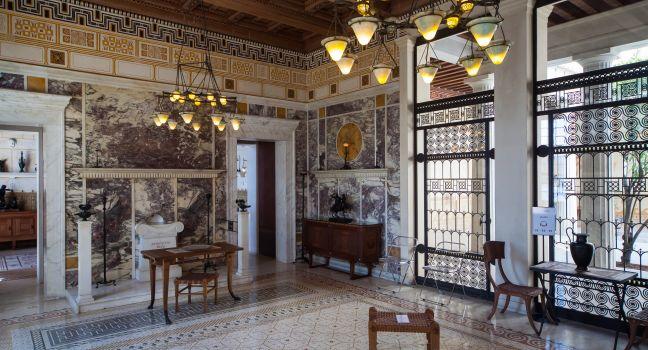
BEAULIEU SUR MER – FRANCE - APRIL 24 : Villa Kerylos in Beaulieu-sur-Mer is a Greek-style property built in the early 1900s by French archaeologist Theodore Reinach, and his wife Fanny Kann, a daughter of Maximilien Kann and Betty Ephrussi, of the E
(c) Photogolfer | Dreamstime.com

One manifestation of Beaulieu's Belle Époque excess is this eye-popping 1902 mansion built in the style of classical Greece (to be exact, of the villas that existed on the island of Delos in the 2nd century BC). It was the dream house of amateur archaeologist Théodore Reinach, who hailed from a wealthy German family, helped the French in their excavations at Delphi, and became an authority on ancient Greek music. He commissioned an Italian architect from Nice, Emmanuel Pontremoli, to surround him with cool Carrara marble, rare fruitwoods, and a dining salon where guests reclined to eat à la grecque. It's one of the most unusual houses in the south of France.

Atelier Cézanne

Fodor's Choice

Just north of the Vieille Ville (Old Town) loop you'll find Cézanne's studio. After the death of his mother forced the sale of the painter's beloved country retreat, Jas de Bouffan, he had this atelier built and some of his finest works, including Les Grandes Baigneuses (The Large Bathers), were created in the upstairs workspace. But what is most striking is the collection of simple objects that once featured prominently in his portraits and still lifes—redingote, bowler hat, ginger jar—all displayed as if awaiting his return. The atelier is behind an obscure garden gate on the left as you climb Avenue Paul-Cézanne.

9 av. Paul-Cézanne, Aix-en-Provence, 13100, France
04–42–16–16–61
Sight Details
€8
Closed Jan., Sun. and Mon. in Feb., and Sun. in Dec.

Something incorrect in this review?

Fondation Le Corbusier

Western Paris Fodor's Choice

Maison La Roche is a must-see for architecture and design lovers. Built as a residence in 1923, it’s a stellar example of Swiss architect Le Corbusier's innovative construction techniques based on geometric forms, recherché color schemes, and a visionary use of iron and concrete. The sloping ramp that replaces the traditional staircase is one of the most eye-catching features. Hour-long English tours are available (four-person minimum) by advance booking.

8–10 sq. du Docteur Blanche, Paris, 75016, France
01–42–88–75–72-Maison La Roche
Sight Details
Maison La Roche: €10, €15 for guided tour; Le Corbusier's studio-apartment: €10, €15 for guided tour
Closed Sun. and Mon.

Something incorrect in this review?

Recommended Fodor's Video

Hôtel Groslot

Fodor's Choice

Just across the square from the cathedral is the Hôtel Groslot, a Renaissance-era extravaganza bristling with caryatids, strap work, and Flemish columns. Inside are regal salons redolent of the city's history (this used to be the Town Hall); they're done up in the most sumptuous 19th-century Gothic Troubadour style and perhaps haunted by King François II, who died here in 1560 by the side of his bride, Mary, Queen of Scots.

Pl. de l'Étape, Orléans, 45000, France
02–38–79–22–30
Sight Details
Free
Closed Sat. and Oct.–Apr.

Something incorrect in this review?

Musée Dior

Fodor's Choice

If you've ever imagined your home strewn with haute-couture creations, this place will, perhaps, give you a clearer picture. Christian Dior's childhood abode is now a museum dedicated to the fashion designer; the house would prove to be a source of inspiration throughout his career, as he recalled "the nostalgia of stormy nights, of the foghorn, of the Norman drizzle." A number of his garments are on display, and special exhibitions focus on themes like Dior creations worn by movie stars on- and off-screen. The beautiful "artist's" garden, created by Dior's mother Madeleine, overlooks the sea.

Musée Nissim de Camondo

Grands Boulevards Fodor's Choice

The story of the Camondo family is steeped in tragedy, but you'd never know it by the interiors of this superb museum, as beautiful as the day patriarch Moïse de Camondo last closed its sculpted doors. Born in Istanbul to a successful Jewish banking family, Camondo built his showpiece mansion in 1911 in the style of the Petit Trianon at Versailles and stocked it with some of the most exquisite furniture, wainscoting, artworks, and bibelots of the mid- to late 18th century. Despite his vast wealth and purported charm, his wife left him five years into their marriage. Then his son, Nissim, was killed in World War I. Upon Moïse's death in 1935, the house and its contents were left to the state as a museum named for his lost son. A few years after Moïse's death, daughter Béatrice, her husband, and two children were deported from France and murdered at Auschwitz. No heirs remained, and the Camondo name died out. Today, the house is an impeccable tribute to Moïse's largesse and his passion for French decorative arts. Besides the mansion's grand spaces, such as various living rooms, a visit includes some of the family's private apartments, the kitchen, scullery, and the servants' dining room. There's also a chic contemporary café with a lovely terrace in the adjoining former garage.  Please note that the museum closed for renovations in August 2024 and is scheduled to reopen in February 2026.

Pavillon de Vendôme

Fodor's Choice

This extravagant Baroque villa was built in 1665 as a country house for the duke of Vendôme. Its position just outside the city's inner circle allowed the duke to commute discreetly from his official home on Cours Mirabeau to this retreat, where his mistress, La Belle du Canet, was comfortably installed. The villa was expanded and heightened in the 18th century to draw attention to the classical orders—Ionic, Doric, and Corinthian—on parade in the row of neo-Grecian columns. Inside the cool, broad chambers you can find a collection of Provençal furniture and artwork. Note the two curious, giant Atlantes that hold up the interior balcony.

Villa Eilenroc

Fodor's Choice

Le Sentier du Littoral passes along the beach at the Villa Eilenroc (designed by Charles Garnier, who created the Paris Opéra), which commands the tip of the peninsula from a grand garden. The site has a café and an eco-museum, as well as a scented garden at the entrance to La Rosaerie (Rose Garden). You can also catch glimpses of the distant Château de la Cröe, another legendary villa. On Wednesdays, September through June, you can wander through the villa's reception salons. Highlights include the Winter Salon's 1,001 Nights ceiling mural painted by famed Art Deco designer Jean Dunand, display cases filled with memorabilia donated by Caroline Groult-Flaubert (Antibes resident and goddaughter of the great author), and a boudoir with boiseries (decorative wooden features) from the Marquis de Sévigné's Paris mansion. Note that the villa is sometimes closed for private events; check the Antibes tourist office's website before you visit.

Villa Ephrussi de Rothschild

Fodor's Choice

Between the port and the mainland, the floridly beautiful Villa Ephrussi de Rothschild attests to the wealth and worldly flair of the baroness who had it built. Constructed in 1905 in neo-Venetian style (its flamingo-pink facade was thought not to be in the best of taste by the local gentry), the house was baptized "Île-de-France" in homage to the Baroness Béatrice de Rothschild's favorite ocean liner. In keeping with that theme, her staff wore sailing costumes, and her ship travel kit is on display in her bedroom. Precious artworks, tapestries, and furniture adorn the salons—in typical Rothschildian fashion, each is given over to a different "époque." 

The grounds are landscaped with no fewer than nine gardens and topped off with a Temple of Diana. Spectacular fountain displays set to music spring up like a grand aquatic ballet. Be sure to allow yourself time to wander here, as this is one of the few places on the coast where you'll be allowed to experience the lavish pleasures characteristic of the Belle Époque Côte d'Azur. Tea and light lunches, served in a glassed-in porch overlooking the grounds and spectacular coastline, encourage you to linger.

Villa Majorelle

Quartier Art-Nouveau Fodor's Choice

Designed by Paris architect Henri Sauvage as a showcase for Art Nouveau, this stunning 1902 villa was built for furniture designer Louis Majorelle. Its sinuous metal supports seem to sneak up on the unsuspecting balcony like swaying cobras. The two grand windows are by Jacques Gruber: one lights the staircase (visible from the street), and the other is set in the dining room on the south side of the villa. Visitor numbers are limited (it's open to individual visits on afternoons only), so it's worth pre-booking online to explore the interior of the Majorelle's family villa, decorated with more than 100 pieces of sublime furniture, paintings, and ornaments—all mostly original.

Castel Béranger

Western Paris
Castel Beranger, Paris
MOSSOT [CC BY 1.0], via Wikimedia Commons

It's a shame you can't go inside this house, which is considered the city's first Art Nouveau structure. Dreamed up in 1898 by Hector Guimard, the wild combination of materials and the grimacing grillwork led neighbors to call it Castle Dérangé (Deranged). Yet the project catapulted the 27-year-old Guimard into the public eye, leading to his famous métro commission. After ogling the sea-inspired front entrance, go partway down the alley to admire the inventive treatment of the traditional Parisian courtyard, complete with a melting water fountain. A few blocks up the road at No. 60 is the Hotel Mezzara, designed by Guimard in 1911 for textile designer Paul Mezzara. You can trace Guimard's evolution by walking to the subtler Agar complex at the end of the block. Tucked beside the stone entrance at the corner of Rue Jean de la Fontaine and Rue Gros is a tiny café-bar with an Art Nouveau glass front and furnishings.

14 rue Jean de la Fontaine, Paris, 75016, France

Something incorrect in this review?

Bateau-Lavoir

Montmartre

The birthplace of Cubism isn't open to the public, but a display in the front window details this unimposing spot's rich history. Montmartre poet Max Jacob coined the name because the original structure here reminded him of the laundry boats that used to float in the Seine, and he joked that the warren of paint-splattered artists' studios needed a good hosing down (wishful thinking, because the building had only one water tap). It was in the Bateau-Lavoir that, early in the 20th century, Pablo Picasso, Georges Braque, and Juan Gris made their first bold stabs at Cubism, and Picasso painted the groundbreaking Les Demoiselles d'Avignon in 1906–07. The experimental works of the artists weren't met with open arms, even in liberal Montmartre. All but the facade was rebuilt after a fire in 1970. Like the original building, though, the current incarnation houses artists and their studios.

13 pl. Émile-Goudeau, Paris, 75018, France

Something incorrect in this review?

Château de Bazoches

The former home of Sébastien de Vauban is just outside Vézelay in the small town of Bazoches-du-Morvan. Built during the 12th century in the stolid form of a trapezium with four towers and a keep, it was bought by Vauban in 1675 with the money Louis XIV awarded him for devising the parallel trenches successfully used in the siege of Maastricht. He transformed Château de Bazoches into a fortress and created many of his military engineering designs here. Vauban is considered the "father of civil engineering," and his innovations influenced innumerable forts throughout France. His designs and furnishings of his day are on display.

Bazoches, 58190, France
03–86–22–10–22
Sight Details
€12
Closed late Nov.–early Feb.

Something incorrect in this review?

Château de Monte-Cristo

If you're fond of the swashbuckling novels of Alexandre Dumas, you’ll enjoy the Château de Monte-Cristo at Port-Marly on the southern fringe of St-Germain. Dumas built the château after the surging popularity of books like The Count of Monte Cristo made him rich in the 1840s. Construction costs and lavish partying meant he went broke just as quickly, and he skedaddled into a Belgian exile in 1849. You may find the fanciful exterior, where pilasters, cupolas, and stone carvings compete for attention, crosses the line from opulence to tastelessness, but—as in Dumas’s fiction—swagger, not subtlety, is what counts. Dumas’s mementos aside, the highlight of the interior is the luxurious Moorish Chamber, with spellbinding, interlacing plasterwork executed by Arab craftsmen (lent by the Bey of Tunis) and restored thanks to a donation from the late Moroccan king Hassan II.

1 av. du Président-Kennedy, St-Germain-en-Laye, 78100, France
01–39–16–49–49
Sight Details
€8
Closed Mon. Apr.--Oct., and Sat.--Mon. Nov.–Mar.

Something incorrect in this review?

Clos Lucé

If you want to see where "the 20th century was born"—as the curators here like to proclaim—head to the Clos Lucé, about 600 yards up Rue Victor-Hugo from the château. Leonardo da Vinci (1452–1519) spent the last four years of his life in this handsome Renaissance manor, tinkering away at inventions, amusing his patron, King François I, and gazing out over a garden that was planted in the most fashionable Italian manner. The garden was completely restored in 2008 to contain plants and trees found in his sketches, as well as a dozen full-size renderings of machines he designed. The Halle Interactive contains working models of some of Leonardo's extraordinary inventions, all built by IBM engineers using the artist's detailed notebooks (by this time Leonardo had put away his paint box because of arthritis). Mechanisms on display include three-speed gearboxes, a military tank, a clockwork car, and a flying machine complete with designs for parachutes. Originally called Cloux, the property was given to Anne of Brittany by Charles VIII, who built a chapel for her that is still here. Some of the house's furnishings are authentically 16th century—indeed, thanks to the artist's presence, Clos Lucé was one of the first places where the Italian Renaissance made inroads in France: Leonardo's Mona Lisa and Virgin of the Rocks, both of which once graced the walls here, were bought by the king, who then moved them to the Louvre. You can now see these and 15 other da Vinci masterpieces projected in full living color in the on-site immersive museum; it also features 3D re-creations of the master's unrealized plans for palaces and other constructions, video games, and a host of fun educational games for kids.

Hôtel Bullioud

Vieux Lyon

This superb Renaissance mansion, close to the Hôtel Paterin, is noted for its courtyard, with an ingenious gallery built in 1536 by Philibert Delorme, one of France's earliest and most accomplished exponents of classical architecture. Delorme also worked on several spectacular châteaux in central France, including those at Fontainebleau and Chenonceaux.

8 rue Juiverie, Lyon, 69005, France
Sight Details
Free

Something incorrect in this review?

Hôtel d'Arnaud Brucelles

One of the tallest and best of Toulouse's 49 towers can be seen at this privately owned 16th-century mansion.

19 rue des Changes, Toulouse, 31000, France

Something incorrect in this review?

Hôtel d'Astorg et St-Germain

This 16th-century mansion is notable for its lovely Romanesque wooden stairways and galleries and for its top-floor mirande, or wooden balcony.

16 rue des Changes, Toulouse, 31000, France

Something incorrect in this review?

Hôtel d'Escoville

A good place to begin exploring Caen is the Hôtel d'Escoville, a stately mansion in the city center built by wealthy merchant Nicolas Le Valois d'Escoville in the 1530s. The building was badly damaged during the war but has since been restored; the austere facade conceals an elaborate inner courtyard, reflecting the Italian influence on early Renaissance Norman architecture (there's no access to the interiors). The on-site city tourist office is an excellent resource.

Hôtel de Bernuy

Now part of a school, this mansion, around the corner from the Ensemble Conventuel des Jacobins, was built for Jean de Bernuy in the 16th century, the period when Toulouse was at its most prosperous. De Bernuy made his fortune exporting woad, the dark-blue dye that brought unprecedented wealth to the city; his success is reflected in the use of stone (a costly material in this region of brick) and by the octagonal stair tower. You can visit this mansion on one of the many themed city tours (€13); the Toulouse L'Essentiel tour includes a stop here.

1 rue Gambetta, Toulouse, 31000, France

Something incorrect in this review?

Hôtel de Clary

One of the finest mansions on rue de la Dalbade is also known as the Hôtel de Pierre because of its unusually solid pierre (stone) construction, which was considered a sign of great wealth at the time. The ornately sculpted facade was designed by Nicolas Bachelier in the 16th century.

25 rue de la Dalbade, Toulouse, 31000, France

Something incorrect in this review?

Hôtel de Sade

Make your way to the Hôtel de Sade, a 15th- and 16th-century private manor now housing the treasures unearthed from the ruins of Glanum. The de Sade family built the house around remains of 4th-century baths and a 5th-century baptistery, now nestled in its courtyard.

Rue du Parage, St-Rémy-de-Provence, 1380, France
04–90–92–64–04
Sight Details
€5
Closed mid-Sept.–May

Something incorrect in this review?

Hôtel Delpech

Look for the 17th-century biblical inscriptions carved in Latin in the stone under the windows.

20 rue des Changes, Toulouse, 31000, France

Something incorrect in this review?

Hôtel du Vieux Raisin

Officially the Hôtel Beringuier Maynier, this building was dubbed the Vieux Raisin (Old Grape) after the early name of the street and even earlier inn. Built in the 15th and 16th centuries, the mansion has an octagonal tower, male and female figures on the facade, and allegorical sculptures of the three stages of life—infancy, maturity, and old age—over the windows to the left.

36 rue de Languedoc, Toulouse, 31000, France

Something incorrect in this review?

Jas de Bouffan

Cézanne's father bought this lovely property 1 km (½ mile) west of the center of town in 1859 to celebrate his rise from hatmaker to banker. The budding artist lived at the estate, whose name translates as "the sheepfold," until 1899 and painted his first images of Mont Sainte-Victoire—foundations of 20th-century art—from the grounds. Today the salons are empty, but the estate is full of the artist's spirit, especially the Allée des Marronniers out front.  The site is closed for renovations until 2026. Check with the central tourist office before visiting, as access has traditionally been via guided tours arranged through the office.

Le Vergeur Museum

One of the best examples of late medieval and early Renaissance architecture in Reims was built during the 13th century. Originally overlooking the historic linen-and-wheat market in the center of town, this noble town house changed hands between aristocrats and Champagne traders before being acquired in 1910 by Hugues Kraft—a man whose sole passion was preserving the city's historic buildings. It was completely restored after the WWI bombings and today houses an impressive collection of historical prints, paintings, and furnishings from the region, as well as an original, complete series of 15th-century Albrecht Dürer prints of the "Apocalypse" and "Large Passion." Guided tours, included in the ticket price, at are 10 am, 11 am, and every 30 minutes from 2 pm to 5 pm.

36 pl. du Forum, Reims, 51100, France
03–26–35–61–95
Sight Details
€5.50
Closed Mon.

Something incorrect in this review?

Maison de Balzac

Western Paris

The modest home of the great French 19th-century writer Honoré de Balzac (1799–1850) contains exhibits charting his tempestuous yet prolific career. Balzac penned nearly 100 novels and stories known collectively as The Human Comedy, many of them set in Paris. You can still feel his presence in his study and pay homage to his favorite coffeepot—his working hours were fueled by a tremendous consumption of the "black ink." He would escape his creditors by exiting the flat through a secret passage that led down to what is now the Musée du Vin.

47 rue Raynouard, Paris, 75016, France
01–55–74–41–80
Sight Details
Free; €9 during temporary exhibitions
Closed Mon.

Something incorrect in this review?

Maison de Jeanne d'Arc

During the 10-day Siege of Orléans in 1429, 17-year-old Joan of Arc stayed on the site of the Maison de Jeanne d'Arc. This faithful reconstruction of the house she knew contains exhibits about her life and costumes and weapons of her time. Several dioramas modeled by Lucien Harmey recount the main episodes in Joan's saintly saga, from the audience at Chinon to the coronation at Reims, her capture at Compiègne, and her burning at the stake at Rouen.

3 pl. du Général-de-Gaulle, Orléans, 45000, France
02–38–68–32–63
Sight Details
€6
Closed Mon.

Something incorrect in this review?

Maison de Van Gogh

Opposite the town hall, the Auberge Ravoux—where van Gogh lived and died—is now the Maison de Van Gogh. The inn opened in 1876 and owes its name to Arthur Ravoux, the landlord from 1889 to 1891. He had seven lodgers in all, who paid 3.50 francs for room and board (that was cheaper than the other inns in Auvers, where 6 francs was the going rate). A dingy staircase leads up to the tiny attic where van Gogh stored some of modern art's most iconic paintings under his bed. A short film retraces the artist's time at Auvers, and there's a well-stocked souvenir shop. Stop for a drink or lunch in the ground-floor restaurant.

52 rue du Général de Gaulle, Auvers-sur-Oise, 95430, France
01–30–36–60–60
Sight Details
€10
Closed Mon. and Tues.

Something incorrect in this review?

Maison de Victor Hugo

Marais Quarter

France's most famous scribe lived in this house on the southeast corner of Place des Vosges between 1832 and 1848. It's now a museum dedicated to the multitalented author. In Hugo's apartment on the second floor, you can see the tall desk, next to the short bed, where he began writing his masterwork Les Misérables (as always, standing up). There are manuscripts and early editions of the novel on display, as well as others such as Notre-Dame de Paris, known to English readers as The Hunchback of Notre-Dame. You can see illustrations of Hugo's writings, including Bayard's rendering of the impish Cosette holding her giant broom (which has graced countless Les Miz T-shirts). The collection includes many of Hugo's own, sometimes macabre, ink drawings (he was a fine artist), and furniture from several of his homes. Particularly impressive is the room of carved and painted Chinese-style wooden panels that Hugo designed for the house of his mistress, Juliette Drouet, on the island of Guernsey, when he was exiled there for agitating against Napoléon III. Try to spot the intertwined Vs and Js (hint: look for the angel's trumpet in the left corner). A recent restoration not only spiffed up the house but made the museum fully accessible to people with physical or mental disabilities and impaired sight or hearing, with improved touch screens and audioguides. It also added a lovely garden terrace and a café by Paris's famous pastry shop Maison Mulot.

6 pl. des Vosges, Paris, 75004, France
01–42–72–10–16
Sight Details
Free; from €6 for temporary exhibitions
Closed Mon.

Something incorrect in this review?