
18 Best Sights in France

Background Illustration for Sights

We've compiled the best of the best in France - browse our top choices for the top things to see or do during your stay.

Rue Montorgueil

Grands Boulevards Fodor's Choice
Shops, Rue Montorgueil, Paris, France
© Halie Cousineau/ Fodor’s Travel

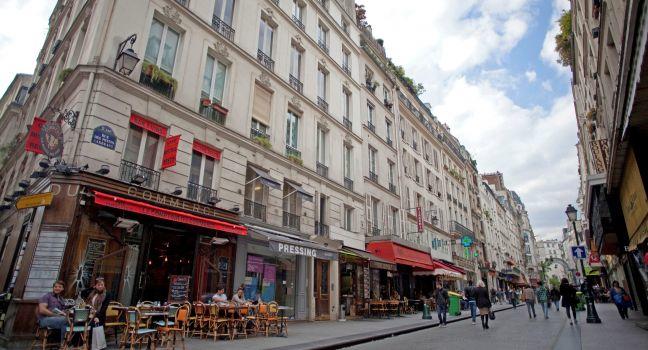
Rue Montorgueil was once the gritty oyster hub of Les Halles; now lined with food shops and cafés, the cobbled street—whose name translates to Mount Pride—is the heart of one of the city's most culinary neighborhoods. History runs deep here. Monet captured the scene in 1878, when Montorgueil was ablaze with tricolor flags during the World's Fair (see the painting in the Musée d'Orsay). Honoré de Balzac and his 19th-century band of scribes frequented Au Rocher de Cancale at No. 78, whose famously crumbling facade has been painstakingly restored with gilt panache. Stohrer at No. 51 has been baking elaborate pastries since 1730.

Indeed, it is pastries that reign over this small street these days, thanks to the arrivals of Fou de Pâtisseries at No. 45 and Jeffrey Cagnes at No. 73. The street extends onto Rue des Petits-Carreaux just before the Sentier métro, home to an outpost of excellent Breton crêperie Breizh Café at No. 14. Cross the boulevard to reach the diminutive Rue du Nil, a foodie haven home to Frenchie restaurant (No. 5) and wine bar (No. 6) as well as Terroirs d'Avenir's locavore shops and Plaq (No. 4), known for bean-to-bar chocolate. Even the area around Rue d'Aboukir, once far scruffier, is now a hipster fave thanks to the arrival of American-style baked goods like Boneshaker's doughnuts (No. 86) and Cookie Love's cookies (No. 84) as well as brunch spots Echo (No. 95) and Maafim (5 rue de Forges).
Rue Montorgueil, off Rue de Turbigo, Paris, 75002, France
Sight Details
Many shops closed Mon.

Something incorrect in this review?

Carrefour de Buci

St-Germain-des-Prés
Carrefour de Buci
© Ross Brinkerhoff / Fodor’s Travel

A short walk from the neighborhood's namesake St-Germain church, this lively crossroads (carrefour means "intersection") was once a notorious Rive Gauche landmark. During the French Revolution, the army enrolled its first volunteers here. It was also here that thousands of royalists and priests lost their heads during the 10-month wave of public executions known as the Reign of Terror. There's certainly nothing sinister about the area today, though: popular outdoor cafés brim with tourists and locals alike, and colorful coffee-table books are sold alongside take-out ice cream and other gourmet treats. Devotees of the superb, traditional bakery Carton ( 6 rue de Buci) line up for fresh breads and pastries (try the pain aux raisins, tuiles cookies, and tarte au citron).

Intersection of Rues Mazarine, Dauphine, and de Buci, Paris, France

Something incorrect in this review?

Cour du Commerce St-André

St-Germain-des-Prés
Cour du Commerce-Saint-Andre, Paris, france, Bistro, Restaurant
By Mbzt [CC-BY-3.0], via Wikimedia Commons

Like an 18th-century engraving come to life, this charming street arcade is a remnant of ancien Paris, with its uneven cobblestones, antique roofs, and old-world facades. Famed for its rabble-rousing inhabitants—journalist Jean-Paul Marat ran the Revolutionary newspaper L'Ami du Peuple at No. 8, and the agitator Georges Danton lived at No. 20—it is also home to Le Procope, Paris's oldest restaurant (which may seem like a tourist trap, but the food and service are very good). The passageway contains a turret from the 12th-century wall of Philippe-Auguste.

Linking Bd. St-Germain and Rue St-André-des-Arts, Paris, 75006, France

Something incorrect in this review?

Recommended Fodor's Video

Allée Sainte-Catherine

After touring the Abbaye Royale, head outside the gates of the complex a block to the north to discover one of the Loire Valley's most time-burnished streets, Allée Ste-Catherine. Bordered by the Fontevraud park, headed by a charming medieval church, and lined with a few scattered houses (which now contain the town tourist office, a gallery that sells medieval illuminated manuscript pages, and the lovely Licorne restaurant), this street still conjures up the 14th century.

Fontevraud-l'Abbaye, 49590, France

Something incorrect in this review?

Avenue de Paris

Not far from the palace, a breadth of 120 yards makes Avenue de Paris wider than the Champs-Élysées, and its buildings are just as grand and even more historic. The avenue leads down to Place d'Armes, a vast sloping plaza usually filled with tour buses. Facing the château are the Trojan-size royal stables. Recently added bike lanes along the length of the avenue allow for a scenic cycling tour that leads to the historic neighborhoods that flank Versailles: the Quartier St-Louis to the south (to the left when facing the château) and the Quartier Notre-Dame to the north (to the right when facing the château).

Av. de Paris, Versailles, 78000, France

Something incorrect in this review?

Avenue des Champs-Élysées

Champs-Élysées

Marcel Proust lovingly described the genteel elegance of the storied Champs-Élysées (pronounced chahnz-el-ee-zay, with an n sound instead of m, and no p) during its Belle Époque heyday, when its cobblestones resounded with the clatter of horses and carriages. Today, despite unrelenting traffic and the intrusion of chain stores and fast-food franchises, the avenue still sparkles. There's always something happening here: stores are open late (and many are open on Sunday, a rarity in Paris); nightclubs remain top destinations; and cafés offer prime people-watching, though you'll pay for the privilege. Ater all, this is Europe's most expensive piece of real estate. Along the 2-km (1¼-mile) stretch, you can find marquee names in French luxury, like Cartier, Guerlain, and Louis Vuitton. Car manufacturers lure international visitors with space-age showrooms. Old stalwarts, meanwhile, are still going strong—including the Lido cabaret and Fouquet's, whose celebrity clientele extends back to James Joyce. The avenue is also the setting for the last leg of the Tour de France bicycle race (the third or fourth Sunday in July), as well as Bastille Day (July 14) and Armistice Day (November 11) ceremonies. The Champs-Élysées, which translates to "Elysian Fields" (the resting place of the blessed in Greek mythology), began life as a cow pasture and in 1666 was transformed into a park by the royal landscape architect André Le Nôtre. Traces of its green origins are visible toward the Concorde, where elegant 19th-century park pavilions house the historic restaurants Ledoyen and Laurent. The celebrated avenue has undergone positive changes in recent years—including a widening of pedestrian walks and the addition of cycling lanes—with more improvements planned for the future.

Paris, France

Something incorrect in this review?

Avenue Foch

Quartier Art-Nouveau

This busy boulevard lined with mansions was laid out for Nancy's affluent 19th- and early-20th-century middle class. At No. 69, built in 1902 by Émile André, the occasional pinnacle suggests Gothic influence; André designed the neighboring No. 71 two years later. Number 41, built by Paul Charbonnier in 1905, bears ironwork by Louis Majorelle.

Nancy, 54000, France

Something incorrect in this review?

Beaupassage Grenelle

St-Germain-des-Prés

This chic and sleek courtyard is home to a Thierry Marx bakery, Pierre Hermé café, and the very popular Certified Coffee where you'll usually find hipsters working on their laptops. There's also a nice collection of restaurants, a wine bar, outdoor seating, and contemporary artwork. Enjoy a gourmet snack or meal and soak in the modern contrast to the 19th-century limestone buildings on the street that hides this quiet haven of gastronomy. Enter from  83 rue du Bac or  14 bd. Raspail, which features a 79-foot-long cardboard and wood forest by artist Eva Jospin.

14 bd. Raspail, Paris, 75007, France

Something incorrect in this review?

Boulevard des Pyrénées

There are splendid views of the peaks of the Pyrénées all the way along this promenade, just under a mile long, which extends from the Château to the Palais Beaumont. A free funicular, with its top station in the middle of the boulevard, connects the city center with the railroad station beneath.

Bd. des Pyrénées, Pau, 64000, France

Something incorrect in this review?

Cours Mirabeau

Shaded by a double row of tall plane trees, the Cours Mirabeau is one of the most beautiful avenues anywhere, designed so its width and length would be in perfect proportion with the height of the dignified 18th-century hôtels particuliers lining it. You can view this lovely assemblage from one of the dozen or so cafés that spill onto the pavement.

Aix-en-Provence, 13100, France

Something incorrect in this review?

La Canebière

La Canebière

This wide avenue leading from the port, known affectionately as the "Can o' Beer" by American sailors, once figured in popular songs and operettas and was once crammed with cafés, theaters, bars, and tempting stores full of zoot suits and swell hats. It's noisy but dull today, yet you might still take pleasure in studying its grand 19th-century mansions.

Marseille, France

Something incorrect in this review?

Rue d'Antibes

Two blocks behind La Croisette lies this attractive high-end shopping street. At its western end is Rue Meynadier, packed with trendy clothing boutiques and fine-food shops. Not far away is the covered Marché Forville, the scene of the animated morning food market. Rue Hoche, behind Rue d'Antibes and down from Galleries Lafayette, has lots of boutiques and cafés.

Cannes, 06400, France

Something incorrect in this review?

Rue de la Citadelle

Several sights of interest line Rue de la Citadelle, including the Maison Arcanzola (Arcanzola House) at No. 32 (1510), the Maison des Évêques (Bishops' House) at No. 39, and the famous Prison des Évêques (Bishops' Prison) next door to it. Continuing up you'll reach the Citadelle itself—a classic Vauban fortress built between 1625 and 1627, now occupied by a school. The views from the top, complete with maps identifying the surrounding heights and valleys, are panoramic.

Rue de la Citadelle, St-Jean-Pied-de-Port, 64220, France

Something incorrect in this review?

Rue des Consuls

The church of Ste-Marie points the way to Sarlat's most interesting street, Rue des Consuls. Among its medieval buildings are the Hôtel Plamon, with broad windows that resemble those of a Gothic church, and, opposite, the 15th-century Hôtel de Vassal.

Sarlat-la-Canéda, 24620, France

Something incorrect in this review?

Rue Longue-des-Capucins/Rue d'Aubagne

La Canebière

As you wander along these streets, you may feel you have been transported to a Moroccan souk (market). Shops that serve the needs of Marseille's large and vibrant North African community have open bins of olives, coffee beans, tea, spices, chickpeas, couscous, peppers, and salted sardines. Tiny shoebox cafés sell African sweets, and the daily Marché de Noailles in the surrounding maze of streets is the city's most vibrant and colorful market.

Marseille, 13001, France

Something incorrect in this review?

Rue Montaigne

Running the length of the Enfeus gardens is Rue Montaigne, where the great 16th-century philosopher Michel de Montaigne once lived. Some of the half-timber houses that line it cast a fairy-tale spell. Rue d'Albusse (adjoining the garden behind the cathedral) and Rue de la Salamandre are narrow, twisty streets that head to Place de la Liberté and the 18th-century Hôtel de Ville.

Sarlat-la-Canéda, 24620, France

Something incorrect in this review?

Rue Obscure

Running parallel to the waterfront, the extraordinary 14th-century Rue Obscure (Dark Street) is entirely covered by vaulted arcades; it sheltered the people of Villefranche when the Germans fired their parting shots—an artillery bombardment—near the end of World War II.

Villefranche-sur-Mer, 06230, France

Something incorrect in this review?

Rue St-Michel

Serving as the main commercial artery of the Vieille Ville, Rue St-Michel is lined with shops, cafés, and orange trees.

Menton, 06520, France

Something incorrect in this review?