


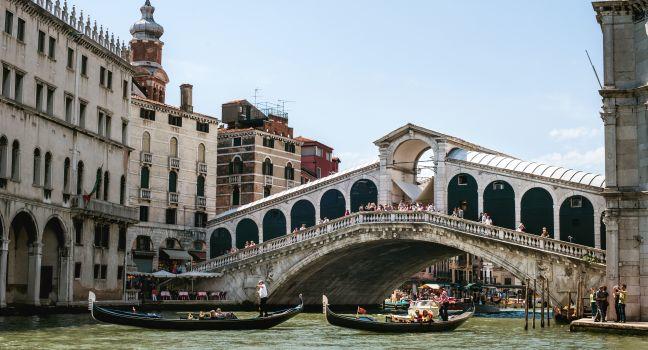
Ponte di Rialto
Get FREE email communications from Fodor's Travel, covering must-see travel destinations, expert trip planning advice, and travel inspiration to fuel your passion.

It's called La Serenissima, "the most serene," a reference to the majesty, wisdom, and impressive power of this city that was for centuries the leader in trade between Europe and the Orient, and a major source of European culture. Built on and around a cluster of tiny islands in a lagoon by a people who saw the sea as a defense and ally, Venice is unlike any other city.
No matter how often you've seen Venice in photos and films, the city is more dreamlike than you could ever imagine. The key landmarks, the Basilica di San Marco and the Palazzo Ducale, are hardly what we normally think of as Italian: fascinatingly idiosyncratic, they are exotic mixes of Byzantine, Romanesque, Gothic, and Renaissance styles. Shimmering sunlight and silvery mist soften every perspective here; it’s easy to understand how the city became renowned in the Renaissance for its artists' use of color. The city is full of secrets, inexpressibly romantic, and, in both art and everyday life, given over to an unabashed celebration of the material world.
You'll see Venetians going about their daily affairs in vaporetti (water buses), aboard the traghetti (gondola ferries) that carry them across the Grand Canal, in the campi (squares), and along the calli (narrow streets). They are skilled—and remarkably tolerant—in dealing with the hordes of tourists from all over the world, attracted by the city's fame and splendor.
Venice proper is divided into six sestieri, or districts (the word sestiere means, appropriately, "sixth"): Cannaregio, Castello, Dorsoduro, San Marco, San Polo, and Santa Croce. More-sedate outer islands float around them—San Giorgio Maggiore and the Giudecca just to the south, beyond them the Lido, the barrier island; to the north, Murano, Burano, and Torcello.
This compact yet informative museum displays glass items dating from the 3rd century to today. You’ll learn all about techniques introduced through the ages (many of which are still in use), including 15th-century gold-leaf decoration, 16th-century filigree work that incorporated thin bands of white or colored glass into the crystal, and the 18th-century origins of Murano's iconic chandeliers. A visit here will help you to understand the provenance of the glass you’ll see for sale—and may be tempted to buy—in shops around the island.
Facing the basilica, on your left, the long, arcaded building is the Procuratie Vecchie, renovated to its present form in 1514 as offices and residences for the powerful procurators, or magistrates.
On your right is the Procuratie Nuove, built half a century later in a more imposing, classical style. It was originally planned by Venice's great Renaissance architect Jacopo Sansovino (1486–1570), to carry on the look of his Libreria Sansoviniana (Sansovinian Library), but he died before construction on the Nuove had begun. Vincenzo Scamozzi (circa 1552–1616), a pupil of Andrea Palladio (1508–80), completed the design and construction. Still later, the Procuratie Nuove was modified by architect Baldassare Longhena (1598–1682), one of Venice's Baroque masters.
When Napoléon (1769–1821) entered Venice with his troops in 1797, he expressed his admiration for the piazza and promptly gave orders to alter it. His architects demolished a church with a Sansovino facade in order to build the Ala Napoleonica (Napoleonic Wing), or Fabbrica Nuova (New Building), which linked the two 16th-century procuratie and effectively enclosed the piazza.
Piazzetta San Marco is the "little square" leading from Piazza San Marco to the waters of Bacino San Marco (St. Mark's Basin); its molo (landing) once served as the grand entrance to the Republic. Two imposing columns tower above the waterfront. One is topped by the winged lion, a traditional emblem of St. Mark that became the symbol of Venice itself; the other supports St. Theodore, the city's first patron, along with his dragon. (A third column fell off its barge and ended up in the bacino before it could be placed alongside the others.) Although the columns are a glorious vision today, the Republic traditionally executed convicts here—and some superstitious Venetians still avoid walking between them.

The impressive boat collection here includes scale models, such as the doges' ceremonial Bucintoro, and full-size boats, such as Peggy Guggenheim's private gondola complete with romantic felze (cabin). There's a range of old galley and military pieces, a section dedicated to Admiral Morosini (who plundered the Arsenale's Porta Magna lions nearby), and a large collection of seashells. A visit to the Paglione delle Nave, a part of the museum, allows you to see a portion of the interior of the Arsenale otherwise closed to visitors.
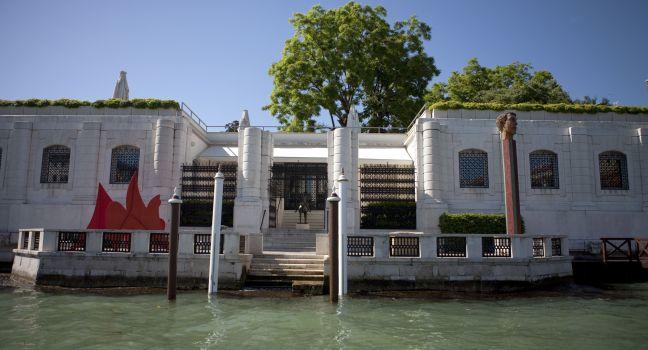
Housed in the incomplete but nevertheless charming Palazzo Venier dei Leoni, this choice selection of 20th-century painting and sculpture represents the taste and extraordinary style of the late heiress Peggy Guggenheim. Through wealth, social connections, and a sharp eye for artistic trends, Guggenheim (1898–1979) became an important art dealer and collector from the 1930s through the 1950s, and her personal collection here includes works by Picasso, Kandinsky, Pollock, Motherwell, and Ernst (her onetime husband). The museum serves beverages, snacks, and light meals in its refreshingly shady and artistically sophisticated garden.

This enameled clock, completed in 1499, was most likely designed by Venetian Renaissance architect Mauro Codussi. Twin giant figures with tarnished bronze bodies strike the hour each day, while three wise men with an angel walk out and bow to the Virgin Mary on Epiphany (January 6) and during Ascension Week (40 days after Easter). An inscription on the tower reads "Horas non numero nisi serenas" ("I only count happy hours"). Originally, the clock tower had a much lighter, more graceful appearance, and was freestanding. The four lateral bays were added in the early 16th century, while the upper stories and balustrades were completed in 1755. The clock itself was neglected until the 19th century, but after years of painstaking labor, it was reassembled and is fully operational. Guided tours, which start at the Museo Correr's ticket office, are held in English numerous times a week (for adults and children age six and older); book in advance online or by phone.
Located just across the Grand Canal between Piazzale Roma and the train station, this lush oasis was created in the 1830s by demolishing the former monastery of Santa Croce. A tranquil place to sit in the shade, the gardens feature flowers, large, leafy trees, and a small playground for children. Pause to admire the marble statue of civil engineer Pietro Paleòcapa; not a Venetian, but one of the great 19th-century hydraulic engineers modifying rivers and swamps in Italy and Europe. He served in Venice as Director of Public Works and crowned his career by collaborating with Luigi Negrelli in the planning of the Suez Canal.
Most hotels on the Lido have access to charming beach clubs with cabanas, striped umbrellas, and chaise longues—all of which are often available for nonguests to use for a fee. On either end of the long barrier island, the public beaches offer a more rustic but still delightful setting for nature lovers to dig their toes in the sand. Amenities: food and drink; lifeguards; showers; toilets. Best for: swimming; walking.
Home to the Burano Lace School from 1872 to 1970, the palace of Podestà of Torcello now houses a museum dedicated to the craft for which this island is known. Detailed explanations of the manufacturing process and Burano's distinctive history as a lace-making capital provide insight into displays that showcase everything from black Venetian Carnival capes to fingerless, elbow-length “mitten gloves” fashionable in 17th-century France. Portraits of Venice’s aristocracy as well as embroidered silk and brocade gowns with lace embellishments provide greater societal context on the historical use of lace in European fashion. You can also watch interesting lace-making demonstrations.
San Trovaso is one of only four squeri, or boatbuilding yards specifically dedicated to gondolas and other Venetian wooden boats, still operating in Venice. (There once were at least 45.) Dating from the 17th century, it is a registered monument where you can really observe and appreciate a unique mode of transportation that still thrives today. If the small wooden buildings seem to resemble an Alpine chalet, it's because Venice's boatbuilders historically came from the nearby mountains. Notice the wooden planks stacked outside to season (a gondola is made of eight different types of wood). Half-hour visits can be booked.


