


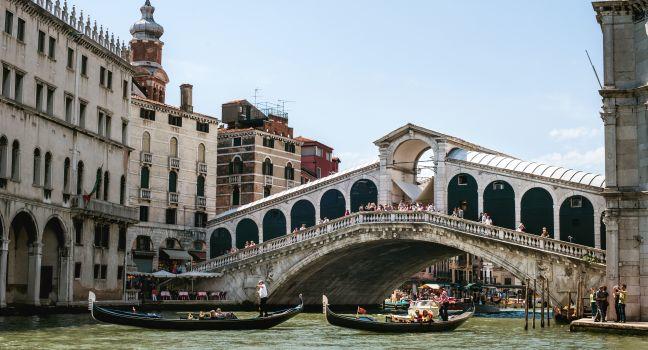
Ponte di Rialto
Get FREE email communications from Fodor's Travel, covering must-see travel destinations, expert trip planning advice, and travel inspiration to fuel your passion.

It's called La Serenissima, "the most serene," a reference to the majesty, wisdom, and impressive power of this city that was for centuries the leader in trade between Europe and the Orient, and a major source of European culture. Built on and around a cluster of tiny islands in a lagoon by a people who saw the sea as a defense and ally, Venice is unlike any other city.
No matter how often you've seen Venice in photos and films, the city is more dreamlike than you could ever imagine. The key landmarks, the Basilica di San Marco and the Palazzo Ducale, are hardly what we normally think of as Italian: fascinatingly idiosyncratic, they are exotic mixes of Byzantine, Romanesque, Gothic, and Renaissance styles. Shimmering sunlight and silvery mist soften every perspective here; it’s easy to understand how the city became renowned in the Renaissance for its artists' use of color. The city is full of secrets, inexpressibly romantic, and, in both art and everyday life, given over to an unabashed celebration of the material world.
You'll see Venetians going about their daily affairs in vaporetti (water buses), aboard the traghetti (gondola ferries) that carry them across the Grand Canal, in the campi (squares), and along the calli (narrow streets). They are skilled—and remarkably tolerant—in dealing with the hordes of tourists from all over the world, attracted by the city's fame and splendor.
Venice proper is divided into six sestieri, or districts (the word sestiere means, appropriately, "sixth"): Cannaregio, Castello, Dorsoduro, San Marco, San Polo, and Santa Croce. More-sedate outer islands float around them—San Giorgio Maggiore and the Giudecca just to the south, beyond them the Lido, the barrier island; to the north, Murano, Burano, and Torcello.
Commonly referred to as the "Calatrava Bridge" after its designer, Santiago Calatrava, this swooping modern arch crossing the Grand Canal connects Piazzale Roma to the train station. Opinions have differed wildly on its aesthetic ever since its inauguration in 2008, but no one can deny its long-overdue usefulness—as many as 5,000 people a day cross it when arriving, departing, or daily commuting. It has become notorious for its structural flaws, most notably slippery steps made of Murano glass that—it is said—are eventually going to be replaced by concrete. Whatever your thoughts on its beauty, the views from its graceful summit are always engaging.


