9 Best Sights in Venice, Italy

Background Illustration for Sights

It's called La Serenissima, "the most serene," a reference to the majesty, wisdom, and impressive power of this city that was for centuries the leader in trade between Europe and the Orient, and a major source of European culture. Built on and around a cluster of tiny islands in a lagoon by a people who saw the sea as a defense and ally, Venice is unlike any other city.

No matter how often you've seen Venice in photos and films, the city is more dreamlike than you could ever imagine. The key landmarks, the Basilica di San Marco and the Palazzo Ducale, are hardly what we normally think of as Italian: fascinatingly idiosyncratic, they are exotic mixes of Byzantine, Romanesque, Gothic, and Renaissance styles. Shimmering sunlight and silvery mist soften every perspective here; it’s easy to understand how the city became renowned in the Renaissance for its artists' use of color. The city is full of secrets, inexpressibly romantic, and, in both art and everyday life, given over to an unabashed celebration of the material world.

You'll see Venetians going about their daily affairs in vaporetti (water buses), aboard the traghetti (gondola ferries) that carry them across the Grand Canal, in the campi (squares), and along the calli (narrow streets). They are skilled—and remarkably tolerant—in dealing with the hordes of tourists from all over the world, attracted by the city's fame and splendor.

Venice proper is divided into six sestieri, or districts (the word sestiere means, appropriately, "sixth"): Cannaregio, Castello, Dorsoduro, San Marco, San Polo, and Santa Croce. More-sedate outer islands float around them—San Giorgio Maggiore and the Giudecca just to the south, beyond them the Lido, the barrier island; to the north, Murano, Burano, and Torcello.

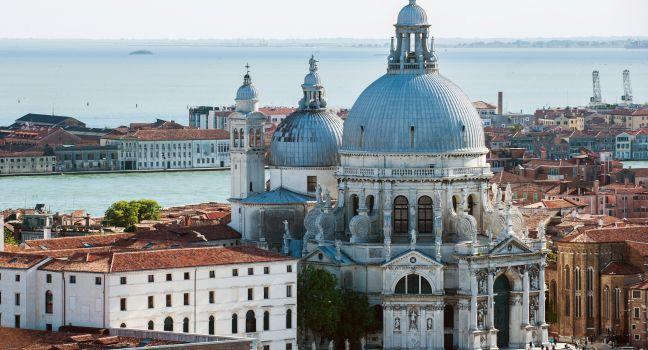
Santa Maria della Salute
Dorsoduro Fodor's Choice
Santa Maria della Salute; Dorsoduro, Venice, Italy.
© Ross Brinkerhoff / Fodors Travel

The most iconic landmark of the Grand Canal, "La Salute" (as this church is commonly called) is most unforgettably viewed from the Riva degli Schiavoni at sunset, or from the Accademia Bridge by moonlight. En route to becoming Venice's most important baroque architect, 32-year-old Baldassare Longhena won a competition in 1631 to design a shrine honoring the Virgin Mary for saving Venice from a plague that in the space of two years (1629–31) killed 47,000 residents, or one-third of the city's population, including the doge. It was not completed, however, until 1687—five years after Longhena's death.

Outside, this ornate white Istrian stone octagon is topped by a colossal cupola with snail-like ornamental buttresses—in truth, piers encircled by finely carved "ropes," an allusion to the sail-making industry of the city (or so say today's art historians). Inside, a white-and-gray color scheme is complemented by a polychrome marble floor and the six chapels. The Byzantine icon above the main altar has been venerated as the Madonna della Salute (Madonna of Health) since 1670, when Francesco Morosini brought it here from Crete. Above it is a dramatic marble sculpture by Giusto Le Court showing Venice on her knees before the Madonna as she implores aid and a cherub drives the plague from the city.

Do not leave the church without visiting the Sacrestia Maggiore, which contains a dozen works by Titian, including his San Marco Enthroned with Saints altarpiece. You'll also see Tintoretto's Wedding at Cana. For the Festa della Salute, held November 21, a votive bridge is constructed across the Grand Canal from Campo Santa Maria del Giglio to San Gregorio, and Venetians make a pilgrimage here to light candles in prayer for another year's health. Check the website for information on guided tours.

Punta della Dogana, Venice, 30123, Italy
041-2743928
Sight Details
Church free, sacristy €6, sacristy and art gallery €10, balustrade of the prophets €5, dome €8

Something incorrect in this review?

Cimitero di San Michele (San Michele Cemetery)

Fodor's Choice

It's no surprise that serenity prevails on San Michele in Venice’s northern lagoon. The city's island cemetery is surrounded by ocher brick walls and laced with cypress-lined pathways amid plots filled with thousands of graves; there's also a modern extension completed by British architect David Chipperfield in 2017. Among those who have made this distinctive island their final resting place are such international arts and science luminaries as Igor Stravinsky, Sergei Diaghilev, Ezra Pound, and the Austrian mathematician Christian Doppler (of the Doppler effect). You're welcome to explore the grounds if you dress respectfully and adhere to a solemn code of conduct. Photography and picnicking are not permitted.

Campo Santa Margherita

Dorsoduro

Lined with cafés and restaurants generally filled with students from the two nearby universities, Campo Santa Margherita also has produce vendors and benches where you can sit and take in the bustling local life of the campo. Also close to Ca' Rezzonico and the Scuola Grande dei Carmini, and only a 10-minute walk from the Gallerie dell'Accademia, the square is the center of Dorsoduro social life. It takes its name from the church to one side, closed since the early 19th century and now used as an auditorium. On weekend evenings, especially in the summer, it attracts hordes of students, even from the mainland.

Campo Santa Margherita, Venice, Italy

Something incorrect in this review?

Recommended Fodor's Video

Constitution Bridge

Commonly referred to as the "Calatrava Bridge" after its designer, Santiago Calatrava, this swooping modern arch crossing the Grand Canal connects Piazzale Roma to the train station. Opinions have differed wildly on its aesthetic ever since its inauguration in 2008, but no one can deny its long-overdue usefulness—as many as 5,000 people a day cross it when arriving, departing, or daily commuting. It has become notorious for its structural flaws, most notably slippery steps made of Murano glass that—it is said—are eventually going to be replaced by concrete. Whatever your thoughts on its beauty, the views from its graceful summit are always engaging.

Ponte della Costituzione, 30135, Italy

Something incorrect in this review?

Fondamenta delle Zattere

This broad, bustling waterfront promenade is one of Venice's prime stretches for strolling; thanks to its southern orientation along the Giudecca Canal, it is full of families, students, children, and dogs whenever there is the slightest ray of sunshine. Come in spring or winter to warm up a little, or in the summer to cool off under café umbrellas with drinks or gelato. Restaurant terraces over the water lure diners until late. The name Zattere means "rafts," and this was the area designated by the Venetian government for storing the vast platforms of tree trunks that were floated down rivers from the nearby Alps destined to become pilings, beams, ships, or any other item made of wood.

Giardini Papadopoli

Located just across the Grand Canal between Piazzale Roma and the train station, this lush oasis was created in the 1830s by demolishing the former monastery of Santa Croce. A tranquil place to sit in the shade, the gardens feature flowers, large, leafy trees, and a small playground for children. Pause to admire the marble statue of civil engineer Pietro Paleòcapa; not a Venetian, but one of the great 19th-century hydraulic engineers modifying rivers and swamps in Italy and Europe. He served in Venice as Director of Public Works and crowned his career by collaborating with Luigi Negrelli in the planning of the Suez Canal.

30135 Sestriere Santa Croce, Italy
041-2748111

Something incorrect in this review?

San Nicolò dei Mendicoli

San Nicolò is one of the oldest churches in Venice (7th century), though the present building dates from 1300, and the covered porch was added in the 15th century. It was dedicated to the patron saint of sailors and fishermen. "Mendicoli" might refer to its earliest neighbors ("mendici," or beggars), or to "mendigola," the original name of the little island on which it stands. Under the Venetian Republic, the inhabitants of this area were categorically called "Nicolotti" (those from the easternmost part of Venice were "Castellani") and granted many special privileges by the doge. They elected their own "doge" in this church, and he was allowed, among other things, to follow directly behind the doge's barge on the Feast of the Ascension.

The church interior always seems a little dark, despite an unusual amount of gold leaf, not only on the picture frames but under the arches of the stone columns. You'll notice the classic three-nave Roman basilica design, and that the walls are covered with paintings, many by artists of the school of Veronese. The round painting by Francesco Montemezzano of St. Nicholas in Glory in the center of the ceiling may well be one of the most chaotic scenes of its type ever created. The imposing gilt wooden statue of St. Nicholas in the niche above the high altar is from the mid-15th century. Parts of the classic horror film Don't Look Now (1973) were filmed here.

Dorsoduro 1907, 30123, Italy
041-2750382
Sight Details
Closed Sun. afternoon

Something incorrect in this review?

Scoletta dei Calegheri

The "little scuola" of the shoemakers—also known as the Scoletta of Sant' Aniano—conducted its affairs in its headquarters in this charming building on Campo San Tomà. It is now used for community meetings and lectures open to the public, as well as small exhibitions. Most notable is the relief carving (Pietro Lombardo, 1478) above the main door that vividly portrays San Marco miraculously healing Aniano, a poor shoemaker and the scuola's patron saint. The story goes that San Marco had arrived in Alexandria, Egypt, and was directed by the archangel Michael to go to Aniano to fix his broken sandal. He found the shoemaker in terrible pain from having injured himself with one of his tools. Marco preached the gospel to him, and then created a substance by mixing his saliva with dust from the road that healed the injury immediately. Aniano converted to Christianity and was baptized by Marco himself.

V-A-C Zattere

When it comes to contemporary art, Venice's Biennale may get all the ink, but this new art center on the Zattere gives it a run for its money. Set up within the Palazzo Clary, it features both permanent and temporary exhibitions of thought-provoking contemporary art. Be aware that some of its shows are dense, technical creations. When you work up an appetite, café-restaurant Sudest 1401 features classic and innovative dishes from the Piemonte and Valle d'Aosta regions, uncommon elsewhere in Venice. A bonus: it's one of the few museums open on Monday.

Dorsoduro 1401, 30123, Italy
041-0996840
Sight Details
Free
Closed Wed.

Something incorrect in this review?