4 Best Sights in Venice, Italy

Background Illustration for Sights

It's called La Serenissima, "the most serene," a reference to the majesty, wisdom, and impressive power of this city that was for centuries the leader in trade between Europe and the Orient, and a major source of European culture. Built on and around a cluster of tiny islands in a lagoon by a people who saw the sea as a defense and ally, Venice is unlike any other city.

No matter how often you've seen Venice in photos and films, the city is more dreamlike than you could ever imagine. The key landmarks, the Basilica di San Marco and the Palazzo Ducale, are hardly what we normally think of as Italian: fascinatingly idiosyncratic, they are exotic mixes of Byzantine, Romanesque, Gothic, and Renaissance styles. Shimmering sunlight and silvery mist soften every perspective here; it’s easy to understand how the city became renowned in the Renaissance for its artists' use of color. The city is full of secrets, inexpressibly romantic, and, in both art and everyday life, given over to an unabashed celebration of the material world.

You'll see Venetians going about their daily affairs in vaporetti (water buses), aboard the traghetti (gondola ferries) that carry them across the Grand Canal, in the campi (squares), and along the calli (narrow streets). They are skilled—and remarkably tolerant—in dealing with the hordes of tourists from all over the world, attracted by the city's fame and splendor.

Venice proper is divided into six sestieri, or districts (the word sestiere means, appropriately, "sixth"): Cannaregio, Castello, Dorsoduro, San Marco, San Polo, and Santa Croce. More-sedate outer islands float around them—San Giorgio Maggiore and the Giudecca just to the south, beyond them the Lido, the barrier island; to the north, Murano, Burano, and Torcello.

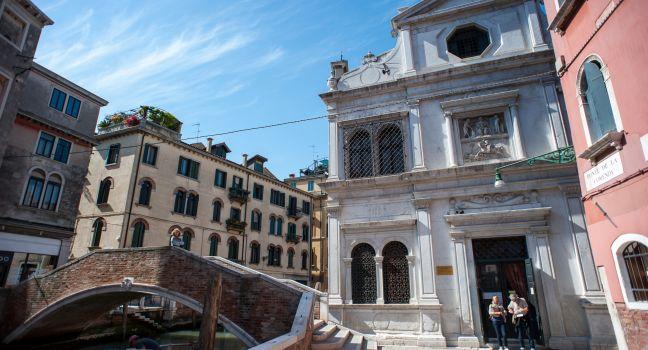
Scuola di San Giorgio degli Schiavoni (Scuola Dalmata)

Castello Fodor's Choice
Scuola di San Giorgio degli Schiavoni, Castello, Venice, Italy.
© Ross Brinkerhoff / Fodors Travel

Founded in 1451 by the Dalmatian community, this small scuola, or confraternity, was, and still is, a social and cultural center for migrants from what is now Croatia. It contains one of Italy's most beautiful rooms, harmoniously decorated between 1502 and 1507 by Vittore Carpaccio. Although Carpaccio generally painted legendary and religious figures against backgrounds of contemporary Venetian architecture, here is perhaps one of the first instances of "Orientalism" in Western painting.  Opening hours are quite flexible. Since this is a must-see site, book in advance so you won't be disappointed.

Scuola Grande dei Carmini

Dorsoduro
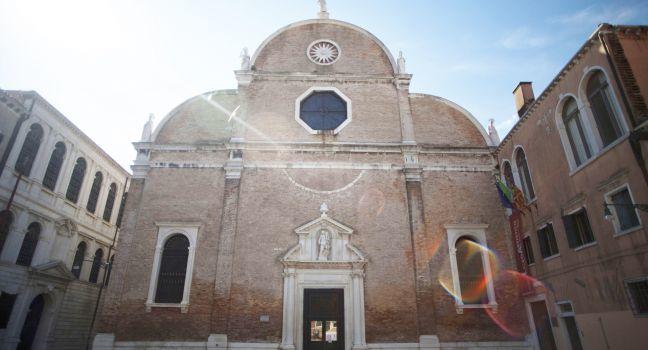
Scuola Grande dei Carmini
© Halie Cousineau/ Fodors Travel

When the order of Santa Maria del Carmelo commissioned Baldassare Longhena to finish the work on the Scuola Grande dei Carmini in the 1670s, their confraternity was one of the largest and wealthiest in Venice. Little expense was spared in the stuccoed ceilings and carved wooden paneling, and the artwork is remarkable. The paintings by Gianbattista Tiepolo that adorn the Baroque ceiling of the Sala Capitolare (Chapter House) are particularly alluring. In what many consider his best work, the artist’s nine canvases vividly transform some rather conventional religious themes into dynamic displays of color and movement.

Scuola Grande San Giovanni Evangelista

Another of the six "great" scuole, San Giovanni Evangelista, founded in 1261, is only a few steps from the Frari and San Rocco, but undeservedly lacks the popularity of San Rocco despite its impressive Renaissance architecture by two of the greatest architects of the 15th century (Pietro Lombardo and Mauro Codussi). The wealth of paintings by Titian, Palma il Giovane, and Giandomenico Tiepolo favor depictions of St. John's visions of the Apocalypse. The famous paintings of the "Miracles of the Reliquary of the Holy Cross," created by Giovanni Bellini in 1490 for the scuola, are in the Accademia Gallery. The grand staircase was redesigned in 1498 by Mauro Codussi, who employed several visual tricks to make it seem larger than its small space would allow, and the mosaic marble pavement of the Salone (Giorgio Massari, 1752) is a masterpiece of the stoneworker's art. If you don't have time to visit the scuola itself, be sure to stop in its unique semi-enclosed medieval courtyard. The marble wall (Pietro Lombardo, 1481) is surmounted by a cross, eagle, and books, all symbols of St. John. The pavement (1759) echoes the designs seen on Piazza San Marco.

San Polo 2454, 30125, Italy
041-718158-museum
Sight Details
€10
Imperative to consult the website for any closures

Something incorrect in this review?

Recommended Fodor's Video

Squero di San Trovaso

San Trovaso is one of only four squeri, or boatbuilding yards specifically dedicated to gondolas and other Venetian wooden boats, still operating in Venice. (There once were at least 45.) Dating from the 17th century, it is a registered monument where you can really observe and appreciate a unique mode of transportation that still thrives today. If the small wooden buildings seem to resemble an Alpine chalet, it's because Venice's boatbuilders historically came from the nearby mountains. Notice the wooden planks stacked outside to season (a gondola is made of eight different types of wood). Half-hour visits can be booked.