12 Best Sights in Savannah, Georgia

Background Illustration for Sights

With an eclectic array of shops, restaurants, museums, and monuments spread across the Historic District, the best way to explore downtown Savannah is on foot. Whether you plan a route ahead of time or just wander aimlessly, a leisurely stroll will always result in unique discoveries. If your feet start to ache, flag down a pedicab driver—these people-powered vehicles are a great way to get around, and the drivers usually tell a good story or two.
Forsyth Park

Fodor's Choice
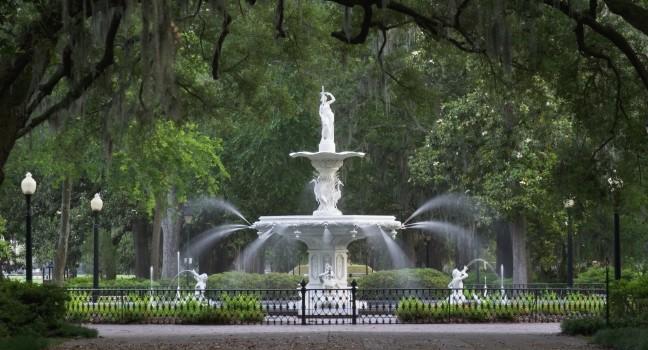
Forsyth Park Fountain in Savannah Georgia.; Shutterstock ID 1711880; Project/Title: Fodors; Downloader: Melanie Marin
David Davis / Shutterstock

The heart of the city's outdoor life, Forsyth Park hosts a number of popular cultural events, including film screenings, sports matches, and the annual Savannah Jazz Festival. Built in 1840 and expanded in 1851, the park was part of General Oglethorpe's original city plan and made possible by the donation of land from Georgia governor John Forsyth. A glorious white fountain dating to 1858, Confederate and Spanish-American War memorials, a fragrant garden, multiple playgrounds, tennis and basketball courts, and an old fort (which houses the gorgeous Collins Quarter Forsyth Café, with indoor/outdoor seating) are spread across this grand, green space. Be sure to stop by the south end on Saturday mornings for the bustling farmers' market. The park's 1-mile perimeter is among the prettiest walks in the city and takes you past many beautifully restored historic homes.

Owens-Thomas House & Slave Quarters

Historic District Fodor's Choice
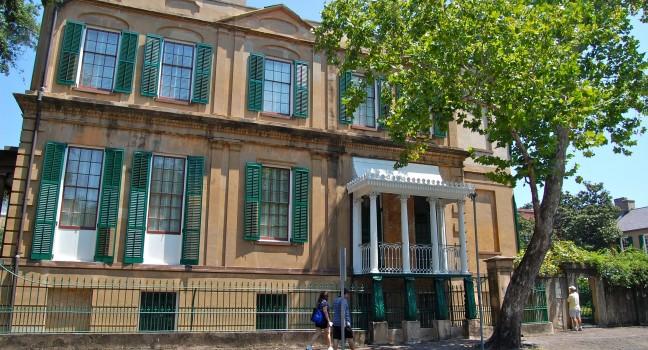
Lafayette's balcony where he addressed crowd in 1825
Lafayette's balcony where he addressed crowd in 1825 by David McSpadden

 Designed by William Jay, the Owens-Thomas House is widely considered to be one of the finest examples of English Regency architecture in America. Built in 1816–19, the house was constructed with local materials. Of particular note are the curving walls, Greek-inspired ornamental molding, half-moon arches, stained-glass panels, original Duncan Phyfe furniture, the hardwood "bridge" on the second floor, and the indoor toilets, which it had before the White House or Versailles. In 2018, the site renamed itself the Owens-Thomas House & Slave Quarters and revealed a new interpretive exhibition that includes the restored dwellings of those enslaved here and stories of their lives and work. Owned and administered by Telfair Museums, this home gives an inside perspective on Savannah's history.

Bonaventure Cemetery

Thunderbolt Fodor's Choice

 The largest and most famous of Savannah's municipal cemeteries, Bonaventure spreads over 100 acres and sits on a bluff above the Wilmington River. Once a sprawling plantation, the land became a private cemetery in 1846 and was established as a public cemetery in 1907. An emblematic destination for visitors, the evocative landscape is one of lush natural beauty transposed against an elegant, eerie backdrop of lavish marble headstones, monuments, and mausoleums as well as sweeping oaks and blooming camellia trees. John Muir reportedly camped at Bonaventure in 1867 on his legendary "thousand-mile walk," and local photographer Jack Leigh, novelist and poet Conrad Aiken, and singer-songwriter Johnny Mercer are among those interred here. Great tours of the cemetery are offered by "Bonaventure Don." 

Recommended Fodor's Video

Davenport House Museum

Historic District Fodor's Choice

Semicircular stairs with wrought-iron railings lead to the recessed doorway of the redbrick Federal home constructed by master builder Isaiah Davenport for his family between 1815 and 1820. Three dormered windows poke through the sloping roof of the stately house, and the interior has polished hardwood floors and fine woodwork and plasterwork, showcasing Davenport's talents to potential clients. The proposed demolition of this historic Savannah structure galvanized the city's residents into action to save their treasured buildings. The home endured a history of dilapidation that had lingered since the 1920s, when it was divided into tenements. When someone proposed razing it to build a parking lot in 1955, a small group of neighbors raised $22,000 in 24 hours to buy and restore the property. This action was the inception of the Historic Savannah Foundation and the first of many successful efforts to preserve the architectural treasure that is the city today.

Flannery O’Connor Childhood Home

Historic District Fodor's Choice

 Flannery O’Connor, Southern Gothic's literary grand dame, lived in this three-story house on Lafayette Square until she was ten (when her family decamped to Milledgeville, Georgia, to live at Andalusia Farm), experiencing her first brush with fame when she taught a chicken to walk backwards.

50-minute fully guided tours of the home are scheduled Thursday through Sunday at 11 am, 1 pm, and 3 pm; self-guided tours are also possible. The gift shop sells copies of  Flannery's novels and other souvenirs. 

Fort Pulaski National Monument

Thunderbolt Fodor's Choice

 Named for Casimir Pulaski, the Polish count and Revolutionary War hero, this must-see sight for history buffs was designed by Napoléon's military engineer and built on Cockspur Island between 1829 and 1847. Robert E. Lee's first assignment after graduating from West Point was as an engineer here. The fort was thought to be impervious to attack, but as weapons advanced, it proved penetrable. During the Civil War, the fort fell after bombardment by newfangled rifled cannons. The restored fortification, operated by the National Park Service, has moats, drawbridges, massive ramparts, towering walls, and an informative visitors center. Trails, picnic areas, and a protected bird refuge surround the park.

Jepson Center for the Arts

Historic District Fodor's Choice

 This contemporary building is one of a kind among the characteristic 18th- and 19th-century architecture of historic Savannah. The modern art extension of the adjacent Telfair Academy museum, the Jepson was designed by renowned architect Moshe Safdie. Within the marble-and-glass edifice are rotating exhibits, on loan and from the permanent collection, ranging from European masters to contemporary locals. There's also an outdoor sculpture terrace and an interactive, kid-friendly area on the third level.

Mercer Williams House

Historic District Fodor's Choice

 A staple on the tourist circuit, this house museum has been the stuff of legend since the release of the longtime best-selling novel Midnight in the Garden of Good and Evil, which was based on the murder trial of local architectural restorer and antiques dealer Jim Williams. Williams, who purportedly killed his lover in the front den while sitting at the desk where he later died, purchased the house in 1969. Scandal aside, Williams was an aficionado of historic preservation, and the Mercer House was one of some 50 Savannah properties that he purchased and restored. Designed by New York architect John S. Norris for General Hugh Mercer, great-grandfather of Johnny Mercer, the home was constructed in 1860 and completed after the end of the Civil War in 1868. Inside are fine examples of 18th- and 19th-century furniture and art from Jim Williams's private collection. Don't miss a look around the charming gift shop.

SCAD Museum of Art

Historic District Fodor's Choice

 This architectural marvel rose from the ruins of the oldest surviving railroad building in the United States. Appropriately, the architect chosen for the lofty design and remodel project was Christian Sottile, the valedictorian of Savannah College of Art and Design's 1997 graduating class and the former dean of the School of Building Arts. Sottile rose to the hearty challenge of merging the past with the present, preserving key architectural details of the original structure while introducing contemporary design elements. SCAD Museum of Art houses two main galleries with rotating exhibits by some of the most acclaimed figures in contemporary art: the Evans Gallery features works of African American arts and culture, while the André Leon Talley Gallery is devoted to fashion and high style.

Ships of the Sea Maritime Museum

Historic District Fodor's Choice

This exuberant Greek Revival mansion was the home of William Scarborough, a wealthy early-19th-century merchant and one of the principal owners of the Savannah, the first steamship to cross the Atlantic. The structure, with its portico capped by half-moon windows, is another of architect William Jay's notable contributions to the Historic District and Regency-style architecture. These days, it houses the Ships of the Sea Maritime Museum, with displays of model ships and exhibits detailing maritime history. The ambitious North Garden nearly doubled the original walled courtyard's size and provides ample space for naturalist-led walks and outdoor concerts.

Telfair Academy

Historic District Fodor's Choice

The oldest public art museum in the South was designed by William Jay in 1819 as a residence for Alexander Telfair. Within its marble rooms are a variety of paintings from American and European masters, plaster casts of the Elgin Marbles and other classical sculptures, and some of the Telfair family furnishings, including a Duncan Phyfe sideboard and Savannah-made silver.

Tybee Island Marine Science Center

Fodor's Choice

Don't miss the Tybee Island Marine Science Center's interesting exhibit on Coastal Georgia, which houses local wildlife ranging from Ogeechee corn snakes to American alligators. Schedule one of two guided walks along the beach and marshes if you're interested in the flora and fauna of the Lowcountry. There is also a "Turtle Talk," which consists of a classroom discussion and hands-on workshop. Arrive early, as parking near the center can be competitive in the busier months.