


18 Best Sights in Savannah, Georgia

With an eclectic array of shops, restaurants, museums, and monuments spread across the Historic District, the best way to explore downtown Savannah is on foot. Whether you plan a route ahead of time or just wander aimlessly, a leisurely stroll will always result in unique discoveries. If your feet start to ache, flag down a pedicab driver—these people-powered vehicles are a great way to get around, and the drivers usually tell a good story or two.
Ellis Square
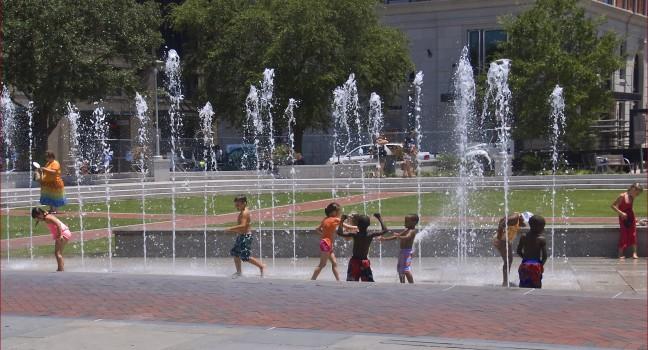
Converted from a public square to a parking garage in the 1970s, Ellis Square has been restored in recent years and is once again one of Savannah's most popular spots. Near the western end stands a statue of legendary songwriter Johnny Mercer, a Savannah native. Nearby is a visitor center with a touch-screen city guide, maps and brochures, and public restrooms. To the east is a life-size chess board; the pieces can be requested at the visitor center. A treat for youngsters (and the young at heart) is the square's interactive fountain, which is entertaining and refreshing in the warmer months.
Black Holocaust Memorial
Recommended Fodor's Video
Bull Street Library
Even if you don't have a library card, it's worth browsing the beautiful neoclassical building built in 1916 with funding from a Carnegie grant. The grand foyer and revolving exhibits are nourishment for the senses, and the massive windowed reading lounge and third-story alcove are wonderful places to curl up with a book.
Cathedral Basilica of St. John the Baptist
Chippewa Square
Colonial Park Cemetery
Emmet Park
Once a Native American burial ground, the lovely tree-shaded park is named for Robert Emmet, a late-18th-century Irish patriot and orator. The park contains monuments to Georgia Hussars, fallen soldiers from the Vietnam War, and the Celtic Cross Irish memorial, among others. Various small festivals are held in the park each year.
Factors Walk
A network of iron crosswalks and steep stone stairways connects Bay Street to Factors Walk below. The congested area of multistory buildings was originally the center of commerce for cotton brokers (also called factors), who walked between and above the lower cotton warehouses. Ramps lead down to River Street. This area is paved in cobblestones and features steep, historic stone staircases, so wear comfortable shoes and step carefully.
Johnson Square
The oldest of James Oglethorpe's original squares was laid out in 1733 and named for South Carolina governor Robert Johnson. A monument marks the grave of Nathanael Greene, a hero of the Revolutionary War and close friend of George Washington. The square has always been a popular gathering place: Savannahians came here to welcome President Monroe in 1819, to greet the Marquis de Lafayette in 1825, and to cheer for Georgia's secession in 1861. Locals call this Bank Square because of the plethora of nearby banks—perfect if you need an ATM.
Lafayette Square
Named for the Marquis de Lafayette, who aided the Americans during the Revolutionary War, the square contains a graceful three-tier fountain donated by the Georgia chapter of the Colonial Dames of America. The Cathedral Basilica of St. John the Baptist is located on this square, as are the Andrew Low House and the impressive and elegant Hamilton-Turner Inn. The childhood home of celebrated Southern author Flannery O'Connor also sits on this square.
Madison Square
Laid out in 1839 and named for President James Madison, this square is home to a statue depicting Sergeant William Jasper hoisting a flag, a tribute to his bravery during the Siege of Savannah. Though mortally wounded, Jasper rescued the colors of his regiment in the assault on the British lines, and his valor is celebrated each year with an annual memorial ceremony. A granite marker denotes the southern line of the British defense during the 1779 battle. The Green-Meldrim House, General Sherman's headquarters after capturing the city in 1864, is here.
Monterey Square
Commemorating the victory of General Zachary Taylor's forces in Monterrey, Mexico, in 1846, this is the southernmost of Bull Street's squares. A monument honors General Casimir Pulaski, the Polish nobleman who lost his life in the Siege of Savannah during the Revolutionary War. On the square sits Temple Mickve Israel (one of the country's oldest Jewish congregations) and some of the city's most beautiful mansions, including the iconic Mercer Williams House.
Reynolds Square
Anglican cleric and theologian John Wesley is remembered here. He arrived in Savannah in 1736 at the behest of General James Oglethorpe to minister to the newly established colony. During his short stay, the future founder of the Methodist Church preached and wrote the first English hymnal in the city. His monument in Reynolds Square is shaded by greenery and surrounded by park benches. The landmark Planters Inn, formerly the John Wesley Hotel, is also located on the square. Ironically, though it was named after a man of the cloth, it was considered the best brothel in town at the turn of the 20th century.
Savannah African Art Museum
Once the private collection of Savannah businessman Don Cole, this assemblage of more than a thousand sculptures, artifacts, tribal costumes, carved masks, pottery, and other sacred objects from West and Central Africa is now on display for the general public in a beautifully restored yellow mansion. The museum has works and artifacts from more than 180 cultures and also hosts workshops and lectures relating to African history.
Tybee Island Pier and Pavilion
This is Tybee's "grand strand," the center of the summer beach action. Anchored by a 700-foot pier that is sometimes host to summer concerts, this stretch of shoreline is your best bet for people-watching and beach activities. Just off the sand at the bustling intersection of Tybrisa Street and Butler Avenue, a cluster of watering holes, souvenir shops, bike shacks, and oyster bars makes up Tybee's main business district. There are public restrooms at the Pier and at 15th and Tybrisa Streets. The pier is popular for fishing and is also the gathering place for fireworks displays. There's metered street parking as well as two good-sized lots. Both fill up fast during the high season, so arrive early.
Waving Girl Statue
This statue at River Street and East Broad Ramp is a beloved symbol of Savannah's Southern hospitality. It commemorates Florence Martus, a sister to the lighthouse keeper, who waved to ships as they came into Savannah's port for more than 44 years. She would wave a white towel and, when young, always had her dog by her side. Late in her life, locals threw her a huge birthday party at Fort Pulaski with more than 5,000 guests. Despite having welcomed so many sailors to port, she died without ever having been wed.
Wright Square
Named for James Wright, Georgia's last colonial governor, this square has an elaborate monument in its center that honors William Washington Gordon, founder of the Central of Georgia Railroad. A granite boulder from Stone Mountain adorns the grave of Tomochichi, the Yamacraw chief who befriended General Oglethorpe and the colonists, giving his permission for the English settlers to establish their colony on Yamacraw Bluff.


