28 Best Sights in Savannah, Georgia

Background Illustration for Sights

With an eclectic array of shops, restaurants, museums, and monuments spread across the Historic District, the best way to explore downtown Savannah is on foot. Whether you plan a route ahead of time or just wander aimlessly, a leisurely stroll will always result in unique discoveries. If your feet start to ache, flag down a pedicab driver—these people-powered vehicles are a great way to get around, and the drivers usually tell a good story or two.
Forsyth Park

Fodor's Choice
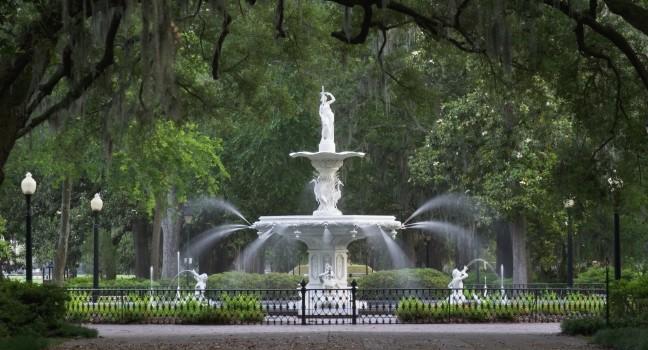
Forsyth Park Fountain in Savannah Georgia.; Shutterstock ID 1711880; Project/Title: Fodors; Downloader: Melanie Marin
David Davis / Shutterstock

The heart of the city's outdoor life, Forsyth Park hosts a number of popular cultural events, including film screenings, sports matches, and the annual Savannah Jazz Festival. Built in 1840 and expanded in 1851, the park was part of General Oglethorpe's original city plan and made possible by the donation of land from Georgia governor John Forsyth. A glorious white fountain dating to 1858, Confederate and Spanish-American War memorials, a fragrant garden, multiple playgrounds, tennis and basketball courts, and an old fort (which houses the gorgeous Collins Quarter Forsyth Café, with indoor/outdoor seating) are spread across this grand, green space. Be sure to stop by the south end on Saturday mornings for the bustling farmers' market. The park's 1-mile perimeter is among the prettiest walks in the city and takes you past many beautifully restored historic homes.

Owens-Thomas House & Slave Quarters

Historic District Fodor's Choice
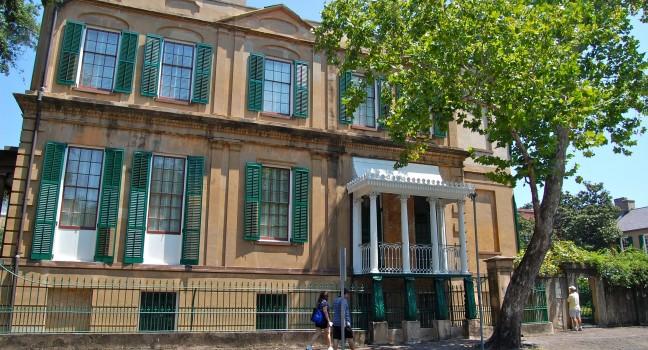
Lafayette's balcony where he addressed crowd in 1825
Lafayette's balcony where he addressed crowd in 1825 by David McSpadden

 Designed by William Jay, the Owens-Thomas House is widely considered to be one of the finest examples of English Regency architecture in America. Built in 1816–19, the house was constructed with local materials. Of particular note are the curving walls, Greek-inspired ornamental molding, half-moon arches, stained-glass panels, original Duncan Phyfe furniture, the hardwood "bridge" on the second floor, and the indoor toilets, which it had before the White House or Versailles. In 2018, the site renamed itself the Owens-Thomas House & Slave Quarters and revealed a new interpretive exhibition that includes the restored dwellings of those enslaved here and stories of their lives and work. Owned and administered by Telfair Museums, this home gives an inside perspective on Savannah's history.

Davenport House Museum

Historic District Fodor's Choice

Semicircular stairs with wrought-iron railings lead to the recessed doorway of the redbrick Federal home constructed by master builder Isaiah Davenport for his family between 1815 and 1820. Three dormered windows poke through the sloping roof of the stately house, and the interior has polished hardwood floors and fine woodwork and plasterwork, showcasing Davenport's talents to potential clients. The proposed demolition of this historic Savannah structure galvanized the city's residents into action to save their treasured buildings. The home endured a history of dilapidation that had lingered since the 1920s, when it was divided into tenements. When someone proposed razing it to build a parking lot in 1955, a small group of neighbors raised $22,000 in 24 hours to buy and restore the property. This action was the inception of the Historic Savannah Foundation and the first of many successful efforts to preserve the architectural treasure that is the city today.

Recommended Fodor's Video

Fort Pulaski National Monument

Thunderbolt Fodor's Choice

 Named for Casimir Pulaski, the Polish count and Revolutionary War hero, this must-see sight for history buffs was designed by Napoléon's military engineer and built on Cockspur Island between 1829 and 1847. Robert E. Lee's first assignment after graduating from West Point was as an engineer here. The fort was thought to be impervious to attack, but as weapons advanced, it proved penetrable. During the Civil War, the fort fell after bombardment by newfangled rifled cannons. The restored fortification, operated by the National Park Service, has moats, drawbridges, massive ramparts, towering walls, and an informative visitors center. Trails, picnic areas, and a protected bird refuge surround the park.

Jepson Center for the Arts

Historic District Fodor's Choice

 This contemporary building is one of a kind among the characteristic 18th- and 19th-century architecture of historic Savannah. The modern art extension of the adjacent Telfair Academy museum, the Jepson was designed by renowned architect Moshe Safdie. Within the marble-and-glass edifice are rotating exhibits, on loan and from the permanent collection, ranging from European masters to contemporary locals. There's also an outdoor sculpture terrace and an interactive, kid-friendly area on the third level.

SCAD Museum of Art

Historic District Fodor's Choice

 This architectural marvel rose from the ruins of the oldest surviving railroad building in the United States. Appropriately, the architect chosen for the lofty design and remodel project was Christian Sottile, the valedictorian of Savannah College of Art and Design's 1997 graduating class and the former dean of the School of Building Arts. Sottile rose to the hearty challenge of merging the past with the present, preserving key architectural details of the original structure while introducing contemporary design elements. SCAD Museum of Art houses two main galleries with rotating exhibits by some of the most acclaimed figures in contemporary art: the Evans Gallery features works of African American arts and culture, while the André Leon Talley Gallery is devoted to fashion and high style.

Ships of the Sea Maritime Museum

Historic District Fodor's Choice

This exuberant Greek Revival mansion was the home of William Scarborough, a wealthy early-19th-century merchant and one of the principal owners of the Savannah, the first steamship to cross the Atlantic. The structure, with its portico capped by half-moon windows, is another of architect William Jay's notable contributions to the Historic District and Regency-style architecture. These days, it houses the Ships of the Sea Maritime Museum, with displays of model ships and exhibits detailing maritime history. The ambitious North Garden nearly doubled the original walled courtyard's size and provides ample space for naturalist-led walks and outdoor concerts.

Telfair Academy

Historic District Fodor's Choice

The oldest public art museum in the South was designed by William Jay in 1819 as a residence for Alexander Telfair. Within its marble rooms are a variety of paintings from American and European masters, plaster casts of the Elgin Marbles and other classical sculptures, and some of the Telfair family furnishings, including a Duncan Phyfe sideboard and Savannah-made silver.

Tybee Island Marine Science Center

Fodor's Choice

Don't miss the Tybee Island Marine Science Center's interesting exhibit on Coastal Georgia, which houses local wildlife ranging from Ogeechee corn snakes to American alligators. Schedule one of two guided walks along the beach and marshes if you're interested in the flora and fauna of the Lowcountry. There is also a "Turtle Talk," which consists of a classroom discussion and hands-on workshop. Arrive early, as parking near the center can be competitive in the busier months.
Ellis Square

Historic District
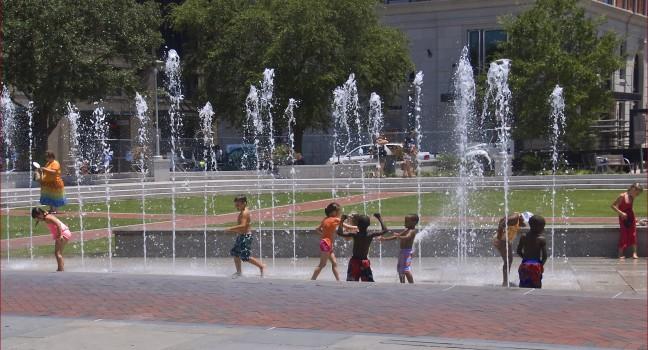
Summer Fun -- Ellis Square Fountain Savannah (GA) July 2012
Summer Fun -- Ellis Square Fountain Savannah (GA) July 2012 by Ron Cogswell

Converted from a public square to a parking garage in the 1970s, Ellis Square has been restored in recent years and is once again one of Savannah's most popular spots. Near the western end stands a statue of legendary songwriter Johnny Mercer, a Savannah native. Nearby is a visitor center with a touch-screen city guide, maps and brochures, and public restrooms. To the east is a life-size chess board; the pieces can be requested at the visitor center. A treat for youngsters (and the young at heart) is the square's interactive fountain, which is entertaining and refreshing in the warmer months.

Barnard St., Savannah, GA, 31401, USA

Something incorrect in this review?

American Prohibition Museum

Historic District
In the heart of City Market, America's only museum dedicated to the Prohibition era shares history from 1907 to 1933. In the 6,000-square-foot space, guests wander 13 galleries, a theater, and a real speakeasy. From stories of Southern rumrunners to the history of moonshine, the museum offers a fun and informative look at the past—there are even four antique cars on the premises. Make sure to enjoy a specially crafted cocktail at the museum speakeasy bar, Congress Street Up, which stays open long after the museum closes and uses period-authentic recipes and ingredients.

Beach Institute

Historic District

Works by African American artists from the Savannah area and around the country are on display in this building, which once housed the first school for African American children in Savannah. On permanent exhibit are more than 230 wood carvings by renowned folk artist Ulysses Davis.

502 E. Harris St., Savannah, GA, 31401, USA
912-335--8868
Sight Details
$10
Closed Sun. and Mon.

Something incorrect in this review?

Chef Darin's Kitchen Table

After making a name for himself in the local dining scene, Chef Darin created his own cooking school in 2015 with hands-on classes for cooks of all levels. The state-of-the-art facility includes a kitchen stocked with five KitchenAid dual fuel ranges and a double wall oven as well as Savannah's only local kitchen shop. Class subjects range from Lowcountry comfort food to Pan Asian cuisine.

Coastal Georgia Botanical Gardens

In 1890, Mrs. Herman B. Miller planted three clumps of Japanese timber bamboo near her farmhouse 15 miles south of Savannah. As the bamboo took to the warm Southern climate, it spread to what now stands today at the Bamboo Farms at the Coastal Georgia Botanical Gardens. The gardens, deeded to the University of Georgia in 1983 for research and cultivation, now boast a 4-acre bamboo maze, a children's garden, and stunning seasonal formal and shade gardens including beds of iris and daffodil bulbs and the wonderful camellia trail in late winter/early spring. The annual Christmas lights event glimmers with fun for the whole family.

2 Canebrake Rd., Savannah, GA, 31419, USA
912-921–5460
Sight Details
$5
Closed Mon.

Something incorrect in this review?

First African Baptist Church

Historic District

 Enslaved people constructed this church at night by lamplight after having worked the plantations during the day, finishing it in 1859. It is one of the first organized black Baptist churches on the continent, constituted in 1777. The basement floor still shows signs of its time as a stop on the Underground Railroad. Holes drilled in the floor are designed in a prayer symbol known as an "African cosmogram," and are rumored to actually have been air holes for slaves hiding underneath, waiting to be transported to the Savannah River for their trip to freedom. It was also an important meeting place during the civil rights era.

23 Montgomery St., Savannah, GA, 31401, USA
912-233–6597
Sight Details
$15
Closed Mon. No tours on Sun.

Something incorrect in this review?

Georgia State Railroad Museum

Historic District

This museum preserves the legacy of the Central of Georgia Railway, an integral part of the industrial heritage of Savannah and of the South. A step into a different era, the museum is home to numerous railcars and boxcars, working diesel and steam locomotives, and a rare functioning railroad turntable. Around the corner is an iconic 125-foot-tall smokestack and the original quarters for workers and managers. Children of all ages will appreciate the expansive model-train exhibit, a fully operable rendition of a train traveling through the region. Ride on a historic diesel or steam locomotive.

Juliette Gordon Low Birthplace

Historic District

 This early-19th-century townhouse, attributed to William Jay, was designated in 1965 as Savannah's first National Historic Landmark. "Daisy" Low, founder of the Girl Scouts, was born here in 1860, and the house is now owned and operated by the Girl Scouts of America. Mrs. Low's paintings and other artwork are on display in the house, restored to the style of 1886, the year of Mrs. Low's marriage. Droves of Girl Scout troops make the regular pilgrimage to Savannah to see their founder's birthplace and earn merit badges. In addition to its value as a pilgrimage site for Girl Scouts, the home is a beautiful look into the lives of Savannahians during the Victorian era. Tickets sell fast, so book in advance if you want to tour the house on a specific day.

Oatland Island Wildlife Center

Oatland Island

A few miles east of the Historic District, this wildlife preserve and educational center is one of the best family outings around. Home to a variety of animal habitats spread along a 2-mile path through pristine maritime forest, it feels more like a nature walk than a trip to the zoo as you're as likely to see wild otters and red-tailed hawks as you are the permanent residents. Several coastal habitats are represented, including the wetlands that are home to alligators, herons, and cranes. Bobcats, wolves, bison, armadillos, and assorted birds of prey live in large exhibits, and a butterfly garden flutters with colorful pollinators. Call or visit the website for reservations and/or additional information. Be sure to wear comfortable shoes.

711 Sandtown Rd., Savannah, GA, 31410, USA
912-395–1212
Sight Details
$5

Something incorrect in this review?

Ralph Mark Gilbert Civil Rights Museum

Historic District

 This history museum, named after the late Dr. Ralph Mark Gilbert, the father of Savannah's modern-day civil rights movement and leader of the NAACP, has a series of engaging exhibits on segregation, from emancipation through the civil rights movement. The role of Black and white Savannahians in ending segregation in their city is well detailed and includes archival photographs and videos housed in this former Black-owned bank in what was once the heart of Savannah's Black business community. There's also a replica of a lunch counter where Black patrons were denied service.

Savannah Children's Museum

Historic District

Adhering to the principle of learning through doing, the Savannah Children's Museum has open green spaces with several stations geared toward sensory play, including a water–sand play excavation station, sound station of percussion instruments, and an organic garden. The storybook nook is a partnership with the public library and encourages visiting youngsters to balance physical and mental recreation. One station includes costumes for stage performances.

655 Louisville Rd., Savannah, GA, 31401, USA
912-651–4292
Sight Details
$10
Closed Sun. in June–Aug., and Mon. and Tues. in Sept.–May

Something incorrect in this review?

Savannah History Museum

Historic District

This history museum houses exhibits on Savannah's cultural and military history. Inside you'll find much about the lives of early Native American settlers, including the development of tabby (crushed oyster shells with lime, sand, and water) for use in early construction. Subsequent historical periods are portrayed, including the Revolutionary and Civil War eras and the Industrial Revolution. More modern highlights include the city's countless Hollywood film appearances over the years, the most memorable of which might be Forrest Gump. The very bench that Tom Hanks sat on can be seen here.

St. John's Episcopal Church

Historic District

Built in 1852, this church is famous for its whimsical chimes and stained-glass windows. The extraordinary parish house is the revered Green-Meldrim House, the only remaining Gothic-style private home in the Historic District. An interesting bit of trivia: on Christmas 1864, after General Sherman moved into the Green-Meldrim House, his army chaplain conducted the church's Christmas service. Though the house is still an active parish house, tours are available on a limited basis. Contact the church to learn whether a house tour is available for your selected date.

325 Bull St., Savannah, GA, 31401, USA
912-232–1251
Sight Details
Church tours free ($10 donation suggested); Green-Meldrim House tours $15
Call to find out about last-minute closings for church events

Something incorrect in this review?

Temple Mickve Israel

Historic District

 This unique Gothic-revival synagogue on Monterey Square houses the third-oldest Jewish congregation in the United States; its founding members settled in town only five months after the establishment of Savannah in 1733. The synagogue's permanent collection includes documents and letters (some from such notables as George Washington, James Madison, and Thomas Jefferson) pertaining to early Jewish life in Savannah and Georgia, as well as a 15th-century Torah, the oldest Torah in North America.

20 E. Gordon St., Savannah, GA, 31401, USA
912-233–1547
Sight Details
Tour $10
Closed weekends except for Super Museum Sunday

Something incorrect in this review?

Tricentennial Park and Battlefield

Historic District

 This 25-acre complex is home to the Savannah History Museum, the Georgia State Railroad Museum, and the Savannah Children's Museum, as well as Battlefield Memorial Park. This site offers an unbeatable introduction to the city and a full day of fun for the whole family. The battlefield was the site of the second-bloodiest battle of the Revolutionary War, where on October 9, 1779, 800 of the 8,000 troops who fought lost their lives.

Tybee Island Light Station and Museum

 Considered one of North America's most beautifully renovated lighthouses, the Tybee Light Station has been guiding Savannah River mariners since 1736. It's not the first lighthouse built on this site; the original was constructed on orders of General James Oglethorpe in 1732. You can walk up 178 steps for amazing views at the top. The lightkeeper's cottage houses a small theater showing a video about the lighthouse. The nearby museum is in a gun battery constructed for the Spanish-American War.

30 Meddin Dr., Savannah, GA, 31328, USA
912-786–5801
Sight Details
$10
Closed Tues.

Something incorrect in this review?

UGA Marine Education Center and Aquarium

Moon River District

On the grounds of the former Modena Plantation, the University of Georgia runs this aquarium with revolving exhibits about the state's coastal wildlife and ecosystems. Kids love the touch tanks featuring creatures from tidal creeks, the ocean beaches, and the open waters of the continental shelf up-close. The sea turtles are especially popular. Pack a picnic lunch and enjoy the fresh air after visiting the aquarium, and don't miss the nearby nature trails and ADA-approved salt marsh boardwalk.

Waving Girl Statue

Historic District

This statue at River Street and East Broad Ramp is a beloved symbol of Savannah's Southern hospitality. It commemorates Florence Martus, a sister to the lighthouse keeper, who waved to ships as they came into Savannah's port for more than 44 years. She would wave a white towel and, when young, always had her dog by her side. Late in her life, locals threw her a huge birthday party at Fort Pulaski with more than 5,000 guests. Despite having welcomed so many sailors to port, she died without ever having been wed.

River St. near E. Broad Ramp, Savannah, GA, 31401, USA

Something incorrect in this review?

Wesley Monumental United Methodist Church

Historic District

This Gothic revival–style church memorializes the founders of Methodism, brothers John and Charles Wesley, who both lived in Savannah for a brief time in the 1730s. The sanctuary is patterned after Queen's Kerk in Amsterdam. It dates from 1868 and is particularly noted for its magnificent stained-glass windows.