


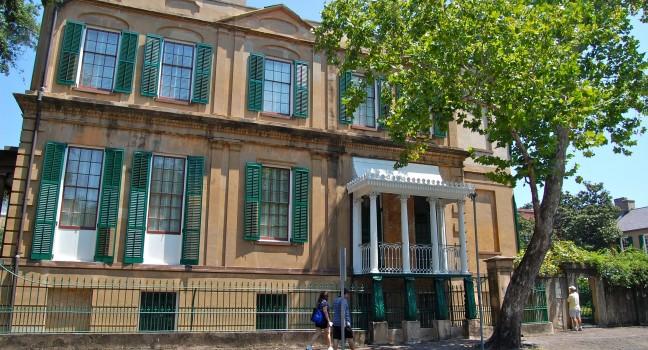
Owens-Thomas House & Slave Quarters
Get FREE email communications from Fodor's Travel, covering must-see travel destinations, expert trip planning advice, and travel inspiration to fuel your passion.

With an eclectic array of shops, restaurants, museums, and monuments spread across the Historic District, the best way to explore downtown Savannah is on foot. Whether you plan a route ahead of time or just wander aimlessly, a leisurely stroll will always result in unique discoveries. If your feet start to ache, flag down a pedicab driver—these people-powered vehicles are a great way to get around, and the drivers usually tell a good story or two.
Semicircular stairs with wrought-iron railings lead to the recessed doorway of the redbrick Federal home constructed by master builder Isaiah Davenport for his family between 1815 and 1820. Three dormered windows poke through the sloping roof of the stately house, and the interior has polished hardwood floors and fine woodwork and plasterwork, showcasing Davenport's talents to potential clients. The proposed demolition of this historic Savannah structure galvanized the city's residents into action to save their treasured buildings. The home endured a history of dilapidation that had lingered since the 1920s, when it was divided into tenements. When someone proposed razing it to build a parking lot in 1955, a small group of neighbors raised $22,000 in 24 hours to buy and restore the property. This action was the inception of the Historic Savannah Foundation and the first of many successful efforts to preserve the architectural treasure that is the city today.
50-minute fully guided tours of the home are scheduled Thursday through Sunday at 11 am, 1 pm, and 3 pm; self-guided tours are also possible. The gift shop sells copies of Flannery's novels and other souvenirs.
This exuberant Greek Revival mansion was the home of William Scarborough, a wealthy early-19th-century merchant and one of the principal owners of the Savannah, the first steamship to cross the Atlantic. The structure, with its portico capped by half-moon windows, is another of architect William Jay's notable contributions to the Historic District and Regency-style architecture. These days, it houses the Ships of the Sea Maritime Museum, with displays of model ships and exhibits detailing maritime history. The ambitious North Garden nearly doubled the original walled courtyard's size and provides ample space for naturalist-led walks and outdoor concerts.
Built on the site of the former city jail, this residence was constructed in 1848 for Andrew Low, a native of Scotland and one of Savannah's merchant princes. Designed by architect John S. Norris, the residence later belonged to Low's son, William, who inherited his father's wealth and married his longtime sweetheart, Juliette Gordon. The couple moved to England and several years after her husband's death, Juliette returned to this house and founded the Girl Scouts here on March 12, 1912. The house has 19th-century antiques, stunning silver, and some of the finest ornamental ironwork in Savannah, but it is the story and history of the family—even a bedroom named after family friend and visitor General Robert E. Lee—that is fascinating and well told by the tour guides.
Celebrated Southern author Flannery O'Connor lived in this austere Charlton Street home from her birth in 1925 until 1938 when the family moved to Milledgeville, Georgia. The beautifully renovated home includes oddities like the "kiddie coop," a cage for children designed by O'Connor's father. In fall, the home hosts a reception with lectures by academics and experts discussing different aspects of O'Connor's life and work. Events are free and open to the public.
Designed by New York architect John Norris and built in 1850 for cotton merchant Charles Green, this Gothic-revival mansion cost $93,000 to build—a princely sum in those days. The house was purchased in 1892 by Judge Peter Meldrim, whose heirs sold it to St. John's Episcopal Church in the 1940s to use as a parish house. General Sherman lived here after taking the city in 1864. Sitting on Madison Square, the house has Gothic features such as oriels, a crenellated roof, and an external gallery with filigree ironwork. Inside are mantels of Carrara marble, carved black-walnut woodwork, and doorknobs and hinges of either silver plate or porcelain.


