182 Best Sights in Rome, Italy

Background Illustration for Sights

We've compiled the best of the best in Rome - browse our top choices for the top things to see or do during your stay.

Casa di Augustus

Campitelli Fodor's choice

First discovered in the 1970s and open to the public only since 2006, this was the residence of Octavian Augustus (27 BC–AD 14) after his victory at Actium. (Archaeologists have recently found two courtyards rather than one, though, in the style of Rome's ancient Greek kings, suggesting Augustus maintained this house after his ascension to prominence.) Four rooms have exquisite examples of decorative frescoes on the walls; startlingly vivid and detailed are the depictions of a narrow stage with side doors, as well as some striking comic theater masks. An exquisitely painted upper room has been identified as the Emperor's study.

Northwest crest of Palatine Hill, Rome, 00184, Italy
Sight Details
€22 2-day Full Experience ticket required
Closed Mon.

Something incorrect in this review?

Catacombe di San Sebastiano

Via Appia Antica Fodor's choice

The 4th-century church at this site was named after the saint who was buried in its catacomb, which burrows underground on four different levels. This was the only early Christian cemetery to remain accessible during the Middle Ages, and it was from here that the term "catacomb" is derived—it's in a spot where the road dips into a hollow, known to the Romans as a catacumba (Greek for "near the hollow").

Via Appia Antica, 136, Rome, 00179, Italy
06-7850350
Sight Details
€10
Closed Mon. and Dec.

Something incorrect in this review?

Centrale Montemartini

Testaccio Fodor's choice

A decommissioned early-20th-century power plant is now this intriguing exhibition space for the overflow of ancient art from the Musei Capitolini collection. Getting here is half the fun. A 15-minute walk from the heart of Testaccio will lead you past walls covered in street art to the urban district of Ostiense. Head southwest and saunter under the train tracks passing buildings adorned with four-story-high murals until you reach the often-uncrowded Centrale Montemartini, where Roman sculptures and intricate mosaics are set amid industrial machinery and pipes.

Unusually, the collection is organized by the area in which the ancient pieces were found. Highlights include the former boiler room filled with ancient marble statues that once decorated Rome's private villas, such as the beautiful Esquiline Venus, as well as a large mosaic of a hunting scene. A purchase of the Capitolini Card will allow entry into Musei Capitolini and Centrale Montemartini.

Via Ostiense, 106, Rome, 00154, Italy
06-0608
Sight Details
€11.50; admission included with the purchase of the Capitolini Card (€14.50)
Closed Mon.

Something incorrect in this review?

Recommended Fodor's Video

Cimitero Acattolico

Testaccio Fodor's choice

Built up against the ancient Aurelian Walls, this famed cemetery was intended for the interment of non-Catholics who were barred from burial within the city walls. Poetic souls seek out the tomb of John Keats, who tragically died in Rome after succumbing to consumption at age 25 in 1821. The headstone is famously inscribed, "Here lies one whose name was writ in water" (the poet requested that no name or dates should appear). Nearby is the place where Shelley's heart was buried, as well as the tombs of Goethe's son, the founder of the Italian Communist Party and vehement anti-Fascist Antonio Gramsci, and America's famed beat poet Gregory Corso.

The cemetery's quiet paths are lined with fruit trees and prowled by shy cats from a nearby animal sanctuary. The tranquil spot is far from morbid and quite easy to find: simply catch the Metro B from Termini station to the Piramide stop, which is just around the corner from the entrance to the cemetery.

Galleria Nazionale d'Arte Moderna e Contemporanea

Villa Borghese Fodor's choice

This massive white Beaux-Arts building, built for the 1911 World Exposition in Rome, contains one of Italy's leading collections of 19th- and 20th-century works. It's primarily dedicated to the history of Italian modernism, examining the movement's development over the last two centuries, but crowd-pleasers Monet, Rodin, Van Gogh, and Warhol put in appearances, and there's also an outstanding Dadaist collection. You can mix coffee and culture at the mid-century-inspired Caffè delle Arti in a columned alcove.

Gran Priorato di Roma dell'Ordine di Malta

Aventino Fodor's choice

Although the line to peek through the keyhole of a nondescript green door in the Gran Priorato, the walled compound of the Knights of Malta, sometimes snakes around Piazza dei Cavalieri di Malta, the enchanting view is worth the wait. Far across the city, you'll see the dome of St. Peter's Basilica flawlessly framed by the keyhole and tidily trimmed hedges that lie just beyond the locked door. The priory and the square are the work of Giovanni Battista Piranesi, an 18th-century engraver who is more famous for etching Roman views than for orchestrating them, but he fancied himself a bit of an architect and did not disappoint.

Founded in the Holy Land during the Crusades, the Knights of Malta is the world's oldest and most exclusive order of chivalry. The knights amassed huge tracts of land in the Middle East and were based on the Mediterranean island of Malta from 1530 until 1798, when Napoléon expelled them. In 1834, they established themselves in Rome, where ministering to the sick became thelr raison d'être.

MACRO

Repubblica Fodor's choice

Formerly known as Rome's Modern and Contemporary Art Gallery, and before that as the Peroni beer factory, this redesigned industrial space has brought new life to the gallery and museum scene of a city hitherto hailed for its "then," not its "now." The collection here covers Italian contemporary artists from the 1960s through today. The goal is to bring current art to the public in innovative spaces and, not incidentally, to support and recognize Rome's contemporary art scene, which labors in the shadow of the city's artistic heritage. After a few days—or millennia—of dusty marble, it's a breath of fresh air.  Check the website for occasional late-night openings and events.

Monumento a Vittorio Emanuele II, or Altare della Patria

Trevi Fodor's choice

The huge white mass known as the "Vittoriano" is an inescapable landmark that has been likened to a giant wedding cake or an immense typewriter. Present-day Romans joke that you can only avoid looking at it if you are standing on it, but at the beginning of the 20th century, it was the source of great civic pride. Built to honor the unification of Italy and the nation's first king, Victor Emmanuel II, it also shelters the eternal flame at the tomb of Italy's Unknown Soldier, killed during World War I. Alas, to create this elaborate marble behemoth and the vast surrounding piazza, its architects blithely destroyed many ancient and medieval buildings and altered the slope of the Campidoglio (Capitoline Hill), which abuts it.

The underwhelming exhibit inside the building tells the history of the country's unification. The Vittoriano has a rooftop terrace, however, that offers some of the best panoramic views of Rome.

Entrances on Piazza Venezia, Piazza del Campidoglio, and Via di San Pietro in Carcere, Rome, 00186, Italy
06-0608
Sight Details
Main building free; €17 for the terrace

Something incorrect in this review?

Palatine Hill

Monti Fodor's choice

Just beyond the Arco di Tito, the Clivus Palatinus—the road connecting the Forum and the Palatine Hill—gently rises to the heights of the Colle Palatino (Palatine Hill), the oldest inhabited site in Rome. Now charmingly bucolic, with pines and olive trees providing shade in summer, this is where Romulus is said to have founded the city that bears his name, and despite its location overlooking the Forum's traffic and attendant noise, the Palatine was the most coveted address for ancient Rome's rich and famous. During the Roman Republic it was home to wealthy patrician families—Cicero, Catiline, Crassus, and Agrippa all had homes here—and when Augustus (who had himself been born on the hill) came to power, declaring himself to be the new Romulus, it would thereafter become the home of emperors. The Houses of Livia and Augustus (which you can visit with the S.U.P.E.R. ticket, for the same price as the Roman Forum admission) are today the hill's best-preserved structures, replete with fabulous frescoes. If you only have time for one, the House of Augustus is the more spectacular of the two. After Augustus's relatively modest residence, Tiberius extended the palace and other structures followed, notably the gigantic extravaganza constructed for Emperor Domitian which makes up much of what we see today.

Entrances at Piazza del Colosseo and Via di San Gregorio 30, Rome, 00184, Italy
06-39967700
Sight Details
€16 combined ticket, includes single entry to Palatine Hill–Forum site and single entry to Colosseum (if used within 2 days); S.U.P.E.R. ticket €16 (€18 with online reservation) includes access to the Houses of Augustus and Livia, the Palatine Museum, Aula Isiaca, Santa Maria Antiqua, and Temple of Romulus
Jan.–Feb. 15, daily 8:30–4:30; Feb. 16–Mar. 15, daily 8:30–5; Mar. 16–last Sat. in Mar., daily 8:30–5:30; last Sun. in Mar.–Aug., daily 8:30–7:15; Sept., daily 8:30–7; Oct. 1–last Sat. in Oct., daily 8:30–6:30; last Sun. in Oct.–Dec., daily 8:30–4:30

Something incorrect in this review?

Palazzo Barberini/Galleria Nazionale d'Arte Antica

Quirinale Fodor's choice

One of Rome's most splendid 17th-century buildings is a Baroque landmark. The grand facade was designed by Carlo Maderno (aided by his nephew, Francesco Borromini), but when Maderno died, Borromini was passed over in favor of his great rival, Gian Lorenzo Bernini. The palazzo is now home to the Galleria Nazionale d'Arte Antica, with a collection that includes Raphael's La Fornarina, a luminous portrait of the artist's lover (a resident of Trastevere, she was reputedly a baker's daughter). Also noteworthy are Guido Reni's portrait of the doomed Beatrice Cenci (beheaded in Rome for patricide in 1599)—Nathaniel Hawthorne called it "the saddest picture ever painted" in his Rome-based novel, The Marble Faun—and Caravaggio's dramatic Judith Beheading Holofernes.

The showstopper here is the palace's Gran Salone, a vast ballroom with a ceiling painted in 1630 by the third (and too-often-neglected) master of the Roman Baroque Pietro da Cortona. It depicts the Glorification of Urban VIII's Reign and has the spectacular conceit of glorifying Urban VIII as the agent of Divine Providence, escorted by a "bomber squadron" (to quote art historian Sir Michael Levey) of huge Barberini bees, the heraldic symbol of the family.

Palazzo Colonna

Trevi Fodor's choice

Rome's grandest private palace is a fusion of 17th- and 18th-century buildings that have been occupied by the Colonna family for more than 20 generations. The immense residence faces Piazza dei Santi Apostoli on one side and the Quirinale (Quirinal Hill) on the other—with a little bridge over Via della Pilotta linking to gardens on the hill—and contains an art gallery that's open to the public on Saturday morning or by guided tour on Friday morning.

The gallery is itself a setting of aristocratic grandeur; you might recognize the Sala Grande as the site where Audrey Hepburn meets the press in Roman Holiday. An ancient red marble colonna (column), which is the family's emblem, looms at one end, but the most spectacular feature is the ceiling fresco of the Battle of Lepanto painted by Giovanni Coli and Filippo Gherardi beginning in 1675. Adding to the opulence are works by Poussin, Tintoretto, and Veronese, as well as portraits of illustrious members of the family, such as Vittoria Colonna, Michelangelo's muse and longtime friend.

It's worth paying an extra fee to take the guided, English-language gallery tour, which will help you navigate through the array of madonnas, saints, goddesses, popes, and cardinals to see Annibale Carracci's lonely Beaneater, spoon at the ready and front teeth missing. The gallery also has a caffè with a pleasant terrace.

Via della Pilotta, 17, Rome, 00187, Italy
06-6784350
Sight Details
€15 for gallery and gardens, €25 to also visit the Princess Isabelle Apartment, €35 for a guided tour on Friday
Closed Sun.–Thurs.
Friday for guided tour only

Something incorrect in this review?

Parco degli Acquedotti

Via Appia Antica Fodor's choice

This massive park, technically part of the Parco dell'Appia Antica, was named for the six remaining aqueducts that formed part of the famously elaborate system that carried water to ancient Rome. The park has some serious film cred: it was featured in the opening scene of La Dolce Vita and in a rather memorable scene depicting some avant-garde performance art in La Grande Bellezza. On weekends, it's a popular place for locals to picnic, exercise, and generally enjoy a day out with their kids or dogs.

Piazza San Pietro

Vatican Fodor's choice

Mostly enclosed within high walls that recall the papacy's stormy history, the Vatican opens the spectacular arms of Bernini's colonnade to embrace the world only at St. Peter's Square, scene of the pope's public appearances and another of Bernini's masterpieces. The elliptical Piazza di San Pietro was completed in 1667—after only 11 years' work—and holds about 100,000 people.

Surrounded by a pair of quadruple colonnades, the piazza is gloriously studded with 140 statues of saints and martyrs. At its center is the 85-foot-high Egyptian obelisk, which was brought to Rome by Caligula in AD 37 and moved here in 1586 by Pope Sixtus V. The famous Vatican post offices can be found on both sides of St. Peter's Square and inside the Vatican Museums complex. 

The main information office is just left of the basilica as you face it.

Pincio Promenade

Villa Borghese Fodor's choice

Redolent of the era of Henry James and Edith Wharton, the Pincian gardens have long been a classic setting for a walk. Grand Tourists—and even a pope or two—came here to see and be seen among the beau monde of Rome. Today, the Pincian terrace remains a favorite spot for locals taking a springtime Sunday stroll. The rather formal, early-19th-century style contrasts with the far more elaborate terraced gardens of Lucullus, the Roman gourmand who held legendary banquets here. Today, off-white marble busts of Italian Risorgimento heroes and artists line the pathways. Along with similar busts on the Gianicolo (Janiculum Hill), their noses have been targets of vandalism.

A stretch of ancient walls separates the Pincio from the southwest corner of Villa Borghese. From the balustraded terrace, you can look down at Piazza del Popolo and beyond, surveying much of Rome. Southeast of the Pincian terrace is the Casina Valadier ( www.casinavaladier.it), a magnificently decorated neoclassical building that contains an event space with glorious views.

Piazzale Napoleone I and Viale dell'Obelisco, Rome, 00187, Italy

Something incorrect in this review?

The Roman Forum

Monti Fodor's choice

Whether it's from the main entrance on Via dei Fori Imperali or by the entrance at the Arch of Titus, descend into the extraordinary archaeological complex that is the Foro Romano and the Palatine Hill, once the very heart of the Roman world. The Forum began life as a marshy valley between the Capitoline and Palatine hills—a valley crossed by a mud track and used as a cemetery by Iron Age settlers. Over the years, a market center and some huts were established here, and after the land was drained in the 6th century BC, the site eventually became a political, religious, and commercial center: the Forum.

Hundreds of years of plunder reduced the Forum to its current desolate state. But this enormous area was once Rome's pulsating hub, filled with stately and extravagant temples, palaces, and shops and crowded with people from all corners of the empire. Adding to today's confusion is the fact that the Forum developed over many centuries; what you see today are not the ruins from just one period but from a span of almost 900 years, from about 500 BC to AD 400. Nonetheless, the enduring romance of the place, with its lonely columns and great broken fragments of sculpted marble and stone, makes for a quintessential Roman experience.

There is always a line at the Colosseum ticket office for the combined Colosseum/Palatine/Forum ticket, but in high season, lines sometimes also form at the Forum and Palatine entrances. Those who don't want to risk waiting in line can book their tickets online in advance, for a €2 surcharge. Choose the print-at-home option (a PDF on a smartphone works, too) and avoid the line to pick up tickets. Your ticket is valid for one entrance to the Roman Forum and the Palatine Hill which are part of a single continuous complex. Certain sites within the Forum require a S.U.P.E.R. ticket .

Entrance at Via dei Fori Imperiali, Rome, 00186, Italy
06-39967700
Sight Details
€16 (combined ticket with the Colosseum and Palatine Hill, if used within 2 days); audio guide €5
Jan.–Feb. 15, daily 8:30–4:30; Feb. 16–Mar. 15, daily 8:30–5; Mar. 16–last Sat. in Mar., daily 8:30–5:30; last Sun. in Mar.–Aug., 8:30–7:15; Sept., daily 8:30–7; Oct. 1–last Sat. in Oct., daily 8:30–6:30; last Sun. in Oct.–Dec., 8:30–4:30

Something incorrect in this review?

San Luigi dei Francesi

Piazza Navona Fodor's choice

San Luigi's Contarelli Chapel (the fifth and last chapel on the left, toward the main altar) is adorned with three stunningly dramatic works by Caravaggio (1571–1610), the Baroque master of the heightened approach to light and dark. They were commissioned for the tomb of Mattheiu Cointerel in one of Rome's French churches (San Luigi is St. Louis, patron saint of France). The inevitable coin machine will light up his Calling of Saint Matthew, Saint Matthew and the Angel, and Martyrdom of Saint Matthew (seen from left to right), and Caravaggio's mastery of light takes it from there.

When painted, they caused considerable consternation among the clergy of San Luigi, who thought the artist's dramatically realistic approach was scandalously disrespectful. A first version of the altarpiece was rejected; the priests were not particularly happy with the other two, either. Time has fully vindicated Caravaggio's patron, Cardinal Francesco del Monte, who secured the commission for these works and staunchly defended them. This church regularly enforces the rule of covered knees and shoulders, and turns away those who do not abide.

San Pietro in Vincoli

Monti Fodor's choice

Michelangelo's Moses, carved in the early 16th century for the never-completed tomb of Pope Julius II, has put this church on the map. The tomb was to include dozens of statues and stand nearly 40 feet tall when installed in St. Peter's Basilica. But only three statues—Moses and the two that flank it here, Leah and Rachel—had been completed when Julius died. Julius's successor as pope, from the rival Medici family, had other plans for Michelangelo, and the tomb was abandoned unfinished.

The fierce power of this remarkable sculpture dominates its setting. People say that you can see the sculptor's profile in the lock of Moses's beard right under his lip and that the pope's profile can also be seen. As for the rest of the church, St. Peter takes second billing to Moses. The reputed sets of chains (vincoli) that bound St. Peter during his imprisonment by the Romans in both Jerusalem and Rome are in a bronze and crystal urn under the main altar. Other treasures include a 7th-century mosaic of St. Sebastian, in front of the second altar to the left of the main altar, and, by the door, the tomb of the Pollaiuolo brothers, two 15th-century Florentine artists.

Piazza di San Pietro in Vincoli, 4/A, Rome, 00184, Italy
06-97844952

Something incorrect in this review?

Sant'Agostino

Piazza Navona Fodor's choice

This basilica set atop a steep staircase between Piazza Navona and the Pantheon houses several treasures. In the first chapel on the left is Caravaggio's celebrated Madonna of the Pilgrims, which scandalized all of Rome for depicting a kneeling pilgrim all too realistically for the era's tastes, with dirt on the soles of his feet and the Madonna standing in a less-than-majestic pose in a dilapidated doorway. Pause at the third column on the left of the nave to admire Raphael's blue-robed Isaiah, said to be inspired by Michelangelo's prophets on the Sistine ceiling (Raphael, with the help of Bramante, had taken the odd peek at the master's original against strict orders of secrecy). Directly below is Sansovino's Leonardo-influenced sculpture, St. Anne and the Madonna with Child.

As you leave, in a niche just inside the door, is the sculpted Madonna and Child, known to the Romans as the "Madonna del Parto" (of Childbirth) and piled high with ex-voto offerings giving thanks for the safe deliveries of children. The artist was Jacopo Tatti, also sometimes confusingly known as Sansovino after his master.

Santa Cecilia in Trastevere

Trastevere Fodor's choice

This basilica commemorates the aristocratic St. Cecilia, patron saint of musicians. One of ancient Rome's most celebrated early Christian martyrs, she was most likely put to death by the Emperor Diocletian just before the year AD 300. After an abortive attempt to suffocate her in the baths of her own house (a favorite means of quietly disposing of aristocrats in Roman days), she was brought before the executioner. But not even three blows of the executioner's sword could dispatch the young girl. She lingered for several days, converting others to the Christian cause, before finally dying. In 1595, her body was exhumed—it was said to look as fresh as if she still breathed—and the heart-wrenching sculpture by eyewitness Stefano Maderno that lies below the main altar was, he insisted, exactly how she looked.

The basilica is built atop the ruins of a Republican-age home that purportedly belonged to the martyr herself. It is possible to descend to the ruins, as well as to an underground gilt chapel via the bookstore. Time your visit in the morning to also enter the cloistered convent to see what remains of Pietro Cavallini's Last Judgment, dating from 1293. It's the only major fresco in existence known to have been painted by Cavallini, a contemporary of Giotto. To visit the frescoes, ring the bell of the convent to the left of the church entrance between 10 am and 12 pm.

Piazza di Santa Cecilia, 22, Rome, 00153, Italy
06-45492739
Sight Details
Frescoes €3, underground €2.50
Access to frescoes closed in the afternoon

Something incorrect in this review?

Santa Maria Maggiore

Monti Fodor's choice

Despite its florid 18th-century facade, Santa Maria Maggiore is one of the city's oldest churches, built around 440 by Pope Sixtus III. One of Rome's four great pilgrimage churches, it's also the city center's best example of an early Christian basilica—one of the immense, hall-like structures derived from ancient Roman civic buildings and divided into thirds by two great rows of columns marching up the nave. The other three major basilicas in Rome (San Giovanni in Laterano, St. Peter's, and St. Paul Outside the Walls) have largely been rebuilt. Paradoxically, the major reason why this church is such a striking example of early Christian design is that the same man who built the undulating exteriors circa 1740, Ferdinando Fuga, also conscientiously restored the interior, throwing out later additions and, crucially, replacing a number of the great columns.

Precious 5th-century mosaics high on the nave walls and on the triumphal arch in front of the main altar bear splendid testimony to the basilica's venerable age. Those along the nave show 36 scenes from the Old Testament (unfortunately, tough to see clearly without binoculars), and those on the arch illustrate the Annunciation and the Youth of Christ. The resplendent carved-wood ceiling dates from the early 16th century; it's supposed to have been gilded with the first gold brought from the New World. The inlaid marble pavement (called cosmatesque, after the family of master artisans who developed the technique) in the central nave is even older, dating from the 12th century.

The Cappella Sistina (Sistine Chapel), in the right-hand transept, was created by architect Domenico Fontana for Pope Sixtus V in 1585. Elaborately decorated with precious marbles "liberated" from the monuments of ancient Rome, the chapel includes a lower-level museum in which some 13th-century sculptures by Arnolfo da Cambio are all that's left of what was the once richly endowed chapel of the presepio (Christmas crèche), looted during the Sack of Rome in 1527.

Directly opposite, on the church's other side, stands the Cappella Paolina (Pauline Chapel), a rich Baroque setting for the tombs of the Borghese popes Paul V—who commissioned the chapel in 1611 with the declared intention of outdoing Sixtus's chapel across the nave—and Clement VIII. The Cappella Sforza (Sforza Chapel) next door was designed by Michelangelo and completed by Della Porta. Just right of the altar, next to his father, lies Gian Lorenzo Bernini; his monument is an engraved slab, as humble as the tombs of his patrons are grand. Above the loggia, the outside mosaic of Christ raising his hand in blessing is one of Rome's most beautiful sights, especially when lighted at night.

Santa Maria sopra Minerva

Piazza Navona Fodor's choice

The name of the church reveals that it was built sopra (over) the ruins of a temple of Minerva, the ancient goddess of wisdom. Erected in 1280 by Dominicans along severe Italian Gothic lines, it has undergone a number of more or less happy interior restorations. Certainly, as the city's major Gothic church, it provides a refreshing contrast to Baroque flamboyance. Have a €1 coin handy to illuminate the Cappella Carafa in the right transept; the small investment is worth it to better see Filippino Lippi's (1457–1504) glowing frescoes featuring a deep azure expanse of sky and musical angels hovering around the Virgin.

Under the main altar is the tomb of St. Catherine of Siena, one of Italy's patron saints and a major destination for faithful locals who drop written prayers on her final resting place. Left of the altar you'll find Michelangelo's Risen Christ and the tomb of the gentle artist Fra Angelico. Bernini's unusual and little-known monument to the Blessed Maria Raggi is on the fifth pier of the left-hand aisle.

In front of the church, Bernini's Elephant and Obelisk is perhaps the city's most charming sculpture. An inscription on the base references the church's ancient patroness, reading something to the effect that it takes a strong mind to sustain solid wisdom.

Santi Cosma e Damiano

Campitelli Fodor's choice

Home to one of the most striking early Christian mosaics, this church was adapted in the 6th century from two ancient buildings: the library in Vespasian's Forum of Peace and a hall of the Temple of Romulus (dedicated to the son of Maxentius, who had been named for Rome's founder). In the apse is the famous AD 530 mosaic of Christ in Glory. It reveals how popes at the time strove to recreate the splendor of imperial audience halls into Christian churches: Christ wears a gold, Roman-style toga, and his pose recalls that of an emperor addressing his subjects. He floats on a blue sky streaked with a flaming sunset—a miracle of tesserae mosaic work. To his side are the figures of Saint Peter and Saint Paul, who represent Cosmas and Damian (patron saints of doctors), two Syrian benefactors whose charity was such that they were branded Christians and condemned to death. Beneath this awe-inspiring work is an enchanting mosaic frieze of holy lambs.

Scala Santa

San Giovanni Fodor's choice

According to tradition, the Scala Santa was the staircase from Pilate's palace in Jerusalem—and, therefore, the one trod by Christ himself. St. Helena, Emperor Constantine's mother, brought the 28 marble steps to Rome in 326. As they have for centuries, pilgrims still come to climb the steps on their knees. At the top, they can glimpse the Sancta Sanctorum (Holy of Holies)—the pope's richly decorated private chapel (long before the Sistine Chapel), which contains an image of Christ "not made by human hands." You can sneak a peek, too, by taking one of the (nonsanctified) staircases on either side.

Piazza di San Giovanni in Laterano, 14, Rome, 00184, Italy
06-7726641
Sight Details
Scala Santa free, Sancta Sanctorum €3.50
Sancta Sanctorum closed Sun.

Something incorrect in this review?

Villa Farnesina

Trastevere Fodor's choice

Money was no object to the extravagant Agostino Chigi, a banker from Siena who financed many papal projects. His munificence is evident in this elegant villa, built for him in about 1511. Agostino entertained the popes and princes of 16th-century Rome, impressing his guests at riverside suppers by having his servants clear the table by casting the precious silver and gold dinnerware into the Tiber (indeed, nets were unfurled a foot or two beneath the water's surface to retrieve the valuable ware).

In the magnificent Loggia of Psyche on the ground floor, Giulio Romano and others created the frescoes from Raphael's designs. Raphael's lovely Galatea is in the adjacent room. On the floor above you can see the trompe-l'oeil effects in the aptly named Hall of Perspectives by Peruzzi. Agostino Chigi's bedroom, next door, was frescoed by Il Sodoma with the Wedding of Alexander and Roxanne, which is considered to be the artist's best work. The palace also houses the Gabinetto Nazionale delle Stampe, a treasure trove of old prints and drawings.

Villa Medici

Villa Borghese Fodor's choice

Originally belonging to Cardinal Ferdinando I de' Medici, who also laid out the immaculate Renaissance garden to set off his sculpture collection, this villa was purchased by Napoléon to create the French Academy of Rome, opened in 1803, where artists could study Italian art and put it toward the (French) national good. You can visit during special exhibitions or take a guided tour to see the gardens and the incredibly picturesque garden facade, which is studded with Mannerist and Rococo sculpted reliefs and overlooks a loggia with a beautiful fountain devoted to Mercury. Some of the historic rooms have been restyled by Fendi and Paris-based designer India Mahdavi.

Viale della Trinità dei Monti, 1, Rome, 00187, Italy
06-6761200
Sight Details
€10, exhibits; €14, includes guided tour of the gardens and historic rooms and exhibit
Closed Tues.

Something incorrect in this review?

Basilica di Santa Maria in Aracoeli

Campitelli
Santa Maria di Aracoeli, Campidoglio, Ancient Rome, Rome, Italy.
© Zach Nelson / Fodors Travel

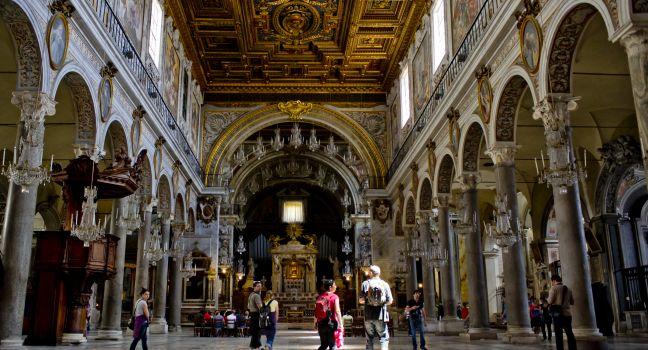
Perched atop 124 steps, on the north slope of the Capitoline Hill, Santa Maria in Aracoeli occupies the site of the temple of Juno Moneta (Admonishing Juno), which also housed the Roman mint. According to legend, it was here that the Sibyl, a prophetess, predicted to Augustus the coming of a Redeemer. Augustus responded by erecting an altar, the Ara Coeli (Altar of Heaven). This was eventually replaced by a Benedictine monastery and then by a church, which was passed in 1250 to the Franciscans, who restored and enlarged it in Romanesque-Gothic style.

Today, the Aracoeli is best known for the Santo Bambino, a much-revered olivewood figure of the Christ Child (a copy of the 15th-century original, which was stolen in 1994). At Christmas, everyone pays homage to the "Bambinello" as children recite poems from a miniature pulpit. In true Roman style, the church interior is a historical hodgepodge, with classical columns and large marble fragments from pagan buildings, as well as a 13th-century cosmatesque pavement. The richly gilded Renaissance ceiling commemorates the naval victory at Lepanto in 1571 over the Turks. The first chapel on the right is noteworthy for Pinturicchio's frescoes of St. Bernardino of Siena (1486).

Scala dell'Arce Capitolina 14, Rome, 00186, Italy
06-69763839

Something incorrect in this review?

Capuchin Museum

Quirinale
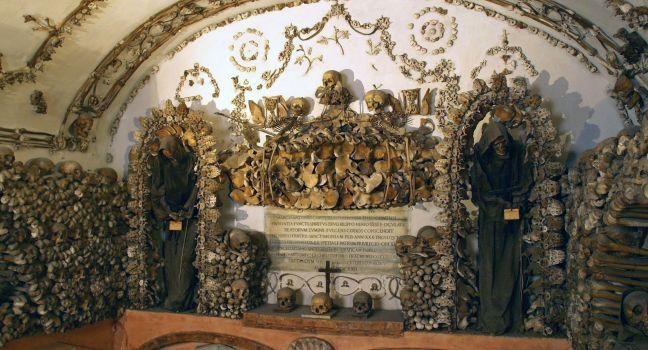
The Capuchin Crypt is a small space comprising several tiny chapels located beneath the church of Santa Maria della Concezione dei Cappuccini on the Via Veneto near Piazza Barberini in Rome, Italy. It contains the skeletal remains of 4,000 bodies believed
Luigi Roscia | Dreamstime.com

Devoted to teaching visitors about the Capuchin order, this museum is mainly notable for its strangely touching and beautiful crypt under the church of Santa Maria della Concezione. The bones of some 4,000 friars are arranged in odd decorative designs around the shriveled and decayed remains of their kinsmen, a macabre reminder of the impermanence of earthly life. As one sign proclaims: "What you are, we once were. What we are, you someday will be."

Upstairs in the church, the first chapel on the right contains Guido Reni's mid-17th-century Archangel St. Michael Trampling the Devil. The painting caused great scandal after an astute contemporary observer remarked that the face of the devil bore a surprising resemblance to Pope Innocent X, archenemy of Reni's Barberini patrons. Compare the devil with the bust of the pope that you saw in the Palazzo Doria Pamphilj and judge for yourself.

Mausoleo di Cecilia Metella

Via Appia Antica
Mausoleo di Cecelia Metella Fachade in Via Appia antica at Rome - Italy.
Pablo Debat/Shutterstocik

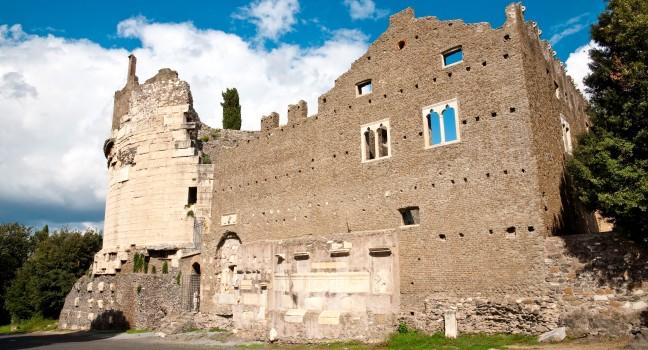
For centuries, sightseers have flocked to this famous landmark, one of the most complete surviving tombs of ancient Rome. Of the many round mausoleums that once lined the Appian Way, this tomb is a smaller version of the Mausoleum of Augustus but impressive nonetheless. It was the burial place of a Roman noblewoman: the wife of the son of Crassus, who was one of Julius Caesar's rivals and known as the richest man in the Roman Empire (infamously entering the English language as "crass").

The original decoration includes a frieze of bulls' skulls near the top. The travertine stone walls were made higher, and the medieval-style crenellations were added when the tomb was transformed into a fortress by the Caetani family in the 14th century. An adjacent chamber houses a small museum with exhibits on the area's geological phases. Entrance to this site also includes access to the splendid Villa dei Quintili.

Via Appia Antica, 161, Rome, 00178, Italy
06-7886254
Sight Details
€8, includes 4 sites in the Parco dell'Appia Antica (Mausoleo di Cecilia Metella, Villa dei Quintili, Antiquarium di Lucrezia Romana, Complesso di Capo di Bove)
Closed Mon.

Something incorrect in this review?

Palazzo Mattei di Giove

Jewish Ghetto
Palazzo Mattei di Giove, Rome, Italy
© Zach Nelson / Fodors Travel

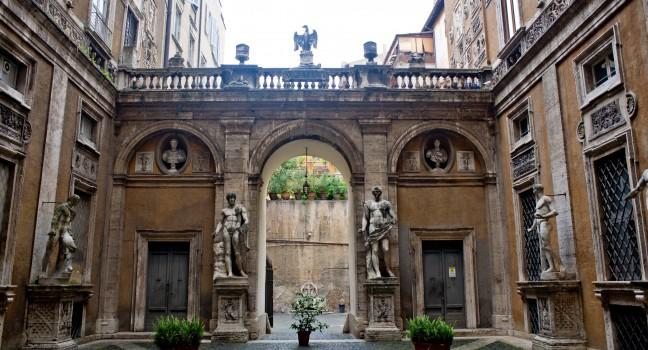
Graceful and opulent, the arcaded, multistory courtyard of this palazzo is a masterpiece of turn-of-the-17th-century style. Designed by Carlo Maderno, it is a veritable panoply of sculpted busts, heroic statues, sculpted reliefs, and Paleo-Christian epigrams, all collected by Marchese Asdrubale Mattei. Inside are various scholarly institutes, including the Centro Studi Americani (Center for American Studies), which also contains a library of American books. Salons in the palace (not usually open to visitors) are decorated with frescoes by Cortona, Lanfranco, and Domenichino.

Via Michelangelo Caetani, 32, Rome, 00186, Italy
06-68801613-Centro Studi Americani
Sight Details
Closed weekends

Something incorrect in this review?

San Carlo alle Quattro Fontane

Quirinale
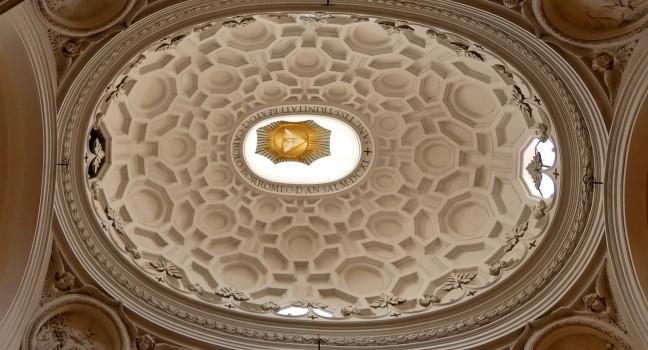
Elliptic dome of San Carlo alle Quattro Fontane (1638-1641) in Rome, designed by Francesco Borromini.
Marie-Lan Nguyen [public domain], via Wikimedia Commons

Sometimes known as San Carlino because of its tiny size, this is one of Borromini's masterpieces. In a space no larger than the base of one of the piers of St. Peter's Basilica, he created a church that is an intricate exercise in geometric perfection, with a coffered dome that seems to float above the curves of the walls. Borromini's work is often bizarre, definitely intellectual, and intensely concerned with pure form. In San Carlo, he invented an original treatment of space that creates an effect of rippling movement, especially evident in the double-S curves of the facade. Characteristically, the interior decoration is subdued, in white stucco with no more than a few touches of gilding, so as not to distract from the form. Don't miss the cloister: a tiny, understated Baroque jewel, with a graceful portico and loggia above, echoing the lines of the church.

Via del Quirinale, 23, Rome, 00187, Italy
06-48907729
Sight Details
Closed Sun.

Something incorrect in this review?