182 Best Sights in Rome, Italy

Background Illustration for Sights

We've compiled the best of the best in Rome - browse our top choices for the top things to see or do during your stay.

Ara Pacis Augustae

Piazza di Spagna Fodor's choice
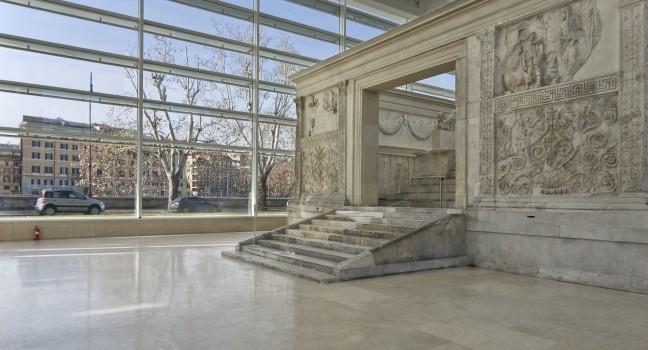
Rome. Ara Pacis from new museum complex.
(c) Archeofoto | Dreamstime.com

This pristine monument sits inside one of Rome's contemporary architectural landmarks: a gleaming, rectangular, glass-and-travertine structure designed by American architect Richard Meier. It overlooks the Tiber on one side and the ruins of the marble-clad Mausoleo di Augusto (Mausoleum of Augustus) on the other and is a serene, luminous oasis right in the center of Rome.

This altar itself dates from 13 BC and was commissioned to celebrate the Pax Romana, the era of peace ushered in by Augustus's military victories. When viewing it, keep in mind that the spectacular reliefs would have been painted in vibrant colors, now long gone. The reliefs on the short sides portray myths associated with Rome's founding and glory; those on the long sides display a procession of the imperial family. Although half of his body is missing, Augustus is identifiable as the first full figure at the procession's head on the south-side frieze; academics still argue over exact identifications of most of the figures. Be sure to check out the small downstairs museum, which hosts rotating exhibits on Italian culture, with themes ranging from design to film.

Lungotevere in Augusta, Rome, 00186, Italy
06-0608
Sight Details
€12, €13 when there is an exhibition
Reservations essential for groups of 11 to 25 persons

Something incorrect in this review?

Arco di Settimio Severo

Campitelli Fodor's choice
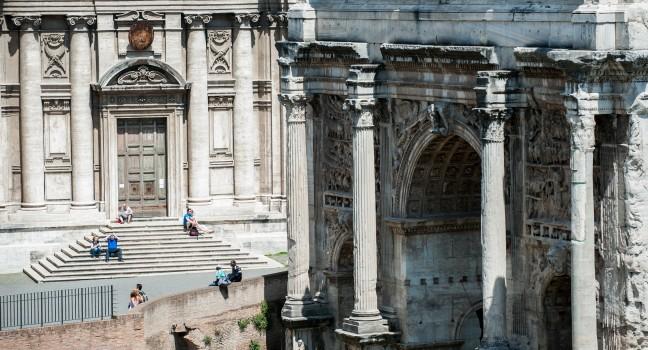
Arco di Settimio Severo, Rome, Italy
© Ross Brinkerhoff / Fodor’s Travel

One of the grandest triumphal arches erected by a Roman emperor, this richly decorated monument was built in AD 203 to celebrate Severus's victory over the Parthians. It was once topped by a bronze statuary group depicting a chariot drawn by four (or perhaps as many as six) life-size horses. Masterpieces of Roman statuary, the stone reliefs on the arch were probably based on huge painted panels depicting the event, a kind of visual report on his foreign campaigns that would have been displayed during the emperor's triumphal parade in Rome to impress his subjects (and, like much statuary then, were originally painted in florid, lifelike colors).

West end of Foro Romano, Rome, 00186, Italy
Sight Details
€18 24-hr ticket required

Something incorrect in this review?

Basilica di San Pietro

Vatican Fodor's choice
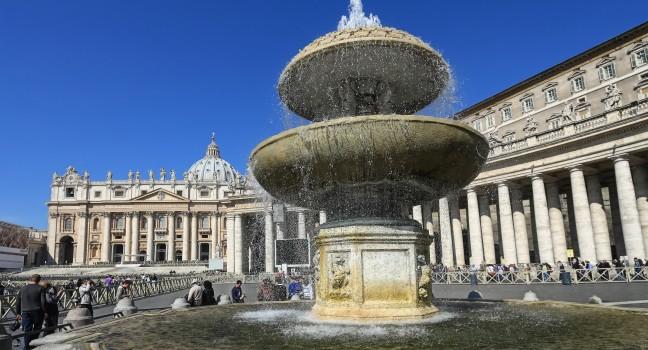
Vatican fountain.
WDG Photo / Shutterstock

The world's largest church, built over the tomb of St. Peter, is the most imposing and breathtaking architectural achievement of the Renaissance (although much of the lavish interior dates to the Baroque period). No fewer than five of Italy's greatest artists—Bramante, Raphael, Peruzzi, Antonio da Sangallo the Younger, and Michelangelo—died while striving to erect this new St. Peter's.

The history of the original St. Peter's goes back to AD 326, when the emperor Constantine completed a basilica over the site of the tomb of St. Peter, the Church's first pope. The original church stood for more than 1,000 years, undergoing a number of restorations and alterations, until, toward the middle of the 15th century, it was on the verge of collapse. In 1452, a reconstruction job began but was abandoned for lack of money.

In 1503, Pope Julius II instructed the architect Bramante to raze all the existing buildings and build a new basilica, one that would surpass even Constantine's for grandeur. It wasn't until 1626 that the new basilica was completed and consecrated.

Highlights include the Loggia delle Benedizioni (Benediction Loggia), the balcony where newly elected popes are proclaimed; Michelangelo's Pietà; and Bernini's great bronze baldacchino, a huge, spiral-columned canopy—at 100,000 pounds, perhaps the largest bronze object in the world—as well as many other Bernini masterpieces. There are also collections of Vatican treasures in the Museo Storico-Artistico e Tesoro and the Grotte Vaticane crypt.

For views of both the dome above and the piazza below, take the elevator or stairs to the roof. Those with more stamina (and without claustrophobia) can then head up more stairs to the apex of the dome.

 The basilica is free to visit, but a security check at the entrance can create very long lines. Arrive before 8:30 or after 5:30 to minimize the wait and avoid the crowds.

Piazza San Pietro, Rome, 00120, Italy
Sight Details
Free
Closed during Papal General Audience (Wed. until 1 pm) and during other ceremonies in piazza

Something incorrect in this review?

Recommended Fodor's Video

The Campidoglio

Piazza Venezia Fodor's choice
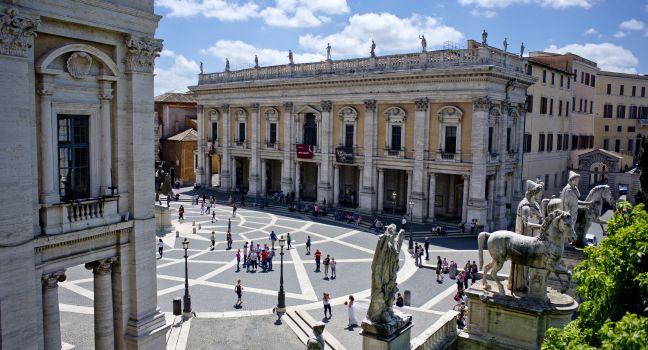
The Campidoglio, Campidoglio, Ancient Rome, Italy.
© Zach Nelson / Fodors Travel

Spectacularly transformed by Michelangelo's late-Renaissance designs, the Campidoglio was once the epicenter of the Roman Empire, the place where the city's first shrines stood, including its most sacred, the Temple of Jupiter. The Capitoline Hill originally consisted of two peaks: the Capitolium and the Arx (where Santa Maria in Aracoeli now stands). The hollow between them was known as the Asylum. Here, prospective settlers once came to seek the protection of Romulus, legendary first king of Rome—hence the term "asylum." Later, during the Republic, in 78 BC, the Tabularium, or Hall of Records, was erected here.

By the Middle Ages, however, the Capitoline had become an unkempt hill strewn with ancient rubble. In preparation for the impending visit of Charles V in 1536, triumphant after the empire's victory over the Moors, his host, Pope Paul III Farnese, decided that the Holy Roman Emperor should follow the route of the emperors, finishing triumphantly at the Campidoglio. The pope was embarrassed by the decrepit goat pasture the hill had become and so commissioned Michelangelo to restore the site to glory. The resulting design added a third palace along with Renaissance-style facades and a grand paved piazza. Newly excavated ancient sculptures, designed to impress the visiting emperor, were installed in the palaces, and the piazza was ornamented with the giant stone figures of the Discouri and the ancient Roman equestrian statue of Emperor Marcus Aurelius. A copy of this extraordinary statue is still the piazza's centerpiece (the 2nd-century original has been housed in the neighbouring Musei Capitolini since 1999).

While there are great views of the Roman Forum from the terrace balconies to either side of the Palazzo Senatorio, the best view is from the 1st century BC Tabularium, now part of the Musei Capitolini. The museum café is on the Terrazza Caffarelli, with a magical view toward Trastevere and St. Peter's, and is accessible without a museum ticket.

Cappella Sistina

Vatican Fodor's choice
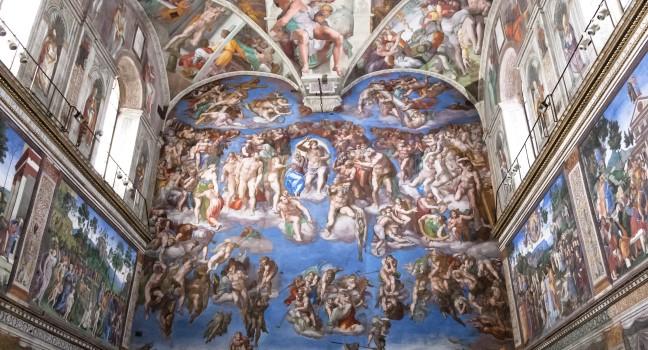
The Last Judgement, Sistine Chapel, Vatican, Rome
(c) Anitasstudio | Dreamstime.com

In 1508, the redoubtable Pope Julius II commissioned Michelangelo to fresco the more than 10,000 square feet of the Sistine Chapel's ceiling. (Sistine, by the way, is simply the adjective form of Sixtus, in reference to Pope Sixtus IV, who commissioned the chapel itself.) The task took four years, and it's said that, for many years afterward, Michelangelo couldn't read anything without holding it over his head. The result, however, was the greatest artwork of the Renaissance. A pair of binoculars helps greatly, as does a small mirror—hold it facing the ceiling and look down to study the reflection.

More than 20 years after his work on the ceiling, Michelangelo was called on again, this time by Pope Paul III, to add to the chapel's decoration by painting the Last Judgment on the wall over the altar. By way of signature on this, his last great fresco, Michelangelo painted his own face on the flayed-off human skin in St. Bartholomew's hand. 

The chapel is entered through the Musei Vaticani, and lines are slightly shorter after 2:30 (reservations are always advisable)—except free Sundays, which are extremely busy and when admissions close at 12:30.

Colosseum

Colosseo Fodor's choice
Colosseum, Rome, Italy
© Ross Brinkerhoff / Fodor’s Travel

The most spectacular extant edifice of ancient Rome, the Colosseum has a history that is half gore, half glory. Once able to house 50,000 spectators, it was built to impress Romans with its spectacles involving wild animals and fearsome gladiators from the farthest reaches of the empire. Senators had marble seats up front, the vestal virgins took the ringside position, the plebs sat in wooden tiers at the back, and the masses watched from the top tier. Looming over all was the amazing velarium, an ingenious system of sail-like awnings rigged on ropes and maneuvered by sailors from the imperial fleet, who would unfurl them to protect the arena's occupants from sun or rain.

From the second floor, you can get a bird's-eye view of the hypogeum—the subterranean passageways that were the architectural engine rooms that made the slaughter above proceed like clockwork. In a scene prefiguring something from Dante's Inferno, hundreds of beasts would wait to be launched via a series of slave-powered hoists and lifts into the bloodthirsty sand of the arena above.

Designed by order of the emperor Vespasian in AD 72 and completed by his son Titus in AD 80, the arena has a circumference of 573 yards, and its external walls were built with travertine from nearby Tivoli. Its construction was a remarkable feat of engineering, for it stands on marshy terrain reclaimed by draining an artificial lake that formed part of the vast palace of Nero. Originally known as the Flavian amphitheater (Vespasian's and Titus's family name was Flavius), it came to be known as the Colosseum thanks to a colossal gilded bronze statue that once stood nearby.

The legend made famous by the Venerable Bede says that as long as the Colosseum stands, Rome will stand; and when Rome falls, so will the world . . . not that the prophecy deterred medieval and Renaissance princes and popes from using the Colosseum as a quarry. In the 19th century, poets came to view the arena by moonlight; today, mellow golden spotlights make the arena a spectacular sight at night, and evening visits are possible with guided tours from May through October. To enter, book a combination ticket (with the Roman Forum and Palatine Hill) in advance online, though if you have a Roma Pass, you can use it.

Tickets cost €18. Aim for early or late slots to minimize lines, as even the preferential lanes get busy in the middle of the day. Alternatively, you can book a tour online with a company (do your research to make sure it's reputable) that lets you skip the line. Avoid the tours sold on the spot around the Colosseum; although you can skip the lines, the tour guides tend to be dry, the tour groups huge, and the tour itself rushed. To see the arena or the underground, you must purchase a special timed-entry ticket with those features, though the arena is included if you buy the Roman Forum–Palatine complex €24 two-day Full Experience ticket.

Piazza del Colosseo, Rome, 00184, Italy
Sight Details
Requires either the €18 24-hr ticket or the €24 Full Experience ticket (can include the arena, the underground, and/or the attic for no additional fee, but it must be specified during the purchase)

Something incorrect in this review?

Galleria Borghese

Villa Borghese Fodor's choice
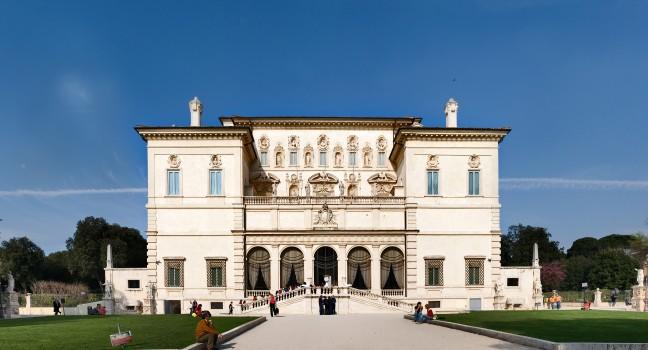
Villa Borghese, Galleria Borghese, Roma, Italy.
Khirman Vladimir / Shutterstock

It's toss-up as to which is more magnificent: the museum or the art that lies within it. The luxury-loving Cardinal Scipione Borghese had the museum custom built in 1612 as a showcase for his collection of both antiquities and more "modern" works, including those he commissioned from the masters Caravaggio and Bernini. Today, it's a monument to Roman interior decoration at its most extravagant.

One of the collection's most famous works is Canova's neoclassical sculpture Pauline Borghese as Venus Victorious. The next three rooms hold three key early Baroque sculptures: Bernini's David; Apollo and Daphne; and The Rape of Persephone. All were done when the artist was in his twenties and all illustrate his extraordinary skill. Apollo and Daphne shows the moment when, to aid her escape from the pursuing Apollo, Daphne is turned into a laurel tree. Leaves and twigs sprout from her fingertips as she stretches agonizingly away from Apollo. In The Rape of Persephone, Pluto has either just plucked Persephone (or Proserpina) from her flower-picking or is in the process of returning to Hades with his prize. Note the realistic way his grip causes dimples in Persephone's flesh. This is the stuff that makes the Baroque exciting—and moving. Other Berninis on view include a large, unfinished figure called Verità, or Truth.

Room 8 contains six paintings by Caravaggio, the hotheaded genius who died at age 37. All of his paintings, even the charming Boy with a Basket of Fruit, have an undercurrent of darkness. The disquieting Sick Bacchus is a self-portrait of the artist who, like the god, had a fondness for wine. David and Goliath, painted in the last year of Caravaggio's life—while he was on the run, murder charges hanging over his head—includes his self-portrait in the head of Goliath. Upstairs, the Pinacoteca (Picture Gallery) boasts paintings by Raphael (including his moving Deposition), Pinturicchio, Perugino, Bellini, and Rubens. Probably the gallery's most famous painting is Titian's allegorical Sacred and Profane Love, a mysterious image with two female figures, one nude, one clothed.  Admission to the Galleria Borghese is by reservation only. Visitors are admitted in two-hour shifts 9–5. Prime-time slots sell out days in advance, so reserve directly (and early) through the museum's website.

Piazzale Scipione Borghese, 5, Rome, 00197, Italy
06-32810-reservations
Sight Details
€15, including €2 reservation fee; increased fee during temporary exhibitions
Closed Mon.
Reservations essential

Something incorrect in this review?

MAXXI—Museo Nazionale delle Arti del XXI Secolo

Flaminio Fodor's choice
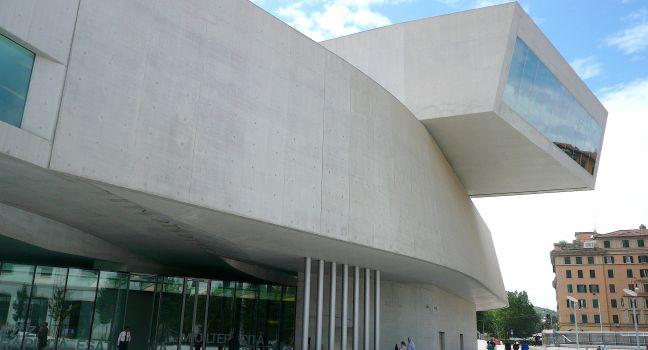
MAXXI, national museum of arts of XXI century by Zaha Hadid architect in Rome, Italy.
(c) Enrysacc | Dreamstime.com

Designed by the late Iraqi-British architect Zaha Hadid, this modern building plays with lots of natural light and has curving and angular lines, big open spaces, glass ceilings, and steel staircases that twist through the air—all meant to question the division between "within" and "without." The MAXXI hosts temporary exhibitions of art, architecture, film, and more. The permanent collection, displayed on a rotating basis, has more than 350 works from modern and contemporary artists, including Andy Warhol, Francesco Clemente, and Gerhard Richter.

Via Guido Reni, 4/A, Rome, 00196, Italy
06-3201954
Sight Details
€15
Closed Mon.

Something incorrect in this review?

Musei Capitolini

Campitelli Fodor's choice
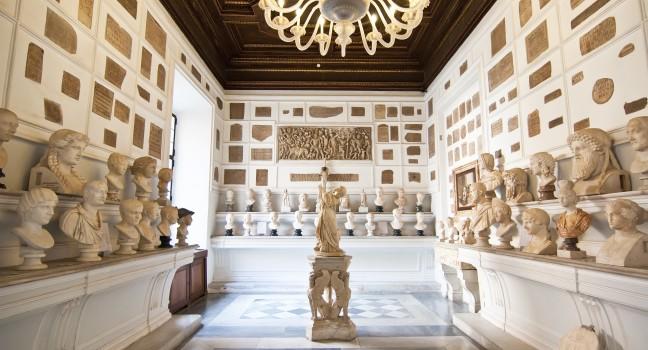
Inside one of the rooms of the Capitoline Museums in Rome, Italy  The museum was opened to the public at the wish of Pope Clement XII in 1734.
Chanclos/Shutterstock

Surpassed in size and richness only by the Musei Vaticani, the world's first public museum—with the greatest hits of Roman art through the ages, from the ancients to the Baroque—is housed in the Palazzo dei Conservatori and the Palazzo Nuovo, which mirror one another across Michelangelo's famous piazza. The collection was begun by Pope Sixtus IV (the man who built the Sistine Chapel) in 1473, when he donated a room of ancient statuary to the people of the city. This core of the collection includes the She Wolf, which is the symbol of Rome, and the piercing gaze of the Capitoline Brutus.

Buy your ticket and enter the Palazzo dei Conservatori, where in the first courtyard, you'll see the giant head, foot, elbow, and imperially raised finger of the fabled seated statue of Constantine, which once dominated the Basilica of Maxentius in the Forum. Upstairs is the resplendent Sala degli Orazi e Curiazi (Hall of the Horatii and Curatii), decorated with a magnificent gilt ceiling, carved wooden doors, and 16th-century frescoes depicting the history of Rome's legendary origins. At each end of the hall are statues of two of the most important popes of the Baroque era, Urban VIII and Innocent X.

The heart of the museum is the modern Exedra of Marcus Aurelius (Esedra di Marco Aurelio), which displays the spectacular original bronze statue of the Roman emperor whose copy dominates the piazza outside. To the right, the room segues into the area of the Temple of Jupiter, with the ruins of part of its vast base rising organically into the museum space. A reconstruction of the temple and the Capitoline Hill from the Bronze Age to the present day makes for a fascinating glimpse through the ages. On the top floor, the museum's pinacoteca, or painting gallery, has some noted Baroque masterpieces, including Caravaggio's The Fortune Teller and St. John the Baptist.

To get to the Palazzo Nuovo section of the museum, take the stairs or elevator to the basement of the Palazzo dei Conservatori, where the corridor uniting the two contains the Epigraphic Collection, a poignant assembly of ancient gravestones. Just over halfway along the corridor, and before going up into the Palazzo Nuovo, be sure to take the staircase to the right to the Tabularium gallery and its unparalleled view over the Forum.

On the stairs inside the Palazzo Nuovo, you'll be immediately dwarfed by Mars in full military rig and lion-topped sandals. Upstairs is the noted Sala degli Imperatori, lined with busts of Roman emperors, and the Sala dei Filosofi, where busts of philosophers sit in judgment—a fascinating who's who of the ancient world. Within these serried ranks are 48 Roman emperors, ranging from Augustus to Theodosius. Nearby are rooms filled with sculptural masterpieces, including the famed Dying Gaul, the Red Faun from Hadrian's Villa, and a Cupid and Psyche.

Piazza del Campidoglio, 1, Rome, 00186, Italy
06-0608
Sight Details
€13 (€15.50 with exhibitions); €13.50 with access to Centrale Montemartini; €4 audio guide

Something incorrect in this review?

Musei Vaticani

Vatican Fodor's choice
A double spiral staircase in Vatican, Italy.
Fedor Selivanov / Shutterstock

Other than the pope and his papal court, the occupants of the Vatican are some of the most famous artworks in the world. The Vatican Palace, residence of the popes since 1377, consists of an estimated 1,400 rooms, chapels, and galleries. The pope and his household occupy only a small part; most of the rest is given over to the Vatican Library and Museums.

Beyond the glories of the Sistine Chapel, the collection is extraordinarily rich: highlights include the great antique sculptures (including the celebrated Apollo Belvedere in the Octagonal Courtyard and the Belvedere Torso in the Hall of the Muses); the Stanze di Raffaello (Raphael Rooms), with their famous gorgeous frescoes; and the Old Master paintings, such as Leonardo da Vinci's beautiful (though unfinished) St. Jerome in the Wilderness, some of Raphael’s greatest creations, and Caravaggio’s gigantic Deposition in the Pinacoteca ("Picture Gallery").

For those interested in guided visits to the Vatican Museums, tours start at €40, including entrance tickets, and can also be booked online. Other offerings include a regular three-hour guided tour of the Vatican gardens; call or check online to confirm. For more information, call  06/69884676 or go to  www.museivaticani.va. For information on tours, call  06/69883145 or  06/69884676; visually impaired visitors can arrange tactile tours by calling  06/69884947.

Viale Vaticano, Rome, 00165, Italy
06-69883145
Sight Details
€20
Closed Sun. (except the last Sun. of each month) and Roman Catholic holidays

Something incorrect in this review?

Museo Nazionale Etrusco di Villa Giulia

Villa Borghese Fodor's choice
Museo Etrusco di villa giulia
(c) Mariocarbone | Dreamstime.com

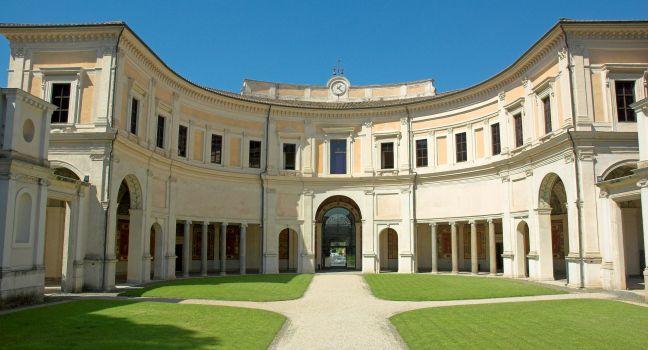
The world's most outstanding collection of Etruscan art and artifacts is housed in Villa Giulia, built around 1551 for Pope Julius III. Among the team called in to plan and construct the villa were Michelangelo and fellow Florentine Vasari. Most of the actual work, however, was done by Vignola and Ammannati. The villa's nymphaeum—or sunken sculpture garden—is a superb example of a refined late-Renaissance setting for princely pleasures.

No one knows precisely where the Etruscans originated, but many scholars maintain they came from Asia Minor, appearing in Italy about 2000 BC and creating a civilization that was a dazzling prelude to that of the ancient Romans. Among the most striking pieces are the terra-cotta statues, such as the Apollo of Veii and the serenely beautiful Sarcophagus of the Spouses. Dating from 530–500 BC, this couple (or Sposi) look at the viewer with almond eyes and archaic smiles, suggesting an openness and joie de vivre rare in Roman art. Other highlights include the cinematic frieze from a later temple (480 BC) in Pyrgi, resembling a sort of Etruscan Elgin marbles in terra-cotta; the displays of Etruscan jewelry; and the beautiful gardens.

Piazzale di Villa Giulia, 9, Rome, 00196, Italy
06-3226571
Sight Details
€12
Closed Mon.

Something incorrect in this review?

Palazzo Altemps

Piazza Navona Fodor's choice
Bust, Hall, Palazzo Altemps, Rome, Italy
© Ross Brinkerhoff / Fodors Travel

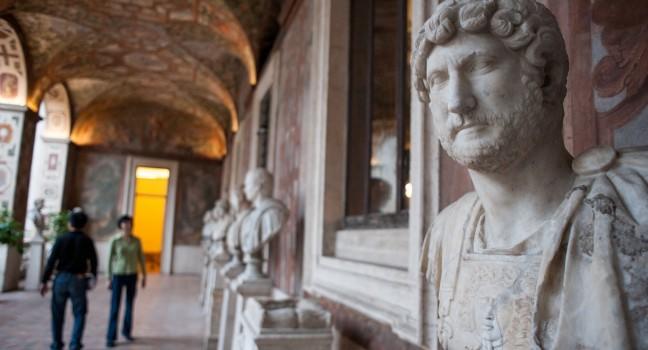
Containing some of the world's finest ancient Roman marbles, Palazzo Altemps is part of the Museo Nazionale Romano. The palace's sober exterior belies a magnificence that appears as soon as you walk into the majestic courtyard, studded with statues and covered in part by a retractable awning. The restored interior hints at the Roman lifestyle of the 16th–18th centuries while showcasing the most illustrious pieces from the Museo Nazionale, including the collection of the Ludovisi noble family.

In the frescoed salons you can see the Galata Suicida, a poignant sculptural work portraying a barbarian warrior who chooses death for himself and his wife rather than humiliation by the enemy. Another highlight is the large Ludovisi sarcophagus, magnificently carved from marble. In a place of honor is the Ludovisi Throne, which shows a goddess emerging from the sea and being helped by her acolytes. For centuries this was heralded as one of the most sublime Greek sculptures, but today at least one authoritative art historian considers it a colossally overrated fake. Look for the framed explanations of the exhibits that detail (in English) how and exactly where Renaissance sculptors, Bernini among them, added missing pieces to the classical works.

In the lavishly frescoed loggia stand busts of the Caesars. In the wing once occupied by early-20th-century poet Gabriele d'Annunzio (who married into the Altemps family), three rooms host the museum's Egyptian collection.

Piazza di Sant'Apollinare, 46, Rome, 00186, Italy
Sight Details
€8; €16 combined ticket includes 3 other Museo Nazionale Romano sites over 1 wk (Crypta Balbi, Palazzo Massimo alle Terme, and Museo delle Terme di Diocleziano)
Closed Mon.

Something incorrect in this review?

Palazzo Doria Pamphilj

Trevi Fodor's choice
View of the courtyard of the Palazzo Pamphili in Rome, italy
(c) Kpapaioanno | Dreamstime.com

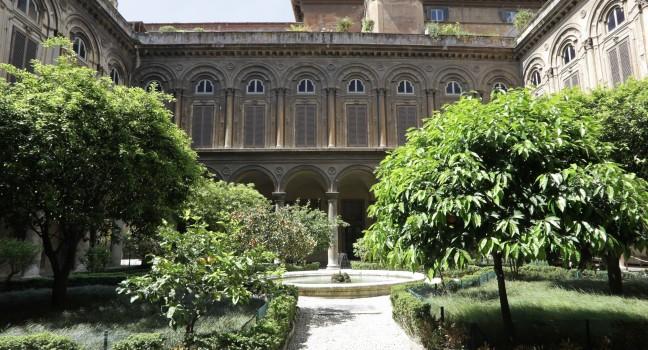
Like the Palazzo Colonna and the Galleria Borghese, this dazzling 15th-century palace provides a fantastic glimpse of aristocratic Rome. It passed through several hands before becoming the property of the Pamphilj family, who married into the famous seafaring Doria family of Genoa in the 18th century. The family still lives in part of the palace.

The understated beauty of the graceful facade, designed by Gabriele Valvassori in 1730 and best admired from the opposite side of the street, barely hints at the interior's opulent halls and gilded galleries, which are filled with Old Master works. The 550 paintings here include three by Caravaggio: St. John the Baptist, Mary Magdalene, and the breathtaking Rest on the Flight to Egypt. Off the eye-popping Galleria degli Specchi (Gallery of Mirrors)—a smaller version of the one at Versailles—are the famous Velázquez Pope Innocent X, considered by some historians to be the greatest portrait ever painted, and the Bernini bust of the same Pamphilj pope.

A delightful audio guide is included in the ticket price and is narrated by the current heir, Prince Jonathan Doria Pamphilj, who divulges intimate family history. Plan to stay for lunch, or at least pause for a coffee, at the fashionable Caffè Doria, with elegant tables set out in the palace's peaceful cloisters.

Palazzo Farnese

Campo de' Fiori Fodor's choice
Soccer, Palazzo Farnese, Rome, Italy
© Zach Nelson / Fodors Travel

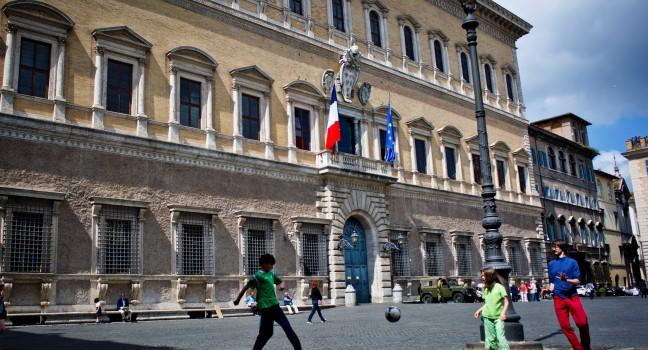
Rome's most beautiful Renaissance palace is fabled for its Galleria Carracci, whose ceiling is to the Baroque age what the Sistine Chapel ceiling is to the Renaissance. The Farnese family rose to great power and wealth during the Renaissance, in part because of the favor Pope Alexander VI showed to the beautiful Giulia Farnese. The massive palace was begun when, with Alexander's aid, Giulia's brother became cardinal; it was further enlarged on his election as Pope Paul III in 1534.

The uppermost frieze decorations and main window overlooking the piazza are the work of Michelangelo, who also designed part of the courtyard, as well as the graceful arch over Via Giulia at the back. The facade on Piazza Farnese has geometrical brick configurations that have long been thought to hold some occult meaning. When looking up at the palace, try to catch a glimpse of the splendid frescoed ceilings, including the Galleria Carracci vault painted by Annibale Carracci between 1597 and 1604. 

The Carracci gallery depicts the loves of the gods, a supremely pagan theme that the artist painted in a swirling style that announced the birth of the Baroque. Other opulent salons are among the largest in Rome, including the Salon of Hercules, which has an impressive replica of the ancient Farnese Hercules. The French Embassy, which occupies the palace, offers tours (in English) on Monday, Wednesday, and Friday; book at least a few weeks (and up to eight months) in advance through the website and bring a photo ID.

Palazzo Massimo alle Terme

Repubblica Fodor's choice
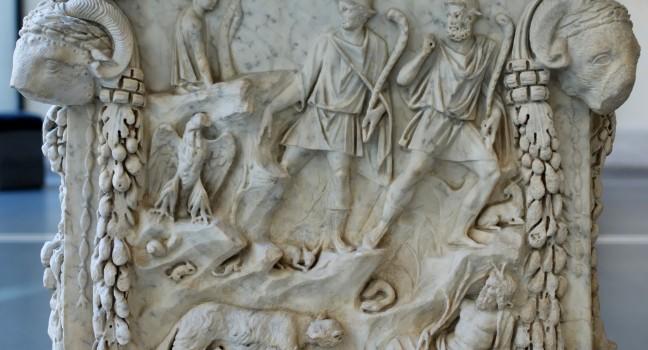
Representation of the lupercal: Romulus and Remus fed by a she-wolf, surrounded by representations of the Tiber and the Palatine. Panel from an alter dedicated to the divine couple of Mars and Venus. Marble, Roman artwork of the end of the reign of Trajan
By Marie-Lan Nguyen (2006) [Public domain], via Wikimedia Commons

The Museo Nazionale Romano, with items ranging from striking classical Roman paintings to marble bric-a-brac, has four locations: Palazzo Altemps, Crypta Balbi, the Museo delle Terme di Diocleziano, and this, the Palazzo Massimo alle Terme—a vast structure containing the great ancient treasures of the archaeological collection and also the coin collection. Highlights include the Dying Niobid, the famous bronze Boxer at Rest, and the Discobolus Lancellotti.

Among the museum's most intriguing attractions, however, are the ancient frescoes on view on the top floor. They're stunningly set up to "recreate" the look of the homes they once decorated, and their colors are remarkably preserved. You'll see stuccoes and wall paintings found in the area of the Villa Farnesina (in Trastevere), as well as those depicting a garden in bloom and an orchard alive with birds that once covered the walls of cool sunken rooms at Empress Livia's villa in Prima Porta, just outside the city.

Largo di Villa Peretti, 2, Rome, 00185, Italy
06-39967700
Sight Details
€8, or €12 for a combined ticket including access to Crypta Balbi, Museo delle Terme di Diocleziano, and Palazzo Altemps (valid for 1 wk)
Closed Mon.

Something incorrect in this review?

Pantheon

Piazza Navona Fodor's choice
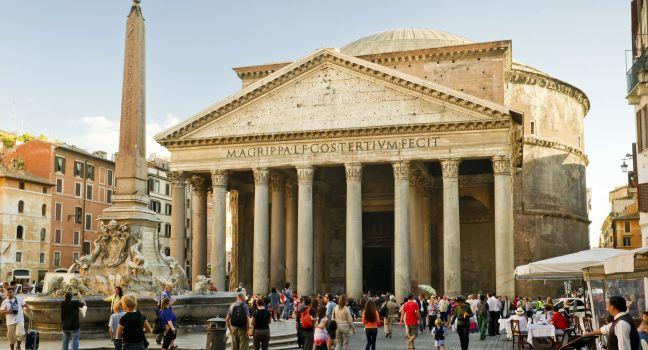
ROME - OCTOBER 2: Tourists visit the Pantheon on October 2, 2012 in Rome, Italy. Pantheon is a famous monument of ancient Roman culture, the temple of all the gods, built in the 2nd century.;
Viacheslav Lopatin/Shutterstock

The city's best-preserved ancient building, this former Roman temple is a marvel of architectural harmony and proportion. It was entirely rebuilt by the emperor Hadrian around AD 120 on the site of a Pantheon (from the Greek: pan, all, and theon, gods) erected in 27 BC by Augustus's right-hand man and son-in-law, Agrippa.

The most striking thing about the Pantheon is not its size, immense though it is, nor even the phenomenal technical difficulties posed by so massive a construction; rather, it's the remarkable unity of the building. The diameter described by the dome is exactly equal to its height. It's the use of such simple mathematical balance that gives classical architecture its characteristic sense of proportion and its nobility. The opening at the apex of the dome, the oculus, is nearly 30 feet in diameter and was intended to symbolize the "all-seeing eye of the heavens." On a practical note, this means when it rains, it rains inside: look out for the drainage holes in the floor.

Although little is known for sure about the Pantheon's origins or purpose, it's worth noting that the five levels of trapezoidal coffers (sunken panels in the ceiling) represent the course of the five then-known planets and their concentric spheres. Ruling over them is the sun, represented symbolically and literally by the 30-foot-wide eye at the top. The heavenly symmetry is further paralleled by the coffers: 28 to each row, the number of lunar cycles. In the center of each would have shone a small bronze star. Down below, the seven large niches were occupied not by saints, but, it's thought, by statues of Mars, Venus, the deified Caesar, and the other "astral deities," including the moon and sun, the "sol invictus." (Academics still argue, however, about which gods were most probably worshipped here.)

One of the reasons the Pantheon is so well preserved is that it was consecrated as a church in AD 608. (It's still a working church today.) No building, church or not, though, escaped some degree of plundering through the turbulent centuries of Rome's history after the fall of the empire. In 655, for example, the gilded bronze covering the dome was stripped. The Pantheon is also one of the city's important burial places. Its most famous tomb is that of Raphael (between the second and third chapels on the left as you enter). Mass takes place on Sunday and on religious holidays at 10:30; it's open to the public, but you are expected to arrive before the beginning and stay until the end. General access usually resumes at about 11:30.

You can buy tickets in person via cash or credit card, or online (which requires registering for an account). If you plan on purchasing tickets in person, coming prepared with both cash and a credit card will allow you to select the faster-moving line that day.  On the first Sunday of every month, visitors can enter for free.

Piazza del Popolo

Piazza del Popolo Fodor's choice
piazza del popolo
© Halie Cousineau/ Fodors Travel

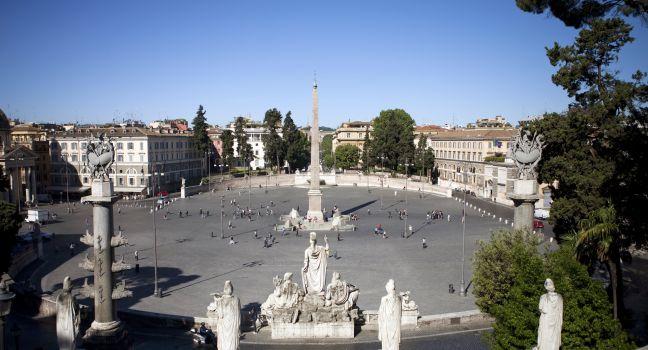
With its obelisk and twin churches, this immense square marks what was, for centuries, Rome's northern entrance, where all roads from the north converged and where visitors, many of them pilgrims, got their first impression of the Eternal City. The desire to make this entrance to Rome something special was a pet project of popes and their architects for more than three centuries. Although it was once crowded with fashionable carriages, the piazza today is a pedestrian zone. At election time, it's the scene of huge political rallies, and on New Year's Eve, Rome stages a mammoth alfresco party here.

Piazza Navona

Piazza Navona Fodor's choice
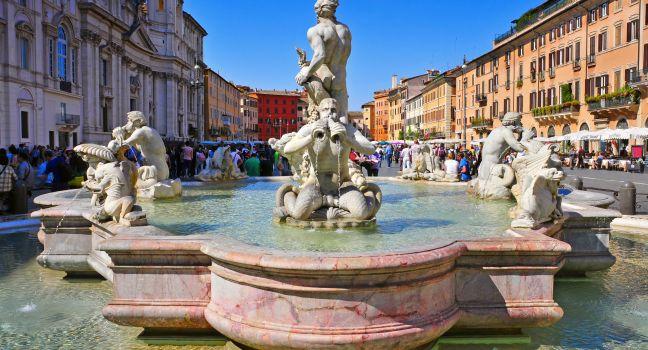
ROME, ITALY - APRIL 18: View of Fontana del Moro, in Piazza Navona, looking northwards on April 18, 2013 in Rome, Italy. This popular city square is the largest in Rome; Shutterstock ID 137683064; Project/Title: Fodor's Essential Europe insert; Downloader:
nito/Shutterstock

Always camera-ready, this beautiful plaza has Bernini sculptures, three gorgeous fountains, and a magnificently Baroque church (Sant'Agnese in Agone), all built atop the remains of a Roman athletics track. Pieces of the arena are still visible near the adjacent Piazza Sant'Apollinare, and the ancient spirit of entertainment lives on in the buskers and artists who populate the piazza today.

The piazza took on its current look during the 17th century, after Pope Innocent X of the Pamphilj family decided to make over his family palace (now the Brazilian embassy and an ultraluxe hotel) and its surroundings. Center stage is the Fontana dei Quattro Fiumi, created for Innocent by Bernini in 1651. Bernini's powerful figures of the four rivers represent the longest rivers of the known continents at the time: the Nile (his head covered because the source was unknown); the Ganges; the Danube; and the Plata (the length of the Amazon was then unknown). Popular legend has it that the figure of the Plata—the figure closest to Sant'Agnese in Agone—raises his hand before his eyes because he can't bear to look upon the church's "inferior" facade designed by Francesco Borromini, Bernini's rival.

If you want to sip a coffee with one of the most beautiful, if pricey, views in Rome, grab a seat at Piazza Navona. Just be aware that all the restaurants here are heavily geared toward tourists, so while it's a beautiful place for a drink, you can find cheaper, more authentic, and far better meals elsewhere. 

San Clemente

Celio Fodor's choice
San Clemente church mosaic, Rome, Italy.
Vlad G/Shutterstock

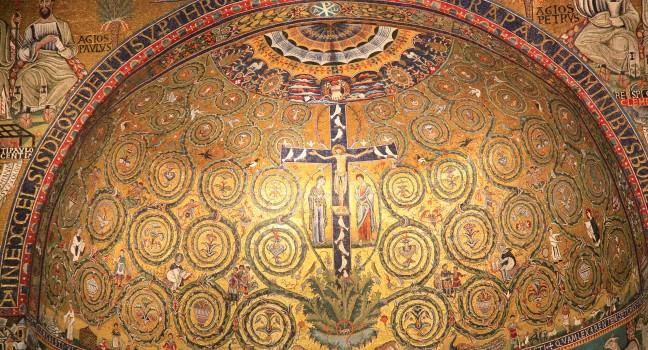
One of the most impressive archaeological sites in Rome, San Clemente is a historical triple-decker. A 12th-century church was built on top of a 4th-century church, which had been built over a 2nd-century pagan temple to the god Mithras and 1st-century Roman apartments. The layers were uncovered in 1857, when a curious prior, Friar Joseph Mullooly, started excavations beneath the present basilica. Today, you can descend to explore all three.

The upper church (at street level) is a gem in its own right. In the apse, a glittering 12th-century mosaic shows Jesus on a cross that turns into a living tree. Green acanthus leaves swirl and teem with small scenes of everyday life. Early Christian symbols, including doves, vines, and fish, decorate the 4th-century marble choir screens. In the left nave, the Castiglioni chapel holds frescoes painted around 1400 by the Florentine artist Masolino da Panicale (1383–1440), a key figure in the introduction of realism and one-point perspective into Renaissance painting. Note the large Crucifixion and scenes from the lives of saints Catherine, Ambrose, and Christopher, plus the Annunciation (over the entrance).

To the right of the sacristy (and bookshop), descend the stairs to the 4th-century church, used until 1084, when it was damaged beyond repair during a siege of the area by the Norman prince Robert Guiscard. Still intact are some vibrant 11th-century frescoes depicting stories from the life of St. Clement. Don't miss the last fresco on the left, in what used to be the central nave. It includes a particularly colorful quote—including "Go on, you sons of harlots, pull!"—that's not only unusual for a religious painting, but also one of the earliest examples of written vernacular Italian.

Descend an additional set of stairs to the Mithraeum, a shrine dedicated to the god Mithras. His cult spread from Persia and gained a foothold in Rome during the 2nd and 3rd centuries AD. Mithras was believed to have been born in a cave and was thus worshipped in cavernous, underground chambers, where initiates into the all-male cult would share a meal while reclining on stone couches, some visible here along with the altar block. Most such pagan shrines in Rome were destroyed by Christians, who often built churches over their remains, as happened here.

Via Labicana, 95, Rome, 00184, Italy
06-7740021
Sight Details
Archaeological area €10
Reservations required

Something incorrect in this review?

Sant'Ignazio

Trevi Fodor's choice
Rome - ceiling of Chiesa Sant Ignazio di Loyola - fresco
(c) Sedmak | Dreamstime.com

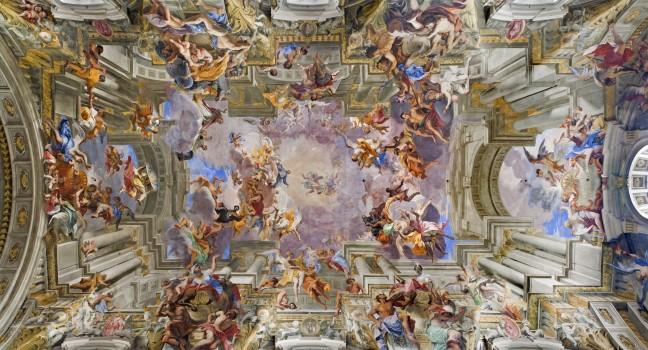
Rome's second Jesuit church, this 17th-century landmark set on a Rococo piazza harbors some of the city's most magnificent trompe l'oeils. To get the full effect of the illusionistic ceiling by priest-artist Andrea Pozzo, stand on the small yellow disk set into the floor of the nave. The heavenly vision that seems to extend upward almost indefinitely represents the Allegory of the Missionary Work of the Jesuits. It's part of Pozzo's cycle of works in this church exalting the early history of the Jesuit order, whose founder was the reformer Ignatius of Loyola. The saint soars heavenward, supported by a cast of thousands, creating a jaw-dropping effect that was fully intended to rival that of the glorious ceiling by Baciccia in the nearby mother church of Il Gesù. Be sure to have coins handy for the machine that switches on the lights so you can marvel at the false dome, which is actually a flat canvas—a trompe l'oeil trick Pozzo used when the architectural budget drained dry.

Scattered around the nave are several awe-inspiring altars; their soaring columns, gold-on-gold decoration, and gilded statues are pure splendor. Splendid, too, are the occasional sacred music concerts performed by choirs from all over the world. Look for posters by the main doors, or check the website for more information.

Santa Maria del Popolo

Piazza del Popolo Fodor's choice
The Basilica of Santa Maria del Popolo
© Halie Cousineau/ Fodors Travel

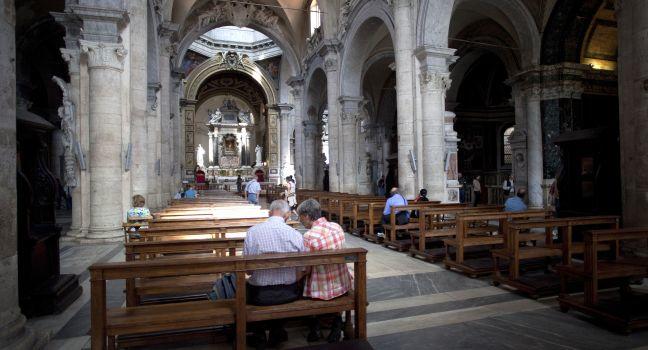
Standing inconspicuously in a corner of the vast Piazza del Popolo, this church often goes unnoticed, but the treasures inside make it a must for art lovers. Bramante enlarged the apse, which was rebuilt in the 15th century on the site of a much older place of worship. Inside, in the first chapel on the right, you'll see some frescoes by Pinturicchio from the mid-15th century; the adjacent Cybo Chapel is a 17th-century exercise in decorative marble.

Raphael designed the famous Chigi Chapel, the second on the left, with vault mosaics—showing God the Father in Benediction—as well as statues of Jonah and Elijah. More than a century later, Bernini added the oval medallions on the tombs and the statues of Daniel and Habakkuk. Finally, the Cerasi Chapel, to the left of the high altar, holds two Caravaggios: The Crucifixion of St. Peter and The Conversion of St. Paul. Exuding drama and realism, both are key early Baroque works that show how "modern" 17th-century art can appear. Compare their style with the much more restrained and classically "pure" Assumption of the Virgin by Annibale Carracci, which hangs over the altar of the chapel.

Santa Maria della Vittoria

Repubblica Fodor's choice
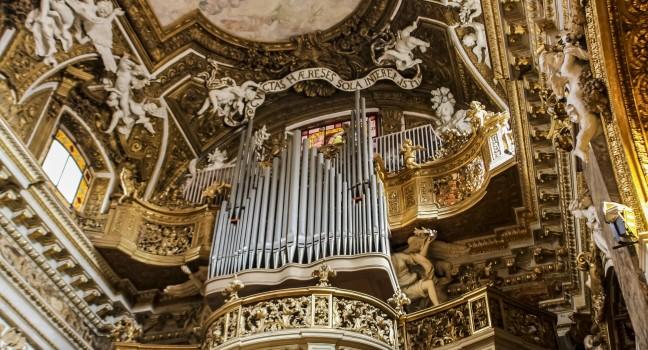
ROME, ITALY - JUNE 4: Cantoria of the Santa Maria della Vittoria church in Rome, Italy at June 4, 2012. Church was opened at 1620 and cantoria was decorated by Mattia de Rossi.
Goran Bogicevic/Shutterstock

Designed by Carlo Maderno, this church is best known for Bernini's sumptuous Baroque decoration of the Cappella Cornaro (Cornaro Chapel, the last on the left as you face the altar), which houses his interpretation of divine love in the Ecstasy of St. Teresa. Bernini's masterly fusion of sculpture, light, architecture, painting, and relief is a multimedia extravaganza, with the chapel modeled as a theater, and one of the key examples of the Roman High Baroque. The members of the Cornaro family meditate on the communal vision of the great moment of divine love before them: the swooning saint's robes appear to be on fire, quivering with life, and the white marble group seems suspended in the heavens as golden rays illuminate the scene. An angel assists as Teresa abandons herself to the joys of heavenly love. To modern eyes, Bernini's representation of the saint's experience may seem more earthly than mystical. As the visiting French dignitary Charles de Brosses put it in the 18th century, "If this is divine love, I know all about it." 

Via XX Settembre, 17, Rome, 00187, Italy
06-42740571

Something incorrect in this review?

Santa Maria in Cosmedin

Aventino Fodor's choice
Fountain, Santa Maria in Cosmedin, Rome, Italy
(c) Kpapaioanno | Dreamstime.com

One of Rome's oldest churches—built in the 6th century and restored in the late 19th century—is on the Piazza della Bocca della Verità, originally the location of the Forum Boarium, ancient Rome's cattle market and later the site of public executions. Although the church has a haunting interior and contains the flower-crowned skull of St. Valentine, who is celebrated every February 14th, it plays second fiddle to the renowned artifact installed out in its portico.

The Bocca della Verità (Mouth of Truth) is in reality nothing more than an ancient drain cover, unearthed during the Middle Ages. Legend has it, however, that the teeth will clamp down on a liar's hand if they dare to tell a fib while holding their fingers up to the fearsome mouth. Hordes of tourists line up to take the test every day (kids especially get a kick out of it).

Santa Maria in Trastevere

Trastevere Fodor's choice
Santa Maria in Trastevere, Trastevere, Rome, Italy.
© Zach Nelson / Fodors Travel

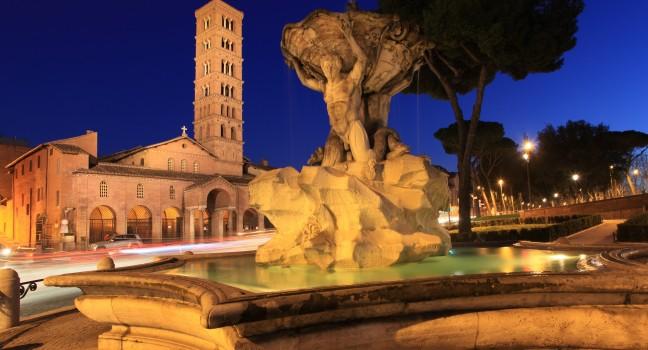
Built during the 4th century and rebuilt in the 12th century, this is one of Rome's oldest and grandest churches. It is also the earliest foundation of any Roman church to be dedicated to the Virgin Mary. The 18th-century portico draws attention to the facade's 800-year-old mosaics, which represent the parable of the Wise and Foolish Virgins. They enhance the whole piazza, especially at night, when the church front and bell tower are illuminated.

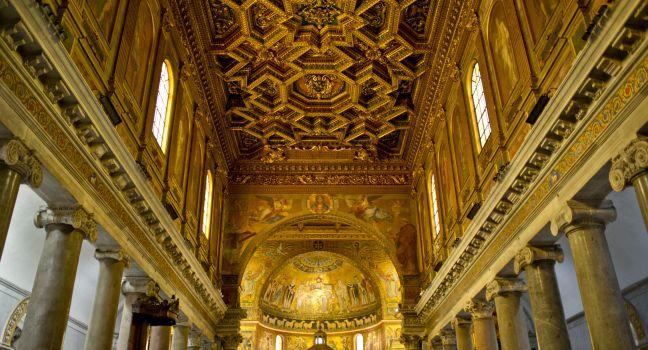
With a nave framed by a processional of two rows of gigantic columns (22 in total) taken from the ancient Baths of Caracalla and an apse studded with gilded mosaics, the interior conjures the splendor of ancient Rome. Overhead is Domenichino's gilded ceiling (1617). The church's most important mosaics, Pietro Cavallini's six panels of the Life of the Virgin, cover the semicircular apse. Note the building labeled "Taberna Meritoria" just under the figure of the Virgin in the Nativity scene, with a stream of oil flowing from it; it recalls the legend that a fountain of oil appeared on this spot, prophesying the birth of Christ. Off the piazza's northern side is a street called Via delle Fonte dell'Olio in honor of this miracle.

Santi Giovanni e Paolo

Celio Fodor's choice
Santi Giovanni e Paolo, Rome, Italy
© Ross Brinkerhoff / Fodors Travel

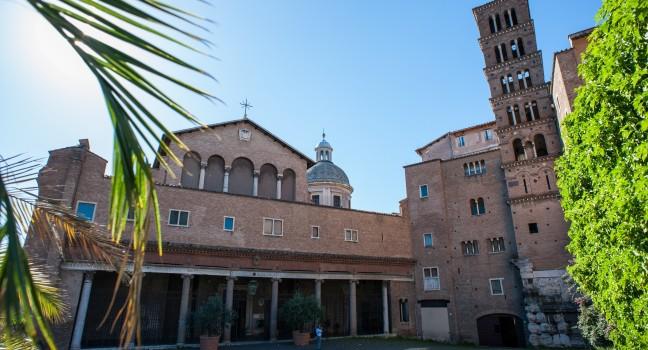
Perched up the incline of the Clivio di Scauro—a magical time-machine of a street, where the dial seems to be stuck somewhere in the 13th century—Santi Giovanni e Paolo is an image that would tempt most landscape painters. Marked by one of Rome's finest Romanesque bell towers, it looms over a picturesque piazza. Underneath, however, are other treasures, whose excavations can be seen in the Case Romane del Celio museum.

A basilica erected on the spot was, like San Clemente, destroyed in 1084 by attacking Normans. Its half-buried columns, near the current church entrance, are visible through misty glass. The current church's origins date to the start of the 12th century, but most of the interior dates to the 17th century and later. The lovely, incongruous chandeliers are hand-me-downs from New York's Waldorf-Astoria hotel, a gift arranged by the late Cardinal Francis Spellman of New York, whose titular church this was. Spellman also initiated the excavations here in 1949.

The Spanish Steps

Piazza di Spagna Fodor's choice
The Spanish Steps, Trinita Dei Monti, Rome, Italy
© Halie Cousineau/ Fodors Travel

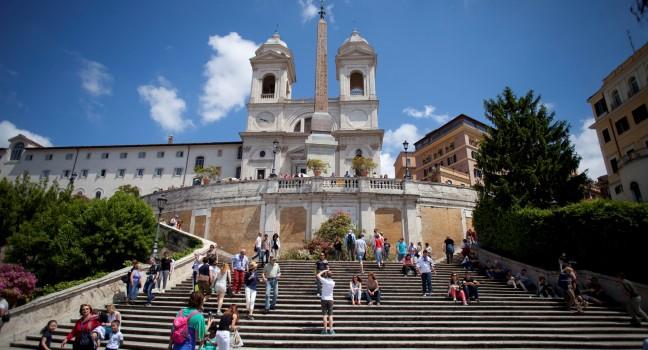
The iconic Spanish Steps (often called simply la scalinata, or "the staircase," by Italians) and the Piazza di Spagna from which they ascend both get their names from the Spanish Embassy to the Vatican on the piazza—even though the staircase was built with French funds by an Italian in 1723. In honor of a diplomatic visit by the King of Spain, the hillside was transformed by architect Francesco de Sanctis with a spectacular piece of urban planning to link the church of Trinità dei Monti at the top with the Via Condotti below.

In an allusion to the church, the staircase is divided by three landings (beautifully lined with potted azaleas from mid-April to mid-May). Bookending the bottom of the steps are beloved holdovers from the 18th century, when the area was known as the "English Ghetto": to the right, the Keats-Shelley House and to the left, Babington's Tea Rooms—both beautifully redolent of the era of the Grand Tour.

For weary sightseers who find the 135 steps too daunting, there is an elevator at Vicolo del Bottino 8, next to the Metro entrance. (Those with mobility problems should be aware that there is still a small flight of stairs after, however, and that the elevator is sporadically closed for repair.) At the bottom of the steps, Pietro Bernini's splendid 17th-century Barcaccia Fountain still spouts drinking water from the ancient aqueduct known as the Acqua Vergine.

Trevi Fountain

Trevi Fodor's choice
Trevi fountain
© Halie Cousineau/ Fodors Travel

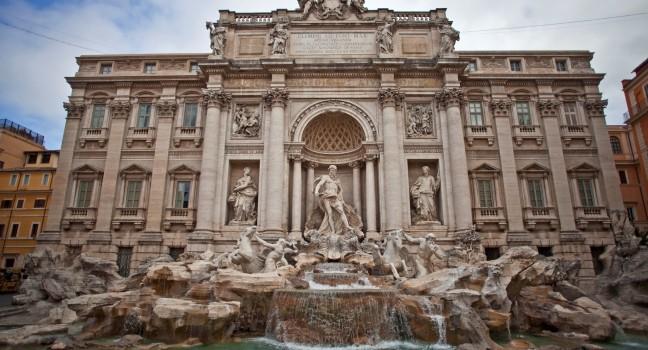
Alive with rushing waters commanded by an imperious sculpture of Oceanus, the Fontana di Trevi has been all about theatrical effects from the start; it is an aquatic marvel in a city filled with them. The fountain's unique drama is largely due to its location: its vast basin is squeezed into the tight confluence of three little streets (the tre vie, which may give the fountain its name), with cascades emerging as if from the wall of Palazzo Poli.

The dream of a fountain emerging full force from a palace was first envisioned by Bernini and Pietro da Cortona from Pope Urban VIII's plan to rebuild an older fountain, which had earlier marked the end point of the Acqua Vergine, an aqueduct created in 18 BC by Agrippa. Three popes later, under Pope Clement XIII, Nicola Salvi finally broke ground with his winning design. Unfortunately, Salvi did not live to see his masterpiece of sculpted seashells, roaring sea beasts, and diva-like mermaids completed; he caught a cold and died while working in the culverts of the aqueduct 11 years before the fountain was finished in 1762.

Everyone knows the famous legend that if you throw a coin into the Trevi Fountain you will ensure a return trip to the Eternal City, but not everyone knows how to do it the right way. You must toss a coin with your right hand over your left shoulder, with your back to the fountain. One coin means you'll return to Rome; two, you'll return and fall in love; three, you'll return, find love, and marry. The fountain grosses some €1,500,000 a year, with every cent going to the Catholic charity Caritas, which is why Fendi was willing to fully fund the Trevi's recent restoration.

Tucked away in a little nearby alley is the Vicus Caprarius ( Vicolo del Puttarello, 25), a small museum where visitors can pay €8 for a guided tour that descends into a subterranean area that gives a glimpse at the water source that keeps the fountain running.

Via Giulia

Campo de' Fiori Fodor's choice
Street, Via Giulia, Rome, Italy
© Ross Brinkerhoff / Fodors Travel

Straight as a die and still something of a Renaissance-era diorama, Via Giulia was the first street in Rome since ancient times to be deliberately planned. It was named for Pope Julius II (of Sistine Chapel fame), who commissioned it in the early 1500s as part of a scheme to open up a grandiose approach to St. Peter's Basilica. Although the pope's plans were only partially completed, Via Giulia became an important thoroughfare in Renaissance Rome. It's still, after more than four centuries, the address of choice for Roman aristocrats, despite a recent, controversial addition: a large parking lot along one side of the street (creating it meant steamrolling through ancient and medieval ruins underneath).

A stroll around and along Via Giulia reveals elegant palaces and churches, including one, San Eligio, on the little side street Via di Sant'Eligio, that was designed by Raphael himself. Note also the Palazzo Sacchetti ( Via Giulia, 66), with an imposing stone portal and an interior containing some of Rome's grandest staterooms; it remains, after 300 years, the private quarters of the Marchesi Sacchetti. The forbidding brick building that housed the Carceri Nuove (New Prison) ( Via Giulia, 52), Rome's prison for more than two centuries, now contains the offices of the Direzione Nazionale Antimafia. Near the bridge that arches over Via Giulia's southern end is the church of Santa Maria dell'Orazione e Morte (Holy Mary of Prayer and Death), with stone skulls on its door. These are a symbol of a confraternity that was charged with burying the bodies of the unidentified dead found in the city streets.

Designed by Borromini and home, since 1927, to the Hungarian Academy, the Palazzo Falconieri ( Via Giulia, 1 06/68896700) has Borromini-designed salons and loggia that are sporadically open as part of guided tours; call for information. The falcon statues atop its belvedere are best viewed from around the block, along the Tiber embankment. Remnant of a master plan by Michelangelo, the arch over the street was meant to link massive Palazzo Farnese, on the east side of Via Giulia, with the building across the street and a bridge to the Villa Farnesina, directly across the river. Finally, on the right and rather green with age, dribbles that star of many a postcard, the Fontana del Mascherone.

Via Giulia, Rome, 00186, Italy

Something incorrect in this review?

Villa Borghese

Villa Borghese Fodor's choice
The Garden of Venus, In Villa Borghese, Rome, Italy.
Preisler | Dreamstime.com

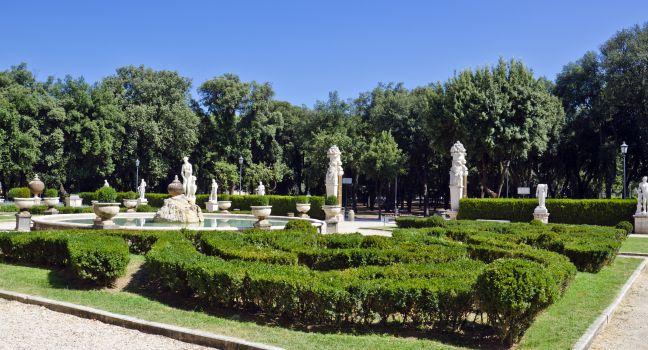
Rome's Central Park, the Villa Borghese was originally laid out as a recreational garden in the early 17th century by Cardinal Scipione Borghese. The word "villa" was used to mean suburban estate, of the type developed by the ancient Romans and adopted by Renaissance nobles. Today's gardens cover a much smaller area—by 1630, the perimeter wall was almost 5 km (3 miles) long. At the end of the 18th century, Scottish painter Jacob More remodeled the gardens into the English style popular at the time. In addition to the gloriously restored Galleria Borghese, the highlights of the park are Piazza di Siena, a graceful amphitheater, and the botanical garden on Via Canonica, where there is a pretty little lake as well as the neoclassical faux–Temple of Aesculapius, the Biopark zoo, Rome's own replica of London's Globe Theatre, and the Villa Giulia museum.

The Carlo Bilotti Museum ( www.museocarlobilotti.it) is particularly attractive for Giorgio de Chirico fans, and there is more modern art in the nearby Galleria Nazionale d'Arte Moderna e Contemporanea. The 63-seat children's movie theater, Cinema dei Piccoli, shows films for adults in the evening. There's also Casa del Cinema, where film buffs can screen films or sit at the sleek, cherry-red, indoor-outdoor caffè (you can find a schedule of events at  www.casadelcinema.it).

Arcibasilica di San Giovanni in Laterano

San Giovanni Fodor's choice

The cathedral of Rome is San Giovanni in Laterano, not St. Peter's. The church was built here by Emperor Constantine 10 years before he built the church dedicated to Peter, making it the ecclesiastical seat of the Bishop of Rome (the pope). But thanks to vandals, earthquakes, and fires, today's building owes most of its form to 16th- and 17th-century restorations, including an interior designed by Baroque genius Borromini. Colossal statues stand watch over the towering facade: the 12 apostles plus Christ, John the Baptist, and the Virgin Mary.

Some earlier fragments do remain: under the portico on the left stands an ancient statue of Constantine, while the central portal's ancient bronze doors were brought here from the Forum's Curia. The altar's rich Gothic tabernacle, holding what the faithful believe are the heads of saints Peter and Paul, dates from 1367. The last chapel on the left aisle houses the cloister, which is encrusted with 12th-century cosmatesque mosaics. Around the corner stands one of the oldest Christian structures in Rome: Emperor Constantine's octagonal baptistery. Despite several restorations, a 17th-century interior redecoration, and even a 1993 Mafia-related car bombing, the baptistery from AD 315 remains true to its ancient form.