


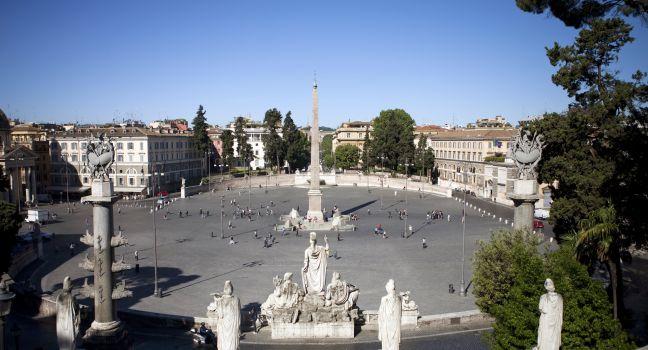
Piazza del Popolo
Get FREE email communications from Fodor's Travel, covering must-see travel destinations, expert trip planning advice, and travel inspiration to fuel your passion.

We've compiled the best of the best in Rome - browse our top choices for the top things to see or do during your stay.
The Bocca della Verità (Mouth of Truth) is in reality nothing more than an ancient drain cover, unearthed during the Middle Ages. Legend has it, however, that the teeth will clamp down on a liar's hand if they dare to tell a fib while holding their fingers up to the fearsome mouth. Hordes of tourists line up to take the test every day (kids especially get a kick out of it).
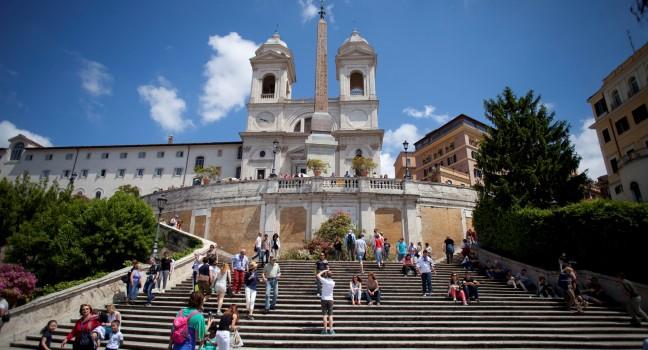
In an allusion to the church, the staircase is divided by three landings (beautifully lined with potted azaleas from mid-April to mid-May). Bookending the bottom of the steps are beloved holdovers from the 18th century, when the area was known as the "English Ghetto": to the right, the Keats-Shelley House and to the left, Babington's Tea Rooms—both beautifully redolent of the era of the Grand Tour.
For weary sightseers who find the 135 steps too daunting, there is an elevator at Vicolo del Bottino 8, next to the Metro entrance. (Those with mobility problems should be aware that there is still a small flight of stairs after, however, and that the elevator is sporadically closed for repair.) At the bottom of the steps, Pietro Bernini's splendid 17th-century Barcaccia Fountain still spouts drinking water from the ancient aqueduct known as the Acqua Vergine.
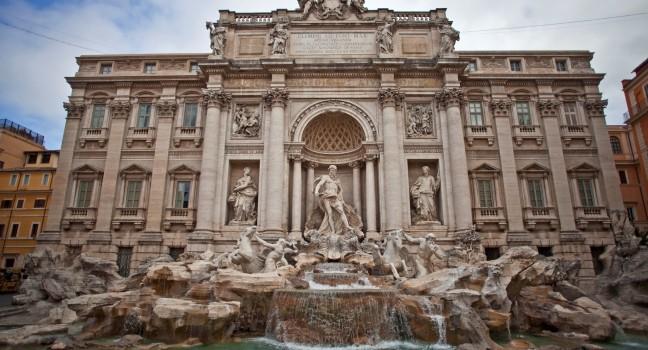
The dream of a fountain emerging full force from a palace was first envisioned by Bernini and Pietro da Cortona from Pope Urban VIII's plan to rebuild an older fountain, which had earlier marked the end point of the Acqua Vergine, an aqueduct created in 18 BC by Agrippa. Three popes later, under Pope Clement XIII, Nicola Salvi finally broke ground with his winning design. Unfortunately, Salvi did not live to see his masterpiece of sculpted seashells, roaring sea beasts, and diva-like mermaids completed; he caught a cold and died while working in the culverts of the aqueduct 11 years before the fountain was finished in 1762.
Everyone knows the famous legend that if you throw a coin into the Trevi Fountain you will ensure a return trip to the Eternal City, but not everyone knows how to do it the right way. You must toss a coin with your right hand over your left shoulder, with your back to the fountain. One coin means you'll return to Rome; two, you'll return and fall in love; three, you'll return, find love, and marry. The fountain grosses some €1,500,000 a year, with every cent going to the Catholic charity Caritas, which is why Fendi was willing to fully fund the Trevi's recent restoration.
Tucked away in a little nearby alley is the Vicus Caprarius ( Vicolo del Puttarello, 25), a small museum where visitors can pay €8 for a guided tour that descends into a subterranean area that gives a glimpse at the water source that keeps the fountain running.
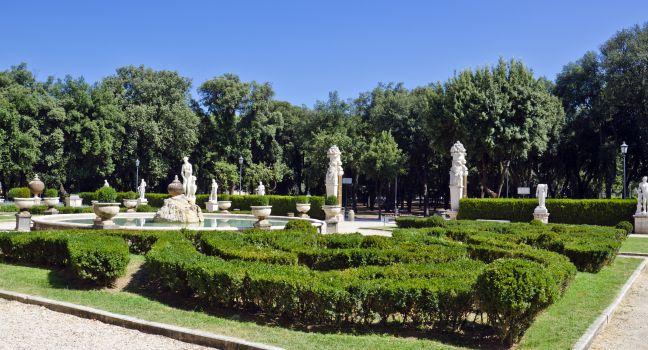
Rome's Central Park, the Villa Borghese was originally laid out as a recreational garden in the early 17th century by Cardinal Scipione Borghese. The word "villa" was used to mean suburban estate, of the type developed by the ancient Romans and adopted by Renaissance nobles. Today's gardens cover a much smaller area—by 1630, the perimeter wall was almost 5 km (3 miles) long. At the end of the 18th century, Scottish painter Jacob More remodeled the gardens into the English style popular at the time. In addition to the gloriously restored Galleria Borghese, the highlights of the park are Piazza di Siena, a graceful amphitheater, and the botanical garden on Via Canonica, where there is a pretty little lake as well as the neoclassical faux–Temple of Aesculapius, the Biopark zoo, Rome's own replica of London's Globe Theatre, and the Villa Giulia museum.
The Carlo Bilotti Museum ( www.museocarlobilotti.it) is particularly attractive for Giorgio de Chirico fans, and there is more modern art in the nearby Galleria Nazionale d'Arte Moderna e Contemporanea. The 63-seat children's movie theater, Cinema dei Piccoli, shows films for adults in the evening. There's also Casa del Cinema, where film buffs can screen films or sit at the sleek, cherry-red, indoor-outdoor caffè (you can find a schedule of events at www.casadelcinema.it).
Founded in the Holy Land during the Crusades, the Knights of Malta is the world's oldest and most exclusive order of chivalry. The knights amassed huge tracts of land in the Middle East and were based on the Mediterranean island of Malta from 1530 until 1798, when Napoléon expelled them. In 1834, they established themselves in Rome, where ministering to the sick became thelr raison d'être.
Redolent of the era of Henry James and Edith Wharton, the Pincian gardens have long been a classic setting for a walk. Grand Tourists—and even a pope or two—came here to see and be seen among the beau monde of Rome. Today, the Pincian terrace remains a favorite spot for locals taking a springtime Sunday stroll. The rather formal, early-19th-century style contrasts with the far more elaborate terraced gardens of Lucullus, the Roman gourmand who held legendary banquets here. Today, off-white marble busts of Italian Risorgimento heroes and artists line the pathways. Along with similar busts on the Gianicolo (Janiculum Hill), their noses have been targets of vandalism.
A stretch of ancient walls separates the Pincio from the southwest corner of Villa Borghese. From the balustraded terrace, you can look down at Piazza del Popolo and beyond, surveying much of Rome. Southeast of the Pincian terrace is the Casina Valadier ( www.casinavaladier.it), a magnificently decorated neoclassical building that contains an event space with glorious views.
A former monastery, founded in the 7th century by monks fleeing Jerusalem following the Arab invasion, this is a major monument of Rome, though it takes on a subdued air thanks to its modern quiet surroundings in the upscale San Saba district. The serene but rustic interior harbors 10th-century frescoes, a famed Cosmatesque mosaic floor, and a hodgepodge of ancient marble pieces.
This Early Christian basilica is stark and tranquil, showing off the lovely simplicity common to churches of its era. Although some of the side chapels were added in the 16th and 17th centuries, the essential form is as Rome's Christians knew it in the 5th century. Most striking are the 24 fluted Corinthian columns that line the classical interior. Once bright with mosaics, today the church has only one above the entrance door (its gold letters announce how the church was founded by Peter of Illyria, "rich for the poor," under Pope Celestine I). The beautifully carved, 5th-century cedar doors to the left of the outside entrance are the oldest of their kind in existence.
This zoo has been remodeled along eco-friendly lines: there is now more space for the animals, most of which were brought from other zoos or born from animals already in captivity (rather than those snatched from the wild). There aren't any koalas, pandas, or polar bears, but there are big cats, elephants, chimpanzees, and local brown bears from Abruzzo, and other creatures. You'll also find the Reptilarium, the Bioparco Train, a picnic area next to the flamingos, and a farm.
Standing between the Tiber and the Vatican, this circular castle has long been one of Rome's most distinctive landmarks. Opera lovers know it well as the setting for the final scene of Puccini's Tosca. Started in AD 135, the structure began as a mausoleum for the emperor Hadrian and was completed by his successor, Antoninus Pius. From the mid-6th century the building became a fortress, a place of refuge for popes during wars and sieges.
Its name dates to AD 590, when Pope Gregory the Great, during a procession to plead for the end of a plague, saw an angel standing on the summit of the castle, sheathing his sword. Taking this as a sign that the plague was at an end, the pope built a small chapel at the top, placing a statue next to it to celebrate his vision—thus the name, Castel Sant'Angelo.
In the rooms off the Cortile dell'Angelo, look for the Cappella di Papa Leone X (Chapel of Pope Leo X), with a facade by Michelangelo. In the Pope Alexander VI courtyard, a wellhead bears the Borgia coat of arms. The stairs at the far end of the courtyard lead to the open terrace for a view of the Passetto, the fortified corridor connecting Castel Sant'Angelo with the Vatican. In the appartamento papale (papal apartment), the Sala Paolina (Pauline Room) was decorated in the 16th century by Perino del Vaga and assistants with lavish frescoes of scenes from the Old Testament and the lives of St. Paul and Alexander the Great.
Film buffs may want to make the trip out to Cinecittà Studios—stomping ground of Fellini, Audrey Hepburn, and Elizabeth Taylor and birthplace of such classics as Roman Holiday, Cleopatra, and La Dolce Vita. You can take a guided tour of the sets and see the exhibition Cinecittà Shows Off, with memorabilia like original gowns, suits, and props from movies and TV series. Cinecittà is about 25 minutes southeast of the city center on Metro A. Sometimes tours in English are available; inquire via email ( [email protected]).
At the foot of the Spanish Steps, this curious, leaky boat fountain is fed by Rome's only surviving ancient aqueduct, the Acqua Vergine. The sinking ship design is a clever solution to low water pressure and was created by Pietro Bernini, with the help of his son, the prolific sculptor Gian Lorenzo Bernini. The project was commissioned by Barberini Pope Urban VIII, and the bees and suns on the boat are symbols of the Barberini family. Looking for more symbolism, some insist that the Berninis intended the fountain to be a reminder that this part of town was often flooded by the Tiber; others claim that it represents the Ship of the Church; and still others think that it marks the presumed site of the emperor Domitian's water stadium in which sea battles were reenacted in the glory days of the Roman Empire.
Designed by Giacomo della Porta in 1581 and sculpted by Taddeo Landini, this fountain, set in pretty Piazza Mattei, is one of Rome's most charming. Its focal point consists of four bronze boys, each grasping a dolphin spouting water into a marble shell. Bronze turtles just out of reach of the boys' hands drink from the upper basin. The turtles were added in the 17th century by Bernini.
The Pantheon area is ice-cream heaven, with some of Rome's best gelaterias within a few steps of each other. But for many Romans, a scoop at Giolitti, which opened in 1900, is tradition. The scene at the counter often looks like the storming of the Bastille; remember to pay the cashier first, and hand the stub to the counter-person when you order your cone.
In imperial times, Romans sheathed the entire island with marble to make it look like Aesculapius's ship, replete with a towering obelisk as a mast. Amazingly, a fragment of the ancient sculpted ship's prow still exists. You can marvel at it on the downstream end of the embankment. Today, medicine still reigns here. The island is home to the hospital of Fatebenefratelli (literally, "Do good, brothers"). Nearby is San Bartolomeo, built at the end of the 10th century by the Holy Roman Emperor Otto III and restored in the 18th century.
During summer, the island hosts an outdoor cinema, while its walkway is dotted with white tented bars and pop-up eateries.
At the very heart of the Trastevere rione (district) lies this beautiful piazza, with its elegant raised fountain and sidewalk caffès. The centerpiece is the 12th-century church of Santa Maria in Trastevere, first consecrated in the 4th century. Across countless generations, this piazza has seen the comings and goings of residents and travelers, as well as intellectuals and artists, who today often lounge on the steps of the fountain or eat lunch at an outdoor table at Sabatini's. At night, the piazza is the center of Trastevere's action, with street festivals, musicians, and the occasional mime vying for attention from the many people taking the evening air.
Once a part of the Aurelian Walls and now a part of the Cimitero Acattolico, this monumental tomb was designed in 12 BC for the immensely wealthy praetor Gaius Cestius, in the form of a 120-foot-tall pyramid. According to an inscription, it was completed in a little less than a year. Though little else is known about the Roman official, he clearly had a taste for grandeur and liked to show off his travels to far parts of the nascent empire. The pyramid was restored in 2015 thanks to a €1 million donation from Japanese fashion tycoon Yuzo Yagi. Guided visits (when available) require a reservation but are usually on the second and fourth Saturday of each month.
Framed by two squat, circular towers, this gate was constructed at the beginning of the 5th century during a renovation of the 3rd century Aurelian Walls. Here you can see just how well the walls have been preserved and imagine hordes of Visigoths trying to break through them. Sturdy as they look, these walls couldn't always keep out the barbarians: Rome was sacked three times during the 5th century alone.
One of the most important archaeological areas in Rome was only discovered in 1926 when construction around Teatro Argentina unearthed four Republican-age temples. The so-called Sacred Area was closed to the public for decades and was happily colonized by cats, who still roam the ruins. But now, a series of walkways allows up-close visits to the site, along with a small but smart collection of antiquities. The exact history of the temples is still being studied, but it is thought that the most ancient of the four (built in the 4th century BC) was dedicated to Feronia, a fertility goddess. While scholars continue to debate the origins of some of the temples here, they do agree that the large tuffa foundation behind the round temple was the Curia of Pompey, where senate sessions were once held—and the spot on which Julius Caesar was assassinated on the Ides of March (March 15) of 44 BC.
Rather than a simple dip in a tub, Romans turned "bathing" into one of the most lavish leisure activities imaginable. A bath began in the sudatoria, a series of small rooms resembling saunas, which then led to the caldarium, a circular room that was humid rather than simply hot. Here a strigil, or scraper, was used to get the dirt off the skin. Next stop: the warm(-ish) tepidarium, which helped start the cool-down process. Finally, it ended with a splash around the frigidarium, a chilly swimming pool.
Although some black-and-white mosaic fragments remain, most of the opulent mosaics, frescoes, and sculptures have found their way into Rome's museums. Nevertheless, the towering walls and sheer size of the ruins give one of the best glimpses into ancient Rome's ambitions. A newly installed fountain has returned some water to the baths, while a portable video guide allows a glimpse of the past grandeur, with images and audio that describe how the ruins appeared centuries ago. If you're here in summer, don't miss the chance to catch an open-air opera or ballet in the baths, put on by the Teatro dell'Opera di Roma.
This small, verdant park across the street from the Piazza del Quirinale is a good spot to stop and take a break. In the center sits an equestrian statue of King Carlo Alberto, the king of Piedmont-Sardinia during the turbulent period of the Reunification of Italy. There are benches to sit and kids often play on the grass. If you happen to be in the area at sunset, cross the street to see the spectacular sunset over Piazza del Quirinale and the rooftops of Rome.
Built for aristocrats-come-lately, the Torlonia family—the Italian Rockefellers of the 19th century—this villa became Mussolini's residence and now serves as a public park. The Casino Nobile, the main palace designed by architect Giuseppe Valadier, is a grand, Neoclassical edifice, replete with a gigantic ballroom, frescoed salons, and a soaring temple-like facade. While denuded of nearly all their furnishings and art treasures, some salons have important remnants of decor, including the reliefs once fashioned by the father of Italian Neoclassical sculpture, Antonio Canova.
A complete contrast is offered by the Casina delle Civette (Little House of Owls), a hyper-charming example of the Liberty (art nouveau) style of the early 1900s. The gabled, fairy tale–like cottage-palace now displays majolica and stained-glass decorations, including windows with owl motifs—a stunning, oft-overlooked find for lovers of 19th-century decorative arts. Temporary exhibitions are held in the small and elegant Il Casino dei Principi (The House of Princes), designed in part by Valadier.


