4 Best Sights in Rome, Italy

Background Illustration for Sights

We've compiled the best of the best in Rome - browse our top choices for the top things to see or do during your stay.

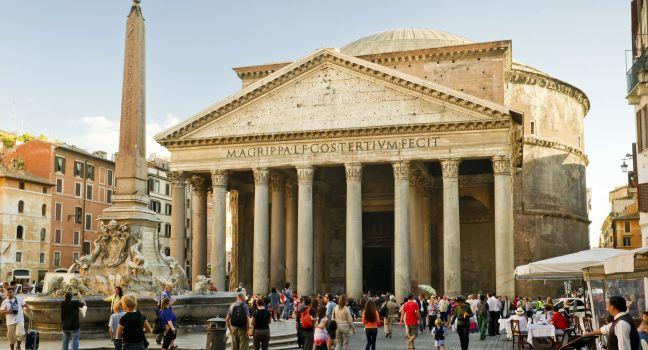
Pantheon

Piazza Navona Fodor's Choice
ROME - OCTOBER 2: Tourists visit the Pantheon on October 2, 2012 in Rome, Italy. Pantheon is a famous monument of ancient Roman culture, the temple of all the gods, built in the 2nd century.;
Viacheslav Lopatin/Shutterstock

The city's best-preserved ancient building, this former Roman temple is a marvel of architectural harmony and proportion. It was entirely rebuilt by the emperor Hadrian around AD 120 on the site of a Pantheon (from the Greek: pan, all, and theon, gods) erected in 27 BC by Augustus's right-hand man and son-in-law, Agrippa.

The most striking thing about the Pantheon is not its size, immense though it is, nor even the phenomenal technical difficulties posed by so massive a construction; rather, it's the remarkable unity of the building. The diameter described by the dome is exactly equal to its height. It's the use of such simple mathematical balance that gives classical architecture its characteristic sense of proportion and its nobility. The opening at the apex of the dome, the oculus, is nearly 30 feet in diameter and was intended to symbolize the "all-seeing eye of the heavens." On a practical note, this means when it rains, it rains inside: look out for the drainage holes in the floor.

Although little is known for sure about the Pantheon's origins or purpose, it's worth noting that the five levels of trapezoidal coffers (sunken panels in the ceiling) represent the course of the five then-known planets and their concentric spheres. Ruling over them is the sun, represented symbolically and literally by the 30-foot-wide eye at the top. The heavenly symmetry is further paralleled by the coffers: 28 to each row, the number of lunar cycles. In the center of each would have shone a small bronze star. Down below, the seven large niches were occupied not by saints, but, it's thought, by statues of Mars, Venus, the deified Caesar, and the other "astral deities," including the moon and sun, the "sol invictus." (Academics still argue, however, about which gods were most probably worshipped here.)

One of the reasons the Pantheon is so well preserved is that it was consecrated as a church in AD 608. (It's still a working church today.) No building, church or not, though, escaped some degree of plundering through the turbulent centuries of Rome's history after the fall of the empire. In 655, for example, the gilded bronze covering the dome was stripped. The Pantheon is also one of the city's important burial places. Its most famous tomb is that of Raphael (between the second and third chapels on the left as you enter). Mass takes place on Sunday and on religious holidays at 10:30; it's open to the public, but you are expected to arrive before the beginning and stay until the end. General access usually resumes at about 11:30.

You can buy tickets in person via cash or credit card, or online (which requires registering for an account). If you plan on purchasing tickets in person, coming prepared with both cash and a credit card will allow you to select the faster-moving line that day.  On the first Sunday of every month, visitors can enter for free.

Gran Priorato di Roma dell'Ordine di Malta

Aventino Fodor's Choice

Although the line to peek through the keyhole of a nondescript green door in the Gran Priorato, the walled compound of the Knights of Malta, sometimes snakes around Piazza dei Cavalieri di Malta, the enchanting view is worth the wait. Far across the city, you'll see the dome of St. Peter's Basilica flawlessly framed by the keyhole and tidily trimmed hedges that lie just beyond the locked door. The priory and the square are the work of Giovanni Battista Piranesi, an 18th-century engraver who is more famous for etching Roman views than for orchestrating them, but he fancied himself a bit of an architect and did not disappoint.

Founded in the Holy Land during the Crusades, the Knights of Malta is the world's oldest and most exclusive order of chivalry. The knights amassed huge tracts of land in the Middle East and were based on the Mediterranean island of Malta from 1530 until 1798, when Napoléon expelled them. In 1834, they established themselves in Rome, where ministering to the sick became thelr raison d'être.

Scala Santa

San Giovanni Fodor's Choice

According to tradition, the Scala Santa was the staircase from Pilate's palace in Jerusalem—and, therefore, the one trod by Christ himself. St. Helena, Emperor Constantine's mother, brought the 28 marble steps to Rome in 326. As they have for centuries, pilgrims still come to climb the steps on their knees. At the top, they can glimpse the Sancta Sanctorum (Holy of Holies)—the pope's richly decorated private chapel (long before the Sistine Chapel), which contains an image of Christ "not made by human hands." You can sneak a peek, too, by taking one of the (nonsanctified) staircases on either side.

Piazza di San Giovanni in Laterano, 14, Rome, 00184, Italy
06-7726641
Sight Details
Scala Santa free, Sancta Sanctorum €3.50
Sancta Sanctorum closed Sun.

Something incorrect in this review?

Recommended Fodor's Video

Sinagoga

Jewish Ghetto

This synagogue has been the city's largest Jewish temple, and a Roman landmark with its distinctive aluminum dome, since its construction in 1904. The building also houses the Jewish Museum on its lower floor, with displays of precious ritual objects and exhibits that document the uninterrupted presence of a Jewish community in the city for nearly 22 centuries. Until the 16th century, Jews were esteemed citizens of Rome. Among them were bankers and physicians to the popes, who had themselves given permission for the construction of synagogues. But, in 1555, during the Counter-Reformation, Pope Paul IV decreed the building of the walls of the Ghetto, confining the Jews to this small flood-prone area and imposing restrictions, some of which continued to be enforced until 1870. For security reasons, entrance is via guided visit only, and tours in English are available twice a day but should be booked online ahead of time. Entrance to the synagogue is through the museum on Via Catalana.

Lungotevere de' Cenci, 15, Rome, 00186, Italy
06-68400661
Sight Details
€11
Museum closed Sat. and Jewish holidays

Something incorrect in this review?