182 Best Sights in Rome, Italy

Background Illustration for Sights

We've compiled the best of the best in Rome - browse our top choices for the top things to see or do during your stay.

Santa Pudenziana

Monti
Santa Pudenziana, Rome, Italy
© Halie Cousineau/ Fodors Travel

Apart from Ravenna, Rome has some of Italy's most opulent mosaics, and this church has the earliest example. Commissioned during the papacy of Innocent I, its early 5th-century apse mosaic, depicting Christ teaching the apostles, sits above a Baroque altarpiece surrounded by a bevy of florid 18th-century paintings. The mosaic is remarkable for its iconography; at the center sits Christ Enthroned, shown as an emperor or as a philosopher holding court, surrounded by his apostles. Each apostle faces the spectator, literally rubbing shoulders with his companion (unlike later hieratic styles in which each figure is isolated) and bears an individualized expression. Above these figures and a landscape symbolizing Heavenly Jerusalem float the signs of the four evangelists in a blue sky flecked with the orange of sunset, made from thousands of tesserae (mosaic tiles).

To either side of Christ, saints Praxedes and Pudentiana hold wreaths over the heads of saints Peter and Paul. These two women were actually daughters of the Roman senator Pudens (probably the one mentioned in 2 Timothy 4:21), whose family befriended both apostles. During the persecutions of Nero, both sisters collected the blood of many martyrs before suffering their fate. Pudentiana transformed her house into a church, but her namesake church was constructed over a 2nd-century bathhouse. Beyond the sheer beauty of the mosaic work, the size, rich detail, and number of figures make this both the last gasp of ancient Roman art and one of the first major works of Early Christian art.
Via Urbana, 160, Rome, 00184, Italy
06-4817292
Sight Details
Closed Sun.

Something incorrect in this review?

Santi Quattro Coronati

Celio
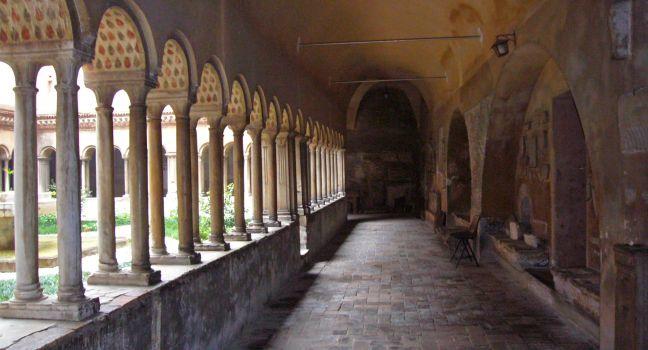
Roma, Santi Quattro Coronati: chiostro
Lalupa (CC BY-SA 3.0), via Wikimedia Commons

Situated on one of those evocative cul-de-sacs in Rome where history seems to be holding its breath, this quiet citadel has resisted the tides of time and traffic. The church—which is both strongly imbued with the sanctity of the Romanesque era and marvelously redolent of the Middle Ages—dates from the 4th century and honors the Four Crowned Saints: the four brothers Severus, Severianus, Carpophorus, and Victorinus, all Roman officials who were whipped to death for their faith by Emperor Diocletian (284–305).

After its 9th-century reconstruction, the church was twice as large as it is now; the abbey was partially destroyed during the Normans' sack of Rome in 1084 but reconstructed about 30 years later. This explains the inordinate size of the apse in relation to the small nave. Don't miss the cloister, with its well-tended gardens and 12th-century fountain. The entrance is the door in the left nave; ring the bell if it's not open.

There's another medieval gem hidden away off the courtyard at the church entrance: the Chapel of San Silvestro. The chapel has remained, for the most part, as it was when consecrated in 1246. Some of the best-preserved medieval frescoes in Rome decorate the walls, telling the story of the Christian emperor Constantine's recovery from leprosy thanks to Pope Sylvester I. Note, too, the delightful Last Judgment fresco above the door, in which the angel on the left neatly rolls up sky and stars like a backdrop, signaling the end of the world.

Arco di Costantino

Colosseo

This majestic arch was erected in AD 315 to commemorate Constantine's victory over Maxentius at the Milvian Bridge. It was just before this battle, in AD 312, that Constantine—the emperor who converted Rome to Christianity—legendarily had a vision of a cross and heard the words "In this sign thou shalt conquer." Many of the costly marble decorations for the arch were scavenged from earlier monuments, both saving money and placing Constantine in line with the great emperors of the past. It is easy to picture ranks of Roman centurions marching under the great barrel vault.

Piazza del Colosseo, Rome, 00184, Italy

Something incorrect in this review?

Recommended Fodor's Video

Arco di Tito

Campitelli

Standing at the northern approach to the Palatine Hill on the Via Sacra, this triumphal arch was erected in AD 81 to celebrate the sack of Jerusalem 10 years earlier, after the First Jewish–Roman War. The superb view of the Colosseum from the arch reminds us that it was the emperor Titus who helped finish the vast amphitheater, begun earlier by his father, Vespasian. Under the arch are two great sculpted reliefs, both showing scenes from Titus's triumphal parade along this very Via Sacra. You still can make out the spoils of war plundered from Herod's Temple, including a gigantic seven-branched candelabrum (menorah) and silver trumpets. During his sacking of Jerusalem, Titus killed or deported most of the Jewish population, thus initiating the Jewish diaspora—an event that would have far-reaching historical consequences.

East end of Via Sacra, Rome, 00186, Italy
Sight Details
€18 24-hour ticket required

Something incorrect in this review?

Basilica di Massenzio

Campitelli

Although its great arched vaults still dominate the north side of the Via Sacra, only about one-third of the original of this gigantic basilica (in the sense of a Roman courthouse and meeting hall) remains, so you can imagine what a wonder this building was when first erected. Begun under the emperor Maxentius about AD 306, the edifice was a center of judicial and commercial activity, the last of its kind to be built in Rome. Over the centuries, like so many Roman monuments, it was exploited as a quarry for building materials and was stripped of its sumptuous marble and stucco decorations. Its coffered vaults, like that of the Pantheon's dome, were later copied by many Renaissance artists and architects.

Via Sacra, Rome, 00186, Italy
Sight Details
€18 24-hour ticket required

Something incorrect in this review?

Basilica di San Saba

Aventino

A former monastery, founded in the 7th century by monks fleeing Jerusalem following the Arab invasion, this is a major monument of Rome, though it takes on a subdued air thanks to its modern quiet surroundings in the upscale San Saba district. The serene but rustic interior harbors 10th-century frescoes, a famed Cosmatesque mosaic floor, and a hodgepodge of ancient marble pieces.

Piazza Gian Lorenzo Bernini, 20, Rome, 00153, Italy
06-64580140

Something incorrect in this review?

Basilica di Sant'Andrea delle Fratte

Piazza di Spagna

Two of Bernini's original angels that decorated the Ponte Sant'Angelo are found here, on either side of the high altar. The door in the right aisle leads into one of Rome's hidden gardens, where orange trees bloom in the cloister. Borromini's fantastic contributions—the dome and a curious bell tower with its droop-winged angels looking out over the city—are best seen from Via di Capo le Case, across Via dei Due Macelli.

Basilica di Santa Sabina

Aventino

This Early Christian basilica is stark and tranquil, showing off the lovely simplicity common to churches of its era. Although some of the side chapels were added in the 16th and 17th centuries, the essential form is as Rome's Christians knew it in the 5th century. Most striking are the 24 fluted Corinthian columns that line the classical interior. Once bright with mosaics, today the church has only one above the entrance door (its gold letters announce how the church was founded by Peter of Illyria, "rich for the poor," under Pope Celestine I). The beautifully carved, 5th-century cedar doors to the left of the outside entrance are the oldest of their kind in existence.

Basilica Emilia

Campitelli

Once a great colonnaded hall, this served as a meeting place for merchants and as a courthouse from the 2nd century BC; it was rebuilt by Augustus in the 1st century AD. To the right as you enter the Forum from Via dei Fori Imperiali, a spot on one of the basilica's preserved pieces of floor testifies to one of Rome's more harrowing moments—and to the hall's purpose. That's where bronze coins melted, leaving behind green stains, when Rome was sacked and the basilica was burned by the Visigoths in 410 AD. The term "basilica" refers here to the particular architectural form developed by the Romans: a rectangular hall flanked by colonnades, it could serve as a court of law or a center for business and commerce. The basilica would later become the building type adopted for the first official places of Christian worship in the city.

Rome, 00186, Italy
Sight Details
€18 24-hour ticket required

Something incorrect in this review?

Basilica Giulia

Campitelli

The Basilica Giulia owes its name to Julius Caesar, who ordered its construction; it was later completed by his adopted heir, Augustus. One of several such basilicas in the center of Rome, it was where the Centumviri, the hundred-or-so judges forming the civil court, met to hear cases. The open space between the Basilica Emilia and this basilica was the heart of the Forum proper—the prototype of Italy's Renaissance piazzas and the center of civic and social activity in ancient Rome.

Via Sacra, Rome, 00186, Italy
Sight Details
€18 24-hour ticket required

Something incorrect in this review?

Bioparco

Villa Borghese

This zoo has been remodeled along eco-friendly lines: there is now more space for the animals, most of which were brought from other zoos or born from animals already in captivity (rather than those snatched from the wild). There aren't any koalas, pandas, or polar bears, but there are big cats, elephants, chimpanzees, and local brown bears from Abruzzo, and other creatures. You'll also find the Reptilarium, the Bioparco Train, a picnic area next to the flamingos, and a farm.

Piazzale del Giardino Zoologico, 1, Rome, 00197, Italy
06-3608211
Sight Details
€19; €2 for Bioparco Train

Something incorrect in this review?

Carcere Mamertino

Campitelli

The state prison of the ancient city has two subterranean cells where Rome's enemies, most famously the Goth, Jugurtha, and the indomitable Gaul, Vercingetorix, were imprisoned and died of either starvation or strangulation. Legend has it that, under Nero, saints Peter and Paul were imprisoned in the lower cell, and they used the water from a miraculous spring that appeared to baptize their jailers. A church, San Giuseppe dei Falegnami, now stands over the prison. The multimedia tour has received mixed reviews: it focuses on the Christian history of the site, and the audio is more fluffy than historical.

Clivo Argentario, 1, Rome, 00186, Italy
06-69924652
Sight Details
€10

Something incorrect in this review?

Casa di Livia

Campitelli

First excavated in 1839, this house was identifiable from the name inscribed on a lead pipe, Iulia Augusta. In other words, it belonged to the notorious Livia who—according to Robert Graves's I, Claudius—made a career of dispatching half of the Roman imperial family. (There's actually very little evidence for such claims.) She was the wife of Rome's first, and possibly greatest, emperor, Augustus. He married Livia when she was six months pregnant by her previous husband, whom Augustus "encouraged" to get a divorce.

As empress, Livia became a role model for Roman women, serving her husband faithfully, shunning excessive displays of wealth, and managing her household. But she also had real influence: as well as playing politics behind the scenes, she even had the rare honor (for a woman) of being in charge of her own finances. Here, atop the Palatine, is where she made her private retreat and living quarters. The delicate, delightful frescoes reflect the sophisticated taste of wealthy Romans, whose love of beauty and theatrical conception of nature were revived by their descendants in the Renaissance Age.

Northwest crest of Palatino, Rome, 00184, Italy
Sight Details
€22 2-day Full Experience ticket required
Closed Tues.

Something incorrect in this review?

Case Romane del Celio

Celio

Formerly accessible only through the church of Santi Giovanni e Paolo, this important ancient Roman excavation was opened in 2002 as a museum in its own right. An underground honeycomb of rooms, the site consists of the lower levels of a so-called insula, or apartment block, the heights of which were a wonder to ancient Roman contemporaries.

Through the door on the left of the Clivo di Scauro lane, a portico leads to the Room of the Genie, where painted figures grace the walls virtually untouched over two millennia. Farther on is the Confessio altar of Saint John and Saint Paul, officials at Constantine's court who were executed under Julian the Apostate. Still lower is the Antiquarium, where state-of-the-art lighting showcases amphorae, pots, and ancient Roman bricks, with stamps so fresh they might have been imprinted yesterday.

Via del Clivio di Scauro, Rome, 00184, Italy
Sight Details
€8
Closed Tues. and Thurs.

Something incorrect in this review?

Castel Sant'Angelo

Borgo

Standing between the Tiber and the Vatican, this circular castle has long been one of Rome's most distinctive landmarks. Opera lovers know it well as the setting for the final scene of Puccini's Tosca. Started in AD 135, the structure began as a mausoleum for the emperor Hadrian and was completed by his successor, Antoninus Pius. From the mid-6th century the building became a fortress, a place of refuge for popes during wars and sieges.

Its name dates to AD 590, when Pope Gregory the Great, during a procession to plead for the end of a plague, saw an angel standing on the summit of the castle, sheathing his sword. Taking this as a sign that the plague was at an end, the pope built a small chapel at the top, placing a statue next to it to celebrate his vision—thus the name, Castel Sant'Angelo.

In the rooms off the Cortile dell'Angelo, look for the Cappella di Papa Leone X (Chapel of Pope Leo X), with a facade by Michelangelo. In the Pope Alexander VI courtyard, a wellhead bears the Borgia coat of arms. The stairs at the far end of the courtyard lead to the open terrace for a view of the Passetto, the fortified corridor connecting Castel Sant'Angelo with the Vatican. In the appartamento papale (papal apartment), the Sala Paolina (Pauline Room) was decorated in the 16th century by Perino del Vaga and assistants with lavish frescoes of scenes from the Old Testament and the lives of St. Paul and Alexander the Great.

Catacombe di San Callisto

Via Appia Antica

Burial place of several very early popes, this is Rome's oldest and best-preserved underground cemetery. One of the (English-speaking) friars who acts as custodian of the catacomb will guide you through its crypts and galleries, some adorned with early Christian frescoes. Watch out for wrong turns: this catacomb is five stories deep!  This site has a large parking area and is favored by big groups; it can get busy.

Via Appia Antica, 110, Rome, 00179, Italy
06-5130151
Sight Details
€10
Closed Wed. and mid-Jan.–Feb.
reservations required

Something incorrect in this review?

Chiesa del Domine Quo Vadis

Via Appia Antica

This church was built on the spot where tradition says Christ appeared to St. Peter as the apostle was fleeing Rome and persuaded him to return and face martyrdom. A paving stone in the church bears an imprint said to have been made by the feet of Christ.

Chiesa del Gesù

Campo de' Fiori

With an overall design by Vignola and a facade and dome by Della Porta, the first Jesuit church in Rome influenced the city’s ecclesiastical architecture for more than a century. Consecrated in 1584—after the Council of Trent (1545–63) solidified the determination of the Roman Catholic Church to push back against northern Europe's Reformed Protestants—Il Gesù also became the prototype for Counter-Reformation churches throughout not only Italy but also Europe and the Americas.

Although low lighting underplays the brilliance of everything, the inside of the church drips with gold and lapis lazuli, gold and precious marbles, and gold and more gold. The interior was initially left plain to the point of austerity; when it was finally fully embellished 100 years later, no expense was spared to inspire believers with pomp and majesty. The most striking element is the ceiling, where frescoes swirl down from on high and merge with painted stucco figures at the base. The artist Baciccia achieved extraordinary effects, especially over the nave in the Triumph of the Holy Name of Jesus. Here, the figures representing evil who are being cast out of heaven seem to hurtle down onto the observer.

The founder of the Jesuit order himself is buried in the Chapel of St. Ignatius, in the left-hand transept. This is surely one of the most sumptuous altars in Rome, though as is typical of Baroque decoration, which is renowned for its illusions, the enormous globe of lapis lazuli that crowns the altar is really only a shell of lapis over a stucco base. Note, too, architect Carlo Fontana’s heavy bronze altar rail, which is in keeping with the surrounding opulence.

Cinecittà Studios

Via Appia Antica

Film buffs may want to make the trip out to Cinecittà Studios—stomping ground of Fellini, Audrey Hepburn, and Elizabeth Taylor and birthplace of such classics as Roman Holiday, Cleopatra, and La Dolce Vita. You can take a guided tour of the sets and see the exhibition Cinecittà Shows Off, with memorabilia like original gowns, suits, and props from movies and TV series. Cinecittà is about 25 minutes southeast of the city center on Metro A. Sometimes tours in English are available; inquire via email ( [email protected]).

Via Tuscolana, 1055, Rome, 00173, Italy
06-722861
Sight Details
€10 exhibition (Mon. and Wed.–Fri.), €15 exhibition and tour (weekends), €15 combined ticket with MIAC (Italian Museum of Moving Images)
Closed Tues.

Something incorrect in this review?

Circo Massimo

Aventino

From the belvedere of the Domus Flavia on the Palatine Hill, you can see the Circus Maximus; there's also a great free view from Piazzale Ugo La Malfa on the Aventine Hill side. The giant space where 300,000 spectators once watched chariot races while the emperor looked on is ancient Rome's oldest and largest racetrack; it lies in a natural hollow between the two hills. The oval course stretches about 650 yards from end to end; on certain occasions, there were as many as 24 chariot races a day, and competitions could last for 15 days. The charioteers could amass fortunes rather like the sports stars of today. (The Portuguese Diocles is said to have totted up winnings of 35 million sestertii.)

The noise and the excitement of the crowd must have reached astonishing levels as the charioteers competed in teams, each with their own colors—the Reds, the Blues, etc. Betting also provided Rome's majority of unemployed with a potentially lucrative occupation. The central ridge was the site of two Egyptian obelisks (now in Piazza del Popolo and Piazza San Giovanni in Laterano). Picture the great chariot race scene from MGM's Ben-Hur and you have an inkling of what this was like.  The "Circo Massimo Experience," a 40-minute augmented and virtual reality experience through the stadium, costs €12.

Between Palatine and Aventine Hills, Rome, 00153, Italy
06-0608
Sight Details
Free

Something incorrect in this review?

Colonna di Foca

Campitelli

The last monument to be added to the Forum was erected in AD 608 in honor of the Byzantine emperor Phocas, who had donated the Pantheon to Pope Boniface IV. It stands 44 feet high and remains in good condition.

West end of Foro Romano, Rome, 00186, Italy
Sight Details
€18 24-hour ticket required

Something incorrect in this review?

Colonna di Marco Aurelio

Piazza di Spagna

Inspired by Trajan's Column, this 2nd-century-AD column is composed of 27 blocks of marble covered in reliefs recounting Marcus Aurelius's victory over the Germanic tribes. A bronze statue of St. Paul, which replaced the original effigy of the emperor and his wife, Faustina, in the 16th century, stands at the top. The column is the centerpiece of Piazza Colonna.

Piazza Colonna, Rome, 00187, Italy

Something incorrect in this review?

Colonna di Traiano

Monti

The remarkable series of reliefs spiraling up this column, which has stood in this spot since AD 113, celebrate the emperor's victories over the Dacians in today's Romania. The scenes on the column are an important primary source for information on the Roman army and its tactics. An inscription on the base declares that the column was erected in Trajan's honor and that its height corresponds to the height of the hill that was razed to create a level area for the grandiose Foro di Traiano. The emperor's ashes, no longer here, were kept in a golden urn in a chamber at the column's base; his statue stood atop the column until 1587, when the pope had it replaced with a statue of St. Peter.

Via del Foro di Traiano, Rome, 00186, Italy

Something incorrect in this review?

Comitium

Campitelli

The open space in front of the Curia was the political hub of ancient Rome. Julius Caesar had rearranged the Comitium, moving the Curia to its current site and transferring the imperial Rostra, the podium from which orators spoke to the people (decorated originally with the prows of captured ships, or rostra, the source for the term "rostrum"), to a spot just south of where the Arch of Septimius Severus would be built. It was from this location that Mark Antony delivered his funeral oration in Caesar's honor. On the left of the Rostra stands what remains of the Tempio di Saturno, which served as ancient Rome's state treasury. The area of the Comitium has been under excavation for several years and is currently not open to visitors.

West end of Foro Romano, Rome, 00186, Italy
Sight Details
€18 24-hour ticket required

Something incorrect in this review?

Crypta Balbi

Jewish Ghetto

The fourth component of the magnificent collections of the Museo Nazionale Romano, this museum is unusual because it represents several periods of Roman history. The crypt is part of the Balbus Theater complex (13 BC), and other parts of the complex are from the medieval period, up through the 20th century. Though the interior lacks the lingering opulence of some other Roman sites, its evolution via continuous use over centuries offers a unique archaeological glimpse at how the city transformed. Note that recent restoration works have resulted in closures here; check for updates before visiting.

Via delle Botteghe Oscure, 31, Rome, 00186, Italy
06-684851
Sight Details
€8 Crypta Balbi only; €12 includes three other Museo Nazionale Romano sites over a 1-wk period (Palazzo Altemps, Palazzo Massimo, Museo Diocleziano)
Closed Mon.

Something incorrect in this review?

Curia Giulia

Campitelli

This large brick structure next to the Arch of Septimius Severus, restored during Diocletian's reign in the late 3rd century AD, is the Forum's best-preserved building—thanks largely to having been turned into a church in the 7th century. By the time the Curia was built, the Senate, which met here, had lost practically all of the power and prestige that it had possessed during the Republican era. Still, the Curia appears much as the original Senate house would have looked. Note, especially, the intricately inlaid 3rd-century floor of marble and porphyry, a method called opus sectile.

Via Sacra, Rome, 00186, Italy
Sight Details
€24 2-day Full Experience ticket required
Closed weekdays

Something incorrect in this review?

Domus Augustana

Campitelli

In the imperial palace complex, this area, named in the 19th century for the "Augustuses" (a generic term used for emperors, in honor of Augustus himself), consisted of private apartments built for Emperor Domitian and his family. Here Domitian—"Dominus et Deus," as he liked to be called—would retire to dismember flies (at least, according to Suetonius) before his eventual assassination.

Southern crest of Palatine Hill, Rome, 00184, Italy
Sight Details
€18 24-hour ticket required

Something incorrect in this review?

Domus Aurea

Monti

Legend has it that Nero fiddled while Rome burned. Fancying himself a great actor and poet, he played, as it turns out, his harp to accompany his recital of "The Destruction of Troy" while gazing at the flames of Rome's catastrophic fire of AD 64. Anti-Neronian historians propagandized that Nero, in fact, had set the Great Fire to clear out a vast tract of the city center to build his new palace. Today's historians discount this as historical folderol (going so far as to point to the fact that there was a full moon on the evening of July 19, hardly the propitious occasion to commit arson).

Regardless, Nero did get to build his new palace, the extravagant Domus Aurea (Golden House)—a vast "suburban villa" that was inspired by the emperor's pleasure palace at Baia on the Bay of Naples. His new digs were huge and sumptuous, with a facade of pure gold; seawater piped into the baths; decorations of mother-of-pearl, fretted ivory, and other precious materials; and vast gardens. It was said that after completing this gigantic house, Nero exclaimed, "Now I can live like a human being!" Note that access to the site is exclusively via guided tours that use virtual-reality headsets for part of the presentation. Booking ahead is essential.

Viale della Domus Aurea, 1, Rome, 00184, Italy
06-21115843
Sight Details
€18; €26 including guided visit and virtual reality experience
Closed Mon.--Thurs.
Reservations essential

Something incorrect in this review?

Domus Flavia

Campitelli

Domitian used this area of the imperial palace complex for official functions and ceremonies. It included a basilica where the emperor could hold judiciary hearings. There was also a large audience hall, a peristyle (a columned courtyard), and the imperial triclinium (dining room)—some of its mosaic floors and stone banquettes are still in place. According to Suetonius, Domitian had the walls and courtyards of this and the adjoining Domus Augustana covered with the shiniest marble to act as mirrors to alert him to any knife pointed at his back. They failed in their purpose: he died in a palace plot, engineered, some say, by his wife Domitia.

Southern crest of Palatine Hill, Rome, 00184, Italy
Sight Details
€18 24-hour ticket required

Something incorrect in this review?

Fondazione Pastificio Cerere

San Lorenzo

This small nonprofit art foundation is housed inside the turn-of-the-century Cerere factory, which produced pasta until 1960 and embodies San Lorenzo's transition from industrial to artsy. Although the foundation was established in 2004 to promote the work of young contemporary artists, artists have been renting studio space in the factory since the 1970s. Part of the exhibition space has remained raw, which makes for interesting site-specific installations. Check in advance to see what's happening, as exhibitions typically change every couple of months.

Via degli Ausoni, 7, Rome, 00185, Italy
06-45422960
Sight Details
Free
Closed Sun. and Mon. Oct.–May; closed weekends Jun.–Sept.

Something incorrect in this review?