Welcome:
Login/Register

Home Destinations Europe Italy Rome Sights Basilica di San Pietro
Basilica di San Pietro Review

Read our Rome sights reviews. Or post your own.

Basilica di San Pietro

Fodor's Review:

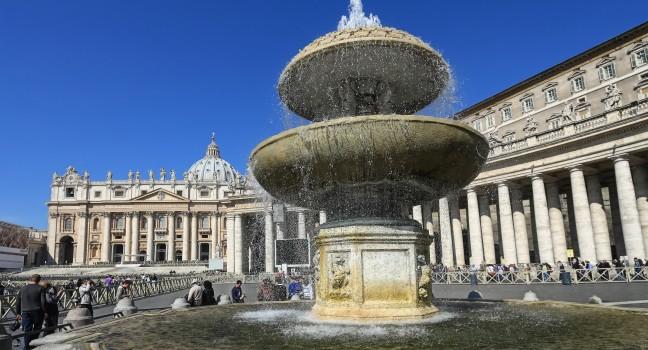
The largest church in the world, built over the tomb of St. Peter, is also the most imposing and breathtaking architectural achievement of the Renaissance (although much of the lavish interior dates to the Baroque). The physical statistics are impressive: it covers 18,000 square yards, runs 212 yards in length, and carries a dome that rises 435 feet and measures 138 feet across its base. Its history is equally impressive: No less than five of Italy's greatest artists -- Bramante, Raphael, Peruzzi, Antonio Sangallo the Younger, and Michelangelo -- died while striving to erect this new St. Peter's.

The history of the original St. Peter's goes back to AD 349, when the emperor Constantine completed a basilica over the site of the tomb of St. Peter, the Church's first pope. The original church stood for more than 1,000 years, undergoing a number of restorations and alterations, until it was in danger of collapse toward the middle of the 15th century. In 1452 a reconstruction job began but was quickly abandoned for lack of money. In 1503 Pope Julius II instructed the architect Bramante to raze all the existing buildings and to build a new basilica, one that would surpass even Constantine's for grandeur. It wasn't until 1626 that the basilica was completed and consecrated.

Though Bramante made little progress in rebuilding St. Peter's, he succeeded nonetheless in outlining a basic plan for the church, and, a crucial step, he built the piers of the crossings -- the massive pillars supporting the dome. After Bramante's death in 1514, Raphael, the Sangallos, and Peruzzi all proposed variations on the original plan at one time or another. Again, however, lack of finances, rivalries between the architects, and, above all, the turmoil caused by the Sack of Rome in 1527 and the mounting crisis of the Reformation conspired to prevent much progress from being made. In 1546, however, Pope Paul III turned to Michelangelo and more or less forced the aging artist to complete the building. Michelangelo, in turn, insisted on having carte blanche to do as he thought best. He returned to Bramante's first idea of having a centralized Greek-cross plan -- that is, with the "arms" of the church all the same length -- and completed most of the exterior architecture except for the dome and the facade. His design for the dome, however, was modified after his death by Giacomo della Porta (his dome was much taller in proportion). The nave, too, was altered after Michelangelo's death. Pope Paul V wanted a Latin-cross church (a church with one "arm" longer than the rest), so Carlo Maderno lengthened one of the arms to create a longer central nave. He was also responsible for the facade. This was much criticized at the time because it hides the dome from observers below. It's also wider than it is high.

As you climb the shallow steps up to the great church, flanked by the statues of Sts. Peter and Paul, you'll see the Loggia delle Benedizioni (Benediction Loggia) over the central portal. This is the balcony where newly elected popes are proclaimed and where they stand to give their apostolic blessing on solemn feast days. The vault of the vestibule is encrusted with rich stuccowork, and the mosaic above the central entrance to the portico is a much-restored work by the 14th-century painter Giotto that was in the original basilica. The bronze doors of the main entrance also were salvaged from the old basilica. The sculptor Filarete worked on them for 12 years; they show scenes from the martyrdom of St. Peter and St. Paul, and the life of Pope Eugene IV (1431-47), Filarete's patron. In the basilica, look at the inside of these doors for the amusing "signature" at the bottom in which Filarete shows himself and his assistant dancing with joy, tools in hand, upon having completed their task. To the left are two modern bronze doors, the so-called Doors of Death, in both of which you'll see Pope John XXIII. On the right of the main entrance are the Door of the Sacraments and the Holy Door, opened only during Holy Years.

Pause a moment to appraise the size of the great building. The people near the main altar seem dwarfed by the incredible dimensions of this immense temple. The statues, the pillars, and the holy-water stoups borne by colossal cherubs are all imposing -- walk over to where the cherub clings to a pier and place your arm across the sole of the cherub's foot; you will discover that it's as long as the distance from your fingers to your elbow. It's because the proportions of this giant building are in such perfect harmony that its vastness may escape you at first. Brass inscriptions in the marble pavement down the center of the nave indicate the approximate lengths of the world's other principal Christian churches, all of which fall far short of the 186-meter span of St. Peter's Basilica. In its megascale -- inspired by the spatial volumes of ancient Roman ruins -- the church reflects Roman grandiosità in all its majesty.

As you enter the great nave from the entrance, you'll find immediately to your right Michelangelo's Pietà, one of the world's most famous statues. Could you question whether this moving work, sculpted when he was only 22, owes more to man's art than to an artist's faith? As we contemplate this masterpiece we are able to understand a little better that art and faith sometimes partake of the same impulse.

In the entrance to the second chapel on the right aisle, the body of Pope John XXIII is laid out in a glass case, his skin waxed to prevent decay. It was brought up from his tomb in the burial area below the basilica in 2000, to celebrate the pope's beatification, and John Paul II now lies in his place. Exquisite bronze grilles and doors by Borromini open into the third chapel in the right aisle, the Cappella del Santissimo Sacramento (Chapel of the Most Holy Sacrament), with a Baroque fresco of the Trinity by Pietro da Cortona and carved angels by Bernini. At the last pillar on the right (the pier of St. Longinus) is a bronze statue of St. Peter, whose big toe is ritually kissed by the faithful. In the right transept, over the door to the Cappella di San Michele (Chapel of St. Michael), usually closed, Canova created a brooding Neoclassical monument to Pope Clement XIII.

In the central crossing, Bernini's great bronze baldacchino -- a huge, spiral-columned canopy -- rises high over the altare papale (papal altar). Bernini's Barberini patron, Pope Urban VIII, had no qualms about stripping the bronze from the Pantheon to provide Bernini with the material to create this curious structure. The Romans reacted with the famous quip "Quod non fecerunt barbari, fecerunt Barberini" ("What the barbarians didn't do, the Barberini did"). A curious legend connected with the baldacchino, which swarms with Barberini bees (the bee was the Barberini family symbol), relates that the pope commissioned it in thanks for the recovery of a favorite niece who had almost died in childbirth. The story is borne out by the marble reliefs on the bases of the columns: the Barberini coat of arms is surmounted by a series of heads, all but two of which seem to represent a woman in what might be the pain of labor, while a smiling baby's face appears on the base at the right front.

The splendid gilt-bronze Cattedra di San Pietro (throne of St. Peter) in the apse above the main altar was designed by Bernini to contain a wooden and ivory chair that St. Peter himself is said to have used, though in fact it doesn't date from further back than medieval times. (You can see a copy of the chair in the treasury.) Above it, Bernini placed a window of thin alabaster sheets that diffuses a golden light around the dove, symbol of the Holy Spirit, in the center.

Two of the major papal funeral monuments in St. Peter's Basilica are on either side of the apse and unfortunately are usually only dimly lighted. To the right is the tomb of Pope Urban VIII; to the left is the tomb of Pope Paul III. Paul's tomb is of an earlier date, designed between 1551 and 1575 by Giacomo della Porta, the architect who completed the dome of St. Peter's Basilica after Michelangelo's death. The nude figure of Justice was widely believed to be a portrait of the pope's beautiful sister, Giulia. The charms of this alluring figure were such that in the 19th century, it was thought that she should no longer be allowed to distract worshippers from their prayers, and she was swathed in marble drapery. It was in emulation of this splendid late-Renaissance work that Urban VIII ordered Bernini to design his tomb. The tomb of Pope Alexander VII, also designed by Bernini, stands to the left of the altar as you look up the nave, behind the farthest pier of the crossing. This may be the most haunting memorial in the basilica, thanks to the frightening skeletonized figure of Death Bernini has added, which holds an hourglass up in its hand.

With advance notice you can take a 1¼-hour guided tour in English of the Vatican Necropolis (06/69885318. 06/69873017. EUR 10. Ufficio Scavi Mon.-Sat. 9-5), under the basilica, which gives a rare glimpse of early Christian Roman burial customs. Apply by fax or e-mail (scavi@fsp.va) at least 10 days in advance, specifying the number of people in the group (all must be age 15 or older), preferred language, preferred time, available dates, and your contact information in Rome.

Under the Pope Pius V monument, the entrance to the sacristy also leads to the Museo Storico-Artistico e Tesoro (Historical-Artistic Museum and Treasury. EUR 9. Apr.-Sept., daily 9-6; Oct.-Mar., daily 9-5), a small collection of Vatican treasures. They range from the massive and beautifully sculptured 15th-century tomb of Pope Sixtus IV by Pollaiuolo, which you can view from above, to a jeweled cross dating from the 6th century and a marble tabernacle by the Florentine mid-15th-century sculptor Donatello. Among the other priceless objects are a platinum chalice presented to Pope Pius VI by Charles III of Spain in the middle of the 18th century and an array of sacred vessels in gold, silver, and precious stones.

Continue on down the left nave past Algardi's tomb of St. Leo. The handsome bronze grilles in the Capella del Coro (Chapel of the Choir) were designed by Borromini to complement those opposite in the Cappella del Santissimo Sacramento. The next pillar holds a rearrangement of the Pollaiuolo brothers' austere monument to Pope Innocent VIII, the only major tomb to have been transferred from the old basilica. The next chapel contains the handsome bronze monument to Pope John XXIII by contemporary sculptor Emilio Greco. On the last pier in this nave stands a monument by the late-18th-century Venetian sculptor Canova marking the burial in the crypt below of the ill-fated Stuarts -- the 18th-century Roman Catholic claimants to the British throne, who were long exiled in Rome.

Above, the vast sweep of the basilica's dome is the cynosure of all eyes. To reach the dome of St. Peter's, proceed from the vestibule and follow the signs; you can either take the elevator or climb the long flight of shallow stairs to the roof of the church (06/69883462. Elevator EUR 5, stairs EUR 4. Daily 8-5; closed during ceremonies in piazza). From here you'll see a surreal landscape of vast sloping terraces punctuated by cupolas that serve as skylights over the various chapels. The roof affords unusual perspectives on the dome above and the piazza below. The terrace is equipped with the inevitable souvenir shop and restrooms. A short flight of stairs leads to the entrance of the tamburo (drum) -- the base of the dome -- where, appropriately enough, there's a bust of Michelangelo, the dome's principal designer. Within the drum, another short ramp and staircase give access to the gallery encircling the base of the dome. From here you have a dove's-eye view of the interior of the church. It's well worth the slight effort to make your way up here -- unless you suffer from vertigo.

Only if you're of stout heart and strong lungs should you then make the taxing climb from the drum of the dome up to the lanterna (lantern) at the very apex of the dome. A narrow, seemingly interminable staircase follows the curve of the dome between inner and outer shells, finally releasing you into the cramped space of the lantern balcony for an absolutely gorgeous panorama of Rome and the countryside on a clear day. There's also a nearly complete view of the palaces, courtyards, and gardens of the Vatican. Be aware, however, that it's a tiring, slightly claustrophobic climb. There's one stairway for going up and a different one for coming down, so you can't change your mind halfway and turn back.

The entrance to the Grotte Vaticane (Vatican Grottoes. Free. Apr.-Sept., daily 7-6; Oct.-Mar., daily 7-5) is at the base of the pier dedicated to St. Longinus. Because the only exit from the crypt leads outside St. Peter's Basilica, it's best to leave this visit for last. The crypt is lined with marble-face chapels and simple tombs occupying the area of Constantine's basilica and standing over what is believed to be the tomb of St. Peter himself. Other tombs and graves include those of Queen Christina of Sweden, the only woman buried in the church, and Pope John Paul II, buried in a simple grave nearby.

  • Open: Apr.-Sept., daily 7-7; Oct.-Mar., daily 7-6

Get Advice From Other Travelers

Visit the Travel Talk forums for help on planning your trip >>


Buy the Guidebook

  • Fodor's Rome, 7th Edition
    $18.95
  • Fodor's See It Rome, 3rd Edition
    $22.95

Get the Fodor's Newsletter

Read the current issue
For more travel ideas, tips, and deals, sign up for the Fodor's newsletter here. Browse previous issues.

Current Fodor's Newsletter

Copyright © 2008 Fodor's Travel, a division of Random House, Inc.