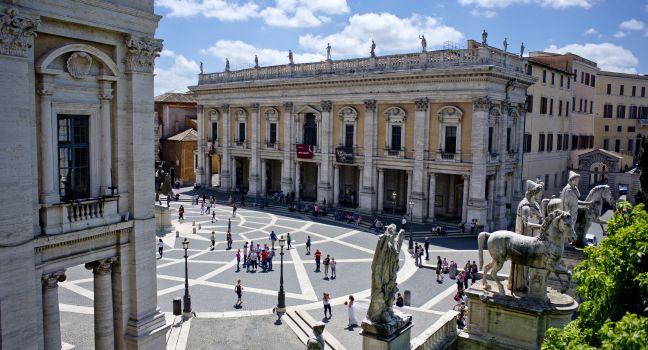
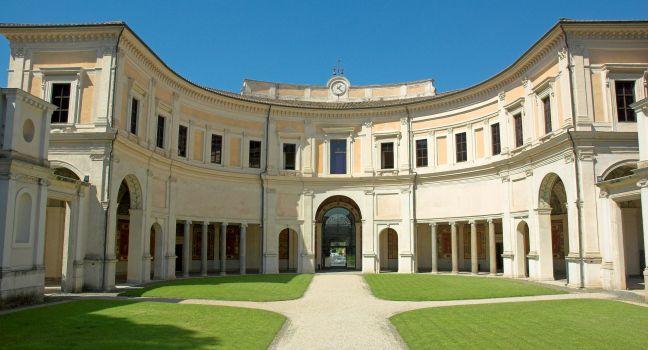
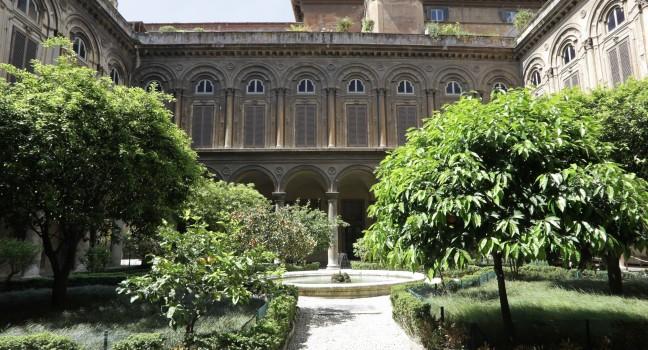
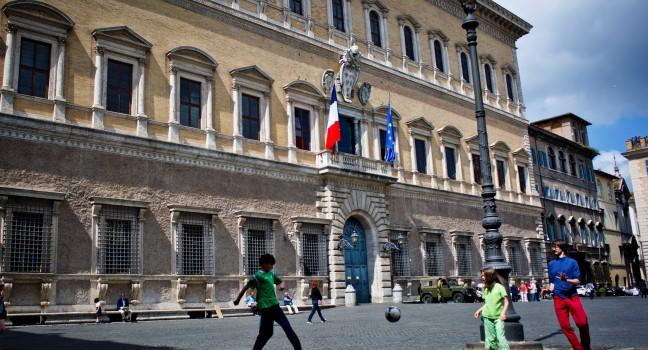
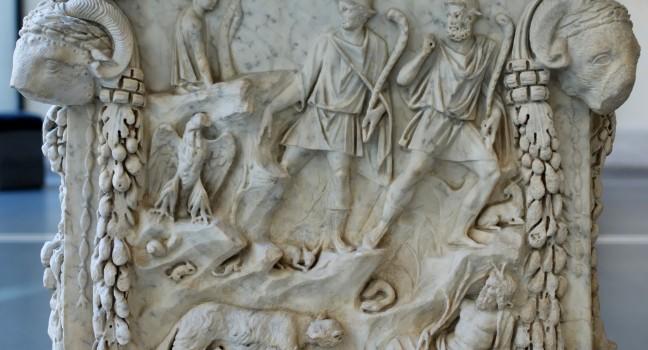
Surpassed in size and richness only by the Musei Vaticani, the world's first public museum—with the greatest hits of Roman art through the ages, from the ancients to the Baroque—is housed in the Palazzo dei Conservatori and the Palazzo Nuovo, which mirror one another across Michelangelo's famous piazza. The collection was begun by Pope Sixtus IV (the man who built the Sistine Chapel) in 1473, when he donated a room of ancient statuary to the people of the city. This core of the collection includes the She Wolf, which is the symbol of Rome, and the piercing gaze of the Capitoline Brutus.
Buy your ticket and enter the Palazzo dei Conservatori, where in the first courtyard, you'll see the giant head, foot, elbow, and imperially raised finger of the fabled seated statue of Constantine, which once dominated the Basilica of Maxentius in the Forum. Upstairs is the resplendent Sala degli Orazi e Curiazi (Hall of the Horatii and Curatii), decorated with a magnificent gilt ceiling, carved wooden doors, and 16th-century frescoes depicting the history of Rome's legendary origins. At each end of the hall are statues of two of the most important popes of the Baroque era, Urban VIII and Innocent X.
The heart of the museum is the modern Exedra of Marcus Aurelius (Esedra di Marco Aurelio), which displays the spectacular original bronze statue of the Roman emperor whose copy dominates the piazza outside. To the right, the room segues into the area of the Temple of Jupiter, with the ruins of part of its vast base rising organically into the museum space. A reconstruction of the temple and the Capitoline Hill from the Bronze Age to the present day makes for a fascinating glimpse through the ages. On the top floor, the museum's pinacoteca, or painting gallery, has some noted Baroque masterpieces, including Caravaggio's The Fortune Teller and St. John the Baptist.
To get to the Palazzo Nuovo section of the museum, take the stairs or elevator to the basement of the Palazzo dei Conservatori, where the corridor uniting the two contains the Epigraphic Collection, a poignant assembly of ancient gravestones. Just over halfway along the corridor, and before going up into the Palazzo Nuovo, be sure to take the staircase to the right to the Tabularium gallery and its unparalleled view over the Forum.
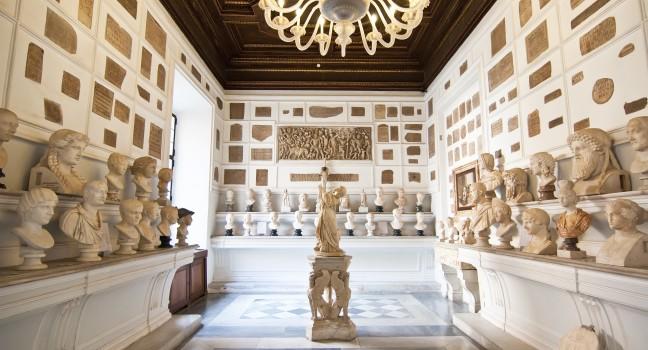
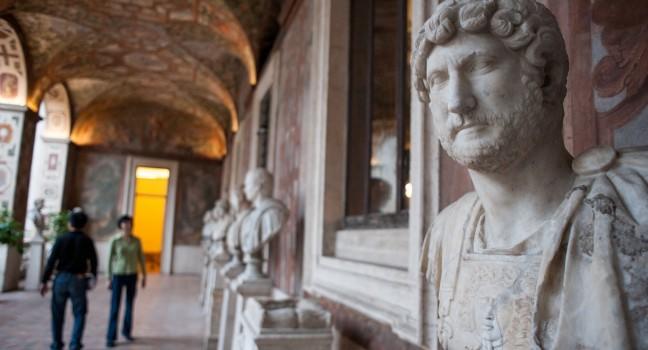
On the stairs inside the Palazzo Nuovo, you'll be immediately dwarfed by Mars in full military rig and lion-topped sandals. Upstairs is the noted Sala degli Imperatori, lined with busts of Roman emperors, and the Sala dei Filosofi, where busts of philosophers sit in judgment—a fascinating who's who of the ancient world. Within these serried ranks are 48 Roman emperors, ranging from Augustus to Theodosius. Nearby are rooms filled with sculptural masterpieces, including the famed Dying Gaul, the Red Faun from Hadrian's Villa, and a Cupid and Psyche.