9 Best Sights in Lima, Peru

Background Illustration for Sights

We've compiled the best of the best in Lima - browse our top choices for the top things to see or do during your stay.

Convento de San Francisco
El Centro Fodor's choice
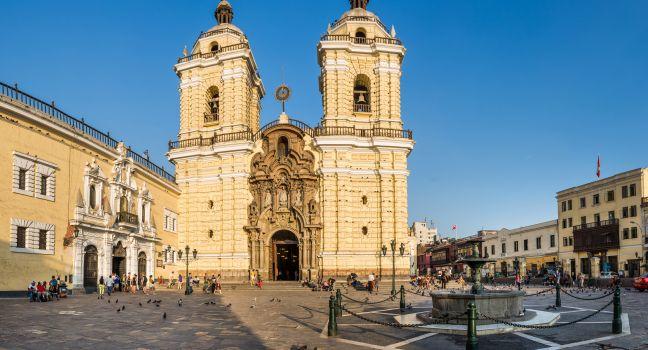
Panoramic view of San San francisco church, in Lima, Peru
Christian Vinces / Shutterstock

With its ornate facade and bell towers, ancient library, and catacombs full of human skulls, the Convento de San Francisco is one of Lima's most impressive sites. The catacombs hold the remains of some 75,000 people, some of whose bones have been arranged in eerie geometric patterns (warning: the narrow, dusty tunnels aren't for the claustrophobic). Meanwhile, the convent's massive church, the Iglesia de San Francisco, is the quintessential example of Lima baroque. Its handsome, carved portal is like an oversized retablo, projecting the church's sacred space out onto the busy street, while the central nave is known for its beautiful ceilings carved in a style called mudéjar (a blend of Moorish and Spanish designs). The 50-minute tour includes the church, the library, ample colonial art, and the catacombs.
Huaca Pucllana

Miraflores Fodor's choice
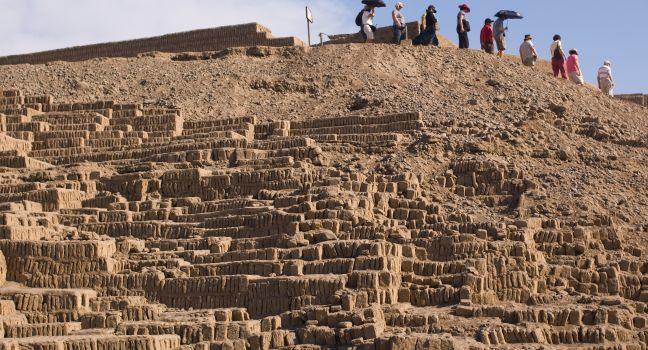
Group of tourists decends the Huaca Pucllana pyramid
e2dan / Shutterstock

Rising out of a nondescript residential neighborhood is Lima's most-visited huaca, or pre-Columbian temple—a huge, mud-brick platform pyramid that covers several city blocks. The site, which dates from at least the 5th century, has ongoing excavations, and new discoveries are announced every so often. A tiny museum highlights a few of those finds. Knowledgeable, English-speaking guides will lead you through reconstructed sections to the pyramid's top platform and, from there, to an area that is being excavated.

This site is most beautiful at night, when parts of it are illuminated. Thirty-minute partial tours are available during this time.

Cl. General Borgoño s/n, Lima, 18, Peru
01-617–7148
Sight Details
S/15 during the day, S/17 at night

Something incorrect in this review?

Casa de Aliaga

El Centro Fodor's choice

From the outside, you'd never guess this was one of Lima's most opulent addresses. Ranked as the oldest private residence in the Americas, the stunning Spanish colonial casona, built in 1535 by Jerónimo de Aliaga—one of Pizarro's officers—has been continuously inhabited by 17 generations of his descendants ever since. Each room boasts a different period decor, from colonial to republican, and Don Jerónimo's German-made sword is still on display in one of the salons. To visit, you must hire an officially approved guide or go as part of a city tour.

Recommended Fodor's Video

Casa Torre Tagle

El Centro Fodor's choice

This viceregal-era mansion sums up the graceful style of the early 18th century. Flanked by a pair of elegant balconies, the stone entrance is as expertly carved as that of any of the city's churches, while the patio is a jewel of the Andalusian baroque, with slender columns supporting delicate Moorish arabesques. The Casa Torre Tagle currently holds offices of the Foreign Ministry and is open to the public only occasionally, but if your timing is serendipitous, you can check out the tiled ceilings of the ground floor and see the house's 18th-century carriage. Across the street is Casa Goyeneche, built some 40 years later in 1771 and clearly influenced by the rococo movement.

Convento de Santo Domingo

El Centro Fodor's choice

If the Iglesia de San Francisco is Lima Gothic—all skulls and penitential gloom—Santo Domingo represents the city's sunny side. From pink facade to rococo tower, every detail here glows with charm. The main cloister is especially enticing: long arcades with Sevillian tiles, gardens redolent of jasmine, coffered ceilings carved from Panamanian oak. But don't overlook the chapter room, which housed Peru's University of San Marcos when it was founded in 1551, or the tombs of Santa Rosa de Lima and San Martín Porres, the first two saints in the New World. In a city given over to the here and now, this temple offers a glimpse into another world. As of this writing, the convent's facade was receiving a much-needed makeover, which may continue through 2024, but the church interior and museum remain open to visitors.

Museo de Arte de Lima (MALI)

El Centro Fodor's choice

Built in 1871 as the Palacio de la Exposición, this mammoth neoclassical structure was designed by the Italian architect Antonio Leonardi, with metal columns from the workshop of Gustav Eiffel (who later built the famous Parisian tower). The ground floor hosts temporary exhibitions by national and international artists, while the second level houses a permanent exhibition that spans Peru's past, with everything from pre-Columbian artifacts and colonial-era art to republican-era paintings and drawings that provide a glimpse into 19th- and 20th-century Peruvian life. One of the museum's treasures is the collection of quipus, or "talking knots"—webs of strings that were the closest thing the Incas had to writing.

Leave time to sip an espresso in the café near the entrance.

Museo Larco

Pueblo Libre Fodor's choice

Hot-pink bougainvillea spills over the white walls of this lovely colonial mansion, which is built atop a pre-Columbian temple. What those walls house is the city's most exquisite collection of ancient art, with works from all of Peru's major pre-Hispanic cultures spanning several thousand years. Highlights include a Moche stirrup vessel detailing grisly human sacrifices, a selection of Inca quipus (knots used for record-keeping), and thousands of ceramic "portrait heads" that give astonishingly realistic insights into their subjects' personalities. The sala erótica reveals that Peru's ancient artisans were an uninhibited lot, creating clay pottery adorned with explicit sexual images. Guides are a good idea, and the cost is just S/35 per group. The café overlooking the museum's garden is an excellent option for lunch or dinner.

Museo Pedro de Osma

Barranco Fodor's choice

Even if it contained no art, this century-old Beaux-Arts mansion would be worth the trip for its design elements alone. The mansard-roofed structure—with inlaid wood floors, delicately painted ceilings, and stained-glass windows in every room—was the home of a wealthy collector of religious artifacts. The best of his collection is permanently on display. The finest of the paintings, the 18th-century Virgen de Pomata, combines Marian iconography with Indigenous symbols in the Holy Mother's mountain-shaped robes festooned with garlands of corn. Other halls contain canvases of archangels, fine silverwork, and sculptures of Huamanga alabaster. Make sure to visit the manicured grounds.

Plaza de Armas

El Centro Fodor's choice

This massive square has been the center of the city since 1535. Over the years it has served many functions, from open-air theater for melodramas to impromptu ring for bullfights. Huge fires once burned in the center for people sentenced to death by the Spanish Inquisition. Much has changed over the years, but one thing remaining is the bronze fountain unveiled in 1651. It was here that José de San Martín declared the country's independence from Spain in 1821.