15 Best Sights in Lima, Peru

Background Illustration for Sights

We've compiled the best of the best in Lima - browse our top choices for the top things to see or do during your stay.

Huaca Pucllana

Miraflores Fodor's choice
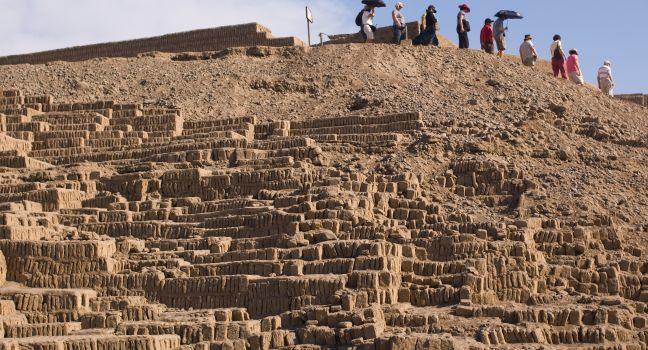
Group of tourists decends the Huaca Pucllana pyramid
e2dan / Shutterstock

Rising out of a nondescript residential neighborhood is Lima's most-visited huaca, or pre-Columbian temple—a huge, mud-brick platform pyramid that covers several city blocks. The site, which dates from at least the 5th century, has ongoing excavations, and new discoveries are announced every so often. A tiny museum highlights a few of those finds. Knowledgeable, English-speaking guides will lead you through reconstructed sections to the pyramid's top platform and, from there, to an area that is being excavated.

This site is most beautiful at night, when parts of it are illuminated. Thirty-minute partial tours are available during this time.

Cl. General Borgoño s/n, Lima, 18, Peru
01-617–7148
Sight Details
S/15 during the day, S/17 at night

Something incorrect in this review?

Museo Larco

Pueblo Libre Fodor's choice

Hot-pink bougainvillea spills over the white walls of this lovely colonial mansion, which is built atop a pre-Columbian temple. What those walls house is the city's most exquisite collection of ancient art, with works from all of Peru's major pre-Hispanic cultures spanning several thousand years. Highlights include a Moche stirrup vessel detailing grisly human sacrifices, a selection of Inca quipus (knots used for record-keeping), and thousands of ceramic "portrait heads" that give astonishingly realistic insights into their subjects' personalities. The sala erótica reveals that Peru's ancient artisans were an uninhibited lot, creating clay pottery adorned with explicit sexual images. Guides are a good idea, and the cost is just S/35 per group. The café overlooking the museum's garden is an excellent option for lunch or dinner.

Plaza de Armas

El Centro Fodor's choice

This massive square has been the center of the city since 1535. Over the years it has served many functions, from open-air theater for melodramas to impromptu ring for bullfights. Huge fires once burned in the center for people sentenced to death by the Spanish Inquisition. Much has changed over the years, but one thing remaining is the bronze fountain unveiled in 1651. It was here that José de San Martín declared the country's independence from Spain in 1821.

Recommended Fodor's Video

Bajada de los Baños

Barranco

This pathway leading down to the "baths"—Barranco's beaches—is shaded by leafy trees and lined with historic architecture. Once the route local fishermen took to reach their boats, it's now a popular promenade at night, when boleros and ballads can be heard from the adjoining restaurants. At the bottom of the hill, a covered wooden bridge takes you across a busy road, the Circuito de Playas, to a promenade containing beaches and restaurants. A short walk to the north is Playa Barranquito; Playa Agua Dulce is half a mile south.

Lima, 04, Peru

Something incorrect in this review?

Circuito Mágico del Agua

El Centro

Motion-activated fountains, fairy-tale Italian loggias, and nocturnal laser shows make this vast park a surefire winner with families. Built in 2007 in Lima's historic Parque de la Reserva, the water-themed attraction draws crowds from all over Peru with its 13 pools and connecting watercourses. The best time to go is around 7 in the evening, when you can see a series of over-the-top multimedia spectacles set to rousing patriotic themes. Bring bathing suits for the kids: they're going to beg to get wet.

El Faro la Marina

Miraflores

Constructed in 1900, this little lighthouse at the north end of Parque Antonio Raimondi, a short walk north from the Parque del Amor, has been guiding ships for more than a century. On sunny weekends, the large green space that surrounds it is one of the most popular spots in Miraflores, with paragliders floating overhead and bicyclists and skateboarders rolling along the ocean-view malecón. Children of all ages play on the lawns and playground.

El Mirador

Barranco

Head down the path to the left of La Ermita church and you'll come upon El Mirador, a scenic lookout with a splendid view of Lima's coastline all the way out to the port of El Callao. It's especially attractive at night, when you can see an illuminated cross and Christ statue on the promontory in Chorrillos to the south. There are also several good bars here, plus local criollo musicians who'll sing you "La Flor de la Canela" for a small tip.

Lima, 04, Peru

Something incorrect in this review?

Huaca Huallamarca

This mud-brick pyramid, thought to be a place of worship, predates the Incas. It was first constructed around 200 BC and later inhabited by the Lima culture, a pre-Hispanic civilization that occupied the Rímac River valley between AD 100 and 700. Painstakingly restored on the front side, it seems out of place among the neighborhood's upscale homes and apartment buildings. Here you'll find a small museum with displays of objects found at the site, including several mummies. From the upper platform you can take in views of San Isidro.

Museo Nacional de Antropología, Arqueología e Historia del Perú

Pueblo Libre

Housed in an 18th-century quinta that has been occupied by both José de San Martín and Simón Bolívar, this fascinating if somewhat discombobulated museum is like Peru's national attic. The left wing is dedicated to pre-Columbian civilizations, with special emphasis on the cultures of Paracas, Chavín, and Nazca; in it, the crowning treasure is the Stella Raimondi, a 2,000-year-old slab inscribed with images of the so-called Staff God, a deity born in Chavín de Huántar that presided over Andean religion for more than a millennium. On the museum's right side, a rambling mansion harbors a collection of independence-era artifacts, including Bolívar's own saber, a pair of viceregal carriages, and reconstructions of a typical 18th-century Lima interior. It's a bit of a hodgepodge, but the peek it affords into Peru's 5,000-year evolution is tantalizing.

Part of the museum's pre-Hispanic wing was closed for remodeling as of this writing, but the exhibits featuring the Stella Raimondi and the Tello Obelisk remain open, as are the museum's beautifully refurbished republican-era halls.

Parque del Amor

Miraflores

You could be forgiven for thinking you're in Barcelona when you stroll through this lovely park designed by Peruvian artist Victor Delfín. As in Antoni Gaudí's Park Güell, which provided inspiration, the benches here are encrusted with broken pieces of tile. In keeping with the romantic theme—the name translates as "Park of Love"—the mosaic includes sayings such as Amor es como luz ("Love is like light"). The centerpiece is a massive statue of two lovers locked in a passionate embrace. The park affords a sweeping view of the Pacific, and on windy days, paragliders take off from an adjacent green.

Across the bridge from the park, you can see the Intihuatana by Fernando de Szyszlo, a huge concrete sculpture inspired by an Inca astronomical clock.

Malecón Cisneros, Lima, 18, Peru
Sight Details
Free

Something incorrect in this review?

Parque El Olivar

For years, this rambling olive grove was slowly being eroded, as homes for wealthy limeños were built in and around its perimeter. The process was halted in the 1960s, in time to save more than 1,500 gnarled olive trees. Some of the trees are four centuries old and still bear fruit. A network of sidewalks, flower beds, fountains, and playgrounds makes this 20-hectare (50-acre) park a popular spot on weekend afternoons.

Parque Kennedy

Miraflores

What locals call Parque Kennedy is, strictly speaking, two parks. A smaller section, near the óvalo, or roundabout, is Parque 7 de Junio, whereas the rest of it is Parque Kennedy proper. On the park's east side stands Miraflores's stately Parroquia La Virgen Milagrosa (Church of the Miraculous Virgin), built in the 1930s on the site of a colonial church. The equally young colonial-style building behind it is the Municipalidad de Miraflores (district town hall). Several open-air cafés along the park's eastern edge serve decent food and drink. At night, a round cement amphitheater in front of those cafés called La Rotonda fills up with performing artists, and the park becomes especially lively. Street vendors also sell popcorn and traditional Peruvian desserts such as picarones (fried doughnuts bathed in molasses), mazamorra morada (a pudding made with blue-corn juice and fruit), and arroz con leche (rice pudding). This park is the most popular meetup spot for the entire district.

Between Av. José Larco and Av. Diagonal, Lima, 18, Peru
Sight Details
Free

Something incorrect in this review?

Parque Municipal

Barranco

Elegant royal palms, swirls of purple-and-yellow bougainvillea, and the surrounding neocolonial architecture make this park a Lima standout. Its southern end is lined with historic buildings, the most prominent of which is the library, with its pink clock tower. To the west stands Barranco's Iglesia La Hermita, a lovely neo-Gothic structure unfortunately closed to the public since its roof caved in during a 1940 earthquake. A nearby staircase leads down to the Puente de los Suspiros and Bajada de los Baños.

Lima, 04, Peru

Something incorrect in this review?

Playa Barranquito

Barranco

A short walk north of the pedestrian bridge at the bottom of Barranco's Bajada de los Baños, this narrow beach is one of Lima's most popular. The sand is dark gray, and when the sea is rough it is unsafe for swimming. But that doesn't stop Playa Barranquito from getting packed from December to April, when vendors stroll through the crowd selling snacks (which inevitably generates litter on the beach). It's a quiet spot the rest of the year except for the cries of seagulls and the rumble of cars passing on the Circuito de Playas. Amenities: food and drink, parking (fee); toilets. Best for: sunset; walking.

Circuito de Playas, ½ km (¼ mile) north of Bajada de los Baños, Lima, 04, Peru

Something incorrect in this review?

Plaza San Martín

El Centro

This spectacular plaza is unlike any other in the city. It's surrounded on three sides by neocolonial buildings dating from the 1920s, the pale facades of which are lit at night, when the plaza is most impressive. Presiding over the western edge is the Gran Hotel Bolívar, a pleasant spot for a pisco sour. Even if you're not thirsty, you should step inside for a look at its elegant lobby. At the plaza's center is a massive statue of José de San Martín, the Argentine general who brought about the independence of Argentina, Chile, and Peru from Spain.

Between Jr. de la Unión and Jr. Carabaya, Lima, 01, Peru

Something incorrect in this review?