4 Best Sights in Lima, Peru

Background Illustration for Sights

We've compiled the best of the best in Lima - browse our top choices for the top things to see or do during your stay.

Huaca Pucllana

Miraflores Fodor's choice
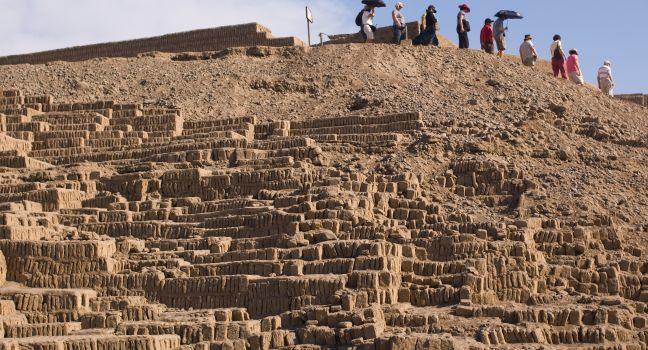
Group of tourists decends the Huaca Pucllana pyramid
e2dan / Shutterstock

Rising out of a nondescript residential neighborhood is Lima's most-visited huaca, or pre-Columbian temple—a huge, mud-brick platform pyramid that covers several city blocks. The site, which dates from at least the 5th century, has ongoing excavations, and new discoveries are announced every so often. A tiny museum highlights a few of those finds. Knowledgeable, English-speaking guides will lead you through reconstructed sections to the pyramid's top platform and, from there, to an area that is being excavated.

This site is most beautiful at night, when parts of it are illuminated. Thirty-minute partial tours are available during this time.

Cl. General Borgoño s/n, Lima, 18, Peru
01-617–7148
Sight Details
S/15 during the day, S/17 at night

Something incorrect in this review?

Caral

It’s the oldest city in the Western Hemisphere, predating the pyramids at Giza by some 400 years. Archaeologists say it’s revolutionized their ideas about the very nature of Homo sapiens. Yet this vast pyramid complex in Peru's Supe valley remains largely unknown, to tourists and locals alike. Discovered by archaeologist Ruth Shady Solis in 1994, Caral is one of the most astonishing sites in the Americas, since it marks one of only six spots on earth where humans crossed what scholars call "the great divide"—i.e., where civilization itself began. When you go, you'll find excellent signage in Spanish and English, as well as informed docents to guide you through this UNESCO World Heritage Site. Walking amid its crumbling pyramids and sunken plazas, it's impossible not to imagine a priest in his headdress and tunic, arms hieratically outstretched over the fire pit before him.

The site is some 220 km (120 miles) north of Lima and not easy to find; taking an all-day tour is the best way to visit.

Panamericana Norte, Caral, Peru
955-881–340
Sight Details
S/11

Something incorrect in this review?

Huaca Huallamarca

This mud-brick pyramid, thought to be a place of worship, predates the Incas. It was first constructed around 200 BC and later inhabited by the Lima culture, a pre-Hispanic civilization that occupied the Rímac River valley between AD 100 and 700. Painstakingly restored on the front side, it seems out of place among the neighborhood's upscale homes and apartment buildings. Here you'll find a small museum with displays of objects found at the site, including several mummies. From the upper platform you can take in views of San Isidro.

Recommended Fodor's Video

Pachacamac

Sacred to the god of earthquakes, this sprawling adobe temple was for 1,300 years the chief pilgrimage destination on Peru's Pacific coast. What those votaries came to see was Pachacamac—"he who moves the earth"—a scowling lord carved into a wooden staff wielded by the sanctuary's fearsome priests (elsewhere, he appears on ceramic vessels as a strange, griffin-like creature, with a bird's beak and feline claws). Pachacamac's cult began with the Lima culture around AD 200, but grew when the Huari took over the complex some four centuries later. It exploded when the Incas came in 1470, elevating the earth-shaker to the rank of their own creator-god and erecting a sun temple in his honor on the bluff's apex. Today, visitors can meander through the pre-Inca Painted Temple, with its traces of red brick, as well as the hilltop Temple of the Sun that looks out on the Pacific. A museum offers informative displays.

The best way to visit Pachacamac is by taking a half-day guided tour with an agency like Mirabus, since the site is 32 km (20 miles) south of downtown, and getting a taxi back can be tricky.

Km 31.5, Panamericana Sur, Lima, 19, Peru
01-321–5606
Sight Details
S/15
Closed Mon.

Something incorrect in this review?