7 Best Sights in Lima, Peru

Background Illustration for Sights

We've compiled the best of the best in Lima - browse our top choices for the top things to see or do during your stay.

Convento de San Francisco
El Centro Fodor's choice
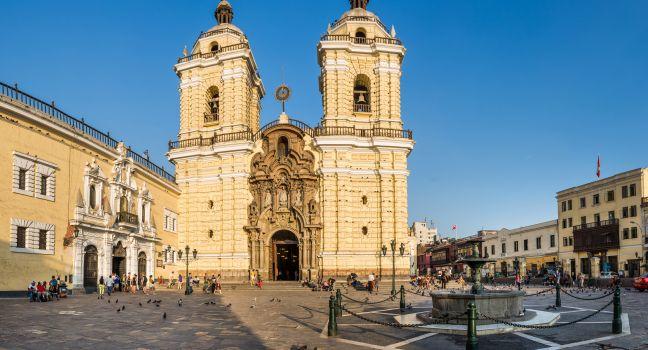
Panoramic view of San San francisco church, in Lima, Peru
Christian Vinces / Shutterstock

With its ornate facade and bell towers, ancient library, and catacombs full of human skulls, the Convento de San Francisco is one of Lima's most impressive sites. The catacombs hold the remains of some 75,000 people, some of whose bones have been arranged in eerie geometric patterns (warning: the narrow, dusty tunnels aren't for the claustrophobic). Meanwhile, the convent's massive church, the Iglesia de San Francisco, is the quintessential example of Lima baroque. Its handsome, carved portal is like an oversized retablo, projecting the church's sacred space out onto the busy street, while the central nave is known for its beautiful ceilings carved in a style called mudéjar (a blend of Moorish and Spanish designs). The 50-minute tour includes the church, the library, ample colonial art, and the catacombs.

Convento de Santo Domingo

El Centro Fodor's choice

If the Iglesia de San Francisco is Lima Gothic—all skulls and penitential gloom—Santo Domingo represents the city's sunny side. From pink facade to rococo tower, every detail here glows with charm. The main cloister is especially enticing: long arcades with Sevillian tiles, gardens redolent of jasmine, coffered ceilings carved from Panamanian oak. But don't overlook the chapter room, which housed Peru's University of San Marcos when it was founded in 1551, or the tombs of Santa Rosa de Lima and San Martín Porres, the first two saints in the New World. In a city given over to the here and now, this temple offers a glimpse into another world. As of this writing, the convent's facade was receiving a much-needed makeover, which may continue through 2024, but the church interior and museum remain open to visitors.

Catedral de Lima

El Centro

In its nearly 500-year history, Lima's cathedral has been torn down, built back up, razed by earthquakes, shot at, hollowed out, and remodeled too many times to count. Miraculously, however, it's still here, and today shines more resplendently than ever, despite its hodgepodge of artistic styles and endless, meddling restorations. The church visitors see today is actually the basilica's fourth incarnation, reconstructed after the earthquakes of 1687 and 1746. The facade impresses with its stately Renaissance portal and neoclassical bell towers, but the interior is where the real action's at. Here, under arched ceiling vaults traced with fretwork and delicately carved choir stalls, you'll find crypts for Lima luminaries and recently excavated mass tombs for commoners. Crowning it all is the mausoleum of Francisco Pizarro himself, complete with the lead box that once held his skull. Recorded tours in English are available.

Jr. Carabaya s/n, Lima, 01, Peru
01-427–9647
Sight Details
S/10

Something incorrect in this review?

Recommended Fodor's Video

Iglesia de Jesús, María y José

El Centro

The 1713 Church of Jesus, Mary, and Joseph may be smaller than some of El Centro's other sanctuaries, but inside is a feast for the eyes. Retablos representing various saints rise from the main altar and line both walls. Originally a convent for nuns of the Capuchin Poor Clares, this is the only church in Lima to retain its original baroque ornamentation, untouched by earthquakes or changing artistic fads.

Jr. Camaná 765, Lima, 01, Peru
01-427–6809
Sight Details
Free
Closed Sun.

Something incorrect in this review?

Iglesia de la Merced

El Centro

Nothing about this colonial-era church could be called restrained. Take the pink-and-gray stone facade, for instance: done in an over-the-top style known as churrigueresco, it piles on twisty Solomonic columns, geometric cornices, a scalloped entryway, and an arms-outstretched statue of the Virgin that gestures down at worshippers below. The interior is no different. The main altar has a stunning monstrance and a silverwork medallion from the 16th century, while the intricately carved choir stalls, dating from the 1700s, have images of cherubic singers. You could lose yourself for hours contemplating the layer upon layer of detail in this stunning temple.

Don't miss the grave of Fr. Urraca, a Lima saint said to have been tempted by the devil within these very walls.

Jr. de la Unión at Jr. Miro Quesada, Lima, 01, Peru
01-427–8199
Sight Details
Free

Something incorrect in this review?

Iglesia de San Agustín

El Centro

Disfigured by the violence of Peru’s history—earthquakes and war—this church, or more specifically, its magnificent facade, remains one of the summits of religious art in the New World. Carved in stone in 1710 in the churrigueresco style (a Spanish variant of the baroque), it’s crowded with images alluding to the life of St. Augustine, who is depicted stamping out heresy on the cornice above the main door. Inside, look for the macabre masterpiece La Muerte (Death), by the great 18th-century Indigenous sculptor Baltasar Gavilán. As of this writing, the church was closed for restoration work on the atrium's protective railing, but this project should be finished by late 2024.

Iglesia de San Pedro

El Centro

The Jesuits built three churches in rapid succession on this corner, inaugurating the current temple in 1638. It remains one of the finest examples of early colonial religious architecture in Peru. The facade is remarkably restrained, but the interior shows all the extravagance of the era, including a series of baroque retablos thought to be the best in the city. The one dedicated to St. Francis Xavier soars to an apocalyptic culmination, with carved saints and angels towering over the viewer. Also notable are the canvases by Bernardo Bitti, who arrived on these shores from Italy in 1575 and influenced an entire generation of painters with his style. In the sacristy is The Coronation of the Virgin, one of his most famous works.

Don't miss the side aisles, where gilded arches lead to chapels decorated with beautiful hand-painted tiles.