42 Best Sights in Lima, Peru

Background Illustration for Sights

We've compiled the best of the best in Lima - browse our top choices for the top things to see or do during your stay.

Convento de San Francisco
El Centro Fodor's choice
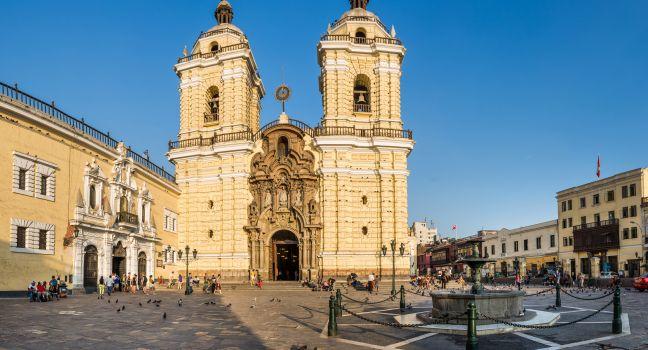
Panoramic view of San San francisco church, in Lima, Peru
Christian Vinces / Shutterstock

With its ornate facade and bell towers, ancient library, and catacombs full of human skulls, the Convento de San Francisco is one of Lima's most impressive sites. The catacombs hold the remains of some 75,000 people, some of whose bones have been arranged in eerie geometric patterns (warning: the narrow, dusty tunnels aren't for the claustrophobic). Meanwhile, the convent's massive church, the Iglesia de San Francisco, is the quintessential example of Lima baroque. Its handsome, carved portal is like an oversized retablo, projecting the church's sacred space out onto the busy street, while the central nave is known for its beautiful ceilings carved in a style called mudéjar (a blend of Moorish and Spanish designs). The 50-minute tour includes the church, the library, ample colonial art, and the catacombs.
Huaca Pucllana

Miraflores Fodor's choice
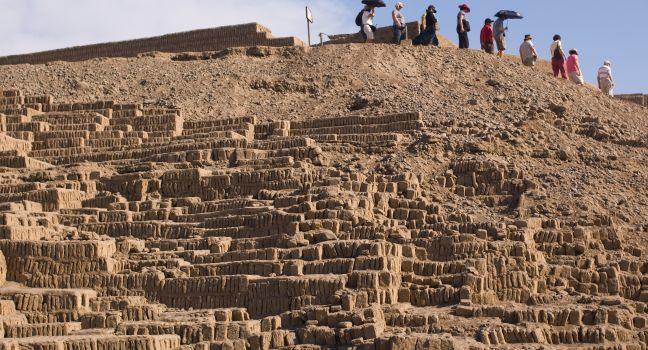
Group of tourists decends the Huaca Pucllana pyramid
e2dan / Shutterstock

Rising out of a nondescript residential neighborhood is Lima's most-visited huaca, or pre-Columbian temple—a huge, mud-brick platform pyramid that covers several city blocks. The site, which dates from at least the 5th century, has ongoing excavations, and new discoveries are announced every so often. A tiny museum highlights a few of those finds. Knowledgeable, English-speaking guides will lead you through reconstructed sections to the pyramid's top platform and, from there, to an area that is being excavated.

This site is most beautiful at night, when parts of it are illuminated. Thirty-minute partial tours are available during this time.

Cl. General Borgoño s/n, Lima, 18, Peru
01-617–7148
Sight Details
S/15 during the day, S/17 at night

Something incorrect in this review?

Casa de Aliaga

El Centro Fodor's choice

From the outside, you'd never guess this was one of Lima's most opulent addresses. Ranked as the oldest private residence in the Americas, the stunning Spanish colonial casona, built in 1535 by Jerónimo de Aliaga—one of Pizarro's officers—has been continuously inhabited by 17 generations of his descendants ever since. Each room boasts a different period decor, from colonial to republican, and Don Jerónimo's German-made sword is still on display in one of the salons. To visit, you must hire an officially approved guide or go as part of a city tour.

Recommended Fodor's Video

Casa Torre Tagle

El Centro Fodor's choice

This viceregal-era mansion sums up the graceful style of the early 18th century. Flanked by a pair of elegant balconies, the stone entrance is as expertly carved as that of any of the city's churches, while the patio is a jewel of the Andalusian baroque, with slender columns supporting delicate Moorish arabesques. The Casa Torre Tagle currently holds offices of the Foreign Ministry and is open to the public only occasionally, but if your timing is serendipitous, you can check out the tiled ceilings of the ground floor and see the house's 18th-century carriage. Across the street is Casa Goyeneche, built some 40 years later in 1771 and clearly influenced by the rococo movement.

Convento de Santo Domingo

El Centro Fodor's choice

If the Iglesia de San Francisco is Lima Gothic—all skulls and penitential gloom—Santo Domingo represents the city's sunny side. From pink facade to rococo tower, every detail here glows with charm. The main cloister is especially enticing: long arcades with Sevillian tiles, gardens redolent of jasmine, coffered ceilings carved from Panamanian oak. But don't overlook the chapter room, which housed Peru's University of San Marcos when it was founded in 1551, or the tombs of Santa Rosa de Lima and San Martín Porres, the first two saints in the New World. In a city given over to the here and now, this temple offers a glimpse into another world. As of this writing, the convent's facade was receiving a much-needed makeover, which may continue through 2024, but the church interior and museum remain open to visitors.

Museo de Arte de Lima (MALI)

El Centro Fodor's choice

Built in 1871 as the Palacio de la Exposición, this mammoth neoclassical structure was designed by the Italian architect Antonio Leonardi, with metal columns from the workshop of Gustav Eiffel (who later built the famous Parisian tower). The ground floor hosts temporary exhibitions by national and international artists, while the second level houses a permanent exhibition that spans Peru's past, with everything from pre-Columbian artifacts and colonial-era art to republican-era paintings and drawings that provide a glimpse into 19th- and 20th-century Peruvian life. One of the museum's treasures is the collection of quipus, or "talking knots"—webs of strings that were the closest thing the Incas had to writing.

Leave time to sip an espresso in the café near the entrance.

Museo Larco

Pueblo Libre Fodor's choice

Hot-pink bougainvillea spills over the white walls of this lovely colonial mansion, which is built atop a pre-Columbian temple. What those walls house is the city's most exquisite collection of ancient art, with works from all of Peru's major pre-Hispanic cultures spanning several thousand years. Highlights include a Moche stirrup vessel detailing grisly human sacrifices, a selection of Inca quipus (knots used for record-keeping), and thousands of ceramic "portrait heads" that give astonishingly realistic insights into their subjects' personalities. The sala erótica reveals that Peru's ancient artisans were an uninhibited lot, creating clay pottery adorned with explicit sexual images. Guides are a good idea, and the cost is just S/35 per group. The café overlooking the museum's garden is an excellent option for lunch or dinner.

Museo Pedro de Osma

Barranco Fodor's choice

Even if it contained no art, this century-old Beaux-Arts mansion would be worth the trip for its design elements alone. The mansard-roofed structure—with inlaid wood floors, delicately painted ceilings, and stained-glass windows in every room—was the home of a wealthy collector of religious artifacts. The best of his collection is permanently on display. The finest of the paintings, the 18th-century Virgen de Pomata, combines Marian iconography with Indigenous symbols in the Holy Mother's mountain-shaped robes festooned with garlands of corn. Other halls contain canvases of archangels, fine silverwork, and sculptures of Huamanga alabaster. Make sure to visit the manicured grounds.

Plaza de Armas

El Centro Fodor's choice

This massive square has been the center of the city since 1535. Over the years it has served many functions, from open-air theater for melodramas to impromptu ring for bullfights. Huge fires once burned in the center for people sentenced to death by the Spanish Inquisition. Much has changed over the years, but one thing remaining is the bronze fountain unveiled in 1651. It was here that José de San Martín declared the country's independence from Spain in 1821.

Bajada de los Baños

Barranco

This pathway leading down to the "baths"—Barranco's beaches—is shaded by leafy trees and lined with historic architecture. Once the route local fishermen took to reach their boats, it's now a popular promenade at night, when boleros and ballads can be heard from the adjoining restaurants. At the bottom of the hill, a covered wooden bridge takes you across a busy road, the Circuito de Playas, to a promenade containing beaches and restaurants. A short walk to the north is Playa Barranquito; Playa Agua Dulce is half a mile south.

Lima, 04, Peru

Something incorrect in this review?

Barrio Chino

El Centro

A ceremonial arch at the corner of Jirones Ucayali and Andahuaylas marks the entrance to Lima's compact Chinatown, which consists of 10 square blocks of markets and chifas (Peruvian-Chinese restaurants). Of the latter, the best are Chifa San Joy Lao, which dates from 1927, and Salón Capón and Wa Lok on Jirón Paruro.

Jr. Ucayali and Jr. Andahuaylas, Lima, 01, Peru

Something incorrect in this review?

Caral

It’s the oldest city in the Western Hemisphere, predating the pyramids at Giza by some 400 years. Archaeologists say it’s revolutionized their ideas about the very nature of Homo sapiens. Yet this vast pyramid complex in Peru's Supe valley remains largely unknown, to tourists and locals alike. Discovered by archaeologist Ruth Shady Solis in 1994, Caral is one of the most astonishing sites in the Americas, since it marks one of only six spots on earth where humans crossed what scholars call "the great divide"—i.e., where civilization itself began. When you go, you'll find excellent signage in Spanish and English, as well as informed docents to guide you through this UNESCO World Heritage Site. Walking amid its crumbling pyramids and sunken plazas, it's impossible not to imagine a priest in his headdress and tunic, arms hieratically outstretched over the fire pit before him.

The site is some 220 km (120 miles) north of Lima and not easy to find; taking an all-day tour is the best way to visit.

Panamericana Norte, Caral, Peru
955-881–340
Sight Details
S/11

Something incorrect in this review?

Casa de Correos y Telégrafos

El Centro

Inaugurated in 1897, this regal Beaux-Arts structure looks more like a palace than a post office. At one time, locals deposited letters in the mouth of the bronze lion by the front doors, while Lima's stamp aficionados met below the building's arcades every Sunday to share their collections. Postal service from the building has been suspended since the COVID pandemic, but the edifice is still worth a visit to glimpse a great example of Lima's fin-de-siècle architectural style.

Jr. Camaná 157, Lima, 01, Peru
01-426–7624
Sight Details
Interior closed to the public indefinitely

Something incorrect in this review?

Casa Riva-Agüero

El Centro

A pair of balconies with celosías—intricate wood screens through which ladies could watch passersby unobserved—grace the facade of this rambling mansion dating from the 1760s. Step inside, and the downtown traffic fades away as you stroll across the stone courtyard and admire the elegant neoclassical salons and galleries. Peru's Catholic University, which administers the landmark, uses it for changing folk-art exhibitions, but the real reason to come is for a glimpse into a colonial-era home. As of this writing, the house was undergoing structural renovations but was expected to have reopened by late 2024.

The house retains many of its original neoclassical and Second Empire furnishings.

Catedral de Lima

El Centro

In its nearly 500-year history, Lima's cathedral has been torn down, built back up, razed by earthquakes, shot at, hollowed out, and remodeled too many times to count. Miraculously, however, it's still here, and today shines more resplendently than ever, despite its hodgepodge of artistic styles and endless, meddling restorations. The church visitors see today is actually the basilica's fourth incarnation, reconstructed after the earthquakes of 1687 and 1746. The facade impresses with its stately Renaissance portal and neoclassical bell towers, but the interior is where the real action's at. Here, under arched ceiling vaults traced with fretwork and delicately carved choir stalls, you'll find crypts for Lima luminaries and recently excavated mass tombs for commoners. Crowning it all is the mausoleum of Francisco Pizarro himself, complete with the lead box that once held his skull. Recorded tours in English are available.

Jr. Carabaya s/n, Lima, 01, Peru
01-427–9647
Sight Details
S/10

Something incorrect in this review?

Cerro San Cristóbal

El Centro

Rising over the northeastern edge of the city is this massive hill, recognizable from the cross at its peak—a replica of the one once placed there by Pizarro. On a clear day, more common during the southern summer, the views of the city below are lovely.

The neighborhood at the base of the hill is sketchy, so hire a taxi or take a tour to the summit and back. Tour buses leave continuously from the Plaza de Armas until 5 or 6 pm.

Lima, 01, Peru

Something incorrect in this review?

Circuito Mágico del Agua

El Centro

Motion-activated fountains, fairy-tale Italian loggias, and nocturnal laser shows make this vast park a surefire winner with families. Built in 2007 in Lima's historic Parque de la Reserva, the water-themed attraction draws crowds from all over Peru with its 13 pools and connecting watercourses. The best time to go is around 7 in the evening, when you can see a series of over-the-top multimedia spectacles set to rousing patriotic themes. Bring bathing suits for the kids: they're going to beg to get wet.

Convento de los Descalzos

El Centro

Founded in 1595 as a retreat for Franciscans who wanted to escape the bustle of worldly Lima, this functioning monastery offers an intriguing glimpse into a colonial convent. Walled up in its self-sufficient cloisters, the good friars did more than just pray: they also ran an infirmary, a pharmacy with Amazonian plants, and even a distillery for making pisco. The temple's ornamentation can be stunning—the chapel is inlaid with Nicaraguan cedar and mother-of-pearl—but what truly captivates here are the silences. The tolling bells still summon the faithful to prayer. As of this writing, the convent was closed for extensive maintenance but was expected to have reopened by late 2024.

El Faro la Marina

Miraflores

Constructed in 1900, this little lighthouse at the north end of Parque Antonio Raimondi, a short walk north from the Parque del Amor, has been guiding ships for more than a century. On sunny weekends, the large green space that surrounds it is one of the most popular spots in Miraflores, with paragliders floating overhead and bicyclists and skateboarders rolling along the ocean-view malecón. Children of all ages play on the lawns and playground.

El Mirador

Barranco

Head down the path to the left of La Ermita church and you'll come upon El Mirador, a scenic lookout with a splendid view of Lima's coastline all the way out to the port of El Callao. It's especially attractive at night, when you can see an illuminated cross and Christ statue on the promontory in Chorrillos to the south. There are also several good bars here, plus local criollo musicians who'll sing you "La Flor de la Canela" for a small tip.

Lima, 04, Peru

Something incorrect in this review?

Estación de Desamparados

El Centro

Inaugurated in 1912, Desamparados Station was the Lima terminal for one of the continent's first railways, which upon completion stretched from the port of Callao to the Andean city of Huancayo. The station was named for a Jesuit church and monastery that stood next door at the time of its construction but that have since been demolished. It now houses the Casa de la Literatura Peruana (House of Peruvian Literature), with exhibits on national writers and a reading library. It's well worth stepping inside to admire the building's elegant art nouveau interior, especially the stained-glass skylight. These days the station also serves as the departure point for luxury rail trips to Huancayo.

Fortaleza Real Felipe

Commissioned in 1747 to defend Lima against pirate attacks, this hulking citadel was once the largest Spanish military installation in the Americas and played a decisive role in Peru's turbulent history. During South America's wars of independence, its firepower was such that it forced the liberator José de San Martín to scuttle his plan for a sea invasion of Lima in favor of a land attack; later, in 1866, it was used by newly independent Peru to repel a Spanish flotilla bent on reconquering the former colony. Today the fortress continues to be one of Lima's most darkly imposing sights. Visitors can walk the ramparts and look out over the harbors of El Callao, or climb the Torreones del Rey y de la Reina, twin towers that became torture chambers for the prisoners shackled there. If you're a fan of the paranormal, the nighttime tours here are genuinely creepy.

Huaca Huallamarca

This mud-brick pyramid, thought to be a place of worship, predates the Incas. It was first constructed around 200 BC and later inhabited by the Lima culture, a pre-Hispanic civilization that occupied the Rímac River valley between AD 100 and 700. Painstakingly restored on the front side, it seems out of place among the neighborhood's upscale homes and apartment buildings. Here you'll find a small museum with displays of objects found at the site, including several mummies. From the upper platform you can take in views of San Isidro.

Iglesia de Jesús, María y José

El Centro

The 1713 Church of Jesus, Mary, and Joseph may be smaller than some of El Centro's other sanctuaries, but inside is a feast for the eyes. Retablos representing various saints rise from the main altar and line both walls. Originally a convent for nuns of the Capuchin Poor Clares, this is the only church in Lima to retain its original baroque ornamentation, untouched by earthquakes or changing artistic fads.

Jr. Camaná 765, Lima, 01, Peru
01-427–6809
Sight Details
Free
Closed Sun.

Something incorrect in this review?

Iglesia de la Merced

El Centro

Nothing about this colonial-era church could be called restrained. Take the pink-and-gray stone facade, for instance: done in an over-the-top style known as churrigueresco, it piles on twisty Solomonic columns, geometric cornices, a scalloped entryway, and an arms-outstretched statue of the Virgin that gestures down at worshippers below. The interior is no different. The main altar has a stunning monstrance and a silverwork medallion from the 16th century, while the intricately carved choir stalls, dating from the 1700s, have images of cherubic singers. You could lose yourself for hours contemplating the layer upon layer of detail in this stunning temple.

Don't miss the grave of Fr. Urraca, a Lima saint said to have been tempted by the devil within these very walls.

Jr. de la Unión at Jr. Miro Quesada, Lima, 01, Peru
01-427–8199
Sight Details
Free

Something incorrect in this review?

Iglesia de San Agustín

El Centro

Disfigured by the violence of Peru’s history—earthquakes and war—this church, or more specifically, its magnificent facade, remains one of the summits of religious art in the New World. Carved in stone in 1710 in the churrigueresco style (a Spanish variant of the baroque), it’s crowded with images alluding to the life of St. Augustine, who is depicted stamping out heresy on the cornice above the main door. Inside, look for the macabre masterpiece La Muerte (Death), by the great 18th-century Indigenous sculptor Baltasar Gavilán. As of this writing, the church was closed for restoration work on the atrium's protective railing, but this project should be finished by late 2024.

Iglesia de San Pedro

El Centro

The Jesuits built three churches in rapid succession on this corner, inaugurating the current temple in 1638. It remains one of the finest examples of early colonial religious architecture in Peru. The facade is remarkably restrained, but the interior shows all the extravagance of the era, including a series of baroque retablos thought to be the best in the city. The one dedicated to St. Francis Xavier soars to an apocalyptic culmination, with carved saints and angels towering over the viewer. Also notable are the canvases by Bernardo Bitti, who arrived on these shores from Italy in 1575 and influenced an entire generation of painters with his style. In the sacristy is The Coronation of the Virgin, one of his most famous works.

Don't miss the side aisles, where gilded arches lead to chapels decorated with beautiful hand-painted tiles.

Lugar de la Memoria

Miraflores

From 1980 to 2000, two terrorist groups waged a fierce war against the Peruvian state: Sendero Luminoso and the Movimiento Revolucionario Túpac Amaru. Their assaults and the brutal reaction of the Peruvian military left some 70,000 citizens dead—mostly poor campesinos (country folk) from the sierra. This somber museum commemorates that dark period, with historical exhibits and video testimony from many of the victims. The displays are all in Spanish, but even if you don't know the language, this place makes an impression.

You can view an even more powerful exhibit on Sendero Luminoso on the sixth floor of the Ministerio de la Cultura, in the San Borja district.

Bajada San Martín 151, Lima, Peru
01-618–9393
Sight Details
Free
Closed Mon.

Something incorrect in this review?

Municipalidad de Lima

El Centro

Although it resembles the colonial-era buildings that abound in the area, the Municipalidad (City Hall) was constructed in 1944. Step into the foyer to see the stained-glass windows above the marble staircase. To the south of the building is a popular pedestrian walkway called the Portal de los Escribanos, or Passage of the Scribes, lined with restaurants. On the right, you'll find the entrance to a small gallery run by City Hall that hosts exhibitions by Peruvian artists.

Museo Amano

Miraflores

Although relatively small, this private museum of pre-Columbian artifacts holds some of the city's best textiles, in addition to well-preserved ceramics and other handiwork. The museum was founded by Japanese businessman and collector Yoshitaro Amano in 1964 and expanded and remodeled by his offspring in 2015. The chronological exhibition charts Peru's artistic development from 800 BC to the 15th century across four halls packed with well-preserved pieces from pre-Inca cultures, including the Paracas, Nazca, Moche, and Chancay. The impressive collection of weavings contains some that are almost 2,000 years old; miraculously, many have retained their vivid colors and (sometimes comic) imagery. Displays are in English and Spanish; you can also call ahead to reserve an English-speaking guide.

Cl. Retiro 160, Lima, 18, Peru
01-441–2909
Sight Details
S/35
Closed Mon.

Something incorrect in this review?