363 Best Sights in New York City, New York

Background Illustration for Sights

We've compiled the best of the best in New York City - browse our top choices for the top things to see or do during your stay.

Queens Botanical Garden

Flushing

Adjacent to Flushing Meadows Corona Park, these 39 acres include rose and herb gardens, an arboretum, and plantings especially designed to attract bees and birds. An environmentally friendly visitor center uses solar energy and recycles gray water. To learn more about what you're looking at, use the garden's guides, like the summer plant walk guide, the Indigenous Heritage plant guide, or the winter plant walk guide.

43--50 Main St., Queens, NY, 11355, USA
718-886–3800
Sight Details
$6 (free Dec. 16–Mar.); parking from $8
Closed Mon.

Something incorrect in this review?

The Frick Collection

Upper East Side
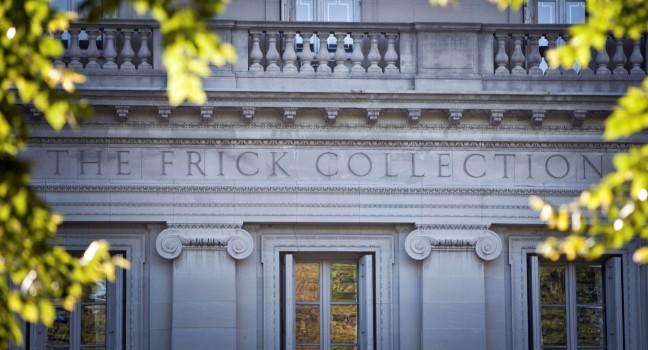
The Frick Collection art museum in New York on August 30, 2012 in Manhattan, New York City.
Stuart Monk / Shutterstock

Spring 2025 was when the Frick Collection returned to its opulent Gilded Age mansion on 5th Avenue, which has been renovated and modernized with new technology and accessibility features to the tune of $200 million. In addition, a new suite of galleries on the second floor has been unveiled. The museum's namesake, Henry Clay Frick (1849–1919), made his fortune amid the smoke of Pittsburgh, where he was a coke (a coal fuel derivative) and steel baron, but his amazing art collection—Old Master paintings as well as works from the Renaissance through the late 19th century—is decidedly far removed from soot. Expect masterpieces from Holbein, Vermeer, Rembrandt, El Greco, Goya, Van Dyck, Degas, Whistler, Manet, Monet, and Turner. The museum also has 18th-century French furniture, delicate Chinese ceramics, and other decorative arts on display. It also houses a state-of-the-art auditorium, gift shop, and 60-seat café overlooking the 70th Street Garden. Children under 10 are not admitted. 

1 E. 70th St., New York, NY, 10021, USA
212-288–0700
Sight Details
$30
Closed Mon. and Tues.

Something incorrect in this review?

9/11 Memorial & Museum

Financial District Fodor's Choice
NEW YORK - MAY 27: NYC's 9/11 Memorial at World Trade Center Ground Zero seen on May 27, 2013. The memorial is located at the World Trade Center site, on the former location of the Twin Towers
(c) Marcorubino | Dreamstime.com

Opened in 2011 to mark the 10th anniversary of the September 11, 2001, terrorist attacks, the somber 9/11 Memorial is an open-access, free public plaza occupying much of the 16-acre World Trade Center site. It comprises two giant, recessed square footprints lined with 30-foot-tall waterfalls marking where the Twin Towers once stood. Edging the memorial pools are bronze panels inscribed with the names of the nearly 3,000 people who were killed in the 1993 and 2001 terrorist attacks. Around the plaza are benches, grassy strips, and more than 400 swamp white oak trees harvested from within a 500-mile radius of the site, as well as from Pennsylvania and the Washington, D.C., area. Be sure to stop at the remarkable Callery pear \"Survivor Tree\" that, rather miraculously, withstood the 2001 attacks and was nurtured back to health.

\n

Along Liberty Street on the south side of the site is the elevated Liberty Park, home to Fritz Koenig's The Sphere, which for three decades stood on the plaza at the World Trade Center as a symbol of peace. Damaged in the 2001 attacks, the sculpture was installed in the park in 2017. On the park's east end stands St. Nicholas Greek Orthodox Church and National Shrine ( stnicholaswtc.org), erected to replace the church that was destroyed on 9/11. Unlike an average church, this house of worship cost $85 million, took 21 years to design and construct, and among its splendid features, was built with white marble sourced from the same Greek quarry as the Parthenon's stone. Visitors are welcome daily (except Tuesday), 10–3.

\n

Beside the twin pools that form the 9/11 Memorial Plaza is the glass pavilion of the 9/11 Memorial Museum. The museum descends some seven stories down to the Twin Towers' original bedrock foundations, and the vast space displays a poignant, powerful collection of artifacts, memorabilia, photographs, and multimedia exhibits, as well as a gallery that takes visitors through the history of events surrounding both the 1993 and 2001 attacks. You might appreciate the tissue boxes around the museum when beholding the memorial wall with portraits and personal stories of those who perished. There's a panoramic media installation about the site's \"rebirth,\" as well as World Trade Center–related art and history exhibits that change throughout the year. Giant pieces of the towers' structural steel and foundations are displayed, along with the partially destroyed Ladder Company 3 fire truck. You can also see the remnants of the Survivors Stairs, which allowed hundreds of people to escape the buildings that fateful September day. (Check the website for current ticket packages and other discounts.)

180 Greenwich St., New York, NY, 10007, USA
212-266–5211-general information
Sight Details
Memorial is free; museum admission $36

Something incorrect in this review?

Recommended Fodor's Video

American Museum of Natural History

Upper West Side Fodor's Choice
The famous American Museum for National History holds a large collection of prehistoric and human exhibits from all over the world.  Open for public at July 8,2010, New York,  USA.
Jorg Hackemann / Shutterstock

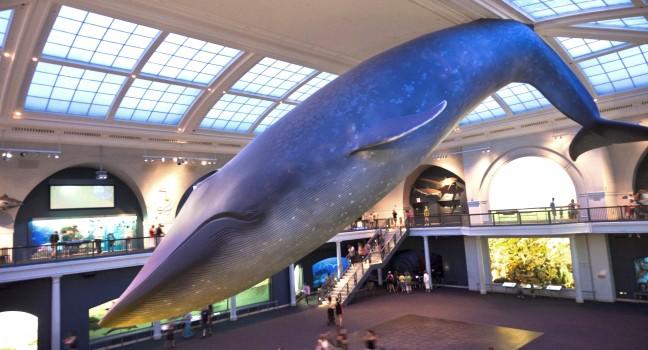
With more than 40 exhibition halls and 34 million artifacts and specimens, the world's largest and most important museum of natural history can easily keep you occupied for more than a day. The dioramas might seem a bit dated but are still fun; dinosaur fossils and exhibits, including a massive T. rex, are highlights for many people, especially kids. A 94-foot model of a blue whale, another museum icon, is suspended from the ceiling in the Milstein Hall of Ocean Life. Attached to the museum is the Rose Center for Earth and Space featuring various exhibits, the Hayden Planetarium, a giant-screen theater, and the Worlds Beyond Earth space show, which takes you on a cosmic journey to the inner reaches of our solar system. Do your bling thing at the dazzling Mignone Halls of Gems and Minerals, displaying giant geodes, diamonds, and sapphires, and explore the revitalized Northwest Coast Hall, where you will find exhibits on the history and creativity of the cultures of the Pacific Northwest. The latest addition to this ever-changing museum is the Richard Gilder Center for Science, Innovation, and Education, which opened in mid-2023 adding an organic, canyonlike atrium with large skylights to create a welcoming new space for discovery; new galleries dedicated to insects; a permanent butterfly vivarium; classrooms; a research library; and a state-of-the-art theater-in-the-round. 

\n

Many family-friendly events, including storytelling and dance performances, are included with admission. Purchase timed entry tickets in advance, and check the website for special programs, including sleepovers for kids.

200 Central Park W, New York, NY, 10024, USA
212-769–5100
Sight Details
$30 includes admission to Rose Center for Earth and Space; $36 includes one ticketed exhibition, giant-screen film, or space show

Something incorrect in this review?

Bronx Zoo

Belmont Fodor's Choice
BRONX, NY - APRIL 14, 2014:  Landmark Zoo Center Building, formerly Elephant House, at the Bronx Zoo in New York City. This world famous zoo opened in 1899.
littleny / Shutterstock

With 265 acres and more than 11,000 animals representing 700-plus species, this is the largest metropolitan zoo in the United States, opened in 1899. See exotic creatures in natural settings that re-create native habitats; you're often separated from the animals by no more than a moat or wall of glass. Don't miss the Congo Gorilla Forest, a 6½-acre re-creation of a lush African rain forest with western lowland gorillas, as well as mandrills, okapis, and red river hogs. At Tiger Mountain an open-viewing shelter lets you get incredibly close to Siberian tigers. As the big cats nap at midday, visit in the morning or afternoon. Madagascar! is a verdant re-creation of one of the world's most threatened natural habitats, with six species of lemurs and more.

\n

Go on a minisafari via the Wild Asia Monorail, May through October, weather permitting. Here you can view Asian elephants, Indo-Chinese tigers, Indian rhinoceroses, and other species. Try to visit the popular exhibits early to avoid lines later in the day. In winter, some outdoor exhibitions have fewer animals on view, but there's plenty to savor indoors. Some exhibits have an extra charge; to see everything, consider purchasing the Total Experience ticket.

2300 Southern Blvd., Bronx, NY, 10460, USA
718-220–5100
Sight Details
Flex pricing from $31 (depending on date of visit)
No walk-in admission; all guests must purchase date-specific tickets online in advance
Wed. free with advanced reservations made after 5 pm the Mon. before; parking $22

Something incorrect in this review?

Brooklyn Botanic Garden

Fodor's Choice
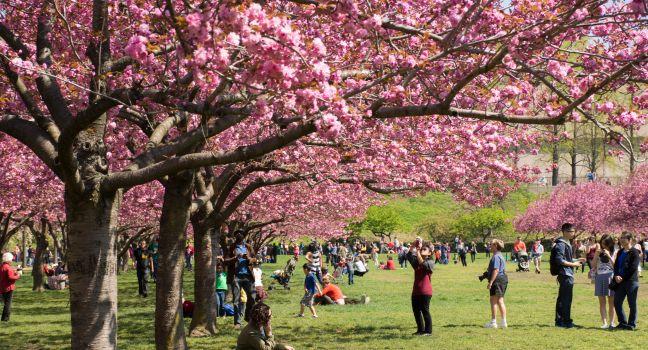
Cherry Blossom trees lined at Brooklyn Botanical garden in New York City on May 3, 2014.
Priyankamadia | Dreamstime.com

A verdant, 52-acre oasis, the BBG charms with its array of “gardens within the garden,” including idyllic the Japanese hill-and-pond, rose, and Shakespeare gardens. Inside the climate-controlled Steinhardt Conservatory, flora thrive in different ecosystems year-round. A variety of free garden tours are available with admission; check the website for seasonal information on the many events held throughout the year, including the bloom at the Cherry Esplanade during cherry blossom season.

990 Washington Ave., New York, NY, 11225, USA
718-623–7200
Sight Details
$22
Closed Mon.

Something incorrect in this review?

Brooklyn Bridge (Entrance)

Fodor's Choice
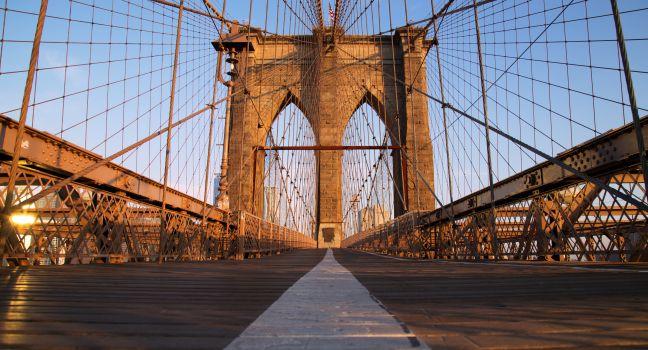
The Brooklyn bridge, New York City, New York. USA.
Revoc9 | Dreamstime.com

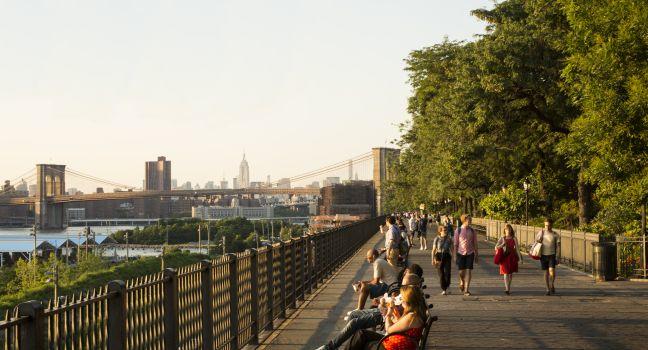
“A drive-through cathedral\" is how the journalist James Wolcott once described the Brooklyn Bridge—one of New York's noblest and most recognizable landmarks—perhaps rivaling Walt Whitman's comment that it was \"the best, most effective medicine my soul has yet partaken.\" The bridge stretches over the East River, connecting Manhattan and Brooklyn. A walk across its promenade—a boardwalk elevated above the roadway, shared by pedestrians and cyclists—is a quintessential New York experience, and the roughly 40-minute stroll delivers exhilarating views. (Cyclists mainly use a lane on the vehicular level below.) If you start from Lower Manhattan near City Hall, you'll end up near Brooklyn Heights and DUMBO; you can also take the subway to the Brooklyn side and walk back to Manhattan. From midday through early evening, the narrow path gets very congested, especially when the weather is nice. Head here early in the morning to find the magical quiet hours.

Brooklyn Heights Promenade

Brooklyn Heights Fodor's Choice
Brooklyn Heights, Brooklyn, New York
Jennifer Arnow

Strolling this esplanade famous for its magnificent Manhattan views, you might find it surprising to learn that its origins were purely functional: the promenade was built as a sound barrier to protect nearby brownstones from highway noise. Find a bench, and take in the skyline, the Statue of Liberty, and the Brooklyn Bridge; in the evening, the lights of Manhattan sparkle across the East River. Below are the Brooklyn–Queens Expressway (BQE) and Brooklyn Bridge Park.

Bryant Park

Midtown West Fodor's Choice
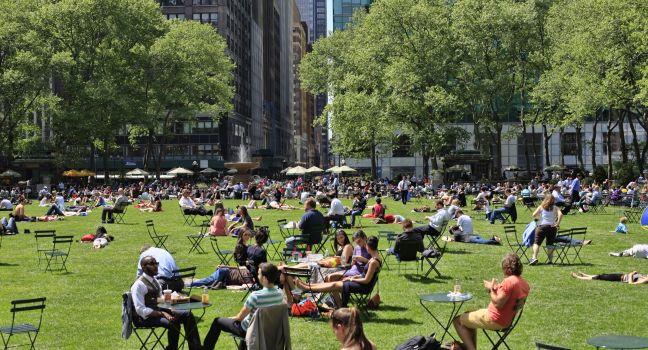
NEW YORK, USA - MAY 16: People enjoying a nice day in Bryant Park on May 16, 2013 in New York City, NY. Bryant Park is a 9,603 acre privately managed park in the center of Manhattan.
(c) Friday | Dreamstime.com

This lovely green space spread out among landmarks and skyscrapers is one of Manhattan's most popular parks. Tall London plane trees line the perimeter of the sunny central lawn, overlooking stone terraces, flower beds, and snack kiosks. The garden tables scattered about fill with lunching office workers and folks enjoying the park's free Wi-Fi. In summer, there are free readings, live jazz, and \"Broadway in Bryant Park\" musical theater performances. Most popular of all is the summer film festival: locals leave work early to snag a spot on the lawn for the outdoor screenings each Monday at dusk.

\n

At the east side of the park, near a bronze cast of Gertrude Stein, is the stylish Bryant Park Grill, which has a rooftop garden, and the adjacent open-air Bryant Park Café, open seasonally. On the south side of the park is an old-fashioned carousel ($4) where kids can also attend storytellings and magic shows. Come late October, the park rolls out the artificial frozen \"pond\" (October–March, daily 8 am–10 pm) for free ice-skating (bring your own padlock for the lockers; skate rental starts at $18). Surrounding the ice rink are the Christmas-market stalls of the holiday shops, selling handcrafted goods and local foods.

Central Park

Upper West Side Fodor's Choice
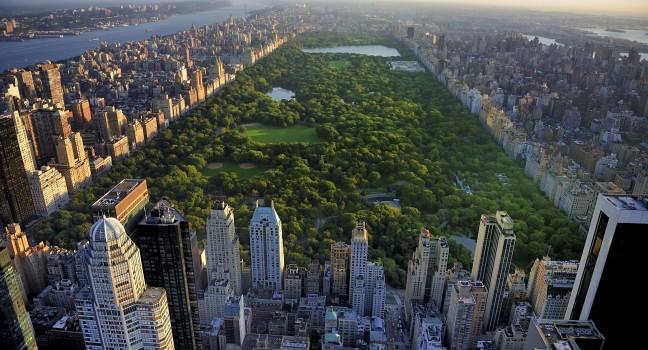
Central Park aerial view, Manhattan, New York; Park is surrounded by skyscraper.
T photography / Shutterstock

Central Park's creators, landscape architects Frederick Law Olmsted and Calvert Vaux, had a simple goal when they submitted their plan in 1858: to design a place where city dwellers could go to forget the city. Even though New York eventually grew far taller than the trees planted to hide it, the park has always been an urbanized Eden that gives residents and visitors alike a bite of the apple. Indeed, without Central Park's 843 acres of meandering paths, tranquil lakes, ponds, and open meadows, New Yorkers (especially Manhattanites) might be a lot less sane. Olmsted and Vaux also designed Brooklyn's Prospect Park and the grounds of the White House.

\n

The busy southern section of Central Park, from 59th to 72nd Street, is where most people get their first impression. But no matter how many people congregate around here, you can always find a spot to picnic, ponder, or just take in the foliage, even on a sunny weekend day. In the southern corner is the Hallett Nature Sanctuary, one of the park's lesser-known areas. The nature sanctuary is a 4-acre patch of wilderness—one of the park’s three woodlands—and is home to native flora and fauna and rustic trails that lead to quiet overlooks; it's also a popular birding spot. Playgrounds, lawns, jogging and biking paths, and striking buildings populate the midsection of the park, from 72nd Street to the reservoir. You can soak up the sun, take in the public art, take pictures at Bethesda Fountain, visit the penguins at the Central Park Zoo, or join the runners huffing counterclockwise on the dirt track that surrounds the reservoir. North of the reservoir and up to 110th Street, Central Park is less crowded and feels more rugged. In 2025, the Central Park Conservancy completed a revitalization of the area around the Harlem Meer (a man-made lake) at the north end of the park to add a full-scale ice rink, an additional new skating experience on the meer, a larger-than-Olympic-size pool, and revamp the parkland around it. The new facility is called the Davis Center at the Harlem Meer (formerly the Lasker Rink and Pool site). To find out about park events and year-round walking tours, check the website of the Central Park Conservancy ( www.centralparknyc.org).

\n

If you're taking the subway to the park's southernmost parts, the stops at either Columbus Circle (southwest corner) or 5th Avenue–59th Street (southeast corner) are handy. If headed for points north, the A, B, C, and D subway lines travel along Central Park West (beware of local versus express stops); the 4, 5, and 6 lines travel along Lexington Avenue, three blocks east of 5th Avenue and the park.

\n

There are many paved pedestrian entrances into the park from 5th Avenue, Central Park North (110th Street), Central Park West, and Central Park South (59th Street). Four roads, or transverses, for cars and city buses cut through the park from east to west—66th, 79th, 86th, and 96th Streets. The East and West drives are both along the north–south axis; Center Drive enters the south edge of the park at 6th Avenue and connects with East Drive around 66th Street. Cars are no longer allowed on the drives, which are exclusively for pedestrians, cyclists, and horse-drawn carriages. Along the main loop, lampposts are marked with location codes that include a letter—always \"E\" (for east) or \"W\" (for west)—followed by numbers, the first two of which tell you the nearest cross street. For example, E7803 means you're near 78th Street; above 99, the initial \"1\" is omitted, so W0401 is near West 104th Street. Download the Central Park Conservancy's free app for a GPS-enabled map to help you navigate the park. The app also includes an audio guide, self-guided tours, and current events in the park, as well as a new interactive Cherry Blossom Tracker Map to help visitors and locals track when and where the flowers will peak in the park in spring.

\n

If you haven't packed a picnic and you want a snack, you can usually find one of those rather tired-looking food carts selling hot dogs, pretzels, and ice-cream sandwiches. Specialty food carts are often around, too, mostly in the park's southern half, especially when there are concerts or other major events—your taste buds will thank you. Other reliable options include the café next to the Boathouse Restaurant (midpark at 74th Street), or a branch of Le Pain Quotidien (midpark at 69th Street). Both serve sandwiches, soups, pastries, and other satisfying on-the-go grub (and Le Pain also has free Wi-Fi). For something a little more elegant, you can stop for brunch, lunch, or dinner at the Tavern on the Green.

\n

As part of a park-wide restoration project named Plan for Play, all 21 playgrounds have undergone (or are still scheduled to receive) updates. Most have seen renovations to play structures, plus other improvements that will ensure each one's structural stability and ongoing maintenance for years to come.

Citi Field

Flushing Fodor's Choice
NEW YORK - JULY 15: Citi Field, home of the National League Mets, on July 15, 2011 in New York. Opened in 2009, it seats 41,800 baseball fans and cost $900 million.
Ffooter / Shutterstock

Opened in 2009, the Mets' stadium was designed to harken back to Brooklyn's Ebbets Field (where the Dodgers played until 1957), with a brick exterior and lots of fun features for fans of all ages, from a batting cage and Wiffle-ball field to the original giant apple taken from the team's old residence, Shea Stadium. Even those who aren't Mets fans but simply love baseball should come to see the Jackie Robinson Rotunda, a soaring multistory entrance and history exhibit dedicated to the Dodgers player who shattered baseball's color barrier. While here, don't miss the chance to taste your way through the fabulous food court, set behind center field (on the Field Level), where you'll find Shake Shack burgers and Pig Beach BBQ. Still feeling nostalgic for the old Shea? Stop by the Mets Hall of Fame & Museum (located by the Bullpen Gate). Behind the scenes ballpark tours (starting at $25) are available year-round; see mlb.com/mets/tickets/tours for schedule and ticketing info.

Ellis Island

Financial District Fodor's Choice
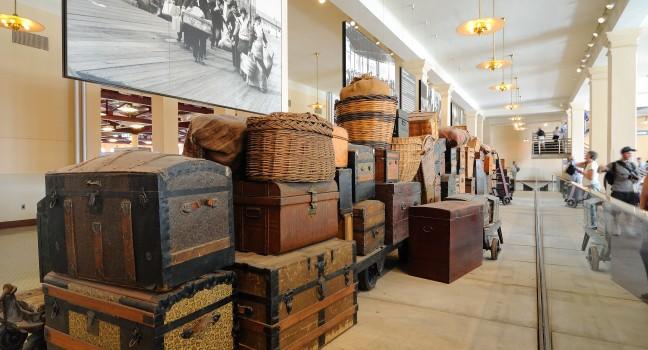
NEW YORK CITY - SEPTEMBER 11: Actual vintage luggage left by some of the millions of immigrants who came through Ellis Island on display at the Ellis Island Museum September 11, 2010 in New York, NY.
Sean Pavone / Shutterstock

Between 1892 and 1924, millions of people first entered the United States at the Ellis Island federal immigration facility. When the complex closed in 1954, it had processed the ancestors of nearly 40% (more than 100 million) of Americans living today. The island's main building, now a national monument, is known as the Ellis Island National Museum of Immigration, and it tells the story not just of Ellis Island but of immigration from the Colonial era to the present day, through numerous galleries containing artifacts, photographs, and taped oral histories. The museum's centerpiece is the cavernous, white-tile Registry Room (also known as the Great Hall). There's much to take in, so make use of the museum's interpretive tools. Check at the visitor desk for free film tickets, a good audio tour, ranger-led tour times, and special programs.

\n

There is no admission fee for the Statue of Liberty or Ellis Island, but an adult ferry ride (from Battery Park to Liberty Island to Ellis Island) costs $25.50 round-trip. Ferries leave from Battery Park (and from Liberty State Park in New Jersey) every 25–30 minutes depending on the time of year (buy your tickets online at  www.statuecruises.com). There are often long security lines, so arrive early, especially if you have a timed-entry ticket. There is an indoor-outdoor café on Ellis Island.

Empire State Building

Murray Hill Fodor's Choice
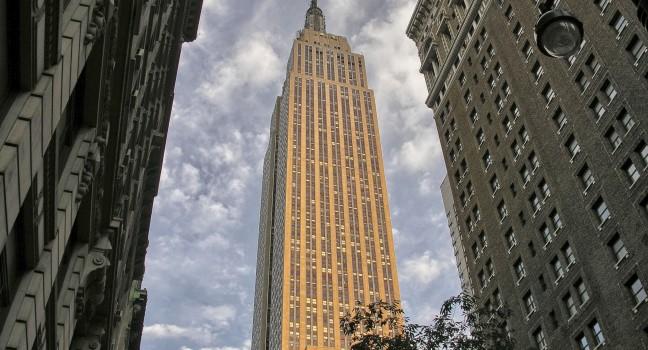
NEW YORK CITY - AUG 16: The Empire State Building on August 16, 2008 in New York, USA. The Empire State Building is a 102-story landmark and American cultural icon in New York City.
CristinaMuraca/Shutterstock

With a legendary silhouette recognizable virtually worldwide, the Empire State Building is an Art Deco monument to progress, a symbol of NYC, and a star in many romantic scenes—on- and off-screen. Built in 1931 at the peak of the skyscraper craze, this 103-floor limestone giant opened after 13 months of construction. The framework rose at a rate of 4½ stories per week, making the Empire State Building the fastest-rising skyscraper ever built, to date.

\n

Enter the visitor experience in the building's designated Observatory lobby—a two-story hall off 34th Street—and exit through the building's illustrious 5th Avenue lobby. Purchase or retrieve prepurchased timed tickets at kiosks, then head to the 10,000-square-foot Second Floor Galleries to learn all about the skyscraper—from its engineering to its role in modern culture (including a fun photo op with King Kong himself). There are interactive experiences, along with marvelous Art Deco details throughout.

\n

Rise from Floor 2 to reach Floor 80's enclosed observatory, with interactive kiosks to create custom NYC itineraries and an impressive NYC skyline drawing by memory artist Steven Wiltshire. Then head to the 86th-floor observatory (1,050 feet high) to find another enclosed area and the spectacular wraparound outdoor deck. The views from the compact 102nd-floor observatory are better still, though it comes with an extra price tag. A new Sunrise@ESB experience ($135) provides preopening access to the 86th floor observation deck on Saturday morning to watch the sunrise with pastries and a custom Starbucks coffee. A Starbucks Reserve Store opened inside the building in 2022.

\n

Expect long lines during peak tourist times/seasons—best avoided with weekday morning or winter visits. Plan for three-plus hours to absorb the full experience and to pass through security. Save time by purchasing tickets online in advance. The building opens the stairs from the 86th floor down to the 80th floor on busy days so visitors can bypass any potential lines.

20 W. 34th St., New York, NY, 10001, USA
212-736–3100
Sight Details
$44 for 86th fl.; $79 to add 102nd fl.; $120 for Express Pass to 86th and 102nd fls.

Something incorrect in this review?

Governors Island

Financial District Fodor's Choice
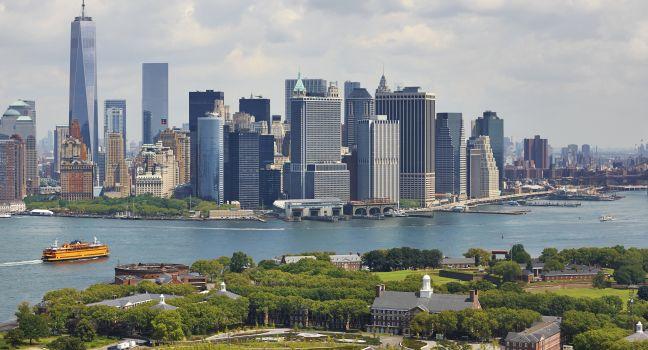
Aerial view of  Manhattan and Governors Island, New York City, U.S.A. ; Shutterstock ID 212400088; Project/Title: 25 Things to Do in New York City This Spring; Downloader: Fodor's Travel
R.A.R. de Bruijn Holding BV / Shutterstock

Open year-round to the public (7 am–6 pm in winter; until 10 pm through the summer season) and accessible via ferry, Governors Island is essentially a big, charming park that resembles a small New England town. It's popular with locals for biking and walking by the water, festivals, art shows, concerts, and family programs, and delights visitors with a natural serenity—especially since it's in the middle of one of America's busiest harbors. In 1637, Wouter van Twiller, a representative for the country of Holland, supposedly purchased the island from the Indigenous Lenape people for his private use for two ax heads, a string of beads, and a handful of nails. In 1784, the island was named for English colonial governors and was used almost exclusively by the American military until the 1960s, when the Coast Guard took it over. In 2002, the city purchased the island and soon began reimagining its 172 acres as versatile public green space. The island's evolution continues with public art installations, all-ages park features (like slides and hammocks), various food and drink vendors, open-air Gitano Island modern-Mexican restaurant and club ( www.gitano.com/nyc), and even the QCNY ( www.qcny.com) luxury \"destination day spa\" inside the retired barracks. The Governors Island ferry departs from the Battery Maritime Building (free before 11 am on weekends, and daily for seniors, children, NYC ID  holders, and military), while the NYC Ferry links there from Wall Street/Pier 11, Brooklyn's Pier 6, and other docks in Manhattan and Brooklyn.

10 South St., New York, NY, USA
212-440–2200
Sight Details
Free (Pier 6 ferry either free or $5; all NYC Ferry tickets $4.50)

Something incorrect in this review?

Grand Central Terminal

Midtown East Fodor's Choice
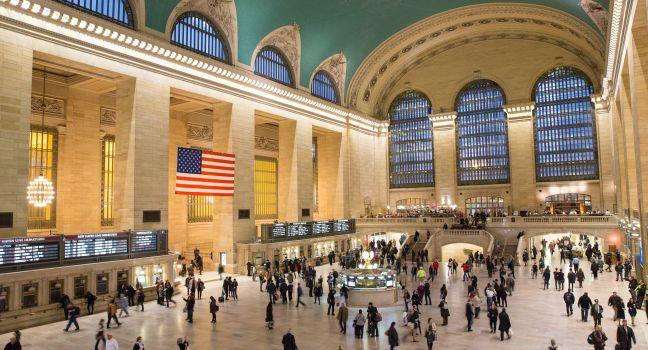
New York City, USA - November 6: View of the Grand Central Station in New York City, USA on November 6, 2014
Victor Maschek / Shutterstock

Grand Central is not only the world's largest railway station by area (at 49 acres and 44 platforms), but also one of the world's most magnificent public spaces, the majesty of its 1913 building preserved, in part, by Jacqueline Kennedy Onassis's 1975 campaign to save it as a landmark. The main concourse stands roughly 12 stories high and is modeled after an ancient Roman public bath. Overhead, an LED-lit map of the constellations covers the ceiling. Of course, Grand Central still functions primarily as a transit hub: underground, trains travel to Connecticut and through various New York counties and the Bronx via the Metro-North commuter rail and to Long Island via the Long Island Rail Road through Grand Central Madison; the subway connects here as well.

\n

To best admire Grand Central's exquisite Beaux-Arts architecture, avoid rush hour and head up one of the staircases at either end, where an Apple store occupies the top of one of the balcony spaces. From this level, you can survey the concourse and feel the terminal's dynamism. Then head to the southwest corner to reach the tucked-away The Campbell cocktail lounge. The on-site Vanderbilt Tennis Club is a best-kept secret; court time can be reserved there. Around and below the main concourse are fantastic shops and eateries—including the New York Transit Museum gallery annex, Grand Central Market and Grand Central Oyster Bar. If you're with a friend, position yourselves in opposite corners of the tiled passageway just outside the Oyster Bar, facing away from each other, and murmur your secrets to the wall. Or just stand and watch others indulge in the delightful acoustic oddity that is the whispering gallery. Take Walks NYC ( www.takewalks.com/new-york-tours/grand-central-tours) leads two official daily walking tours for $35 at 11 am and 3 pm.

The High Line

Chelsea Fodor's Choice
NEW YORK CITY - JUN 3: High Line Park in NYC seen on June 3rd, 2012.The High Line is a public park built on an historic freight rail line elevated above the streets on Manhattans West Side.; Shutterstock ID 105076949; Project/Title: Summer Plans for Kids;
Stuart Monk/Shutterstock

Once a railroad track carrying freight trains, this elevated space has been transformed into one of the city’s top attractions—a 1½-mile landscaped “walking park,” with curving walkways, picnic tables and benches, public art installations, and views of the Hudson River and the Manhattan skyline. Running from Gansevoort Street in the Meatpacking District (at the Whitney Museum of American Art) to West 34th Street and Hudson Yards, the High Line somehow manages to host about 5 million visitors a year and still feel like a wonderful retreat. That said, the crowds can seem overwhelming when the weather is nice, so visit as early in the morning as possible and avoid the lunchtime and weekend mass of humanity.

\n

One of the main draws of the High Line is the landscaping, which is both wild and cultivated at the same time, and dotted with public art. Chelsea Market Passage, between 15th and 16th Streets, is accented with Spencer Finch’s stained-glass art and is home to public art displays, video programs, music performances, and sit-down events. A feature that illustrates the High Line’s greatest achievement—the ability to see the city with fresh eyes—is the 10th Avenue Square (between 16th and 17th Streets). This viewing window with stadium seating and large picture windows frames the city below as art, encouraging viewers to linger.

\n

To fully appreciate the High Line, walk a length in one direction (preferably from Gansevoort Street uptown so that you can end with panoramic city and river views) and then make the return journey at street level, taking in the Chelsea neighborhood below. Nearby Chelsea Market and Market 57 are convenient places to pick up fixings for a picnic lunch.

The Met Cloisters

Washington Heights Fodor's Choice
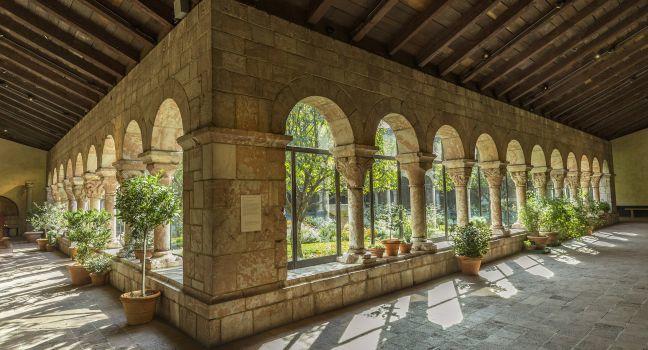
NEW YORK, USA - OCT 22, 2015: Colonnade and garden at The Cloisters, the branch of The Metropolitan Museum of Art devoted to the art and architecture of medieval Europe, , New York,USA.
(c) Meinzahn | Dreamstime.com

Perched on a wooded hill in Fort Tryon Park, near Manhattan's northwestern tip, the Cloisters museum and gardens houses part of the medieval collection of the Metropolitan Museum of Art and is a scenic destination in its own right. Colonnaded walks connect authentic French and Spanish monastic cloisters, a French Romanesque chapel, a 12th-century chapter house, and a Romanesque apse. One room is devoted to the 15th- and 16th-century Unicorn Tapestries, which date from 1500 and are must-see masterpieces of medieval mythology and craftsmanship. The tomb effigies are another highlight, as is the Reliquary containing silver and gold religious objects. Two of the three enclosed gardens shelter more than 250 species of plants similar to those grown during the Middle Ages, including flowers, herbs, and medicinals; the third is an ornamental garden.

\n

Concerts of medieval music are held regularly, and there are holiday concerts in December. Concert tickets include same-day admission to the museum, and tickets to either the main Met on 5th Avenue or to the Met Cloisters include same-day admission to the other. The outdoor Trie Café is open during museum hours, rain or shine, April through October, with a light menu of sandwiches, desserts, and coffee.

99 Margaret Corbin Dr., New York, NY, 10040, USA
212-923–3700
Sight Details
$30 (includes same-day admission to the Metropolitan Museum of Art); New York State residents have a pay-what-you-wish option
Closed Wed.

Something incorrect in this review?

The Metropolitan Museum of Art

Upper East Side Fodor's Choice
View of the hall of Metropolitan Museum in New York.
Asier Villafranca / Shutterstock

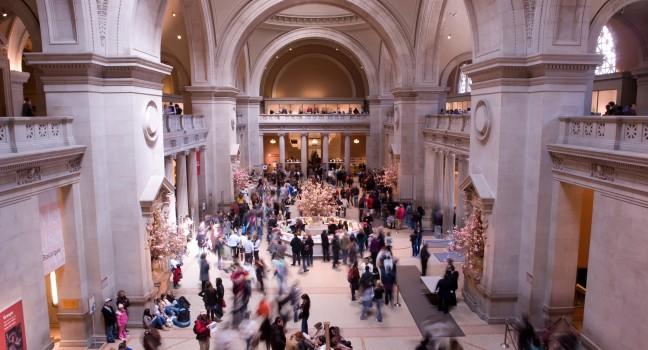
 If Manhattan had no museums other than the colossal Metropolitan Museum of Art, you could still occupy yourself for days—even a week—roaming its labyrinthine corridors. It is the largest museum in the western hemisphere, with more than 1.5 million works of art representing 5,000 years of world history, so plan ahead and be selective. The famous Egyptian Art collection (including the Temple of Dendur) is reason enough to visit. Other don't-miss sections include the renovated Michael C. Rockefeller Wing, the extensive European Paintings galleries, the magnificent Islamic Art galleries, the vibrant collection of Impressionist paintings, the American Wing, the Anna Wintour Costume Institute (named for the celebratedVogue editor-in-chief, and known for hosting the annual star-studded Met Gala), and tons (literally) of ancient Greek and Roman statues. Kids will love the Arms and Armor displays. 

\n

Be aware of ongoing renovations. A rebuild of the Ancient Near Eastern and Cypriot Art galleries will continue into early 2026; check the website and museum map to plan your visit around gallery closures. In between exhibits, take a break at the Cantor Roof Garden, open late April through late October, or at one of five cafés and lounges offering light bites and cocktails. Or book a reservation for The Met Dining Room, an upscale restaurant with Central Park views and a seasonal menu. Admission includes same-day entry to The Met Cloisters, a combination of medieval European art, architecture, and gardens in Fort Tryon Park in Upper Manhattan. Make the most of your visit by downloading a free digital or audio guide from The Met's website or take advantage of guided tours available in 10 different languages.

1000 5th Ave., New York, NY, 10028, USA
212-535–7710
Sight Details
$30 (includes same-day admission to Met Cloisters); New York State residents have a pay-what-you-wish option
Closed Wed.

Something incorrect in this review?

MoMA PS1

Long Island City Fodor's Choice
MoMA PS1 Queens New York NY, USA
PS1 by guillermo varela

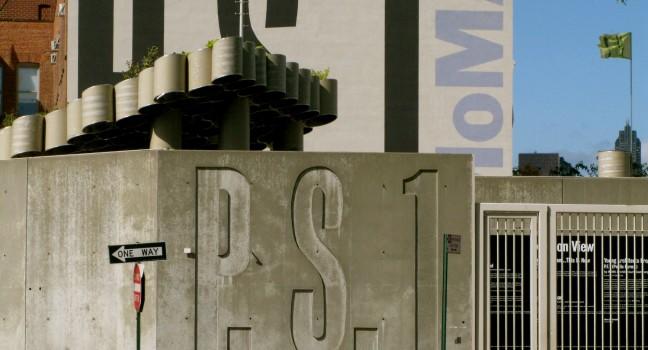
A pioneer in the \"alternative-space\" movement, MoMA PS1 rose from the ruins of an abandoned school in 1976 as a sort of community arts center for the future, focusing on the work of currently active experimental and innovative artists. Long-term installations include work by Sol LeWitt, James Turrell, and Pipilotti Rist. Every available corner of the enormous building is used; discover art not only in former classrooms–turned–galleries, but also in the boiler room, and even in some bathrooms.

22--25 Jackson Ave., Queens, NY, 11101, USA
718-784–2084
Sight Details
$10
Closed Tues. and Wed.

Something incorrect in this review?

The Morgan Library & Museum

Murray Hill Fodor's Choice
The Morgan Library & Museum, in New York City, which was originally founded to house the private library of American financier J. P. Morgan.
(c) Bigapplestock | Dreamstime.com

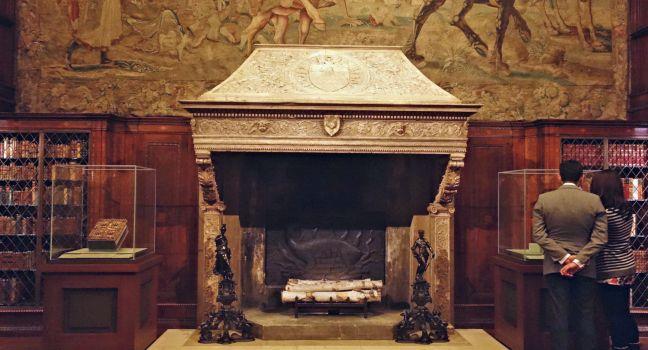
The treasures inside this museum and research center, gathered by financier John Pierpont Morgan (1837–1913), are exceptional: medieval and Renaissance illuminated manuscripts, Old Master drawings and prints, and autographed literary and musical manuscripts. Some of the library's crowning achievements on paper include letters penned by John Keats and Thomas Jefferson; a summary of the theory of relativity in Einstein's own elegant handwriting; three Gutenberg Bibles; drawings by Dürer, Leonardo da Vinci, Rubens, Blake, and Rembrandt; the only known manuscript fragment of Milton's Paradise Lost; Thoreau's journals; and original manuscripts and letters by Charlotte Brontë, Jane Austen, Thomas Pynchon, and many others. Rotating exhibits highlight works from the collection and other arts and cultural subjects. Additionally, the museum recognizes the importance of its inaugural director, Belle da Costa Greene.

\n

225 Madison Ave., New York, NY, 10016, USA
212-685–0008
Sight Details
$25; free admission Fri. 5--8 pm but online advance reservations required
Closed Mon.; garden closed late Oct.--May

Something incorrect in this review?

Museum of Modern Art (MoMA)

Midtown West Fodor's Choice
Redesigned interior of the Museum of Modern Art in New York.
(c) Mirceani | Dreamstime.com

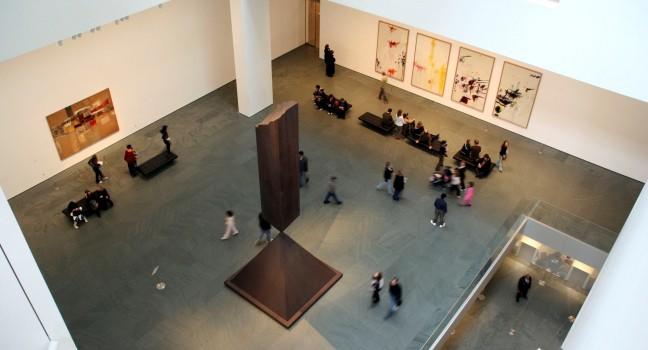
Housing one of the world's finest collections of modern art, MoMA is renowned for its permanent collection, which includes masterpieces by Picasso, Van Gogh, Monet, Kahlo, Warhol, and Dalí, as well as its first-rate multimedia exhibitions. MoMA completed a $450 million renovation and expansion in 2019, and the building now features walkways between old and new galleries, each organized to showcase familiar masters alongside great, but lesser-known, artists—many of them women and people of color. Contemporary works and those of varied media also are strategically exhibited beside familiar classics. The displays breathe new life into the institution's curatorial experience.

\n

MoMA spans six levels, and it's helpful to explore from top to bottom. See the most famous works on Floors 4 and 5; installations on 6; and galleries of photography, drawings, architecture projects, and special exhibitions on the lower floors. Level 1 remains home to the delightful Abby Aldrich Rockefeller Sculpture Garden. Within the museum, dine at high-end The Modern; snack at cafés on Floor 2; and enjoy outdoor views from the Terrace café on Floor 6. The cellar-level cinema screens international films and theme series (museum entry is a discounted $14 with your film ticket). Browse at the famous MoMA Store and MoMA Design Store (across 53rd Street). Entry is free for NYC residents the first Friday of each month, 4–8 pm. The first-floor galleries are always free and open to the public.

11 W. 53rd St., New York, NY, 10019, USA
212-708–9400
Sight Details
$30

Something incorrect in this review?

New York Botanical Garden

Belmont Fodor's Choice
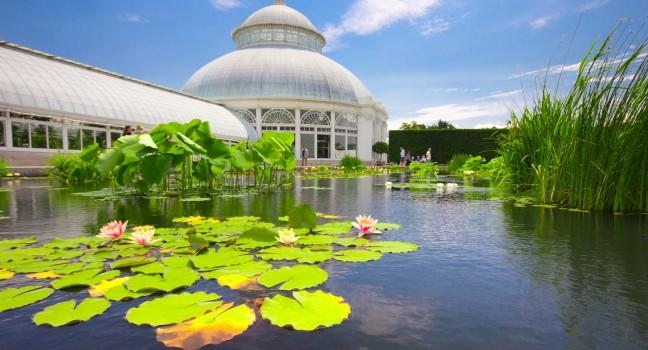
Water Lilly Pond at conservatory in New York Botanical Garden in the Bronx, NYC on June 1, 2012. The Victorian greenhouse is an architectural centerpiece at this 250 acre garden.
littleny / Shutterstock

Considered one of the world's leading botany centers, this beautiful, 250-acre campus is also one of the best reasons to make a trip to the Bronx. Built around the dramatic gorge of the Bronx River, it's home to lush indoor and outdoor gardens and acres of natural forest, and it offers classes, concerts, and special exhibits. Be captivated by the seasonal fragrance of the Peggy Rockefeller Rose Garden's 4,000 blooms, which represent more than 650 varieties. Relax in the leafy Thain Family Forest, or explore the Everett Children's Adventure Garden, a 12-acre, indoor-outdoor museum with a boulder maze, giant animal topiaries, and a plant discovery center. The Victorian-style Enid A. Haupt Conservatory houses re-creations of misty tropical rain forests and arid African and North American deserts, as well as exhibitions such as the annual Holiday Train Show and the winter-into-spring Orchid Show, which showcases flowers that look like the stuff of science fiction. The All-Garden Pass gives you access to the conservatory, adventure garden, special exhibitions, and more.

2900 Southern Blvd., Bronx, NY, 10458, USA
718-817–8700
Sight Details
All Garden Pass $35 off-peak, $39 peak; check website as pricing varies for special exhibitions and events; parking $22
Closed Mon.

Something incorrect in this review?

Prospect Park

Prospect Park Fodor's Choice
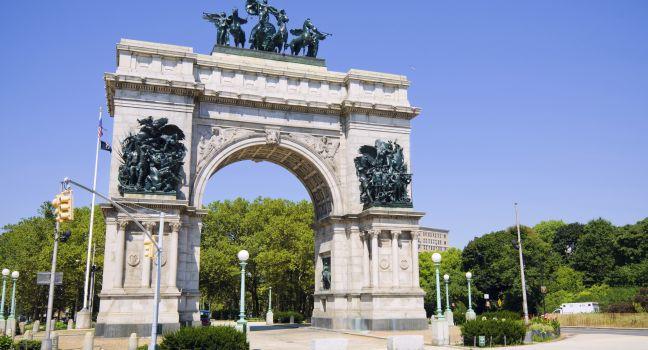
Soldiers' and Sailors' Arch at Grand Army Plaza in Brooklyn, dedicated on October 21, 1892 with an inscription that reads "To the Defenders of the Union, 1861-1865."
gregobagel/iStockphoto

Brooklyn residents are passionate about Prospect Park, and with good reason: lush green spaces, gently curved walkways, summer concerts, vivid foliage in autumn, and an all-season skating rink make it a year-round getaway. In 1859, the New York Legislature decided to develop plans for a park in the fast-growing city of Brooklyn. After landscape architects Frederick Law Olmsted and Calvert Vaux completed the park in the late 1880s, Olmsted remarked that he was prouder of it than any of his other works—including Manhattan's Central Park—and many critics agree. On weekends, those not jogging the 3.35-mile loop gravitate to the rolling hills of the Long Meadow to picnic, fly kites, or play cricket, flag football, or Frisbee. On summer Sundays, foodies flock to Breeze Hill, site of outdoor food market Smorgasburg's second Brooklyn location. The park's north entrance is at Grand Army Plaza, where the Soldiers' and Sailors' Memorial Arch (patterned on the Arc de Triomphe in Paris) honors Civil War veterans. On Saturday, year-round, a greenmarket at the plaza throngs with shoppers.

\n

A good way to experience the park is to walk the Long Meadow—venue for the occasional free yoga class—and then head to the eastern side and south towards the lake. Along the way, you'll encounter attractions including a few waterfalls, the Prospect Park Zoo, and the Lefferts Historic House. Nearby, the Prospect Park Carousel, built in 1912, still thrills the kids. The Boathouse, dating from 1905, is a stunning example of Beaux-Arts architecture, and houses a cafe and the Prospect Park Audubon Center. The annual Celebrate Brooklyn! Festival takes place at the Prospect Park Bandshell from early June through mid-August.

The Seaport

Financial District Fodor's Choice
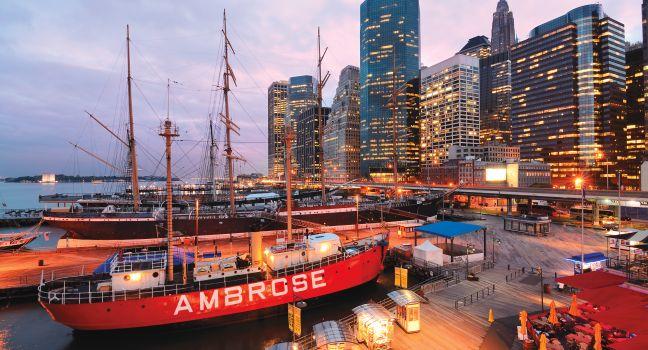
South Street Seaport in New York, NY. The port is a designated historic district containing the largest concentration of 19th century landmarks in the city.
Sepavo | Dreamstime.com

Had this charming cobblestone neighborhood not been declared a historic district in 1977, the city's largest concentration of early-19th-century commercial buildings would have been destroyed. Thankfully, they survived, and in recent years have come to enjoy new life. The landmarked \"South Street Seaport Historic District\" has undergone a thorough makeover as a diverse shopping and dining destination, with seasonal markets, art installations, IPIC Theater (a luxury cinema with dining), and live entertainment—plus a simplified moniker as The Seaport.

\n

At the intersection of Fulton and Water Streets, the main Seaport gateway, is the Titanic Memorial Lighthouse, a small white lighthouse that commemorates the sinking of the RMS Titanic in 1912. Beyond the lighthouse, Fulton Street turns into a cobblestone pedestrian mall. On the south side of Fulton is The Seaport's architectural centerpiece, Schermerhorn Row, a redbrick terrace of Georgian- and Federal-style warehouses and countinghouses built from 1810 to 1812. Cross South Street to Pier 16, where historic 19th- and 20th-century ships are docked. Pier 16 also is the departure point for various seasonal cruises. (Ship tours are included in the admission to the South Street Seaport Museum).

\n

Across South Street along the East River are Pier 17 and the renovated Tin Building. Previously the longtime site of the Fulton Fish Market, in 2022, the latter reopened as the Tin Building by renowned chef Jean-Georges Vongerichten, a high-end dining destination and specialty food market ( tinbuilding.com). In 2018, the Pier 17 building became a multilevel office complex with several restaurants and bars at street level, and a 60,000-square-foot rooftop that's programmed with concerts and seasonal pop-ups ( rooftopatpier17.com). But the real highlight is the wraparound public wharf that's open year-round, with seating and stunning views of the harbor and Brooklyn Bridge.

Snug Harbor Cultural Center and Botanical Garden

Livingston Fodor's Choice
Snug Harbor was established in the 19th century as a hospice for sailors. It is now a public park.
(c) Sangaku | Dreamstime.com

One of the largest ongoing adaptive reuse projects in America, Snug Harbor Cultural Center and Botanical Garden’s 83-acre campus—with 3 museums, 26 buildings, 9 gardens, 10 acres of wetlands, and a 2-acre farm—is an ideal place to enjoy nature, history, and the arts. Its on-site attractions are managed and, if applicable, ticketed independently of each other (although some are a part of an encompassing Discovery Pass). Events, performances, and cultural celebrations occur regularly throughout campus.

\n

The Newhouse Center for Contemporary Art is Staten Island's oldest contemporary art gallery, exhibiting vibrant, dynamic displays of local and international artwork, all housed in Snug Harbor’s landmarked Greek Revival building. Next door, the Noble Maritime Collection maintains historic collections specific to Staten Island's maritime past. Enjoy the Staten Island Children's Museum with kids, or visit the Staten Island Museum, with exhibits on art, history, and science—including a partial life-size replica of a mastodon. Among the unique botanical gardens is the Ming Dynasty--inspired New York Chinese Scholar's Garden, one of the first classical outdoor scholar’s gardens in North America, fabricated in Suzhou and constructed on-site.

1000 Richmond Terr., Staten Island, NY, 10301, USA
718-425–3504
Sight Details
Grounds and Botanical Gardens free; Newhouse Center $5, Noble Maritime Collection, pay what you wish, Staten Island Museum $8, Chinese Scholar's Garden $5—but all a part of the $20 Discovery Pass; Staten Island Children's Museum $8
Newhouse Center closed Jan.–Mar.; Mon.–Thurs. (Apr.–Dec.); Noble Maritime Collection closed Mon. and Tues.; Staten Island Museum closed Mon. and Tues. (Apr.–Dec.), Mon.–Thurs. (Jan.–Mar.); Chinese Scholar’s Garden closed Jan.–Mar.; Children's Museum closed Mon. and Tues.

Something incorrect in this review?

Solomon R. Guggenheim Museum

Upper East Side Fodor's Choice
People entering Guggenheim Museum to visit Kandinski exhibition December 10, 2009 in New York, US.
Adriano Castelli / Shutterstock

Frank Lloyd Wright's landmark nautilus-like building is renowned as much for its famous architecture as for its superlative collection of modern and contemporary art and well-curated shows, some of which utilize the entire museum. Opened in 1959, shortly after Wright's death, the Guggenheim is acclaimed as one of the greatest buildings of the 20th century. Inside, under a 96-foot-high skylight, just over a quarter-mile long ramp spirals down past current exhibits. The museum has strong holdings of works by Vasily Kandinsky (over 150 paintings), René Magritte, Jeff Koons, Paul Klee, Marc Chagall, Francis Bacon, and Faith Ringold.  In 2023, the museum hired its first associate curator of art and technology to promote artists working with technology. 

\n

Wright's superior design was criticized by some who believed that the distinctive building detracted from the art, but the spiraling layout allows artwork to be viewed from different angles and distances. On permanent display, the museum's Thannhauser Collection is made up primarily of works by French Impressionists and Postimpressionists Van Gogh, Degas, Picasso, and Manet. Escape the crowded lobby by taking the elevator to the top and working your way down the spiral. The Cafe Rebay offers snacks, salads, and sandwiches, while the gift shop is near the museum's exit.

Staten Island Ferry

Financial District Fodor's Choice
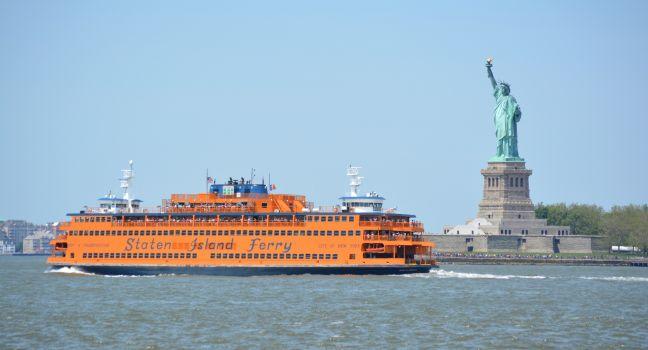
NEW YORK CITY, USA - May 26, 2014: Staten Island Ferry passing the Statue of Liberty in  New York Harbor. ; Shutterstock ID 195164825; Project/Title: 25; Downloader: Fodors Travel
Christopher Penler / Shutterstock

Some 70,000 people ride the free ferry daily to Staten Island, one of the city's five boroughs, and you, too, can join them for the city's most scenic commute. Without paying a cent, you get phenomenal views of the Lower Manhattan skyline, the Statue of Liberty, Ellis Island, and Governors Island during the 25-minute cruise across New York Harbor. You also pass tugboats, freighters, and cruise ships—a reminder that this is very much still a working harbor. The ferry sails every 15–30 minutes (24 hours a day, 365 days a year) from Whitehall Terminal at Whitehall and South Streets, on the east side of Battery Park. You must disembark once you reach the opposite terminal, but you can loop around and reboard if you don't plan to stay. A small concession stand on each ferry sells a few snacks and beverages (including beer). If you're sightseeing, avoid the packed morning and afternoon rush hours.

Statue of Liberty

Financial District Fodor's Choice
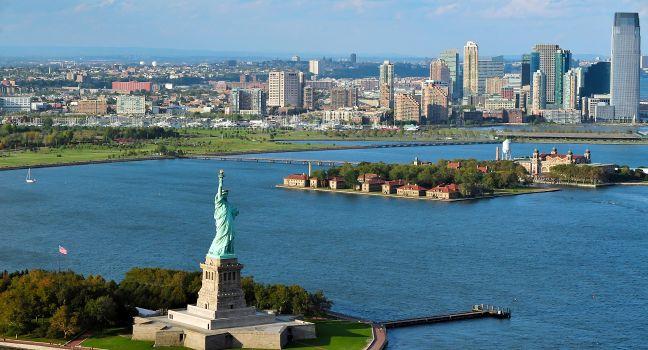
NEW YORK - OCT 15: Aerial view of the Statue of Liberty and Ellis Island on Oct 15 2010. From 1892 to 1954, over 12 million immigrants entered USA through the portal of Ellis Island in New York Harbor; Shutterstock ID 151423415; Project/Title: 10 Things NO
ChameleonsEye / Shutterstock

For millions of immigrants, the first glimpse of America was the Statue of Liberty, and today it remains a powerful symbol of American ideals. Liberty Enlightening the World, as the statue is officially named, was presented to the United States in 1886 as a gift from France. The 152-foot-tall figure was sculpted by Frédéric-Auguste Bartholdi and erected around an iron skeleton engineered by Gustave Eiffel. It stands atop an 89-foot pedestal designed by Richard Morris Hunt, with Emma Lazarus's sonnet \"The New Colossus\" (\"Give me your tired, your poor, your huddled masses . . .\") inscribed on a bronze plaque at the base.

\n

There is no admission fee for either the Statue of Liberty or Ellis Island, but an adult ferry ride (which goes round-trip to both Liberty Island and Ellis Island) costs $25.50, and includes entrance to the statue's pedestal and museum. Access to the statue's crown, via a famously narrow, twisting staircase, is strictly limited and tickets must be booked months in advance. Ferries leave from Battery Park (and from Liberty State Park in New Jersey) every 25–30 minutes depending on the time of year (buy your tickets online at  www.statuecruises.com). There are often long lines, so arrive early, especially if you have a timed-entry ticket (strongly recommended since they do sell out). There is a pleasant indoor-outdoor café on Liberty Island. In 2019, a new 26,000-square-foot museum opened on the island to showcase the statue's history and legacy, with artifacts including the statue's original torch, across three interactive galleries.

New York, NY, 10004, USA
212-363–3200
Sight Details
Free; ferry $25.50 round-trip (includes Ellis Island)

Something incorrect in this review?

Tenement Museum

Lower East Side Fodor's Choice
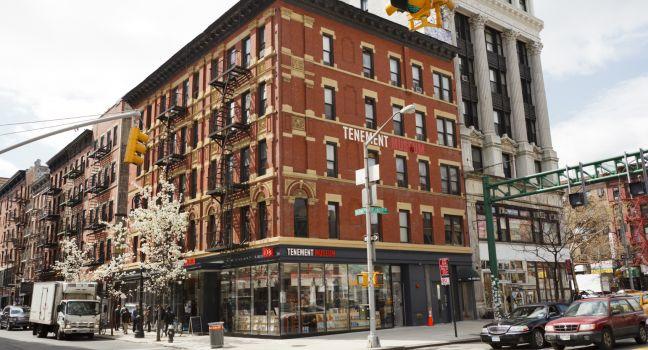
The Tenement Museum located on the lower east side of Manhattan. Among other things, the museum has recreated-preserved living and working spaces to show what tenement life was like spanning the turn of the of the century (latter half of 1800's to early pa
wdstock / iStockphoto

For a step back to various points in time on the Lower East Side, book one of the experiences that revolve around the partially restored 19th-century buildings that comprise the Tenement Museum. Options include apartment tours, neighborhood walks (including \"Reclaiming Black Lives\" introduced in 2021), and informative talks. At 97 Orchard Street, theme tours take you through the preserved apartments of several generations of immigrants who lived in the building. The \"Hard Times\" tour visits the homes of Natalie Gumpertz, a German–Jewish dressmaker (dating from 1878), and Adolph and Rosaria Baldizzi, Catholic immigrants from Sicily (1935). \"Sweatshop Workers\" visits the Levine family's garment shop–apartment and the home of the Rogarshevsky family from Eastern Europe (1918), while \"Irish Outsiders\" explores the life of the Moores, an Irish American family living in the building in 1869. Nearby, at 103 Orchard Street, the Under One Roof exhibition explores the lives of immigrant families from Poland, China, and Puerto Rico who lived in the building after World War II. All the tours fill up fast so it's best to sign up in advance.

103 Orchard St., New York, NY, 10002, USA
877-975–3786
Sight Details
Most tours $30 (not all allow children under 5)

Something incorrect in this review?

Top of the Rock

Midtown West Fodor's Choice
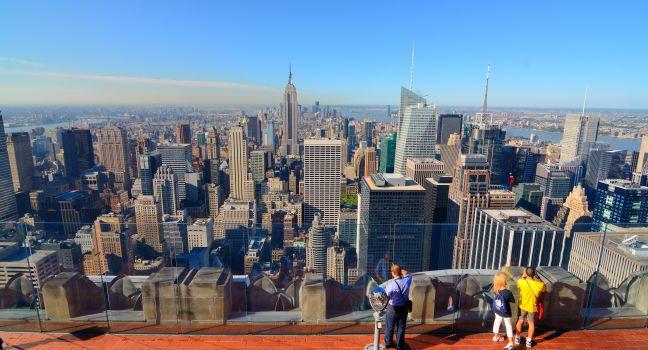
NEW YORK CITY - AUGUST 30: Observers view Midtown from Top of the Rock August 30, 2011 in New York, NY. The GE Building observation deck is one of only two open to the public in Manhattan.; Shutterstock ID 84067600; Project/Title: Fodor's New York City 201
Sean Pavone / Shutterstock

Sky-high views dazzle visitors to the Top of the Rock, Rockefeller Center's famous, multifloor observation deck. Arrive presunset to watch New York's five boroughs (and New Jersey) morph into a dazzling wash of colors, casting magic-hour light on the Empire State and Chrysler Buildings, Central Park to the north, and World Trade Center towers to the south. Indoor exhibits include films of Rockefeller Center's history, a building model, and endless photo ops—including the Beam Experience, where you can re-create the famous 1932 \"Lunch atop a Skyscraper\" picture; and the Skylift compact, private elevator rising above the deck (each requires separate tickets).

\n

Rapid elevators lift you to the 67th-floor interior viewing area, and then an escalator leads to the outdoor deck on the 69th floor for sightseeing through glass safety panels. Take another elevator or stairs to the 70th floor for a 360-degree, open-air NYC panorama on a deck that stretches nearly 200 feet long. You can opt for a general-admission ticket or the Rock's combo deal with other local attractions (like MoMA); or better still, save money across town by investing in a CityPASS or other NYC sightseeing pass. For Rock Center only, starting at $95, the Express Pass allows sunset entrance and ticket rescheduling (for poor weather or any other reason). Starting at $190, the VIP Pass includes expedited entry, a guided tour, Skylift and Beam Experience tickets, sparkling wine at the Weather Room café, and a gift-shop discount.