363 Best Sights in New York City, New York

Background Illustration for Sights

We've compiled the best of the best in New York City - browse our top choices for the top things to see or do during your stay.

Mermaid Parade

Coney Island Fodor's Choice
Plan a trip to Coney Island in mid to late June for the neighborhood's biggest event of the year, and you'll without a doubt have something to talk about for months to come. The costumes (or lack thereof) and floats are memorable, with some pretty outlandish presentations. It can get hot and crowded and hedonistic—more akin to Mardi Gras, with some nudity, than the Thanksgiving Parade, so you may wish to leave the kids at home.

Museum at FIT

Chelsea Fodor's Choice

What this small three-gallery museum in the Fashion Institute of Technology (FIT) lacks in size and effects it more than makes up for in substance and style. You might not find interactive mannequins, elaborate displays, or overcrowded galleries at the self-declared \"most fashionable museum in New York City,\" but you will find carefully curated, fun, and interesting exhibits. The Fashion and Textile History Gallery, on the main floor, provides context with a rotating selection of historically and artistically significant objects from the museum’s permanent collection of more than 50,000 garments and accessories (exhibits change every six months). The real draws, though, are the special exhibitions in the lower-level gallery. Gallery FIT, also on the main floor, is dedicated to student and faculty exhibitions.

Museum of the Moving Image

Astoria Fodor's Choice

Although it's full of Hollywood and television memorabilia, this museum's core exhibition is Behind the Screen, which demonstrates how movies and TV shows are produced and shown and has stations where you can create your own short animation, experiment with sound effects, or view the behind-the-scenes editing process of a live Mets baseball game. The Jim Henson Exhibition tells the stories of Henson's film and TV works and has a build-a-muppet station. A wide range of films (more than 400), from classic Hollywood to avant-garde works to foreign-festival hits, is generally shown on weekend evenings and afternoons. Special programs include film retrospectives, lectures, and workshops, as well as daily short films in Tut's Fever Movie Palace, a fab Red Grooms-- and Lysiane Luong–designed installation.

Recommended Fodor's Video

Neue Galerie New York

Upper East Side Fodor's Choice

 Early-20th-century German and Austrian art and design are the focus here, with works by Ernst Ludwig Kirchner, Egon Schiele, and designers from the Wiener Werkstätte. It's perhaps best known for having Gustav Klimt's portrait, Adele Bloch-Bauer I or Woman in Gold, a painting with a story almost as compelling as the art. The gallery sits Inside a 1914 mansion created by architects Carrère and Hastings, who also created the New York Public Library. Once the home of Mrs. Cornelius Vanderbilt III, the Neue Galerie was founded by the late art dealer Serge Sabarsky and cosmetics heir and art collector Ronald S. Lauder. The first-floor Café Sabarsky is popular for its elegant Viennese coffeehouse setting and menu. If busy, try the lower-key and smaller Café Fledermaus, which has much the same offerings. 

1048 5th Ave., New York, NY, 10028, USA
212-628–6200
Sight Details
$28; free 5–8 pm on some Fri.
Closed Tues.

Something incorrect in this review?

New Museum

Lower East Side Fodor's Choice

This seven-story structure—a glimmering, metal-mesh-clad assemblage of off-center squares—caused a small neighborhood uproar when it was built in 2007, with some residents slow to accept the nontraditional building. It also caused a stir when it shut down in 2024 and reopened a year later with a Rem Koolhaas--designed extension that has nearly doubled its exhibition space. Not surprisingly, given the museum's name and the building, shows are all about contemporary art, often provocative and frequently with a video element. Free tours are offered; check the website for times.

New York Aquarium

Coney Island Fodor's Choice

Run by the Wildlife Conservation Society, one of the country's oldest continually operating aquariums is home to hundreds of aquatic species. At the Sea Cliffs, watch penguins, sea lions, sea otters, and seals frolic; the best action is at feeding time. The Ocean Wonders: Sharks! exhibit holds a giant tank of sharks and rays—there's even a glass tunnel underneath you can walk through. The Playquarium, which features a Touch Pool of crabs, marine snails, and sea urchin, also invites children to imagine themselves as sharks, sardines, or whales amid a kelp forest, coral reef, and sandy shore. Purchase tickets online for discounted rates.

602 Surf Ave., Brooklyn, NY, 11224, USA
718-265–3474
Sight Details
$33 peak, $30 off-peak; reduced tickets Wed. afternoon with advance reservations

Something incorrect in this review?

New York Transit Museum

Brooklyn Heights Fodor's Choice

History buffs, train geeks, and playful children will all appreciate this unique museum inside an underground, decommissioned 1930s subway station. Exhibitions include timelines of the transit system's construction and evolution over the decades, but the true highlight is the subway platform two levels down, featuring train cars of different eras of the subway, dating back over a century ago. Adults and kids alike can wander these cars, each a time capsule of vintage aesthetics and advertising, or sit behind the driving wheel of a replica MTA bus. There are also old turnstiles and other transit memorabilia. The gift shop carries subway-line socks, decorative tile reproductions, and other fun souvenirs.

New-York Historical Society

Upper West Side Fodor's Choice

New York City's oldest (and perhaps most under-the-radar) museum, founded in 1804, has an extensive research library in addition to sleek interactive technology, a children's museum, and inventive exhibitions that shed light on America's history, art, and architecture. The eclectic permanent collection includes more than 14 million pieces of art, literature, prints, photographs, and memorabilia, and special exhibitions showcase the museum's unique voice and ability to provide fresh insight on all things related to New York and the nation. The Henry Luce III Center for the Study of American Culture includes 100 dazzling Tiffany lamps on display and historic treasures that tell the American story in a novel way. Also part of the Luce Center is the Center for Women's History, examining the untold stories of women who have impacted and continue to shape the American experience. The DiMenna Children's History Museum on the lower level invites children to become \"history detectives\" and explore New York's past through interactive displays, hands-on activities, and the stories of notable New York children through the centuries. The gift shop offers excellent New York--specific gifts and souvenirs.

\n

In late 2023, the museum began construction of its Democracy Wing, scheduled to open in 2026 to celebrate the 250th anniversary of the United States of America. The new wing will include expanded space for educational programs, state-of-the-art preservation facilities, a new exhibition gallery, a courtyard, and rooftop garden terraces. The museum will remain open during construction.

170 Central Park W, New York, NY, 10024, USA
212-873–3400
Sight Details
$24; pay-as-you-wish admission Fri. 5 pm–8 pm
Closed Mon.

Something incorrect in this review?

Pace Gallery

Chelsea Fodor's Choice

In September 2019, Pace moved into a new eight-story building at 540 West 25th Street, turning the gallery more into an art center than just a gallery. The impressive roster of talent represented here includes a variety of upper-echelon artists, sculptors, and photographers, such as Richard Avedon, Alexander Calder, Tara Donovan, Chuck Close, Sol LeWitt, and Robert Rauschenberg. Pace has two spaces in Chelsea, including 510 West 25th Street.

Park Slope House Tour

Park Slope Fodor's Choice
For nearly 60 years, the annual Park Slope house tour has offered a glimpse inside beautiful private family homes. The self-guided, ticketed event takes place on a Sunday afternoon in May, rain or shine, and shuttle buses connect key sites. Ticket-holders receive an illustrated brochure with the history and details of the participating homes.

Pioneer Works

Red Hook Fodor's Choice

Occupying the refurbished 19th-century redbrick factory of the eponymous machine manufacturer, the Pioneer Works is a nonprofit cultural center comprising a soaring three-level space dedicated to nurturing independent artists, scientists, musicians, and their creative avant-garde communities. In fact, director Darren Aronofsky and David Byrne of the Talking Heads are on the advisory board. The performance stages and giant exhibition space designed by Red Hook artist Dustin Yellin regularly showcase changing exhibitions and performance art with lively opening parties, films, book fairs, and music concerts. On the grounds outside is an artfully landscaped yard with a bar. 

\n
\n

Pratt Institute Sculpture Park

Fodor's Choice
One of New York City's largest sculpture gardens is free to the public and houses installations by students, faculty, and alumni of the Pratt Institute, an arts and architecture school founded in 1887. The 50-plus-piece collection changes slightly from year to year, spanning the 25-acre campus.

Prospect Park Lake

Prospect Park Fodor's Choice
Every corner of Prospect Park (see Chapter 8) is worth exploring, but the part closest to Windsor Terrace includes this lovely man-made lake, home to ducks and swans. Benches and small wooden gazebos dot the waterfront.
Prospect Park entrance at Vanderbilt St. and Prospect Park SW, Brooklyn, NY, 11218, USA

Something incorrect in this review?

Riegelmann Boardwalk

Coney Island Fodor's Choice

Built in 1923, this famous wood-planked walkway is better known as the Coney Island Boardwalk, and in summer it seems like all of Brooklyn is out strolling along the 2½-mile stretch. The quintessential walk starts at the end of the pier in Coney Island, opposite the Parachute Jump, where you can see the shoreline stretched out before you, where the waves of the Atlantic Ocean meet the Big Apple. From here to Brighton Beach is a little over a mile and should take about a half hour at a leisurely amble. Admire the modernistic, rectangular structures perched over the beach, housing bathrooms and lifeguard stations.

Riverside Park

Upper West Side Fodor's Choice

This expansive green space runs alongside the Hudson River—hence its name—and offers a welcome dose of tranquility from 72nd to 158th Street, as does the park's south extension, from about 59th to 72nd Street. Walking and biking paths dot the entire park, among them the broad Promenade between 83rd and 96th Streets. The park's original sections were designed by Frederick Law Olmsted and Calvert Vaux of Central Park fame and laid out between 1873 and 1888. Riverside Park also includes the soaring white marble Soldiers' and Sailors' Monument (at 89th Street), dedicated to New Yorkers who served in the Civil War, and the Warsaw Ghetto Memorial Plaza (at 80th Street), dedicated in 1947. The 79th Street Marina, with its café, visiting yachts, and permanently moored houseboats, is closed for renovations to make the marina climate resilient and expand access for boaters.

Rockaway Beach and Boardwalk

Rockaway Beach Fodor's Choice

Stretching almost the entire length of the peninsula, this beach is separated into sections according to and labeled with the nearest cross street. In order to prevent erosion that worsened after Hurricane Sandy, certain sections of the beach are closed on various days, so check the website for details. The adjoining concrete boardwalk becomes a see-and-be-seen bazaar in the height of summer. Bikers, strollers, joggers, and rollerbladers all share space with day-trippers trying to spot their friends on the sand. There are also plenty of eateries and some swimsuit and surf shops for browsing. Amenities: food and drink; toilets; lifeguards (in season). Best for: swimming; walking; surfing; partiers.

Schomburg Center for Research in Black Culture

Harlem Fodor's Choice

Founded in 1925 and named a National Historic Landmark in 2017, the Schomburg Center for Research in Black Culture is one of the world’s leading cultural institutions devoted to the research, preservation, and exhibition of materials focused on Black, African-diaspora, and African experiences. Established with the collections of Arturo Alfonso Schomburg, this research division of the New York Public Library features diverse programming, including exhibits that draw from a collection of more than 11 million items illuminating the richness of global Black history, arts, and culture. The Photographs and Prints Division houses over 300,000 images that document African culture and history since the 18th century, while the Rare Books Division houses an extraordinary collection of manuscripts and archives available for research purposes. 

515 Lenox Ave. (Malcolm X Blvd.), New York, NY, 10037, USA
212-491–2265
Sight Details
Closed Sun.
Appointment needed for the Manuscripts, Archives, and Rare Books Division; walk-ups allowed for the Photographs and Prints Division

Something incorrect in this review?

Shore Park and Parkway

Fodor's Choice
This narrow park follows the Bay Ridge waterfront and has spectacular views of the Verrazano-Narrows Bridge and the ships in New York Harbor. The promenade is perfect for a long walk or a bike ride. At the north end is the American Veterans Memorial Pier, where the NYC Ferry docks. The pier is also home to Brooklyn’s official monument honoring those lost on 9/11.

Stonewall National Monument Visitor Center

Greenwich Village Fodor's Choice

Opened in June 2024, the Stonewall National Monument Visitor Center on Christopher Street is an information hub and an immersive exhibition on the Gay Rights movement that started right next door at the Stonewall Inn during the June 1969 Stonewall Riots when LGBTQ+ patrons fought back against one of the police department's routine raids, ultimately galvanizing America's homosexual civil-rights movement. You can spend time in the info center learning about how the movement started and progressed and then move next door to the historic bar, literally drinking in the history of the place via a beer or cocktail among the friendly locals and visitors who frequent the place. The bar is open nightly until late.

Stuyvesant Heights

Fodor's Choice
More than 8,000 Victorian brownstones and row houses line the streets of Bed-Stuy, 825 of which fall in the landmarked historic district of Stuyvesant Heights. MacDonough Street and Stuyvesant Avenue are highlights. You can see some of the best buildings if you stroll east on MacDonough, starting at Lewis Avenue. Pass the 1860s Italianate brownstone that’s now Akwaaba Luxury B&B (347 MacDonough) and turn right onto Stuyvesant Avenue. Just south of Bainbridge Street, on the west side, are two gorgeous white mansions.

SUMMIT One Vanderbilt

Midtown East Fodor's Choice

Taking you 1,210 feet and 93 floors above the heart of New York City, in part via an all-glass-enclosed elevator, NYC’s newest observation deck (opened in late 2021) \"elevates\" the observation deck concept, offering unique immersive and multisensory art installations amid three levels. Among them, the Air exhibit by Kenzo Digital evokes mirrored floors and ceilings to reflect and multiply the incredible skyline views of the Chrysler Building, the Empire State Building, and beyond. In fact, there are so many reflective surfaces in this experience that Summit recommends pants and sunglasses to protect your modesty and your eyes.

\n

The 91st and 92nd floors are completely enclosed. The views are endless and even with crowds, it is easy to find an impressive selfie backdrop. After you have had your fill of spotting NYC rooftops and before you come back down to earth, linger a while longer at Après on the 93rd floor, where you can enjoy food, coffee, and cocktails on the wraparound terrace. Those who dare to go higher can try Ascent, the world’s largest exterior glass-floor elevator, which takes you up the outside of the building to its highest point.

Sunset Park

Fodor's Choice
The neighborhood’s namesake park offers fabulous views of New York Harbor and the Lower Manhattan skyline from one of Brooklyn’s highest hills. Stretching three blocks between 5th and 7th avenues, the green space has a seasonal public swimming pool, playgrounds, and multiple ball courts. Head to the park at sunset to see why it’s worthy of its name.

Sylvan Terrace

Washington Heights Fodor's Choice

Walk up a small and unassuming staircase from St. Nicholas Avenue in Washington Heights, and Sylvan Terrace appears as if you have magically stepped back in time to 19th-century New York City or onto a film set. The one-block cobblestone street lined on both sides with charmingly restored wooden town houses built in 1882 is one of New York City's greatest \"secret streets\" and hidden gems. Before the rows of town houses were built, the street served as a carriage drive to the 1765-built Morris-Jumel Mansion, the oldest house in New York City. The quaint town houses are occupied (and rarely come on the market, sorry) but are still worth visiting, especially when paired with a visit to the Morris-Jumel Mansion. A view of the mansion, framed by the charming yellow houses with ornate brown details and usually unobstructed by tourists, can be seen when looking eastward.

Sylvan Terrace, New York, NY, 10032, USA

Something incorrect in this review?

Tompkins Square Park

East Village Fodor's Choice

This leafy park is a favorite spot, year-round, for the neighborhood locals who lunch on the benches, picnic in the central green spaces, and put on impromptu jazz concerts. There's a year-round farmers' market by the southwest corner on Sunday, and an annual Halloween dog-costume event. It wasn't always so rosy in the park, though: in 1988, police followed then-mayor Ed Koch's orders to evict the many homeless people who had set up makeshift shelters here, and homeless rights and anti-gentrification activists fought back with sticks and bottles. The park was reclaimed and reopened in 1992 with a midnight curfew, still in effect today.

Verrazano-Narrows Bridge

Fodor's Choice
One of the most iconic bridges in New York City, seen worldwide as the starting point of the New York City marathon, this 4,260-foot double-decked bridge connects Brooklyn and Staten Island. It was the longest suspension bridge in the world when it opened in 1964 (it’s now 13th) and is named after Giovanni da Verrazzano (his name has two z's, unlike the bridge), an Italian explorer who was the first European to sail into New York Harbor in 1524. There are two times each year when people are allowed to cross the bridge under their own power: for the New York City marathon held every November, and during the Five Boro Bike Tour each May. If you don’t want to work that hard for your views (and photos), walk south on 5th Avenue until you hit the bridge or stroll along the Shore Park and Parkway promenade.
Brooklyn, NY, USA

Something incorrect in this review?

WNYC Transmitter Park

Greenpoint Fodor's Choice
Greenpoint residents of all ages head to this waterfront park to soak up the sun and stunning views of the Midtown skyline. From the manicured lawn and the benches on the esplanade, the Chrysler Building and the Empire State Building seem just a stone’s throw away. Formerly the site of WNYC radio's transmission towers, this pristine public space opened in 2012, part of the city's ongoing project to redevelop waterfront property throughout the five boroughs.

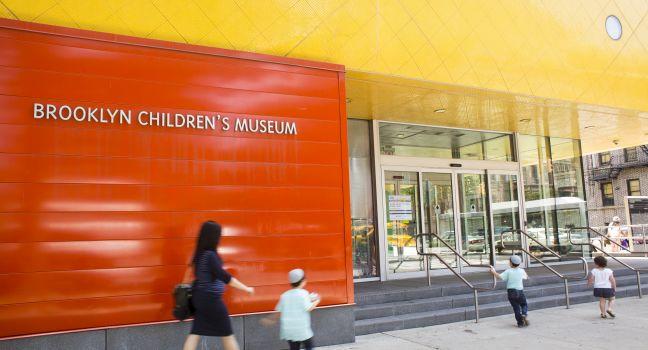
Brooklyn Children's Museum

Crown Heights
Brooklyn Children's Museum, Crown Heights, Brooklyn, New York.
Jennifer Arnow

What looks like a giant block of yellow cheese is actually the Brooklyn Children’s Museum, an interactive space where kids can run, touch, and play with abandon. Exhibits include a greenhouse, a rooftop play space, World Brooklyn—a warren of rooms dedicated to various NYC cultures—and the new Air Maze, where kids can insert objects into a topsy-turvy pneumatic-tube system. Check their calendar for ongoing programs, including their Drag Story Hour, which celebrates gender diversity.

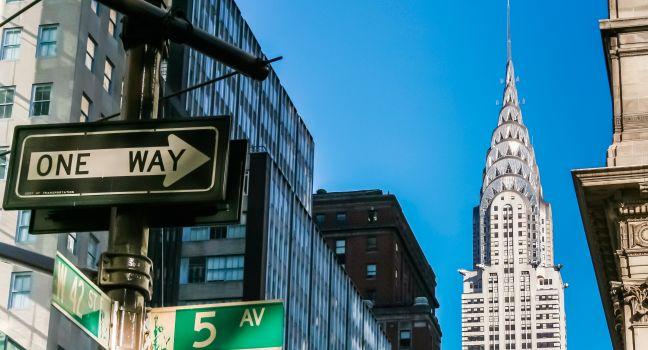
Chrysler Building

Midtown East
New York City street signs and Chrysler building
Marc Venema/iStockphoto

A monument to modernity and the mighty automotive industry, the former Chrysler headquarters wins many New Yorkers' vote for the city's most marvelous and beloved skyscraper, despite the fact that you can only love it from a distance. Architect William Van Alen, who designed this 1930 Art Deco masterpiece, incorporated car details into its form: American eagle gargoyles, made of chromium nickel and resembling hood ornaments used on 1920s Chryslers, sprout from the 61st floor; winged urns festooning the 31st floor reference the car's radiator caps. Most breathtaking is the pinnacle, with tiered crescents and spiked windows that radiate out like a magnificent steel sunburst. While the current owner has been given permission to reopen an observation deck on the 71st floor that closed in 1945, for now you have to make do with appreciating it from afar or ducking in for a quick look at the amazing time-capsule lobby replete with chrome \"grillwork,\" intricately patterned wood elevator doors, marble walls and floors, and an enormous ceiling mural saluting transportation and human endeavor. You may enter the lobby during business hours (8 am–6 pm). For a great view/photo, walk to the northeast corner of 44th Street and 3rd Avenue.

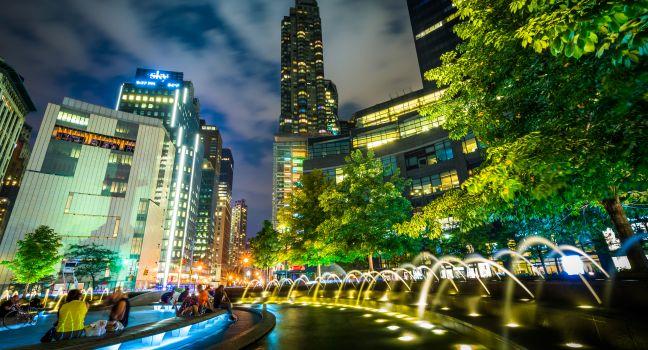
Columbus Circle

Upper West Side
Fountains and buildings at night at Columbus Circle, in Manhattan, New York.
(c) Appalachianviews | Dreamstime.com

This busy traffic circle at Central Park's southwest corner anchors the Upper West Side and makes a good starting place for exploring the neighborhood. The 700-ton, granite monument in the circle's center, capped by a marble statue of Christopher Columbus, serves as a popular meeting place. To some people, Columbus Circle is synonymous with the Deutsche Bank Center building and its several floors of shops, restaurants, and quick-bite cafés. The Whole Foods market and the food hall Turnstyle (on the subway-station mezzanine) are good spots to pick up sandwiches, coffee, or sushi for a Central Park picnic. The building is also home to the Rose Hall performing arts complex, part of Jazz at Lincoln Center.

Broadway between 58th and 60th Sts., New York, NY, 10019, USA

Something incorrect in this review?

The Cyclone

Coney Island
Historical landmark Cyclone roller coaster on May 17, 2014 in the Coney Island section of Brooklyn. Cyclone is a historic wooden roller coaster opened on June 26, 1927.
Zhukovsky | Dreamstime.com

This historic wooden roller coaster first thrilled riders in 1927, and it'll still make you scream. Anticipation builds as the cars slowly clack up to the first unforgettable 85-foot plunge—and the look on your face is captured in photos that you can purchase at the end of the ride. The Cyclone might not have the speed or the twists and turns of more modern rides, but that's all part of its rickety charm. It's one of two New York City landmarks in Coney Island, and deservingly in the National Register of Historic Places.