Get FREE email communications from Fodor's Travel, covering must-see travel destinations, expert
trip planning advice, and travel inspiration to fuel your passion.
We've compiled the best of the best in New York City - browse our top choices for the top
things to see or do during your stay.
Sorry! We don't have any recommendations for New York City right now.
Sights Filter
Flatiron Building
Flatiron District
Share This
Marco Rubino / Shutterstock
When completed in 1902, the wedge-shape Fuller Building, as it was originally known, caused a sensation. Architect Daniel Burnham made ingenious use of the triangular wedge of land at 23rd Street, 5th Avenue, and Broadway, employing a revolutionary steel frame that allowed for the structure's 22-story, 286-foot height. Covered with a facade of limestone and white terra-cotta in the Italian Renaissance style, the building's shape resembled a clothing iron, hence its nickname. When it became apparent that the building generated strong winds, gawkers would loiter at 23rd Street hoping to catch sight of ladies' billowing skirts. Local traffic cops had to shoo away the male peepers—one purported origin of the phrase \"23 skidoo.\"
Flushing Meadows Corona Park
Flushing
Share This
Paul Hakimata Photography / Shutterstock
The gleaming Unisphere (an enormous, 140-foot-high, steel globe) might tip you off that this 898-acre park, which is the largest in the borough, was the site of two World's Fairs. Take advantage of the park's barbecue pits, seasonal boat and kayak rentals, sports fields, and cultural festivals, but don't forget the art museum, science hall, zoo, theater, carousel, indoor pool, ice-skating rink, pitch-and-putt and mini-golf courses, and model-airplane field. Set aside a day to hit a few primary spots: several are clustered together on the park's northwest side, but reaching others will require long (though peaceful) walks.
\n
The outdoor Queens Night Market (www.queensnightmarket.com) is held Saturday evening, late April through October, near the New York Hall of Science. It's reminiscent of Asia's popular food markets and generally has about 100 vendors serving flavorful, often-adventurous global fare.
\n
The flat grounds are ideal for family biking; bike rentals are available at two locations from March to early November.
\n
The park is open from 6 am to 9 pm, 365 days a year (as in most city parks, exercise caution when visiting outside daytime hours).
Intrepid Sea, Air & Space Museum
Midtown West
Share This
Songquan Deng/Shutterstock
Manhattan's only floating museum—a historic, nonprofit, and educational institution like no other—occupies the Intrepid, a 900-foot-long aircraft carrier that was launched in 1943 and decommissioned in 1974. The carrier's most trying moment of service, the day it was attacked in World War II by kamikaze pilots, is recounted in a stirring multimedia presentation. On the ship’s various indoor and outdoor decks is a collection of 28 aircraft. NASA's original prototype orbiter that paved the way for the space-shuttle program, the Enterprise, is housed in a climate-controlled pavilion on the Intrepid’s flight deck. Fascinating exhibits share the shuttle's history, along with many more stories and artifacts from America's aviation, naval, and military heritage.
\n
Docked alongside the Intrepid, the submarine Growler—the only American guided-missile submarine open to the public—offers a firsthand look at life aboard a submarine, as well as a close-up inspection of the once top-secret missile command center. Also in the museum’s collection is a retired British Airways Concorde Alpha Delta G-BOAD passenger jet, which holds the record for the fastest Atlantic crossing by any Concorde. The museum provides specialized programs and resources to support visitors with disabilities and their families.
Recommended Fodor's Video
New York Public Library Main Branch
Midtown West
Share This
Jorg Hackemann/Shutterstock
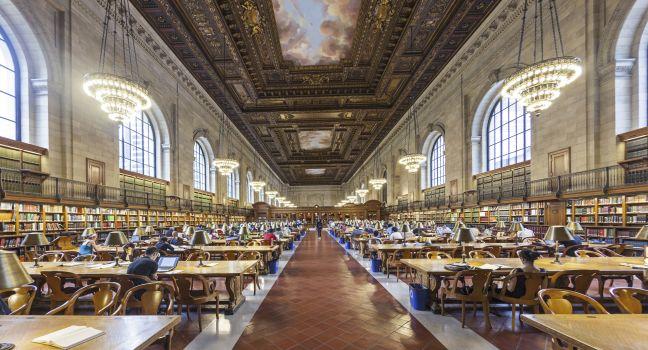
The \"Library with the Lions,\" open since 1911, is a masterpiece of Beaux-Arts and one of the world's great research institutions, with a repository for millions of items including books, manuscripts, photographs, maps, periodicals, and more. Dubbed the Stephen A. Schwarzman Building since 2008, the flagship recently underwent a renovation that created more public space for visitors to enjoy, including a new 40th Street entrance, improved infrastructure, and expanded exhibition spaces. Within Gottesman Hall, the free, permanent Polonsky Exhibition of the New York Public Library's Treasures features more than 250 rare and unique items (check the website for details and to see listings for rotating exhibits).
\n
The library's bronze front doors on 5th Avenue open into Astor Hall, which leads to special exhibit galleries and, to the left, a stunning periodicals room. Ascend the double staircase to a second-floor balconied corridor overlooking the hall, with panels highlighting the library's development. Continue up to behold the magisterial Rose Main Reading Room, where natural light pours through the massive windows (the room is open to anyone for quiet study; those just viewing the room must be on a tour). Third-floor galleries show rotating exhibits on print and photography. Free hour-long tours leave Monday–Saturday at 11 and 2, with a reservation.
\n
Across 5th Avenue from the main branch is the central circulating branch known as the Stavros Niarchos Foundation Library (455 5th Ave.), which completed a major renovation in 2021. There, visitors can see the famous lions built from LEGOs, view an imaginative ceiling installation, and spend time on the free roof terrace overlooking the main branch; and yes, NYPL members can even check out books.
New York Stock Exchange (NYSE)
Financial District
Share This
Donald R. Swartz / Shutterstock
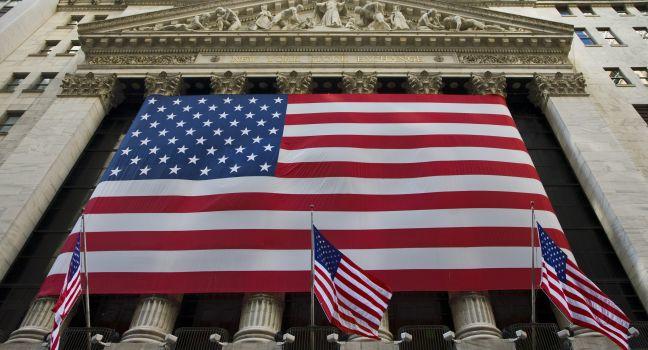
Unfortunately, you can't tour the stock exchange anymore—though the pace on the floor is much less frenetic than it used to be, now that technology has changed how the trading floor works. The building itself, though, at the intersection of Wall and Broad Streets, is still worth ogling. The neoclassical structure, designed by architect George B. Post, opened on April 22, 1903. It has six Corinthian columns supporting a pediment with a sculpture titled Integrity Protecting the Works of Man, featuring a tribute to the Gilded Age's sources of American prosperity: Agriculture and Mining to the left of Integrity; Science, Industry, and Invention to the right. Don't miss a peek at The Fearless Girl, the 4-foot-tall bronze statue by Kristen Visbal who faces down the NYSE in a show of support for gender equality (though there's often talk of relocating The Fearless Girl). As an interesting aside, the NYSE was one of the world's first air-conditioned buildings.
The Rink at Rockefeller Center
Midtown West
Share This
Stuart Monk/Shutterstock
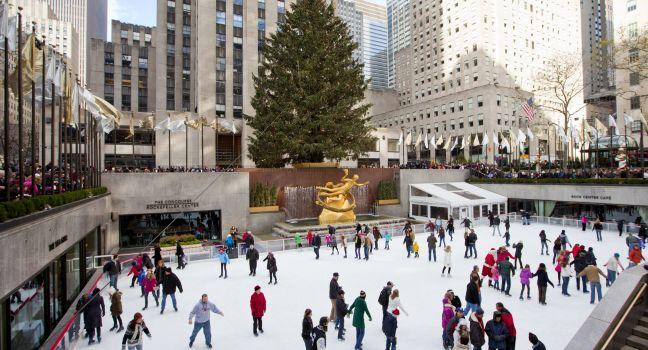
Set in the shadow of the giant Rockefeller Center Christmas tree (in season), the city's most iconic ice-skating rink is a quintessential winter experience for visitors and a long-standing tradition for many locals. General-admission, timed-ticket skating can be reserved in advance, in person or online. The Rink has changing specials and packages, so check the website for seasonal ticket deals.
Rockefeller Center
Midtown West
Share This
ruigsantos/Shutterstock
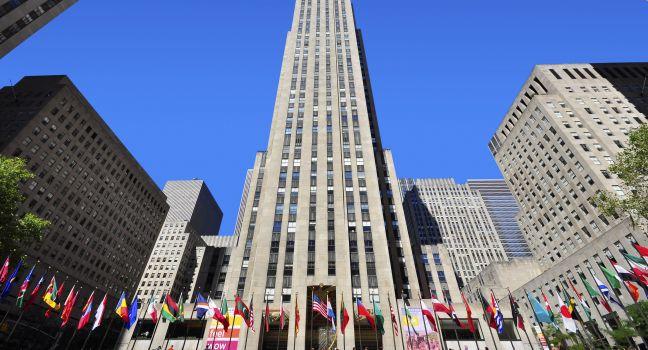
Comprising more than 100 shops and 50 eateries, the Rockefeller Center complex runs from 47th to 52nd Street between 5th and 6th Avenues; special events dominate the central plazas in spring and summer. In December an enormous, twinkling tree towers above the ice-skating rink, causing crowds of visitors from across the country and the globe to shuffle through with cameras flashing.
\n
The world's most famous ice-skating rink occupies Rockefeller Center's sunken lower plaza from October through mid-April and converts to a roller-skating rink in summer. A gold-leaf statue of the Greek hero Prometheus hovers above. The lower plaza also provides access to the marble-lined concourse underneath Rockefeller Center, which houses restaurants, a post office, and clean public restrooms.
\n
Rising from the lower plaza's west side is the 70-story Art Deco GE building. Here John D. Rockefeller Jr. commissioned and then destroyed a mural by Diego Rivera. He replaced it with the monumental American Progress by José María Sert, still on view in the lobby, flanked by additional murals by Sert and English artist Frank Brangwyn. Up on the 65th floor is the landmark Rainbow Room, a glittering big-band ballroom dating from 1934. Higher up, Top of the Rock has what many consider the finest panoramas of the city. Rockefeller Center guided walking tours are available several times daily (tickets start at $27), with the option to add a visit to the observation deck.
Roosevelt Island
Upper East Side
Share This
(c) Debchephotography | Dreamstime.com
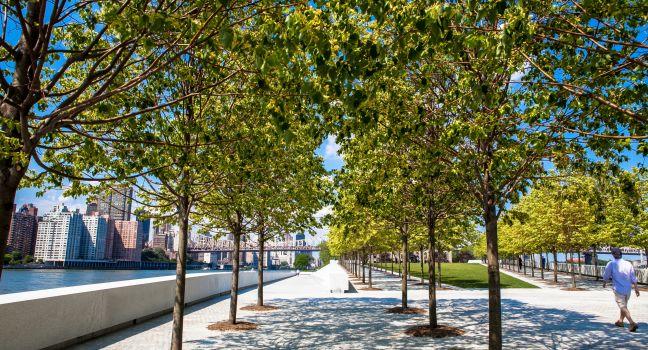
The 2-mile-long East River slice of land that parallels Manhattan from 48th to 85th Streets is now a quasi-suburb of more than 20,000 people, and the vestiges of its infamous asylums, hospitals and prisons make it an offbeat historical destination. At its southern tip are the ruins of a Smallpox Hospital, built in 1854. Neighboring the hospital ruins is Four Freedoms Park, a memorial to Franklin Delano Roosevelt designed by architect Louis I. Kahn. In addition to viewing a giant bust of FDR and a wall inscribed with the wartime “Four Freedoms” speech, you can stroll the park's walkways and enjoy views of the United Nations and East River. Group guided walking tours ($15 per person) of the park are available; email or call to reserve. At the island's north tip is a small park with a lighthouse built in 1872 by island convicts. Other developments include the 224-room Graduate Roosevelt Island Hotel. The island's mile of pink- and white-flowering cherry trees along the East River Promenade is a popular springtime destination.
You can get to the island by subway—but it's more fun to take the five-minute ride on the Roosevelt Island Tramway ($2.75, the price of a single subway or bus fare), which lifts you 250 feet for impressive views of Queens and Manhattan. A visitor center stands to your left as you exit the tram. Free red buses service the island.
23rd Regiment Armory
Crown Heights
Share This
At Atlantic and Bedford, the 23rd Regiment Armory is one of Brooklyn’s most imposing and important landmarks: an almost full-block Romanesque Revival building by architects Fowler & Hough that dates back to 1895. The building—much of it restored, from the crenelated towers to the arched windows—now serves as a homeless shelter, which means that the nearby blocks can feel a bit dodgy. During the day it’s safe, though, with people milling about—just be smart.
56 Bogart (The BogArt)
Bushwick
Share This
Many Bushwick galleries showcase edgy and experimental work, but visiting this converted warehouse is an easy way to see a lot of art in one place. The BogArt houses a few galleries, including standouts M. David & Go and the Amos Eno Gallery, plus large loft studios, often with open studio viewing sessions. Gallery hours vary, but the best time to visit is on Friday and weekends, when most places are open.
75½ Bedford Street
Share This
Rising real-estate prices inspired the construction of New York City's narrowest house—just 9½ feet wide and 32 feet deep—in 1873. Built on a lot that was originally a carriage entrance of the Isaacs-Hendricks House next door, this sliver of a building has illustrious past residents including actor John Barrymore and poet Edna St. Vincent Millay.
9/11 Tribute Museum
Financial District
Share This
This nonprofit project of the September 11th Families' Association opened in 2006 with the intent of putting the events of that day into context—at the time, there was little to see beyond a big construction site. Its galleries include displays about the history and construction of Lower Manhattan; the events of September 11, 2001; the response and recovery efforts after the attacks; and first-person histories. A Tribute visit tends to feel more intimate, and is a good alternative or complement to the broader mission of the separate National 9/11 Memorial & Museum. Guided walking tours are often led by survivors or first responders and cover the gallery and the memorial (not the National 9/11 Memorial Museum on the WTC site).
A.I.R. Gallery
DUMBO
Share This
The country's first all-female, artist-run cooperative was established in 1972. This modern gallery space features hundreds of women artists' work every year and also hosts events, lectures, and creative symposiums.
Acquavella Galleries
Upper East Side
Share This
The 19th-, 20th-, and 21st-century, museum-quality art inside this five-story, marble-floored French neoclassical town house tends to be big-name stuff from the Impressionism, Post-impressionism, Cubism and Surrealism movements. The gallery showcases works from well-known artists, including Pablo Picasso, Amedeo Modigliani, Claude Monet, Edgar Degas, Jean-Michel Basquiat, and Andy Warhol. It's best to check the website of this third-generation, family-owned gallery for individual exhibit hours, which can vary.
African Burial Ground National Monument
Financial District
Share This
Often overlooked due to its location amid downtown’s Civic Center courthouses and high-rises, this powerful, compact site is well worth a visit to learn about a lesser-known part of New York’s colonial history. The African Burial Ground National Monument commemorates what was once a 6-acre cemetery, discovered in 1991 when an archaeological study for a new development revealed more than 15,000 intact skeletal remains of enslaved and free Africans. Today, visitors can view the 24-foot-high Ancestral Chamber and the large Circle of the Diaspora, each made of stone from Africa and North America, adorned with African symbols, and designed with symbolic details that honor those who were laid to rest at the site. On the other side of the block, the visitor center features the “Reclaiming Our History” exhibit, details about the work and life of African people in early New York, and the 20th-century community success that preserved the burial ground. The memorial was proclaimed a national monument in 2006 in a ceremony presided over by former mayor Michael Bloomberg and poet Maya Angelou. The visitor center is located at 290 Broadway and the Outdoor Monument is located on the corner of Duane Street and African Burial Ground Way (Elk Street).
Alamo
East Village
Share This
Perhaps the most obvious landmark at the junction of Astor Place and Cooper Square is the giant cube balanced on one of its pointy ends. The sculpture, made by Tony Rosenthal, was meant to be temporary when it was installed in 1967, but residents liked it so much that they petitioned to have it made permanent. The steel structure is 8 feet long on each side and has a hidden pole at the center so that it can revolve. The pedestrian plaza in front of the sculpture has a few benches, chairs and tables, plus a kiosk selling coffee and snacks. In the traffic island across the street, an ornate cast-iron replica of a Beaux-Arts kiosk marks the subway entrance for the uptown 6 train—at the beginning of the 20th century, most of the city's Interborough Rapid Transit (IRT) subway entrances resembled this one.
American Folk Art Museum
Upper West Side
Share This
The focus of this museum near Lincoln Center is its incredible collection of work by folk and self-taught artists of the 20th and 21st centuries, including the single largest collection of reclusive Chicago artist Henry Darger, known for his painstakingly detailed collage paintings of fantasy worlds. The gift shop has an impressive collection of handcrafted items.
Appellate Division Courthouse
Flatiron District
Share This
Figures representing Wisdom and Force flank the main portal of this imposing Beaux-Arts courthouse, built in 1899. The structure's purpose coincides with artistic symbolism, and there are statues of great lawmakers, including Moses, Justinian, and Confucius, lining the roof balustrade. In total, sculptures by 16 artists adorn the ornate building, a showcase of themes relating to the law. A branch of the New York State Supreme Court, this is one of the most important appellate courts in the country: it hears more than 3,000 appeals and 6,000 motions annually and also admits approximately 3,000 new attorneys to the bar each year. Inside the courtroom is a stunning stained-glass dome set into a gilt ceiling. The main hall and the courtroom are generally open to visitors weekdays from 9 to 5.
Asia Society and Museum
Upper East Side
Share This
The Asian art collection of Mr. and Mrs. John D. Rockefeller III forms the core of this museum's holdings, with artworks and artifacts dating as far back as the 11th century BCE. A growing contemporary collection features video, animation, photography, and new media art by artists from Asia and the Americas. Founded in 1956, the society has a regular program of panel discussions, film screenings, family events, and performances, in addition to changing on-loan exhibitions of traditional and contemporary art. Trees and flowering vines grow within the glass-enclosed, skylighted Leo Café, whose menu reflects the diversity of Asian cuisine. The AsiaStore carries the best in Asian design and literature. Docent tours are offered regularly; a schedule is posted on the museum's website.
Atlantic Antic
Share This
Food, music, and a lot of fun are the features of this gigantic yearly party that closes down Atlantic Avenue from 4th Avenue to the waterfront on a Sunday in late September. There are several stages for performances and all kinds of antics at this family-friendly event, which celebrated its 43rd anniversary in 2017.
Barclays Center
Prospect Heights
Share This
This rust-tinted spaceship of an arena with a lawn for a roof houses the NBA's Brooklyn Nets and the WNBA's New York Liberty, and hosts events from concerts to family shows to boxing. With a capacity hovering around 17,000, Barclays Center also has plenty of room to offer concessions courtesy of local restaurateurs, including Fuku, Parm, and Federoff's Cheesesteaks.
Basilica of Our Lady of Perpetual Help
Share This
This imposing block-long Romanesque church stands tall on a ridge is unusual because it's actually two churches, one stacked on the other. The lower church opened on Easter Sunday in 1909. The larger, upper one was completed in 1928 in time for Christmas. In recognition of Sunset Park's diversity, masses are said in English, Spanish, Chinese, and Vietnamese.
Bastille Day
Carroll Gardens
Share This
The French equivalent of the Fourth of July, Bastille Day is celebrated annually on Smith Street on a Sunday in July that falls closest to July 14, the actual date of the holiday. The street is closed off and transformed into a massive party, with area restaurants setting up booths and a temporary pétanque court near Bar Tabac.
The Battery
Financial District
Share This
Marking the southernmost point of Manhattan, the Battery is a respite from the hurried Financial District. Even if you don't plan to stay for long, carve out a few minutes to enjoy the view, which includes the Statue of Liberty, Ellis Island, and the harbor. The park's main structure is Castle Clinton National Monument, the gathering point for ferries to the Statue of Liberty and Ellis Island. This monument is a former fort erected during the War of 1812 to defend the city. (Its sister fort, Castle Williams, sits across the harbor on Governors Island.) From 1855 to 1890, Castle Clinton served as America's first official immigration center.
\n
The Battery is home to memorials, monuments, an urban garden, a playscape, and a labyrinth, as well as the lovely SeaGlass Carousel, where for $6 children and adults can ride \"inside\" luminescent fish and pretend to float magically underwater. To the east is the Staten Island Ferry Terminal; to the west is Robert F. Wagner Jr. Park, with its tidy lawn and benches from which to view the harbor and summertime shows.
Bay Ridge Architecture Tour
Share This
Bay Ridge has no shortage of eclectic architecture. Wandering the neighborhood, you'll see everything from one of the oldest freestanding Greek Revival homes in Brooklyn (99th Street and Shore Road) to circa-1880 Shingle-style Victorians with conical towers (81st and 82nd streets, between 3rd and Colonial avenues); rows of limestone houses on Bay Ridge Parkway (lit by working gas lamps); and charming cul-de-sacs lined with redbrick, slate-roof homes (68th Street between Ridge Boulevard and 3rd Avenue). The most popular architectural attraction in the neighborhood, though, is the fanciful Arts and Crafts home known to locals as the Gingerbread House. Built for shipping magnate Howard E. Jones in 1917, the 6,000-square-foot private home at 8220 Narrows Avenue has a thatched-style shingle roof, rustic stonework, and abundant landscaped greenery that make it look like it came straight out of a Hans Christian Andersen story.
Bleecker Street
Greenwich Village
Share This
Walking the stretch of Bleecker Street between 7th Avenue and Broadway provides a smattering of just about everything synonymous with Greenwich Village these days: NYU buildings, record stores, Italian cafés and food shops, pizza and takeout joints, bars and nightclubs, and funky boutiques. A lazy afternoon here may consist of sampling some of the city's best pizza, grabbing an espresso, and soaking up the downtown fashion scene. Foodies love the blocks between 6th and 7th Avenues for the specialty purveyors like Murray's Cheese (No. 254). At the intersection of Bleecker and Carmine Streets is Our Lady of Pompeii Church, where Mother Cabrini, a naturalized Italian immigrant who became the first American citizen to be canonized, often prayed. West of 7th Avenue, the shops get more upscale, with fashion and home-furnishings boutiques featuring antiques, eyeglasses, handbags, shoes, and designer clothing.
Blum & Poe New York
Upper East Side
Share This
This contemporary art gallery might be a relative newbie on the Upper East Side art scene (it opened in 2014), but as one of L.A.'s top art galleries, it was quick to settle into its renovated town house on East 66th Street and establish itself in the New York art world. Past exhibits have featured artists such as Hugh Scott-Douglas, Kishio Suga, Yun Hyong-keun, and Zhu Jinshi.
Bowling Green
Financial District
Share This
The small plaza that is Bowling Green, at the foot of Broadway, became New York's first public park in 1733. Legend has it that before that, this was the site upon which Peter Minuit purchased the island of Manhattan from the Indigenous Lenape people, in 1626, supposedly for what amounted to 24 U.S. dollars. On July 9, 1776, a few hours after citizens learned about the signing of the Declaration of Independence, rioters toppled a statue of British king George III that had occupied the spot for 11 years; much of the statue's lead was melted down into bullets. In 1783, when the occupying British forces fled the city, they defiantly hoisted a Union Jack on a greased, uncleated flagpole so it couldn't be lowered; but patriot John Van Arsdale drove his own cleats into the pole to replace it with the Stars and Stripes. The copper-top subway entrance across State Street is the original one, built in 1904–05. Many know Bowling Green as the home of Arturo Di Modica's 7,000-pound, bronze Charging Bull statue (1989); look for it on the northern tip of the park.
The Brant Foundation
East Village
Share This
A crowd-pleasing Basquiat show in 2019 marked the inauguration of this East Village art space, and subsequent shows have proved that the privately owned Brant Foundation isn't a one-trick pony. That's not surprising since Peter Brant's own collection includes a vast selection of works by such contemporary artists as Andy Warhol, David Altmejd, Carl Andre, John Chamberlain, Urs Fischer, Dan Flavin, Dash Snow, and the aforementioned Basquiat, just to name a few. The four-level space was once a power station (it later became the studio of conceptual artist Walter De Maria), and it's towering ceilings and giant windows are the perfect setting for large-scale artworks. There’s a quiet garden and a gift shop, too. Check the website to confirm opening times, price of admission, and to make a reservation to visit.
BRIC Arts Media House
Fort Greene
Share This
The organizers of renowned arts festival Celebrate Brooklyn! (see Best Brooklyn Events in Chapter 1) operate this 40,000-square-foot gallery, television studio, and performance space between the Brooklyn Academy of Music (BAM) and Downtown Brooklyn. The gallery specializes in Brooklyn-based artists, and the artwork also spills over into the café and hallways. Upstairs, the UrbanGlass studio has classes for all ages, as well as a shop/showcase on the first floor with jewelry, housewares, and objets d'art.
Subscribe to Newsletter
Sign up for Travel Tips & News
I want emails from Fodor's Travel with travel information and promotions. I can unsubscribe
any time using the unsubscribe link at the end of all emails.
Thank you for your interest!
Look out for our newsletters with travel tips and special offers.
Sign up for Travel Tips & News
By signing up for the
newsletter, I agree to the Privacy Policy. You must check the box to subscribe
Thank you for your interest!
Look out for our newsletters with travel tips and special offers.