363 Best Sights in New York City, New York

Background Illustration for Sights

We've compiled the best of the best in New York City - browse our top choices for the top things to see or do during your stay.

Union Square Park and Greenmarket
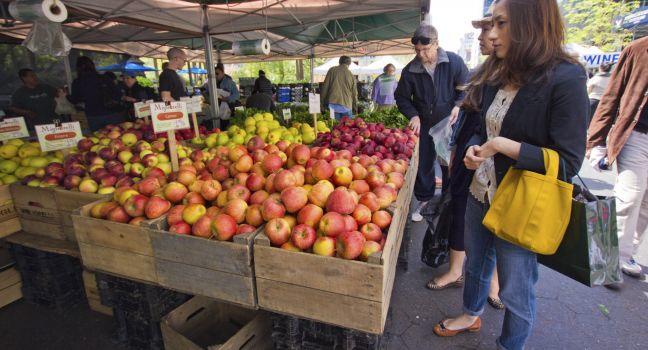
Fodor's Choice
NEW YORK CITY - APR. 20: Woman selects produce at Union Square Greenmarket in NYC on Apr 20, 2012. This world famous farmers' market began in 1976 and has grown to 140 farmers during peak season.; Shutterstock ID 100566316; Project/Title: Weekend Getaways;
littleny/Shutterstock

A park, farmers' market, meeting place, and the site of rallies and demonstrations, this pocket of green space and surrounding public square sit in the center of a bustling residential and commercial neighborhood. The name \"Union\" originally signified that two main roads—Broadway and 4th Avenue—crossed here. It took on a different meaning in the late 19th and early 20th centuries, when the square became a rallying spot for labor protests; many unions, as well as fringe political parties, moved their headquarters nearby.

\n

Union Square is at its best on Monday, Wednesday, Friday, and Saturday (8–6), when the largest of the city's greenmarkets draws farmers and food purveyors from the tristate area selling fruit and vegetables, plants, fresh-baked pies and breads, cheeses, cider, fish, and meat. Between Thanksgiving and Christmas, artisans sell gift items and food at the large Union Square Holiday Market ( www.usqholiday.nyc).

\n

New York University dormitories, theaters, and cavernous commercial spaces occupy the restored 19th-century commercial buildings that surround the park, along with some chain stores and restaurants. Statues in the park include those of George Washington, Abraham Lincoln, Mahatma Gandhi (often wreathed in flowers), and the Marquis de Lafayette (sculpted by Frédéric-Auguste Bartholdi, designer of the Statue of Liberty).
Washington Square Park

Greenwich Village Fodor's Choice
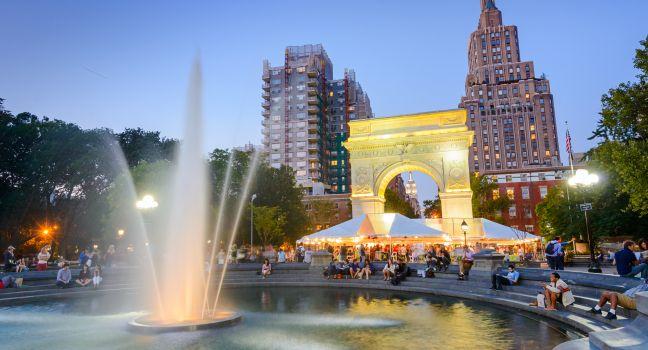
NEW YORK CITY - SEPTEMBER 12, 2012: Crowds gather at Washington Square Park. The historic park is popular in the summer.
(c) Sepavo | Dreamstime.com

NYU students, street musicians, skateboarders, chess players, and those just watching the grand opera of it all generate a maelstrom of activity in this physical and spiritual heart of Greenwich Village. The 9¾-acre park with its gorgeous central fountain had inauspicious beginnings as a cemetery, principally for yellow-fever victims—an estimated 10,000–22,000 bodies lie below (a headstone was even unearthed in 2009). In the early 1800s, the park was a parade ground and the site of public executions; the notorious Hanging Elm still stands at the northwest corner of the square. 

\n

The triumphal European-style Washington Arch at the square's northern flank marks the start of 5th Avenue. The original wood-and-papier-mâché arch, situated a half block north, was erected in 1889 to commemorate the 100th anniversary of George Washington's presidential inauguration. The arch was reproduced in Tuckahoe marble in 1892, and the statues—Washington as General Accompanied by Fame and Valor on one side, and Washington as Statesman Accompanied by Wisdom and Justice on the other—were added in 1916 and 1918, respectively.

5th Ave. between Waverly Pl. and 4th St., New York, NY, 10003, USA

Something incorrect in this review?

Whitney Museum of American Art

Meatpacking District Fodor's Choice
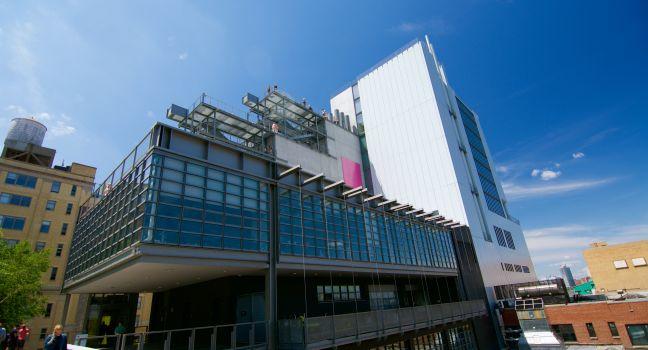
New building of Whitney Museum on Gansevoort Street in Manhattan, designed by architect Renzo Piano.
Hannoonnes | Dreamstime.com

The Renzo Piano–designed museum welcomes visitors with a lively plaza, bold works of contemporary and modern American art, plenty of terraced outdoor spaces, and expansive windows. There are eight floors (not all open to the public), with a lauded French bakery on the ground floor and a café on the eighth floor. The galleries house rotating exhibitions from the permanent collection of postwar and contemporary works by artists such as Jackson Pollock, Jim Dine, Jasper Johns, Mark Rothko, Chuck Close, Cindy Sherman, and Roy Lichtenstein. Notable pieces often on view include Hopper's Early Sunday Morning (1930), Bellows's Dempsey and Firpo (1924), Calder's beloved Circus, and several of O'Keeffe's dazzling flower paintings.

\n

The Whitney experience is as much about the setting as the incredible artwork. The outdoor terraces on floors six, seven, and eight are connected by exterior stairs that provide a welcome reprieve from crowded galleries as well as stunning skyline views. Visitors 25 and under get in free with valid ID; Friday night is free to all 5–10 pm. Skip the line and buy tickets in advance online; same-day tickets are often available.

99 Gansevoort St., New York, NY, 10014, USA
212-570–3600
Sight Details
$30
Closed Tues.

Something incorrect in this review?

Recommended Fodor's Video

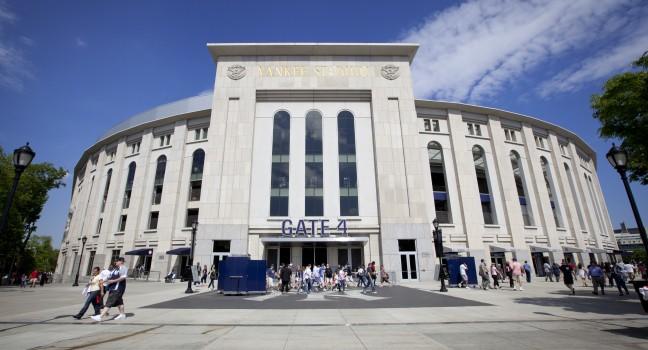
Yankee Stadium

South Bronx Fodor's Choice
The Yankees are at home playing against the Seattle Mariners on Mothers Day, May 13, 2012 at Yankee Stadium, New York City.
(c) Ericro | Dreamstime.com

From April through October, you can see one of baseball's great franchises, the \"Bronx Bombers,\" in action at their $1.5 billion Yankee Stadium, opened in 2009 right across the street from the site of the original (aka \"the House that Ruth Built\"), which is now parkland. Tickets can be pricey, but the experience is like watching baseball in a modern-day coliseum. It's quite opulent: a traditional white frieze adorns the stadium's top; inside, limestone-and-marble hallways are lined with photos of past Yankee greats. History buffs and hard-core fans should visit the museum (set on the main level and open 'til the end of the eighth inning), filled with team memorabilia, and Monument Park (closes 45 minutes prior to first pitch), with plaques of past Yankee legends, by center field. Pregame and off-season one-hour stadium tours are held on a near-daily basis year-round; visit the Yankees website for more info on times and ticketing.

Afropunk Fest

Fort Greene Fodor's Choice
This annual multicultural fete brings artists like Macy Gray, D'Angelo, Big Freedia, and Chuck D to an urban park near the Brooklyn Navy Yard, at the far north end of Fort Greene. The fashion scene is as fabulous as the music. Local food trucks provide sustenance and a thrift market keep fans occupied between sets.

Arthur Avenue (Belmont)

Belmont Fodor's Choice

Manhattan's Little Italy is overrun with mediocre restaurants aimed at tourists, but Belmont (meaning \"beautiful hill\"), the Little Italy of the Bronx, is a real, thriving Italian American community. Unless you have family in the area, the main reason to come here is for the food: eating it, buying it, looking at it fondly through windows, and chatting with shopkeepers about it—perhaps getting recipe advice.

\n

Nearly a century after pushcarts on Arthur Avenue catered to Italian American workers constructing the zoo and botanical garden, the area teems with meat markets, bakeries, cheese makers, and shops selling kitchenware (espresso machines, pasta makers, etc.). There are debates about which store or restaurant is the \"best,\" but thanks to generations of Italian grandmothers, most vendors here serve fresh, handmade foods—including the sausages of the famed \"sausage chandelier\" at the Calabria Pork Store (  2338 Arthur Ave.). Although the area is no longer solely Italian—many Latinos and Albanians share this neighborhood now—Italian Americans dominate the food scene. 

Arthur Ave. between Crescent Ave./184th St. and 188th St., and 187th St. between Lorillard Pl. and Cambreleng Ave., Bronx, NY, 10458, USA
718-294–8259

Something incorrect in this review?

Bethesda Fountain

Central Park Fodor's Choice

Few New York views are more romantic than the one from the top of the magnificent stone staircase that leads down to the ornate three-tiered Bethesda Fountain. The fountain, dedicated in 1873, was built to celebrate the opening of the Croton Aqueduct, which brought clean drinking water to New York City. The name Bethesda was taken from the biblical pool in Jerusalem that was supposedly given healing powers by an angel, which explains the statue The Angel of the Waters rising from the center. The four figures around the fountain's base symbolize Temperance, Purity, Health, and Peace. Beyond the terrace stretches The Lake, filled with swans, gondolas, and amateur rowboat captains. At its eastern end is the new and improved Boathouse, home of a deck bar, an outdoor café for on-the-go snacks, and a pricier restaurant for more leisurely meals.

Brooklyn Bridge (Entrance)

Brooklyn Heights Fodor's Choice

Most visitors cross the Brooklyn Bridge from Manhattan, but you'll get better views traversing the span from the Brooklyn side. It's a surprisingly long walk (more than a mile) that normally takes about 40 minutes, but the exhilarating views are worth the exertion. No need to look out for cyclists; a separated bike lane on the vehicle road has made the pedestrian walkway much more pleasant. The bridge is most magical and quiet in the early morning, but if you don't mind the crowds, it's worth making the trip at sunset in summer, when the lights of Manhattan come to life. There are two pedestrian access points for the bridge on the Brooklyn side: at the intersection of Tillary Street and Adams Street, and another in DUMBO from a staircase at the underpass where Cadman Plaza East intersects Prospect Street.

Brooklyn, NY, 11201, USA

Something incorrect in this review?

Brooklyn Bridge Park

DUMBO Fodor's Choice

This sprawling, 85-acre industrial-turned-recreational riverside park stretches from the Manhattan Bridge in DUMBO, under the Brooklyn Bridge, and all the way south to Pier 6 at the end of Atlantic Avenue. It's a gathering spot for tourists and Brooklynites alike, who come to picnic or watch movies on the lawn in the summer, play various sports on its many courts and playing fields, or simply stroll the promenade and gawk at the most postcard perfect view of the downtown Manhattan skyline—especially at sunset. The DUMBO section has a playground and a small pebble beach, plus the wonderfully restored Jane’s Carousel ( janescarousel.com).

Brooklyn Museum

Prospect Heights Fodor's Choice

New York’s second-largest museum (after Manhattan’s Metropolitan Museum of Art) is also one of the largest in America, with 560,000 square feet of exhibition space. The colossal Beaux-Arts structure houses a world-class collection of Egyptian art, as well as impressive collections of African, pre-Columbian, Native American, pan-Asian, and feminist art. In addition, you'll find works by Georgia O'Keeffe, Winslow Homer, John Singer Sargent, George Bellows, Thomas Eakins, and Milton Avery. The museum is also well-known for its contemporary, cutting-edge special exhibits. The monthly First Saturday (except September and November through January) is a free-entry night that's a neighborhood party of art, music, and dancing, with food vendors and several cash bars.

The Bushwick Collective

Bushwick Fodor's Choice

Bushwick is well known for its street art, as the Brooklyn graffiti scene endures with colorful, larger-than-life murals. It's all encouraged, supported, and curated by this urban art collective, under the helm of Joseph Ficalora. The outdoor street art gallery is omnipresent as you walk Troutman Street and the adjacent blocks of St. Nicholas Avenue and Wyckoff Avenue, the area's main drag. Fans of global street art will recognize featured artists, including Sam Lao, Robert Vargas, and Case Maclaim. Every summer, the Collective throws a block party that's a mix of DJs, hip-hop performances, food trucks, and local vendors. Check their social media for details.

Celebrate Brooklyn!

Prospect Park Fodor's Choice
New York City’s longest-running summer outdoor performance festival began in 1979 and remains a top-notch crowd-pleaser with its diverse roster of mostly free (and some benefit) star acts. There's ample band shell seating, but locals tend to favor arriving early with a blanket to get a good seat on the grassy slope. Acts range from artists such as Janelle Monáe, the National, Neutral Milk Hotel, and St. Vincent to the Shen Wei Dance Arts company and Dance Theatre of Harlem. Look for silent film nights accompanied by innovative live music as well as spoken word performances. Pack a picnic or buy food from local, on-site vendors.

Chelsea Market

Chelsea Fodor's Choice

This former Nabisco plant—where the first Oreos were baked in 1912—now houses more than 50 shops, food vendors, and sit-down restaurants. Probably the biggest draw are the food kiosks (some with counter seating), including favorite taco spot Los Tacos No. 1, Israeli-based sandwich spot Miznon, Amy's Bread, Berlin Currywurst, Ninth Street Espresso, and so much more. Also look for an Anthropologie store, an outpost of Pearl River Mart, a wine bar, upscale groceries, teas, spices, gift baskets, kitchen supplies, and one of New York City's last independent bookstores (Posman Books). The market's funky industrial design—a tangle of glass and metal for an awning, a factory pipe converted into an indoor waterfall—complements the eclectic assortment of shops, but the narrow space can get very crowded. A downstairs level has a few additional food stands as well as bathrooms. There is some seating inside and outside along West 15th Street, but if the weather's nice, take your goodies to the High Line.

City College of New York

Harlem Fodor's Choice

Built in 1847 as the founding college of what is now the largest public urban university system in America, City College was originally called Free Academy of the City of New York. Affectionately dubbed the \"Harvard of the Proletariat,\" or \"the poor man's Harvard,\" the idyllic Neo-Gothic campus was designed by George Brown Post (the architect behind the Stock Exchange) and has since expanded to 36 acres. At a time when private universities were predominantly restricted to Protestant students, City College became a beacon for religious tolerance, and over the years, several City College graduates went on to win Nobel Prizes, among a long list of notable alumni. It’s also the site where Albert Einstein first presented his theory of general relativity in America. Stroll between Convent Avenue and St. Nicholas Terrace to admire five landmark structures with white terra-cotta trim, four great arches, green spaces, and more than 600 Gothic gargoyles and grotesques, originally designed to symbolize the academic purpose of each building.

Clinton Hill Architecture Walk

Fodor's Choice
Part of the National Register of Historic Places, the buildings along Clinton and Washington avenues were originally lavish summer homes for turn-of-the-20th-century industrialists like Charles Pratt. Federal, French Second Empire, Romanesque Revival, Greek Revival, Gothic Revival, and neo-Grec mansions line the streets, serving as university buildings, community centers, and private residences. There are also quintessentially Brooklyn brownstones and Italianate row houses, with mansard roofs as far as the eye can see.

Coney Island Museum

Coney Island Fodor's Choice
Founded as a labor of love by Coney Island impresario Dick Zigun, this quirky museum recounts the tumultuous history of the neighborhood and explores the counterculture that still thrives here. Check out the memorabilia from Coney Island's heyday in the early 1900s, as well as video installations, temporary exhibits, and the fabulous collection of funhouse mirrors.
1208 Surf Ave., Brooklyn, NY, 11224, USA
718-372–5159
Sight Details
$5
Labor Day–mid-June closed weekdays; mid-June–Labor Day closed Mon. and Tues.

Something incorrect in this review?

Cooper Hewitt, Smithsonian Design Museum

Upper East Side Fodor's Choice

The Cooper Hewitt has taken an ornate, century-old mansion—once the residence of industrialist Andrew Carnegie—and outfitted it with the latest technologies and amenities to create a slick, highly interactive, 21st-century experience, so you don’t just look at design; you engage with it. Download the free app to guide you through some of the wide-ranging collection's more than 215,000 objects from over 30 centuries, including 3-D printed objects, handcrafted furniture, vintage wallpaper, cultural and period textiles, art and design books, and examples of robotics and animation. Rotating exhibits may focus on a particular designer, design era or theme.

\n

The focus on design and discovery extends to the SHOP, where limited-edition objects are for sale. There is a café, and an outdoor garden is free and open to the public. The museum offers guided tours aligned to exhibition topics at 1:30 daily. Admission tickets can be reserved online.

Fort Greene Park

Fort Greene Fodor's Choice
With 30 acres of green hills, Brooklyn's oldest park is the unofficial nucleus of the neighborhood. It served as a military fort during the Revolutionary War and again during the War of 1812. At its center, the Prison Ship Martyrs Monument commemorates American war prisoners. Although it predates them, landscape architects Olmsted and Vaux (known for designing Central Park and Prospect Park) designed the current layout of Fort Greene Park.

Fort Tryon Park

Inwood Fodor's Choice

Come to Fort Tryon Park to visit the Met Museum's medieval branch, the Cloisters, and stay for the glorious Hudson River views, the gorgeous landscaped gardens, the 8 miles of winding pathways, and the Revolutionary War history. Perched on one of the highest points in Manhattan (hence \"the Heights,\") the 67-acre oasis was designed by Frederick Law Olmsted Jr. and gifted to New York City in 1935 by John D. Rockefeller Jr., and today its more than 650 varieties of plants, trees, and shrubs are the gifts that keep on giving with every season. During the Revolutionary War, the area was part of the Battle of Fort Washington, a seminal Continental army defeat in the American Revolution. While the Continental Army ultimately prevailed, the site originally named for the last British governor of colonial New York, William Tryon, continued to be referred to as Fort Tryon. Look for the monument to Margaret Corbin, a woman who took up her husband's canon when he was shot and killed during battle: “On this hilltop stood Fort Tryon, the northern outwork of Fort Washington, its gallant defense against the Hessian troops by the Maryland and Virginia regiment 16-November-1776 was shared by Margaret Corbin, the first American woman to take a soldier’s part in the war for liberty.” Other highlights include the Billings Arcade, the remains of a stunning arched entrance to a grand mansion (you've likely seen this on Instagram), and the Heather Garden, where locals welcome spring with parading bagpipes and heather shearings. Don't miss the gatehouse on your way into the park with the apt sign \"NYC's coolest office.\"

Grand Ferry Park

Fodor's Choice
Hipsters, Hasidic Jews, and others hang out at this small waterfront park named for the ferry that for a century connected Williamsburg to Manhattan. The views of Manhattan and the Williamsburg Bridge are sublime anytime. Sand covers the ground in summer, and if you sit on a bench near the waves that crash against the rocks, you can almost pretend you're at the beach. Check out the inscription on the redbrick smokestack, which figured in the development of penicillin.

Green-Wood Cemetery

Fodor's Choice
One of the loveliest places for a stroll in the five boroughs, the 478 acres of Green-Wood Cemetery are also home to more than 560,000 permanent residents. Notables include Jean-Michel Basquiat, Leonard Bernstein, and Horace Greeley, but the elaborate monuments and mausoleums of the nonfamous tend to be more awe-inspiring. Equally impressive are the views that stretch to Brooklyn Harbor and Manhattan. Guided walking and trolley tours, as well as special events, are offered. Keep an eye out for parrots: the bright green monk parakeets have been nesting here since the 1960s when, legend has it, they escaped from a shipment at JFK airport.

Herbert Von King Park

Fodor's Choice
This 7.8-acre park is one of Brooklyn's oldest idylls—a leafy expanse with a playground, baseball field, dog run, and an amphitheater that serves as a venue for SummerStage and Bed-Stuy Pride.

Hudson River Park

TriBeCa Fodor's Choice

The quiet green spaces of New York City are treasured by locals, and one of the best is Hudson River Park, a 5-mile path from Battery Place to 59th Street. This riverside stretch, incorporating the piers that jut out into the Hudson, has been renovated into a landscaped park with walking and cycling paths, a seasonal minigolf course, dog runs, and skate parks. The TriBeCa portion consists of Piers 25 and 26, and has picnic spaces, playgrounds, a sand volleyball court, and an educational river-ecology area. The areas adjacent to the West Village (Piers 45 and 46) and near Chelsea (Piers 63 and 64) are equally attractive, with lots of spots for leisure and recreation. To the north, beginning at 72nd Street, is Riverside Park.

Jackie Robinson Museum

SoHo Fodor's Choice

The life and legacy of Jackie Robinson, the trailblazing Black baseball player who broke the color barrier when he signed with the Brooklyn Dodgers in 1947, is the focus of this $42 million interactive museum on the western edge of SoHo. Besides memorabilia—Robinson’s Dodgers uniform, rookie contract, and Rookie of the Year award are among hundreds of archival major-league artifacts on display—Robinson’s Civil Rights legacy is given equal due. The intense racial discrimination the Hall of Famer endured both on and off the field is powerfully narrated through photos and videos, including one clip that vividly recounts the segregation he and his wife, Rachel, experienced en route to Florida spring training as the South was under Jim Crow laws.

Jane's Carousel

DUMBO Fodor's Choice

Equal parts architectural marvel and children's plaything, this beautifully restored 1922 carousel twirls within a glass-walled waterfront pavilion designed by Pritzker Prize--winning French architect Jean Nouvel. Situated between the Brooklyn and Manhattan bridges, near the northern reaches of 85-acre Brooklyn Bridge Park and directly across from Manhattan's skyline, the carousel's 48 horses and two chariots are off to the races year-round.

Brooklyn Bridge Park, Brooklyn, NY, 11201, USA
718-222--2502
Sight Details
$2
Mid-Sept.--mid-May, Thurs.--Sun. 11--6; mid-May--mid-Sept., Wed.--Mon. 11--7
Closed Tues. year-round and Mon. and Wed. mid-Sept.--mid-May

Something incorrect in this review?

The Jewish Museum

Upper East Side Fodor's Choice

Housed in a circa-1908 French Gothic, chateau-style mansion that was once home to German-Jewish immigrant and businessman Felix Warburg, the Jewish Museum holds a collection of nearly 30,000 pieces of art and ceremonial objects that explore Jewish identity and culture for more than 4,000 years. The wide-ranging artifacts include almost 1,050 Hanukkah lamps, the world's largest collection; a 3rd-4th century Roman burial plaque, and a plaster model of George Segal's Holocaust sculpture, while works by artists such as Camille Pissarro, Deborah Kass, Lee Krasner, and Kehinde Wiley have appeared. It's suggested that visitors purchase timed admission tickets in advance. For hungry museumgoers, there's a new restaurant on-site: Lox at the Jewish Museum (closed weekends). Traditional Eastern European dishes are served; the Lox Five Ways entrée is a showstopper. The museum's gift shop carries Judaica, ceremonial objects, and suggested gifts, but it's closed on Saturday.

1109 5th Ave., New York, NY, 10128, USA
212-423–3200
Sight Details
$18 (free Sat. and select Jewish holidays)
Closed Tues. and Wed.

Something incorrect in this review?

Koreatown

Murray Hill Fodor's Choice

Despite sitting in the shade of the Empire State Building and being just steps from Herald Square, Koreatown (or \"K-Town,\" as it's locally known) is not a tourist destination. In fact, it's a bustling area, with traditional and trendy places to shop, eat, drink, and be merry right under the noses of millions of tourists. Technically, Koreatown runs from 31st to 36th Street between 5th and 6th Avenues, though the main drag is 32nd Street between 5th and Broadway. Labeled Korea Way, this strip is home to Korean barbecue joints, karaoke bars, and grocery and beauty stores, all stacked next to each other. Find just about everything K-Pop-related at Koryo Books ( 35 W. 32nd St.), scope out a popular food hall at Food Gallery 32 ( 11 W. 32nd St.), or order desserts most worthy of an Instagram reel at Grace Street Coffee & Desserts ( 17 W 32nd St.). Fill up on kimchi (spicy pickled cabbage), kimbap (seaweed rice rolls), and red bean doughnuts (delicious); then top off your Koreatown experience by stepping into a jade-igloo sauna at Juvenex Spa ( 25 W. 32nd St.).

From 31st to 36th St., New York, NY, 10001, USA

Something incorrect in this review?

Lincoln Center for the Performing Arts

Upper West Side Fodor's Choice

Internationally renowned, this cultural destination attracts more than 6.5 million visitors annually to its massive, white-travertine-clad complex of buildings, including the homes of the New York Philharmonic, Metropolitan Opera, New York City Ballet, the Juilliard School, the Film Center, a branch of the New York Public Library specializing in the performing arts, and the Damrosch Park outdoor performance space. All of this makes Lincoln Center one of the nation's most concentrated destinations for the performing arts. The16-acre campus, containing 30 venues in all, was designed by prolific New York architect Wallace Harrison and was built over the course of several years from 1962 to 1969. When David Geffen Hall reopened in fall 2022 after a two-year $550 million renovation, the acoustically superior venue—home to the New York Philharmonic, the oldest symphony orchestra in the United States—evoked and honored the vibrant Black and Puerto Rican neighborhood that had been razed to make way for the complex with a multimedia piece by the composer Etienne Charles called “San Juan Hill.” The opening included a commitment to making programming more accessible to all audiences: performances from within the Wu Tsai Theater are simulcast on the lobby’s Hauser Digital Wall for anyone to experience, and rotating visual artworks are also shown on the digital wall as well as on the facade on 65th Street at Broadway. You can also get a glimpse of artists working and rehearsing in the new Sidewalk Studio facing Broadway.

\n

The Metropolitan Opera House, notable for its arched entrance, features immense chandeliers and Marc Chagall paintings, both of which can be seen from outside. Even the fountain in the central plaza puts on a show, with performances that include spouts of water 40 feet high. From mid-May to mid-August, Lincoln Center's \"Summer for the City\" presents hundreds of mostly free events. 

\n

Guided tours (weekdays 2 pm and 3:45 pm) are 75 minutes and include backstage access to Geffen and Tully halls where visitors can enjoy a unique look behind the scenes at rehearsals, technical work, backstage areas, and theaters. Book tickets online or at Geffen Hall Box Offices.

From 62nd St. to 66th St., New York, NY, 10023, USA
212-875–5456-for general inquiries
Sight Details
Tickets vary by venue; guided tour $20

Something incorrect in this review?

Little Island

Meatpacking District Fodor's Choice

Much like the High Line when it opened, Little Island was an instant hit with locals and visitors when the gates to this man-made isle in the middle of the Hudson River first swung open in May 2021. The 2.4-acre park is elevated on 132 tulip-looking concrete stilts and connected to Manhattan by two footbridges. Funded mostly by Barry Diller and Diane von Fürstenberg, the island park and its rolling stair-clad hills make for a fun wander. It also provides stunning views of the Manhattan skyline. There's a small outdoor food court and an ambient amphitheater for free concerts.

Louis Valentino, Jr. Park and Pier

Red Hook Fodor's Choice
This small pier and park, named for a fallen firefighter, has awe-inspiring views of the Statue of Liberty and across the Hudson. You won't need prompting to take pictures. There are a few benches for relaxing.