214 Best Sights in USA

Background Illustration for Sights

We've compiled the best of the best in USA - browse our top choices for the top things to see or do during your stay.

Height of Land

Fodor's Choice

Height of Land is the highlight of—and the highest point along—Rangeley Lakes National Scenic Byway, with unforgettable views of mountains and lakes. One of Maine's and even New England's best overlooks, it hugs Route 17 atop Spruce Mountain several miles south of Rangeley's Oquossoc village. It's a twisty drive up on forest-lined roads whether you're coming that way or from the south, but however you get here you'll be amply rewarded. Mooselookmeguntic and Upper Richardson lakes sprawl amid the forestland below. On a clear day, you can look west to the White Mountains on the Maine–New Hampshire border. There's off-road parking, interpretive panels, and stone seating. Hit the Appalachian Trail for a day hike—it crosses Height of Land. Rangeley Lake unfolds at a nearby overlook on the opposite side of the road, north of here toward Oquossoc.

Wheeler Peak Scenic Drive

Fodor's Choice

When this stunning seasonable road is open, it’s a must for Great Basin visitors. Less than a mile from the visitor center off Route 488, turn onto this paved road that winds its way above 10,000 feet in elevation. You’ll pass pinyon-juniper forest in lower reaches; as you climb, the air cools as much as 20–30 degrees. Along the way, pull off at overlooks for awe-inspiring glimpses of the peaks of the South Snake Range. A short interpretive trail leads to a ditch that once carried water to the historic Osceola mining site. Turn off at Mather Overlook, elevation 9,000 feet, for the best photo ops. Wheeler Overlook is the best place to see Wheeler Peak, as well as fall colors. Allow 1½ hours for the 24-mile round-trip, not including hikes.

Highway 1

Fodor's Choice
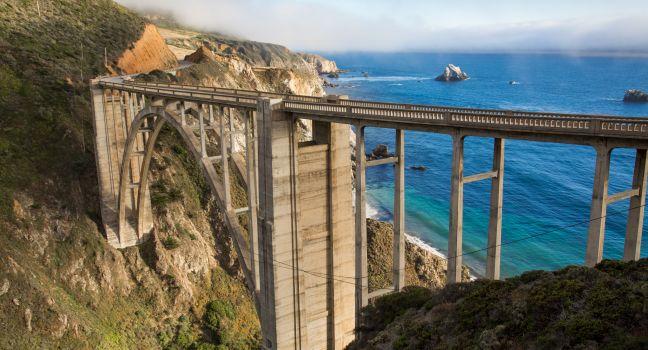
Bixby Bridge, California
topseller / Shutterstock

One of California's most spectacular drives snakes up the coast north of San Simeon. Numerous pullouts offer tremendous views and photo ops. On some beaches, huge elephant seals lounge nonchalantly, seemingly oblivious to the attention of rubberneckers. Heavy rain can cause mudslides that block the highway north and south of Big Sur, so sections of the route are sometimes closed for repairs or general maintenance. Before traveling, visit bigsurcalifornia.org and click on the Highway 1 Conditions and Information link.

Recommended Fodor's Video

Upper Colorado River Scenic Byway—Highway 128

Fodor's Choice
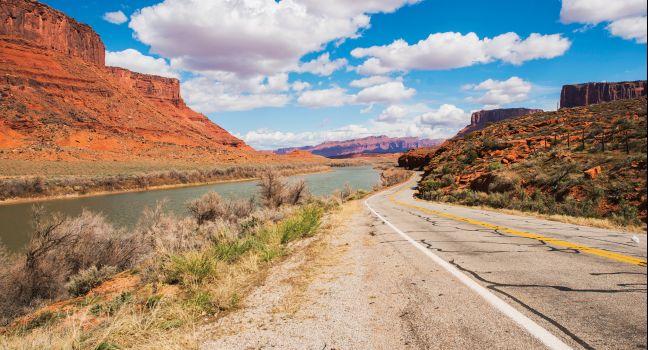
Scenic Utah Highway 128 Along Colorado River. Moab, Utah, United States.
welcomia / Shutterstock

One of the most scenic drives in the Four Corners region, Highway 128 intersects U.S. 191, 3 miles south of Arches. The 44-mile highway runs along the upper Colorado River, with 2,000-foot red rock cliffs rising on both sides. This gorgeous river corridor is home to a winery, orchards, and a couple of luxury lodging options. It also offers a spectacular view of world-class climbing destination Fisher Towers before winding north to Interstate 70. Give yourself an hour to 90 minutes to drive it, though be aware that traffic can get congested in the summer. For the full experience, go through the ghost town of Cisco by taking Exit 214 if you're heading east on I–70 and stop by the delightful Buzzard's Belly General Store. Full of snacks, soda, art, and fun knickknacks, it's an off-beat take on a general store, and you'll likely want to take some pictures to show your friends.

Going-to-the-Sun Road

Fodor's Choice
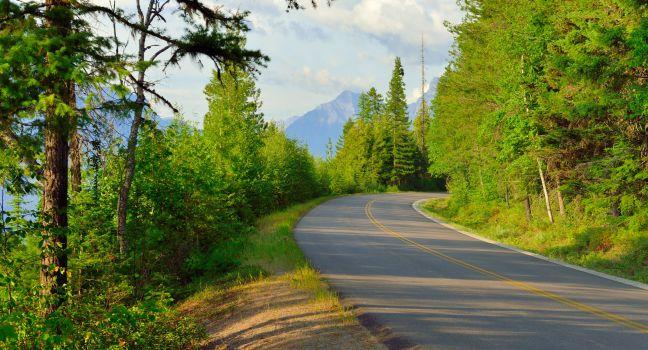
Going to the sun road near McDonald lake in Glacier National Park, Montana in summer
Alexey Kamenskiy / Shutterstock

This magnificent, 50-mile highway—the only American roadway designated both a National Historic Landmark and a National Civil Engineering Landmark—crosses the crest of the Continental Divide at Logan Pass and traverses the towering Garden Wall. Open from mid-June to mid-September only (due to heavy snowfalls), this is one of the most stunning drives in Glacier National Park. A multiyear Sun Road rehabilitation project will result in some driving delays due to reconstruction. The drive is susceptible to frequent delays in summer. To avoid traffic jams and parking problems, take the road early in the morning or in the evening (when the lighting is ideal for photography and wildlife is most likely to appear). Glacier National Park Service operates a free hop on, hop off shuttle service from Apgar Visitor Centre to St. Mary Visitor Centre during the peak season. Vehicle size is restricted to under 21 feet long, 10 feet high, and 8 feet wide, including mirrors, between Avalanche Creek Campground and Sun Point. Cyclists enjoy traveling the open part of the road in early June before it is open to vehicular traffic.

17-Mile Drive

Fodor's Choice

Primordial nature resides in quiet harmony with palatial, mostly Spanish Mission–style estates along 17-Mile Drive, which winds through an 8,400-acre microcosm of the Pebble Beach coastal landscape. Dotting the drive are rare Monterey cypresses, trees so gnarled and twisted that Robert Louis Stevenson described them as "ghosts fleeing before the wind." The most famous of these is the Lone Cypress.

Other highlights include Bird Rock and Seal Rock, home to harbor seals, sea lions, cormorants, and pelicans and other sea creatures and birds, and the Crocker Marble Palace, inspired by a Byzantine castle and easily identifiable by its dozens of marble arches.  If you spend $35 or more on dining in Pebble Beach and show a receipt upon exiting, you'll receive a refund off the drive's $11.75 per-car fee.

17-Mile Dr., Pebble Beach, CA, 93953, USA
Sight Details
$12 per car, free for bicyclists

Something incorrect in this review?

Alpine Loop Scenic Byway

Fodor's Choice

Beyond Timpanogos Cave, Highway 92 continues up American Fork Canyon before branching off to climb behind Mount Timpanogos itself. Designated the Alpine Loop Scenic Byway, this winding road offers stunning mountain views and fall foliage in the latter months before dropping into Provo Canyon to the south. The 14-mile round-trip Timpooneke Trail and the 14-mile round-trip Aspen Grove Trail, both off the byway, reach the summit of Mount Timpanogos. Also along this highway is the famed Sundance Resort. Closed, depending on snowfall, from late October to late May, the Alpine Loop is free to drive, but you need to purchase a National Forest pass ($6, good for three days) to park at any of the trailheads and recreation areas along the route. This is the roundabout way to get to scenic Provo Canyon and Deer Creek Reservoir from I–15 (if heading south from Salt Lake City); the more direct route is U.S. 189 east from near Orem and Provo (stop by Bridal Veil Falls on your way in).

Arches Main Park Road

Fodor's Choice

The main park road and its two short spurs are extremely scenic and allow you to enjoy many park sights from your car. The main road leads through The Courthouse Towers, where you can see Sheep Rock and The Three Gossips, then alongside The Great Wall, The Petrified Dunes, and Balanced Rock. A drive to the Windows section takes you to attractions like Turret Arch, The North Window, and Double Arch, and you can see Skyline Arch along the roadside as you approach the Devils Garden Campground. The road to Delicate Arch allows hiking access to one of the park's main features. Allow about two hours to drive the main road's 35-mile round-trip, more if you explore the spurs and their features and stop at viewpoints along the way.

Artists Drive

Fodor's Choice

Don't rush this quiet, lonely 9-mile paved route that skirts the foothills of the Black Mountains and provides intimate views of a changing landscape. About 4 miles in, a short side road veers right to a parking lot that's a few hundred feet from one of Death Valley's signature sights: Artists Palette, so called for the contrasting colors (including shades of green, gold, and pink) of its volcanic deposits and sedimentary layers. The drive is one-way, heading north off Badwater Road, so if you're visiting Badwater Basin from Furnace Creek, come here on the way back. 

South on Badwater Rd. from Rte. 190 intersection, Death Valley National Park, CA, 92328, USA

Something incorrect in this review?

Avenue of the Giants

Fodor's Choice

Some of Earth's tallest trees tower over this magnificent 32-mile stretch of two-lane blacktop, also known as Highway 254, that follows the south fork of the Eel River through Humboldt Redwoods State Park. The highway runs more or less parallel to U.S. 101 from Phillipsville in the south to the town of Pepperwood in the north. A brochure available at either end of the highway or the visitor center, 2 miles south of Weott, contains a self-guided tour, with short and long hikes through various groves.

A trail at Founders Grove passes by several impressive trees, among them the fallen 362-foot-long Dyerville Giant, whose root base points skyward 35 feet. The tree can be reached via a short trail that begins 4 miles north of the visitor center. About 6 miles north of the center lies the 10,000-acre Rockefeller Forest, containing the world's largest concentration of old-growth coastal redwoods.

Badlands Loop Road

Fodor's Choice

The simplest drive is on two-lane Badlands Loop Road (Route/Highway 240). The drive circles from Exit 110 off I–90 through the park and back to the interstate at Exit 131. Start from either end and make your way around to the various overlooks along the way. Pinnacles and Yellow Mounds overlooks are outstanding places to examine the sandy pink- and brown-toned ridges and spires distinctive to the badlands. The landscape flattens out slightly to the north, revealing spectacular views of mixed-grass prairies. The Cedar Pass area of the drive has some of the park's best trails.

Bajada Loop Drive

Fodor's Choice

This 6-mile drive winds through thick stands of saguaros and past two picnic areas and trailheads to a few short hikes, including one to a petroglyph site. Although the road is unpaved and bumpy, it's a worthwhile trade-off for access to some of the park's densest desert growth. It's one-way between Hugh Norris Trail and Golden Gate Road, so if you want to make the complete circuit, travel counterclockwise. The road is susceptible to flash floods during the monsoon season (July and August), so check road conditions at the visitor center before proceeding. This loop route is also popular among bicyclists, and dogs on leash are permitted along the road.

Saguaro West, Saguaro National Park, AZ, 85743, USA

Something incorrect in this review?

Beartooth Highway

Fodor's Choice

Driving south from Red Lodge along the 68-mile Beartooth Highway (U.S. 212) will take you over the precipitous 11,000-foot Beartooth Pass as the road winds its way through lush alpine country to the "back door" of Yellowstone National Park. With multiple steep climbs and switchbacks, this National Scenic Byway was a feat of 1930s engineering. The highway is usually open from late May to mid-October, but snow can close it at any time of the year. You'll find trailheads for several good hikes along the route.

BMW Performance Center

Fodor's Choice

If you missed your true calling as a race-car driver, BMW lets you live out your dreams at this two-hour experience. A pro driver radios in instructions while you put the pedal to the metal and slide around curves in each of the automaker's fastest cars, including the all-electric i4M50 and the M8. Afterward, cool down on the off-road course, where you'll drive a BMW X SUV through an artificial river and onto two wheels as you navigate rocky outcroppings.

Burr Trail

Fodor's Choice

Fans of epic scenic drives—along with mountain and even road bikers—should consider tackling at least a portion of this storied, 66-mile route that was established as a rugged and remote cattle trail in the 1870s. This remote backcountry byway crosses east through the northern end of Grand Staircase–Escalante National Monument and then across the southern portion of Capitol Reef National Park. The 31-mile stretch from Boulder to the park's western border is paved, making it easily passable and thus more popular if you're driving a passenger car. Beyond the paved stretch, it's another 35 miles of unpaved and often very bumpy road that passes briefly through Capitol Reef, crossing the amazing scenery of Waterpocket Fold via a dramatic series of switchbacks, and then eventually to paved Highway 276 and the village of Bullfrog, at the northern end of Glen Canyon.

If you don't have a lot of time, drive the first 12 miles or so, following the route as it descends into Long Canyon, with its sheer red-rock walls. Hop out at the turnoff for Singing Canyon, where an easy 0.3-mile trail leads into a slot canyon with impressive 80-foot-high walls. See the Capitol Reef National Park chapter for more on exploring the section of Burr Trail that passes through the park and connects with Notom Road, which you can follow north about 35 miles to reach Highway 24 just east of the park boundary—turn left here, and you can loop all the way back to Boulder via Torrey. Note that the unpaved sections of Burr Trail and Notom Road can get washed out and become impassable after heavy rains, especially in summer—monitor weather forecasts carefully, and at the first sign of stormy weather (even in the distance), it's best to turn back. 

Burr Trail Switchbacks

Fodor's Choice

Offering some of the most eye-popping scenery of any drive in southern Utah, the 67-mile Burr Trail twists and turns from the town of Boulder all the way to tiny Bullfrog, which lies at the tip of one of the many fingers of Lake Powell, within Glen Canyon National Recreation Area. Only an 8½-mile stretch of Burr Trail passes through Capitol Reef National Park, but it's arguably the most spectacular section. It's especially dramatic if approaching from the west from Boulder through Grand Staircase–Escalante National Monument. When you reach the Capitol Reef National Park border, the road becomes unpaved but is still generally (unless there's been heavy rain or snow) passable with a passenger car. It curves through juniper-dotted, red-rock countryside, offering sweeping views of the Strike Valley, the Studhorse Peaks, and—in the distance—the Henry Mountains. After about 3 miles, you'll crest the upper, western ridge of the Waterpocket Fold, a 100-mile-long monocline in the earth's crust, and then zigzag some 800 feet down a series of dramatic switchbacks to the lower end of the fold. From here, Burr Trail Road continues southeast past the junction with Notom-Bullfrog Road (where a left turn leads back up to Torrey) toward the small village of Bullfrog.

Cactus Forest Drive

Fodor's Choice

This paved 8-mile drive provides a great overview of all Saguaro East has to offer. The one-way road, which circles clockwise, has several turnouts with roadside displays that make it easy to pull over and admire the scenery; you can also stop at two picnic areas and three easy nature trails. This is a good bicycling route, but watch out for snakes and javelinas crossing in front of you.

Cactus Forest Dr., Saguaro National Park, AZ, 85730, USA

Something incorrect in this review?

Cape May Carriage Company

Fodor's Choice

Park the car and see Cape May's historic district the way they did when these building were born—aboard an elegant horse-drawn buggy. A dispatcher at the edge of Washington Street mall can arrange thirty minute tours for couples group tours for up to eight adults and two children. A fixture on the scene for nearly 30 years, Cape May Carriage Company has a fleet of more than 20 horses that all live on the owners' nearby farm. There are also ghost tours and holiday lights tours.

Capitol Gorge

Fodor's Choice

The narrow, unpaved road that begins at the end of Scenic Drive twists along the floor of the gorge and was a route for pioneer wagons traversing this part of Utah starting in the 1860s. After every flash flood, pioneers would laboriously clear the route so wagons could continue to go through. The gorge was the main automobile route into the area until 1962, when Highway 24 was built. This 2-mile drive with striking views of the surrounding cliffs leads to one of the park's most popular hikes, to several "tanks" eroded into the sandstone that fill naturally with rainwater and snowmelt.

Scenic Dr., Capitol Reef National Park, UT, 84775, USA

Something incorrect in this review?

Cascade Lakes Scenic Byway

Fodor's Choice

For 66 miles, this nationally designated Scenic Byway meanders past a series of high mountain lakes and is good for fishing, hiking, and camping in the summer months. (Much of the road beyond Mt. Bachelor is closed by snow during the colder months.)

Cascade Loop

Fodor's Choice

One of the state's most famous scenic drives, the popular 400-mile Cascade Loop encompasses areas of northwestern Washington from Puget Sound to the Cascades and beyond on a number of roads. Its eastern portion includes towns in the Methow Valley such as Winthrop, the Lake Chelan Valley, and the Wenatchee Valley and Cascade foothills. Winthrop has plenty of outdoor activities as well as a lively downtown; heading south on the loop brings you to the resort area of Chelan, on 50-mile-long Lake Chelan, and then to the fruit-growing center of Wenatchee and on to Leavenworth, with its Bavarian-style architecture and mix of old-style and hip shops and restaurants. Although you could drive this portion of the Cascade Loop in a day, the charming towns, landscapes, and outdoor adventures make it easy to linger for a few days or more.  

Chain of Craters Road

Fodor's Choice

The coastal region of Hawaii Volcanoes National Park is accessed via the spectacularly scenic Chain of Craters Road, which descends 18.8 miles to sea level. You could drive it without stopping, but it's well worth spending a few hours or a day exploring the stops and trails. Winding past ancient craters and modern eruption sites, this scenic road was realigned in 1979 after parts of it were buried by the Mauna Ulu eruption. Marked stops along the way include Lua Manu Crater, Hilina Pali Road, Pauahi Crater, the Mauna Ulu eruption site, Kealakomo Lookout, and Puu Loa Petroglyphs. As you approach the coast, panoramic ocean vistas prevail. The last marked stop features views of the stunning natural Holei Sea Arch from an overlook. In recent decades, many former sights along the coast have been covered in lava, including a black-sand beach and the old campground.

Cherohala Skyway

Fodor's Choice

Many motorists swear that this 43-mile National Scenic Byway rivals the beauty of any comparable stretch on the Blue Ridge Parkway. You're unlikely to encounter traffic, and the solitude found on short hikes to peaks like Huckleberry Knob, a bald with 360-degree views, may be the highlight of your trip. 

Chief Joseph Scenic Highway

Fodor's Choice

In 1877 a few members of the Nez Perce tribe killed some white settlers in Idaho as retribution for earlier killings by whites. Fearing that the U.S. Army would punish the guilty and innocent alike, hundreds of Nez Perce fled on a five-month journey toward Canada along what came to be known as the Nez Perce Trail. On the way they passed through what is now Yellowstone National Park, across the Sunlight Basin area north of Cody, and along the Clarks Fork of the Shoshone River before turning north into Montana. To see the rugged mountain area they traveled through, follow Highway 120 north 17 miles to Highway 296, the Chief Joseph Scenic Highway. The highway twists and turns for 46 miles, ending at similarly stunning U.S. 212, the Beartooth Scenic Highway, which leads west to the pretty hamlet of Cooke City, Montana and then the Northeast Entrance of Yellowstone, or east to the small ski and hiking hub of Red Lodge. Along the way you'll see open meadows, pine forests, and a sweeping vista of the region from the top of Dead Indian Pass.

Chisos Basin Road

Fodor's Choice

This 7-mile road climbs majestically from Chisos Basin Junction to Chisos Mountains Lodge, with a spur leading to a campground. In these higher elevations you're slightly more likely to spot mountain lions and bears as well as white-tailed deer amid juniper and pinyon pines. You'll also see smooth, red-barked Texas madrone along with some Chisos oaks and Douglas fir trees. Roadside exhibits explain the various ecosystems. Because of sharp curves and switchbacks, this drive is not suitable for RVs longer than 24 feet. The road is closed to construction through mid-2027.

Big Bend National Park, TX, 79834, USA

Something incorrect in this review?

Chuckanut Drive

Fodor's Choice

Highway 11, also known as Chuckanut Drive, was once the only highway accessing Bellingham from the south. The drive begins in Fairhaven, reaches the flat farmlands of the Samish Valley near the village of Bow, and joins up with Interstate 5 at Burlington, in Skagit County. The full loop can be made in a couple of hours, but the many notable eateries along the route, especially around Bow—home to the Bow-Edison Food Trail—may tempt you to linger. For a dozen miles this 23-mile road winds along the cliffs above beautiful Chuckanut and Samish bays. It twists its way past the sandstone face of Chuckanut Mountain and crosses creeks with waterfalls; look for lively oyster bars here,too. Turnouts are framed by madrona trees and pines and offer views of the San Juan Islands. Bald eagles cruise along the cliffs or hang out on top of tall firs. Drive carefully: the cliffs are so steep in places that closures resulting from rock slides occasionally occur in winter.

Coastal Drive Loop

Fodor's Choice

The 9-mile, narrow, and partially unpaved Coastal Drive Loop takes about 45 minutes to traverse. Weaving through redwoods, the road yields close-up Klamath River views and expansive Pacific panoramas. This loop, closed to trailers and RVs, is all that remains of a longer drive. A spur road leads to the High Bluff Overlook, a premier whale-watching spot; a ½-mile trail leads down to the beach. A little less than a mile north of the overlook lies the B-71 Radar Station, which looks like a farmhouse, its disguise during World War II. About ½-mile farther along, hikers access the Flint Ridge section of the Coastal Trail, also possible off Klamath Beach Road.

Dunes Drive

Fodor's Choice

This gorgeous drive through the heart of White Sands accesses virtually every part of the park that's accessible to visitors, including all of the trails and picnic areas. It's an 8-mile drive from the visitor center and entrance gate to the one-way loop at the end. The first 5 miles are paved, and as you make your way from the park entrance, the landscape becomes steadily more dominated by higher and whiter dunes, until you reach the final 3 miles, which are unpaved along smooth, hard-packed gypsum. This is where the experience starts to feel truly surreal, as it's easy to feel as though you're driving through a winter wonderland—the gypsum really does look like snow (which feels particularly odd if you're driving this route on a hot summer day). You'll come to the Primrose and Roadrunner picnic areas, on the right, as you enter the one-way loop portion of Dunes Drive, and you'll come to several larger parking areas that access some of the park's biggest dunes as the road curves back around at the Alkali Flat Trailhead. It takes only about 45 minutes to drive the entire route, round-trip, but you'll want to stop and explore the dunes on foot. Part of the fun is watching park visitors, especially kids, riding sleds down the dunes. Groups of friends and families also regularly come and set up tents and umbrellas on the dunes nearest the parking areas and bask in the sun all day. It's quite a sight. Do obey speed limits, which are 45 mph as you enter but drop to 15 mph along the unpaved loop in areas with lots of pedestrian traffic. It may look tempting to zip around, but the sand can get slippery, and the road curves in places, limiting visibility.

Firehole Canyon Drive

Fodor's Choice

The 2-mile narrow asphalt road twists through a deep canyon of curving lava-rock formations and passes the 40-foot Firehole Falls, which are most scenic in the morning when you're not looking into the afternoon sun. In summer look for a sign marking a pull-out and swimming hole. This is the only place where you can safely and legally swim in the thermally heated waters. Look for osprey and other raptors.

Yellowstone National Park, WY, USA
Sight Details
Closed early Nov.–early Apr.

Something incorrect in this review?

Fruit Loop

Fodor's Choice

Either by car or bicycle, tour the quiet country highways of Hood River Valley, which abounds with fruit stands, U-pick berry farms, wineries, and cideries. You can visit nearly 30 businesses along this picturesque, pastoral 35-mile route. Shop for juicy apples, pears, cherries, and peaches fertilized by volcanic soil, pure glacier water, and a conducive harvesting climate. And visit superb wineries and cider houses with sunny patios for tasting, as well as vendors of delicious baked goods, honeys and jams, fresh flowers, and fragrant lavender. While on the loop, consider stopping in the small town of Parkdale for lunch at Apple Valley BBQ, to taste beer at Solera Brewery, and to snap a photo of Mt. Hood's north face.