16 Best Sights in Amsterdam, Netherlands

Background Illustration for Sights

We've compiled the best of the best in Amsterdam - browse our top choices for the top things to see or do during your stay.

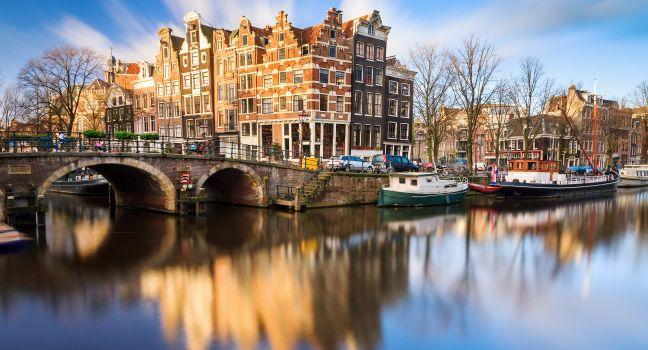
Brouwersgracht

Jordaan Fodor's choice
Beautiful image of the UNESCO world heritage canals the 'Brouwersgracht' en 'Prinsengracht (Prince's canal)' in Amsterdam, the Netherlands; Shutterstock ID 192787925; Project/Title: 20 Best Places to Celebrate New Years Eve; Downloader: Fodor's Travel
Dennis van de Water / Shutterstock

Regularly voted Amsterdam's most beautiful street, this wonderful canal at the northern border of the Jordaan is lined with residences and former warehouses for the brewers, fish processors, and tanneries who operated here in the 17th century when Amsterdam was the "warehouse of the world." On top of the old canal, mansions dotting the Brouwersgracht are symbols referring to the breweries that used this waterway to transport their goods to thirsty drinkers hundreds of years ago. Although most of the buildings have been converted into luxury apartments, an old-world charm still reigns. Of particular note are buildings at Nos. 204–212, with their trapezium gables. At No. 162, there are two dried fish above the door; this decoration on a metal screen was the forerunner of the gable stone to denote occupation. The canal provides long views down the grand canals that are perfect for photo ops.

Magere Brug

Fodor's choice
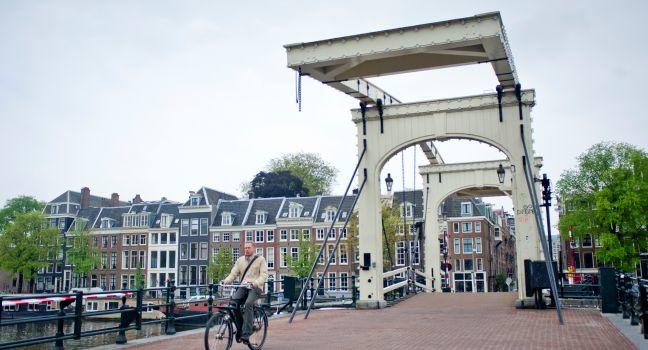
Bridge, Magere Brug, Amsterdam, Holland
© Zach Nelson / Fodors Travel

Of Amsterdam's 60-plus drawbridges, this is the most famous, and it provides gorgeous views of the Amstel and surrounding area. It's said to have been first built in the 1660s, around the time of the construction of the Eastern Canal Ring. While there are many theories about the origins of its name, the most colorful tells a tale of two sisters living on opposite sides of the Amstel who wanted an efficient way of sharing that grandest of Dutch traditions: the gezellige (socially cozy) midmorning coffee break. Whether "mager" referred to their surname, slim physiques, or possibly even their miserliness, we'll never know. Walk by at night when it's spectacularly lighted. Many replacements to the narrow original bridge have come and gone; the current one dates from 1931 but bears a close resemblance to the 19th-century design.

Between Kerkstraat and Nieuwe Kerkstraat, 1018 EK, Netherlands

Something incorrect in this review?

NEMO Science Museum

Fodor's choice
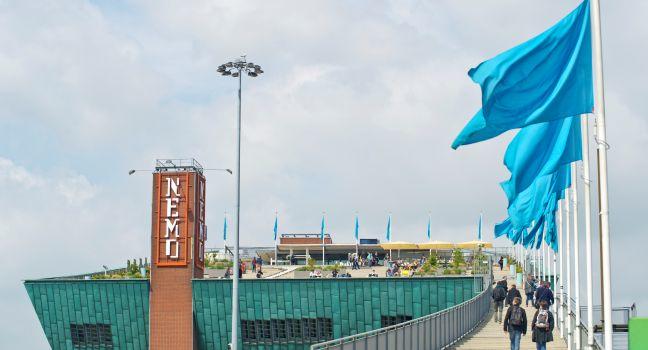
NEMO Science & Technology Center, Amsterdam, Holland
© Zach Nelson / Fodors Travel

Opened in 1997, this copper-clad building designed by world-renowned architect Renzo Piano (co-creator of Centre Pompidou in Paris, among many other notable projects) is an international architectural landmark—a curved green shape like a ship's bow seemingly rising out of the water, over the IJ Tunnel entrance to Amsterdam North. A rooftop café and terrace offer a superb panorama of the area. It's worth a visit just for the view, but there are also five floors of fantastical, hands-on, high-tech fun, which make this a science wonderland, especially for kids. Attractions range from giant "bubbles" on the ground floor to experiments in the Wonder Lab and interactive exhibitions like Teen Facts.

Recommended Fodor's Video

Westerpark

Fodor's choice
Reflections on a canal in Westerpark, Amsterdam.
luismonteiro / Shutterstock

Just beyond the Jordaan and across from the main canal that borders the Western Islands is one of contemporary Amsterdam's most cherished spaces. It's a park first and foremost, with lawns, playgrounds, water fountains, a fabulous designer paddling pool, a barbecue area, and a couple of tennis courts. The sprawling terrain of the city's old Western gasworks has been turned into the Westergasfabriek: cafés, galleries, clubs, shops, and an art-house cinema occupy the former industrial landscape that has been lovingly detoxed, replanted, and refurbished building by building. There's even a bit of natural wilderness (or at least the organized Dutch brand of "wilderness") behind the park, with a community farm, a petting zoo, a natural playground for kids, and some polder areas with footpaths between them. The lovely late-19th-century Sint Barbara cemetery is here, too.

De Hallen

Oud-West Fodor's choice

This historic brick complex has a long and varied history in the neighborhood. It was formerly a tram-maintenance building turned artist squat before becoming a community hotspot in 2014. Today, this busy area adjacent to the Ten Katemarkt is a cultural and entertainment hub where visitors can explore a handful of restaurants, cafés, shops, and galleries. Plus, there's a cinema, hotel, and public library, along with the popular indoor market, De Foodhallen.

Egelantiersgracht

Jordaan Fodor's choice

The floral canal names in the Jordaan district are at odds with the fragrances that would have emanated from them in their early days. This canal, named for the "eglantine rose," is one of Amsterdam's loveliest. Many of its houses and surrounding streets were first occupied by Golden Age painters and artisans, including the legendary Blaeu family of mapmakers. Hidden here is the St. Andrieshofje, famous for its Delftware entryway. And certainly not hidden (because it's usually jammed with people) is the famed Café 't Smalle (on the corner of the Prinsengracht). This brown café, covered with eglantine roses and complete with a floating terrace, was where Pieter Hoppe began his jenever distillery in 1780, an event of such global significance that Café 't Smalle is re-created in Japan's Holland Village in Nagasaki.

Between Prinsengracht and Lijnbaansgracht, Amsterdam, 1015 RG, Netherlands

Something incorrect in this review?

Museum Het Schip

Westerpark Fodor's choice

Right behind Westerpark is the unique Spaarndammerbuurt neighborhood made up of noteworthy monumental brick architecture designed by Michel de Klerk as a prime example of what social housing could be in the 1920s. For a glimpse further inside, guided tours bring visitors into one of the refurbished historic apartments, usually taking place in English at 3 pm daily.

Westergasfabriek

Westerpark Fodor's choice

Located within Westerpark, the Westergasfabriek is a former gas factory that, in 2003, was refurbished into a cultural hot spot and is now home to many festivals and exhibitions throughout the year. A handful of venues are located along the promenade running parallel to the spacious Westerpark, including restaurants, an arthouse movie theater, and an old-school arcade bar. There's even a branch of the Conscious Hotel, a small petting zoo and a market on the first Sunday of the month. Springtime visitors, don’t miss the sakura cherry blossoms when they take over Westerpark.

Amsterdamse Bos

Beyond Oud-Zuid, straddling Amsterdam and Amstelveen, the largest of Amsterdam's parks covers 1,000 hectares (almost 2,500 acres) and incorporates 200 km (124 miles) of foot, bike, and bridle paths traversed by 116 bridges—67 of which designed in the early-20th-century Amsterdam School style, with characteristic redbrick and sculpted-stone detailing. There are wide recreational fields, a boating lake, the impressive Olympic Bosbaan rowing course (overlooked by the terraces of grand café De Bosbaan), and numerous playgrounds and wonderful water-play areas for toddlers.

One popular family attraction is the Geitenboerderij "De Ridammerhoeve" goat farm ( Nieuwe Meerlaan 4, follow blue signs past Boerderij Meerzicht  020/645–5034  www.geitenboerderij.nl) with a playground and lunchroom, a sunny terrace, and lots of chickens hopping about between the goats. Your kids can bottle-feed the four-legged kind and cuddle bleating babies in the barn.

For public transport to the Amsterdamse Bos, there are various options: visit  9292.nl for up-to-date information or call  0900–9292. You can also rent bikes ( 020/644–5473) year-round at the entrance of the Amsterdamse Bos opposite the visitor center; maps, suggested routes, and signposting are plentiful throughout the park.

If you didn't pack your own lunch, Boerderij Meerzicht is a traditional Dutch pancake house, with a small deer zoo and playground for kids ( Koenenkade 56  020/679–2744  www.boerderijmeerzicht.nl).

ARTIS Amsterdam Royal Zoo

The name of this zoo, which was the first of its kind in the Netherlands, is short for Natura Artis Magistra (Nature Is the Teacher of the Arts). Founded in 1838, the park has more than 900 species of animals, more than 200 species of trees, a butterfly pavilion, an insectarium, and beautiful 19th-century architecture, of which the aquarium (closed for renovations until 2025) is a fine example. The Micropia, the world's first museum dedicated to microbes, has lots of interactive exhibits. It provides insights into the importance played by micro-organisms like bacteria, algae, and viruses and their essential role in life on earth (not only as bringers of diseases like COVID). ARTIS-Groote Museum, which reopened in 2022 after a 75-year absence and a major renovation, aims to answer all the big questions about life on earth. 

Plantage Kerklaan 38–40, 1018 CZ, Netherlands
Sight Details
€28 (zoo only), from €31 for combi-ticket

Something incorrect in this review?

Museum 't Kromhout

Founded in 1757 by Doede Jansen Kromhout, a carpenter, this is one of Amsterdam's oldest functioning shipyards. Almost 300 ships were built here during its heyday in the late 19th century. In the early 20th century, 't Kromhout was producing the diesel engines used by Dutch canal boats. Boats and engines are still restored here, and the museum has a collection of historical ships' engines on display.

Hoogte Kadijk 147, 1018 BJ, Netherlands
020-627–6777
Sight Details
€10
Closed Mon. and Wed.–Sun., except 3rd Sun. of month

Something incorrect in this review?

Sarphatipark

This stunning park was built by and named after noted city benefactor Samuel Sarphati (1813–66), whose statue graces the central fountain. It has undulating paths among the trees, duck ponds, and expanses of grass, and though not very large, it's the perfect place to picnic with everything you picked up at the Albert Cuypmarkt. If you have little ones, there's a wonderful sandpit/playground on the northwest side, while a nature playground was added for bigger kids in the summer of 2020 on the southeast side.

Bounded by Ceintuurbaan and Sarphatipark Sts., 1073 CP, Netherlands

Something incorrect in this review?

Tropenmuseum

The country's largest ethnographic museum was first built to educate the Dutch about their colonial history in the East and West Indies, but today it excels in hands-on exhibits covering all non-Western cultures. A gorgeous tiered atrium is rich with wood, marble, and gilt, and displays many, many pieces of antiquity, art, and musical instruments made accessible through workshops and in playful, simulated villages and bazaars, which convey the full sensory experience of life in the former Dutch Indies, the Middle East, India, Africa, and Latin America. There's also a park-facing patio where you can enjoy globally inspired food from the café.

At the Tropenmuseum Junior, children can experience other cultures through programs involving art, dance, song, and sometimes cooking. There are weekend activities such as drawing, building, and crafts for toddlers and preschoolers and their parents in the Kartini Wing. For preschoolers and over, there are special children's routes through the museum and events on Wednesday afternoon and holidays. Most children's activities are in Dutch.

Linnaeusstraat 2, 1092 CK, Netherlands
088-004–2840
Sight Details
€16
Closed Mon. (except during Dutch school holidays)

Something incorrect in this review?

Verzetsmuseum

From May 14, 1940, to May 5, 1945, the Netherlands was occupied by Nazi Germany, and this museum looks at the population's response—who resisted and how. All forms of resistance are covered: strikes, forging documents, hiding and escape (such as the Dutch-Paris line), armed resistance, and espionage. Personal documents, touching personal stories, and sound fragments offer a rich context that not only conveys what occupied life really felt like but also challenges visitors to consider their own behavior and choices today. The Resistance Museum Junior focuses on the stories of four eyewitnesses: Eva, Henk, Jan, and Nelly, who were between 9 and 14 years old during the war (the same age group as the target audience). The children's museum gives the concept of "resistance" a positive twist, using examples from World War II to make kids aware of the importance of mutual respect, freedom, the fragility of democracy, and their own responsibility in dealing with discrimination and persecution. Displays also show how some of today's main Dutch newspapers and magazines, like Het Parool (The Password) and Vrij Nederland (Free Netherlands), began as illegal underground newsletters.

Vondelpark

On sunny days, Amsterdam's "green lung" is the most densely populated section of the city. Vondelpark is the place where sun is worshipped, joints are smoked, beer is quaffed, picnics are luxuriated over, bands are grooved to, dogs are walked, balls are kicked, and lanes are biked, jogged, and rollerbladed on. By evening, the park has invariably evolved into one large outdoor café. The great thing about this park is that, as long as you stay relaxed and go with the flow, you can dress however, hang however, and do whatever. (For years, a mysterious man danced around the park on 1970s silver roller skates, wearing silver body paint and a silver G-string—even in winter—with shaved legs and chest, headphones, and a silver cap with propeller, and nobody batted an eyelid; his spirit lives on today.)

The Vondelpark was laid out in 1865 as a 25-acre "walking and riding park" for residents of the affluent neighborhood rising up around it. It soon expanded to 120 acres and was renamed after Joost van den Vondel, the "Dutch Shakespeare." Landscaped in the informal English style, the park is an irregular patchwork of copses, ponds, children's playgrounds, and fields linked by winding pathways. The park's focal point is the open-air theater, where there is free summer entertainment Friday to Sunday.

Over the years a range of sculptural and architectural pieces have been installed in the park. Picasso even donated a sculpture, The Fish, on the park's centenary in 1965, which stands in the middle of a field to deter football players from using it as a goalpost. On the west side of the park, you can stop in at the Neoclassical-era Hollandsche Manege (the oldest riding school in the Netherlands; Vondelstraat 140), inspired by the famous Spanish Riding School in Vienna. Visit the on-site museum (€12.50) and enjoy a cup of tea in the foyer bar, which overlooks the riding arena where classes are regularly held.

Woonbootmuseum

There are over 2,500 houseboats in Amsterdam, including one especially for cats—the Poezenboot (Cat Boat) sanctuary opposite Singel 38. At the Houseboat Museum, a converted 1914-built freighter, the Hendrika Maria, provides a glimpse into this unique lifestyle.

Prinsengracht 296K, Amsterdam, 1016 HW, Netherlands
020-427–0750
Sight Details
€5
Closed Mon. Mar.–Oct., and Mon.–Wed. in Jan. and Feb. and Nov. and Dec.

Something incorrect in this review?