11 Best Sights in Amsterdam, Netherlands

Background Illustration for Sights

We've compiled the best of the best in Amsterdam - browse our top choices for the top things to see or do during your stay.

Begijnhof

Medieval Center Fodor's choice

This tree-filled courtyard is a residential hideaway where women of the Beguine order lived a chaste, spiritual life from the 14th century onward. Number 34 is the oldest house in Amsterdam—one of two remaining wooden houses in the city following 15th-century fires that consumed three-quarters of the city. The small Engelse Hervormde Kerk (English Reformed Church) dates to the 14th century, when it was a place of worship for the Begijnen. After the Alteration of 1578 the church was relinquished to Protestants. When senior Begijn Cornelia Arents died in 1654, she said she'd rather be buried in the gutter than in the (now Protestant) church. Her wish was granted; look for the granite slab and plaque on the wall between the church and lawn.
Begijnhof 30, Amsterdam, 1012 WT, Netherlands
Sight Details
Free
Closed at night

Something incorrect in this review?

Museum Het Schip

Westerpark Fodor's choice

Right behind Westerpark is the unique Spaarndammerbuurt neighborhood made up of noteworthy monumental brick architecture designed by Michel de Klerk as a prime example of what social housing could be in the 1920s. For a glimpse further inside, guided tours bring visitors into one of the refurbished historic apartments, usually taking place in English at 3 pm daily.

Montelbaanstoren

Nieuwmarkt
Montelbaanstoren, Amsterdam, Netherlands
© Halie Cousineau/ Fodors Travel

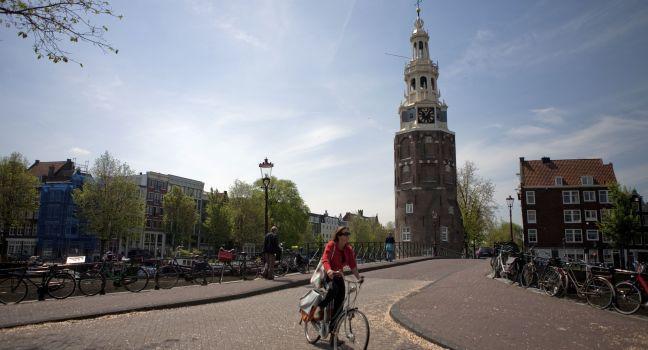
Rembrandt loved to sketch this slightly leaning redbrick tower, which was built in 1516 as part of the city's defenses. In 1606, the Dutch sculptor and architect Hendrick de Keyser oversaw the addition of an octagonal brick superstructure and spire complete with clockworks that was known as Malle Jaap (Crazy Jaap) by locals because the bells pealed at odd times. The year 1610 saw the tower embark on a lean too far, and with lots of manpower and ropes it was reset on a stronger foundation. From 1878 to 2006, it housed the City Water Office. Today it's the office of a company that rents out classic saloon boats (captain included).

Recommended Fodor's Video

Beurs van Berlage

Medieval Center

The old stock-exchange building is revered as Amsterdam's first modern building and the country's most important piece of 20th-century architecture. Built between 1898 and 1903 by H. P. Berlage, its design became a template for the style of a new century. The new Beurs, with its simple lines and the influence it had on the Amsterdam School architects who followed Berlage, earned him the reputation of being the "Father of Modern Dutch Architecture."

A staunch socialist, Berlage designed the building as a "public palace," a function it truly fulfills today with room for conferences, collaborative workspaces, exhibitions, and events. Or just stop by Bistro Berlage for coffee, lunch, or dinner. There was a major redesign of this former Grand Café in 2017, but you can still admire the stunning symbolist mosaics by Jan Toorop inside. Weather permitting, the new Beursplein terrace is a pleasant place to watch the world go by.

De Waag

Nieuwmarkt

Built in 1488, the Waag functioned as a city gate, Sint Antoniespoort, until 1617. It would be closed at exactly 9:30 pm to keep out not only bandits but also the poor and diseased who squatted outside the city's walls. When Amsterdam expanded, the structure began a second life as a weigh house for incoming goods. The top floor of the building accommodated the municipal militia and several guilds, including the stonemasons, who did the evocative decorations that grace each of the seven towers' entrances. One tower housed a teaching hospital for the Surgeons' Guild. The Theatrum Anatomicum (Anatomy Theater), with its cupola tower covered in painted coats of arms, was the first place in the Netherlands to host public autopsies; for obvious reasons, these took place only in the winter. The building is now occupied by Restaurant-Café In De Waag and the Waag Society (Institute for Art, Science, and Technology).

Nieuwmarkt 4, Amsterdam, 1012 CR, Netherlands
020-422–7772-Restaurant-Café In De Waag
Sight Details
Free

Something incorrect in this review?

Haarlemmerpoort

This Neoclassical ceremonial gateway was built in 1840 as an excise post to replace one of the former city gates, which had to be demolished. It has been variously used as a police station, fire station, and public works office; in 1986 it was restored and converted into apartments. It's a useful landmark to find your way to the Westerpark.

Haarlemmerplein 50, 1013 KH, Netherlands

Something incorrect in this review?

Munttoren

This tower received its current name in 1672, when French troops occupied much of the surrounding republic, and Amsterdam was given the right to mint its own coins here for a brief one-year period. The spire was added by Hendrick de Keyser in 1620, and the weather vane on top in the shape of a gilded ox is a reference to the calves market close by: Kalverstraat. The guardhouse, which now houses a rather touristy Dutch porcelain shop, has a gable stone above its entrance that portrays two men and a dog in a boat. This is a symbolic representation of the city, in which warrior and merchant are bound together by loyalty—that would be the dog—and sailing toward the future.

Muntplein, 1012 WR, Netherlands
Sight Details
Free

Something incorrect in this review?

Scheepvaarthuis

With its extravagantly phantasmagoric lead-roof detail spilling over various sculpted sea horses, boat anchors, sea gods (Neptune and his four wives), dolphins, and even shoals of fish, this is one of Amsterdam's most delightful early 20th-century structures. Built in the 1910s with a suitably prow-shape front, it was used as the headquarters for the major shipping firms operating in Java and the Spice Islands during the final Dutch colonial years. Today it's the five-star Grand Hotel Amrâth Amsterdam. Twentieth-century master architects Piet Kramer, Johan van der Mey, and Michel de Klerk all contributed to the design of the building; their structure was one of the opening salvos by the fantastic Amsterdam School. After you admire all the ornamentation on the facade, amble around the sides to take in the busts of noted explorers, such as Barentsz and Mercator, along with patterned brickwork and strutting iron tracery. Wander inside to check out the design of the Seven Seas restaurant and have a drink at the classically restored bar. You can book a private tour of the building and its lavish interiors (Sunday at 11:30, in combination with lunch, via Museum Het Schip  www.hetschip.com).

Schreierstoren

Red Light District

Amsterdam's only surviving defense tower began life around 1487 as the end point of the city wall. The term schreier suggests the Dutch word for wailing and as lore would have it, the "Weeping Tower" was where women came to cry when their sailor husbands left for sea and to cry again when they did not return (there's a commemorative stone from 1569 of a woman and a boat on the Gelderskade side). However, the word schreier actually comes from an Old Dutch term for "sharp," and because the old city wall made a sharp corner here, this is a more accurate derivation for the tower's name. It's also famous as the point from which Henry Hudson set sail to America. A plaque on the building tells you that he sailed on behalf of the Dutch East India Company to find a shorter route to the East Indies. In his failure, he came across Canada's Hudson Bay and later—continuing his unlucky streak—the New York harbor and the Hudson River. He eventually landed at what is now Manhattan and named it New Amsterdam. The attached Café de Schreierstoren has a lovely view and serves apple pie, pancakes, veal croquettes, jenever, and other local delights. 

Prins Hendrikkade 94–95, Amsterdam, 1012 AE, Netherlands
020-428–8291-Cafe de Schreierstoren
Sight Details
Free

Something incorrect in this review?

Trippenhuis

Nieuwmarkt

As family home to the two Trip brothers, who made their fortune in the arms trade during the 17th-century Golden Age, this noted house's buckshot-gray exterior and various armament motifs—including mortar-shape chimneys—designed by Justus Vingboons, are easily explained. But the Corinthian-columned facade actually covers two symmetrical buildings (the dividing wall is positioned behind the middle windows), one for each brother, making it the widest residence (at 72 feet) in Amsterdam. From 1817 to 1885 it housed the national museum or Rijksmuseum and is now the home of the Royal Netherlands Academy of Arts and Sciences. Be sure to look across the canal to No. 26, the white building topped with golden sphinxes and dated 1696, which is known as the "Little Trip House." The story goes that Mr. Trip's coachman remarked that he would be happy with a house as wide as the Trippenhuis door. By way of response, Mr. Trip is alleged to have built just that with the leftover bricks. In reality, the domicile was constructed six decades after the Trip mansion, after both of the brothers had already died, possibly as a way to squeeze a house into an existing alleyway. There are a few other very narrow houses in Amsterdam, too: the narrowest rear gable is at Singel 7 at only 3 feet wide, and the building on Oude Hoogstraat 22 is only 7 feet wide and 19 feet deep.

Kloveniersburgwal 29, Amsterdam, 1011 JV, Netherlands
020-551–0700

Something incorrect in this review?

West-Indisch Huis

The former headquarters of the Dutch West India Company (WIC) has major historical significance. Although not as sovereign as the Dutch East India Company, it was essentially given free rein to trade on Africa's west coast, the Americas, and all the islands of the West Pacific and New Guinea. The WIC also oversaw the infamous export of 275,000 slaves from West Africa to the Caribbean in the 17th century. In these rooms, the decision was made to buy Manhattan for the equivalent of 60 guilders. The building is now largely used as an events space; but there's also a wonderful wine bar, and you can visit the courtyard to see the statue of Peter Stuyvesant, the last Dutch director-general of Nieuw-Nederland---today better known as New York City.

Herenmarkt 99, 1013 EC, Netherlands
020-625–7528

Something incorrect in this review?