


Celebrating España: Mai Tai Tom’s Still “Insane For Spain”
 Nov 13th, 2025 | 07:45 AM
#1
Original Poster

Joined: Mar 2003
Posts: 10,641
Likes: 21
Celebrating España: Mai Tai Tom’s Still “Insane For Spain”
The only hard part about going to Spain is leaving Spain. I think of all the places we’ve traveled at home or abroad, the vibe of Spain is unequaled. Our two weeks included six nights in Madrid, where we visited some old favorites, but also checked out a lot of spots we didn’t have time to see ten years ago. Tracy and I rented a car to visit two cities located along the Camino de Santiago, Burgos and León, and finished our trip in Segovia. Although we didn’t hike the Camino, we did manage to put in about 75 miles of walking during our two weeks, witnessing beautiful sights, scoping out the tapas scene and partaking in a couple of huge city “celebrations,” one of them being on our first night shortly after arriving in Madrid. What a way to start the trip! Come see why we are both still “Insane for Spain.” Chapter One with photos in link below ... You know the rest
https://travelswithmaitaitom.com/cha...n-coming-soon/

 It had been ten years since Tracy and I went “insane for Spain,” so in October, we decided to revisit an old favorite (Madrid), and rent a car to travel to a few Spanish towns not on our radar in 2015. Our usual traveling companions, Kim and Mary, decided to sit this one out after discovering the shocking number of cathedrals, churches, palaces and museums I had added to our already packed itinerary. Our previous dozen or so trips (291 days traveling together) had seemingly taken its toll on them.
After nearly a week exploring Spain’s capital city and its environs, Tracy and I sped off in our sleek, black Mercedes, which would provide us with yet another tale in our never-ending list of rental car fiascos. Our first destination, Burgos, is a major stopping point for those who hike the Camino de Santiago de Compostela, complete with its majestic World Heritage Site cathedral.
Then we would eventually (rental car foreshadowing alert) head off to León, also located along the Camino, where our tapas consumption would ramp up in the Barrio Húmedo.
Finally, we’d loop back to Segovia and its spectacular first century aqueduct.
Along our journey, we would join in a couple of unexpected massive celebrations, one on our first night in Madrid and one in Burgos. We’d also partake in a few side trips to some spectacular palaces located outside Madrid and Segovia.
Although we didn’t hike the Camino, our nearly 75 miles of walking during the two weeks was more than sufficient exercise for my perplexed legs and feet, “Who has hijacked this body?” they wondered.
Everywhere we went the people were friendly and generous with no signs of tourist fatigue. As a matter of fact, we encountered very few Americans on the trip, especially in the cities not named Madrid. So now it’s time to Celebrate España, because MaiTaiTom’s Still Insane For Spain!
Chapter One: Viva Madrid!
Day One: Diverticulitis To Plantar Fasciitis, A Wonderful Home In Madrid, Viva Vermut, On Top Of Madrid, Party Like Its 1492, Tactical Error, Times Square: Madrid Style and Take The Long Way Home
For some unknown reason, it seems before almost every trip I come down with one crazy malady after another. From an infected toe to a suddenly wonky knee to Covid to a scary fall, my pre-flight checklist has not always been stellar. This one would up the ante.
A few weeks before leaving, I awakened with an excruciating shooting pain in my stomach and was told by my doctor to immediately head to my local hospital’s ER that I am still surprised to this day isn’t named after me. Diagnosis: Acute Diverticulitis. I was told that this could take weeks or even months to correct itself, which didn’t bode well for my planned vacation diet of tapas, meat, wine, beer, GinTonics and even more tapas. For the next week, my diet was blander than a Hallmark romantic Christmas movie, but six days before leaving I was back to a regular diet with no side effects. “Boy did I dodge a bullet,” I thought.
Sadly, one more bullet remained in the chamber. Four days before leaving, I got out of bed, took one step and it felt like someone had stabbed me in the heel. This time I immediately knew what it was, because 15 years before I had been diagnosed with plantar fasciitis. On that occasion, it took more than a month for my heel to heal.
Not remembering exactly what I should or shouldn’t do, I had a consult with my computer physician, Dr. AI Overview. One line stood out like a sore foot, “Pain Worsens With Activity.” However, it seemed the more I walked on it, the less pain I felt. Sure enough, when I mentioned this to one of the PT experts where I work out, she concurred that walking can make your foot feel better. By the morning of our trip, the pain was manageable, and although the cobblestone streets of Spain did cause some discomfort at times, fortunately it didn’t preclude us from doing anything.
A late Saturday afternoon nonstop flight from LAX to Madrid was in our plans, and as she likes to do, Tracy took a photo of a relaxed (aka: hadn’t walked 75 miles yet) Tom.
Tracy, on the other hand, once again faced issues. Even though Tracy has TSA Pre-check, Global Entry and a redress number (another of her posts), she was not allowed in the TSA pre-check-line, so it off to the longer line that fortunately wasn’t too bad on this Saturday afternoon.
Tracy inquired of the TSA Agent why she had no pre-check, and the agent merely said, “You must be lucky.” Knowing the agent wasn’t getting paid due to the government shutdown, our minor inconvenience seemed even more minor.
The flight on Iberia was, to be kind, not great. Somehow, airline food gets progressively worse on every trip, as does the entertainment selection and my seat was more uncomfortable than usual. All of this I can deal with because an 11-hour flight is almost never a totally pleasant experience anyway. What made this flight so bad was that about 2/3 of the way through the flight, as I entered what could be the smallest airplane bathroom on the planet, the floor was full of, well, you know what, and the sink was totally backed up. I yearned for those Air New Zealand flights where the bathrooms were cleaned often during flight. We endured, and landed on time in Madrid on a warm Sunday afternoon.
We were expecting delays going through passport control, because October 12 was the first day many EU airports were to roll out the new Entry Exit System (EES). (Tracy wrote a helpful post explaining the changes taking place in Europe.)
No such delays happened because the system had not yet been implemented in Madrid, so we were through passport control in no time.
We grabbed an official taxi (€33 flat fee from the airport to Madrid city center), and it navigated the narrow streets of Barrio de las Letras (Literary Quarter) until it arrived at our hotel for the next six nights, the marvelous Room Mate Collection Alba (C. de las Huertas, 16).
We had reserved the Deluxe Suite, and it was one of the best rooms we’ve had on any trip. Quiet, good location, a large, comfortable bed, a sitting room and a bathroom that was larger than my first apartment all made for a very delightful stay. Add a friendly and helpful front desk, along with our favorite hotel bartender (more on Sebastian later), there wasn’t more we could ask for.
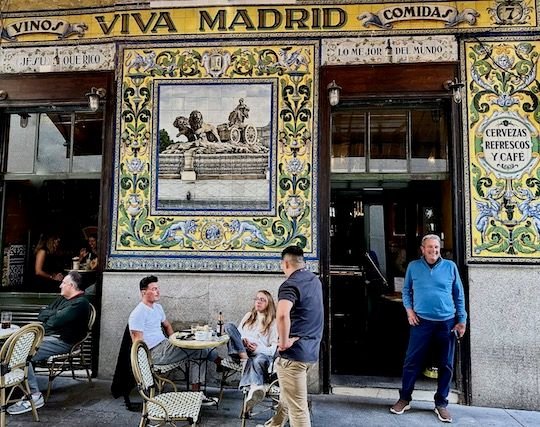
It was 5 o’clock somewhere, and that somewhere happened to be at Viva Madrid, a tavern founded in 1856 that I had read about prior to leaving for Madrid.
Only a few minutes walk from our hotel, we entered the downstairs tavern area. I told my friend Jeff that I would toast him with a vermut (Spanish vermouth) as soon as we reached Spain, and this is the place I chose. Legend has it that Viva Madrid is one of the novel spots in the Literary Quarter where Ernest Hemingway hung out. Today, it would be a place for The Old Man and The Vermut.
Our bartender told us that Viva Madrid has their own special vermut blend, and he poured a glass from the cool looking bar top vermut dispenser.
Tracy, who started with a GinTonic with a cucumber (she’s a healthy drinker), and I toasted our good fortune.
After imbibing, we took a quick look at the cocktail bar upstairs, and then descended the steep stairs carefully.
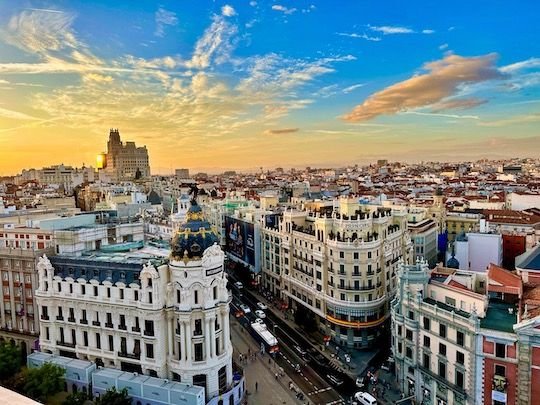
Sufficiently lubricated for our next destination, the rooftop bar atop the Círculo de Bellas Artes beckoned. Situated at the intersection of Calle de Alcalá and Gran Vía, its rooftop commands spectacular Madrid views complete with food and beverage. We had purchased online tickets (€6 … or €5 for well seasoned travelers) for admittance anytime between 4 pm and 9 pm. (Photo below of Circulo de Bellas Artes is from a few nights later).
Once up top, we realized the reviews were correct.
There were commanding views of Madrid from various vantage points, including this one of the Palacio de Cibeles, a place that would play an integral part of our evening a couple of hours later.
We wangled ourselves a table near the huge bronze Estatua de Minerva, who was the Roman goddess of wisdom, the arts and warfare.
Chatting with a nice couple from the Bay Area, we enjoyed vino, patatas bravas and a delicious hummus topped with pomegranate seeds. I was already in EuroTom mode.
It was nearing 7:30 when we got booted from our seats (somebody had the gall to have a reservation at our table). Not to worry, the views were even more spectacular with a setting sun and another glass of wine.
Looking out toward the Gran Via, the view of the iconic 1911 French Beaux-Arts style Edificio Metropolis stood out with its Victoria Alada (Winged Victory) statue straddling the top. The original Winged Victory was removed in 1972, and replaced with this one in 1977.
A little before 8 pm, we left the rooftop, ostensibly planning on making the short walk back to Room Mate Alba for a well-deserved long sleep (we had been awake for over 29 hours by this point). However, while on the elevator, we learned there would be a fireworks display at 9 pm.
Back on the street we took a closer look at the Edificio Metropolis as the evening slipped into darkness and noted the street being cordoned off.
We also saw a crowd of people heading for the now colorfully lit Palacio de Cibeles. Tracy spied the sign for Fiesta Nacional de España along with today’s date. As we’d find out, Spanish National Day (also called Día de la Hispanidad), is a day to "remember the different moments of collective history that are part of Spain’s common historical, cultural and social heritage.” It also commemorates Christopher Columbus “discovering the Americas,” which can be argued at another time.
In our first “near-divorce moment” of the trip (perhaps a new record), I mentioned to the now quite weary and sleepy Tracy that it might be fun to walk down to the Palacio to see what this event entails.
We neared the famed Fuente de Cibeles awash with colorful lights.
The fountain was built in the 1780s and features Roman goddess Cibele (earth, agriculture and fertility) in her chariot led by a couple of lions.
There is a replica of this fountain in Mexico City that we saw on our 2023 trip.
It was at this point (about 8:30 pm), that I made a serious tactical and marital mistake. I cajoled my bleary-eyed spouse, “Since it is only a half hour until the fireworks and we have a primo spot, let’s stay.” Reluctantly, she consented (at least I think so, she may have dozed off when I asked). As we chatted, perhaps because we had been awake for going on 30 hours, we really didn’t notice that the crowd gathering behind us had grown to Times Square on New Years Eve size.
It’s when I took the below photo a little before 9 pm that we came to the stark realization that we might not be able to get back to our hotel any time soon. At 9:05 pm, no fireworks were popping, so I asked the guy next to me the question I should have asked about an hour ago, “Do the fireworks start at 9?” The answer was “No, they start at 9:30.” Oops.
Fireworks would be cool, but getting back to the hotel before Tracy passed out seemed much more prudent, however the streets were jammed. Luckily, one street headed toward the Prado and Parque del Retiro seemed to be relatively pedestrian free, probably because it was shaded by trees that would block views of the fireworks. We worked our way through the throngs to freedom.
Along the route we enjoyed another of Madrid’s fabulous fountains. The 18th century Fuente de Neptuno which was, along with Fuente de Cibeles, commissioned by King Charles III in an attempt to help modernize Madrid.
I think this is the Plus Ultra building that has a Goyesque carillon featuring five animated figures who do their carillon thing a few times a day.
Finally, we came upon Congreso de los Diputados, a former convent destroyed by fire and rebuilt in the early 1850s. It’s supposed to be beautiful inside, and there are tours available on certain days.
We did make it back to our hotel by 10 pm, and, thanks to that comfy bed, we were asleep before Tracy could say, “Tom, you idiot!”
That sleep would be crucial, because our first full day in Madrid would be a regal … and long … one. On the agenda was El Palacio Real de Madrid, the extraordinarily marvelous Galería de las Colecciones Reales, Catedral de Santa María la Real de la Almudena, along with a couple of quick stops at a few of Madrid’s famous plazas. For lunch, we’d go the tapas route at a place that’s been around since 1909, while for dinner we would meet a woman who has been instrumental in planning both my Spain and Portugal trips.
Chapter Two - A Day Fit For A King & Queen
Day Two: Clean Sweep, Touring The Largest Palace In Western Europe, Saving The Best For Last, A Royal Surprise, My First Bosch Sighting, Let The Tapas Begin, A Not-So-Old Royal Cathedral, A Visit To The Oriente, An Old Fashioned Love Song, Meeting Maribel and “Meating” Dinner
https://travelswithmaitaitom.com/cha...n-coming-soon/
After nearly a week exploring Spain’s capital city and its environs, Tracy and I sped off in our sleek, black Mercedes, which would provide us with yet another tale in our never-ending list of rental car fiascos. Our first destination, Burgos, is a major stopping point for those who hike the Camino de Santiago de Compostela, complete with its majestic World Heritage Site cathedral.
Then we would eventually (rental car foreshadowing alert) head off to León, also located along the Camino, where our tapas consumption would ramp up in the Barrio Húmedo.
Finally, we’d loop back to Segovia and its spectacular first century aqueduct.
Along our journey, we would join in a couple of unexpected massive celebrations, one on our first night in Madrid and one in Burgos. We’d also partake in a few side trips to some spectacular palaces located outside Madrid and Segovia.
Although we didn’t hike the Camino, our nearly 75 miles of walking during the two weeks was more than sufficient exercise for my perplexed legs and feet, “Who has hijacked this body?” they wondered.
Everywhere we went the people were friendly and generous with no signs of tourist fatigue. As a matter of fact, we encountered very few Americans on the trip, especially in the cities not named Madrid. So now it’s time to Celebrate España, because MaiTaiTom’s Still Insane For Spain!
Chapter One: Viva Madrid!
Day One: Diverticulitis To Plantar Fasciitis, A Wonderful Home In Madrid, Viva Vermut, On Top Of Madrid, Party Like Its 1492, Tactical Error, Times Square: Madrid Style and Take The Long Way Home
For some unknown reason, it seems before almost every trip I come down with one crazy malady after another. From an infected toe to a suddenly wonky knee to Covid to a scary fall, my pre-flight checklist has not always been stellar. This one would up the ante.
A few weeks before leaving, I awakened with an excruciating shooting pain in my stomach and was told by my doctor to immediately head to my local hospital’s ER that I am still surprised to this day isn’t named after me. Diagnosis: Acute Diverticulitis. I was told that this could take weeks or even months to correct itself, which didn’t bode well for my planned vacation diet of tapas, meat, wine, beer, GinTonics and even more tapas. For the next week, my diet was blander than a Hallmark romantic Christmas movie, but six days before leaving I was back to a regular diet with no side effects. “Boy did I dodge a bullet,” I thought.
Sadly, one more bullet remained in the chamber. Four days before leaving, I got out of bed, took one step and it felt like someone had stabbed me in the heel. This time I immediately knew what it was, because 15 years before I had been diagnosed with plantar fasciitis. On that occasion, it took more than a month for my heel to heal.
Not remembering exactly what I should or shouldn’t do, I had a consult with my computer physician, Dr. AI Overview. One line stood out like a sore foot, “Pain Worsens With Activity.” However, it seemed the more I walked on it, the less pain I felt. Sure enough, when I mentioned this to one of the PT experts where I work out, she concurred that walking can make your foot feel better. By the morning of our trip, the pain was manageable, and although the cobblestone streets of Spain did cause some discomfort at times, fortunately it didn’t preclude us from doing anything.
A late Saturday afternoon nonstop flight from LAX to Madrid was in our plans, and as she likes to do, Tracy took a photo of a relaxed (aka: hadn’t walked 75 miles yet) Tom.
Tracy, on the other hand, once again faced issues. Even though Tracy has TSA Pre-check, Global Entry and a redress number (another of her posts), she was not allowed in the TSA pre-check-line, so it off to the longer line that fortunately wasn’t too bad on this Saturday afternoon.
Tracy inquired of the TSA Agent why she had no pre-check, and the agent merely said, “You must be lucky.” Knowing the agent wasn’t getting paid due to the government shutdown, our minor inconvenience seemed even more minor.
The flight on Iberia was, to be kind, not great. Somehow, airline food gets progressively worse on every trip, as does the entertainment selection and my seat was more uncomfortable than usual. All of this I can deal with because an 11-hour flight is almost never a totally pleasant experience anyway. What made this flight so bad was that about 2/3 of the way through the flight, as I entered what could be the smallest airplane bathroom on the planet, the floor was full of, well, you know what, and the sink was totally backed up. I yearned for those Air New Zealand flights where the bathrooms were cleaned often during flight. We endured, and landed on time in Madrid on a warm Sunday afternoon.
We were expecting delays going through passport control, because October 12 was the first day many EU airports were to roll out the new Entry Exit System (EES). (Tracy wrote a helpful post explaining the changes taking place in Europe.)
No such delays happened because the system had not yet been implemented in Madrid, so we were through passport control in no time.
We grabbed an official taxi (€33 flat fee from the airport to Madrid city center), and it navigated the narrow streets of Barrio de las Letras (Literary Quarter) until it arrived at our hotel for the next six nights, the marvelous Room Mate Collection Alba (C. de las Huertas, 16).
We had reserved the Deluxe Suite, and it was one of the best rooms we’ve had on any trip. Quiet, good location, a large, comfortable bed, a sitting room and a bathroom that was larger than my first apartment all made for a very delightful stay. Add a friendly and helpful front desk, along with our favorite hotel bartender (more on Sebastian later), there wasn’t more we could ask for.
It was 5 o’clock somewhere, and that somewhere happened to be at Viva Madrid, a tavern founded in 1856 that I had read about prior to leaving for Madrid.
Only a few minutes walk from our hotel, we entered the downstairs tavern area. I told my friend Jeff that I would toast him with a vermut (Spanish vermouth) as soon as we reached Spain, and this is the place I chose. Legend has it that Viva Madrid is one of the novel spots in the Literary Quarter where Ernest Hemingway hung out. Today, it would be a place for The Old Man and The Vermut.
Our bartender told us that Viva Madrid has their own special vermut blend, and he poured a glass from the cool looking bar top vermut dispenser.
Tracy, who started with a GinTonic with a cucumber (she’s a healthy drinker), and I toasted our good fortune.
After imbibing, we took a quick look at the cocktail bar upstairs, and then descended the steep stairs carefully.
Sufficiently lubricated for our next destination, the rooftop bar atop the Círculo de Bellas Artes beckoned. Situated at the intersection of Calle de Alcalá and Gran Vía, its rooftop commands spectacular Madrid views complete with food and beverage. We had purchased online tickets (€6 … or €5 for well seasoned travelers) for admittance anytime between 4 pm and 9 pm. (Photo below of Circulo de Bellas Artes is from a few nights later).
Once up top, we realized the reviews were correct.
There were commanding views of Madrid from various vantage points, including this one of the Palacio de Cibeles, a place that would play an integral part of our evening a couple of hours later.
We wangled ourselves a table near the huge bronze Estatua de Minerva, who was the Roman goddess of wisdom, the arts and warfare.
Chatting with a nice couple from the Bay Area, we enjoyed vino, patatas bravas and a delicious hummus topped with pomegranate seeds. I was already in EuroTom mode.
It was nearing 7:30 when we got booted from our seats (somebody had the gall to have a reservation at our table). Not to worry, the views were even more spectacular with a setting sun and another glass of wine.
Looking out toward the Gran Via, the view of the iconic 1911 French Beaux-Arts style Edificio Metropolis stood out with its Victoria Alada (Winged Victory) statue straddling the top. The original Winged Victory was removed in 1972, and replaced with this one in 1977.
A little before 8 pm, we left the rooftop, ostensibly planning on making the short walk back to Room Mate Alba for a well-deserved long sleep (we had been awake for over 29 hours by this point). However, while on the elevator, we learned there would be a fireworks display at 9 pm.
Back on the street we took a closer look at the Edificio Metropolis as the evening slipped into darkness and noted the street being cordoned off.
We also saw a crowd of people heading for the now colorfully lit Palacio de Cibeles. Tracy spied the sign for Fiesta Nacional de España along with today’s date. As we’d find out, Spanish National Day (also called Día de la Hispanidad), is a day to "remember the different moments of collective history that are part of Spain’s common historical, cultural and social heritage.” It also commemorates Christopher Columbus “discovering the Americas,” which can be argued at another time.
In our first “near-divorce moment” of the trip (perhaps a new record), I mentioned to the now quite weary and sleepy Tracy that it might be fun to walk down to the Palacio to see what this event entails.
We neared the famed Fuente de Cibeles awash with colorful lights.
The fountain was built in the 1780s and features Roman goddess Cibele (earth, agriculture and fertility) in her chariot led by a couple of lions.
There is a replica of this fountain in Mexico City that we saw on our 2023 trip.
It was at this point (about 8:30 pm), that I made a serious tactical and marital mistake. I cajoled my bleary-eyed spouse, “Since it is only a half hour until the fireworks and we have a primo spot, let’s stay.” Reluctantly, she consented (at least I think so, she may have dozed off when I asked). As we chatted, perhaps because we had been awake for going on 30 hours, we really didn’t notice that the crowd gathering behind us had grown to Times Square on New Years Eve size.
It’s when I took the below photo a little before 9 pm that we came to the stark realization that we might not be able to get back to our hotel any time soon. At 9:05 pm, no fireworks were popping, so I asked the guy next to me the question I should have asked about an hour ago, “Do the fireworks start at 9?” The answer was “No, they start at 9:30.” Oops.
Fireworks would be cool, but getting back to the hotel before Tracy passed out seemed much more prudent, however the streets were jammed. Luckily, one street headed toward the Prado and Parque del Retiro seemed to be relatively pedestrian free, probably because it was shaded by trees that would block views of the fireworks. We worked our way through the throngs to freedom.
Along the route we enjoyed another of Madrid’s fabulous fountains. The 18th century Fuente de Neptuno which was, along with Fuente de Cibeles, commissioned by King Charles III in an attempt to help modernize Madrid.
I think this is the Plus Ultra building that has a Goyesque carillon featuring five animated figures who do their carillon thing a few times a day.
Finally, we came upon Congreso de los Diputados, a former convent destroyed by fire and rebuilt in the early 1850s. It’s supposed to be beautiful inside, and there are tours available on certain days.
We did make it back to our hotel by 10 pm, and, thanks to that comfy bed, we were asleep before Tracy could say, “Tom, you idiot!”
That sleep would be crucial, because our first full day in Madrid would be a regal … and long … one. On the agenda was El Palacio Real de Madrid, the extraordinarily marvelous Galería de las Colecciones Reales, Catedral de Santa María la Real de la Almudena, along with a couple of quick stops at a few of Madrid’s famous plazas. For lunch, we’d go the tapas route at a place that’s been around since 1909, while for dinner we would meet a woman who has been instrumental in planning both my Spain and Portugal trips.
Chapter Two - A Day Fit For A King & Queen
Day Two: Clean Sweep, Touring The Largest Palace In Western Europe, Saving The Best For Last, A Royal Surprise, My First Bosch Sighting, Let The Tapas Begin, A Not-So-Old Royal Cathedral, A Visit To The Oriente, An Old Fashioned Love Song, Meeting Maribel and “Meating” Dinner


Trending Topics
Nov 18th, 2025 | 03:37 PM
#12

Joined: Mar 2003
Posts: 6,222
Likes: 0
I am looking forward to more, too!!! Love your report and your photos! Those illuminated buildings are gorgeous! I really, really like Madrid. We spent 4 nights there in 2017, and I would love to return. Don't know if we will because my husband doesn't love Madrid. It's not a city he would return to. Unless I included it with some new destinations in Spain. That's a thought.
Looking forward to "meeting" Maribel.
Looking forward to "meeting" Maribel.
Nov 25th, 2025 | 08:37 AM
#14
Original Poster
Joined: Mar 2003
Posts: 10,641
Likes: 21
Finally, our first full day in Madrid, and it was non-stop walking (except for a quick lunch) for seven hours. First up The Royal Palace (El Palacio Real de Madrid) where you can now take photos, then we visited Madrid’s relatively new museum, the wonderful Galería de las Colecciones Reales, and to complete our royal trifecta, Catedral de Santa María la Real de la Almudena and its incredibly colorful ceilings. For lunch, we’d go the tapas route at a place that’s been around since 1909 and also hit one of Madrid’s famous plazas. For dinner. we would meet the woman who has been instrumental in my planning for both my Spain and Portugal trips ... you know her as the marvelous Maribel. Story with photos in link below.
https://travelswithmaitaitom.com/cha...-a-king-queen/


Chapter Two - A Day Fit For A King & Queen
Day Two: Clean Sweep, Touring The Largest Palace In Western Europe, Saving The Best For Last, A Royal Surprise, Things Are Looking Up, My First Bosch Sighting, Let The Tapas Begin, A Not-So-Old Royal Cathedral, A Visit To The Oriente, An Old Fashioned Love Song, Meeting Maribel and “Meating” Dinner
A good night’s sleep helped us adapt quickly with no jetlag, and on a Monday morning we would take the nearly 20-minute walk from Room Mate Alba to El Palacio Real de Madrid, our first of three royal sites we would visit on this day.
Not far from our hotel, I spotted an old friend with a push broom we met back in 2015, who was still “working” at the Plaza de Jacinto Benavente. Monumento Al Barrendero Madrileño, a sculpture dedicated to Madrid’s street sweepers that has been located here for nearly 25 years.
We decided to take a slight detour through the Plaza Mayor and take a photo of the 16th century equestrian statue of Philip III, which has been located in Plaza Mayor since 1848.
At Plaza de Ramales we checked out the 100+-year old Casa-palacio de Ricardo Augustín. We learned the memorial on the square is for famed Spanish painter Don Diego Velázquez, who was buried in the San Juan Batista church crypt in the 1600s. The church was taken down in the early 1800s, leaving Velázquez and his wife buried under the square.
We had 10 a.m. timed entrance tickets for the Royal Palace, which sits on the site of an old Alcazár that burned to the ground on Christmas Eve in 1734. The first stone of this palace was laid a few years later. We had purchased tickets online a few weeks before our trip.
Across the courtyard stands Catedral de Santa María la Real de la Almudena, where we would visit later in the day.
When we visited in 2015, the palace rules were stricter with guided tours only and no photos allowed. On that tour, both Kim and I were stampeded by two different tour groups, one nearly pushing me into a priceless vase. When I read photos were now allowed and you could take an audio guide to tour at your own pace, I jumped at the opportunity to see the palace again.
I highly recommend purchasing tickets before arrival, as you may get shut out, or have to wait in the very long ticket line.
After a statue of Carlos III at the grand entrance …
We ascended the Main Staircase made entirely of Carrara marble, where we were greeted by a statue of Carlos IV attired in a Roman toga. I decided it was too early for Animal House jokes.
The ceiling fresco at the top of the staircase is called The Triumph of Religion and the Church.
The palace contains more than 3,000 rooms, and although the royal family doesn’t live here, it is used for state ceremonies (one had been held the previous day for Fiesta Nacional de España). Obviously our invitation had been lost in the mail.
Fortunately, not all of the 3,000+ rooms are available for touring, so here is a smattering of the ones we did see. Not only is the palace the largest in Europe, it ranks as one of the biggest in the entire world.
The Hall of Columns formerly known as the Banqueting Room, hosted a number of state ceremonies. I asked Tracy if we needed an Excel spreadsheet to add up all the columns, and she quickly exited to the next room. It is actually called that because of their beautiful marble columns.
The first apartment was the Anteroom of King Charles III (who moved into the palace in 1764), where he would meet guests under huge French chandeliers and a frescoed ceiling.
Charles’ antechamber is decorated with Spanish silks. Goya painted the portraits on the wall, while 1773’s The Apotheosis of Hercules hovers above.
We were going to try to get ahead of the crowd, however the beauty of the Gasparini Room (named after the person who designed it) stopped us in our tracks. The audio guide related that after the Throne Room, this room where monarch’s held private audiences, was the next most important room. So complex to design, Charles didn’t live long enough to see this room completed.
He just ran out of time.
Now one step ahead of the crowd, we paused to view The Yellow Room (self-explanatory) and the Porcelain Room, whose walls and ceiling are covered with porcelain panels.
We were now in part of the Queen’s apartments. The Banqueting Hall was finished in 1879.
I wonder if they’d let us borrow this for Thanksgiving.
Next stop was the Royal Chapel, completed in 1757. I had my first St. Michael sighting on the high altar, which has been here since the late 18th century.
The ceiling frescoes date back to the mid 1750s. It had more golden arches than McDonald’s.
We visited the anteroom of Queen María Cristina, which contained a number of musical instruments.
We pulled a view strings and viewed several instruments of Antonio Stradivari
The Crown Room includes the crown (of course) of Charles III and his sceptre, along with his original throne.
Right on cue, we saw the Billiards Room. When I tried that line on Tracy, all she could say was, “Give me a break.”
The Smoking Room of Alfonso XIII was full of embroidered panels made in China in the 19th century.
I did not know what a Camón was until I saw the sign that it’s an enclosed balcony with a view.
There were still a few more rooms left to go.
Entering the Official Antechamber, our eyes were immediately drawn to the ceiling and its fresco, The Conquest of the Golden Fleece. Maybe that’s because Jason and the Argonauts was one of my favorite movies as a kid.
There are also court portraits hanging in this room.
Lots of anterooms in the palace, but according to the sign this was the “Official” one. The tapestries depict scenes from Flemish life.
We were finally in the room where it happens … Salón del Trono (aka The Throne Room). It’s so important that it has three names (also the Hall of Realms or the Hall of Ambassadors). The very large ceiling fresco from 1764 is the Triumph of the Spanish Monarchy, by Tiepolo.
Red velvet walls, lions (of the bronze variety), sculptures, candlesticks, clocks, mirrors and large chandeliers, it truly is a room fit for a king.
Those two thrones are 20th century replicas of King Charles III’s throne.
One last glimpse of Zeus riding on an eagle ready to throw that lightning bolt, and we mere mortals were done.
But not for long.
When on the Palacio Nacionale website, I had purchased a combo ticket which included not only the palace, but the recently (2023) opened Galería de las Colecciones Reales, which united more than 700 works of art spanning five centuries which had been scattered among the Spanish Crown’s numerous royal sites. Like the Carpenters, we’ve only just begun our journey through Spanish history, and it was just like yesterday once more.
It’s just a short walk from the palace to the entrance of the building, which is cool because, as we read, the structure is carved out of rock “from the Campo del Moro gardens to the Armería Square.” Although the building was completed in 2016, because there wasn’t enough money to complete the interior, it did not open until June 2023.
Down, down and down the ramps we walked to Floor -1, where we would visit the Austrias (Habsburgs) period.
Art and artifacts on this floor cover the 15th - 17th centuries. Isabella I’s (aka Isabella The Catholic Queen) portrait and a polyptych of 15 panels for her devotional use were among the first things we saw in this area.
King João III of Portugal owned the Hercules Supporting the Celestial Sphere tapestry that “commemorated the great deeds of Portuguese seafarers.”
No unicorns could be found in the tapestry Animals Entering The Ark.
Luckily for our front yard, there were two squirrels.
King Philip IV was a big patron of the arts, and this painting by El Greco was sent to El Escorial (the royal monastery near Madrid that we would visit the following day) in the mid-1600s.
What do you get when you combine two of my favorite artists, Hieronymous Bosch and Peter Bruegel? The Tribulations of Life (aka The Haywain) cartoon tapestry by Bruegel is based on The El Bosco’s paintings Garden of Earthly Delights, The Temptations of Saint Anthony, The Haywain, along with Saint Martin and theBbeggars. This is part of a 16th century tapestry series.
Joining the collection from El Escorial is the Madonna of Silence, who was not a material girl.
Charles V’s saddle and Philip III’s armor both tell pony tales to stirrup ancient memories.
Speaking of Philip III.
This “Candelabra” fountain has everything but Liberace.
A few of my favorite paintings as we wandered through the Habsburg section.
The Musical Angels tapestry based on a design (cartoon) by Peter Paul Reubens was originally created for the church of the convent of Los Descalzas Reales, which we would also visit on this trip.
In the late 1600s, Luisa Roldán also known as La Roldana, achieved acclaim that was very unusual for a woman at the time. Charles II appointed her court sculptor (first woman to do that), and her Saint Michael is one of her crowning achievements.
We checked out the Black Carriage which carried Mariana of Austria, the second wife of Philip IV (shown here in a painting by Reuben’s workshop).
More from the collection was an Equestrian Portrait of John of Austria. the head of John The Baptist and White Horse from famed Spanish artist Diego Rodríguez de Silva y Velázquez.
Finished with the Habsburg section, it was now time for some Bourbon, as in Spain's Bourbon Dynasty, which has ruled the country (for the most part) since the early 1700s. Of course, all the Bourbon pieces here are Old Fashioned.
This Equestrian painting is of Philip V, whose total reign was the longest (45+ years) in the history of the Spanish monarchy. Talk about the reign in Spain. This painting spent many years at La Granja de San Ildefonso, which we would visit as a day trip from Segovia. It shows Philip as a warrior.
Opposite Philip is Isabella Farnese, who was born in Parma, Italy, and became Queen of Spain when she married King Philip V.
A very cool tapestry on the horizon was a scene from Cervantes’ The Ingenious Gentleman Don Quixote of La Mancha, featuring Don Quixote and Sancho Panza, complete with windmills in the background.
This was offset by the Death of Absalom, who rebelled against his father King David only to have his whose hair get caught in a tree, where he was killed by three spears to the heart thrown by David’s commander. By the way, David was not happy he was killed.
Sometimes when a king took a road trip, he might want to pray. Bu what if there’s no church? Not to worry. Philip IV brought his own portable altar, which included three oil paintings. It was even used for the baptism of Infante Luis Alfonso, Prince of Bavaria, in the Gasparini Room of the Palais Royale. The late 18th century desk even had a mechanical system, which could raise the side modules. It’s good to be king!
Philip V purchased The Suicide of Lucretia from the private collection of one of Rome’s premiere artists, Carlo Maratta.
Alexander the Great and his mother were shown in these very interesting reliefs.
Although this room (like the one for the Asturias) is huge, areas are partitioned off so it feels smaller and not so overwhelming.
I had never heard of a technique called Grisaille until we visited here. We liked it, whatever it was.
The portrait of Philip The Good is from the Workshop of another of my favorites, Rogier Van Der Weyden.
One good carriage deserves another. This Carriage of the Royal Crown (no connection to the cola) was ordered by Ferdinand VII.
Charles III is the main subject of these two paintings …
… while Patron Saints of Spain, The Monarchs and Pope Pious IX round out this painting.
Finally, we admired The Allegories of Peace.
Tracy and I loved this museum. It was well thought out, and the pieces held our interest all the way through. It would be one of our favorite museums in Madrid on this trip, but not THE favorite. Hint: It was not the Prado.
We walked outside to what was now a beautiful sunny day.
We’d only grabbed a quick coffee and croissant for breakfast and were starving, so we headed to the nearby El Anciano Rey de Los Vinos, founded in 1909, for lunch (aka tapas). We took a quick look at the interior …
… before plopping down on the patio (well, we actually sat at a table).
Munching on ham croquettes and patatas bravas washed down with a little vino, while looking out at Catedral de Santa María la Real de la Almudena, and we knew it was time to hit our final big stop for the day.
In 2015, we had marveled at the church’s colorful ceilings, so returning was never in doubt. Although the plans for the cathedral were drawn up in 1879 and construction began in 1883, it was not consecrated until 1993. And it was no regular consecration. Almudena Cathedral was consecrated by Pope John Paul II, becoming the first cathedral to ever be consecrated outside of Rome.
The ornate bronze doors were sculpted at the beginning of the 21st century. You can see the relief of Pope John Paul II in the photo on right. The cathedral is the main church of the Archdiocese of Madrid.
In a little chapel as we entered we saw The Mystical Crown, the original painting of Our Lady of the Way, the Virgin of Camino.
The side chapel Chapel of Saint John Paul II contains a large rock, which serves as the altar.
Then, as Tracy’s neck not so fondly remembered, it was time to look up at the vibrant ceilings.
These were painted in the late 1990s.
Tracy took a break from looking up to walking up to the high altar, dedicated to the Virgin of Almudena (Virgen de la Almudena), who has been the patroness of Madrid since 1377. The 17th century polychromed wooden statue Virgin Mary holding baby Jesus draws quite a crowd.
The main altar showed off colorful frescoes, and even more colorful ceilings inspired by moorish designs.
Undaunted, Tracy again craned her neck to get more ceiling shots.
I finally had to pull her away before her head became permanently tilted skyward.
Back on the ground stood one of Madrid’s oldest pieces of furniture (still not older than the couch at my first apartment), and (according to many experts) it is Europe’s most important medieval artifacts. The 13th century funerary chest (ark) once held the body of Saint Isidro.
Tracy broke away from me once more, and before I could yell, “Neck brace,” she tilted her iPhone skyward to take a couple of photos of what we read was a “deep blue ceiling dotted with stars to represent a celestial vault or the heavens symbolizing a holy or heavenly place. The inner dome's ribs form a star pattern.”
One last stained glass window, and I whisked her away before we’d have to call a chiropractor.
We were going to walk around the corner to the cathedral crypt, the largest crypt in Spain, which is the final resting place for many of Spain’s noblest families, but it was closed until late afternoon.
Instead, since the day had turned so beautiful, we walked to the nearby Plaza de Oriente, which has three distinct areas, one of those being Jardines de Lepanto, with its geometric hedges. It was here we took a look at Monument to Captain Melgar, who perished during the African War in Melilla.
Plaza de Oriente displays a collection of statues of historical Spanish figures …
… including Spanish royalty.
It all centers around the central parterre, where you will find the Equestrian Statue of Philip IV.
From a stable resource, this is “the first equestrian statue in the world supported on the back legs of a horse.” It’s been riding high here since 1843.
It was now a little after three, and even I was tired. While in the neighborhood, we did see some interesting buildings, including Teatro Real, Madrid’s opera house, which opened in 1850. Guided and audio tours are available.
Nearing our hotel, we scoped out Teatro Calderón, a historic theater located in Plaza de Jacinto Benavente. I thought for a minute the building might disappear or be levitated.
Amazingly, back at the hotel, I laid my head down a little after 4 pm. and the next thing I knew it was after 6 pm. According to my late mom, I never took a nap that long after I was six months old.
We had to freshen up, because on this evening we would meet someone who has given me so many travel tips, especially concerning Spain and Portugal. But first, we stopped by the hotel bar and met Sebastián, our bartender for the next couple of nights at Room Mate Alba. Pouring one of the finest Old Fashions I’ve tasted in quite some time, I knew we would be repeat customers.
Walking to our restaurant we passed Pub El Pirita. For some reason I wondered if they had planked salmon.
The brightly lit building is the Galería Canalejas complex that we were told we could find some high end shops and a Four Seasons Hotel.
When we made this turn, for a split second I thought we might be in Amsterdam.
Shortly we arrived at our restaurant, Askuabarra (Calle Arlaban 7), where we would meet my online travel guide Maribel and her husband Philip. I told Philip I had seen his statue in the Place de Oriente, and I believe they wondered what they had gotten themselves into.
Unlike myself, Maribel is a real professional travel planner who can help prepare your travel plans. Her website (https://maribelsguides.com/ ) states “For The Sophisticated Traveler,” so we knew this might be step down in class for her this evening.
She and Philip were a delight, as was the dinner. Nobody who has dined at Askuabarra has ever asked, “Where’s the beef?” Actually, it was an all beef dinner, starting with Steak Tartare …
… and then consuming a perfectly grilled ribeye with a side of fries and piquillo peppers. A wonderful dinner with even more wonderful conversation. Maribel and Phil have led quite a life, with a lot more on the horizon.
After all that, we did leave room for a brioche French toast with ice cream for dessert.
It turned out to be a late night with all that conversing, and we did not return to our hotel until a little before midnight.
We had to be up early the following morning because we were headed out of town to visit one of Spain’s most visited sites, the Royal Site of San Lorenzo de El Escorial. Wow! Then we would head back to Madrid for lunch at an old favorite from ten years ago. Fatigue once again reared its ugly head, and for the second straight day I would take a late afternoon snooze (what is happening to me?) Invigorated, and after hanging with Sebastián, we strolled the streets of our neighborhood, learning about why it is called “The Literary Quarter” and dining at an intimate and fantastic restaurant.
Chapter Three: Royal Site of San Lorenzo de El Escorial
Day Three: Skipping The Bus, The Largest Renaissance Building In The World, Eighth Wonder Of the World, A Royal Library, Are We Already Back In Madrid, Would You Like Some Tonic In That?, A (Very) Short Walk In The Park, The Inside Scoop On Tapas, Happening ‘Hood, and The Mouthwatering Vinoteca
https://travelswithmaitaitom.com/cha...-a-king-queen/
Chapter Two - A Day Fit For A King & Queen
Day Two: Clean Sweep, Touring The Largest Palace In Western Europe, Saving The Best For Last, A Royal Surprise, Things Are Looking Up, My First Bosch Sighting, Let The Tapas Begin, A Not-So-Old Royal Cathedral, A Visit To The Oriente, An Old Fashioned Love Song, Meeting Maribel and “Meating” Dinner
A good night’s sleep helped us adapt quickly with no jetlag, and on a Monday morning we would take the nearly 20-minute walk from Room Mate Alba to El Palacio Real de Madrid, our first of three royal sites we would visit on this day.
Not far from our hotel, I spotted an old friend with a push broom we met back in 2015, who was still “working” at the Plaza de Jacinto Benavente. Monumento Al Barrendero Madrileño, a sculpture dedicated to Madrid’s street sweepers that has been located here for nearly 25 years.
We decided to take a slight detour through the Plaza Mayor and take a photo of the 16th century equestrian statue of Philip III, which has been located in Plaza Mayor since 1848.
At Plaza de Ramales we checked out the 100+-year old Casa-palacio de Ricardo Augustín. We learned the memorial on the square is for famed Spanish painter Don Diego Velázquez, who was buried in the San Juan Batista church crypt in the 1600s. The church was taken down in the early 1800s, leaving Velázquez and his wife buried under the square.
We had 10 a.m. timed entrance tickets for the Royal Palace, which sits on the site of an old Alcazár that burned to the ground on Christmas Eve in 1734. The first stone of this palace was laid a few years later. We had purchased tickets online a few weeks before our trip.
Across the courtyard stands Catedral de Santa María la Real de la Almudena, where we would visit later in the day.
When we visited in 2015, the palace rules were stricter with guided tours only and no photos allowed. On that tour, both Kim and I were stampeded by two different tour groups, one nearly pushing me into a priceless vase. When I read photos were now allowed and you could take an audio guide to tour at your own pace, I jumped at the opportunity to see the palace again.
I highly recommend purchasing tickets before arrival, as you may get shut out, or have to wait in the very long ticket line.
After a statue of Carlos III at the grand entrance …
We ascended the Main Staircase made entirely of Carrara marble, where we were greeted by a statue of Carlos IV attired in a Roman toga. I decided it was too early for Animal House jokes.
The ceiling fresco at the top of the staircase is called The Triumph of Religion and the Church.
The palace contains more than 3,000 rooms, and although the royal family doesn’t live here, it is used for state ceremonies (one had been held the previous day for Fiesta Nacional de España). Obviously our invitation had been lost in the mail.
Fortunately, not all of the 3,000+ rooms are available for touring, so here is a smattering of the ones we did see. Not only is the palace the largest in Europe, it ranks as one of the biggest in the entire world.
The Hall of Columns formerly known as the Banqueting Room, hosted a number of state ceremonies. I asked Tracy if we needed an Excel spreadsheet to add up all the columns, and she quickly exited to the next room. It is actually called that because of their beautiful marble columns.
The first apartment was the Anteroom of King Charles III (who moved into the palace in 1764), where he would meet guests under huge French chandeliers and a frescoed ceiling.
Charles’ antechamber is decorated with Spanish silks. Goya painted the portraits on the wall, while 1773’s The Apotheosis of Hercules hovers above.
We were going to try to get ahead of the crowd, however the beauty of the Gasparini Room (named after the person who designed it) stopped us in our tracks. The audio guide related that after the Throne Room, this room where monarch’s held private audiences, was the next most important room. So complex to design, Charles didn’t live long enough to see this room completed.
He just ran out of time.
Now one step ahead of the crowd, we paused to view The Yellow Room (self-explanatory) and the Porcelain Room, whose walls and ceiling are covered with porcelain panels.
We were now in part of the Queen’s apartments. The Banqueting Hall was finished in 1879.
I wonder if they’d let us borrow this for Thanksgiving.
Next stop was the Royal Chapel, completed in 1757. I had my first St. Michael sighting on the high altar, which has been here since the late 18th century.
The ceiling frescoes date back to the mid 1750s. It had more golden arches than McDonald’s.
We visited the anteroom of Queen María Cristina, which contained a number of musical instruments.
We pulled a view strings and viewed several instruments of Antonio Stradivari
The Crown Room includes the crown (of course) of Charles III and his sceptre, along with his original throne.
Right on cue, we saw the Billiards Room. When I tried that line on Tracy, all she could say was, “Give me a break.”
The Smoking Room of Alfonso XIII was full of embroidered panels made in China in the 19th century.
I did not know what a Camón was until I saw the sign that it’s an enclosed balcony with a view.
There were still a few more rooms left to go.
Entering the Official Antechamber, our eyes were immediately drawn to the ceiling and its fresco, The Conquest of the Golden Fleece. Maybe that’s because Jason and the Argonauts was one of my favorite movies as a kid.
There are also court portraits hanging in this room.
Lots of anterooms in the palace, but according to the sign this was the “Official” one. The tapestries depict scenes from Flemish life.
We were finally in the room where it happens … Salón del Trono (aka The Throne Room). It’s so important that it has three names (also the Hall of Realms or the Hall of Ambassadors). The very large ceiling fresco from 1764 is the Triumph of the Spanish Monarchy, by Tiepolo.
Red velvet walls, lions (of the bronze variety), sculptures, candlesticks, clocks, mirrors and large chandeliers, it truly is a room fit for a king.
Those two thrones are 20th century replicas of King Charles III’s throne.
One last glimpse of Zeus riding on an eagle ready to throw that lightning bolt, and we mere mortals were done.
But not for long.
When on the Palacio Nacionale website, I had purchased a combo ticket which included not only the palace, but the recently (2023) opened Galería de las Colecciones Reales, which united more than 700 works of art spanning five centuries which had been scattered among the Spanish Crown’s numerous royal sites. Like the Carpenters, we’ve only just begun our journey through Spanish history, and it was just like yesterday once more.
It’s just a short walk from the palace to the entrance of the building, which is cool because, as we read, the structure is carved out of rock “from the Campo del Moro gardens to the Armería Square.” Although the building was completed in 2016, because there wasn’t enough money to complete the interior, it did not open until June 2023.
Down, down and down the ramps we walked to Floor -1, where we would visit the Austrias (Habsburgs) period.
Art and artifacts on this floor cover the 15th - 17th centuries. Isabella I’s (aka Isabella The Catholic Queen) portrait and a polyptych of 15 panels for her devotional use were among the first things we saw in this area.
King João III of Portugal owned the Hercules Supporting the Celestial Sphere tapestry that “commemorated the great deeds of Portuguese seafarers.”
No unicorns could be found in the tapestry Animals Entering The Ark.
Luckily for our front yard, there were two squirrels.
King Philip IV was a big patron of the arts, and this painting by El Greco was sent to El Escorial (the royal monastery near Madrid that we would visit the following day) in the mid-1600s.
What do you get when you combine two of my favorite artists, Hieronymous Bosch and Peter Bruegel? The Tribulations of Life (aka The Haywain) cartoon tapestry by Bruegel is based on The El Bosco’s paintings Garden of Earthly Delights, The Temptations of Saint Anthony, The Haywain, along with Saint Martin and theBbeggars. This is part of a 16th century tapestry series.
Joining the collection from El Escorial is the Madonna of Silence, who was not a material girl.
Charles V’s saddle and Philip III’s armor both tell pony tales to stirrup ancient memories.
Speaking of Philip III.
This “Candelabra” fountain has everything but Liberace.
A few of my favorite paintings as we wandered through the Habsburg section.
The Musical Angels tapestry based on a design (cartoon) by Peter Paul Reubens was originally created for the church of the convent of Los Descalzas Reales, which we would also visit on this trip.
In the late 1600s, Luisa Roldán also known as La Roldana, achieved acclaim that was very unusual for a woman at the time. Charles II appointed her court sculptor (first woman to do that), and her Saint Michael is one of her crowning achievements.
We checked out the Black Carriage which carried Mariana of Austria, the second wife of Philip IV (shown here in a painting by Reuben’s workshop).
More from the collection was an Equestrian Portrait of John of Austria. the head of John The Baptist and White Horse from famed Spanish artist Diego Rodríguez de Silva y Velázquez.
Finished with the Habsburg section, it was now time for some Bourbon, as in Spain's Bourbon Dynasty, which has ruled the country (for the most part) since the early 1700s. Of course, all the Bourbon pieces here are Old Fashioned.
This Equestrian painting is of Philip V, whose total reign was the longest (45+ years) in the history of the Spanish monarchy. Talk about the reign in Spain. This painting spent many years at La Granja de San Ildefonso, which we would visit as a day trip from Segovia. It shows Philip as a warrior.
Opposite Philip is Isabella Farnese, who was born in Parma, Italy, and became Queen of Spain when she married King Philip V.
A very cool tapestry on the horizon was a scene from Cervantes’ The Ingenious Gentleman Don Quixote of La Mancha, featuring Don Quixote and Sancho Panza, complete with windmills in the background.
This was offset by the Death of Absalom, who rebelled against his father King David only to have his whose hair get caught in a tree, where he was killed by three spears to the heart thrown by David’s commander. By the way, David was not happy he was killed.
Sometimes when a king took a road trip, he might want to pray. Bu what if there’s no church? Not to worry. Philip IV brought his own portable altar, which included three oil paintings. It was even used for the baptism of Infante Luis Alfonso, Prince of Bavaria, in the Gasparini Room of the Palais Royale. The late 18th century desk even had a mechanical system, which could raise the side modules. It’s good to be king!
Philip V purchased The Suicide of Lucretia from the private collection of one of Rome’s premiere artists, Carlo Maratta.
Alexander the Great and his mother were shown in these very interesting reliefs.
Although this room (like the one for the Asturias) is huge, areas are partitioned off so it feels smaller and not so overwhelming.
I had never heard of a technique called Grisaille until we visited here. We liked it, whatever it was.
The portrait of Philip The Good is from the Workshop of another of my favorites, Rogier Van Der Weyden.
One good carriage deserves another. This Carriage of the Royal Crown (no connection to the cola) was ordered by Ferdinand VII.
Charles III is the main subject of these two paintings …
… while Patron Saints of Spain, The Monarchs and Pope Pious IX round out this painting.
Finally, we admired The Allegories of Peace.
Tracy and I loved this museum. It was well thought out, and the pieces held our interest all the way through. It would be one of our favorite museums in Madrid on this trip, but not THE favorite. Hint: It was not the Prado.
We walked outside to what was now a beautiful sunny day.
We’d only grabbed a quick coffee and croissant for breakfast and were starving, so we headed to the nearby El Anciano Rey de Los Vinos, founded in 1909, for lunch (aka tapas). We took a quick look at the interior …
… before plopping down on the patio (well, we actually sat at a table).
Munching on ham croquettes and patatas bravas washed down with a little vino, while looking out at Catedral de Santa María la Real de la Almudena, and we knew it was time to hit our final big stop for the day.
In 2015, we had marveled at the church’s colorful ceilings, so returning was never in doubt. Although the plans for the cathedral were drawn up in 1879 and construction began in 1883, it was not consecrated until 1993. And it was no regular consecration. Almudena Cathedral was consecrated by Pope John Paul II, becoming the first cathedral to ever be consecrated outside of Rome.
The ornate bronze doors were sculpted at the beginning of the 21st century. You can see the relief of Pope John Paul II in the photo on right. The cathedral is the main church of the Archdiocese of Madrid.
In a little chapel as we entered we saw The Mystical Crown, the original painting of Our Lady of the Way, the Virgin of Camino.
The side chapel Chapel of Saint John Paul II contains a large rock, which serves as the altar.
Then, as Tracy’s neck not so fondly remembered, it was time to look up at the vibrant ceilings.
These were painted in the late 1990s.
Tracy took a break from looking up to walking up to the high altar, dedicated to the Virgin of Almudena (Virgen de la Almudena), who has been the patroness of Madrid since 1377. The 17th century polychromed wooden statue Virgin Mary holding baby Jesus draws quite a crowd.
The main altar showed off colorful frescoes, and even more colorful ceilings inspired by moorish designs.
Undaunted, Tracy again craned her neck to get more ceiling shots.
I finally had to pull her away before her head became permanently tilted skyward.
Back on the ground stood one of Madrid’s oldest pieces of furniture (still not older than the couch at my first apartment), and (according to many experts) it is Europe’s most important medieval artifacts. The 13th century funerary chest (ark) once held the body of Saint Isidro.
Tracy broke away from me once more, and before I could yell, “Neck brace,” she tilted her iPhone skyward to take a couple of photos of what we read was a “deep blue ceiling dotted with stars to represent a celestial vault or the heavens symbolizing a holy or heavenly place. The inner dome's ribs form a star pattern.”
One last stained glass window, and I whisked her away before we’d have to call a chiropractor.
We were going to walk around the corner to the cathedral crypt, the largest crypt in Spain, which is the final resting place for many of Spain’s noblest families, but it was closed until late afternoon.
Instead, since the day had turned so beautiful, we walked to the nearby Plaza de Oriente, which has three distinct areas, one of those being Jardines de Lepanto, with its geometric hedges. It was here we took a look at Monument to Captain Melgar, who perished during the African War in Melilla.
Plaza de Oriente displays a collection of statues of historical Spanish figures …
… including Spanish royalty.
It all centers around the central parterre, where you will find the Equestrian Statue of Philip IV.
From a stable resource, this is “the first equestrian statue in the world supported on the back legs of a horse.” It’s been riding high here since 1843.
It was now a little after three, and even I was tired. While in the neighborhood, we did see some interesting buildings, including Teatro Real, Madrid’s opera house, which opened in 1850. Guided and audio tours are available.
Nearing our hotel, we scoped out Teatro Calderón, a historic theater located in Plaza de Jacinto Benavente. I thought for a minute the building might disappear or be levitated.
Amazingly, back at the hotel, I laid my head down a little after 4 pm. and the next thing I knew it was after 6 pm. According to my late mom, I never took a nap that long after I was six months old.
We had to freshen up, because on this evening we would meet someone who has given me so many travel tips, especially concerning Spain and Portugal. But first, we stopped by the hotel bar and met Sebastián, our bartender for the next couple of nights at Room Mate Alba. Pouring one of the finest Old Fashions I’ve tasted in quite some time, I knew we would be repeat customers.
Walking to our restaurant we passed Pub El Pirita. For some reason I wondered if they had planked salmon.
The brightly lit building is the Galería Canalejas complex that we were told we could find some high end shops and a Four Seasons Hotel.
When we made this turn, for a split second I thought we might be in Amsterdam.
Shortly we arrived at our restaurant, Askuabarra (Calle Arlaban 7), where we would meet my online travel guide Maribel and her husband Philip. I told Philip I had seen his statue in the Place de Oriente, and I believe they wondered what they had gotten themselves into.
Unlike myself, Maribel is a real professional travel planner who can help prepare your travel plans. Her website (https://maribelsguides.com/ ) states “For The Sophisticated Traveler,” so we knew this might be step down in class for her this evening.
She and Philip were a delight, as was the dinner. Nobody who has dined at Askuabarra has ever asked, “Where’s the beef?” Actually, it was an all beef dinner, starting with Steak Tartare …
… and then consuming a perfectly grilled ribeye with a side of fries and piquillo peppers. A wonderful dinner with even more wonderful conversation. Maribel and Phil have led quite a life, with a lot more on the horizon.
After all that, we did leave room for a brioche French toast with ice cream for dessert.
It turned out to be a late night with all that conversing, and we did not return to our hotel until a little before midnight.
We had to be up early the following morning because we were headed out of town to visit one of Spain’s most visited sites, the Royal Site of San Lorenzo de El Escorial. Wow! Then we would head back to Madrid for lunch at an old favorite from ten years ago. Fatigue once again reared its ugly head, and for the second straight day I would take a late afternoon snooze (what is happening to me?) Invigorated, and after hanging with Sebastián, we strolled the streets of our neighborhood, learning about why it is called “The Literary Quarter” and dining at an intimate and fantastic restaurant.
Chapter Three: Royal Site of San Lorenzo de El Escorial
Day Three: Skipping The Bus, The Largest Renaissance Building In The World, Eighth Wonder Of the World, A Royal Library, Are We Already Back In Madrid, Would You Like Some Tonic In That?, A (Very) Short Walk In The Park, The Inside Scoop On Tapas, Happening ‘Hood, and The Mouthwatering Vinoteca
Nov 26th, 2025 | 02:05 PM
#16

Joined: Jan 2008
Posts: 9,811
Likes: 0
Hey Tom & Tracy,
Another excellent and richly-detailed TR that will surely inform most travelers. My God, it sounds like you really pushed yourselves again with the lengthy walking. And great to see that you two were able to rendezvous with Maribel and Phillip. Sounds like health concerns are resolving. Looking forward to the next/third installment.
So, wasn't going to mention the following but...
Garbo has been sending us a series of increasingly desperate emails. In them, she has been expressing concerns about what she sees as you two having had (how did she put it?) 'ignored her attempts to express her personal truth as she pursues a career as Pasadena's first canine found-object art specialist.' Again her words, not ours. She also described being upset that you failed to bring back her requested Bullfighter's cap as a souvenir.
Perhaps none of the above is my business but that ought you should know.
Another excellent and richly-detailed TR that will surely inform most travelers. My God, it sounds like you really pushed yourselves again with the lengthy walking. And great to see that you two were able to rendezvous with Maribel and Phillip. Sounds like health concerns are resolving. Looking forward to the next/third installment.
So, wasn't going to mention the following but...
Garbo has been sending us a series of increasingly desperate emails. In them, she has been expressing concerns about what she sees as you two having had (how did she put it?) 'ignored her attempts to express her personal truth as she pursues a career as Pasadena's first canine found-object art specialist.' Again her words, not ours. She also described being upset that you failed to bring back her requested Bullfighter's cap as a souvenir.
Perhaps none of the above is my business but that ought you should know.
Last edited by zebec; Nov 26th, 2025 at 02:07 PM.
Nov 27th, 2025 | 07:38 PM
#18
Joined: Mar 2003
Posts: 6,222
Likes: 0
I love your first full day in Madrid! I really appreciate seeing all the interior photos of the Royal Palace. We visited in 2017, and I had forgotten how opulent and stunning the Palace is inside.
Love the art museum you visited. The tapestries and paintings are all so interesting. And the cathedral, too. We didn’t have the time to visit in 2017.
Really appreciate the photos of Maribel and her husband. It’s wonderful to put a face to the name we have all heard for so many years and have received awesome travel advice from.
Love the art museum you visited. The tapestries and paintings are all so interesting. And the cathedral, too. We didn’t have the time to visit in 2017.
Really appreciate the photos of Maribel and her husband. It’s wonderful to put a face to the name we have all heard for so many years and have received awesome travel advice from.
Nov 28th, 2025 | 12:50 PM
#19
Joined: Jun 2008
Posts: 31,183
Likes: 0
Hi Tom and Tracy! I just finished day 2 and what a gorgeous set of rooms in Madrid. I never made it into the royal palace so your pix took me through more thoroughly than I could have...more wows as always. Am I am happily jealous that you met Maribel.... her generous sharing is a real gift.
On to day 3..
On to day 3..
Dec 5th, 2025 | 02:04 AM
#20

Joined: Jan 2007
Posts: 1,115
Likes: 0
QUOTE: "We decided to take a slight detour through the Plaza Mayor and take a photo of the 16th century equestrian statue of Philip III, which has been located in Plaza Mayor since 1848".
Philip III was a king nicknamed "El Piadoso" (The Pious). They say he was a "meapilas". In Spanish, the word "meapilas" is derogatory. It literally means "person who pees holy water".
Philip III was a king nicknamed "El Piadoso" (The Pious). They say he was a "meapilas". In Spanish, the word "meapilas" is derogatory. It literally means "person who pees holy water".

