


Celebrating España: Mai Tai Tom’s Still “Insane For Spain”

 May 1st, 2026 | 06:39 AM
#63
Original Poster

Joined: Mar 2003
Posts: 10,647
Likes: 21
Our first day in Segovia was non-stop walking from the time we arrived. Our first stop, the beautiful Catedral de Segovia, was our final cathedral journey of the trip. Hooray! Then we ventured to the former residence of the bishops in Segovia, Palacio Episcopal. A delightful stroll through Segovia (which was not crowded at all on this day) took us to a former royal palace and fortress for the Castilian monarchs (Real Alcázar de Segovia) and finally we stood next to the mammoth 2,000 year-old Acueducto de Segovia. Nearing the end. 
https://travelswithmaitaitom.com/cha...ional-segovia/


Day Eleven - Navigating Carefully Into Segovia, Hotel In A Former Convent, Gothic Masterpiece, Noble Rooms, Formidable Fortress, Medieval Man-Spreading, Vibrant Nightlife, Amazing Aqueduct, Oldest Restaurant In Segovia, Family Ties and I Don’t Need To See Who I Eat
Up before daylight and on the road to Segovia (about a 2 1/2 hour drive). The GPS in our rental mobile stopped working once inside Segovia, but thankfully we were able to get it on our phones, which was important because some of Segovia’s streets are quite narrow and it would have been difficult to navigate without it. Somehow we arrived at the Aurea Convento Capuchinos Parking garage with only one small wrong turn along the way.
The hotel was previously a convent and a church. Speaking of churches, we had one more cathedral to see on this trip, so we immediately headed out to the 16th-century Catedral de Segovia. It was the last Gothic cathedral constructed in Spain and is known as La Dama de las Catedrales.
We entered through Puerta de San Frutos (North Entrance), where we caught a glimpse of the sculpture of Saint James the Apostle, which was visible above the entrance. The cathedral was celebrating its 500th anniversary in 2025 with many special events. Our entrance was not one of them.
For its 400th anniversary, a copy of Peter Paul Rubens’ Landscape with St. George and the Dragon was displayed at the cathedral. The copy from Rubens’s workshop was created in the mid 1630s while the original was still in Rubens’ studio. The painting has quite a history, including being purchased by Napoleon III, who gifted it to a physician. It was looted by the Nazis in 1944, returned to the family in 1950, sold at auction, stolen in 1967 and later recovered.
Despite being a tad tired of looking at cathedrals, we perked up when we saw the magnificent interior. It contains 20 chapels, including the Capilla de San Andrés with its 16th century altarpiece.
The Chapel of the Pietà (Capilla de la Piedad), also known as the Chapel of the Holy Burial, has a centerpiece with a sculpted scene of the Holy Burial (Santo Entierro), which was created in 1571.
Chapel of Saints Cosmas and Damian (Capilla de San Cosme y San Damián) came up next.
There are 157 stained glass windows in the Segovia Cathedral, none more famous than The Adoration of the Magi (1548), part of a larger program depicting the life of Christ in the Chapel of St. Gregory.
There are 21 paintings in the late Gothic Capilla de la Inmaculada Concepción (Chapel of the Immaculate Conception).
One that stands out is El Árbol de la Vida (The Tree of Life) showing “a skeleton representing Death fells the tree with a scythe, while a small demon assists by pulling a rope. Above, figures banquet in the tree branches, representing worldly pleasures and sins. On the right, Jesus stands with a hammer, symbolizing the opportunity for salvation and conversion.”
The trascoro (back-choir) area is originally from the Riofrío Palace (where we would visit tomorrow). It’s crowned by sculptures of Saint Peter, Saint Paul and the Holy Trinity, while the left section contains a niche with the effigy of Saint Philip and on the right is Saint Elizabeth.
We stopped by and saw Santa Barbara, the saint, not the city …
… and Capilla del Cristo Yacente (Chapel of the Reclining Christ Chapel), with its elaborate ceiling.
Capilla del Cristo del Consuelo also showcases a beautiful ceiling.
Before the entryway to the cloisters …
… we saw one of the cathedral’s massive pipe organs.
The Chapel of the Blessed Sacrament (also known as the Capilla del Sagrario or Capilla de los Ayala Berganza) has a gold encrusted altarpiece from 1700.
The chapels kept coming from the baroque altarpiece in the Chapel of San Antón dating from the 17th century …
… to the vivid Rosary Chapel.
The tomb inside the Sala de Santa Catalina features a carved and painted effigy of Pedro Enríquez de Castilla, who was the illegitimate son of King Henry II of Castile.
There are also liturgical objects.
Finally, we visited the Chapter House (or Sala Capitular) with walls covered with a collection of Flemish tapestries, most famously the "Zenobia, Queen of Palmyra" series.
Back outside we looked around Plaza Mayor for a bite to eat and found …
… Pandora, which was not shaped like a box and that’s all I’m going to say about it.
Buying a ticket to the cathedral also included entrance to the Palacio Episcopal, the former residence of the bishops in Segovia. After lunch we walked to Place San Esteban, where before entering the palace we saw Iglesia de San Esteban and its 12th-century Romanesque bell tower, known as the "Queen of Towers.”
Palacio Episcopal houses artistic works including paintings, sculptures and goldsmiths belonging to the Diocese, along with its living quarters featuring “Noble Rooms.” Just like the cathedral, as we entered the palace and walked up the 18th-century Imperial Staircase, Peter Paul Rubens again greeted us, this time with a tapestry that reproduced his triptych of The Raising of the Cross, which we had seen at the Antwerp Cathedral the previous year.
The building dates back to the mid 1550s and was sold to the Salcedo family in the 1600s, which is why it’s also called Palacio de los Salcedo. It fell into disrepair until the 1700s when it became the new headquarters of the Episcopal Palace until the latter part of the 20th century. We checked out Saint Matthew and Saint Gabriel.
We visited the rooms with paintings …
… including The Return of the Prodigal Son and a copy of another Rubens, The Martyrdom of St. Lawrence.
There was lots more religious bling.
After a couple of more items …
… it was off to the state rooms, including, of course, the Throne Room.
The Bishops’s office is where all the work is accomplished.
The Reception Room had a light fixture that Tracy covets for our entry hall, except for the fact it is larger than our entry hall.
A couple of more rooms, and we were on our way.
Has that church gotten bigger since we were inside?
We headed across town toward the western section of Segovia’s old city and its Real Alcázar de Segovia. Along the way we entered the Puerta de la Claustra, the only surviving gate of the old Jewish district of the city. The arch dates back to the 16th century and features a small image of the Virgen de la Piedad, which is a copy of the one located in the Segovia Cathedral.
Continuing on, we came upon a statue of St. John of the Cross, who was a famed Spanish Catholic priest, mystic and Carmelite friar who lived here in the 1600s.
As we approached the Alcazar a gate commemorating the 1817 visit to the Alcázar of King Ferdinand VII and wife Maria Isabel of Braganza beckoned us.
The Plaza de la Reina Victoria Eugenia, which was named after the wife of Alfonso VII, is a beautiful area to stroll, and many people were doing just that. The views back toward town and the cathedral were fantastic, especially with the leaves alerting us autumn had arrived.
There were also views over the valley.
In the plaza is the 1910 Monument to Daoiz and Velarde, Spanish artillery captains Luis Daoíz and Pedro Velarde, who died fighting for Spanish independence during the 1808 uprising against Napoleon.
In front of us loomed the imposing medieval castle, Real Alcázar de Segovia, which has has been utilized through the centuries as a royal palace and a fortress for the Castilian monarchs. It was constructed in the 12th-century, but after a fire in 1862, it was rebuilt in the form of a “storybook castle of 16th-century Northern Europe.”
It’s so storybook-like that it is said it is “famously recognized as one of the inspirations for the castle in Disney's Snow White and the Seven Dwarfs.” Being both Happy and Sleepy, Tracy and I entered.
Ceramic tiles depict a historic map of Spain and Portugal, complete with “traditional nautical illustrations, including galleons in the Atlantic Ocean and Mediterranean Sea.”
Although still daytime, we were wished a good knight.
Long live the Queen and King with the two thrones for Queen Isabella I of Castile and King Ferdinand II of Aragon. Above the thrones is the royal motto "Tanto Monta,” signifying that the King and Queen had equal authority.
The Mudejar ceiling in the Throne Room is magnificent.
As are the stained glass windows.
There are also portraits of Isabella and Ferdinand.
Ahoy mates. We’ve entered the Hall of the Galley, named because the ceiling resembles an upside-down hull. The mural depicts the coronation of Queen Isabella.
The stained glass representing Spanish monarchs dazzled.
We stopped at the King’s Chambers.
The Hall Of Monarchs (aka Sala de Reyes (Hall of Kings)) was commissioned during the reign of Alfonso X El Sabio (the Wise).
Quite a sight is a frieze of 52 polychrome statues of Kings and Queens of Asturias, León, and Castile.
It is not a documented fact that Don Enrique de Lorena, the Count of Portugal (l) was the first person to be seen man-spreading in public.
Next up was the red and gold striped walls of the Sala del Cordón (Belt Room). The name originated from the golden Franciscan cord or lace that wraps around its walls. From here we could look outside toward Iglesia de la Vera Cruz (Church of the True Cross), which was consecrated in 1208.
The stained glass window features King Alfonso VI on the left and Bishop Pedro de Agen.
Also in this room is a panel with Saint Peter, Saint Paul, Saint Lucy, and Saint Barbara, along with a painting of Isabella.
One of the oldest parts of the Alcázar is the chapel, which hosted the marriage of King Philip II to Anna of Austria in 1570 and has a 16th-century Castilian school altarpiece Retablo de la Pasión (Altarpiece of the Passion).
We ventured up to the Tower Of Juan II.
From there, we looked down on the maze that really isn’t a maze, but more of a decorative formal garden.
Finally, we passed through the armory which led to the courtyard.
I could see why Alcázar de Segovia is one of Spain’s top places to visit.
We spent some time just strolling around Plaza de la Reina Victoria Eugenia soaking up the surrounding views and very pleasant autumn weather.
Walking back to town we passed by Iglesia de San Andrés (Church of Saint Andrew), a 12th-century Romanesque-style Catholic temple located in the Plaza de la Merced. It had locked its doors knowing we were in the vicinity.
We passed by the bronze statue of renowned Spanish poet Antonio Machado honoring his life and time spent teaching in Segovia.
I guess lion statues can be found throughout Segovia, many of them feature these lions with long tongues sticking out.
After freshening up for dinner, it was off to a different part of Segovia. Speaking of lions, on the Plaza de Medina del Campo is the 19th century Fuente de los Leones. The plaza is in front of the Church of San Martín.
Also in the plaza is the Monumento a Juan Bravo, a bronze statue dedicated to the Castilian nobleman who led a revolt against Emperor Charles V.
As we walked along Calle Juan Bravo we passed by Casa de los Picos, a 5th-century aristocratic mansion, known for its unique façade covered in 617 granite blocks carved into pyramid shapes. I was ready to count them, but Tracy said there were other things we needed to see.
We passed by the restaurant we would dine at later in the evening, Casa Duque, Segovia’s oldest restaurant.
I caught a glimpse of the young lady taking photos of the restaurant. She looked familiar.
We were nearing what is arguably Segovia’s most famous sight.
I will admit, we’ve seen many an aqueduct in our travels around Europe, some better than others.
In my opinion, most don’t hold water in comparison to Acueducto de Segovia. I had read about this “monumental structure,” but one doesn’t realize until you get up next to it, just how monumental it is.
Its row of 167 arches stretching more than 2,600 feet is constructed from 20,400 granite blocks without using any cement or mortar. Standing in the Plaza del Azoguejo, with the aqueduct towering more than 90 feet above you, is the perfect place to admire this majestic piece of engineering.
Numerous restaurants line the plaza, including the historic Restaurante Mesón de Cándido, sitting virtually underneath the mammoth structure.
It was impressive to photograph from both sides.
We hung out until the Blue Hour for photos of the more than 2,000-year-old aqueduct (built around 50 AD), which is a UNESCO World Heritage site.
A pretty amazing sight indeed!
Our reservation for Casa Duque was still about 20 minutes away, so we stopped into a nearby tapas place to have our usual pre-meal of extra food. I love Spain and thank heaven we walk six to ten miles per day on vacation.
Casa Duque (Calle Cervantes, 12) has been serving wood-fired dishes since 1895, and is on the fourth generation of this family run restaurant. Our server told us he was the grandchild of the founders.
The restaurant’s interior is cozy and decorated with family photos and memorabilia.
We started out with a Casa Duque specialty, Croquetas de gambas al ajillo (garlic/prawn croquettes), which the server said his grandmother made for his birthday and then added to the menu. Our server was terrific throughout the evening regaling us stories about the restaurant and its history. His grandmother’s recipe is a winner.
Casa Duque serves Segovia’s (and the restaurant’s) most famous dish, roasted suckling pig, which we both ordered. Tracy did, however, say that we did not need to see the entire pig as we are averse to knowing who we’re eating. The dish was good, however, like the suckling lamb a few evenings before, it was not really our favorite dish.
Dessert was delicious as was the Spanish red wine from Rioja, Spain’s premier wine region.
We thought about an after dinner libation, but we had put in a rather full day of walking, so sleep seemed like the more prudent choice.
One last day in Segovia.
Tomorrow, we’d hail a taxi for the 13 kilometer drive to the 18th-century Royal Site of La Granja de San Ildefonso, Felipe V’s summer palace and gardens decorated with fountains and sculptures. We had a delectable lunch in the nearby town at La Taberna del Pelón. Then we were whisked back to Segovia for one last meander through town. After dinner, a room malfunction signaled it must be time to go home.
Next: Chapter Twelve - Royal Site of La Granja de San Ildefonso
https://travelswithmaitaitom.com/cha...ional-segovia/
Day Eleven - Navigating Carefully Into Segovia, Hotel In A Former Convent, Gothic Masterpiece, Noble Rooms, Formidable Fortress, Medieval Man-Spreading, Vibrant Nightlife, Amazing Aqueduct, Oldest Restaurant In Segovia, Family Ties and I Don’t Need To See Who I Eat
Up before daylight and on the road to Segovia (about a 2 1/2 hour drive). The GPS in our rental mobile stopped working once inside Segovia, but thankfully we were able to get it on our phones, which was important because some of Segovia’s streets are quite narrow and it would have been difficult to navigate without it. Somehow we arrived at the Aurea Convento Capuchinos Parking garage with only one small wrong turn along the way.
The hotel was previously a convent and a church. Speaking of churches, we had one more cathedral to see on this trip, so we immediately headed out to the 16th-century Catedral de Segovia. It was the last Gothic cathedral constructed in Spain and is known as La Dama de las Catedrales.
We entered through Puerta de San Frutos (North Entrance), where we caught a glimpse of the sculpture of Saint James the Apostle, which was visible above the entrance. The cathedral was celebrating its 500th anniversary in 2025 with many special events. Our entrance was not one of them.
For its 400th anniversary, a copy of Peter Paul Rubens’ Landscape with St. George and the Dragon was displayed at the cathedral. The copy from Rubens’s workshop was created in the mid 1630s while the original was still in Rubens’ studio. The painting has quite a history, including being purchased by Napoleon III, who gifted it to a physician. It was looted by the Nazis in 1944, returned to the family in 1950, sold at auction, stolen in 1967 and later recovered.
Despite being a tad tired of looking at cathedrals, we perked up when we saw the magnificent interior. It contains 20 chapels, including the Capilla de San Andrés with its 16th century altarpiece.
The Chapel of the Pietà (Capilla de la Piedad), also known as the Chapel of the Holy Burial, has a centerpiece with a sculpted scene of the Holy Burial (Santo Entierro), which was created in 1571.
Chapel of Saints Cosmas and Damian (Capilla de San Cosme y San Damián) came up next.
There are 157 stained glass windows in the Segovia Cathedral, none more famous than The Adoration of the Magi (1548), part of a larger program depicting the life of Christ in the Chapel of St. Gregory.
There are 21 paintings in the late Gothic Capilla de la Inmaculada Concepción (Chapel of the Immaculate Conception).
One that stands out is El Árbol de la Vida (The Tree of Life) showing “a skeleton representing Death fells the tree with a scythe, while a small demon assists by pulling a rope. Above, figures banquet in the tree branches, representing worldly pleasures and sins. On the right, Jesus stands with a hammer, symbolizing the opportunity for salvation and conversion.”
The trascoro (back-choir) area is originally from the Riofrío Palace (where we would visit tomorrow). It’s crowned by sculptures of Saint Peter, Saint Paul and the Holy Trinity, while the left section contains a niche with the effigy of Saint Philip and on the right is Saint Elizabeth.
We stopped by and saw Santa Barbara, the saint, not the city …
… and Capilla del Cristo Yacente (Chapel of the Reclining Christ Chapel), with its elaborate ceiling.
Capilla del Cristo del Consuelo also showcases a beautiful ceiling.
Before the entryway to the cloisters …
… we saw one of the cathedral’s massive pipe organs.
The Chapel of the Blessed Sacrament (also known as the Capilla del Sagrario or Capilla de los Ayala Berganza) has a gold encrusted altarpiece from 1700.
The chapels kept coming from the baroque altarpiece in the Chapel of San Antón dating from the 17th century …
… to the vivid Rosary Chapel.
The tomb inside the Sala de Santa Catalina features a carved and painted effigy of Pedro Enríquez de Castilla, who was the illegitimate son of King Henry II of Castile.
There are also liturgical objects.
Finally, we visited the Chapter House (or Sala Capitular) with walls covered with a collection of Flemish tapestries, most famously the "Zenobia, Queen of Palmyra" series.
Back outside we looked around Plaza Mayor for a bite to eat and found …
… Pandora, which was not shaped like a box and that’s all I’m going to say about it.
Buying a ticket to the cathedral also included entrance to the Palacio Episcopal, the former residence of the bishops in Segovia. After lunch we walked to Place San Esteban, where before entering the palace we saw Iglesia de San Esteban and its 12th-century Romanesque bell tower, known as the "Queen of Towers.”
Palacio Episcopal houses artistic works including paintings, sculptures and goldsmiths belonging to the Diocese, along with its living quarters featuring “Noble Rooms.” Just like the cathedral, as we entered the palace and walked up the 18th-century Imperial Staircase, Peter Paul Rubens again greeted us, this time with a tapestry that reproduced his triptych of The Raising of the Cross, which we had seen at the Antwerp Cathedral the previous year.
The building dates back to the mid 1550s and was sold to the Salcedo family in the 1600s, which is why it’s also called Palacio de los Salcedo. It fell into disrepair until the 1700s when it became the new headquarters of the Episcopal Palace until the latter part of the 20th century. We checked out Saint Matthew and Saint Gabriel.
We visited the rooms with paintings …
… including The Return of the Prodigal Son and a copy of another Rubens, The Martyrdom of St. Lawrence.
There was lots more religious bling.
After a couple of more items …
… it was off to the state rooms, including, of course, the Throne Room.
The Bishops’s office is where all the work is accomplished.
The Reception Room had a light fixture that Tracy covets for our entry hall, except for the fact it is larger than our entry hall.
A couple of more rooms, and we were on our way.
Has that church gotten bigger since we were inside?
We headed across town toward the western section of Segovia’s old city and its Real Alcázar de Segovia. Along the way we entered the Puerta de la Claustra, the only surviving gate of the old Jewish district of the city. The arch dates back to the 16th century and features a small image of the Virgen de la Piedad, which is a copy of the one located in the Segovia Cathedral.
Continuing on, we came upon a statue of St. John of the Cross, who was a famed Spanish Catholic priest, mystic and Carmelite friar who lived here in the 1600s.
As we approached the Alcazar a gate commemorating the 1817 visit to the Alcázar of King Ferdinand VII and wife Maria Isabel of Braganza beckoned us.
The Plaza de la Reina Victoria Eugenia, which was named after the wife of Alfonso VII, is a beautiful area to stroll, and many people were doing just that. The views back toward town and the cathedral were fantastic, especially with the leaves alerting us autumn had arrived.
There were also views over the valley.
In the plaza is the 1910 Monument to Daoiz and Velarde, Spanish artillery captains Luis Daoíz and Pedro Velarde, who died fighting for Spanish independence during the 1808 uprising against Napoleon.
In front of us loomed the imposing medieval castle, Real Alcázar de Segovia, which has has been utilized through the centuries as a royal palace and a fortress for the Castilian monarchs. It was constructed in the 12th-century, but after a fire in 1862, it was rebuilt in the form of a “storybook castle of 16th-century Northern Europe.”
It’s so storybook-like that it is said it is “famously recognized as one of the inspirations for the castle in Disney's Snow White and the Seven Dwarfs.” Being both Happy and Sleepy, Tracy and I entered.
Ceramic tiles depict a historic map of Spain and Portugal, complete with “traditional nautical illustrations, including galleons in the Atlantic Ocean and Mediterranean Sea.”
Although still daytime, we were wished a good knight.
Long live the Queen and King with the two thrones for Queen Isabella I of Castile and King Ferdinand II of Aragon. Above the thrones is the royal motto "Tanto Monta,” signifying that the King and Queen had equal authority.
The Mudejar ceiling in the Throne Room is magnificent.
As are the stained glass windows.
There are also portraits of Isabella and Ferdinand.
Ahoy mates. We’ve entered the Hall of the Galley, named because the ceiling resembles an upside-down hull. The mural depicts the coronation of Queen Isabella.
The stained glass representing Spanish monarchs dazzled.
We stopped at the King’s Chambers.
The Hall Of Monarchs (aka Sala de Reyes (Hall of Kings)) was commissioned during the reign of Alfonso X El Sabio (the Wise).
Quite a sight is a frieze of 52 polychrome statues of Kings and Queens of Asturias, León, and Castile.
It is not a documented fact that Don Enrique de Lorena, the Count of Portugal (l) was the first person to be seen man-spreading in public.
Next up was the red and gold striped walls of the Sala del Cordón (Belt Room). The name originated from the golden Franciscan cord or lace that wraps around its walls. From here we could look outside toward Iglesia de la Vera Cruz (Church of the True Cross), which was consecrated in 1208.
The stained glass window features King Alfonso VI on the left and Bishop Pedro de Agen.
Also in this room is a panel with Saint Peter, Saint Paul, Saint Lucy, and Saint Barbara, along with a painting of Isabella.
One of the oldest parts of the Alcázar is the chapel, which hosted the marriage of King Philip II to Anna of Austria in 1570 and has a 16th-century Castilian school altarpiece Retablo de la Pasión (Altarpiece of the Passion).
We ventured up to the Tower Of Juan II.
From there, we looked down on the maze that really isn’t a maze, but more of a decorative formal garden.
Finally, we passed through the armory which led to the courtyard.
I could see why Alcázar de Segovia is one of Spain’s top places to visit.
We spent some time just strolling around Plaza de la Reina Victoria Eugenia soaking up the surrounding views and very pleasant autumn weather.
Walking back to town we passed by Iglesia de San Andrés (Church of Saint Andrew), a 12th-century Romanesque-style Catholic temple located in the Plaza de la Merced. It had locked its doors knowing we were in the vicinity.
We passed by the bronze statue of renowned Spanish poet Antonio Machado honoring his life and time spent teaching in Segovia.
I guess lion statues can be found throughout Segovia, many of them feature these lions with long tongues sticking out.
After freshening up for dinner, it was off to a different part of Segovia. Speaking of lions, on the Plaza de Medina del Campo is the 19th century Fuente de los Leones. The plaza is in front of the Church of San Martín.
Also in the plaza is the Monumento a Juan Bravo, a bronze statue dedicated to the Castilian nobleman who led a revolt against Emperor Charles V.
As we walked along Calle Juan Bravo we passed by Casa de los Picos, a 5th-century aristocratic mansion, known for its unique façade covered in 617 granite blocks carved into pyramid shapes. I was ready to count them, but Tracy said there were other things we needed to see.
We passed by the restaurant we would dine at later in the evening, Casa Duque, Segovia’s oldest restaurant.
I caught a glimpse of the young lady taking photos of the restaurant. She looked familiar.
We were nearing what is arguably Segovia’s most famous sight.
I will admit, we’ve seen many an aqueduct in our travels around Europe, some better than others.
In my opinion, most don’t hold water in comparison to Acueducto de Segovia. I had read about this “monumental structure,” but one doesn’t realize until you get up next to it, just how monumental it is.
Its row of 167 arches stretching more than 2,600 feet is constructed from 20,400 granite blocks without using any cement or mortar. Standing in the Plaza del Azoguejo, with the aqueduct towering more than 90 feet above you, is the perfect place to admire this majestic piece of engineering.
Numerous restaurants line the plaza, including the historic Restaurante Mesón de Cándido, sitting virtually underneath the mammoth structure.
It was impressive to photograph from both sides.
We hung out until the Blue Hour for photos of the more than 2,000-year-old aqueduct (built around 50 AD), which is a UNESCO World Heritage site.
A pretty amazing sight indeed!
Our reservation for Casa Duque was still about 20 minutes away, so we stopped into a nearby tapas place to have our usual pre-meal of extra food. I love Spain and thank heaven we walk six to ten miles per day on vacation.
Casa Duque (Calle Cervantes, 12) has been serving wood-fired dishes since 1895, and is on the fourth generation of this family run restaurant. Our server told us he was the grandchild of the founders.
The restaurant’s interior is cozy and decorated with family photos and memorabilia.
We started out with a Casa Duque specialty, Croquetas de gambas al ajillo (garlic/prawn croquettes), which the server said his grandmother made for his birthday and then added to the menu. Our server was terrific throughout the evening regaling us stories about the restaurant and its history. His grandmother’s recipe is a winner.
Casa Duque serves Segovia’s (and the restaurant’s) most famous dish, roasted suckling pig, which we both ordered. Tracy did, however, say that we did not need to see the entire pig as we are averse to knowing who we’re eating. The dish was good, however, like the suckling lamb a few evenings before, it was not really our favorite dish.
Dessert was delicious as was the Spanish red wine from Rioja, Spain’s premier wine region.
We thought about an after dinner libation, but we had put in a rather full day of walking, so sleep seemed like the more prudent choice.
One last day in Segovia.
Tomorrow, we’d hail a taxi for the 13 kilometer drive to the 18th-century Royal Site of La Granja de San Ildefonso, Felipe V’s summer palace and gardens decorated with fountains and sculptures. We had a delectable lunch in the nearby town at La Taberna del Pelón. Then we were whisked back to Segovia for one last meander through town. After dinner, a room malfunction signaled it must be time to go home.
Next: Chapter Twelve - Royal Site of La Granja de San Ildefonso
May 1st, 2026 | 03:37 PM
#64


Joined: Jan 2008
Posts: 9,864
Likes: 0
'The Reception Room had a light fixture that Tracy covets for our entry hall, except for the fact it is larger than our entry hall.'
LOL Tom and Tracy!
Rhon recently commented about folks 'getting the most from their travels' and that is definitely the sense that one gets from each of your days abroad.
I am done. the Pasadena pair
LOL Tom and Tracy!
Rhon recently commented about folks 'getting the most from their travels' and that is definitely the sense that one gets from each of your days abroad.
I am done. the Pasadena pair
May 2nd, 2026 | 09:28 AM
#65
Joined: Jun 2008
Posts: 31,225
Likes: 0
Tom, if Rhody and I had visited Segovia before Rome, your TR has me convinced that our love affair with Italy would not have occurred first. Segovia looks fabulous. Thank you for your research, humor and outstanding pix. Oh, at first I thought the statue of Spanish poet Antonio Machado was Alfred Hitchcock.
May 3rd, 2026 | 11:25 AM
#67
Joined: Mar 2003
Posts: 6,239
Likes: 0
Wow!!! Sensational Segovia is just that - SENSATIONAL! The 16th century Cathedral is stunning as is the "storybook" castle. The Mudejar ceiling is exquisite! I love your photos of the various street scenes, plazas, and courtyards. Segovia looks very much like old world Spain. And, of course, the Aqueduct is so beautiful! I would love to see it.
Do you have a favorite city from this trip?
Do you have a favorite city from this trip?
Last edited by KarenWoo; May 3rd, 2026 at 11:30 AM.
 May 4th, 2026 | 01:15 PM
#68
Joined: Apr 2009
Posts: 3,399
Likes: 0
Thanks so much for this wonderful trip report. I love the most recent day in Segovia, one of my favorite cities in Spain. There's so much history there on a comprehensible scale and it's so picturesque.
Scenes from the movie Camelot were filmed in Segovia. The Alcazar was a stand-in for Lancelot's castle.
Scenes from the movie Camelot were filmed in Segovia. The Alcazar was a stand-in for Lancelot's castle.
May 30th, 2026 | 02:14 PM
#69
Original Poster
Joined: Mar 2003
Posts: 10,647
Likes: 21
Yes, we're almost at the end. Karen, to belatedly answer you question (health issues have dominated my last few months). Of course we love Madrid. As for the other three, Burgos would be a place I'd like to live. León's Barrio Húmedo and cool tapas scene made me like it more, although I probably could have dropped one day here and added another somewhere else. We really enjoyed Segovia. More later on all that in the last installment.
On our last day in Segovia, we took a taxi 11 kilometers out of town to Palacio Real de La Granja de San Ildefonso (Royal Palace of La Granja de San Ildefonso (aka the Spanish Versailles"). We loved it! Below are the details and three million photos.
https://travelswithmaitaitom.com/cha...san-ildefonso/

Chapter Twelve - Royal Site of La Granja de San Ildefonso
Day Twelve - Retreat For Spanish Monarchs, Modeled After Versailles, Gorgeous Gardens/Fabulous Fountains, One Last Spin Around Segovia and Out Of Lock
Early in the morning, a taxi whisked us the 11 kilometers to the small town of San Ildefonso, where we would spend a couple of hours wandering the Palacio Real de La Granja de San Ildefonso (Royal Palace of La Granja de San Ildefonso), its Royal Chapel and finally the expansive (and gorgeous) gardens. As we pulled into the circular entrance with a view of the chapel, an autumn chill was in the air.
Philip V’s reign in Spain took him mainly to this plain (ok, it’s really in the hills), which he became enamored with in the early 18th century. So much so, he decided to construct a Baroque summer palace and gardens decorated with fountains and sculptures that would become a retreat for Spanish monarchs. It was also the palace were Philip’s widow, Queen Elisabeth, was exiled after his passing until her son, Charles III, became king in 1759 after the death of his older half-brother, Ferdinand VI.
Waiting for the palace to open, we grabbed a quick bite in town, and then wandered back to the palace. Entering through the courtyard, we climbed the staircase to the palace. The site had originally been a hunting grounds for Castillian kings. It was then sold to monks and then purchased by Philip V to build the palace.
The Room of the Halberdiers (the guards who protect the king and queen) was first up.
The room contains a number of paintings highlighting the exploits of Alexander The Great.
Not surprisingly, the Portrait Gallery has a number of royal family portraits from the collection of Philip V and Elisabeth Farnese. The room, originally called the "Room of the Covered Dishes," includes portraits of the future Carlos III, who was Duke of Parma at the time, and “The Family of Philip V.”
The Dressing Room includes the painting Alexander The Great in the Temple of Jerusalem.
Now this is one big bedroom complete with rosewood bed.
It has a fantastic view out toward the Parterre of the New Cascade, which was unfortunately under renovation when we visited.
The ceiling (I believe) shows the Marriage of Eros and Psyche.
The Queen’s Room ceiling is a crowning achievement.
I was waiting for Monty Hall to tell us what’s behind these curtains.
Looks like we won a clock and some vases.
The Principal Dining Room was once used as the bedchamber of Philip V.
We didn’t have to reflect long as to why this is called The Mirror Room.
Once again we caught a glimpse of the gardens we would stroll through after our palace visit.
Numerous decorated hallways line the palace.
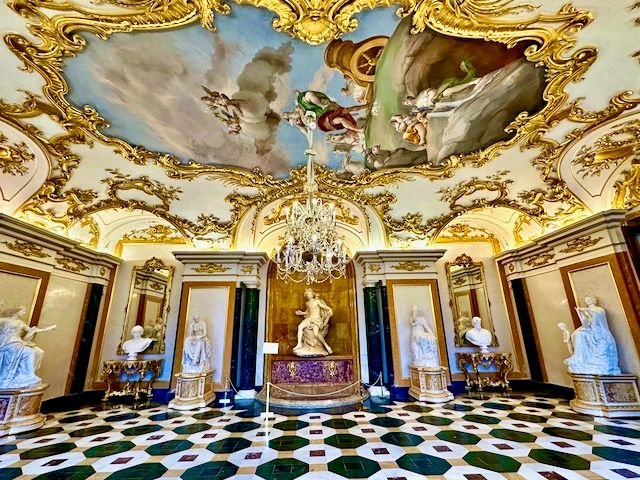
A fire in 1918 damaged the Lacquer Room, and there are still a few reminders in the room whose panels were made in the style of the Chinese Room of Turin’s Palazzo Reale.
We entered the Sale de Hércules where another decorated hallway greeted us. At the end of this hallway is the Room of the Shells and the18th century Fountain of Galatea featuring the “Greek goddess of the calm sea,” Amphitrite.
Philip had wanted to construct his own version of Versailles. Viewing the opulent rooms with statues and elegantly frescoed ceilings, I think he accomplished his quest. I believe this is Augustus Caesar.
Room after room of those incredible frescoes.
Tracy focused on this one.
Every room …
… tried to top the previous one.
In the Room of Truth (certain unnamed politicians are forbidden to enter) is the plaster cast of Castor and Pollux offering a Sacrifice to the Goddess Persephone. The original from the early 1st century was kept here until 1839 and now resides at the Prado Museum.
Palacio Real de La Granja de San Ildefonso was already one of our favorite stops during our two weeks in Spain, and we weren’t nearly done exploring.
Located steps from the royal palace is the Collegiate Church, which was completed in 1723.
During the reign of Charles III the interior of the church was renovated.
The Baroque inspired altar is accompanied by the painting La Santísima Trinidad (The Holy Trinity).
The marble Royal Mausoleum and Chapel holds the marble cenotaph of Philip V and Queen Elisabeth and the Capilla de las Reliquias.
The church made for a good interlude …
… but the day was warming up so we decided to venture outside and check out those gardens Philip had designed to become his “Spanish Versailles.”
Designed in the French style, the gardens encompass more than 360 acres.
There are also more than 2,000 classical sculptures and 26 monumental fountains that feature mythological themes.
Among the first fountain we saw as we wandered the gardens was the Fuente de la Fama designed to shoot water more than 150 feet in the air. Like all the fountains in the garden, they utilize a “complex 18th-century hydraulic system” to enable the magical water eruptions.
I read that it “depicts the goddess Fame sounding her trumpet while mounted on Pegasus, while figures symbolizing Envy and Ignorance lie vanquished.”
Walking the well groomed paths we came upon the humongous Fuente de los Baños de Diana (Baths of Diana). This fountain and its sculptures was no ordinary undertaking with the project lasting from 1920 to 1945. The fountain tells the tale of hunter Actaeon surprising the goddess Diana as she bathed. He then turns her into a deer to be eaten by his own dogs. When the fountains in the gardens are working it supposedly puts on a three-minute show, which led to a famous quote by Philip V.
It seems Philip was forever stressed out as to how much the palace and its gardens was costing to construct (estimates in today’s currency put the cost at around $2 billion). The fountain alone cost three million reales de vellón, the Spanish currency at the time. He famously lamented, “It has cost me three millions and amused me three minutes.” Just think if he tried to build a ballroom.
Fuente de los Dragones with its mythical dragons, is “entirely fed by a mountain reservoir,” bypassing the need for modern pumps.
This, like all the fountains, function just as they did back in the day of King Philip.
Sadly for us, La fuente de La Cascada Nueva was under renovation when we visited. This project which includes restoring the marble and hydraulic system is estimated to cost 6 million euros. Philip would be more than worried.
Outside of a weary traveler shown in front of the palace, a perfect autumn afternoon was shaping up.
Another one of the majestic fountains, Fuente de la Selva (Fountain of the Jungle), was also under renovation.
After nearly three hours of exploring the palace and gardens, we decided it was time to head into the nearby town of La Granja de San Ildefonso for some lunch.
We caught one last glimpse of the Collegiate Church.
La Taberna del Pelón was our luncheon choice, and it was a good one.
We loved the cozy interior.
As nice as the ambiance, the food also hit the mark. The starter of baby potatoes with chorizo, peppers and a spicy sauce was a Wow! dish to be sure. The gigantic bean soup was a winner, too. We enjoyed our lunch with a terrific play list featuring some new (to us) music including songs by the Belgian band with the Spanish name of Vaya Con Dios.
Our attentive server, Jaime, was kind enough to call us a taxi, although we could have waited for the bus. This beautiful mural gave us something to look at while we waited.
The taxi dropped us off at Acueducto de Segovia, where nearby we partook of the afternoon sunshine with a glass of vino.
Walking back to the hotel we strolled by Iglesia de San Martín and got a better view of Monumento a Juan Bravo.
It was a beautiful day in Segovia. Many people make Segovia a day trip, but we think a couple or three days here is an even better idea.
That evening it was back outside to take some blue hour photos in the Plaza Mayor.
It was a glorious evening and people were out and about.
Dinner this night was at the charmingly decorated Restaurante Pasapán, which turned out to be kind of a hit and miss.
The salad with prawns, herby hummus and freshly baked apple pie were quite good, but my dinner of pork ribs glazed with Korean barbecue sauce fell short. They do have a lot of dishes on their menu that look terrific.
We were pretty tired from our long day and were looking for a good night’s rest before we headed out on our last day in Spain. Alas, when we attempted to close the hotel room door, the door lock became stuck open. Since the door would not close and there was no one on the premisses who could fix it, we had to pack up and move to another room.
I will say the hotel staff was not very accommodating and seemed put off by our problem. Not to mention, we were not compensated at all for our trouble. Maybe a free coffee the next morning might have been a nice gesture. Oh well.
On our last day, we would head to the Madrid Airport hotel, but not without visiting one more royal palace along the way.
Chapter Thirteen - The Palace Less Visited & Epilogue
On our last day in Segovia, we took a taxi 11 kilometers out of town to Palacio Real de La Granja de San Ildefonso (Royal Palace of La Granja de San Ildefonso (aka the Spanish Versailles"). We loved it! Below are the details and three million photos.
https://travelswithmaitaitom.com/cha...san-ildefonso/
Chapter Twelve - Royal Site of La Granja de San Ildefonso
Day Twelve - Retreat For Spanish Monarchs, Modeled After Versailles, Gorgeous Gardens/Fabulous Fountains, One Last Spin Around Segovia and Out Of Lock
Early in the morning, a taxi whisked us the 11 kilometers to the small town of San Ildefonso, where we would spend a couple of hours wandering the Palacio Real de La Granja de San Ildefonso (Royal Palace of La Granja de San Ildefonso), its Royal Chapel and finally the expansive (and gorgeous) gardens. As we pulled into the circular entrance with a view of the chapel, an autumn chill was in the air.
Philip V’s reign in Spain took him mainly to this plain (ok, it’s really in the hills), which he became enamored with in the early 18th century. So much so, he decided to construct a Baroque summer palace and gardens decorated with fountains and sculptures that would become a retreat for Spanish monarchs. It was also the palace were Philip’s widow, Queen Elisabeth, was exiled after his passing until her son, Charles III, became king in 1759 after the death of his older half-brother, Ferdinand VI.
Waiting for the palace to open, we grabbed a quick bite in town, and then wandered back to the palace. Entering through the courtyard, we climbed the staircase to the palace. The site had originally been a hunting grounds for Castillian kings. It was then sold to monks and then purchased by Philip V to build the palace.
The Room of the Halberdiers (the guards who protect the king and queen) was first up.
The room contains a number of paintings highlighting the exploits of Alexander The Great.
Not surprisingly, the Portrait Gallery has a number of royal family portraits from the collection of Philip V and Elisabeth Farnese. The room, originally called the "Room of the Covered Dishes," includes portraits of the future Carlos III, who was Duke of Parma at the time, and “The Family of Philip V.”
The Dressing Room includes the painting Alexander The Great in the Temple of Jerusalem.
Now this is one big bedroom complete with rosewood bed.
It has a fantastic view out toward the Parterre of the New Cascade, which was unfortunately under renovation when we visited.
The ceiling (I believe) shows the Marriage of Eros and Psyche.
The Queen’s Room ceiling is a crowning achievement.
I was waiting for Monty Hall to tell us what’s behind these curtains.
Looks like we won a clock and some vases.
The Principal Dining Room was once used as the bedchamber of Philip V.
We didn’t have to reflect long as to why this is called The Mirror Room.
Once again we caught a glimpse of the gardens we would stroll through after our palace visit.
Numerous decorated hallways line the palace.
A fire in 1918 damaged the Lacquer Room, and there are still a few reminders in the room whose panels were made in the style of the Chinese Room of Turin’s Palazzo Reale.
We entered the Sale de Hércules where another decorated hallway greeted us. At the end of this hallway is the Room of the Shells and the18th century Fountain of Galatea featuring the “Greek goddess of the calm sea,” Amphitrite.
Philip had wanted to construct his own version of Versailles. Viewing the opulent rooms with statues and elegantly frescoed ceilings, I think he accomplished his quest. I believe this is Augustus Caesar.
Room after room of those incredible frescoes.
Tracy focused on this one.
Every room …
… tried to top the previous one.
In the Room of Truth (certain unnamed politicians are forbidden to enter) is the plaster cast of Castor and Pollux offering a Sacrifice to the Goddess Persephone. The original from the early 1st century was kept here until 1839 and now resides at the Prado Museum.
Palacio Real de La Granja de San Ildefonso was already one of our favorite stops during our two weeks in Spain, and we weren’t nearly done exploring.
Located steps from the royal palace is the Collegiate Church, which was completed in 1723.
During the reign of Charles III the interior of the church was renovated.
The Baroque inspired altar is accompanied by the painting La Santísima Trinidad (The Holy Trinity).
The marble Royal Mausoleum and Chapel holds the marble cenotaph of Philip V and Queen Elisabeth and the Capilla de las Reliquias.
The church made for a good interlude …
… but the day was warming up so we decided to venture outside and check out those gardens Philip had designed to become his “Spanish Versailles.”
Designed in the French style, the gardens encompass more than 360 acres.
There are also more than 2,000 classical sculptures and 26 monumental fountains that feature mythological themes.
Among the first fountain we saw as we wandered the gardens was the Fuente de la Fama designed to shoot water more than 150 feet in the air. Like all the fountains in the garden, they utilize a “complex 18th-century hydraulic system” to enable the magical water eruptions.
I read that it “depicts the goddess Fame sounding her trumpet while mounted on Pegasus, while figures symbolizing Envy and Ignorance lie vanquished.”
Walking the well groomed paths we came upon the humongous Fuente de los Baños de Diana (Baths of Diana). This fountain and its sculptures was no ordinary undertaking with the project lasting from 1920 to 1945. The fountain tells the tale of hunter Actaeon surprising the goddess Diana as she bathed. He then turns her into a deer to be eaten by his own dogs. When the fountains in the gardens are working it supposedly puts on a three-minute show, which led to a famous quote by Philip V.
It seems Philip was forever stressed out as to how much the palace and its gardens was costing to construct (estimates in today’s currency put the cost at around $2 billion). The fountain alone cost three million reales de vellón, the Spanish currency at the time. He famously lamented, “It has cost me three millions and amused me three minutes.” Just think if he tried to build a ballroom.
Fuente de los Dragones with its mythical dragons, is “entirely fed by a mountain reservoir,” bypassing the need for modern pumps.
This, like all the fountains, function just as they did back in the day of King Philip.
Sadly for us, La fuente de La Cascada Nueva was under renovation when we visited. This project which includes restoring the marble and hydraulic system is estimated to cost 6 million euros. Philip would be more than worried.
Outside of a weary traveler shown in front of the palace, a perfect autumn afternoon was shaping up.
Another one of the majestic fountains, Fuente de la Selva (Fountain of the Jungle), was also under renovation.
After nearly three hours of exploring the palace and gardens, we decided it was time to head into the nearby town of La Granja de San Ildefonso for some lunch.
We caught one last glimpse of the Collegiate Church.
La Taberna del Pelón was our luncheon choice, and it was a good one.
We loved the cozy interior.
As nice as the ambiance, the food also hit the mark. The starter of baby potatoes with chorizo, peppers and a spicy sauce was a Wow! dish to be sure. The gigantic bean soup was a winner, too. We enjoyed our lunch with a terrific play list featuring some new (to us) music including songs by the Belgian band with the Spanish name of Vaya Con Dios.
Our attentive server, Jaime, was kind enough to call us a taxi, although we could have waited for the bus. This beautiful mural gave us something to look at while we waited.
The taxi dropped us off at Acueducto de Segovia, where nearby we partook of the afternoon sunshine with a glass of vino.
Walking back to the hotel we strolled by Iglesia de San Martín and got a better view of Monumento a Juan Bravo.
It was a beautiful day in Segovia. Many people make Segovia a day trip, but we think a couple or three days here is an even better idea.
That evening it was back outside to take some blue hour photos in the Plaza Mayor.
It was a glorious evening and people were out and about.
Dinner this night was at the charmingly decorated Restaurante Pasapán, which turned out to be kind of a hit and miss.
The salad with prawns, herby hummus and freshly baked apple pie were quite good, but my dinner of pork ribs glazed with Korean barbecue sauce fell short. They do have a lot of dishes on their menu that look terrific.
We were pretty tired from our long day and were looking for a good night’s rest before we headed out on our last day in Spain. Alas, when we attempted to close the hotel room door, the door lock became stuck open. Since the door would not close and there was no one on the premisses who could fix it, we had to pack up and move to another room.
I will say the hotel staff was not very accommodating and seemed put off by our problem. Not to mention, we were not compensated at all for our trouble. Maybe a free coffee the next morning might have been a nice gesture. Oh well.
On our last day, we would head to the Madrid Airport hotel, but not without visiting one more royal palace along the way.
Chapter Thirteen - The Palace Less Visited & Epilogue
Jun 1st, 2026 | 11:09 AM
#70
Joined: Mar 2003
Posts: 6,239
Likes: 0
maitaitom, I hope you are on the mend. I read on your other post in the Lounge that you have started a new medication. I hope this is working for you, and that you and Tracy will have many more wonderful travels to look forward to.
As usual, I love your latest installment. The Royal Palace and Collegiate Church are WOW!!!! They are both so opulent and stunning! The gardens are amazing, too, especially with all those sculptures and fountains.
As usual, I love your latest installment. The Royal Palace and Collegiate Church are WOW!!!! They are both so opulent and stunning! The gardens are amazing, too, especially with all those sculptures and fountains.
Jun 1st, 2026 | 10:10 PM
#72
Joined: Oct 2005
Posts: 967
Likes: 28
We made a rather hurried daytrip to Segovia (for the alcazar, primarily) from Madrid many years ago, so didnt get to the Royal Palace or anywhere outside the city itself. Thank you for sharing, very beautiful indeed.
Hope you are feeling better, wishing you good health.
Hope you are feeling better, wishing you good health.

Thread
Original Poster
Forum
Replies
Last Post
maitaitom
Europe
234
Jul 19th, 2025 09:02 PM
maitaitom
United States
27
Aug 7th, 2018 12:47 PM
maitaitom
Europe
208
May 15th, 2017 07:16 AM


