


Trip Report: Outback Adventure
 Sep 1st, 2025 | 09:04 AM
#1
Original Poster

Joined: Apr 2004
Posts: 1,147
Likes: 0
Trip Report: Outback Adventure
Part 1: Intro
Just back from an amazing 5 weeks Down Under, 3+ of which I spent traveling across the Outback of eastern and central Australia. Traveling with me was a good friend (a Brit) and, for the last 1300 miles, my Aussie wife. Three people with different accents!
I had lived in Australia (Canberra) during the 80's and this was the lastest of many return trips over the years. I've always always harbored a fascination with the Outback and had long wanted to do such an adventure - we'd visited the Red Center (twice), the Top End, the Flinders Ranges and the Kimberley before, but these were relatively short trips to places we had flown to, missing everything in between.
In planning the trip, there were two places that were top of the list: Boodjamulla Nat'l Park (aka Lawn Hill) in far western Queensland (Qld) and the Birdsville Track, the historic unpaved stock route in South Australia (SA) extending over 300 miles south from Birdsville (just over the Qld border) to Marree in SA. Unfortunately, after reserving our 4WD camper for pickup in Cairns, Qld, devastating autumn floods had closed off both of those destinations and thus we had to make major last minute changes to the itinerary, which ended up as follows:
Cairns, Qld (2 nights) - pick up 4WD camper
Chillagoe, Qld (1)
Undarra Nat'l Park, Qld (2)
Karumba, Qld (1)
Mt. Isa, Qld (1)
Tobermorey Station, Northern Territory (1)
Jervois Station, NT (1)
Alice Springs, NT (2)
Coober Pedy, SA (1)
Marree, SA (2)
Arkaroola, SA (2)
Melrose, SA (1)
Adelaide, SA (3) - dropped off 4WD camper and rented an SUV.
Broken Hill, New South Wales (1)
Cobar, NSW (1)
Walgett, NSW (1)
Stanthorpe, Qld (2)
Palm Beach, Qld (5)
Fly to Sydney, NSW (3)
We (Dave and I) flew into Cairns at the beginning of July and after a full day to stock up on provisions, loaded up our 4WD Toyota Hilux camper and headed west. Our vehicle was rented from Adventure Rentals, a firm with depots in Cairns, Darwin, Broome, Alice Springs, Adelaide and Perth. It was practically brand new (only ~3500 miles) as was all the equipment supplied, including induction and gas stoves, refridgerator, two rooftop tents, sleeping bags and bedding, cooking/eating utensils, etc., satellite and CB radios, solar panel, extended fuel tank, water tank, sand flag, winch, two spare tires, and compressor. We were very well prepared for any eventuality!
Stay tuned for Part 2
Just back from an amazing 5 weeks Down Under, 3+ of which I spent traveling across the Outback of eastern and central Australia. Traveling with me was a good friend (a Brit) and, for the last 1300 miles, my Aussie wife. Three people with different accents!
I had lived in Australia (Canberra) during the 80's and this was the lastest of many return trips over the years. I've always always harbored a fascination with the Outback and had long wanted to do such an adventure - we'd visited the Red Center (twice), the Top End, the Flinders Ranges and the Kimberley before, but these were relatively short trips to places we had flown to, missing everything in between.
In planning the trip, there were two places that were top of the list: Boodjamulla Nat'l Park (aka Lawn Hill) in far western Queensland (Qld) and the Birdsville Track, the historic unpaved stock route in South Australia (SA) extending over 300 miles south from Birdsville (just over the Qld border) to Marree in SA. Unfortunately, after reserving our 4WD camper for pickup in Cairns, Qld, devastating autumn floods had closed off both of those destinations and thus we had to make major last minute changes to the itinerary, which ended up as follows:
Cairns, Qld (2 nights) - pick up 4WD camper
Chillagoe, Qld (1)
Undarra Nat'l Park, Qld (2)
Karumba, Qld (1)
Mt. Isa, Qld (1)
Tobermorey Station, Northern Territory (1)
Jervois Station, NT (1)
Alice Springs, NT (2)
Coober Pedy, SA (1)
Marree, SA (2)
Arkaroola, SA (2)
Melrose, SA (1)
Adelaide, SA (3) - dropped off 4WD camper and rented an SUV.
Broken Hill, New South Wales (1)
Cobar, NSW (1)
Walgett, NSW (1)
Stanthorpe, Qld (2)
Palm Beach, Qld (5)
Fly to Sydney, NSW (3)
We (Dave and I) flew into Cairns at the beginning of July and after a full day to stock up on provisions, loaded up our 4WD Toyota Hilux camper and headed west. Our vehicle was rented from Adventure Rentals, a firm with depots in Cairns, Darwin, Broome, Alice Springs, Adelaide and Perth. It was practically brand new (only ~3500 miles) as was all the equipment supplied, including induction and gas stoves, refridgerator, two rooftop tents, sleeping bags and bedding, cooking/eating utensils, etc., satellite and CB radios, solar panel, extended fuel tank, water tank, sand flag, winch, two spare tires, and compressor. We were very well prepared for any eventuality!
Stay tuned for Part 2
Last edited by RalphR; Sep 1st, 2025 at 09:38 AM.


 Sep 4th, 2025 | 08:39 PM
#7
Original Poster
Joined: Apr 2004
Posts: 1,147
Likes: 0
Part 2
Part 2 Cairns to Chillagoe
From Cairns we took the steep, winding, and scenic Gillies Highway up over the dividing range through tropical rainforest to the small town of Yungaburra on the Atherton Tablelands, a green and fertile agricultural region averaging about 3000 feet above sea level. After lunch and a beer at the nice old Yungaburra pub (aka “hotel”), we continued west through rolling countryside though fields of banana, apple and mango trees, avocados, potatoes, and other crops. Past Dimbulah on the Burke Developmental Road, the look of the land became drier, and the crops petered out, giving way to the scrub and scattered trees characteristic of Queensland’s Gulf Savannah country. The word “outback” is quite subjective - there is no set boundary between, say, “the coast” and “the outback” – but to me, we were now officially in The Outback, especially once we reached our destination for the evening: Chillagoe, a former copper smelting town, now quite well known for its spectacular limestone caves.
We stayed the night at the Chillagoe Cabins and were very pleased – friendly owners, and clean, comfortable rooms. It was just a short walk down the road to the Post Office Hotel, the pub where we ate dinner that night. Although we found the food to be generally very good in the various places we stopped, this dinner - chicken schnitzel - was a bit disappointing – basically an oversized Chicken McNugget. After dinner we strolled around the block to the other pub in town, the Chillagoe Hotel, for a nightcap and an interesting chat with the proprietor serving at the bar.
Even though we were well into the tropics (17 degrees S), the morning was quite chilly, so we were “rugged up” as we sat and enjoyed a delightful “brekkie”, which was served in an open area next to the pool at our accommodations. The day turned out to be gorgeous – clear skies, highs in the 70’s, the sort of weather we had for most of the whole trip. We had booked a tour of one of the limestone caves, Donna Cave, a short drive out of town among a maze of massive limestone outcroppings (karst). There were perhaps 20 people on the tour, which took around an hour. We were not disappointed – the limestone formations were beautiful, and our guide was very knowledgeable. If we’d had more time we would have seen another cave or two, and we’d have instead toured the more highly recommended Trezkinn cave if the timing was right.
We emerged from the cave into bright sunshine and then took a short walk among the karst outcroppings, including Balancing Rock, a massive, elongated chunk of limestone precariously standing atop a similarly large boulder. Before departing town, we drove out to the site of the copper smelting complex, abandoned in the 40’s after operating about 40 years. Remaining now are just a few tall smokestacks and ruined stone buildings. The site itself was off-limits, but there was a short trail up a hill with a nice view of the surrounding terrain, distant hills, the smelter, and the adjoining slag heap.
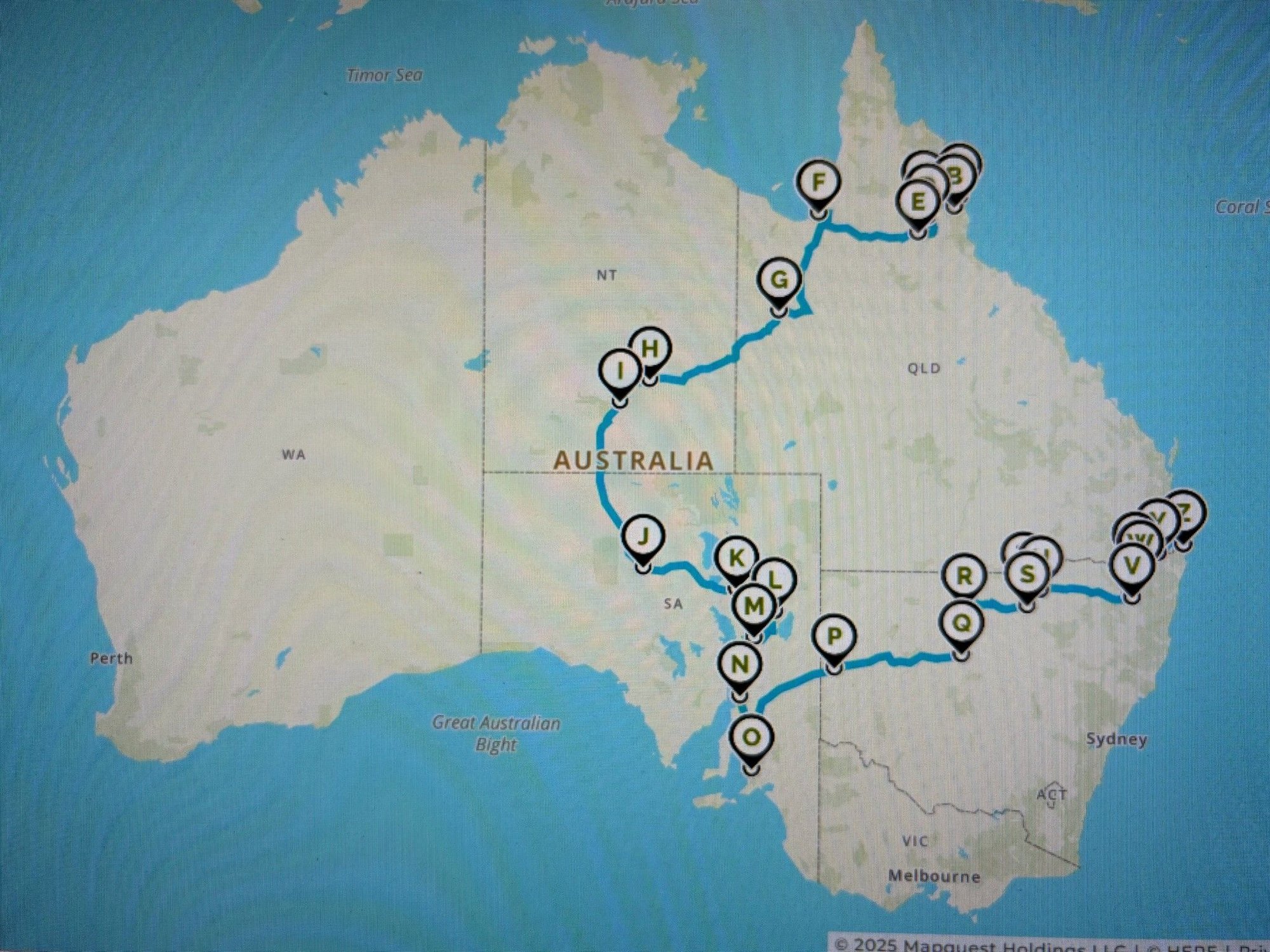
Our route, starting in Cairns (A), southwest to Alice Springs (I), south to Adelaide (O) then northeast to the Gold Coast (Z) over 24 days.
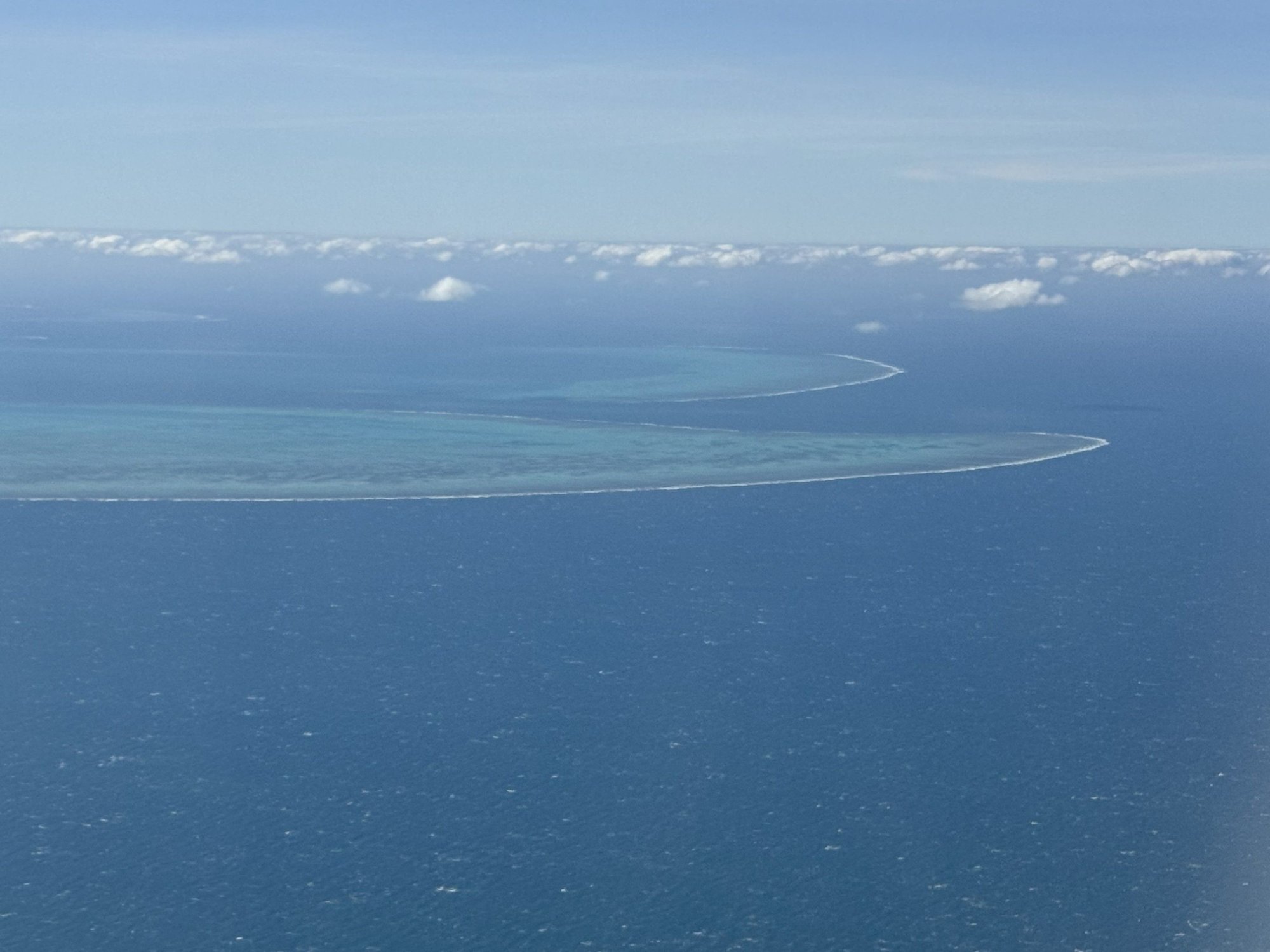
Caught a glimpse of the Barrier Reef landing in Cairns
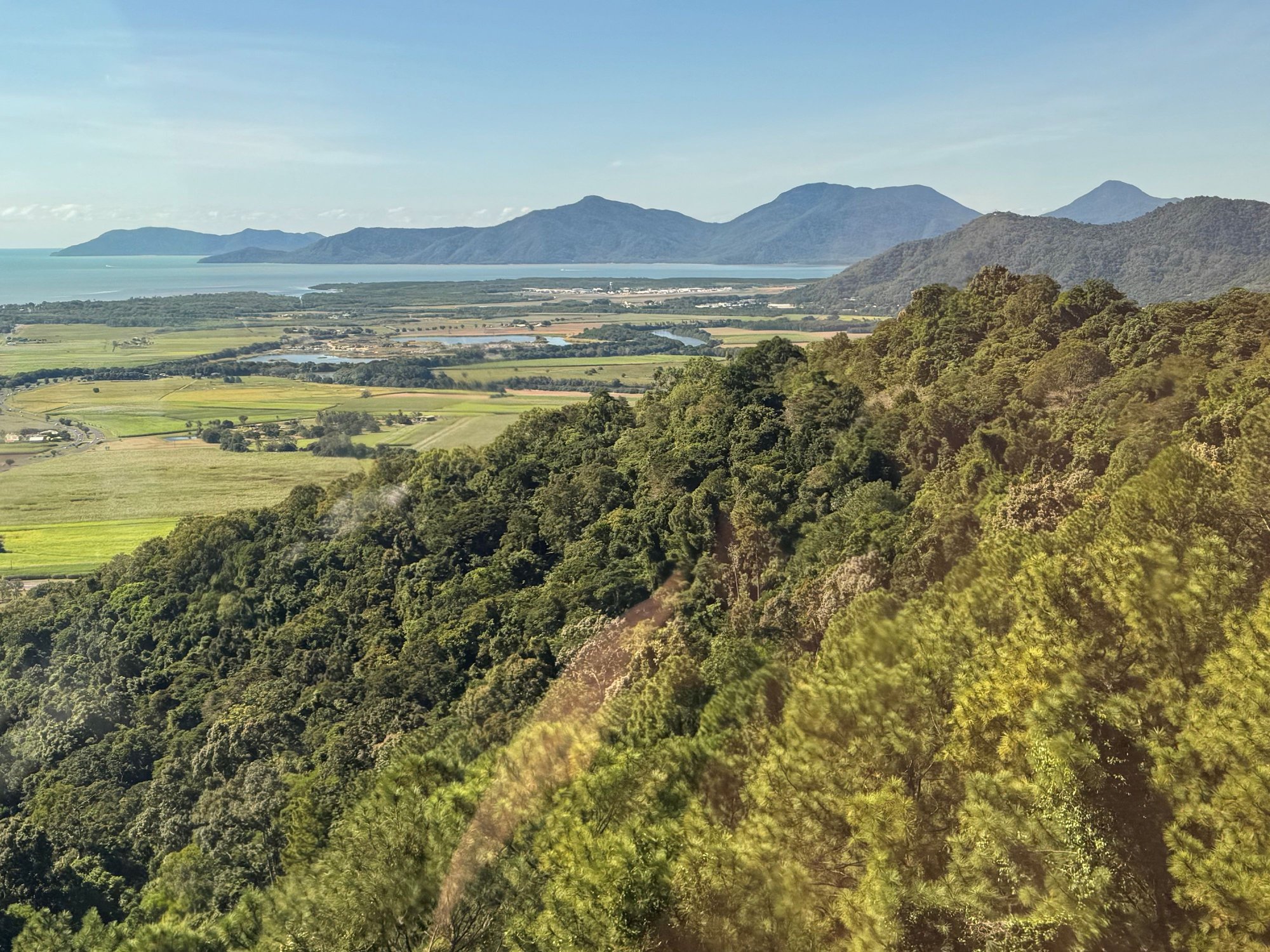
Had some time to spare the day before hitting the road so we took Skyrail up and over the ranges to Kuranda on the Atherton Tablelands
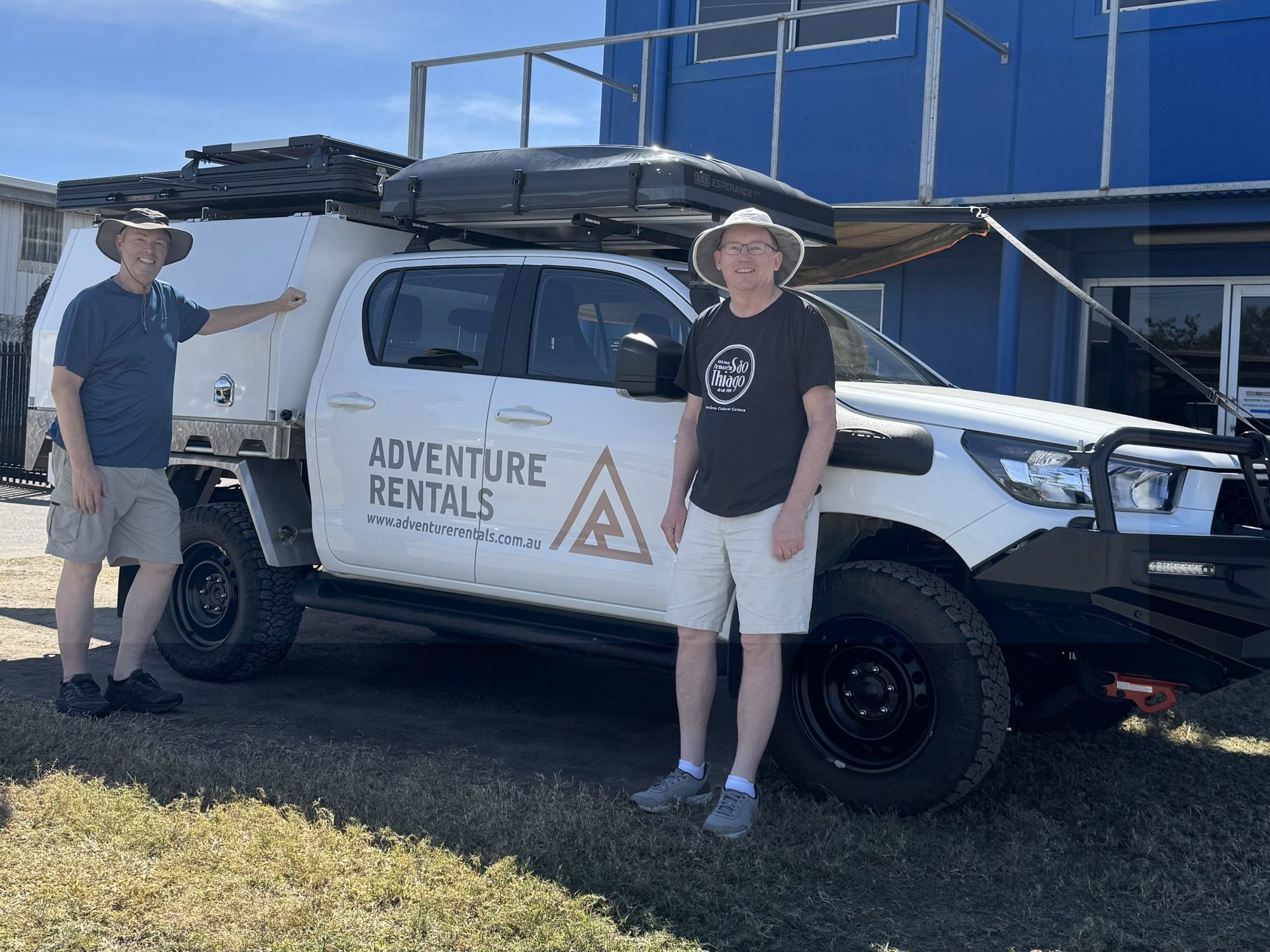
Picking up our vehicle - Ralph on left, Dave on right
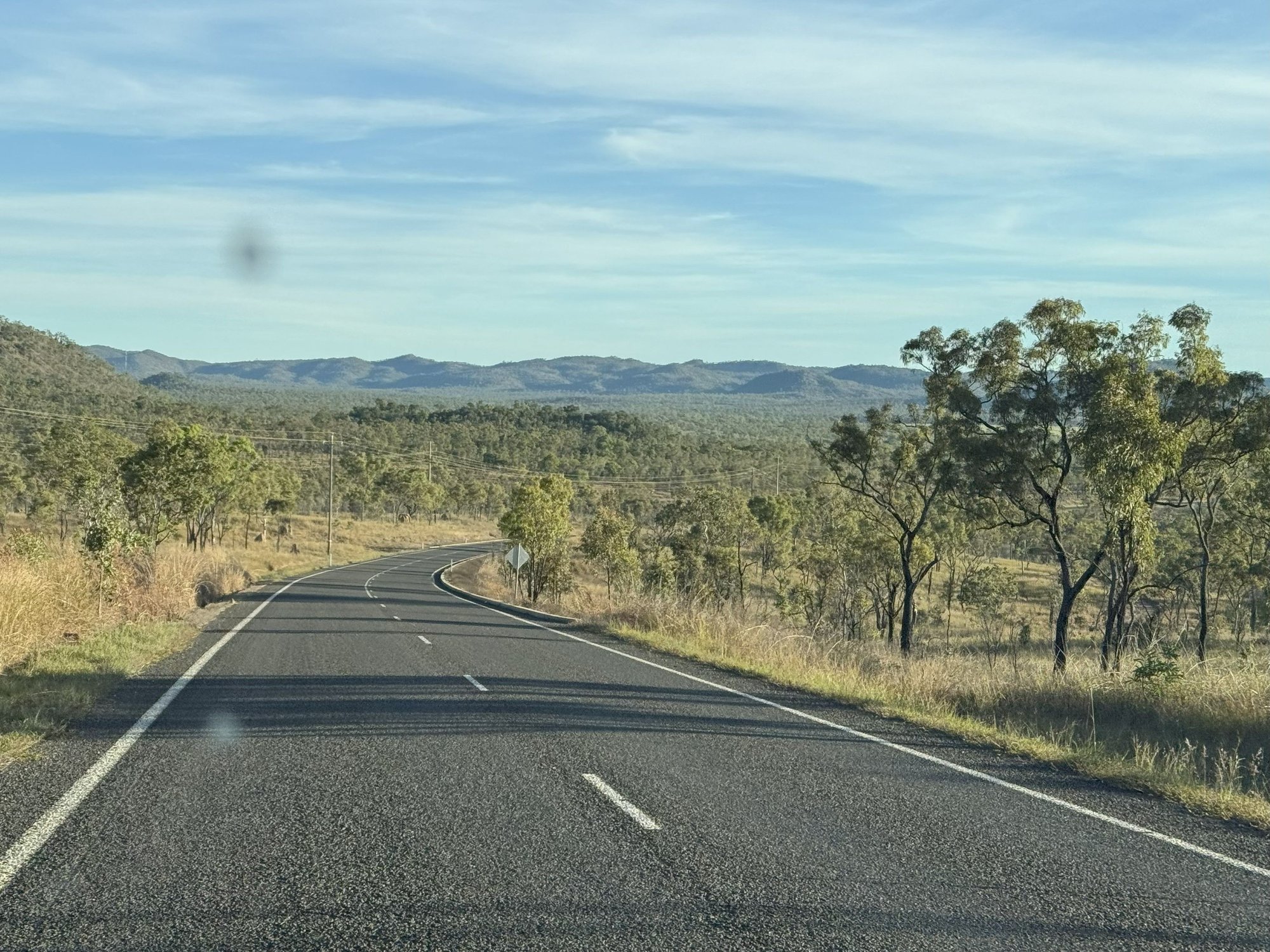
Heading west into the outback, leaving the lush coast and tablelands behind
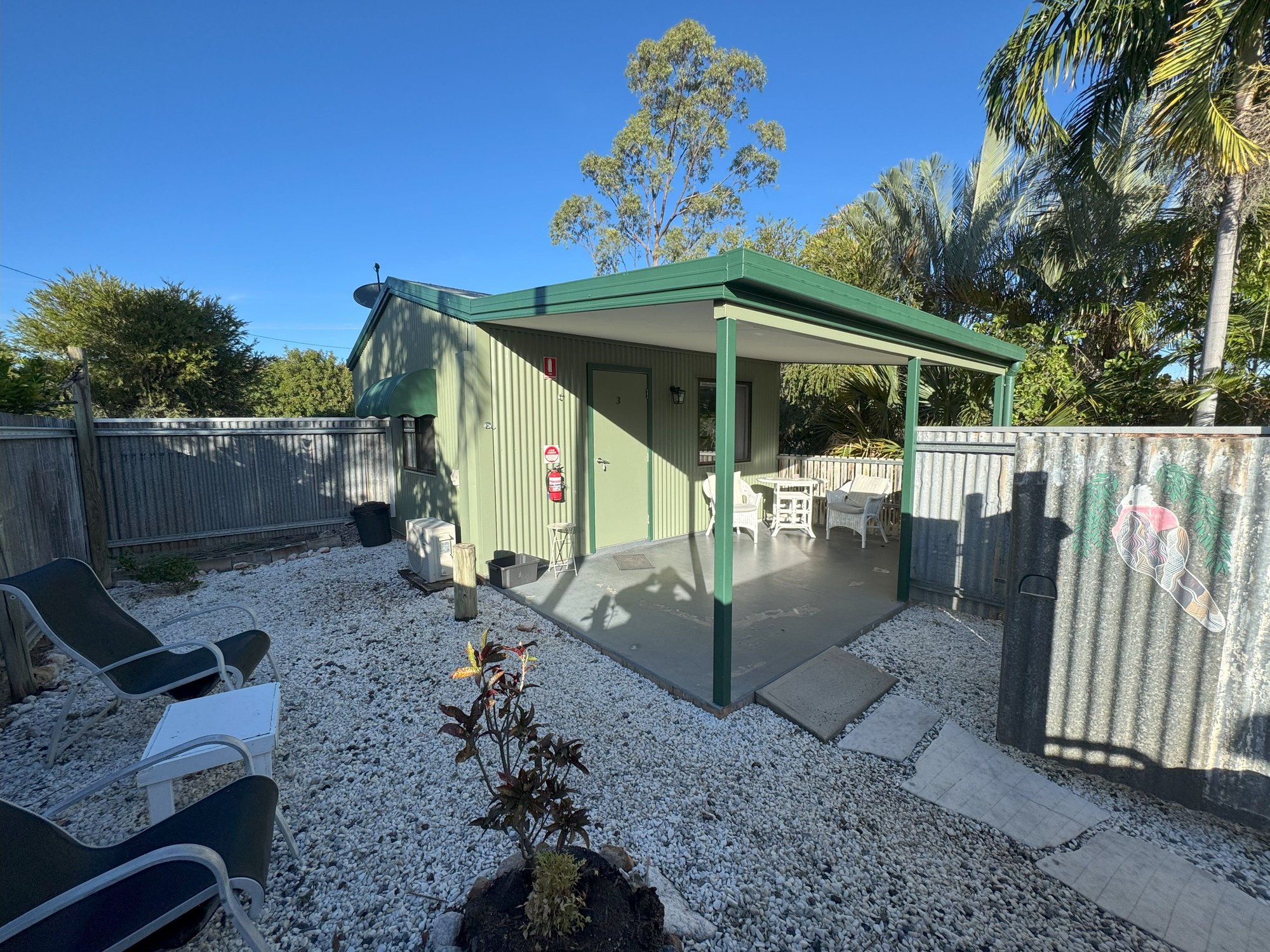
Chillagoe Cabins accommodation - clean and very cozy. We weren't ready for camping yet...
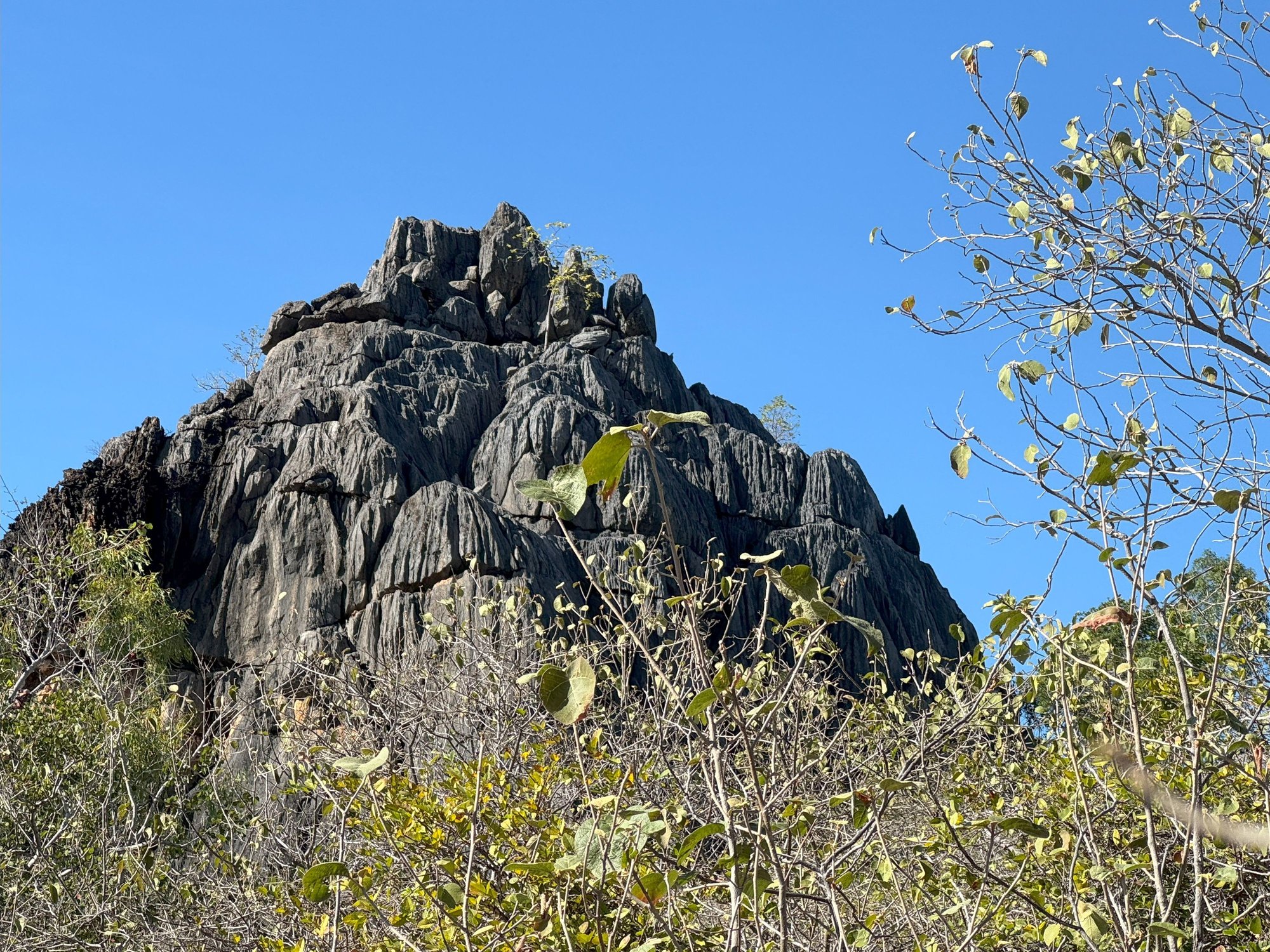
Karst outcropping, Chillagoe
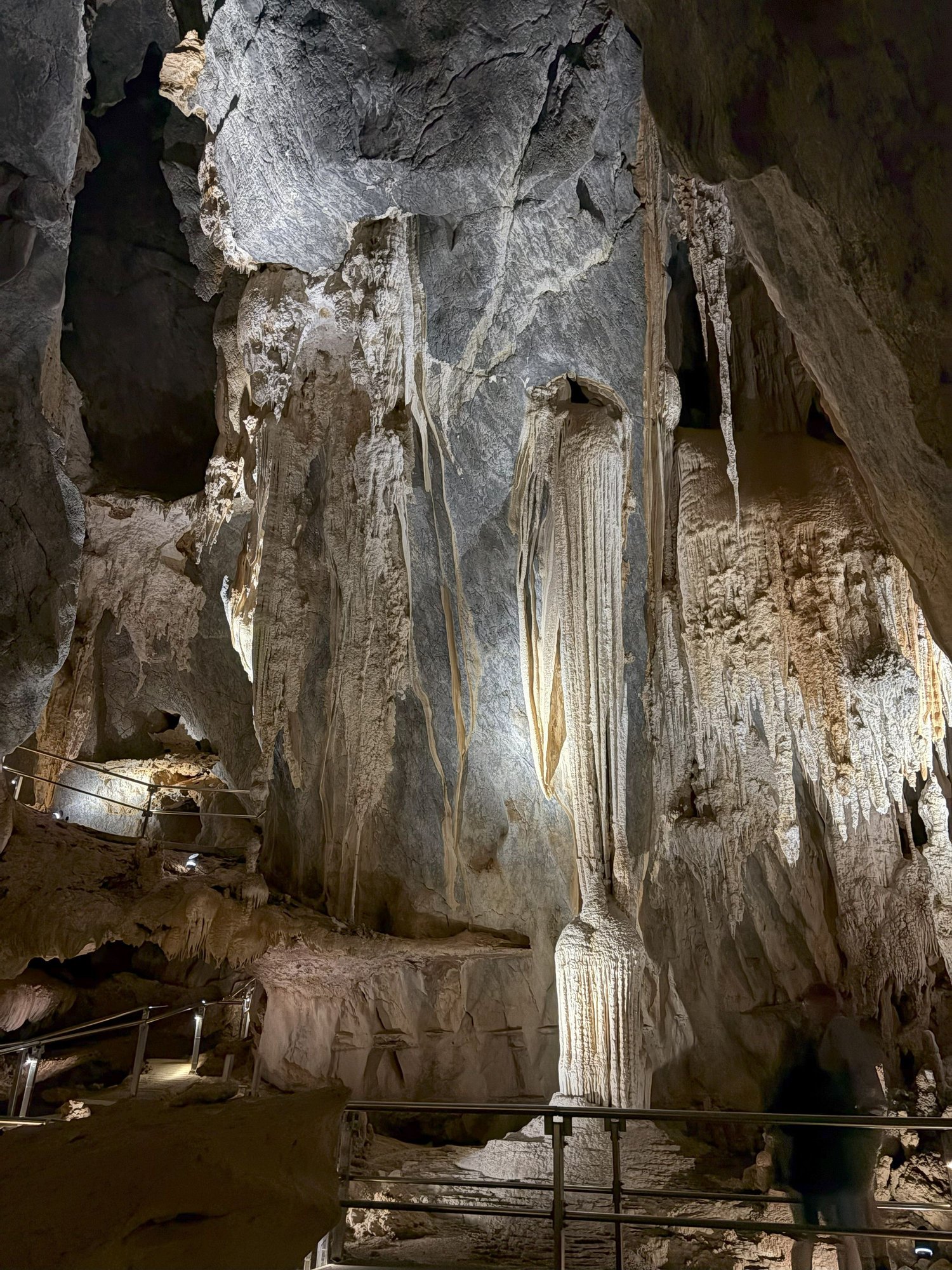
Donna Cave
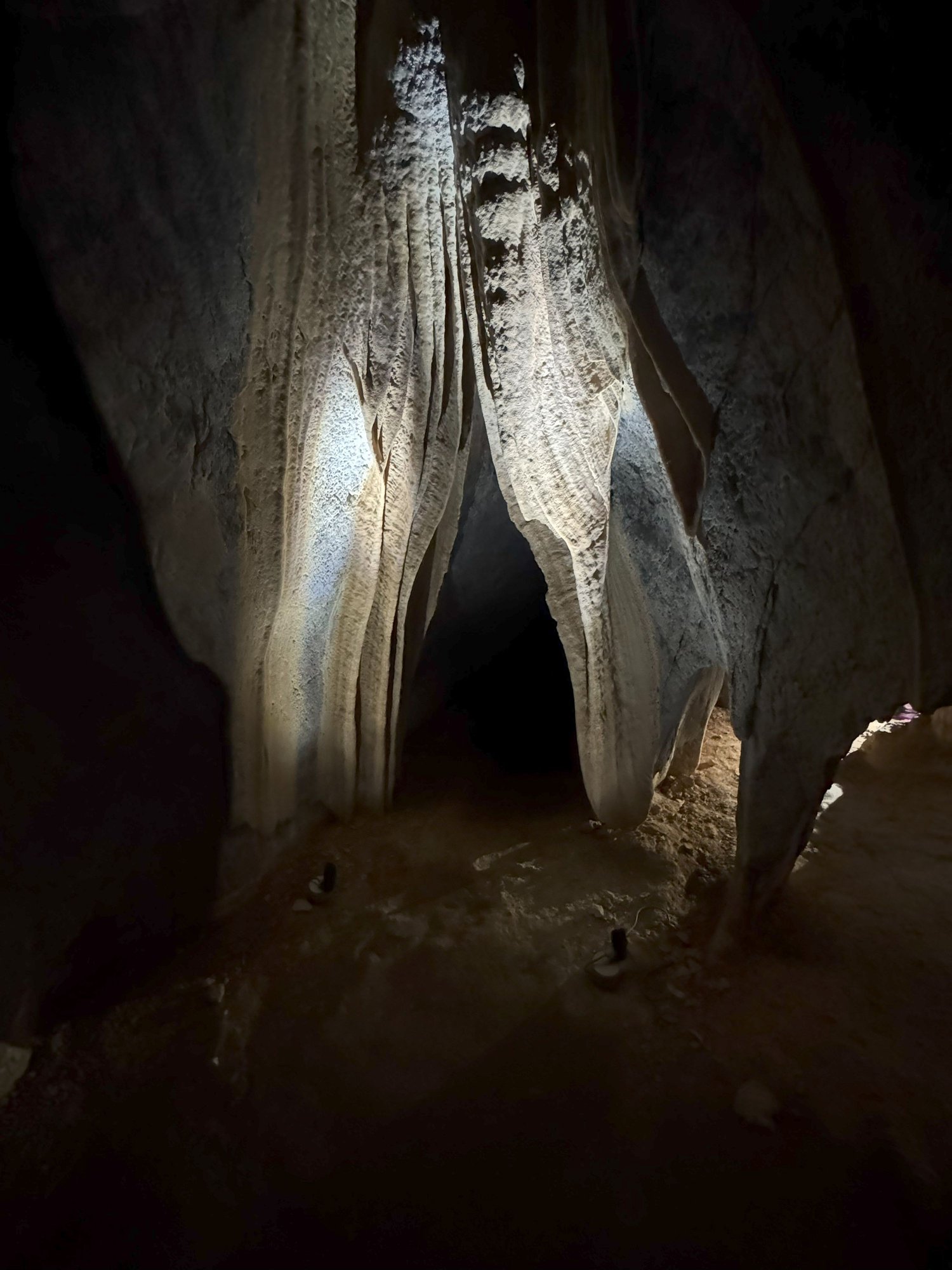
Donna Cave - "The Bedroom Curtains"
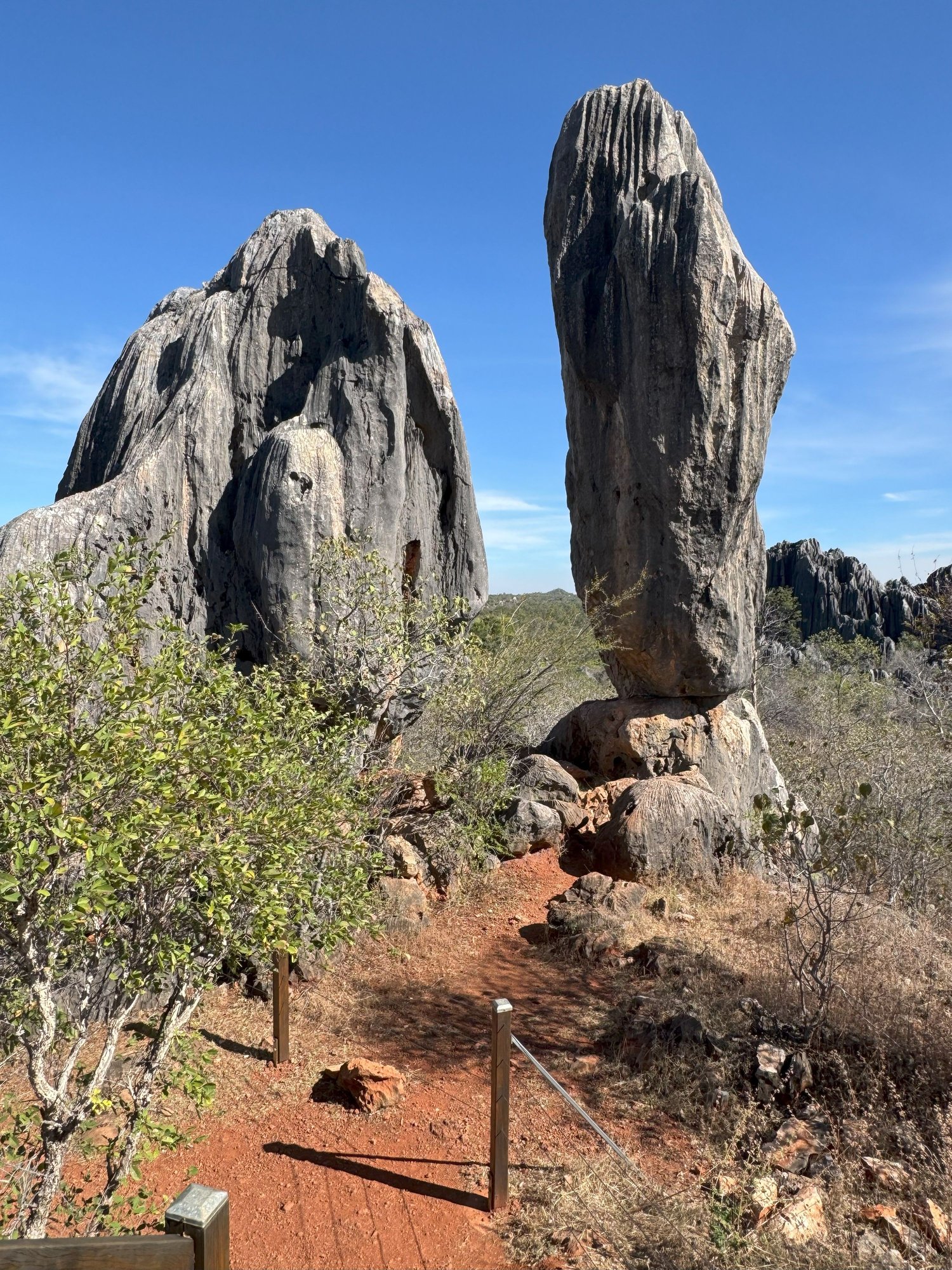
Balancing Rock
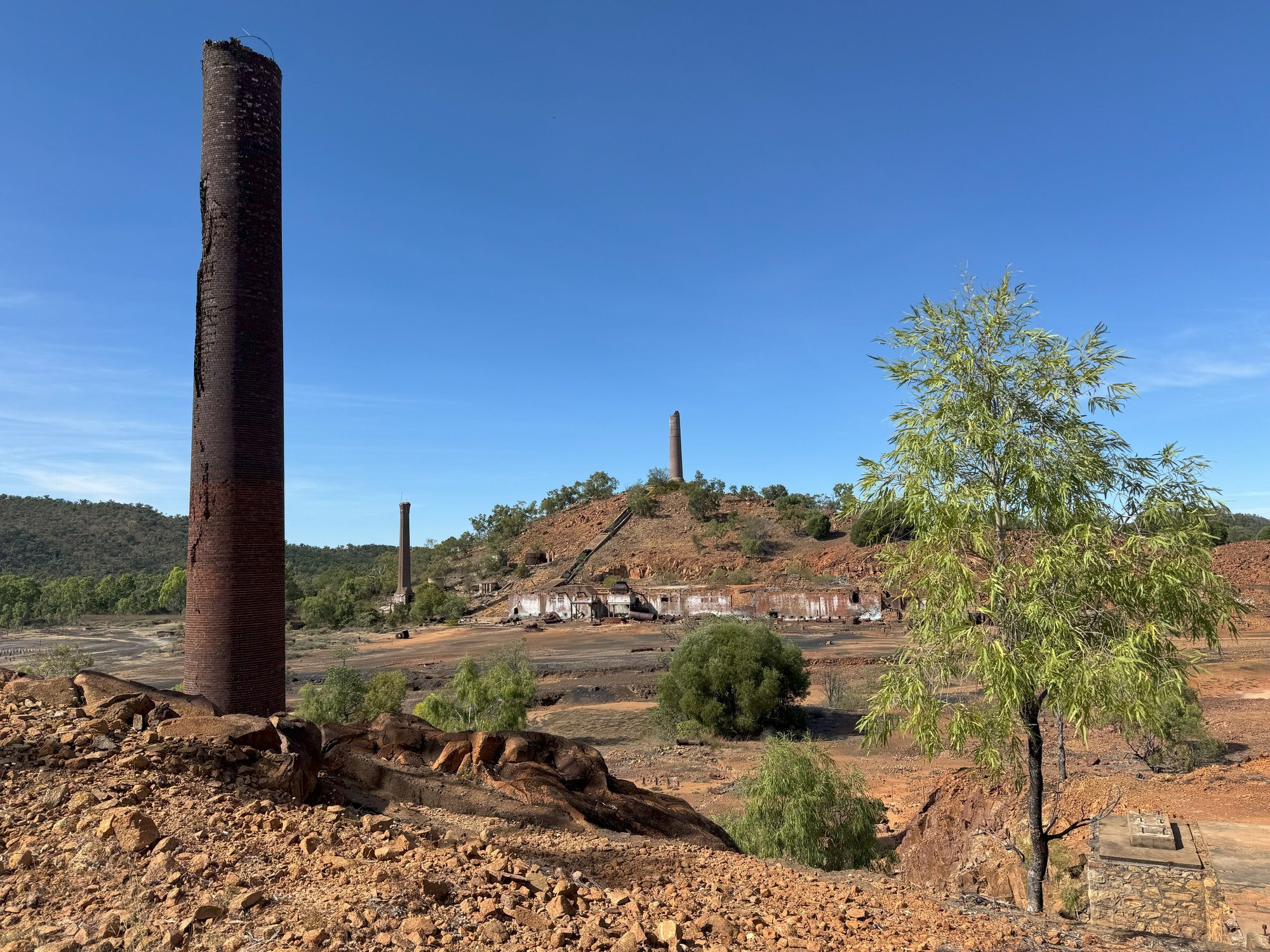
Chillagoe copper smelter ruins
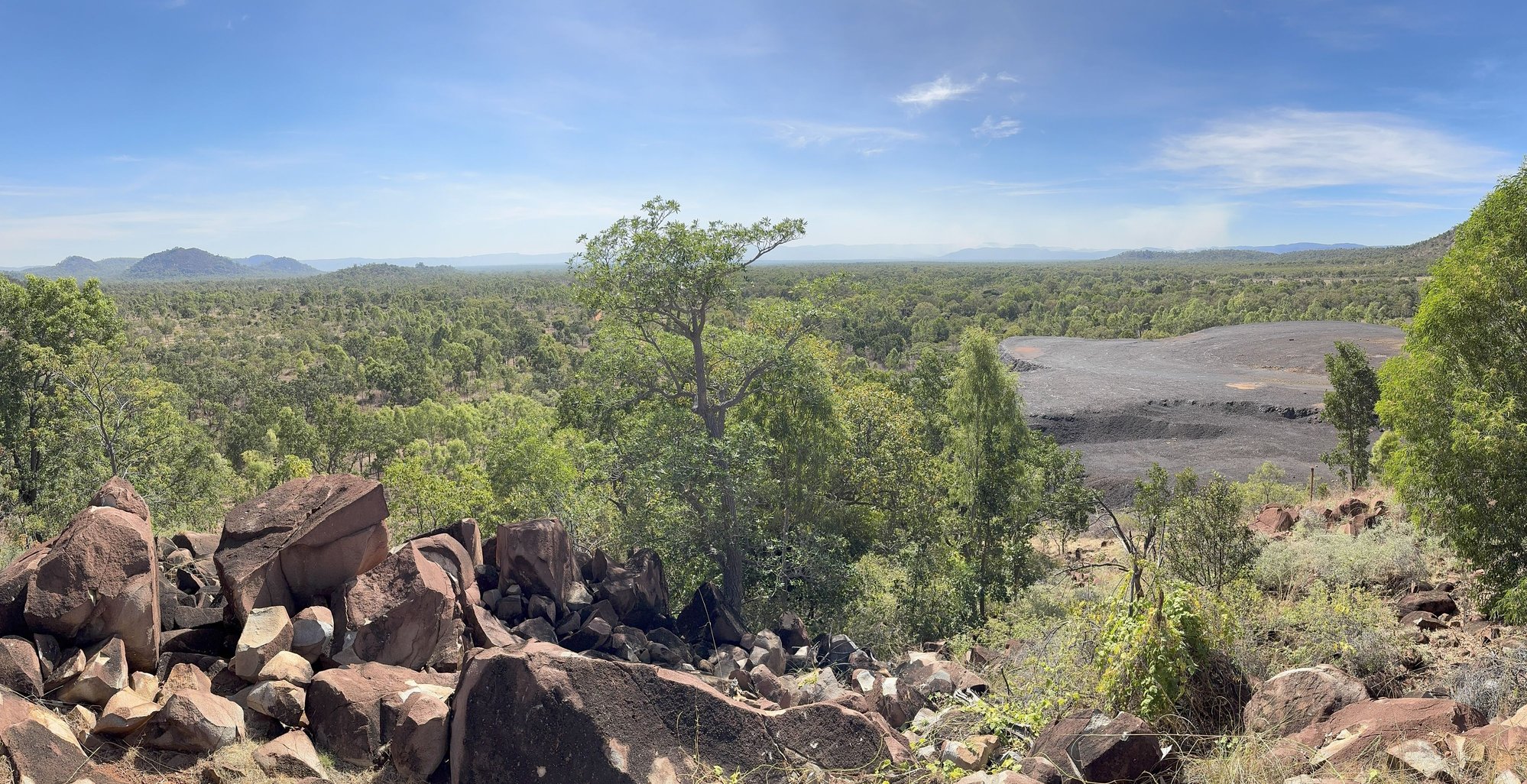
Smelter lookout view - slag heap on right
From Cairns we took the steep, winding, and scenic Gillies Highway up over the dividing range through tropical rainforest to the small town of Yungaburra on the Atherton Tablelands, a green and fertile agricultural region averaging about 3000 feet above sea level. After lunch and a beer at the nice old Yungaburra pub (aka “hotel”), we continued west through rolling countryside though fields of banana, apple and mango trees, avocados, potatoes, and other crops. Past Dimbulah on the Burke Developmental Road, the look of the land became drier, and the crops petered out, giving way to the scrub and scattered trees characteristic of Queensland’s Gulf Savannah country. The word “outback” is quite subjective - there is no set boundary between, say, “the coast” and “the outback” – but to me, we were now officially in The Outback, especially once we reached our destination for the evening: Chillagoe, a former copper smelting town, now quite well known for its spectacular limestone caves.
We stayed the night at the Chillagoe Cabins and were very pleased – friendly owners, and clean, comfortable rooms. It was just a short walk down the road to the Post Office Hotel, the pub where we ate dinner that night. Although we found the food to be generally very good in the various places we stopped, this dinner - chicken schnitzel - was a bit disappointing – basically an oversized Chicken McNugget. After dinner we strolled around the block to the other pub in town, the Chillagoe Hotel, for a nightcap and an interesting chat with the proprietor serving at the bar.
Even though we were well into the tropics (17 degrees S), the morning was quite chilly, so we were “rugged up” as we sat and enjoyed a delightful “brekkie”, which was served in an open area next to the pool at our accommodations. The day turned out to be gorgeous – clear skies, highs in the 70’s, the sort of weather we had for most of the whole trip. We had booked a tour of one of the limestone caves, Donna Cave, a short drive out of town among a maze of massive limestone outcroppings (karst). There were perhaps 20 people on the tour, which took around an hour. We were not disappointed – the limestone formations were beautiful, and our guide was very knowledgeable. If we’d had more time we would have seen another cave or two, and we’d have instead toured the more highly recommended Trezkinn cave if the timing was right.
We emerged from the cave into bright sunshine and then took a short walk among the karst outcroppings, including Balancing Rock, a massive, elongated chunk of limestone precariously standing atop a similarly large boulder. Before departing town, we drove out to the site of the copper smelting complex, abandoned in the 40’s after operating about 40 years. Remaining now are just a few tall smokestacks and ruined stone buildings. The site itself was off-limits, but there was a short trail up a hill with a nice view of the surrounding terrain, distant hills, the smelter, and the adjoining slag heap.
Our route, starting in Cairns (A), southwest to Alice Springs (I), south to Adelaide (O) then northeast to the Gold Coast (Z) over 24 days.
Caught a glimpse of the Barrier Reef landing in Cairns
Had some time to spare the day before hitting the road so we took Skyrail up and over the ranges to Kuranda on the Atherton Tablelands
Picking up our vehicle - Ralph on left, Dave on right
Heading west into the outback, leaving the lush coast and tablelands behind
Chillagoe Cabins accommodation - clean and very cozy. We weren't ready for camping yet...
Karst outcropping, Chillagoe
Donna Cave
Donna Cave - "The Bedroom Curtains"
Balancing Rock
Chillagoe copper smelter ruins
Smelter lookout view - slag heap on right
Last edited by RalphR; Sep 4th, 2025 at 08:43 PM. Reason: mistake!
Trending Topics
Sep 6th, 2025 | 10:44 AM
#11
Original Poster
Joined: Apr 2004
Posts: 1,147
Likes: 0
Part 2 - Undara National Park
From Chillagoe, we backtracked on the main road then went south from Almaden on the dirt Ootan Road toward our next destination, Undara National Park, about 200 km away (125 miles). The road was generally in good shape, though there were steam crossings that would have been risky for a normal car to negotiate. We stopped for lunch near one of the crossings where we enjoyed the peace and quiet sitting on the mostly dry riverbed flanked by white-barked river gum trees - a quintessential Australian setting. It was the first time we used our induction stove, using it to fry sausages and heat up canned chili. A huge road train loaded with livestock, which we could hear coming for some time, broke the silence for a few minutes and was just about the only other vehicle we saw until we turned onto the Kennedy Hwy toward Undara.
Undara National Park is renowned for its volcanic features, in particular its extensive system of lava tubes that are the main draw for tourists. There are also several volcanic cinder cones, including the Kalkani Crater, the rim of which is accessible as part of a 2.3 km (1.4 mile) loop trail. We encountered the turnoff to the Kalkani Crater on the way into the park, and so, with time to spare, we decided to climb it then and there. Views around the rim were limited by trees, but nonetheless, you could look across the perfectly circular bowl to the other side. Pretty cool.
Halfway round the Kalkani rim. I was startled by something I had nearly stepped on – a large greenish-brown snake, which was, fortunately, just as startled as me and quickly slithered away into the bush. I related this to one of the guides the next day, who instantly deemed it being a King Brown, a very poisonous snake that could have quickly ended my trip. Yikes! I have done a lot of hiking in Australia and can confidently say that such a close encounter is a rare occurrence, not because the snakes aren’t there, it’s because they sense you coming and usually disappear.We stayed at the Discovery Resorts facility, the only accommodation in the park. In retrospect, I wish we’d just used our rooftop tents and camped in the designated camping/RV area, closer to the shared bathroom facilities. Instead, we stayed in one of the rigid two-man swag tents that were available at a small rate. Our swag was in pretty good shape, but some were in ruins. Much nicer en suite accommodation was also available, including a line of repurposed antique railroad carriages. That evening we enjoyed a respectable meal and a few beers in the large covered common area at the center of the resort complex. After dark, it was (for me) a glass of wine (or two) sitting and socializing with Dave and others around a central fire pit.
We could have eaten in the dining area the next morning but instead opted for a “bush breakfast”, cooked on and served around a fire in a nearby clearing – eggs, sausages, bacon, toast, billy tea, etc. With time to kill before our lava tube tour, we took a hike on one of the several hiking trails emanating from the resort. We climbed the bluff behind the facility. This was capped with large boulders atop which afforded nice views over the park. Low areas in the mid-distance were flooded - I assume a result of the torrential rains that had submerged huge parts of Queensland earlier in the year.
The Undara lava tubes can only be accessed on a guided tour. Among other options, we opted for the 2-hour Wind Tunnel tour, which goes down a rocky path into one cave entrance (a collapsed section of the tube), along a stretch of giant lava tube and out another opening. On the small bus to the start of the hike, our obviously experienced guide explained how the lava tubes were formed (lava from the Undara crater, some distance away). He also delved into the abundant wildlife in the park and efforts to control feral cats by not killing the dingoes (native animals) that prey on them. As we descended into the cave, he explained the survival of the vine thicket rainforest vegetation existing around the cave openings and collapsed tube sections. In the cave he pointed out some of the creatures that live there – bats (of course), spiders, etc. We also saw the bones of a couple of unfortunate wallabies that had perished in the cave for some reason.
Back at the lodge, it was meat pies for lunch followed by a hike to the Atkinson Lookout, a modest granite dome, about a mile away. The best wildlife sighting was a stunningly beautiful Red Winged Parrot, a new Australian bird for me. It was quite warm and humid that afternoon, so we were eager to relax outside our swag with couple of cold “tinnies” from our vehicle’s refrigerator. Dinner that night was again in the common outdoor dining area. It was amusing to watch a couple of kookaburras positioning themselves in a nearby tree looking for opportunities (which they took) to swoop down and steal food from people’s plates.
Around the firepit that night we talked to several interesting people including a couple of young-ish, somewhat tipsy women from north of Cairns. I wouldn’t have picked one of them as a driver of enormous dump trucks that service a coal mine somewhere in central Queensland: very good money (~150 k/year) but a 10-day on-10-day off commute to/from Cairns by air. Quite a lifestyle!
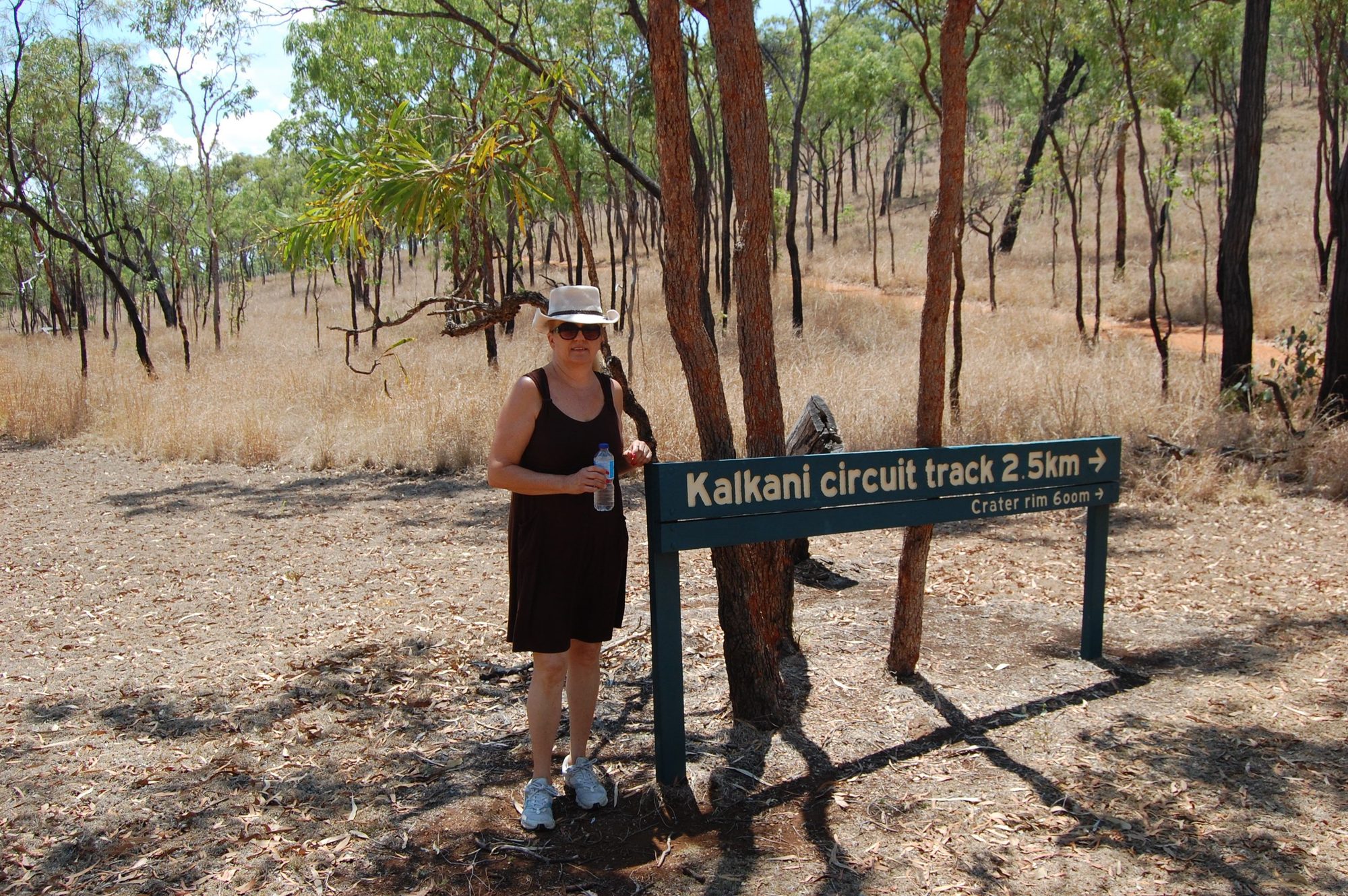
Beginning the Kalkani Crater. This nice lady kindly offered to add perspective to my picture...
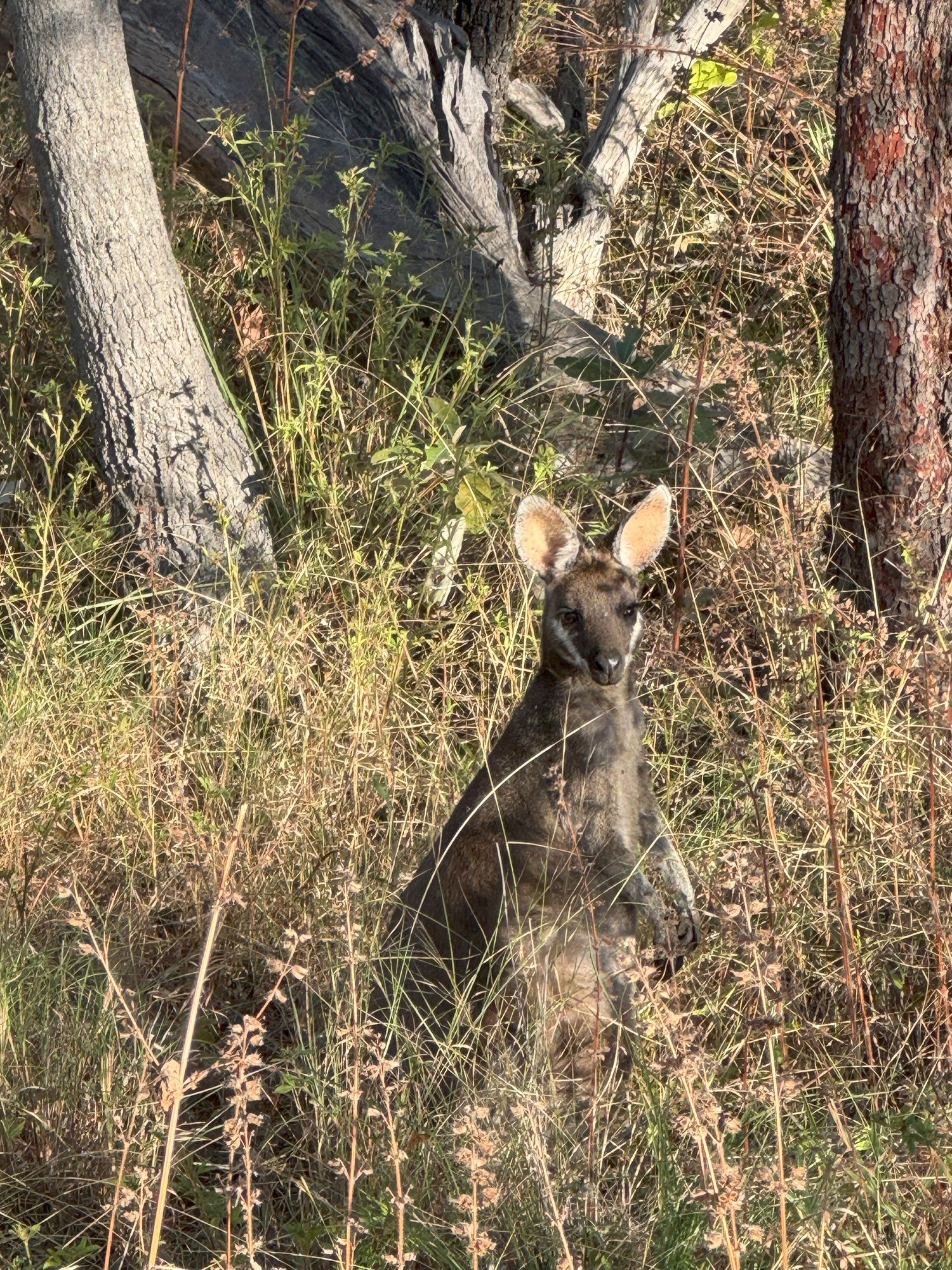
Saw quite a few of these guys...
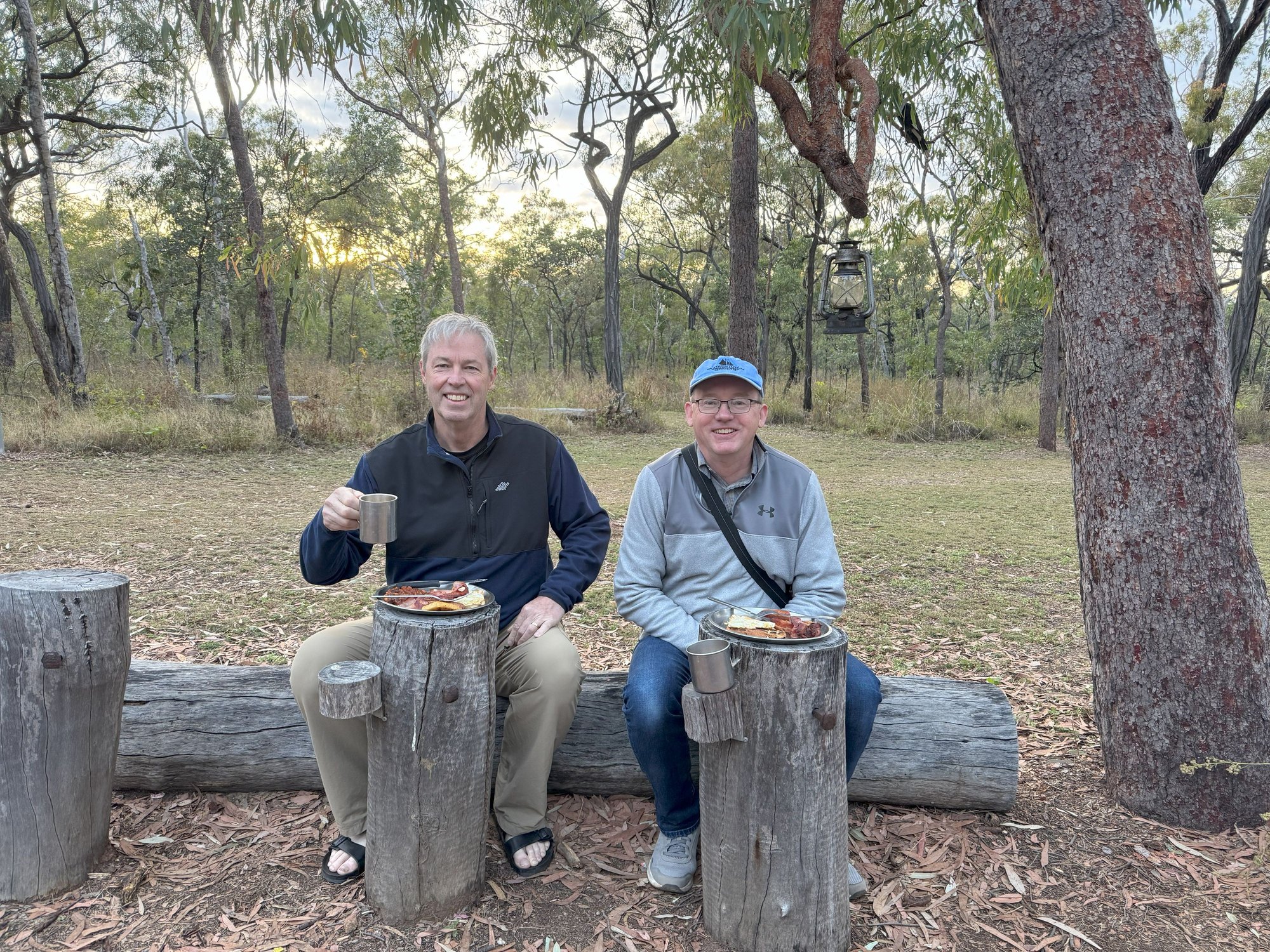
Bush breakfast
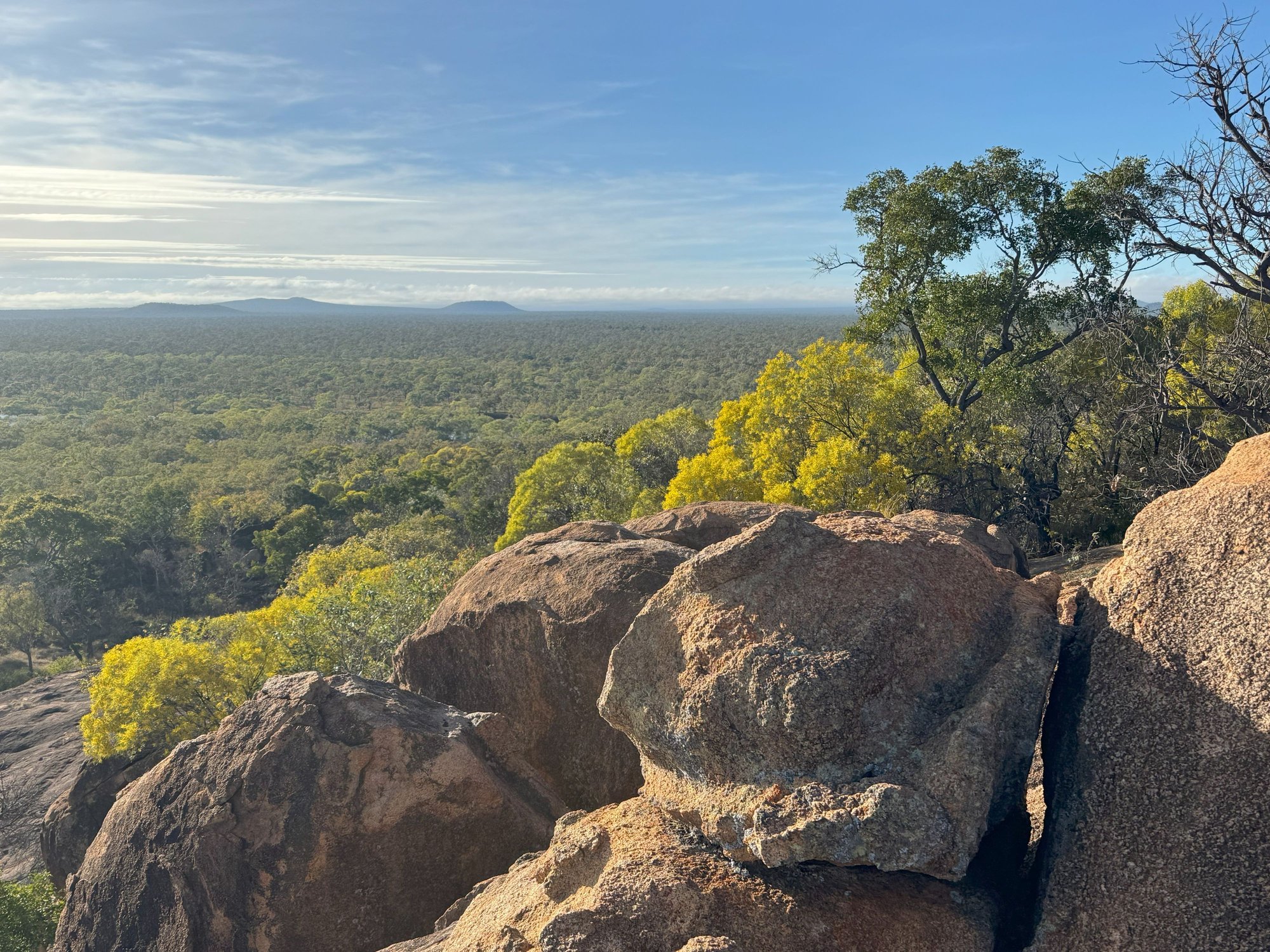
Lovely view from the bluff behind the resort. The hills in the distance are volcanic cinder cones.
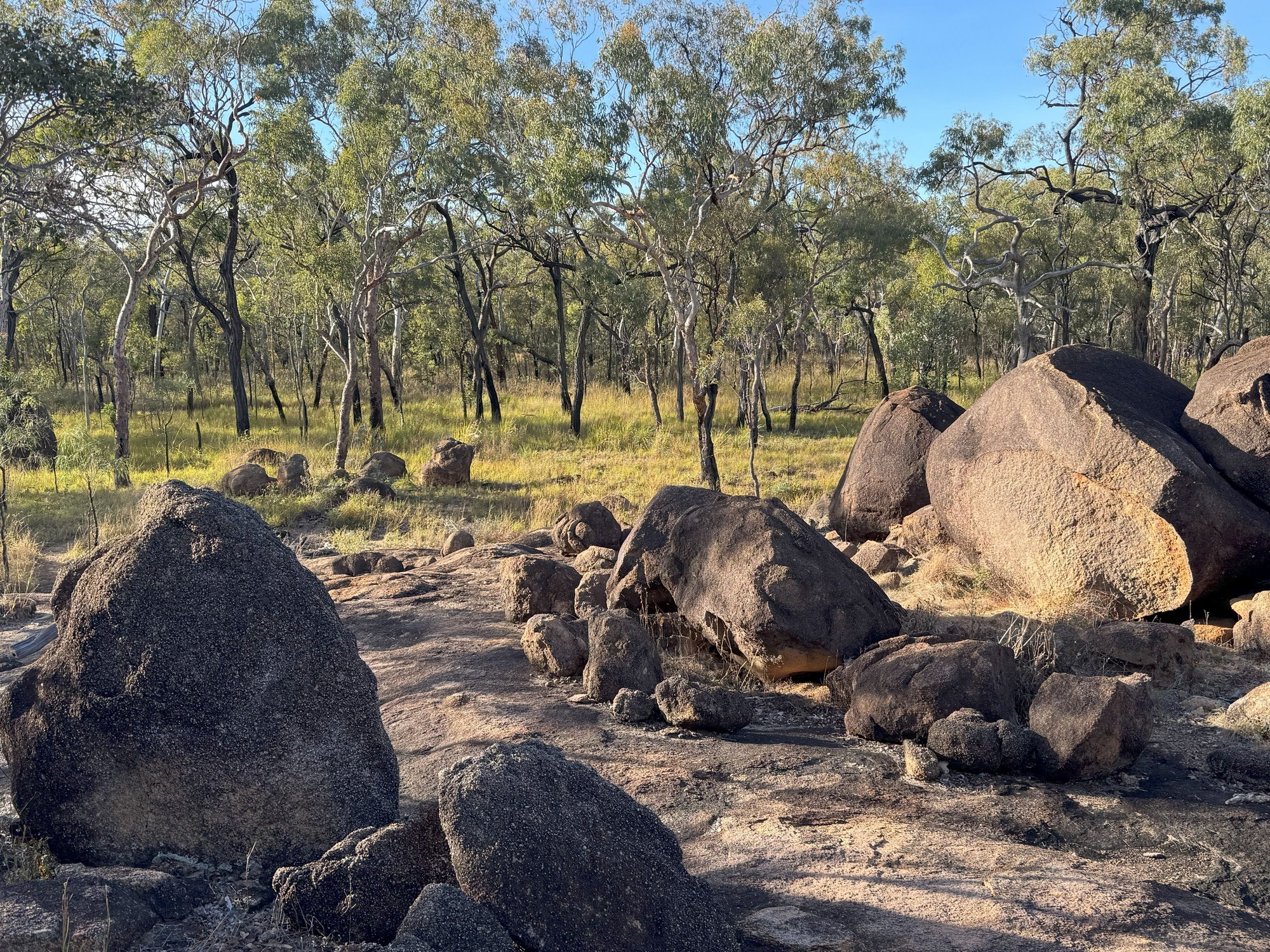
Savannah and boulders galore
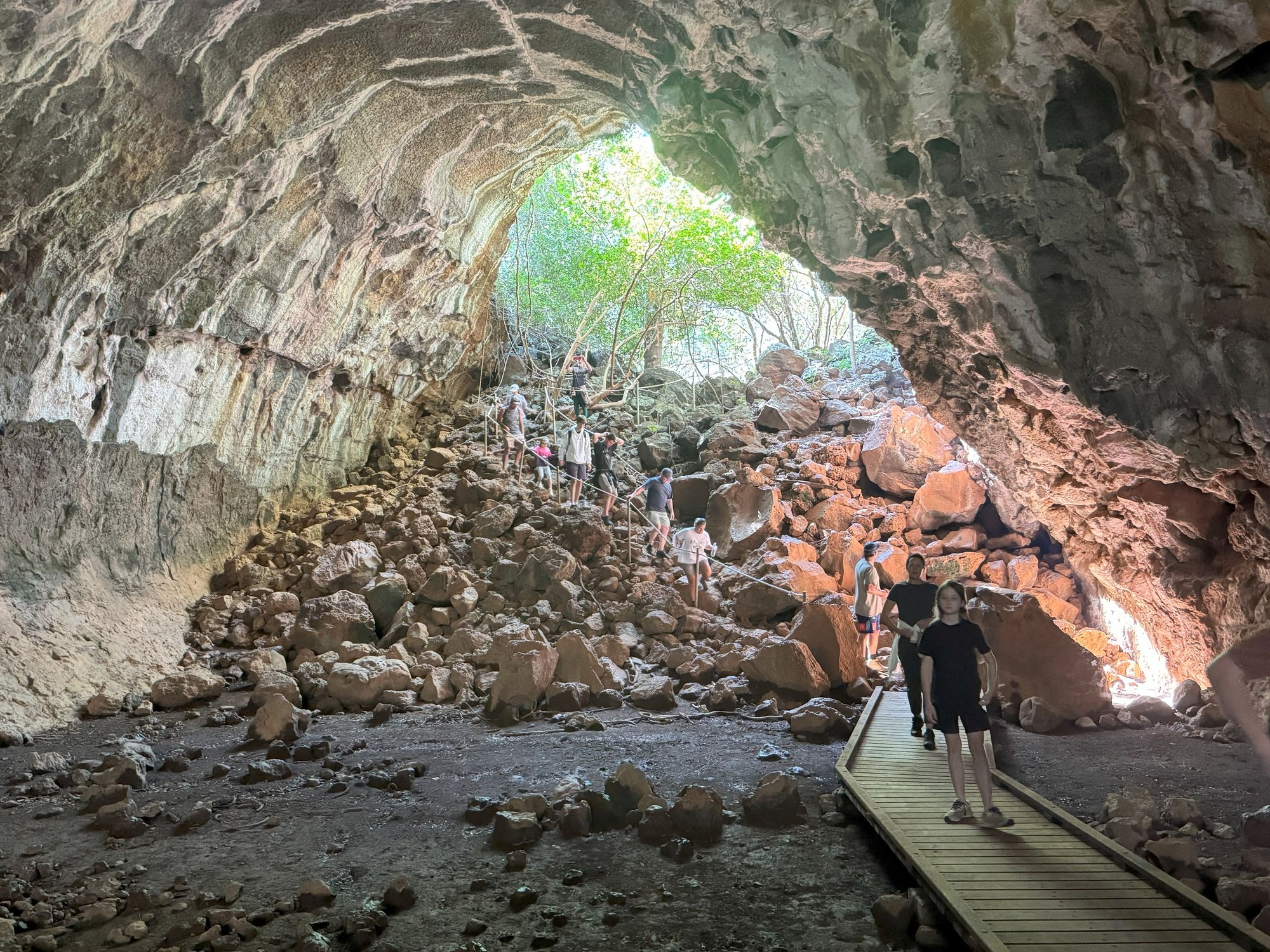
Wind Tunnel lava tube entrance
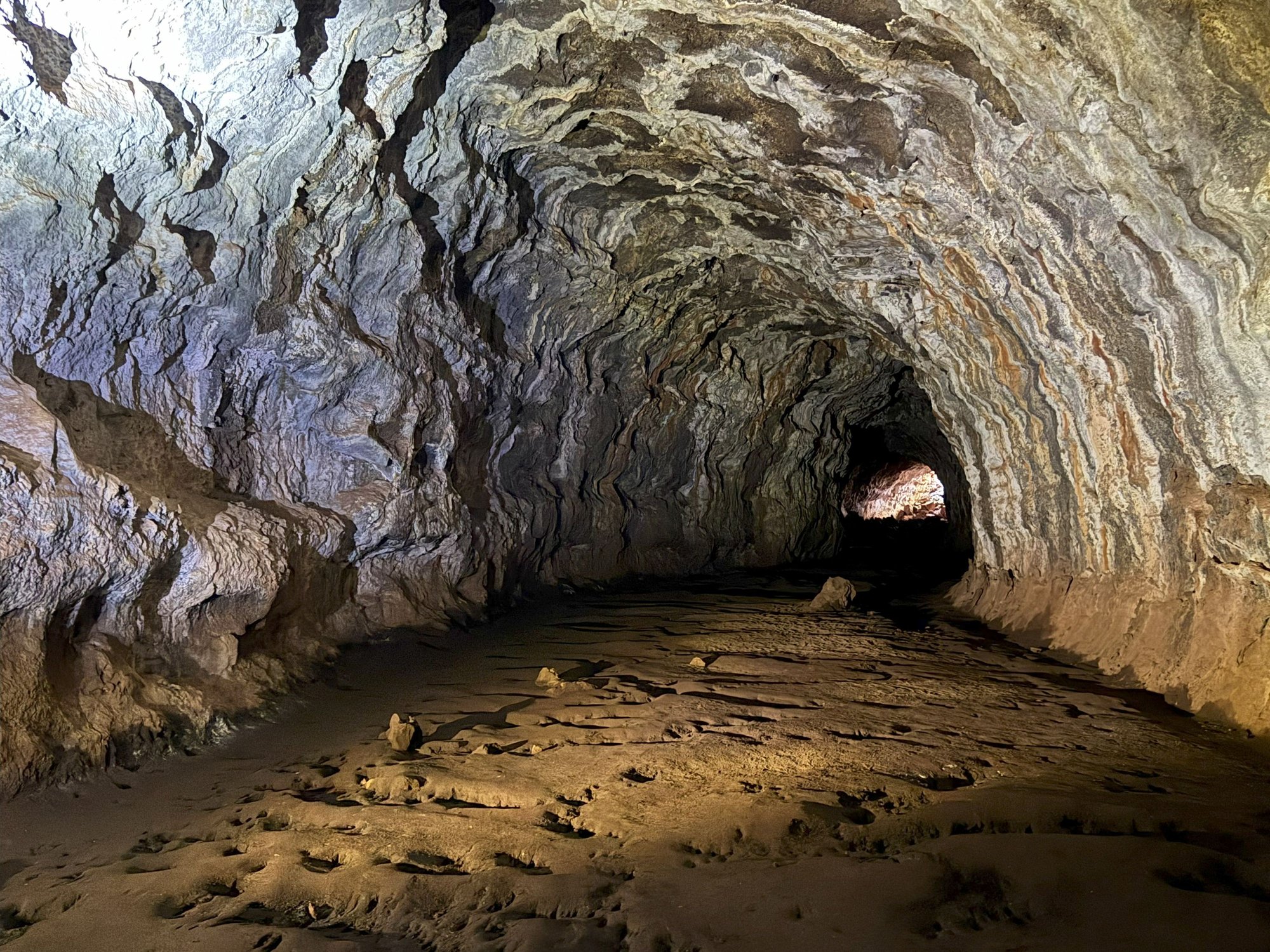
Wind Tunnel lava tube
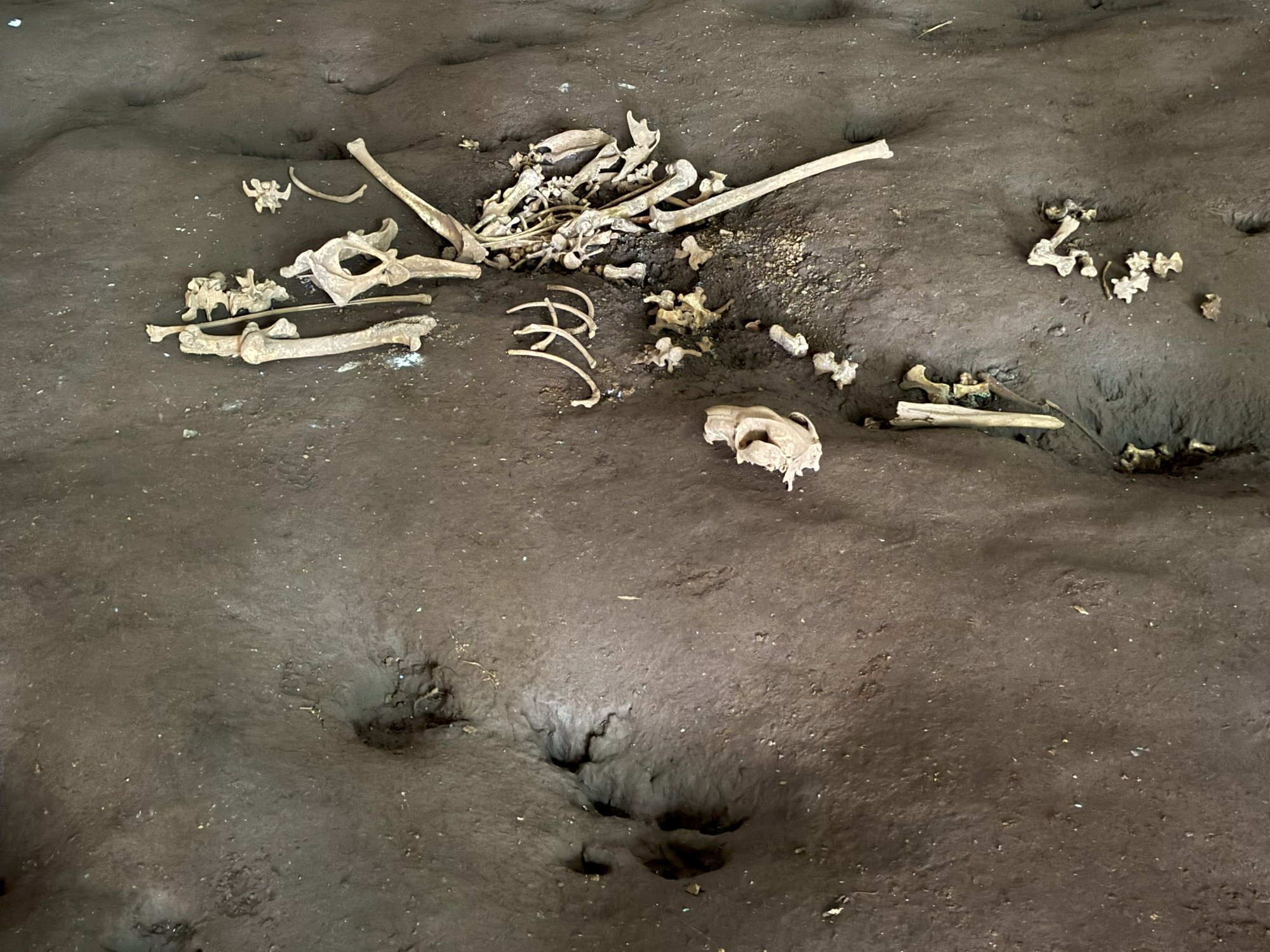
This wallaby got stuck in the tube somehow
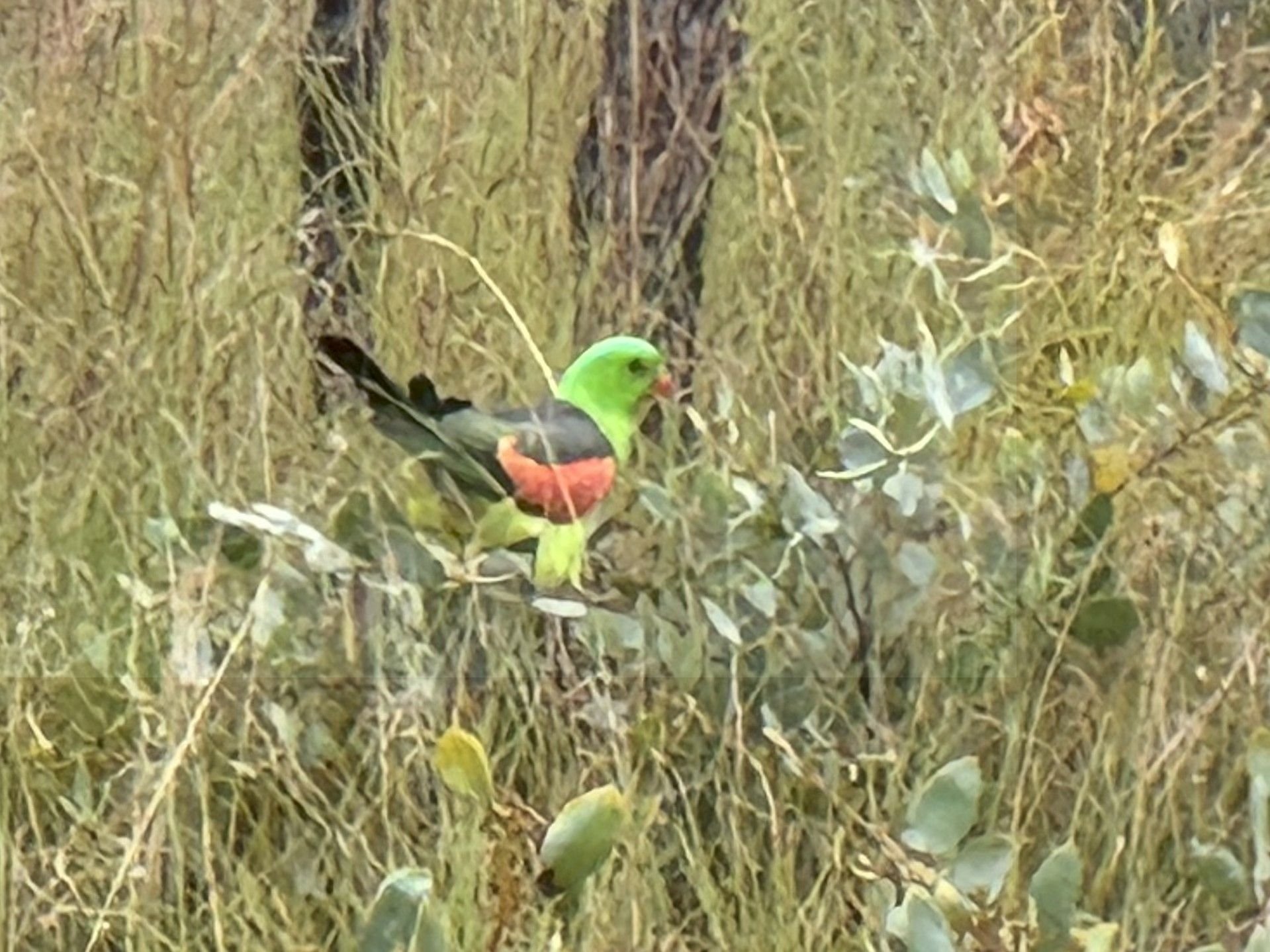
Red Winged Parrot
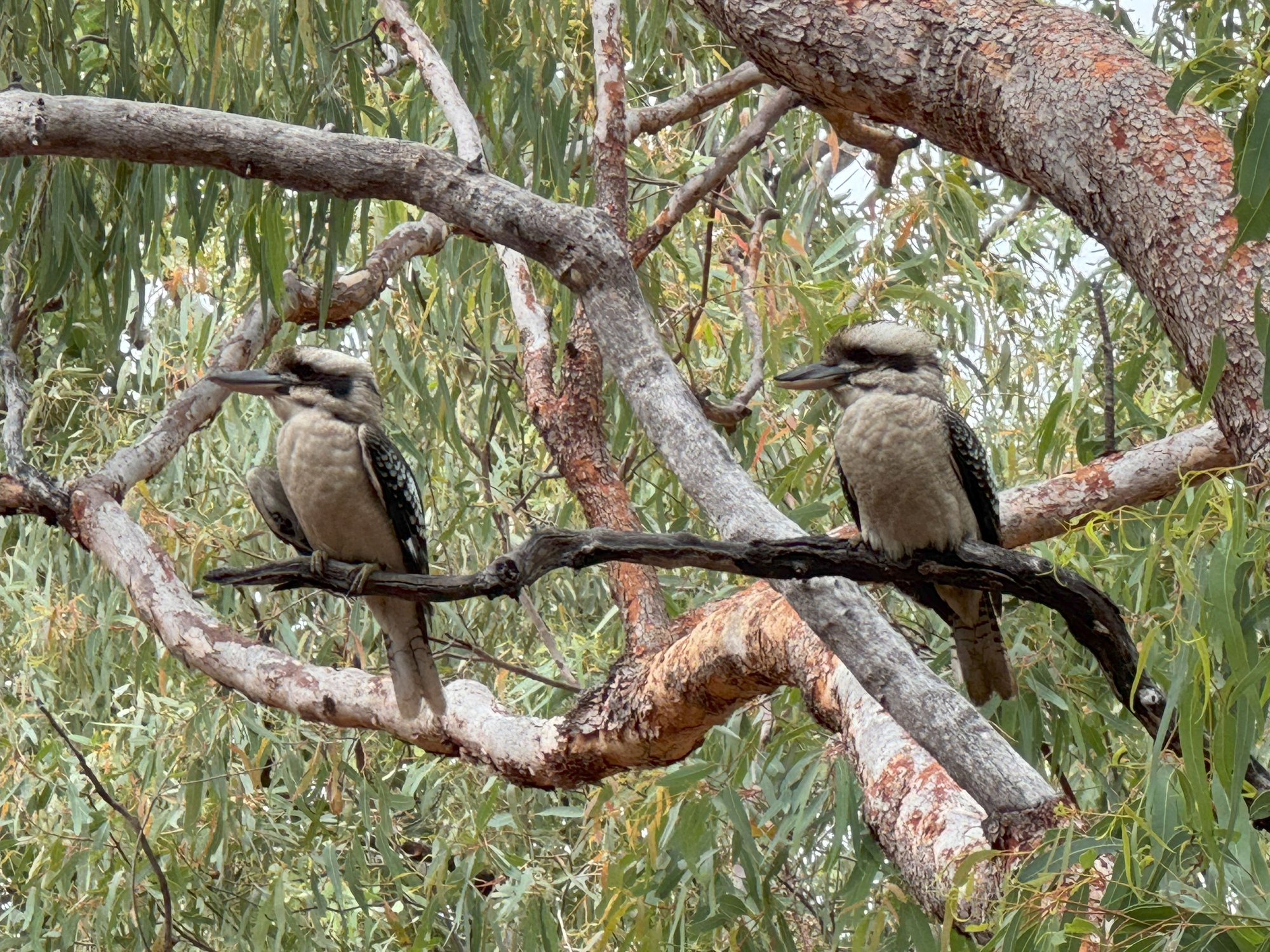
Kookaburras ready to strike - to swoop down to steal our dinners!
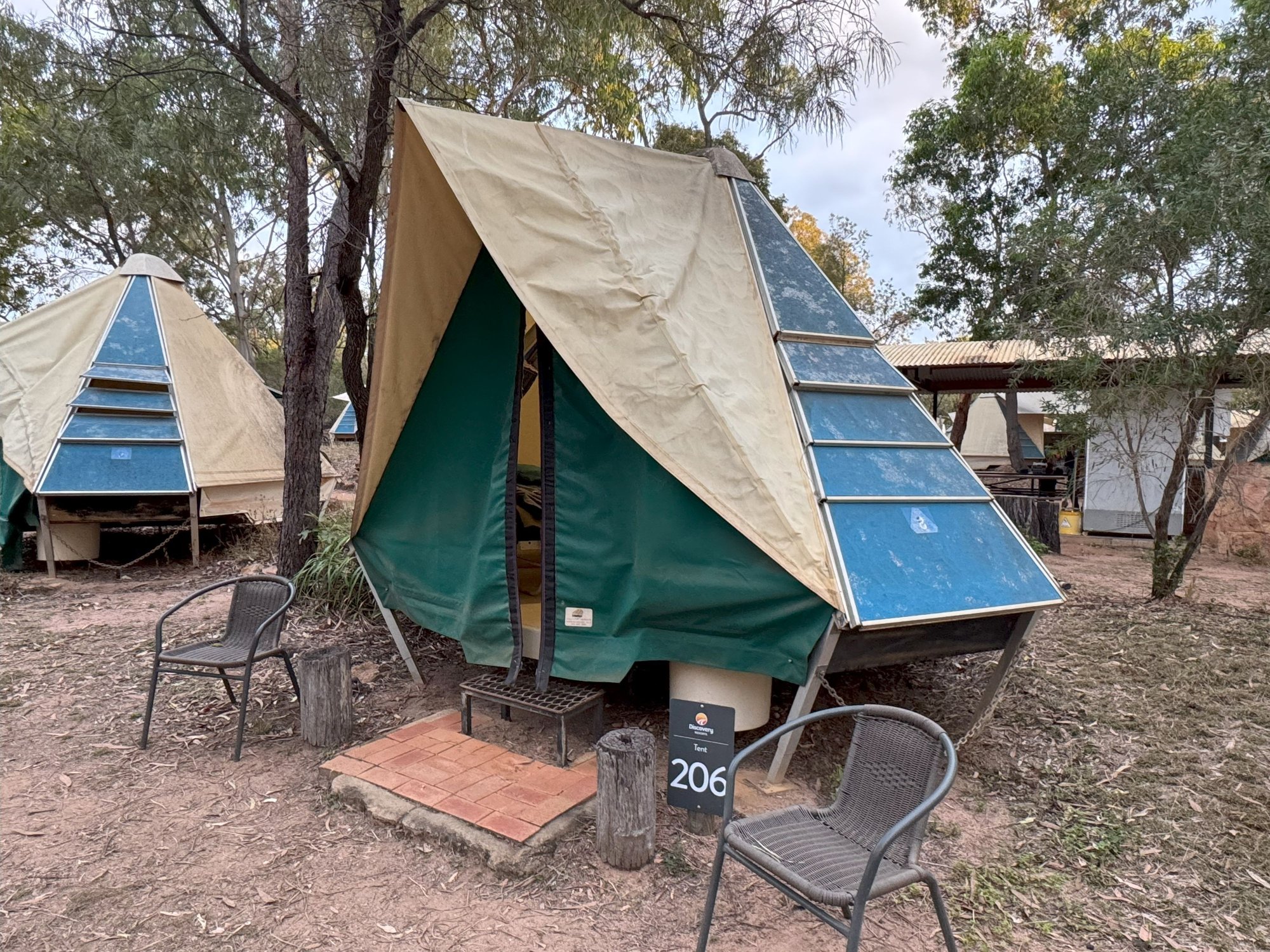
Our swag tent at Undara. There is much nicer accommodation available.
Undara National Park is renowned for its volcanic features, in particular its extensive system of lava tubes that are the main draw for tourists. There are also several volcanic cinder cones, including the Kalkani Crater, the rim of which is accessible as part of a 2.3 km (1.4 mile) loop trail. We encountered the turnoff to the Kalkani Crater on the way into the park, and so, with time to spare, we decided to climb it then and there. Views around the rim were limited by trees, but nonetheless, you could look across the perfectly circular bowl to the other side. Pretty cool.
Halfway round the Kalkani rim. I was startled by something I had nearly stepped on – a large greenish-brown snake, which was, fortunately, just as startled as me and quickly slithered away into the bush. I related this to one of the guides the next day, who instantly deemed it being a King Brown, a very poisonous snake that could have quickly ended my trip. Yikes! I have done a lot of hiking in Australia and can confidently say that such a close encounter is a rare occurrence, not because the snakes aren’t there, it’s because they sense you coming and usually disappear.We stayed at the Discovery Resorts facility, the only accommodation in the park. In retrospect, I wish we’d just used our rooftop tents and camped in the designated camping/RV area, closer to the shared bathroom facilities. Instead, we stayed in one of the rigid two-man swag tents that were available at a small rate. Our swag was in pretty good shape, but some were in ruins. Much nicer en suite accommodation was also available, including a line of repurposed antique railroad carriages. That evening we enjoyed a respectable meal and a few beers in the large covered common area at the center of the resort complex. After dark, it was (for me) a glass of wine (or two) sitting and socializing with Dave and others around a central fire pit.
We could have eaten in the dining area the next morning but instead opted for a “bush breakfast”, cooked on and served around a fire in a nearby clearing – eggs, sausages, bacon, toast, billy tea, etc. With time to kill before our lava tube tour, we took a hike on one of the several hiking trails emanating from the resort. We climbed the bluff behind the facility. This was capped with large boulders atop which afforded nice views over the park. Low areas in the mid-distance were flooded - I assume a result of the torrential rains that had submerged huge parts of Queensland earlier in the year.
The Undara lava tubes can only be accessed on a guided tour. Among other options, we opted for the 2-hour Wind Tunnel tour, which goes down a rocky path into one cave entrance (a collapsed section of the tube), along a stretch of giant lava tube and out another opening. On the small bus to the start of the hike, our obviously experienced guide explained how the lava tubes were formed (lava from the Undara crater, some distance away). He also delved into the abundant wildlife in the park and efforts to control feral cats by not killing the dingoes (native animals) that prey on them. As we descended into the cave, he explained the survival of the vine thicket rainforest vegetation existing around the cave openings and collapsed tube sections. In the cave he pointed out some of the creatures that live there – bats (of course), spiders, etc. We also saw the bones of a couple of unfortunate wallabies that had perished in the cave for some reason.
Back at the lodge, it was meat pies for lunch followed by a hike to the Atkinson Lookout, a modest granite dome, about a mile away. The best wildlife sighting was a stunningly beautiful Red Winged Parrot, a new Australian bird for me. It was quite warm and humid that afternoon, so we were eager to relax outside our swag with couple of cold “tinnies” from our vehicle’s refrigerator. Dinner that night was again in the common outdoor dining area. It was amusing to watch a couple of kookaburras positioning themselves in a nearby tree looking for opportunities (which they took) to swoop down and steal food from people’s plates.
Around the firepit that night we talked to several interesting people including a couple of young-ish, somewhat tipsy women from north of Cairns. I wouldn’t have picked one of them as a driver of enormous dump trucks that service a coal mine somewhere in central Queensland: very good money (~150 k/year) but a 10-day on-10-day off commute to/from Cairns by air. Quite a lifestyle!
Beginning the Kalkani Crater. This nice lady kindly offered to add perspective to my picture...
Saw quite a few of these guys...
Bush breakfast
Lovely view from the bluff behind the resort. The hills in the distance are volcanic cinder cones.
Savannah and boulders galore
Wind Tunnel lava tube entrance
Wind Tunnel lava tube
This wallaby got stuck in the tube somehow
Red Winged Parrot
Kookaburras ready to strike - to swoop down to steal our dinners!
Our swag tent at Undara. There is much nicer accommodation available.
Last edited by RalphR; Sep 6th, 2025 at 11:13 AM. Reason: mistakes
Sep 7th, 2025 | 06:50 AM
#14
Original Poster
Joined: Apr 2004
Posts: 1,147
Likes: 0


 Sep 11th, 2025 | 10:03 AM
#18
Original Poster
Joined: Apr 2004
Posts: 1,147
Likes: 0
Part 4: Undara to Karumba and Mt. Isa
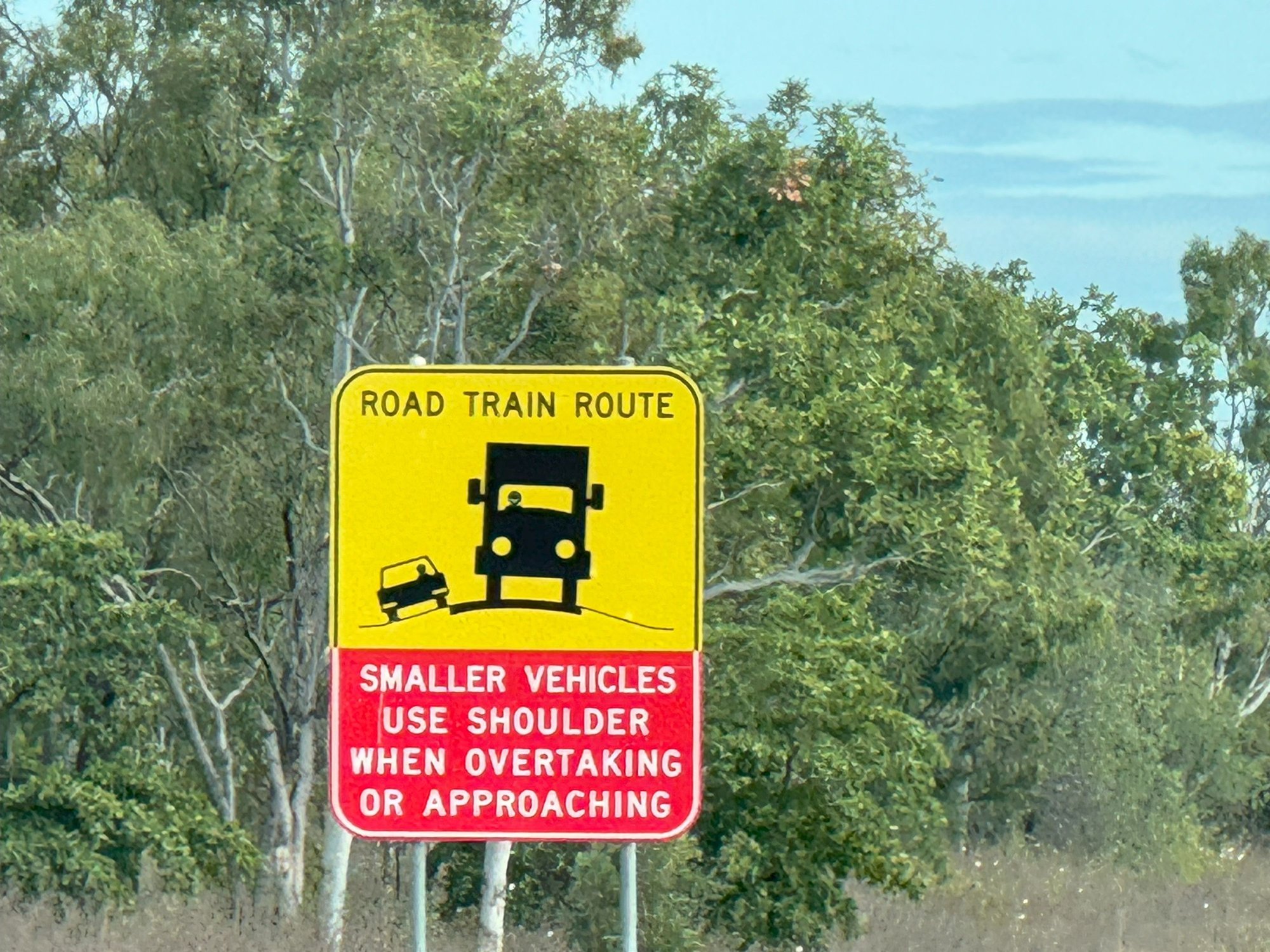
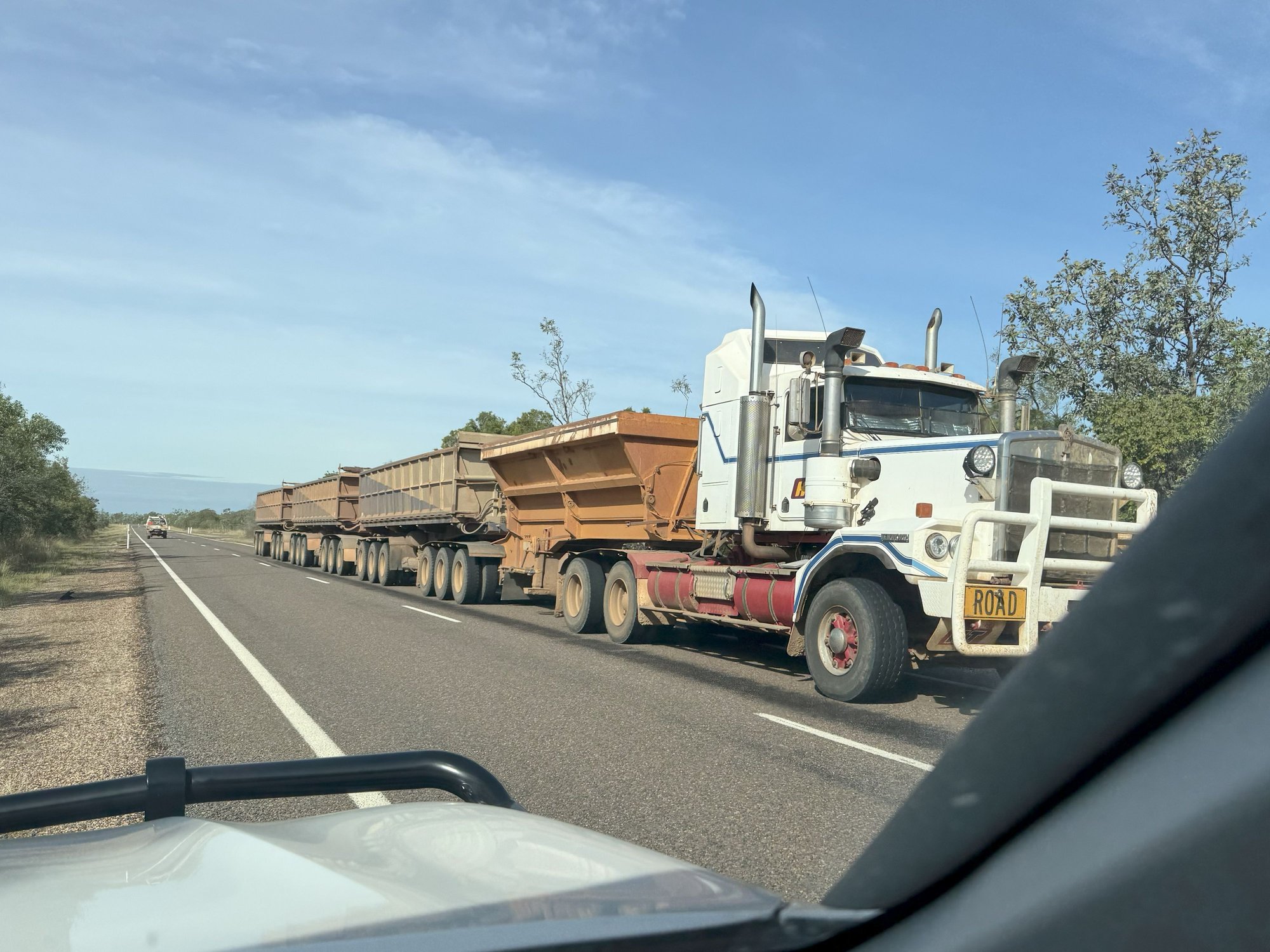
Our drive west on the Gulf Development Road from Undara across the base of the Cape York Peninsula to Karumba on the Gulf of Carpentaria was a long one – 570 km (350 miles). Except at the end as we neared the Gulf, the savannah was less flat than anticipated. But as would be the case for much of our journey, there were long, dead straight sections with the road disappearing over the horizon miles away. The road was mostly two-lane and paved, but in a few sections, it was unpaved or just paved with one lane down the middle. It was on the latter where we had to be particularly careful to mind oncoming road trains. These enormous vehicles - up to 175 feet (53 m) long and pulling up to four large trailers – do not move off the bitumen, forcing oncoming traffic (except, I suppose, other road trains) right off the road and onto the verge. This fact, along with free-ranging livestock and wildlife, are the reasons why driving at night in the outback is such a bad idea. We had planned our itinerary with this in mind, allowing plenty of time to reach our destinations before sunset.
Along the way, we fueled up in Georgetown and stopped to cook lunch at Lake Belmore, a man-made reservoir outside Croydon. At a lookout over Croydon, we got talking to a local gentleman who related the story of a massive fireball meteor that had exploded in the skies above the area in 2023. Amusingly, he was sure that we could find pieces of it if we kept an eye out.
Karumba would be the first place we slept in our rooftop tents as there were no other accommodations option available. We were lucky to get a space at the caravan (RV) park there, Karumba being a popular destination in the “winter” months for fishing in the Gulf and being a scenic coastal stopover for “grey nomads” - retirees like us, usually pulling a caravan, traveling around the continent. Indeed, virtually anywhere went most of the vehicles we encountered were either caravans or road trains.
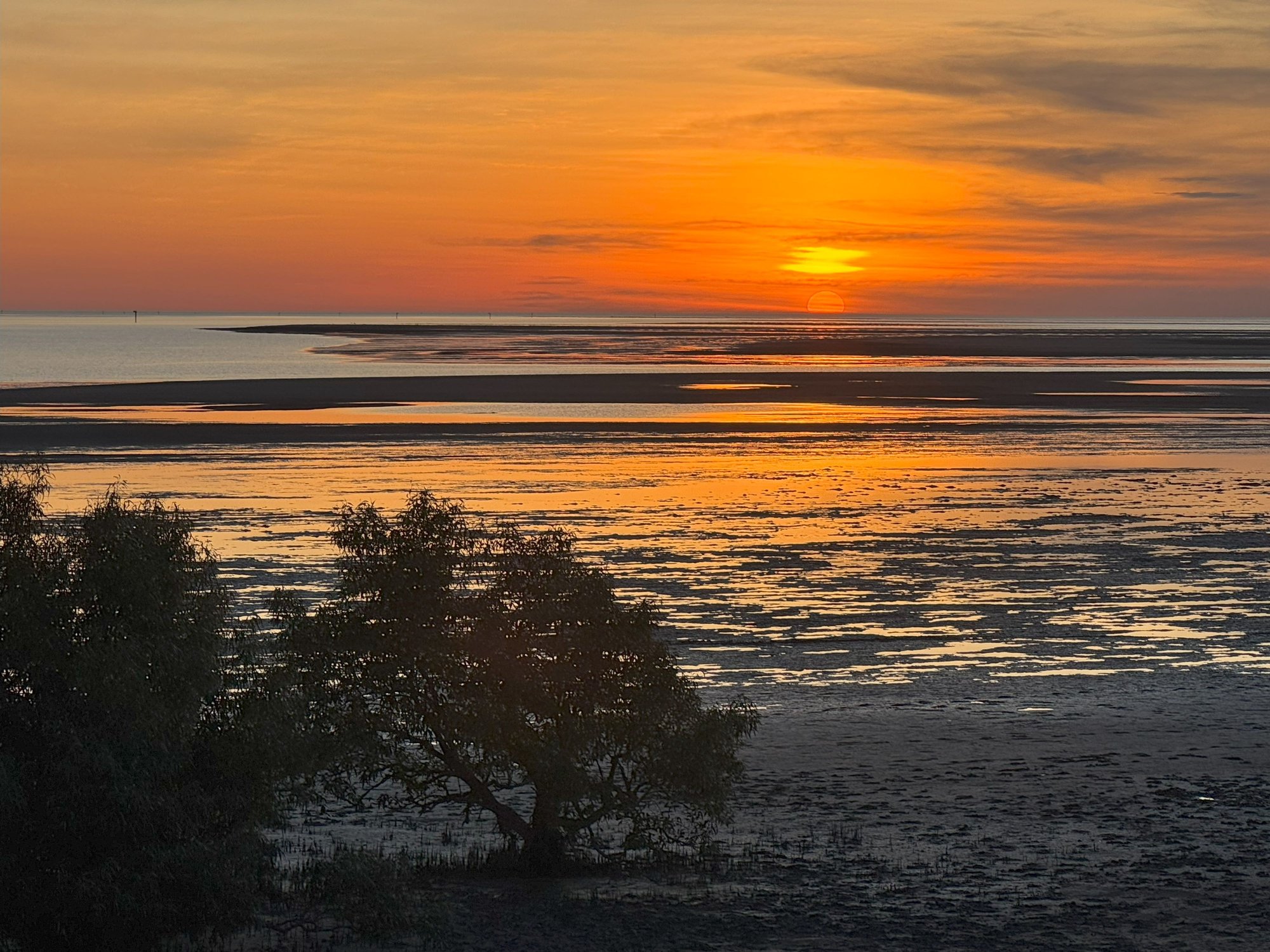
Deploying our rooftop tents was new to us and somewhat involved, so we were sure to get them up before sunset. That done, we ventured up the road to get our first look at the turquoise waters of the Gulf of Carpentaria from the beachside patio of the Sunset Tavern. There we enjoyed fresh-caught barramundi and beer as we watched a magnificent sunset unfold over the sea.
The next day (July 7) we began the southbound section of the adventure heading to the remote mining city of Mt. Isa in far western Queensland. After Normanton, where we picked up groceries, dense concentrations of termite mounds dotted the flat savannah for miles – fascinating! Closer to Mt. Isa, the terrain became hilly and quite rugged. We stopped at a memorial honoring Burke and Wills who perished in the Outback in the 1860’s while leading an expedition to establish an inland route from Melbourne to the Gulf of Carpentaria. If I were Burke and Wills, looking down from above, I think I’d prefer no memorial to that one - a small plaque mounted in a crude stone obelisk accompanied by a similarly sized, bright red rubbish bin six feet away.
In Mt Isa, we checked in to the Burke and Wills Motel, did a load of laundry then walked up the street for beers at the Buffs Club, a modern facility with sports bar, gaming area (i.e., slot machines, or “pokies”) and restaurant. A couple of the bartenders were from France – the first of many young people from overseas we met who were extending their visas by working in rural locales.We felt we deserved a more up-market dinner, so we settled on Giuseppe’s Cantina, a block or two away. I wouldn’t have thought we’d find a place nearly as good as it was in a frontier mining town, but then again, mining creates a lot of wealth.
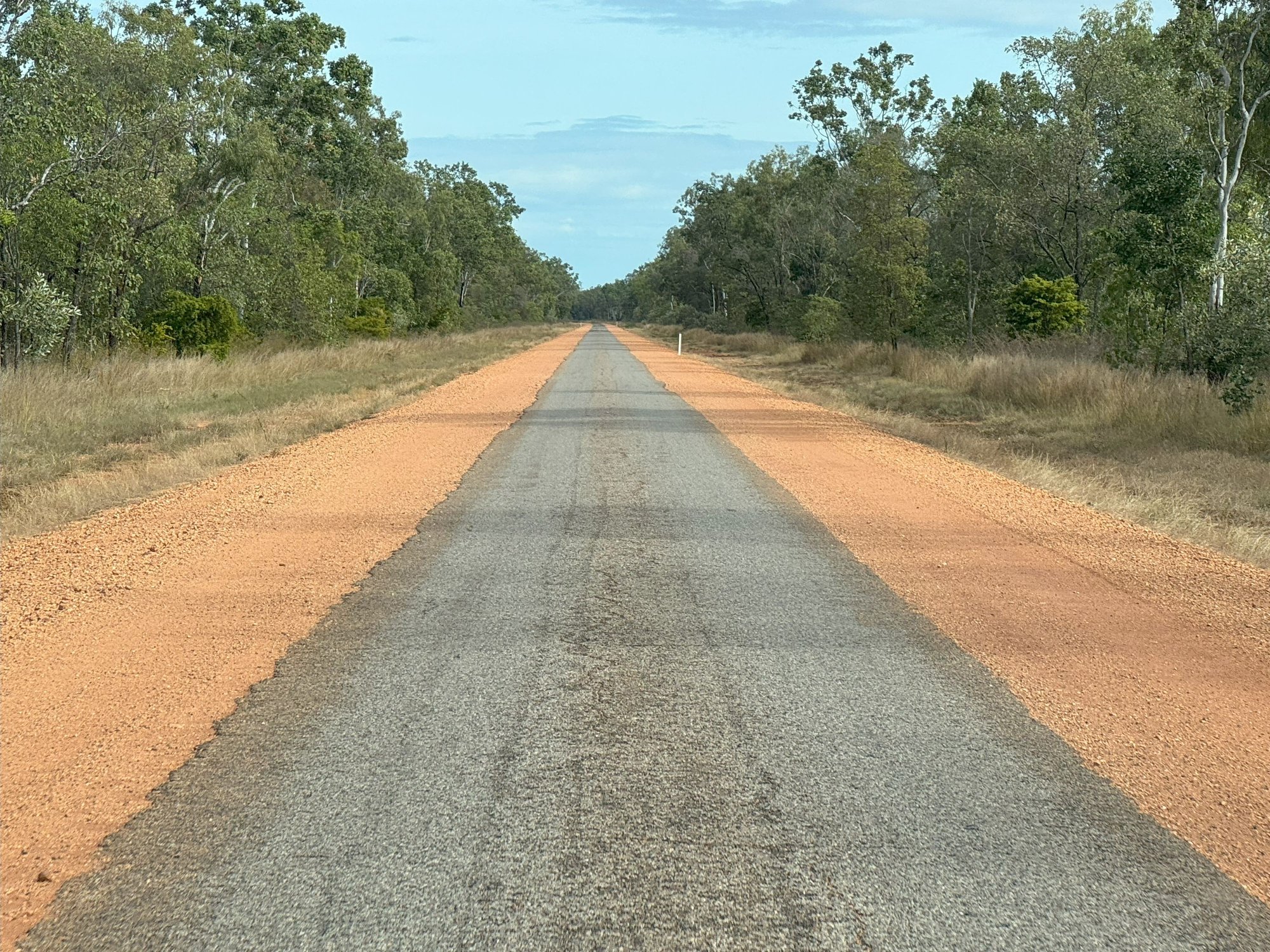
Road paved down the middle.
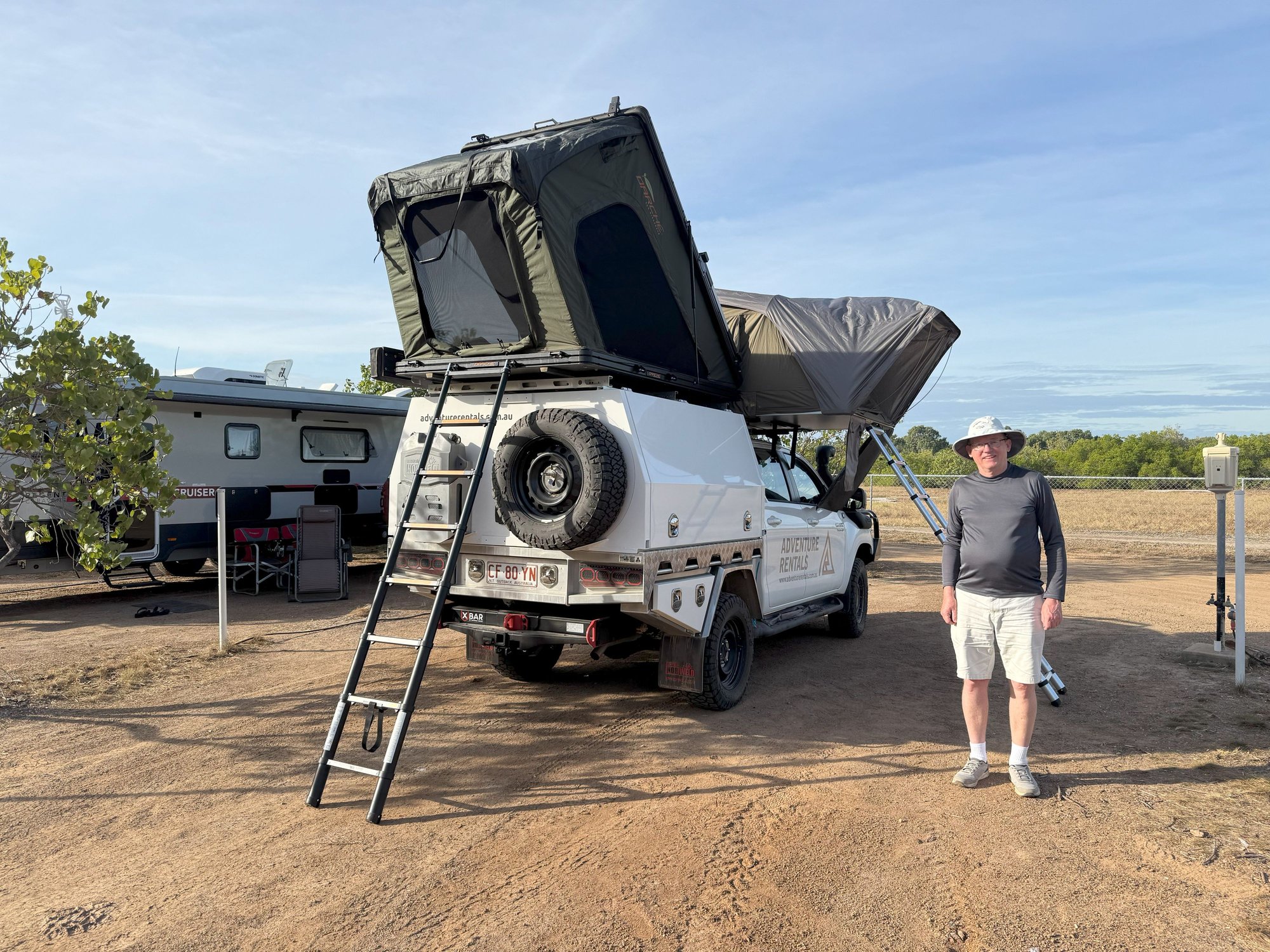
Tents up in Karumba. Pretty confortable, though getting up to pee at night wasn't fun.
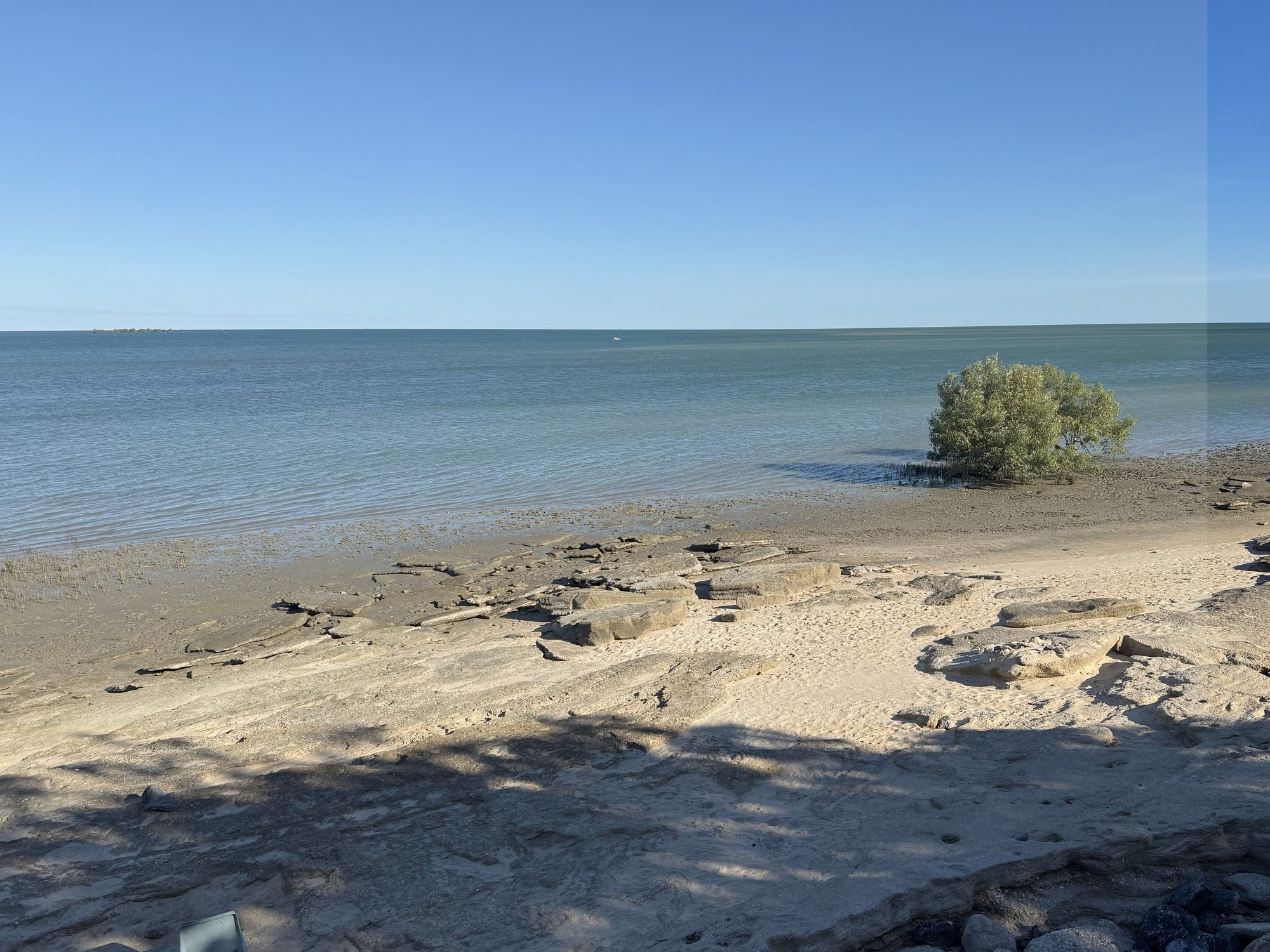
The Gulf of Carpentaria at Karumba
Karumba sunset
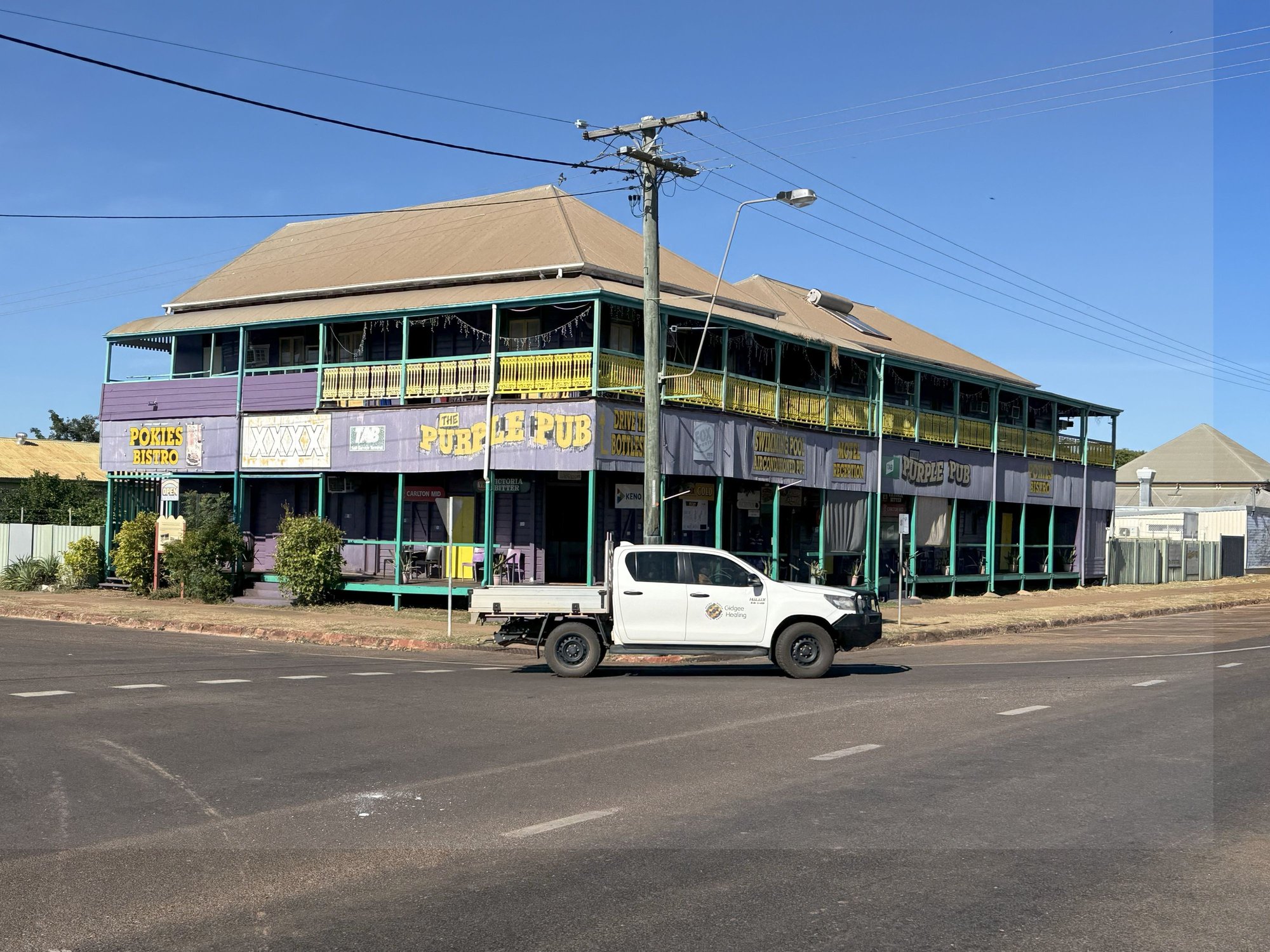
The Purple Pub, Normanton - a classic outback "hotel"
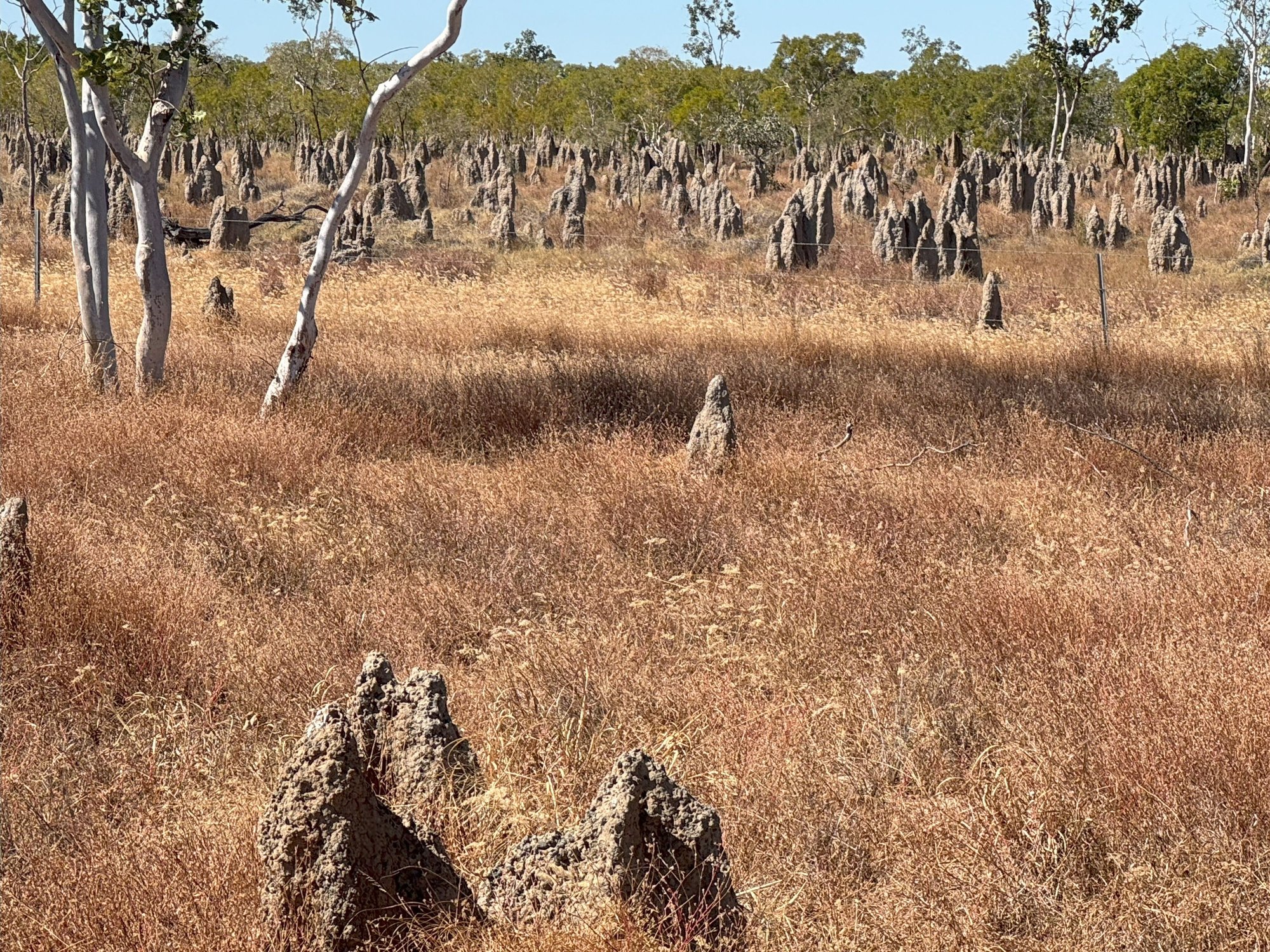
Zillions of termite mounds south of Normanton on the Gulf Savannah
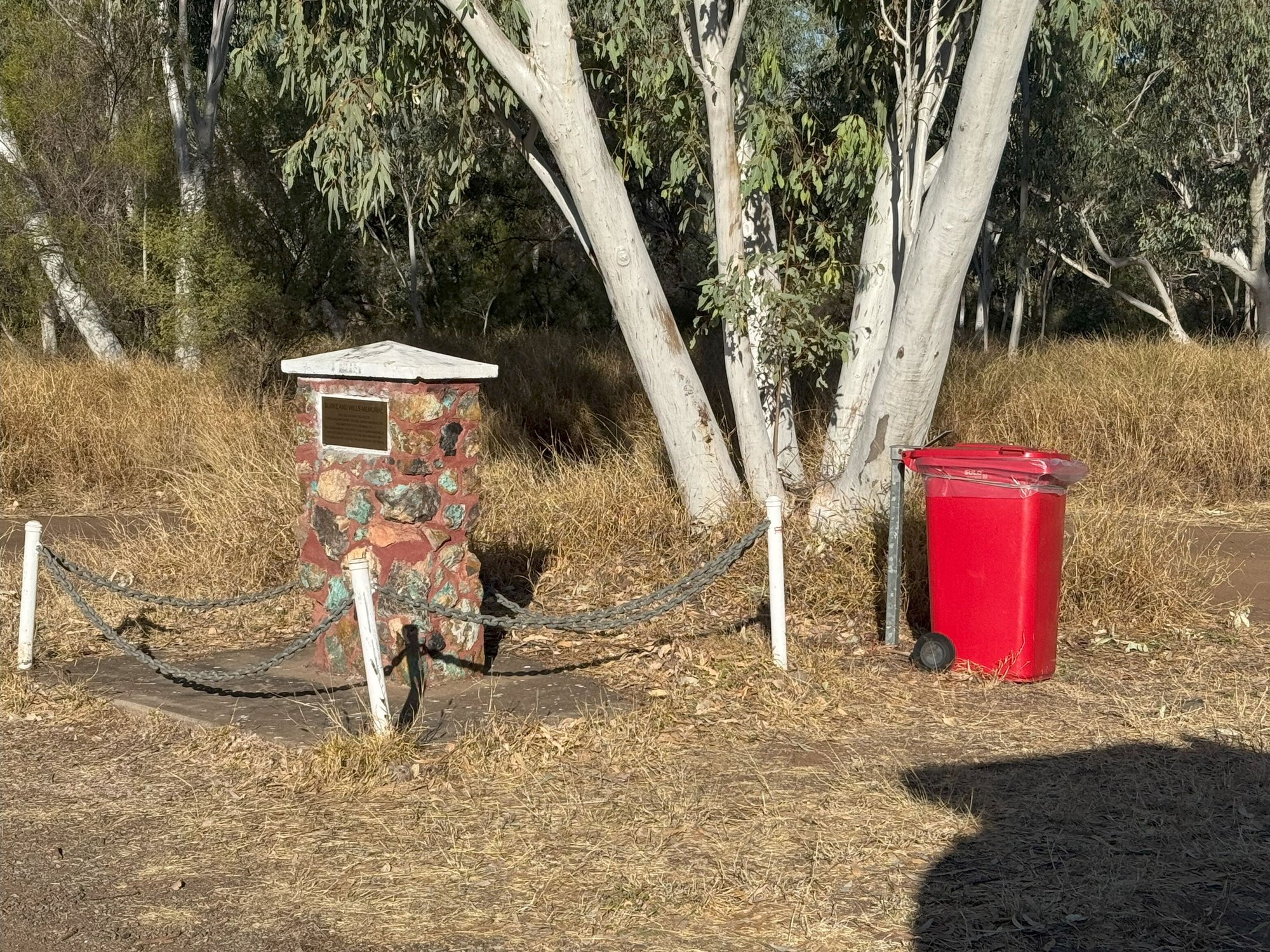
Burke and Wills Memorial outside Mt. Isa. Don't go out of your way!
Along the way, we fueled up in Georgetown and stopped to cook lunch at Lake Belmore, a man-made reservoir outside Croydon. At a lookout over Croydon, we got talking to a local gentleman who related the story of a massive fireball meteor that had exploded in the skies above the area in 2023. Amusingly, he was sure that we could find pieces of it if we kept an eye out.
Karumba would be the first place we slept in our rooftop tents as there were no other accommodations option available. We were lucky to get a space at the caravan (RV) park there, Karumba being a popular destination in the “winter” months for fishing in the Gulf and being a scenic coastal stopover for “grey nomads” - retirees like us, usually pulling a caravan, traveling around the continent. Indeed, virtually anywhere went most of the vehicles we encountered were either caravans or road trains.
Deploying our rooftop tents was new to us and somewhat involved, so we were sure to get them up before sunset. That done, we ventured up the road to get our first look at the turquoise waters of the Gulf of Carpentaria from the beachside patio of the Sunset Tavern. There we enjoyed fresh-caught barramundi and beer as we watched a magnificent sunset unfold over the sea.
The next day (July 7) we began the southbound section of the adventure heading to the remote mining city of Mt. Isa in far western Queensland. After Normanton, where we picked up groceries, dense concentrations of termite mounds dotted the flat savannah for miles – fascinating! Closer to Mt. Isa, the terrain became hilly and quite rugged. We stopped at a memorial honoring Burke and Wills who perished in the Outback in the 1860’s while leading an expedition to establish an inland route from Melbourne to the Gulf of Carpentaria. If I were Burke and Wills, looking down from above, I think I’d prefer no memorial to that one - a small plaque mounted in a crude stone obelisk accompanied by a similarly sized, bright red rubbish bin six feet away.
In Mt Isa, we checked in to the Burke and Wills Motel, did a load of laundry then walked up the street for beers at the Buffs Club, a modern facility with sports bar, gaming area (i.e., slot machines, or “pokies”) and restaurant. A couple of the bartenders were from France – the first of many young people from overseas we met who were extending their visas by working in rural locales.We felt we deserved a more up-market dinner, so we settled on Giuseppe’s Cantina, a block or two away. I wouldn’t have thought we’d find a place nearly as good as it was in a frontier mining town, but then again, mining creates a lot of wealth.
Road paved down the middle.
Tents up in Karumba. Pretty confortable, though getting up to pee at night wasn't fun.
The Gulf of Carpentaria at Karumba
Karumba sunset
The Purple Pub, Normanton - a classic outback "hotel"
Zillions of termite mounds south of Normanton on the Gulf Savannah
Burke and Wills Memorial outside Mt. Isa. Don't go out of your way!
Last edited by RalphR; Sep 11th, 2025 at 10:04 AM. Reason: Formatting
 Sep 12th, 2025 | 02:17 AM
#20
Joined: Oct 2007
Posts: 16,541
Likes: 4
Spectacular sunset at Karumba, Ralph. I agree about the Bourke & Wills Memorial. That's a disgraceful "why bother?" & the Shire Council should be ashamed of themselves.
I looked at that bitumen strip in the middle of the road & remembered when we thought it was marvellous to have the same on our formerly unsealed black soil road. My second thought, looking at the red gravel was to wonder how many windscreens were broken on that road every year.
I looked at that bitumen strip in the middle of the road & remembered when we thought it was marvellous to have the same on our formerly unsealed black soil road. My second thought, looking at the red gravel was to wonder how many windscreens were broken on that road every year.

