


Dornoch to Dunrobin Castle and Glenmorangie Distrillery
 Mar 29th, 2022 | 09:50 AM
#1
Original Poster

Joined: Apr 2004
Posts: 72
Likes: 0
Dornoch to Dunrobin Castle and Glenmorangie Distrillery
While the boys take a day off golf at Royal Dornoch, would it be feasible to visit both Dunrobin Castle and Glenmorangie Distrillery in the same day? We won't have a car so would most likely arrange for private driver/taxi. I realize that one location is north of Dornoch and the other south, but just wonder how much time we should devote to each location. Thanks in advance for your help.
 Mar 29th, 2022 | 10:13 AM
#2


Joined: Oct 2005
Posts: 75,075
Likes: 50
Oh -- sure -- especially with a local driver. Dornoch to Glenmorangie to Dunrobin and back again would be barely an hour's drive total. I'd even be tempted to have the driver squeeze in a detour to the Falls of Shin too. Maybe a total drive time for all three of 90-ish minutes. Two hours at Dunrobin would be generous - a little more if you really want to explore the gardens (and the weather cooperates  ), and the tour + tasting at Glenmorangie can easily be done in 90 minutes.
), and the tour + tasting at Glenmorangie can easily be done in 90 minutes.
 Mar 30th, 2022 | 01:05 PM
#4


Joined: Jan 2003
Posts: 19,887
Likes: 79
Can I suggest a possible alternative to Dunrobin? (Of course I can, this is a website for advice, which you don't have to take.) I will confess that this suggestion is borne of a lot of personal opinion (and likely some very distant family history) having to do with the Dukes (and before them, the Earls) of Sutherland, for which Dunrobin Castle has served as the family (and clan) home. Forgive me if this gets a little political, but there you go.
The history: Following the 1745 Jacobite rising, which ended ingloriously at Culloden Moor near Inverness (and which a lot more people know about today, thanks to Outlander) the Earls and Dukes of Sutherland, who had sided with the English during the rebellion, were major players in the Highland Clearances. This was a campaign basically of what we would now call "ethnic cleansing" - the forced removal of Highlanders from their lands so that the landowners (in many cases now not Scots) could introduce sheep farming as the dominant economy. Sheep farming requires far fewer human workers compared to cattle, the previously dominant land use, so the estate owners were faced with a population "surplus." The rural population, already decimated by the loss of many males due to the rising, and by poverty and disease (and presently Scotland's own potato famine) was summarily evicted from the glens that they'd occupied for centuries. Some were sent to the coast to become fishers, even though they had never known how to be fishers before, and thousands and thousands of others were exiled - some to the Glasgow area, many to Northern Ireland, and thousands more to places like the West Indies, to America (especially the south) and to Canada.
The clearances reached their peak in Sutherland in the 1840s, right about the time that Dunrobin Castle was assuming its present form. The Duchess of Sutherland was one of the most influential, if not THE most influential, advocates of the clearances, along with her husband, who has a dreadful statue standing near Golspie, adorned with a motto something like. "a kind and generous landlord." AS IF.
Anyway, what does this mean to you? So my recommendation, either in lieu of Dunrobin or in addition to it, is to find a local driver who will take you on a very scenic (if ultimately heartbreaking) drive from the Glenmorangie distillery (holy ground) 10 miles up Strathcarron from the village of Ardgay (south of Bonar Bridge) to the lovely and lonely Croick Church.
This church, and the churchyard around it, was used as a staging ground for the eviction of many Highland families from the nearby glens, precipitated by the likes of the Duke and Duchess up the coast at Dunrobin. And the strath itself, once relatively heavily populated, is now vacant, save for a giant stately home or two, the spoils of the campaign.
The windows of the church bear messages scratched on the glass by some of the people who were confined in the churchyard awaiting their transport. The most heartbreaking message reads, "The wicked generation," thanks to the messages of the (bought and paid for) preachers who sought to explain away the people's misfortune as punishment for their sins.
I know this isn't as pleasurable a visit as you might have at the (admittedly lovely) gardens at Dunrobin, but in the context of much of the Dornoch Firth area (from Dunrobin to Andrew Carnegie's Skibo estate) it's a reminder of how intolerance and greed can transform a country. Or it is in my opinion.
Some pictures taken a few years ago -
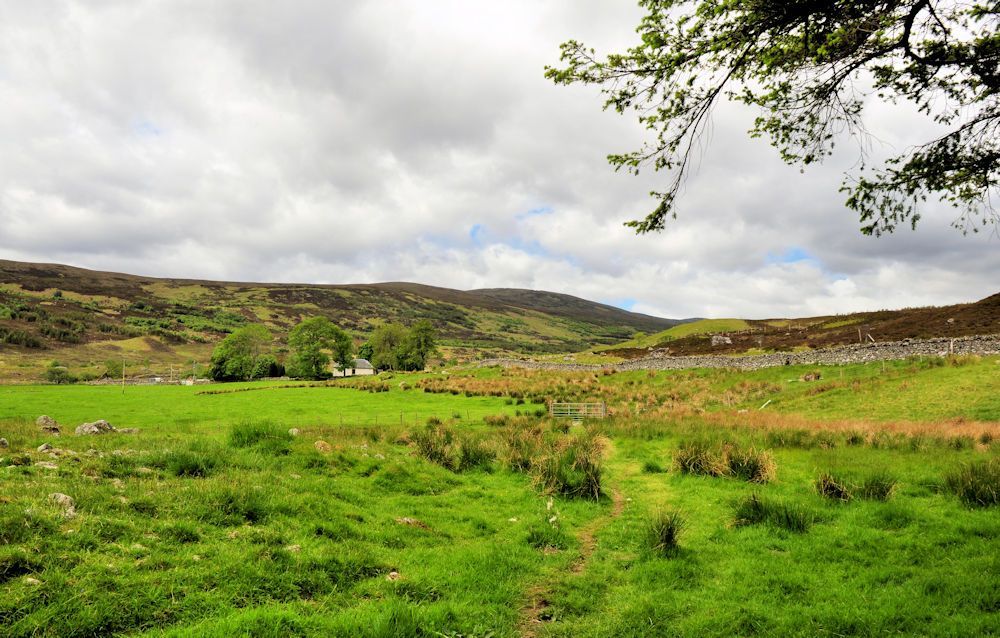
Croick church in the distance
In the churchyard

The wicked generation

Nobody's home

The local laird's wee hoose

Map - https://goo.gl/maps/9gaNMTnSLfkCKsRE6
The history: Following the 1745 Jacobite rising, which ended ingloriously at Culloden Moor near Inverness (and which a lot more people know about today, thanks to Outlander) the Earls and Dukes of Sutherland, who had sided with the English during the rebellion, were major players in the Highland Clearances. This was a campaign basically of what we would now call "ethnic cleansing" - the forced removal of Highlanders from their lands so that the landowners (in many cases now not Scots) could introduce sheep farming as the dominant economy. Sheep farming requires far fewer human workers compared to cattle, the previously dominant land use, so the estate owners were faced with a population "surplus." The rural population, already decimated by the loss of many males due to the rising, and by poverty and disease (and presently Scotland's own potato famine) was summarily evicted from the glens that they'd occupied for centuries. Some were sent to the coast to become fishers, even though they had never known how to be fishers before, and thousands and thousands of others were exiled - some to the Glasgow area, many to Northern Ireland, and thousands more to places like the West Indies, to America (especially the south) and to Canada.
The clearances reached their peak in Sutherland in the 1840s, right about the time that Dunrobin Castle was assuming its present form. The Duchess of Sutherland was one of the most influential, if not THE most influential, advocates of the clearances, along with her husband, who has a dreadful statue standing near Golspie, adorned with a motto something like. "a kind and generous landlord." AS IF.
Anyway, what does this mean to you? So my recommendation, either in lieu of Dunrobin or in addition to it, is to find a local driver who will take you on a very scenic (if ultimately heartbreaking) drive from the Glenmorangie distillery (holy ground) 10 miles up Strathcarron from the village of Ardgay (south of Bonar Bridge) to the lovely and lonely Croick Church.
This church, and the churchyard around it, was used as a staging ground for the eviction of many Highland families from the nearby glens, precipitated by the likes of the Duke and Duchess up the coast at Dunrobin. And the strath itself, once relatively heavily populated, is now vacant, save for a giant stately home or two, the spoils of the campaign.
The windows of the church bear messages scratched on the glass by some of the people who were confined in the churchyard awaiting their transport. The most heartbreaking message reads, "The wicked generation," thanks to the messages of the (bought and paid for) preachers who sought to explain away the people's misfortune as punishment for their sins.
I know this isn't as pleasurable a visit as you might have at the (admittedly lovely) gardens at Dunrobin, but in the context of much of the Dornoch Firth area (from Dunrobin to Andrew Carnegie's Skibo estate) it's a reminder of how intolerance and greed can transform a country. Or it is in my opinion.
Some pictures taken a few years ago -
Croick church in the distance
In the churchyard
The wicked generation
Nobody's home
The local laird's wee hoose
Map - https://goo.gl/maps/9gaNMTnSLfkCKsRE6

Thread
Original Poster
Forum
Replies
Last Post
Bheathia
Europe
4
Mar 31st, 2002 01:26 PM


