

Fodor's Expert Review Liberty Bell Center
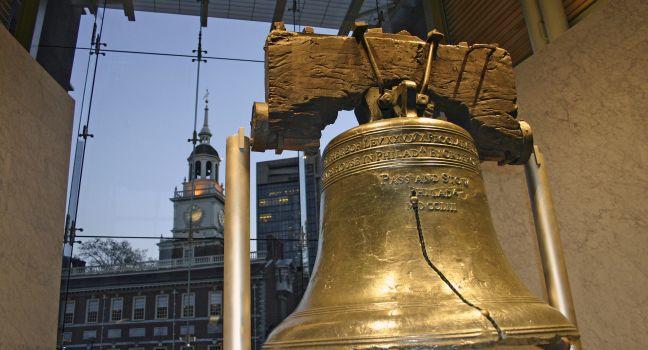
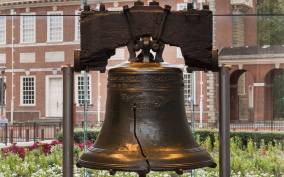
The bell fulfilled the words of its inscription when it rang to "proclaim liberty throughout all the land unto all the inhabitants thereof," beckoning Philadelphians to the State House yard to hear the first reading of the Declaration of Independence. Ordered in 1751 and originally cast in England, it cracked during testing and was recast in Philadelphia by Pass and Stow two years later. To keep it from falling into British hands during the Revolution—they would have melted it down for ammunition—it was spirited away by horse and wagon to Allentown, 60 miles to the north. The Liberty Bell is the subject of much legend; one story says it cracked when tolled at the funeral of Chief Justice John Marshall in 1835. Actually, the bell cracked slowly over a period of years. It was repaired but cracked again in 1846 and was then forever silenced. It was called the State House Bell until the 1830s, when a group of abolitionists adopted it as a symbol of freedom and renamed it the Liberty... READ MORE
The bell fulfilled the words of its inscription when it rang to "proclaim liberty throughout all the land unto all the inhabitants thereof," beckoning Philadelphians to the State House yard to hear the first reading of the Declaration of Independence. Ordered in 1751 and originally cast in England, it cracked during testing and was recast in Philadelphia by Pass and Stow two years later. To keep it from falling into British hands during the Revolution—they would have melted it down for ammunition—it was spirited away by horse and wagon to Allentown, 60 miles to the north. The Liberty Bell is the subject of much legend; one story says it cracked when tolled at the funeral of Chief Justice John Marshall in 1835. Actually, the bell cracked slowly over a period of years. It was repaired but cracked again in 1846 and was then forever silenced. It was called the State House Bell until the 1830s, when a group of abolitionists adopted it as a symbol of freedom and renamed it the Liberty Bell.
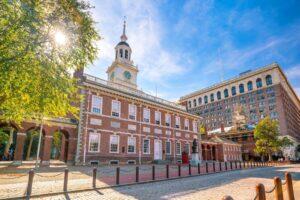
After more than 200 years inside Independence Hall, the bell was moved to a glass-enclosed pavilion for the 1976 Bicentennial, which for many seemed an incongruous setting for such a historic object. In mid-2003 it once again moved to another glass-enclosed pavilion with redbrick accents. This time, great care was taken to improve access and viewing of its former home at Independence Hall, which is seen against the backdrop of the sky—rather than 20th-century buildings. The Liberty Bell complex houses a bell chamber, an interpretive exhibit area with historic displays and memorabilia, and a covered area for waiting in line.
During construction for the bell's current home, the foundation and other archaeological remains of The President's House, the home of the nation's chief executives before the capital shifted to Washington, D.C., were discovered, as well as evidence of slaves owned by President George Washington who lived there during his time in office. A new permanent installation includes a series of video panels focusing on the stories of the nine enslaved African Americans, as well as glass panels through which you can view the remains of the structure's foundation.
READ LESS