311 Best Sights in USA

Background Illustration for Sights

We've compiled the best of the best in USA - browse our top choices for the top things to see or do during your stay.

Tilden Regional Park

Stunning bay views, a kid's steam train, and a botanical garden with a comprehensive collection of California plant life are the hallmarks of this 2,077-acre park in the hills just east of the UC Berkeley campus. The garden's visitor center offers weekend lectures about its plants and information about Tilden's other attractions, including its picnic spots, Lake Anza swimming site, golf course, and hiking trails (the paved Nimitz Way, at Inspiration Point, is a popular hike with wonderful sunset views). Children love Tilden's interactive Little Farm and vintage carousel.

Audubon Park

Uptown Fodor's Choice
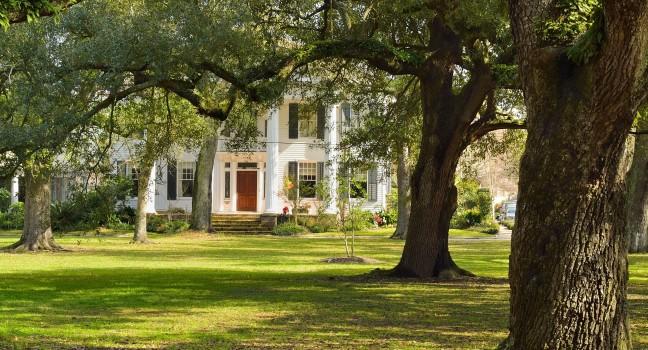
Villa at Audubon Park in New Orleans.
gibleho / Shutterstock

Formerly the plantation of Etienne de Boré, the father of the granulated-sugar industry in Louisiana, this large, lush patch of greenery stretches from St. Charles Avenue across Magazine Street to the river. Designed by John Charles Olmsted, nephew of Frederick Law Olmsted (who laid out New York City's Central Park and Asheville's Biltmore Estate), this park contains the world-class Audubon Zoo; a 1.8-mile track for running, walking, or biking; picnic and play areas; Audubon Park Golf Course; tennis courts; a swimming pool; horse stables; and a river view known by locals as the Fly. Calm lagoons wind through the park, harboring egrets and other indigenous species. The park and zoo were named for the famous ornithologist and painter John James Audubon, who spent many years working in and around New Orleans.

Bryant Park

Midtown West Fodor's Choice
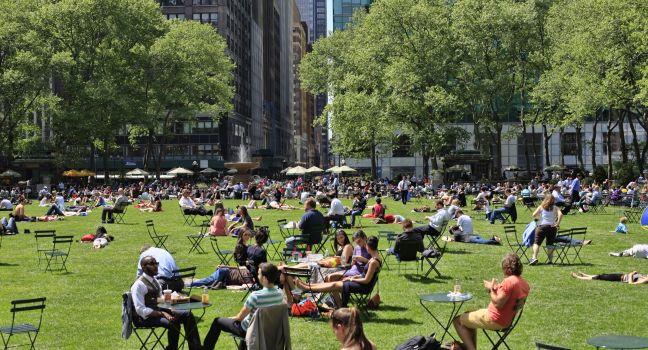
NEW YORK, USA - MAY 16: People enjoying a nice day in Bryant Park on May 16, 2013 in New York City, NY. Bryant Park is a 9,603 acre privately managed park in the center of Manhattan.
(c) Friday | Dreamstime.com

This lovely green space spread out among landmarks and skyscrapers is one of Manhattan's most popular parks. Tall London plane trees line the perimeter of the sunny central lawn, overlooking stone terraces, flower beds, and snack kiosks. The garden tables scattered about fill with lunching office workers and folks enjoying the park's free Wi-Fi. In summer, there are free readings, live jazz, and "Broadway in Bryant Park" musical theater performances. Most popular of all is the summer film festival: locals leave work early to snag a spot on the lawn for the outdoor screenings each Monday at dusk.

At the east side of the park, near a bronze cast of Gertrude Stein, is the stylish Bryant Park Grill, which has a rooftop garden, and the adjacent open-air Bryant Park Café, open seasonally. On the south side of the park is an old-fashioned carousel ($4) where kids can also attend storytellings and magic shows. Come late October, the park rolls out the artificial frozen "pond" (October–March, daily 8 am–10 pm) for free ice-skating (bring your own padlock for the lockers; skate rental starts at $18). Surrounding the ice rink are the Christmas-market stalls of the holiday shops, selling handcrafted goods and local foods.

Recommended Fodor's Video

Central Park

Upper West Side Fodor's Choice
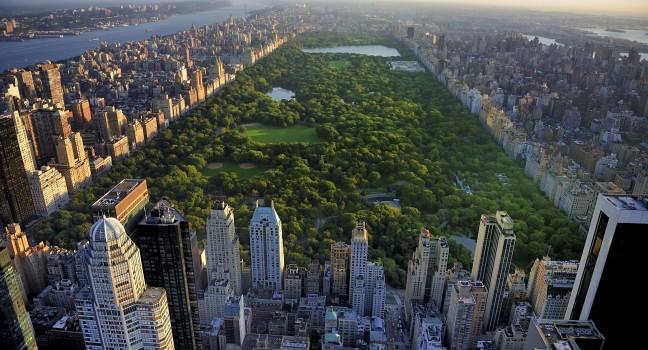
Central Park aerial view, Manhattan, New York; Park is surrounded by skyscraper.
T photography / Shutterstock

Central Park's creators, landscape architects Frederick Law Olmsted and Calvert Vaux, had a simple goal when they submitted their plan in 1858: to design a place where city dwellers could go to forget the city. Even though New York eventually grew far taller than the trees planted to hide it, the park has always been an urbanized Eden that gives residents and visitors alike a bite of the apple. Indeed, without Central Park's 843 acres of meandering paths, tranquil lakes, ponds, and open meadows, New Yorkers (especially Manhattanites) might be a lot less sane. Olmsted and Vaux also designed Brooklyn's Prospect Park and the grounds of the White House.

The busy southern section of Central Park, from 59th to 72nd Street, is where most people get their first impression. But no matter how many people congregate around here, you can always find a spot to picnic, ponder, or just take in the foliage, even on a sunny weekend day. In the southern corner is the Hallett Nature Sanctuary, one of the park's lesser-known areas. The nature sanctuary is a 4-acre patch of wilderness—one of the park’s three woodlands—and is home to native flora and fauna and rustic trails that lead to quiet overlooks; it's also a popular birding spot. Playgrounds, lawns, jogging and biking paths, and striking buildings populate the midsection of the park, from 72nd Street to the reservoir. You can soak up the sun, take in the public art, take pictures at Bethesda Fountain, visit the penguins at the Central Park Zoo, or join the runners huffing counterclockwise on the dirt track that surrounds the reservoir. North of the reservoir and up to 110th Street, Central Park is less crowded and feels more rugged. In 2025, the Central Park Conservancy completed a revitalization of the area around the Harlem Meer (a man-made lake) at the north end of the park to add a full-scale ice rink, an additional new skating experience on the meer, a larger-than-Olympic-size pool, and revamp the parkland around it. The new facility is called the Davis Center at the Harlem Meer (formerly the Lasker Rink and Pool site). To find out about park events and year-round walking tours, check the website of the Central Park Conservancy ( www.centralparknyc.org).

If you're taking the subway to the park's southernmost parts, the stops at either Columbus Circle (southwest corner) or 5th Avenue–59th Street (southeast corner) are handy. If headed for points north, the A, B, C, and D subway lines travel along Central Park West (beware of local versus express stops); the 4, 5, and 6 lines travel along Lexington Avenue, three blocks east of 5th Avenue and the park.

There are many paved pedestrian entrances into the park from 5th Avenue, Central Park North (110th Street), Central Park West, and Central Park South (59th Street). Four roads, or transverses, for cars and city buses cut through the park from east to west—66th, 79th, 86th, and 96th Streets. The East and West drives are both along the north–south axis; Center Drive enters the south edge of the park at 6th Avenue and connects with East Drive around 66th Street. Cars are no longer allowed on the drives, which are exclusively for pedestrians, cyclists, and horse-drawn carriages. Along the main loop, lampposts are marked with location codes that include a letter—always "E" (for east) or "W" (for west)—followed by numbers, the first two of which tell you the nearest cross street. For example, E7803 means you're near 78th Street; above 99, the initial "1" is omitted, so W0401 is near West 104th Street. Download the Central Park Conservancy's free app for a GPS-enabled map to help you navigate the park. The app also includes an audio guide, self-guided tours, and current events in the park, as well as a new interactive Cherry Blossom Tracker Map to help visitors and locals track when and where the flowers will peak in the park in spring.

If you haven't packed a picnic and you want a snack, you can usually find one of those rather tired-looking food carts selling hot dogs, pretzels, and ice-cream sandwiches. Specialty food carts are often around, too, mostly in the park's southern half, especially when there are concerts or other major events—your taste buds will thank you. Other reliable options include the café next to the Boathouse Restaurant (midpark at 74th Street), or a branch of Le Pain Quotidien (midpark at 69th Street). Both serve sandwiches, soups, pastries, and other satisfying on-the-go grub (and Le Pain also has free Wi-Fi). For something a little more elegant, you can stop for brunch, lunch, or dinner at the Tavern on the Green.

As part of a park-wide restoration project named Plan for Play, all 21 playgrounds have undergone (or are still scheduled to receive) updates. Most have seen renovations to play structures, plus other improvements that will ensure each one's structural stability and ongoing maintenance for years to come.

City Park

Mid-City Fodor's Choice
The Parthenon is the most recognizable peice of architecture in New Orlean's City Park. It sits across a placid lake and is flanked by majestic oaks and ornamental palms.
(c) Mishelmccumber | Dreamstime.com

Founded in 1854, this 1,300-acre expanse of moss-draped oaks and 11 miles of gentle lagoons is only 2 miles from the French Quarter, but feels like it could be a world apart. With the largest collection of live oaks in the world, including old grove trees that are more than 600 years old, City Park offers a certain natural majesty that's difficult to find in most other urban areas. The Art Deco benches, fountains, bridges, and ironwork are remnants of a 1930s Works Progress Administration (WPA) refurbishment and add to the dreamy scenery that visitors enjoy boating and bicycling through. Within the park are the New Orleans Museum of Art, the Louisiana Children's Museum, the Sydney and Walda Besthoff Sculpture Garden, the New Orleans Botanical Garden, the kid-friendly Carousel Gardens Amusement Park, as well as a golf course, equestrian stable, sports facilities, and picnic areas. Check the park's website for seasonal activities and special events, such as music festivals, the annual Easter egg hunt, and the eye-popping wonderland that is Celebration in the Oaks between Thanksgiving and New Year's Day. The Café du Monde coffee stand, behind the Sculpture Garden, serves hot beignets and café au lait 24/7. Most of the park's offerings are free, but several of the venues inside City Park charge separate admission fees.

Open seasonally on the weekends, the 18-ride Carousel Gardens Amusement Park ( 504/483–9402  $25 admission, unlimited rides) has a New Orleans treasure as its centerpiece: a 1906 carousel (one of only 100 antique wooden carousels left in the country) listed on the National Register of Historic Places. In addition to the cherished "flying horses," the park has rides like the Musik Express, Rockin' Tug, Coney Tower, Ferris Wheel, Bumper Cars, Monkey Jump, Red Baron miniplane, Scrambler, and Tilt-a-Whirl. The rides here are mostly geared to children, not hard-core thrill seekers, but adults and kids alike enjoy the miniature train that takes passengers on a gentle sightseeing tour through City Park. There are also two 18-hole miniature golf courses, one with a New Orleans theme and one with a Louisiana theme.

The New Orleans Botanical Garden ( 504/483–9402  $12), opened in 1936 as a Depression-era project of the WPA, is one of the few remaining examples of public garden design from the Art-Deco period. The garden's collections contain more than 2,000 varieties of plants from all over the world, complemented by sites such as the Conservatory, the Pavilion of the Two Sisters, and the Yakumo Nihon Teien Japanese Garden, as well as theme gardens containing aquatics, roses, native plants, ornamental trees, and shrubs and perennials. The garden showcases three notable talents: New Orleans architect Richard Koch, landscape architect William Wiedorn, and artist Enrique Alférez. Adding a touch of fun, the Historic Train Garden, open on weekends and included in Botanical Garden admission, offers visitors the chance to enjoy baguette-size cars rolling through a miniature version of New Orleans.

Featuring figures and settings from classic children's literature, the whimsical Storyland ( 504/483–9402  $6), adjacent to the amusement park, has been a favorite romping ground for generations of New Orleans kids. Youngsters can climb aboard Captain Hook's pirate ship, visit the old lady who lived in a shoe, and journey with Pinocchio into the mouth of a whale. In all, there are 18 larger-than-life storybook exhibits to explore.

Discovery Park

Magnolia Fodor's Choice
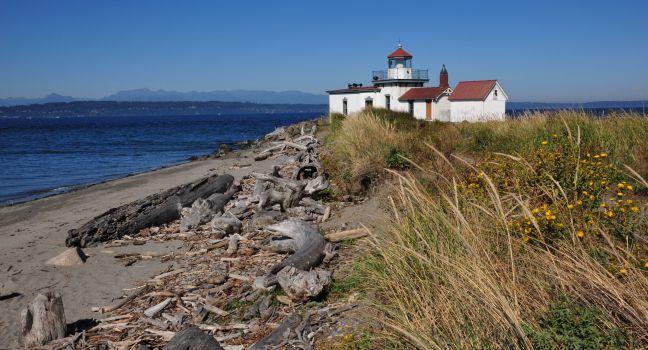
West Point Lighthouse near Discovery Park in Seattle, Washington.
kathmanduphotog / Shutterstock

Come here to get a dose of the PNW's wild beauty without leaving the city. Located on Magnolia Bluff, northwest of Downtown (and across the Chittenden Locks by foot from Ballard), Seattle's largest park covers 534 acres and has an amazing variety of terrain: shaded, secluded forest trails lead to meadows, saltwater beaches, sand dunes, a lighthouse, and 2 miles of protected beaches. The North Beach Trail, which takes you along the shore to the lighthouse, is a must, and the South Bluff Trail has views as far south as Mt. Rainier.

The park has several entrances. If you want to stop at the Learning Center to pick up a trail map before exploring, use the main entrance at Government Way. The North Parking Lot is much closer to the North Beach Trail and to Ballard, if you're coming from that direction. First-come, first-served beach parking passes for the disabled, elderly, and families with small children are available at the Learning Center. Note that it's easier to combine a park day with an exploration of Ballard or Fremont than with a busy Downtown itinerary.

Forsyth Park

Fodor's Choice
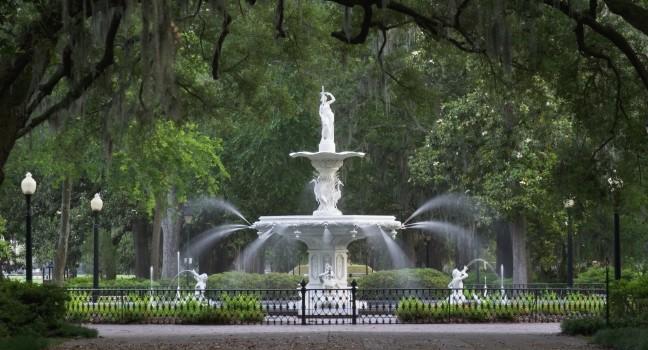
Forsyth Park Fountain in Savannah Georgia.; Shutterstock ID 1711880; Project/Title: Fodors; Downloader: Melanie Marin
David Davis / Shutterstock

The heart of the city's outdoor life, Forsyth Park hosts a number of popular cultural events, including film screenings, sports matches, and the annual Savannah Jazz Festival. Built in 1840 and expanded in 1851, the park was part of General Oglethorpe's original city plan and made possible by the donation of land from Georgia governor John Forsyth. A glorious white fountain dating to 1858, Confederate and Spanish-American War memorials, a fragrant garden, multiple playgrounds, tennis and basketball courts, and an old fort (which houses the gorgeous Collins Quarter Forsyth Café, with indoor/outdoor seating) are spread across this grand, green space. Be sure to stop by the south end on Saturday mornings for the bustling farmers' market. The park's 1-mile perimeter is among the prettiest walks in the city and takes you past many beautifully restored historic homes.

Gas Works Park

Wallingford Fodor's Choice
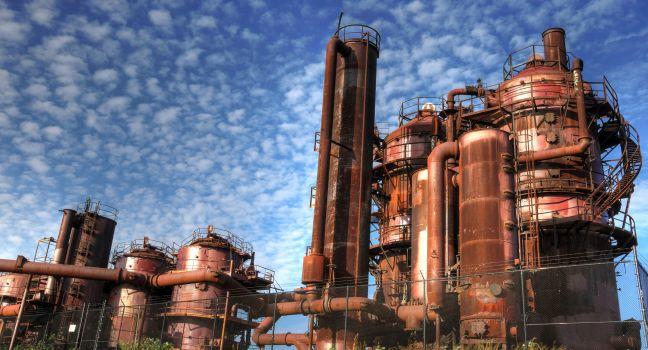
machineries and storage units in a gas industry at gas works park Seattle.
neelsky / Shutterstock

Far from being an eyesore, the hulking remains of an old 1907 gas plant actually lend quirky character to the otherwise open, hilly, 20-acre park. Get a great view of Downtown Seattle while seaplanes rise up from the south shore of Lake Union; the best vantage point is from the zodiac sculpture at the top of the very steep Kite Hill, so be sure to wear appropriate walking shoes. This is a great spot for couples and families alike; the enormous and modern playground has rope climbing structures, a variety of swings, and a padded floor. Crowds throng to picnic and enjoy outdoor summer concerts, movies, and the July 4th fireworks display over Lake Union. Gas Works can easily be reached on foot from Fremont, via the waterfront Burke-Gilman Trail.

The High Line

Chelsea Fodor's Choice
NEW YORK CITY - JUN 3: High Line Park in NYC seen on June 3rd, 2012.The High Line is a public park built on an historic freight rail line elevated above the streets on Manhattans West Side.; Shutterstock ID 105076949; Project/Title: Summer Plans for Kids;
Stuart Monk/Shutterstock

Once a railroad track carrying freight trains, this elevated space has been transformed into one of the city’s top attractions—a 1½-mile landscaped “walking park,” with curving walkways, picnic tables and benches, public art installations, and views of the Hudson River and the Manhattan skyline. Running from Gansevoort Street in the Meatpacking District (at the Whitney Museum of American Art) to West 34th Street and Hudson Yards, the High Line somehow manages to host about 5 million visitors a year and still feel like a wonderful retreat. That said, the crowds can seem overwhelming when the weather is nice, so visit as early in the morning as possible and avoid the lunchtime and weekend mass of humanity.

One of the main draws of the High Line is the landscaping, which is both wild and cultivated at the same time, and dotted with public art. Chelsea Market Passage, between 15th and 16th Streets, is accented with Spencer Finch’s stained-glass art and is home to public art displays, video programs, music performances, and sit-down events. A feature that illustrates the High Line’s greatest achievement—the ability to see the city with fresh eyes—is the 10th Avenue Square (between 16th and 17th Streets). This viewing window with stadium seating and large picture windows frames the city below as art, encouraging viewers to linger.

To fully appreciate the High Line, walk a length in one direction (preferably from Gansevoort Street uptown so that you can end with panoramic city and river views) and then make the return journey at street level, taking in the Chelsea neighborhood below. Nearby Chelsea Market and Market 57 are convenient places to pick up fixings for a picnic lunch.

Ina Coolbrith Park

Russian Hill Fodor's Choice
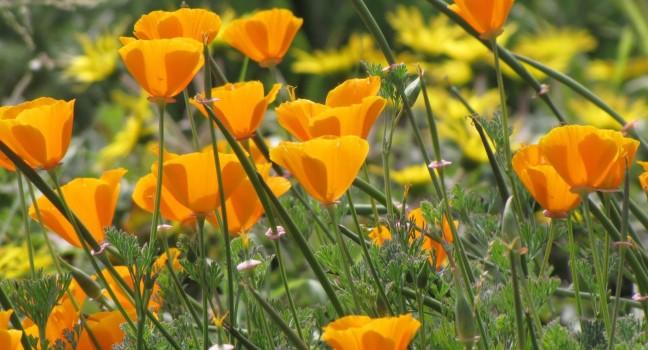
California Poppies. In Ina Coolbrith Park in San Francisco
California Poppies by Karen Brockney

If you make it all the way up here, you may have the place all to yourself, or at least feel like you do. The park's terraces are carved from a hill so steep that it's difficult to see if anyone else is there or not. Locals love this park because it feels like a secret—one of the city's magical hidden gardens, with a meditative setting and spectacular views of the bay peeking out from among the trees. A poet, Oakland librarian, and niece of Mormon prophet Joseph Smith, Ina Coolbrith introduced Jack London and Isadora Duncan to the world of books. For years she entertained literary greats in her Macondray Lane home near the park. In 1915 she was named poet laureate of California.

Lincoln Park

Richmond Fodor's Choice
Men are golfing in Lincoln park, San Francisco.
(c) Russiangal | Dreamstime.com

Lincoln Park is a wild 275-acre park with windswept cliffs and panoramic views. The Coastal Trail, the park's most dramatic, leads out to Lands End; pick it up west of the Legion of Honor (at the end of El Camino del Mar) or from the parking lot at Point Lobos and El Camino del Mar. Time your hike to hit Mile Rock at low tide, and you might catch a glimpse of two wrecked ships peeking up from their watery graves.

Be careful if you hike here; landslides are frequent, and people have fallen into the sea by standing too close to the edge of a crumbling bluff top.

Lincoln Park's 18-hole golf course ( www.lincolnparkgolfcourse.com) is on land that in the 19th century was the Golden Gate Cemetery. (When digging has to be done in the park, human bones still occasionally surface.) Next door on 33rd Avenue and California Street are the dazzling mosaic Lincoln Park Steps, which rival the 16th Avenue Steps and the Hidden Garden Steps in the Sunset District. They provide a delightful backdrop for contemplation or an Instagram photo op.

Millennium Park

Chicago Loop Fodor's Choice
CHICAGO, ILLINOIS AUGUST 21: The popular Jay Pritzker Pavilion in Millennium Park on a beautiful summer day in downtown on August 21, 2011 in Chicago.
Fotoluminate LLC / Shutterstock

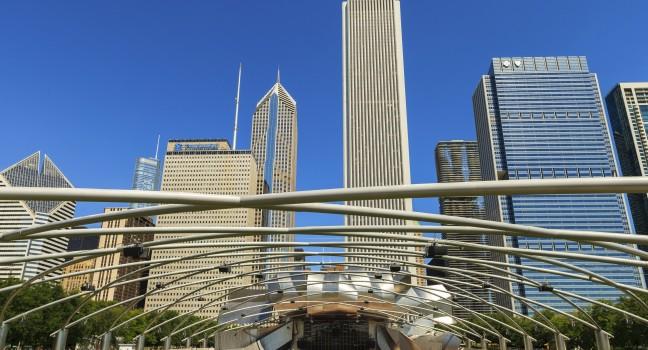
With Anish Kapoor's giant, polished-steel Cloud Gate sculpture (affectionately known as "The Bean"), the fun fountains, and a Disney-esque music pavilion, this park quickly stole the hearts of Chicagoans and visitors alike when it opened in 2004. The showstopper is Frank Gehry's stunning Jay Pritzker Pavilion. Dramatic ribbons of stainless steel stretching 40 feet into the sky look like petals wrapping the music stage. The 1,525-seat Harris Theater for Music and Dance provides an indoor alternative for fans of the performing arts.

In the park's southwest corner, the Crown Fountain features dozens of Chicagoans' faces rotating through on two 50-foot-high glass block–tower fountains. When a face purses its lips, water shoots out its "mouth." Kids love it, and adults feel like kids watching it. More conventional park perks include the lovely Lurie Garden (a four-season delight) and the seasonal McCormick Tribune Ice Rink, which opens for public skating each winter.

Mission Dolores Park

Fodor's Choice
Dolores Park in San Francisco, looking northeast toward downtown.
(c) Rahurlburt | Dreamstime.com

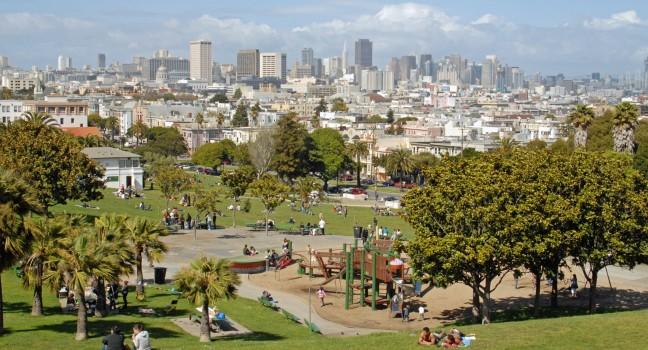
A two-square-block microcosm of life in the district, Mission Dolores Park is one of San Francisco's liveliest green spaces: dog lovers and their pampered pups congregate, kids play at the extravagant playground, and hipsters hold court, drinking beer and rosé cans on sunny days. (Fair warning: if it's over 70°F, the place can get packed like traffic at rush hour for picnic-blanket space.) During the summer, Dolores Park hosts movie nights, performances by the San Francisco Mime Troupe, and pop-up events and impromptu parties. Spend a warm day here—maybe sitting at the top of the park with a view of the city and the Bay Bridge—surrounded by locals and that laid-back, still-abundant San Francisco energy, and you may well find yourself plotting your move to the city. The best views are in the southwest corner, near the historic Golden Fire Hydrant that saved the neighborhood after the 1906 earthquake.

Prospect Park

Prospect Park Fodor's Choice
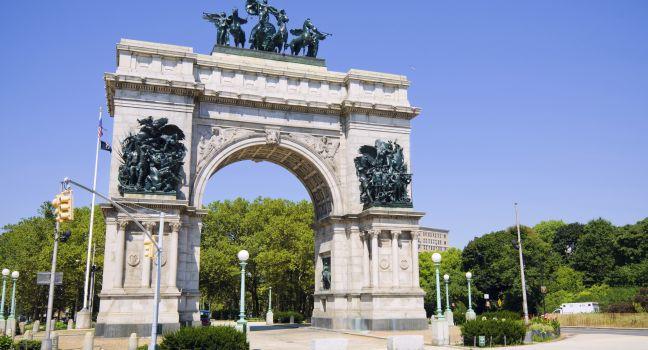
Soldiers' and Sailors' Arch at Grand Army Plaza in Brooklyn, dedicated on October 21, 1892 with an inscription that reads "To the Defenders of the Union, 1861-1865."
gregobagel/iStockphoto

Brooklyn residents are passionate about Prospect Park, and with good reason: lush green spaces, gently curved walkways, summer concerts, vivid foliage in autumn, and an all-season skating rink make it a year-round getaway. In 1859, the New York Legislature decided to develop plans for a park in the fast-growing city of Brooklyn. After landscape architects Frederick Law Olmsted and Calvert Vaux completed the park in the late 1880s, Olmsted remarked that he was prouder of it than any of his other works—including Manhattan's Central Park—and many critics agree. On weekends, those not jogging the 3.35-mile loop gravitate to the rolling hills of the Long Meadow to picnic, fly kites, or play cricket, flag football, or Frisbee. On summer Sundays, foodies flock to Breeze Hill, site of outdoor food market Smorgasburg's second Brooklyn location. The park's north entrance is at Grand Army Plaza, where the Soldiers' and Sailors' Memorial Arch (patterned on the Arc de Triomphe in Paris) honors Civil War veterans. On Saturday, year-round, a greenmarket at the plaza throngs with shoppers.

\n

A good way to experience the park is to walk the Long Meadow—venue for the occasional free yoga class—and then head to the eastern side and south towards the lake. Along the way, you'll encounter attractions including a few waterfalls, the Prospect Park Zoo, and the Lefferts Historic House. Nearby, the Prospect Park Carousel, built in 1912, still thrills the kids. The Boathouse, dating from 1905, is a stunning example of Beaux-Arts architecture, and houses a cafe and the Prospect Park Audubon Center. The annual Celebrate Brooklyn! Festival takes place at the Prospect Park Bandshell from early June through mid-August.

Union Square Park and Greenmarket

Fodor's Choice
NEW YORK CITY - APR. 20: Woman selects produce at Union Square Greenmarket in NYC on Apr 20, 2012. This world famous farmers' market began in 1976 and has grown to 140 farmers during peak season.; Shutterstock ID 100566316; Project/Title: Weekend Getaways;
littleny/Shutterstock

A park, farmers' market, meeting place, and the site of rallies and demonstrations, this pocket of green space and surrounding public square sit in the center of a bustling residential and commercial neighborhood. The name "Union" originally signified that two main roads—Broadway and 4th Avenue—crossed here. It took on a different meaning in the late 19th and early 20th centuries, when the square became a rallying spot for labor protests; many unions, as well as fringe political parties, moved their headquarters nearby.

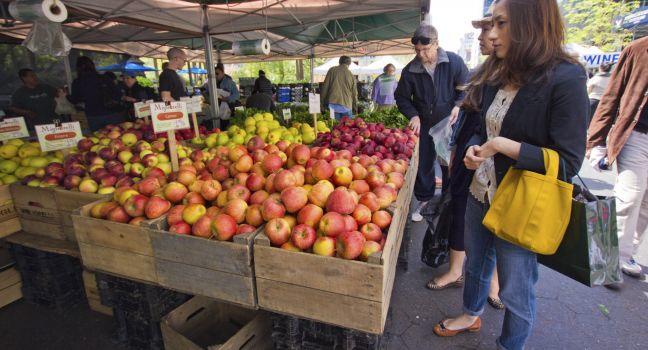
Union Square is at its best on Monday, Wednesday, Friday, and Saturday (8–6), when the largest of the city's greenmarkets draws farmers and food purveyors from the tristate area selling fruit and vegetables, plants, fresh-baked pies and breads, cheeses, cider, fish, and meat. Between Thanksgiving and Christmas, artisans sell gift items and food at the large Union Square Holiday Market ( www.usqholiday.nyc).

New York University dormitories, theaters, and cavernous commercial spaces occupy the restored 19th-century commercial buildings that surround the park, along with some chain stores and restaurants. Statues in the park include those of George Washington, Abraham Lincoln, Mahatma Gandhi (often wreathed in flowers), and the Marquis de Lafayette (sculpted by Frédéric-Auguste Bartholdi, designer of the Statue of Liberty).

Washington Square Park

Greenwich Village Fodor's Choice
NEW YORK CITY - SEPTEMBER 12, 2012: Crowds gather at Washington Square Park. The historic park is popular in the summer.
(c) Sepavo | Dreamstime.com

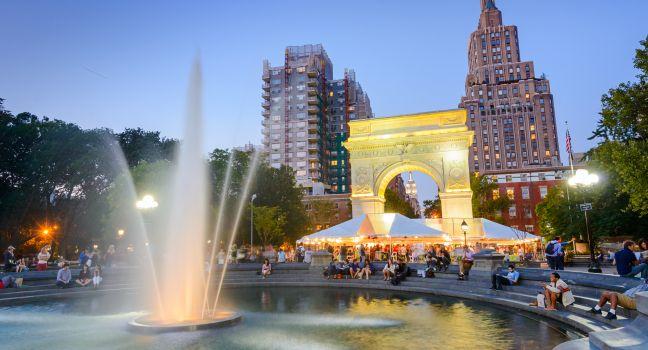
NYU students, street musicians, skateboarders, chess players, and those just watching the grand opera of it all generate a maelstrom of activity in this physical and spiritual heart of Greenwich Village. The 9¾-acre park with its gorgeous central fountain had inauspicious beginnings as a cemetery, principally for yellow-fever victims—an estimated 10,000–22,000 bodies lie below (a headstone was even unearthed in 2009). In the early 1800s, the park was a parade ground and the site of public executions; the notorious Hanging Elm still stands at the northwest corner of the square. 

The triumphal European-style Washington Arch at the square's northern flank marks the start of 5th Avenue. The original wood-and-papier-mâché arch, situated a half block north, was erected in 1889 to commemorate the 100th anniversary of George Washington's presidential inauguration. The arch was reproduced in Tuckahoe marble in 1892, and the statues—Washington as General Accompanied by Fame and Valor on one side, and Washington as Statesman Accompanied by Wisdom and Justice on the other—were added in 1916 and 1918, respectively.

5th Ave. between Waverly Pl. and 4th St., New York, NY, 10003, USA

Something incorrect in this review?

Wissahickon Valley Park (Valley Green)

Chestnut Hill Fodor's Choice
Wissahickon Park, Philadelphia, Pa
DSC_7800 by Jared Rubinsky

There are many great sections of Fairmount Park, but the 1,800 acres around Valley Green known as Wissahickon Valley Park may be the most stunning. Miles and miles of trails running along and above the river lead to covered bridges, a statue of a Lenape chief (rife with inaccuracies but created with good intentions), caves used by a 17th-century free-love cult, large boulders that drip water, and mallards quacking for bread bits. Forbidden Drive, on which cars are forbidden, runs from Northwestern Avenue (the westernmost part of Chestnut Hill) all the way to Lincoln Drive, where it connects to a bike and walking path that leads one way to Historic Rittenhouse Town (where you can also park and enter) and the other way to Manayunk and Kelly Drive, with additional bike/walking paths that take you to the city or out along the Schuylkill to Valley Forge. There are also many miles of surprisingly difficult mountain-bike trails. The Valley Green Inn is a very attractive restaurant with decent food at Forbidden Drive and Valley Green Road. Other recommended spots to hike to include Hudson and Andorra Meadows, Thomas Mill Covered Bridge, and Toleration Statue.

Valley Green Rd., Philadelphia, PA, 19118, USA
215-247–0417
Sight Details
Free

Something incorrect in this review?

The 606

Fodor's Choice

Similar to New York City’s High Line, this abandoned elevated rail line—open since 2015—is now a fun place to walk or bike and take in art all at once. Edgy, splashy and bright murals are depicted along the 2.7-mile route. The route runs through Wicker Park, Humboldt Park, Bucktown, and Logan Square, making it an appealing way to neighborhood hop without getting snarled in the traffic below. Take along some water and sunscreen; on summer days the more exposed stretches of the trail get rather sunbaked. 

ABQ BioPark

Fodor's Choice

The city's foremost outdoor draw, the BioPark comprises four distinct attractions: Aquarium, Botanic Garden, Zoo, and Tingley Beach. Verdant grounds are the setting for summer performances, the River of Lights brings crowds over the winter holidays, and exhibits like River Otters, Komodo Dragons, and the Sasebo Japanese Gardens have year-round appeal. The garden and aquarium are located together, just west of Old Town (admission gets you into both facilities) while the zoo is a short drive southeast, off 10th Street SW, and Tingley Beach (and its trout-stocked ponds) lies between. An electric shuttle connects them all.

2601 Central Ave. NW, Albuquerque, NM, 87104, USA
505-768–2000
Sight Details
Tingley Beach and grounds free; Aquarium and Botanic Garden $14.50; Zoo $14.50; combination ticket for all attractions $22

Something incorrect in this review?

Alamo Square Park

Western Addition Fodor's Choice

Whether you've seen them on postcards or on the old TV show Full House, the colorful "Painted Ladies" Victorian houses are some of San Francisco's world-renowned icons. The signature view of these beauties with the downtown skyline in the background is from the east side of this hilly park. Tourists love the photo opportunities, but locals also adore the park's tennis courts, dog runs, and ample picnic area—with great views, of course. After taking plenty of photos, swing by the park's northwest corner and admire the William Westerfeld House ( 1198 Fulton St.), a splendid five-story late-19th-century Victorian mansion. If it's a sunny day, grab picnic provisions from Bi-Rite Market. Thursday through Sunday, the Lady Falcon Coffee Club truck is stationed in the park, offering a great caffeine pick-me-up.

Alta Plaza Park

Pacific Heights Fodor's Choice

Golden Gate Park's longtime superintendent, John McLaren, designed this 12-acre park in the early 1900s, modeling its steep south-facing terracing on that of the Grand Casino in Monte Carlo. At any time of day, you're guaranteed to find San Francisco's exercise warriors running up the park's south steps. From the top of those steps, you can see Marin to the north, downtown to the east, Twin Peaks to the south, and Golden Gate Park to the west.  Kids love the many play structures at the large, enclosed playground at the top; dogs love the off-leash area in the park's southeast corner.

The Battery

Fodor's Choice

During the Civil War, the Confederate army mounted cannons in the Battery, at the southernmost point of Charleston's peninsula, to fortify the city against Union attack. Cannons and piles of cannonballs still line the oak-shaded park known as White Point Garden—kids can't resist climbing them. Where pirates once hung from the gallows, walkers now take in the serene setting from Charleston benches (small wood-slat benches with cast-iron sides). Stroll the waterside promenades along East Battery and Murray Boulevard to enjoy views of Charleston Harbor, the Ravenel Bridge, and Fort Sumter on one side, with some of the city's most photographed mansions on the other. You'll find locals dangling their fishing lines, waiting for a bite. There are no public bathrooms within a 10-minute walk of the Battery, so plan accordingly. A bicycle is a great way to tour South of Broad, and it allows for a quick exit to the commercial part of town.

Boston Common

Beacon Hill Fodor's Choice

Nothing is more central to the city than Boston Common, the oldest public park in the United States and undoubtedly the largest and most famous of the town commons around which New England settlements were traditionally arranged. Dating from 1634, the Common started as 50 acres for grazing cattle until 1830 when cows were banned. Don't confuse the Common with its sister park, the Public Garden, where the Swan Boats glide and flowers bloom three seasons of the year.

Take a break and enjoy lunch at one of the food trucks parked at the Brewer Fountain Plaza from spring through fall. A few steps away, the Freedom Trail starts in front of the Boston Visitor Information Center. The new MLK memorial sculpture, The Embrace, is close by and worth a visit.

The Common's highest point, near the Parkman Bandstand, was once called Flagstaff Hill and is now surmounted by the Soldiers and Sailors Monument, honoring Civil War troops. The Common's only body of water is the Frog Pond, a tame and frog-free concrete depression used as a wading pool and spray fountain during summer and for ice-skating in winter.

Central Burying Ground lends the park an eerie vibe at its site on Boylston Street; in fact, the Common boasts a fair amount of haunted history. Across from the State House, on the Beacon Street side, sits the splendidly restored Robert Gould Shaw 54th Regiment Memorial, executed in deep-relief bronze by Augustus Saint-Gaudens in 1897.  This is Freedom Trail stop 1.

Brackenridge Park

Alamo Heights Fodor's Choice

Beloved Brackenridge Park has been a big part of San Antonians' lives since 1899. The 343-acre riverside park makes an excellent setting for a picnic or a stroll, with about 3 miles of walking trails, public art, softball fields, a municipal golf course, concessions, and sights like the Japanese Tea Garden and the San Antonio Zoo. Take a 2-mile ride around the park on a miniature train that runs daily; buy tickets at the Train Depot. Dogs must be on a leash at all times. Free parking. 

The mission of the Brackenridge Park Conservancy is to work as a steward of and an advocate for the park, enhancing and protecting its natural, historic, recreational, and educational resources. One of its numerous projects is the renovation of the Sunken Garden Theater, including the preservation of the historic amphitheater and its backstage facilities, redesigned landscaping, and more. The park is on the National Register of Historic Places and is a Texas State Antiquities Landmark.

Brickell Key Park

Fodor's Choice

On the southern tip of the mostly residential Brickell Key (a tiny man-made island), this little slice of heaven is home to some of the most breathtaking views in Miami. The quaint park, which has a few benches and a small playground, faces Key Biscayne with jaw-dropping views of Brickell's skyline and the glistening Biscayne Bay.  Take a stroll on the walking path around the island. It's exactly 1 mile, making for a short and sweet excursion with memorable views.

Claughton Island Dr., FL, 33131, USA
305-416--1361

Something incorrect in this review?

Brooklyn Bridge Park

DUMBO Fodor's Choice

This sprawling, 85-acre industrial-turned-recreational riverside park stretches from the Manhattan Bridge in DUMBO, under the Brooklyn Bridge, and all the way south to Pier 6 at the end of Atlantic Avenue. It's a gathering spot for tourists and Brooklynites alike, who come to picnic or watch movies on the lawn in the summer, play various sports on its many courts and playing fields, or simply stroll the promenade and gawk at the most postcard perfect view of the downtown Manhattan skyline—especially at sunset. The DUMBO section has a playground and a small pebble beach, plus the wonderfully restored Jane’s Carousel ( janescarousel.com).

Cascades Park

Fodor's Choice

History tells us that Territorial Governor William Pope Duval was so entranced by a cascading waterfall, that he chose a nearby hill on which to build Florida's first capitol. Inhabitants were not kind to the site, which became a dump and, later, a water retention area. It was only recently that the city transformed it into what is now one of Tallahassee's most beloved outdoor spaces: the 24-acre Cascade Park, a hub for festivals celebrating Shakespeare, as well as books and music.

In addition to two lakes that hold and channel storm water downstream, the park has an amphitheater, which hosts free and ticketed concerts; dancing water fountains; a playground; a concrete waterfall (in a nod to the long-gone original); and a self-guided history tour. Wide, meandering sidewalks and paths welcome walkers, runners, and bikers. A brick building that once housed the city's electric utility is now a coffee shop and a restaurant, where diners can enjoy a water, sound, and light show with their dinner.

Cathedral Park

Fodor's Choice

Whether it's the view of the imposing and stunning Gothic St. John's Bridge, which rises some 400 feet above the Willamette River, or the historic significance of Lewis and Clark having camped here in 1806, this 23-acre park is divine. Though there's no church, the park gets its name from the picturesque arches supporting the bridge. It's rumored that the ghost of a young girl haunts the bridge, and that may be true, but if you're told that it was designed by the same man who envisioned the Golden Gate Bridge, that's just a popular misconception. There's an off-leash area for dogs, and pollinator gardens have been added in recent years.

Centennial Olympic Park

Downtown Fodor's Choice

This 21-acre swath of green was the central venue for the 1996 Summer Olympics. The benches at the Fountain of Rings allow you to enjoy the water and music spectacle—four times a day, tunes are timed to coincide with water displays that shoot sprays 15 feet to 30 feet high. The All Children's Playground is designed to be accessible to kids with disabilities. Nearby is the world's largest aquarium and the Children's Museum. The park also has a café, restrooms, and a playground, and typically offers ice-skating in winter.

Don't miss seeing Centennial Olympic Park at night, when eight 65-foot-tall lighting towers set off the beauty of the park. They represent the markers that led ancient Greeks to public events.

Central Park

Fodor's Choice

Given to the City of Winter Park by the Genius family (benefactors of the Morse Museum), this 11-acre green space has manicured lawns, specimen plantings, a beautiful rose garden available for private functions, a fountain, and a gazebo. If you take a seat and listen as the Amtrak passenger train rolls by, it's not hard to imagine how Winter Park looked and sounded in the late 19th century. The SunRail commuter and Amtrak trains stop right within the park, giving great car-free access, particularly during the packed art festivals, to and from Downtown Orlando, Kissimmee, and Sanford. The Winter Park Farmers' Market draws people to the southwest corner on Saturday between 8 am and 1 pm. If you don't want to browse in the shops across the street, a walk beneath the park's moss-covered trees is a delightful alternative. There's free Wi-Fi within the park, as well.