42 Best Sights in Chicago, Illinois

Background Illustration for Sights

We've compiled the best of the best in Chicago - browse our top choices for the top things to see or do during your stay.

875 N. Michigan Avenue (formerly the John Hancock Center) and 360 Chicago

Near North Side Fodor's choice
Chicago skyline view from John Hancock Observatory
(c) Sidneyboot | Dreamstime.com

Designed by Skidmore, Owings & Merrill, this multipurpose skyscraper is distinguished by its tapering shape and enormous X braces, which help stabilize its 100 stories. Soon after it went up in 1970, it earned the nickname "Big John." No wonder: it's 1,127 feet tall (the taller east tower is 1,506 feet counting its antennae). Packed with retail space, parking, offices, a restaurant, and residences, it has been likened to a city within a city. Like the Willis Tower, which was designed by the same architectural team, this skyscraper offers views of four states on clear days. To see them, ascend to the 94th-floor observatory—now dubbed 360 Chicago ($30). While there, visitors can grab a cocktail, beer, wine, hot drink or nonalcoholic beverage at Bar 94, which can only be accessed with a General Admission ticket. Thrill seekers can pay an additional fee to take advantage of the tower's most exciting feature, The Tilt ($8), which has eight windows that tilt downward to a 30-degree angle, giving you a unique perspective on the city below. Those with vertigo might prefer a seat in the bar of the 96th-floor Signature Lounge; the tab will be steep, but you don't pay the observatory fee and you'll be steady on your feet.
The Rookery

Chicago Loop Fodor's choice
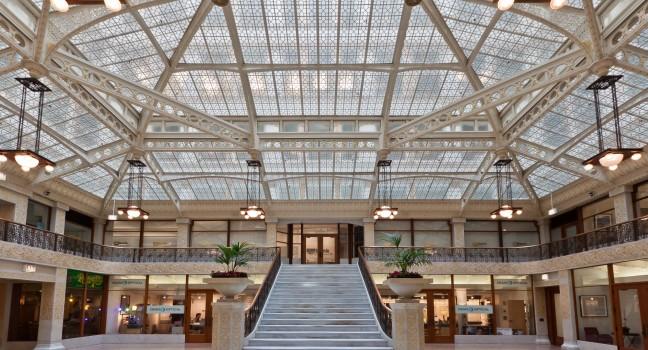
The main lobby of the Rookery building with its glass ceiling and amazing stairs. Chicago downtown, Illinois, United States.
(c) Afagundes | Dreamstime.com

This 11-story structure, with its eclectically ornamented facade, got its name from the pigeons and politicians who roosted at the temporary city hall constructed on this site after the Great Chicago Fire of 1871; the structure didn't last long, and The Rookery replaced it. Designed in 1885 by Burnham & Root, who used both masonry and a more modern steel-frame construction, The Rookery was one of the first buildings in the country to feature a central court that brought sunlight into interior office spaces. Frank Lloyd Wright, who kept an office here for a short time, renovated the two-story lobby and light court, eliminating some of the ironwork and terra-cotta and adding marble scored with geometric patterns detailed in gold leaf. The interior endured some less tasteful alterations after that, but it has since been restored to the way it looked when Wright completed his work in 1907.

Tribune Tower

Near North Side Fodor's choice
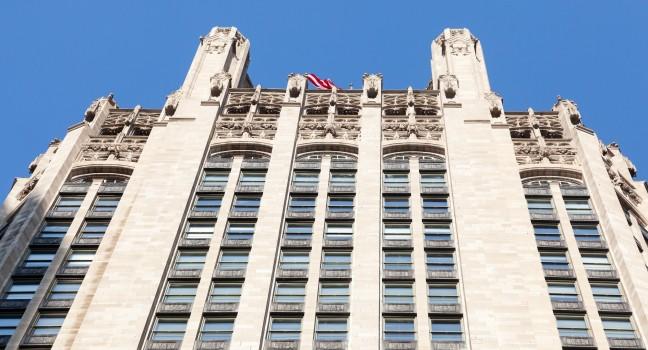
Top of Tribune Tower in Chicago in perspective shot taken from below.
(c) Steveheap | Dreamstime.com

Big changes have arrived at this iconic tower, which opened in 1925 to house the Chicago Tribune. Sold by the Tribune Company to CIM Group and Golub & Company for $240 million in 2016, the neo-gothic structure is no longer home to the newspaper, and WGN’s final broadcast there took place in 2018. Now the interior is 162 luxury residences with more than 55,000 square feet of indoor amenities. Visitors can still see fragments from famous sites, including the Taj Mahal and the Alamo, embedded in the building’s façade.

Recommended Fodor's Video

Willis Tower

Chicago Loop Fodor's choice
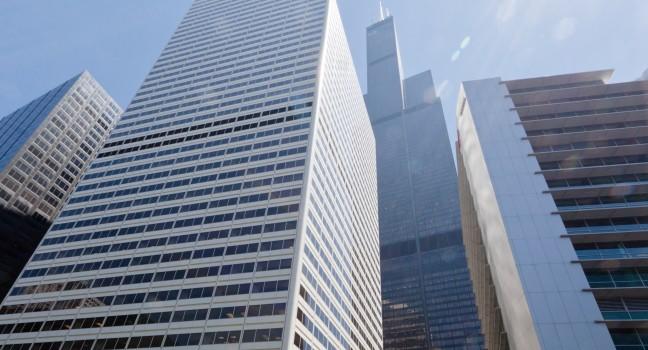
The Willis Tower (formerly Sears Tower) glass windows skyscraper in downtown Chicago, Illinois, United States. The EL mass transport system, pedestrians and cars on the street.
(c) Afagundes | Dreamstime.com

Designed by Skidmore, Owings & Merrill in 1974, the former Sears Tower was the world's tallest building until 1996. The 110-story, 1,730-foot-tall structure may have lost its title and even changed its name, but it’s still tough to top the Willis Tower's 103rd-floor Skydeck—on a clear day it offers views of Illinois, Michigan, Wisconsin, and Indiana. Enter on Jackson Boulevard to take the ear-popping ride up. ( Check the visibility ratings at the security desk before you decide to ascend.) Video monitors turn the 70-second elevator ride into a thrilling trip. Interactive exhibits inside the observatory bring Chicago's dreamers, schemers, architects, musicians, and sports stars to life; and computer kiosks in six languages help international travelers key into Chicago hot spots. For many visitors, though, the highlight (literally) is stepping out on the Ledge, a glass box that extends 4.3 feet from the building, making you feel as if you're suspended 1,353 feet in the air.

Chicago Cultural Center

Chicago Loop Fodor's choice

Built in 1897 as the city's original public library, this huge building houses the Chicago Office of Tourism Visitor Information Center, as well as a gift shop, galleries, and a concert hall. Designed by the Boston firm Shepley, Rutan & Coolidge—the team behind the Art Institute of Chicago—it's a palatial affair notable for its Carrara marble, mosaics, gold leaf, and the world's largest Tiffany glass dome.

Wrigley Building

Near North Side Fodor's choice

The gleaming white landmark—designed by Graham, Anderson, Probst & White and the former headquarters of the chewing-gum company—was instrumental in transforming Michigan Avenue from an area of warehouses to one of the most desirable spots in the city. Its two structures were built several years apart and later connected, and its clock tower was inspired by the bell tower of the Giralda Tower in Seville, Spain. Be sure to check it out at night, when lamps bounce light off the 1920s terracotta facade.

Chicago Board of Trade

Chicago Loop
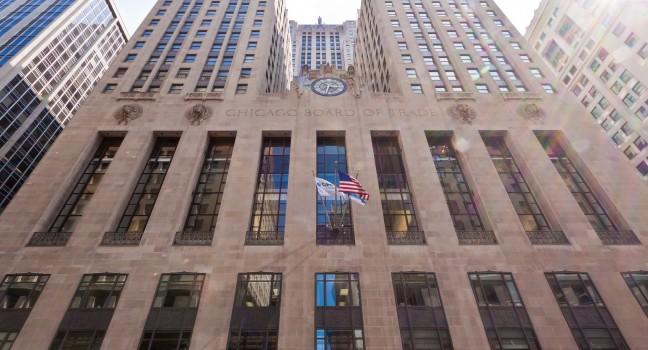
The facade of the famous building with its clock. Chicago Board of Trade at downtown, Illinois state, United States.
(c) Afagundes | Dreamstime.com

Home of the thriving financial district, relatively narrow LaSalle Street earned the moniker "The Canyon" (and it feels like one) because of the large buildings that flank either end. This one was designed by Holabird & Root and completed in 1930. The streamlined, 45-story giant recalls the days when art deco was all the rage. The artfully lighted marble lobby soars three stories, and Ceres (the Roman goddess of agriculture) stands atop its roof. Trading is no longer done here, but it's worth a look at what was the city's tallest skyscraper until 1955, when the Prudential Center topped it.

150 North Michigan Avenue

Chicago Loop

Some wags have pointed out that this building, with its diamond-shaped top, looks like a giant pencil sharpener. Built in 1984 as the Smurfit-Stone Building and later known as the Crain Communications Building, it has a slanted top that carves through the top 10 of its floors. In the plaza is Yaacov Agam's Communication X9, a painted, folded aluminum sculpture that was restored (to some controversy) and reinstalled in 2008. You'll see different patterns in the sculpture depending on your vantage point.

190 South LaSalle Street

Chicago Loop

This 40-story postmodern office building, resembling a supersized château, was designed by John Burgee and Philip Johnson in the mid-1980s. The grand, gold-leaf vaulted lobby is spectacular.

224 South Michigan Avenue

Chicago Loop

This structure, designed in 1904 by Daniel Burnham, who later moved his office here, was once known as the Railway Exchange Building and the Santa Fe Building, for a "Santa Fe" sign on its roof that has since been removed. The Chicago Architecture Foundation uses the building's atrium for rotating exhibits about the changing landscape of Chicago and other cities. The organization also offers a variety of tours via foot, bus, and boat.

224 S. Michigan Ave., Chicago, IL, 60604, USA

Something incorrect in this review?

311 South Wacker Drive

Chicago Loop

The first of three towers intended for the site, this pale-pink edifice is the work of Kohn Pedersen Fox, who also designed 333 West Wacker Drive, a few blocks away. The 1990 building's most distinctive feature is its Gothic crown, brightly lit at night. During migration season so many birds crashed into the illuminated tower that management was forced to tone down the lighting. An inviting atrium has palm trees and a splashy, romantic fountain.

333 West Wacker Drive

Chicago Loop

This green-glazed beauty doesn't follow the rules. Its riverside facade echoes the curve of the Chicago River just in front of it, while the other side is all business, conforming neatly to the straight lines of the street grid. The 1983 Kohn Pedersen Fox design, roughly contemporary to the James R. Thompson Center, enjoyed a much more positive public reception. It also had a small but important role in the 1986 movie Ferris Bueller's Day Off as the location of Ferris's dad's office.

71 S. Wacker

Chicago Loop

At 48 stories, this modern high-rise is no giant, but it more than makes its mark on South Wacker Drive with a bold elliptical shape, a glass-faced street-level lobby rising 36 feet, and a pedestrian-friendly plaza. It displays a noticeable tweaking of the unrelieved curtain wall that makes many city streets forbidding canyons. Designed by Pei Cobb Freed & Partners, the tower was originally known as the Hyatt Center and was completed in 2004.

860–880 N. Lake Shore Drive

Near North Side

These 26-story twin apartment towers overlooking Lake Michigan were an early and eloquent realization of Mies van der Rohe's "less is more" credo, expressed in high-rise form. I-beams running up the facade underscore their verticality; inside, mechanical systems are housed in the center so as to leave the rest of each floor free and open to the spectacular views. Completed in 1951, the buildings, called “flat-chested architecture" by Frank Lloyd Wright, are a prominent example of the International Style, which played a key role in transforming the look of American cities.

860–880 N. Lake Shore Dr., Chicago, IL, 60611, USA

Something incorrect in this review?

Aon Center

Chicago Loop

With the open space of Millennium Park at its doorstep, the Aon Center really stands out. Originally built as the Standard Oil Building, the 83-story skyscraper (first referred to as Big Stan) has changed names and appearances twice. Not long after the building went up in 1972, its marble cladding came crashing down, and the whole thing was resheathed in granite.

200 E. Randolph Dr., Chicago, IL, 60601, USA
312-381–1000

Something incorrect in this review?

Aqua

Chicago Loop

With its undulating concrete balconies suggesting rippling liquid, Aqua’s addition to the skyline in 2009 made Jeanne Gang a household name in architectural circles; the building was not just a critical hit, it was also the world’s tallest building designed by a woman. Aqua recently lost that designation to another Gang design, the nearby St. Regis Chicago, which is currently the third-tallest building in the city.

225 N. Columbus Dr., Chicago, IL, 60601, USA

Something incorrect in this review?

Bloomingdale's (Medinah Temple)

River North

Built in 1912 for the Shriners, the former Medinah Temple is a Middle Eastern fantasy, with horseshoe-shape arches, stained-glass windows, and intricate geometric patterns around windows and doors (it once also held a 4,200-seat auditorium). Vacant for many years, it was transformed into a Bloomingdale's Home & Furniture Store in 2003.

600 N. Wabash Ave., Chicago, IL, 60611, USA
312-324–7500
Sight Details
Mon.–Thurs. 10–7, Fri. and Sat. 10–8, Sun. noon–6

Something incorrect in this review?

Carbide and Carbon Building

Chicago Loop

Designed in 1929 by Daniel and Hubert Burnham, sons of the renowned architect Daniel Burnham, this is arguably the jazziest skyscraper in town. A deep-green terra-cotta tower rising from a black-granite base, its upper reaches are embellished with gold leaf. The original public spaces are a luxurious composition in marble and bronze. The story goes that the brothers Burnham got their inspiration from a gold-foiled bottle of champagne. The building is now home to the swanky Pendry Chicago hotel.

Chase Tower

Chicago Loop

This building's graceful swoop—a novelty when it went up—continues to offer an eye-pleasing respite from all the surrounding right angles, and its spacious, sunken bi-level plaza, with Marc Chagall's mosaic The Four Seasons, is one of the most enjoyable public spaces in the neighborhood. Designed by Perkins & Will and C.F. Murphy Associates in 1969, Chase Tower has been home to a succession of financial institutions. Name changes aside, it remains one of the more distinctive buildings around, not to mention one of the highest in the heart of the Loop.

10 S. Dearborn St., Chicago, IL, 60602, USA

Something incorrect in this review?

Chicago Temple

Chicago Loop

The Gothic-inspired headquarters of the First United Methodist Church of Chicago, built in 1923 by Holabird & Roche, comes complete with a first-floor sanctuary, 21 floors of office space, a sky-high chapel (free tours are available), and an eight-story spire, which is best viewed from the bridge across the Chicago River at Dearborn Street. Outside, along the building's east wall at ground level, stained-glass windows relate the history of Methodism in Chicago. Joan Miró's sculpture Chicago (1981) is in the small plaza just east of the church.

Dearborn Station

South Loop

Part of Printers Row, this is Chicago's oldest-standing passenger train station, designed in the Romanesque Revival style in 1885 by New York architect Cyrus L.W. Eidlitz. Now filled with offices and stores, it has a wonderful 12-story clock tower and a red-sandstone and redbrick facade ornamented with terra-cotta. Striking features inside are the marble floor, wraparound brass walkway, and arching wood-frame doorways.

Fine Arts Building

Chicago Loop

This creaky building was constructed in 1895 to house the showrooms of the Studebaker Company, then makers of carriages. Once counting architect Frank Lloyd Wright among its tenants, the building today provides space for more than 200 musicians, visual artists, and designers. Take a look at the handsome exterior; then step inside the marble-and-woodwork lobby, noting the motto engraved in marble as you enter: "All passes—art alone endures." The building has an interior courtyard, across which strains of piano music and sopranos' voices compete with tenors' as they run through exercises. Visitors can get a peek at the studios and hear live music during "Open Studios" events, held on the second Friday of each month between 5 and 9 pm.

Flatiron Arts Building

Wicker Park

Along with the Northwest Tower across the street, this distinctive three-story, terra-cotta structure, situated on a busy six-cornered intersection, is a visual symbol of Wicker Park. Its creaky upper floors have long served as a sort of informal arts colony, providing studio and gallery space for a number of visual artists.

1579 N. Milwaukee Ave., Chicago, IL, 60622, USA

Something incorrect in this review?

Franklin Building

South Loop

Built in 1888 as the home of the Franklin Company, one of the largest printers at the time, this building has intricate decoration. The tile work on the facade leads up to The First Impression—a medieval scene illustrating the first application of the printer's craft. Above the entryway is a motto: "The excellence of every art must consist in the complete accomplishment of its purpose." The building was turned into condos in 1989.

Historic Water Tower

Near North Side

This famous Michigan Avenue structure, designed by William W. Boyington (who also designed the Pumping Station to the East) and completed in 1869, was originally built to house a 135-foot iron standpipe that equalized the pressure of the water pumped by the similar pumping station across the street. Oscar Wilde uncharitably called it "a castellated monstrosity" studded with pepper shakers. One of the few buildings that survived the Great Chicago Fire, it remains a civic landmark and a symbol of the city's spirit. The small gallery inside hosts rotating art exhibitions of local interest.

806 N. Michigan Ave., Chicago, IL, 60611, USA
312-744–3315
Sight Details
Free

Something incorrect in this review?

Inland Steel Building

Chicago Loop

A runt compared to today's tall buildings, this sparkling 19-story high-rise from Skidmore, Owings & Merrill was a trailblazer when it was built in the late 1950s. It was the first skyscraper erected with external supports (allowing for wide-open, unobstructed floors within), the first to employ steel pilings (driven 85 feet down to bedrock), the first in the Loop to be fully air-conditioned, and the first to feature underground parking.

Louis Sullivan Row Houses

Lincoln Park

The love of geometric ornamentation that Sullivan eventually brought to such projects as the Carson, Pirie, Scott & Co. building (now the Sullivan Center) is already visible in these row houses, built in 1885. The terra-cotta cornices and decorative window tops are especially beautiful.

1826–1834 N. Lincoln Park W, Chicago, IL, 60614, USA

Something incorrect in this review?

Marina City

River North

Likened to everything from corncobs to the spires of Antonio Gaudí's Sagrada Família in Barcelona, these twin towers were a bold departure from the severity of the International Style, which began to dominate high-rise architecture beginning in the 1950s. Designed by Bertrand Goldberg and completed in 1968, they contain condominiums (all pie-shaped, with curving balconies); the bottom 19 stories of each tower are given over to exposed spiral parking garages. The complex is also home to six restaurants, including the House of Blues, plus Hotel Chicago, a huge bowling alley, and the marina.

Marquette Building

Chicago Loop

Like a slipcover over a sofa, the clean, geometric facade of this 1895 building expresses what lies beneath: in this case, a structural steel frame. Sure, the base is marked with roughly cut stone and a fancy cornice crowns the top, but the bulk of the Marquette Building mirrors the cage around which it is built. Inside is another story. The intimate lobby is a jewel box of a space, where a single Doric column stands surrounded by a Tiffany glass mosaic depicting the exploits of French Jesuit missionary Jacques Marquette, an early explorer of Illinois and the Upper Midwest. From its steel skeleton to the terra-cotta ornamentation, this Holabird & Roche structure is a clear example of the Chicago style.

Monadnock Building

Chicago Loop

Built in two segments a few years apart, the Monadnock captures the turning point in high-rise construction. Its northern half, designed in 1891 by Burnham & Root, was erected with traditional load-bearing masonry walls (6 feet deep at the base). In 1893 Holabird & Roche designed its southern half, which rose around the soon-to-be-common steel skeleton. The building's stone-and-brick exterior, shockingly unornamented for its time, led one critic to liken it to a chimney. The lobby is equally spartan; lined on either side with windowed shops, it's essentially a corridor, but one well worth traveling. Walk it from end to end and you'll feel as if you're stepping back in time.