164 Best Sights in Chicago, Illinois

Background Illustration for Sights

We've compiled the best of the best in Chicago - browse our top choices for the top things to see or do during your stay.

Glessner House

Prairie Avenue Fodor's choice

This fortresslike residence is the only surviving building in Chicago by architect H.H. Richardson, who also designed Boston's Trinity Church. Completed in 1887, the L-shaped mansion's stone construction and short towers are characteristic of the Richardsonian Romanesque Revival style. It's also one of the few great mansions left on Prairie Avenue, once home to such heavy hitters as retailer Marshall Field and meatpacking magnate Philip Armour. The area has lately seen the arrival of new, high-end construction, but nothing beats a tour of Glessner House, a remarkable relic of the days when merchant princes really lived like royalty. Enjoy the lavish interiors and the many artifacts, from silver pieces and art glass to antique ceramics and Isaac Scott carvings and furnishings. Guided tours run Wednesday, Friday, and Saturday year-round.
1800 S. Prairie Ave., Chicago, IL, 60616, USA
312-326–1480
Sight Details
$20
Closed Sun.-Tues. and Thurs.
Advance tickets required

Something incorrect in this review?

Goose Island Beer Co.

West Loop Fodor's choice

Born in a small brewpub in 1988, the Goose Island brand has spread worldwide, with pubs in China, Brazil, London, and South Korea (thanks to the help of their owners, Anheuser-Busch, who took over in 2011). Goose Island made their name on fan-favorite beers like their Honkers Ale (a mellow, toasty, English-style bitter) and 312 Wheat Ale, a sweet and lightly citrusy thirst-quencher that is perfect for a hot summer day. 

Their original location on Clybourn Avenue finished its 35-year-run at the end of 2023, but their Fulton Avenue taproom remains a destination for lovers of the brewery’s many beers, including their famed line of barrel-aged brews: Bourbon County Brand Stout. Every year’s release of BCBS is different, with variants through the years including a bananas foster beer and an Earl Grey tea beer. Barrel-focused variants feature beers aged in casks from distilleries like Old Fitzgerald, Eagle Rare, and Elijah Craig.

Graceland Cemetery

Lakeview Fodor's choice

After entering at Clark Street and Irving Park Road, you'll quickly discover that this graveyard has crypts that are almost as strikingly designed as the city skyline. A number of Chicago's most prominent citizens, including city planner Daniel Burnham, railroad magnate George Pullman, and retail icon Marshall Field, are spending eternity here. Architect Louis Sullivan (also a resident) designed some of its more elaborate mausoleums. Free maps, available at the cemetery office, will help you find your way around the pastoral 119-acre property.

Recommended Fodor's Video

Jane Addams Hull-House Museum

University Village Fodor's choice

Hull House was the birthplace of social work. Social welfare pioneers and peace advocates Jane Addams and Ellen Gates Starr started the American settlement house movement in this redbrick Victorian in 1889. They wrought near-miracles in the surrounding community, which was then a slum for new immigrants. Pictures and letters add context to the two museum buildings, which re-create the homey setting the residents experienced. The museum, located on the UIC campus, also hosts a range of events typically geared toward progressive social movements.

Museum of Science and Industry

Fodor's choice

The MSI is one of the most-visited sites in Chicago, and for good reason. The sprawling space has 14 acres of exhibit space on three floors, with new exhibits added constantly. The immersive Coal Mine exhibit and the Henry Crown Space Center featuring the Apollo 8 Command Module are perennial favorites. The museum's high-tech interior is hidden by a neoclassical exterior, designed in 1892 by D.H. Burnham & Company to house the Palace of Fine Arts for the World's Columbian Exposition. Beautifully landscaped Jackson Park and its peaceful, Japanese-style Osaka Garden are behind the museum.

Music Box Theatre

Wrigleyville Fodor's choice

Southport's main claim to fame is this 1929 movie house, which shows independent and classic films on its two screens. Live organ music provides a retro preamble. Before the house lights dim, look up to admire twinkling stars and clouds on the ceiling.

National Veterans Art Museum

Far Northwest Side Fodor's choice

Located in Portage Park, this museum is dedicated to collecting, preserving, and exhibiting art inspired by combat and created by veterans. Founded in 1981, its goal is to serve as a space for civilians, veterans, and current military alike to share an open dialogue on the lasting impacts of warfare. The museum houses over two thousand works of art from those who have served in conflicts from WWII through the Global War on Terror. 

4041 N. Milwaukee Ave., Chicago, IL, 60641, USA
312-326–0270
Sight Details
Free
Closed Sun. and Mon.

Something incorrect in this review?

Northalsted

Boystown Fodor's choice

Just east of Wrigleyville lies this section of Lakeview; it's been a major "gayborhood" since the 1970s, which also makes it one of the country's first. In recent years there's been an admirable push by the local queer community to go beyond the gendered moniker of "Boystown" and reflect the more inclusive LGBTQIA+ world, which is why you'll hear the area referred to as Northalsted more often these days (as most of the queer-oriented shops, bars, and restaurants are concentrated on and around North Halsted Street). In June the area becomes a sea of people, when tens of thousands attend the annual Pride Fest as it floats down the street. One of the city's largest music-focused neighborhood street fests, Northalsted Market Days, floods the area with visitors once again in August.

Promontory Point

Fodor's choice

It’s tough to top the view of Chicago's skyline from the Point—a scenic, man-made peninsula, which projects into Lake Michigan. Opened in 1937 as part of Burnham Park, this 40-acre peninsula, which was originally called 55th Street Promontory, is entered via a tunnel underneath Lake Shore Drive at 55th Street or the Lakefront Trail. The fawn-shaped David Wallach Memorial Fountain is located near the tunnel. The park's field house is a popular wedding venue, so you may catch a glimpse of a beaming bride during your visit. The Promontory Apartments building—Mies van der Rohe's first residential high-rise, completed in 1949—exemplifies the postwar trend toward a clean, simple style. Note the skylines and belching smokestacks of Gary and Hammond, Indiana, to the southeast.

Swedish American Museum

Andersonville Fodor's choice

You don't have to be Swedish to find this tiny and welcoming museum interesting. Permanent displays feature items that tell the story of Swedish immigration to America and about Swedish culture in the States. On the third floor, in the only children's museum in the country dedicated to immigration, kids can climb aboard a colorful Viking ship and trace the journey of a young immigrant from a Swedish farmhouse to a cabin in Minnesota. 

University of Chicago

Fodor's choice

Intellectuals come to the University of Chicago to breathe in the rarified air: after all, the faculty, former faculty, and alumni of this esteemed institution have won 99 Nobel Prizes, awarded in every field, including President Obama's 2009 Peace Prize. History buffs and art lovers are drawn by the Institute for the Study of Ancient Cultures, Reva and David Logan Center for the Arts, and Smart Museum of Art, while the university's professional theater company, Court Theatre, stages new and classic works. Architecture aficionados won’t be disappointed either.

The dominant building here, Rockefeller Memorial Chapel, is a neo-Gothic beauty complete with glorious stained-glass windows, a vaulted ceiling, 72-bell carillon (the single largest musical instrument ever built), and 207-foot-high stone tower. In sharp contrast, the Booth School of Business is very modern looking; its horizontal accents imitate the Frank Lloyd Wright Robie House (1910), located directly across the street. Mid-century buildings designed by Ludwig Mies van der Rohe and Eero Saarinen, as well as contemporary award winners by MacArthur Fellow Jeanne Gang, postmodernist Helmut Jahn, and husband-and-wife duo Tod Williams and Billie Tsien, are also worth seeking out. Self-guided tours of campus highlights, points of interest, and public art on campus can be found at  visit.uchicago.edu/campus-guides.

Wrigley Building

Near North Side Fodor's choice

The gleaming white landmark—designed by Graham, Anderson, Probst & White and the former headquarters of the chewing-gum company—was instrumental in transforming Michigan Avenue from an area of warehouses to one of the most desirable spots in the city. Its two structures were built several years apart and later connected, and its clock tower was inspired by the bell tower of the Giralda Tower in Seville, Spain. Be sure to check it out at night, when lamps bounce light off the 1920s terracotta facade.

Chicago Board of Trade

Chicago Loop
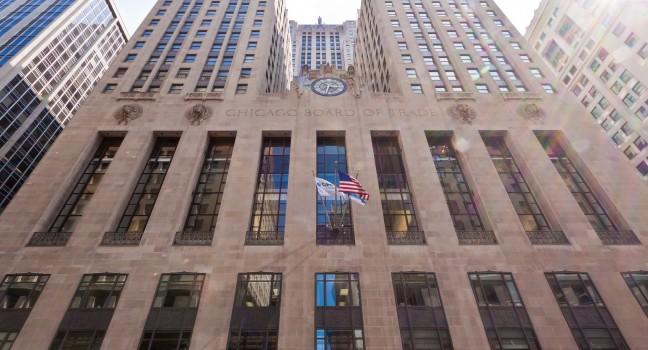
The facade of the famous building with its clock. Chicago Board of Trade at downtown, Illinois state, United States.
(c) Afagundes | Dreamstime.com

Home of the thriving financial district, relatively narrow LaSalle Street earned the moniker "The Canyon" (and it feels like one) because of the large buildings that flank either end. This one was designed by Holabird & Root and completed in 1930. The streamlined, 45-story giant recalls the days when art deco was all the rage. The artfully lighted marble lobby soars three stories, and Ceres (the Roman goddess of agriculture) stands atop its roof. Trading is no longer done here, but it's worth a look at what was the city's tallest skyscraper until 1955, when the Prudential Center topped it.

150 North Michigan Avenue

Chicago Loop

Some wags have pointed out that this building, with its diamond-shaped top, looks like a giant pencil sharpener. Built in 1984 as the Smurfit-Stone Building and later known as the Crain Communications Building, it has a slanted top that carves through the top 10 of its floors. In the plaza is Yaacov Agam's Communication X9, a painted, folded aluminum sculpture that was restored (to some controversy) and reinstalled in 2008. You'll see different patterns in the sculpture depending on your vantage point.

190 South LaSalle Street

Chicago Loop

This 40-story postmodern office building, resembling a supersized château, was designed by John Burgee and Philip Johnson in the mid-1980s. The grand, gold-leaf vaulted lobby is spectacular.

224 South Michigan Avenue

Chicago Loop

This structure, designed in 1904 by Daniel Burnham, who later moved his office here, was once known as the Railway Exchange Building and the Santa Fe Building, for a "Santa Fe" sign on its roof that has since been removed. The Chicago Architecture Foundation uses the building's atrium for rotating exhibits about the changing landscape of Chicago and other cities. The organization also offers a variety of tours via foot, bus, and boat.

224 S. Michigan Ave., Chicago, IL, 60604, USA

Something incorrect in this review?

311 South Wacker Drive

Chicago Loop

The first of three towers intended for the site, this pale-pink edifice is the work of Kohn Pedersen Fox, who also designed 333 West Wacker Drive, a few blocks away. The 1990 building's most distinctive feature is its Gothic crown, brightly lit at night. During migration season so many birds crashed into the illuminated tower that management was forced to tone down the lighting. An inviting atrium has palm trees and a splashy, romantic fountain.

333 West Wacker Drive

Chicago Loop

This green-glazed beauty doesn't follow the rules. Its riverside facade echoes the curve of the Chicago River just in front of it, while the other side is all business, conforming neatly to the straight lines of the street grid. The 1983 Kohn Pedersen Fox design, roughly contemporary to the James R. Thompson Center, enjoyed a much more positive public reception. It also had a small but important role in the 1986 movie Ferris Bueller's Day Off as the location of Ferris's dad's office.

71 S. Wacker

Chicago Loop

At 48 stories, this modern high-rise is no giant, but it more than makes its mark on South Wacker Drive with a bold elliptical shape, a glass-faced street-level lobby rising 36 feet, and a pedestrian-friendly plaza. It displays a noticeable tweaking of the unrelieved curtain wall that makes many city streets forbidding canyons. Designed by Pei Cobb Freed & Partners, the tower was originally known as the Hyatt Center and was completed in 2004.

860–880 N. Lake Shore Drive

Near North Side

These 26-story twin apartment towers overlooking Lake Michigan were an early and eloquent realization of Mies van der Rohe's "less is more" credo, expressed in high-rise form. I-beams running up the facade underscore their verticality; inside, mechanical systems are housed in the center so as to leave the rest of each floor free and open to the spectacular views. Completed in 1951, the buildings, called “flat-chested architecture" by Frank Lloyd Wright, are a prominent example of the International Style, which played a key role in transforming the look of American cities.

860–880 N. Lake Shore Dr., Chicago, IL, 60611, USA

Something incorrect in this review?

Alfred Caldwell Lily Pool

The work of landscape architect Alfred Caldwell, this serene oasis---comprising a gracefully curving pond and Prairie-style pavilion amid native vegetation---hides in plain sight beside Lincoln Park Zoo’s parking lot, poised to allay weary zoo warriors with a Zen break.

Aon Center

Chicago Loop

With the open space of Millennium Park at its doorstep, the Aon Center really stands out. Originally built as the Standard Oil Building, the 83-story skyscraper (first referred to as Big Stan) has changed names and appearances twice. Not long after the building went up in 1972, its marble cladding came crashing down, and the whole thing was resheathed in granite.

200 E. Randolph Dr., Chicago, IL, 60601, USA
312-381–1000

Something incorrect in this review?

Aqua

Chicago Loop

With its undulating concrete balconies suggesting rippling liquid, Aqua’s addition to the skyline in 2009 made Jeanne Gang a household name in architectural circles; the building was not just a critical hit, it was also the world’s tallest building designed by a woman. Aqua recently lost that designation to another Gang design, the nearby St. Regis Chicago, which is currently the third-tallest building in the city.

225 N. Columbus Dr., Chicago, IL, 60601, USA

Something incorrect in this review?

Argyle Strip

Uptown

Also known as "Little Vietnam," the stretch of Argyle Avenue between Broadway and Sheridan (and the blocks surrounding it) offers much more than just steaming bowls of pho. Among the storefront noodle-focused restaurants are Chinese bakeries, Thai curry specialists, dim sum destinations, and pan-Asian grocery stores that are a huge draw for locals and tourists alike. Roasted ducks hang in shop windows and bubble tea shops abound. 

Chicago, IL, 60640, USA

Something incorrect in this review?

Block Museum of Art

Comprised of three galleries, this multipurpose space is among the most notable sights on the Northwestern University campus. The impressive rotating collection includes prints, photographs, and other works on paper spanning the 15th to 21st centuries. An outdoor sculpture garden features pieces by Joan Miró and Barbara Hepworth. Workshops, lectures, and symposia are also hosted here, and the museum's Block Cinema screens classic and contemporary films.

Bloomingdale's (Medinah Temple)

River North

Built in 1912 for the Shriners, the former Medinah Temple is a Middle Eastern fantasy, with horseshoe-shape arches, stained-glass windows, and intricate geometric patterns around windows and doors (it once also held a 4,200-seat auditorium). Vacant for many years, it was transformed into a Bloomingdale's Home & Furniture Store in 2003.

600 N. Wabash Ave., Chicago, IL, 60611, USA
312-324–7500
Sight Details
Mon.–Thurs. 10–7, Fri. and Sat. 10–8, Sun. noon–6

Something incorrect in this review?

Blues Heaven Foundation

Prairie Avenue

For a walk into history, stop by the Blues Heaven Foundation, which occupies the former home of the legendary Chess Records. Breathe the same rarefied air as blues (and rock-and-roll) legends Muddy Waters, Howlin’ Wolf, Chuck Berry, and the Rolling Stones, all of whom recorded here. Check out the Chess brothers’ private offices, the recording studio, and the back stairway used only by signed musicians. During the summer, groove to a free weekly concert in the Blues Garden.

2120 S. Michigan Ave., Chicago, IL, 60616, USA
312-808–1286
Sight Details
$20
Closed Sun. and Mon.
Tour reservations required

Something incorrect in this review?

Cantigny Park

The 500-acre estate of former Chicago Tribune editor and publisher Robert McCormick (1880–1955) has multiple attractions. For starters, there's the First Division Museum, an impressive military history museum that has interactive, immersive exhibits. The sweeping landscape also incorporates formal gardens, picnic grounds, walking trails, and its own 27-hole public golf course with a separate 9-hole course for kids.

1S151 Winfield Rd., Wheaton, IL, 60189, USA
630-668–5161
Sight Details
$15 per car on weekends May-Oct. otherwise $5 per car; free Wednesdays with advance registration
Closed Jan. and Mon.–Thurs. in Feb.

Something incorrect in this review?

Carbide and Carbon Building

Chicago Loop

Designed in 1929 by Daniel and Hubert Burnham, sons of the renowned architect Daniel Burnham, this is arguably the jazziest skyscraper in town. A deep-green terra-cotta tower rising from a black-granite base, its upper reaches are embellished with gold leaf. The original public spaces are a luxurious composition in marble and bronze. The story goes that the brothers Burnham got their inspiration from a gold-foiled bottle of champagne. The building is now home to the swanky Pendry Chicago hotel.

Charnley-Persky House Museum

Gold Coast

Designed by Louis Sullivan and his protégé Frank Lloyd Wright, this almost austere residence is one of the few extant buildings that displays the combined talents of these two architectural innovators. Historians still squabble about who contributed what here, but it's easy to imagine that the young go-getter had a hand in the cleanly rendered interior. Note how the geometric exterior looks unmistakably modern next to its traditional neighbors. Public tours of both the interior and exterior are available and last about one hour. The complimentary Wednesday tours are less comprehensive than the paid ones on Saturday; reservations are required for all tours. Check the website for reservations and pricing.