10 Best Sights in Montreal, Quebec

Background Illustration for Sights

We've compiled the best of the best in Montreal - browse our top choices for the top things to see or do during your stay.

Basilique Notre-Dame-de-Montréal
Fodor's Choice
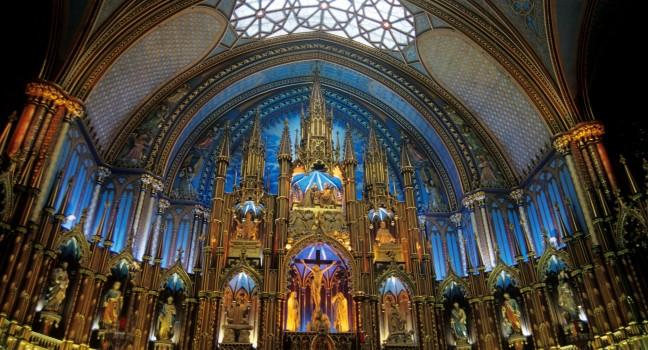
Montreal Notre-Dame Basilica Sunshine on the altar of Montreal
Peter Guttman/PeterGuttmann.com

Few churches in North America are as wow-inducing as Notre-Dame. Everything about the Gothic Revival–style church, which opened in 1829, seems designed to make you gasp—from the 228-foot twin towers out front to the tens of thousands of 24-karat gold stars that stud the soaring blue ceiling.

Nothing in a city renowned for churches matches Notre-Dame for sheer grandeur—or noisemaking capacity: its 12-ton brass bell is the largest in North America, and its 7,000-pipe Casavant organ can make the walls tremble. The pulpit is a work of art in itself, with an intricately curving staircase and fierce figures of Ezekiel and Jeremiah crouching at its base. The whole place is so overwhelming it's easy to miss such lesser features as the stained-glass windows from Limoges and the side altars dedicated to St. Marguerite d'Youville, Canada's first native-born saint; St. Marguerite Bourgeoys, Canada's first schoolteacher; and a group of Sulpician priests martyred in Paris during the French Revolution.

For a peek at the magnificent baptistery, decorated with frescoes by Ozias Leduc, you'll have to tiptoe through the glassed-off prayer room in the northwest corner of the church. Every year dozens of brides—including Céline Dion, in 1994—march up the aisle of Chapelle Notre-Dame-du-Sacré-Coeur (Our Lady of the Sacred Heart Chapel), behind the main altar, to exchange vows with their grooms before a huge modern bronze sculpture that you either love or hate.

Notre-Dame is an active house of worship, so dress accordingly. The chapel can't be viewed weekdays during the 12:15 pm mass, and is often closed Saturday for weddings. Don't miss the 45-minute multimedia spectacle, Aura, which celebrates the basilica's exquisite features through light and sound. See website for schedule ( www.aurabasiliquemontreal.com/en).  The basilica has been under major restoration since 2020 and is not expected to be complete until 2040. Be prepared to see scaffolding at the very least.

110 rue Notre-Dame Ouest, H2Y 1T1, Canada
514-842–2925
Sight Details
Self-guided tour C$16; multimedia show Aura from C$37
Purchase tickets online

Something incorrect in this review?

Jardin Botanique

Fodor's Choice
HDR image of the Chinese Garden of the Montreal Botanical Gardens.
Andre Nantel / Shutterstock

Creating one of the world's great botanical gardens in a city with a winter as harsh as Montréal's was no mean feat, and the result is that no matter how brutal it gets in January there's one corner of the city where it's always summer. With 181 acres of plantings in summer and 10 greenhouses open all year, Montréal's Jardin Botanique is the second-largest attraction of its kind in the world (after England's Kew Gardens). It grows more than 26,000 species of plants, and among its 30 thematic gardens are a rose garden, an alpine garden, and—a favorite with the kids—a poisonous-plant garden.

You can attend traditional tea ceremonies in the Japanese Garden, which has one of the best bonsai collections in the West, or wander among the native birches and maples of the Jardin des Premières-Nations (First Nations Garden). The Jardin de Chine (Chinese Garden), with its pagoda and waterfall, will transport you to the Ming dynasty. In the fall, all three cultural gardens host magical mixes of light, color, plant life, and sculpture during the annual Gardens of Light spectacle.

4101 rue Sherbrooke Est, H1X 2B2, Canada
514-868--3000
Sight Details
C$23.75
Closed Mon., except during summer and holiday season

Something incorrect in this review?

Musée d'Archéologie et d'Histoire Pointe-à-Callière (PAC)

Fodor's Choice
Musee d'Archeologie et d'Histoire Pointe-a-Calliere
Pointe-à-Callière by Jonathan Feinberg

A modern glass edifice built on the site of Montréal's first European settlement, the PAC impresses. The museum presents new local and international temporary exhibitions each year, but the real reason to visit the city's most ambitious archaeological museum is to take the elevator ride down to the 17th century.

It's dark down there, and just a little creepy thanks to the 350-year-old tombstones teetering in the gloom, but it's worth the trip. This is a serious archaeological dig that takes you to the very foundations of the city. A more lighthearted exhibit explores life and love in multicultural Montréal. For a spectacular view of the Old Port, the St. Lawrence River, and the Islands, ride the elevator to the top of the tower, or stop for lunch in the museum's glass-fronted bistro. In summer there are re-creations of period fairs and festivals on the grounds near the museum.

The Fort Ville-Marie pavilion showcases the remains of the forts and artifacts from the first Montrealers. The 360-foot underground William collector sewer, North America's first collector sewer built in the 1830s and considered a masterpiece of civil engineering at the time, connects the original museum space with the new pavilion and features a sound-and-light show projected onto the walls of the collector sewer.

Recommended Fodor's Video

Musée des Beaux-Arts de Montréal

Fodor's Choice
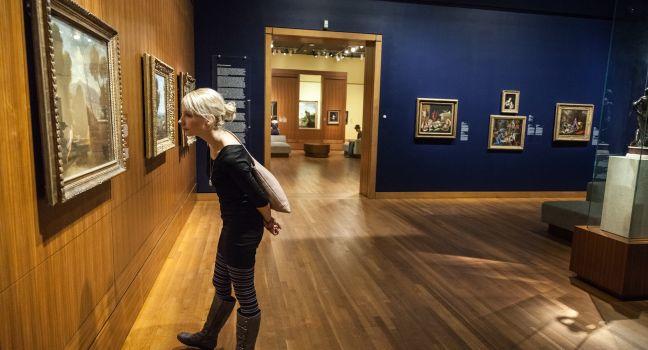
Montreal, Canada, Feb 22 2014 - Montreal Fine Arts Museum Room with Paintings on the wall and Young Adult looking at it.
Benoit Daoust / Shutterstock

Not surprisingly, Canada's oldest museum--and one of its most important institutions for the arts--has one of the finest collections of Canadian art anywhere. The works of such luminaries as Paul Kane, the Group of Seven, Paul-Émile Borduas, and Marc-Aurèle Fortin are displayed here in the Bourgie Pavilion, a space built onto the back of the neoclassical Erskine and American United Church, one of the city's most historic Protestant churches. The nave has been preserved as a meeting place and exhibition hall and also displays the church's 18 Tiffany stained-glass windows, the biggest collection of Tiffany's work outside the United States. The rest of the museum's permanent collection, which includes works by everyone from Rembrandt to Renoir, is housed in its four other pavilions: the neoclassical Hornstein Pavilion; the modernist 1970s Stewart Pavilion; the glittering, glass-fronted Desmarais Pavilion; and the cantilevered glass and aluminum Hornstein Pavilion for Peace, which looks like an illuminated paper lantern at night. All of the pavilions are linked by tunnels. Admission is half-price from 5 to 9 pm Wednesday.

1380 rue Sherbrooke Ouest, H3G 1J5, Canada
514-285–2000
Sight Details
C$31; half-price Wed. after 5 pm
Closed Mon.

Something incorrect in this review?

Parc Jean-Drapeau

Fodor's Choice
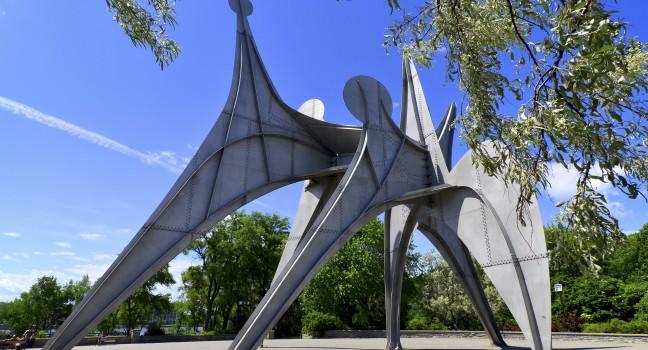
MONTREAL, CANADA - JUNE 19: The Alexander Calder sculpture L'Homme is a large-scale outdoor sculpture on june 19 2013 in Parc Jean-Drapeau, located in Montreal. Made for 1967 World Fair.
meunierd / Shutterstock

Île Ste-Hélène and Île Notre-Dame now constitute a single park named, fittingly enough, for Jean Drapeau (1916–99), the visionary (and spendthrift) mayor who built the métro and brought the city both the 1967 World's Fair and the 1976 Olympics. The park includes La Ronde (a major amusement park), acres of flower gardens, an aquatic complex, a beach with filtered water, the Formula 1 Grand Prix Circuit Gilles Villeneuve, performance spaces, and the Casino de Montréal. There's history here, too, at the Old Fort, which was built by the British to protect the country from a possible invasion by the United States. In winter, you can skate on the old Olympic rowing basin or slide down iced trails on an inner tube.

Avenue Bernard

Fodor's Choice

If your taste runs to the chic and fashionable, then there is simply no better street than avenue Bernard, west of avenue Querbes, for people-watching. Its wide sidewalks and shady trees make it ideal for the kind of outdoor cafés and restaurants that attract the bright and the beautiful. And, in summer, the avenue is pedestrianized between avenues Wiseman and Bloomfield, with people walking freely and outdoor patios spilling out into the street.

Christ Church Cathedral

Fodor's Choice

The seat of the Anglican (Episcopalian) bishop of Montréal offers downtown shoppers and strollers a respite from the hustle and bustle of rue Ste-Catherine. Built in 1859, the cathedral is modeled on Snettisham Parish Church in Norfolk, England, with some distinctly Canadian touches. The steeple, for example, is made with aluminum plates molded to simulate stone, and inside, the Gothic arches are crowned with carvings of the types of foliage growing on Mont-Royal when the church was built. The stained-glass windows behind the main altar, installed in the early 1920s as a memorial to the dead of World War I, show scenes from the life of Christ. On the wall just above and to the left of the pulpit is the Coventry Cross; it's made of nails taken from the ruins of Britain's Coventry Cathedral, destroyed by German bombing in 1940.The church building is a National Historic Site of Canada.  Free Saturday group tours can be arranged by calling the office.

Cimetière Mont-Royal

Fodor's Choice

If you find yourself humming "Getting to Know You" as you explore Mont-Royal Cemetery's 165 acres, blame it on the graveyard's most famous permanent guest, Anna Leonowens (1834–1915). She was the real-life model for the heroine of the Rodgers and Hammerstein musical The King and I. The cemetery—established in 1852 by the Anglican, Presbyterian, Unitarian, and Baptist churches—is laid out like a terraced garden, with footpaths that meander between crab-apple trees and past Japanese lilacs. Birders and nature photographers love to come to this cemetery for the 150 or so species of birds found here, including chestnut-sided warblers, ruby-throated hummingbirds, bluebirds, cedar waxwings, nuthatches, yellow warblers, woodpeckers, goldfinches, and more. And keep an eye out for the resident groundhogs and raccoons!

Croix sur la Montagne

Fodor's Choice

Visible from up to 50 miles away on a clear day, the 98-foot-high steel cross at the top of Mont-Royal has been a city landmark since it was erected in 1924, largely with money raised through the efforts of 85,000 high-school students. Once upon a time, it took four hours and the labor of three to replace the 249 electric bulbs used to light the cross; today, the iconic cross is illuminated via a high-tech remote-control LED system.

St. Patrick's Basilica

Fodor's Choice

Built in 1847, this is one of the purest examples of the Gothic Revival style in Canada, with a high vaulted ceiling glowing with green and gold mosaics. The tall, slender columns are actually pine logs lashed together and decorated to look like marble, so that if you stand in one of the back corners and look toward the altar you really do feel as if you're peering at the sacred through a grove of trees. St. Pat's—as most of its parishioners call it—is to Montréal's anglophone Catholics what the Basilique Notre-Dame-de-Montréal is to their French-speaking brethren—the mother church and a monument to faith and courage. One of the joys of visiting the place is that you'll probably be the only tourist there, so you'll have plenty of time to check out the old pulpit and the huge lamp decorated with six angels two meters (six feet) tall hanging over the main altar. And if you're named after some relatively obscure saint like Scholastica or Aeden of Fleury, you can search for your namesake's portrait among the 170 painted panels on the walls of the nave. For a solemn experience, visit on the third Sunday of the month (September through June), when the mass is sung completely in Latin.

454 boul. René-Lévesque Ouest, H2Z 1A7, Canada
514-866–7379
Sight Details
Free
Free tours are available most Sun. afternoons in summer.

Something incorrect in this review?