15 Best Sights in Montreal, Quebec

Background Illustration for Sights

We've compiled the best of the best in Montreal - browse our top choices for the top things to see or do during your stay.

Jardin Botanique

Fodor's Choice
HDR image of the Chinese Garden of the Montreal Botanical Gardens.
Andre Nantel / Shutterstock

Creating one of the world's great botanical gardens in a city with a winter as harsh as Montréal's was no mean feat, and the result is that no matter how brutal it gets in January there's one corner of the city where it's always summer. With 181 acres of plantings in summer and 10 greenhouses open all year, Montréal's Jardin Botanique is the second-largest attraction of its kind in the world (after England's Kew Gardens). It grows more than 26,000 species of plants, and among its 30 thematic gardens are a rose garden, an alpine garden, and—a favorite with the kids—a poisonous-plant garden.

You can attend traditional tea ceremonies in the Japanese Garden, which has one of the best bonsai collections in the West, or wander among the native birches and maples of the Jardin des Premières-Nations (First Nations Garden). The Jardin de Chine (Chinese Garden), with its pagoda and waterfall, will transport you to the Ming dynasty. In the fall, all three cultural gardens host magical mixes of light, color, plant life, and sculpture during the annual Gardens of Light spectacle.
4101 rue Sherbrooke Est, H1X 2B2, Canada
514-868--3000
Sight Details
C$23.75
Closed Mon., except during summer and holiday season

Something incorrect in this review?

Parc Jean-Drapeau

Fodor's Choice
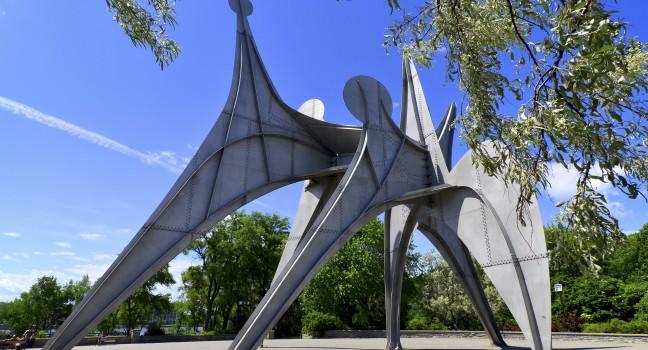
MONTREAL, CANADA - JUNE 19: The Alexander Calder sculpture L'Homme is a large-scale outdoor sculpture on june 19 2013 in Parc Jean-Drapeau, located in Montreal. Made for 1967 World Fair.
meunierd / Shutterstock

Île Ste-Hélène and Île Notre-Dame now constitute a single park named, fittingly enough, for Jean Drapeau (1916–99), the visionary (and spendthrift) mayor who built the métro and brought the city both the 1967 World's Fair and the 1976 Olympics. The park includes La Ronde (a major amusement park), acres of flower gardens, an aquatic complex, a beach with filtered water, the Formula 1 Grand Prix Circuit Gilles Villeneuve, performance spaces, and the Casino de Montréal. There's history here, too, at the Old Fort, which was built by the British to protect the country from a possible invasion by the United States. In winter, you can skate on the old Olympic rowing basin or slide down iced trails on an inner tube.

Biosphère

Nothing captures the exuberance of Expo '67 better than the geodesic dome designed by Buckminster Fuller (1895–1983) as the U.S. Pavilion. It's only a skeleton now—the polymer panels that protected the U.S. exhibits from the elements were burned out in a fire long ago—but it's still an eye-catching sight, like something plucked from a science-fiction movie.

Science of a nonfictional kind, however, is explored in the special environmental center the federal government built in the middle of the dome. It focuses on the challenges of preserving the Great Lakes and St. Lawrence River system, but it has lively and interactive exhibits on climate change, sustainable energy, and air pollution. Kids and others can use games and interactive displays arranged around a large model of the waterway to explore how shipping, tourism, water supplies, and hydroelectric power are affected.  The Biosphère forms part of Espace pour la Vie, which is based in Hochelaga-Maisonneuve and endeavors to bring together art, science, and citizen action.

160 chemin Tour-de-l'Îsle, H3C 4G8, Canada
514-868--3000
Sight Details
C$23.75
Closed Mon., except during summer and the holiday season

Something incorrect in this review?

Recommended Fodor's Video

Centre Bell

The Montréal Canadiens haven't won the Stanley Cup since 1993, though they came very close in June 2021, ultimately losing the finals against Tampa Bay. Most of the team's fans can't remember the golden 1960s and '70s, when Les Glorieux virtually owned the trophy. The superstitious blame the team's fallen fortunes on its 1996 move from the hallowed Forum to the brown-brick Centre Bell arena. Still, Montréal is a hockey-mad city and the Habs, as locals call the team, are still demigods here, and there are even university courses based on this superstar team. (When it celebrated its 100th season in 2009–10, the city changed the name of the strip of rue de la Gauchetière in front of the Centre Bell to avenue des Canadiens-de-Montréal.) Centre Bell is also a venue for blockbuster acts like Coldplay, Drake, Trevor Noah, and Cirque du Soleil.

1260 av. des Canadiens-de-Montréal, H4B 5G0, Canada
877-668–8269
Sight Details
Tours C$22

Something incorrect in this review?

Centre des Sciences de Montréal

You—or more likely, your kids—can design an energy-efficient bike, create a television news report, explore the impact that manufacturing one T-shirt has on the environment, find out what it's like to ride a unicycle 20 feet above the ground, create an animated film, or just watch an IMAX movie on a giant screen at Montréal's interactive science center. Games, puzzles, and hands-on experiments make it an ideal place for rainy days or even fair ones. The center has a cafe/bistro serving coffee, pastries and light meals and a lunch room where visitors can eat food they brought with them, though there are no microwaves.

Exporail

You can rattle around Canada's largest railroad museum in a vintage tram specially built for Montréal sightseeing tours in the 1950s, when the city still had a streetcar system. The museum has more than 120 train cars and locomotives, but if you're a steam buff, you won't want to miss CPR 5935, the largest steam locomotive built in Canada, and CNR 4100, the most powerful in the British Empire when it was built in 1924. To see how the rich and powerful traveled, take a look at Sir William Van Horne's luxurious private car. Of special interest to the kids will be the car that served as a mobile classroom. The museum is south of the city in the town of St-Constant. On weekdays Expo runs commuter trains from the Gare Lucien-l'Allier, next to the Centre Bell, to Candiac/St. Constant. Trains depart at 9:35 am and return at 1:27 pm.

110 rue St-Pierre, St-Constant, J5A 1G7, Canada
450-632–2410
Sight Details
C$21.20

Something incorrect in this review?

Insectarium

After a complete C$38.4 million metamorphosis, the Insectarium, reopened in 2022, now houses more than 3,000 plants of 150 different varieties and approximately 175 species of insects—including up to 80 species of butterflies flitting about any one time. The reconfigured spaces, inspired by real insect habitats, feature chambers, nests, vegetation, galleries, and soil. Immersive educational experiences aim to replicate life as seen and felt by an insect. For instance, the ground vibrates and ultraviolet visual effects mimic a bug’s vision. In this way, visitors are encouraged to move around the way an insect would, by, say, having to squeeze through tunnels or hold on to vertical rods meant to imitate blades of grass. With the new Insectarium, the first of its kind in North America, the hope is that this more intimate experience will lead visitors to rethink our relationships with bugs. The revitalized venue also includes exhibits and a children's activities room.

4581 rue Sherbrooke Est, H1X 2B2, Canada
514-872–1400
Sight Details
C$23.75
Closed Mon. Sept–May

Something incorrect in this review?

La Ronde

Every year, it seems, this amusement park, at the eastern end of Île Ste-Hélène, adds some new and monstrous way to scare the living daylights (and maybe even your lunch) out of you. Vipère, a free-fly roller coaster, lifts you 107 feet up and subjects you to unexpected drops, vertical free falls, and 360-degree somersaults. Chaos is a single loop that takes you forward, backward, and upside down while sitting face-to-face with other riders. Titan, a giant swaying pendulum will have you—or the kids—soaring and spinning 148 feet above the park, traveling at speeds up to 70 mph. Demon, an extreme, high-speed ride, twists you, twirls you, and turns you upside down, then douses you with water jets. The park also aims to terrify with such stomach-turning champions as Endör, the Goliath, the Vampire, Monstre, and Vol Ultime. For the less daring, there are Ferris wheels, boat rides, and kiddie rides.  The popular International Fireworks Competition is held here on Thursdays and Sundays in late June and July.

Lac aux Castors

Mont-Royal's single body of water, actually a reclaimed bog, is a great place for kids (and parents) to float model boats or rent a rowboat in the summertime (See  www.lemontroyal.qc.ca/en/rowboats-and-outdoor-games for rowboat, mölkky, spikeball, and cornhole game rentals). In winter, the lake's frozen surface attracts whole families of skaters, and nearby there's a groomed slope where kids of all ages can ride inner tubes. The glass-fronted Beaver Lake Pavilion is a pleasant bistro that serves lunch and dinner. Skate, snowshoe, and cross-country-ski rentals are available downstairs.

Lachine Canal National Historic Site

The canal is all about leisure—biking, rollerblading, strolling along the water, and picnicking—but it wasn't always so. Built in 1825 to get boats and cargo around the treacherous Lachine Rapids, it quickly became a magnet for all sorts of industries. But when the St. Lawrence Seaway opened in 1959, allowing large cargo ships to sail straight from the Atlantic to the Great Lakes without stopping in Montréal, the canal closed to navigation and became an illicit dumping ground for old cars and the bodies of victims of underworld killings. The area around it degenerated into an industrial slum.

A federal agency rescued the site in 1978, planting lawns and trees along the old canal, transforming it into a long, narrow park, or parc linéaire. Some of the abandoned canneries, sugar refineries, and steelworks have since been converted into desirable residential and commercial condominiums. The bicycle path is the first link in the more than 97 km (60 miles) of bike trails that make up the Pôle des Rapides ( 514/364–4490).

Two permanent exhibits at the Lachine Canal Visitor Services Centre, at the western end of the canal, explain its history and construction. The center also has a shop and lookout terrace.

Musée des Hospitalières de l'Hôtel-Dieu

The nuns of the Religieuses Hospitalières de St-Joseph ran Montréal's Hôpital Hôtel-Dieu for more than 300 years, until the province and the Université de Montréal took it over in the 1970s. The first sisters—girls of good families caught up in the religious fervor of the age—came to New France with Jeanne Mance in the mid-1600s to look after the poor, the sick, and the dying. The order's museum—tucked away in a corner of the hospital the nuns built but no longer run—captures the spirit of that age with a series of meticulously bilingual exhibits. Just reading the excerpts from the letters and diaries of those young women helps you to understand the zeal that drove them to abandon the comforts of home for the hardships of the colonies. The museum also traces the history of medicine and nursing in Montréal.   From May to October, tours of the "secret" monastery gardens are available for C$17. Most tours are in French, but some are offered in English on select dates. 

Old Port

Montréal's favorite waterfront park is your ideal gateway to the St. Lawrence River. Rent a pedal boat, take a ferry to Île Ste-Hélène, sign up for a dinner cruise, or, if you're really adventurous, ride a raft or a jet boat through the turbulent Lachine Rapids. If you're determined to stay ashore, however, there's still plenty to do, including riding the Grande Roue, the tallest Ferris wheel in Canada; soaking in the rays at the Clock Tower Beach (you can't swim, though); and enjoying street performances, sound-and-light shows, or art displays and exhibitions.

Visiting warships from the Canadian navy and other countries often dock here and open their decks to the public. You can rent a bicycle or a pair of in-line skates at one of the shops along rue de la Commune and explore the waterfront at your leisure. In winter, rent a pair of skates and glide around the outdoor rink. You can also, quite literally, lose the kids in Shed 16's Labyrinthe, a maze of alleys, surprises, and obstacles built inside an old waterfront warehouse. With the rope and aerial courses aboard life-size replicas of pirate and royal ships, kids will also go crazy for the Voiles en Voiles adventure park.

Parc Lafontaine

You could say that Parc Lafontaine is a microcosm of Montréal: the eastern half is French, with paths, gardens, and lawns laid out in geometric shapes; the western half is English, with meandering paths and irregularly shaped ponds that follow the natural contours of the land. In summer, you can take advantage of bowling greens, tennis courts, an open-air theater, (Théâtre de Verdure), and two artificial lakes with paddle boats. The Théâtre de Verdure puts on free musical, dance, theater, and circus arts performances, as well as films. In winter, one lake becomes a large skating rink. The park is named for Sir Louis-Hippolyte Lafontaine (1807–64), a pioneer of responsible government in Canada.

3933 av. Parc Lafontaine, H2L 0C7, Canada
514-872–6381

Something incorrect in this review?

Planétarium

In 2013, Montréal got a new, ultramodern, C$48 million planetarium, one of only a handful of planetariums worldwide to have two circular theaters—one for astronomy exhibits and the other a high-tech multimedia venue. Part of the Espace pour la Vie complex, this state-of-the-art facility delivers a futuristic experience unlike any other. The permanent exhibit lets the whole family have fun exploring life on Earth and (perhaps) in the universe through interactive and hands-on stations. Hours vary seasonally, so check online before heading out.

Plage de l'Île Notre-Dame

Île Notre-Dame

The dress code at the neighboring casino might ban camisoles and strapless tops, but here anything seems to go on warm summer days, when the beach is a sea of oiled bodies. You get the distinct impression that swimming is not uppermost on the minds of many of the scantily clad hordes. If you do want to go in, however, the water is filtered and closely monitored for contamination, and there are lifeguards on duty. A shop rents swimming and boating paraphernalia, and there's a restaurant and picnic areas.