187 Best Sights in Hungary

Background Illustration for Sights

We've compiled the best of the best in Hungary - browse our top choices for the top things to see or do during your stay.

Pécs-Belvárosi templom

Fodor's Choice

Crowning the city's main square, Széchenyi tér, this delightful 16th-century Turkish mosque-turned-church is a Pécs landmark. Dating from the years of Turkish occupation (1543–1686) when it was known as the Mosque of Pasha Qasim, the building was converted into a Catholic church in 1702; a fact you might infer from the cross that surmounts the gilded crescent atop the dome. Despite the fierce religious war raging on its walls—Christian statuary and frescoes beneath Turkish arcades and mihrabs (prayer niches)—this church remains the largest and finest relic of Turkish architecture in Hungary. Look out in particular for the enormous painting above the gallery, showing the defeat of the Turks: while triumphalist, the defeated soldiers are depicted rather sympathetically.

Széchenyi tér, 7621, Hungary
30-373–8900
Sight Details
2,400 HUF; combo ticket with Pécsi Bazilika: 4,000 HUF

Something incorrect in this review?

Petrányi Pince

Fodor's Choice

The village of Csopak, just to the northeast of Balatonfüred, is at the heart of the region's wine-growing industry, and a number of local producers—from Jásdi to Szent Donát—now offer wine tastings on their properties. The best of the bunch is Petrányi, thanks to its large hillside terrace with sweeping views of the lake, its great selection of wines for tasting (mostly from their own vineyards, which spread out below), and its menu of delicious Hungarian and international dishes. Ask nicely and you might get a tour of the chapel-like cellar, complete with a hidden room once used to hide bottles from the taxman.

Rudas Gyógyfürdő

Tabán Fodor's Choice

This bath on the riverbank boasts perhaps the most dramatically beautiful interior of all of Budapest's baths, with the original Turkish pool the star of the show. A high, domed roof admits pinpricks of bluish-green light into the dark, circular stone hall with its austere columns and arches. The central octagonal pool catches the light from the glass-tiled cupola and casts it around the surrounding six pools, capturing the feeling of an ancient Turkish hammam. The highly fluoridated waters here have been known for 1,000 yearsand the baths themselves date back to the 16th century. The baths vary in temperature from 16 to 42 degrees Celsius, and you can also drink the water from three springs in the drinking hall (open Tuesday and Thursday only). The thermal part is open to men only on Monday and Wednesday, as well as the mornings of Thursday and Friday; to women only on Tuesday; and to both sexes on Thursday and Friday afternoons and all day weekends. Soak after-hours here on Friday and Saturday nights from 10 pm to 3 am.

Döbrentei tér 9, Budapest, 1013, Hungary
20-321–4568
Sight Details
8,600 HUF weekdays; 12,200 HUF weekends; 12,600 HUF night ticket

Something incorrect in this review?

Recommended Fodor's Video

Szabó Ervin Könyvtár

South Pest Fodor's Choice

Stately on the outside, spectacular on the inside, this ornate library is located in Wenckheim Palace, one of the most grand homes in the Palace District when built by a Hungarian aristocrat in the 1800s, and today the city's most beautiful reading rooms. The library moved in in 1931, after the city bought the neobaroque palace. Head straight to the fourth floor to wander the gilded palatial rooms; take a seat in the former Smoking Room with its carved wood panels and ceiling, ornate spiral staircase, and leather-bound books, or find a velvet chair from which to admire the chandeliers, high ceilings, and elegant finishes in the former Ballroom or the Lady of the House's Room. For bookworms, this is a working library and accessible to the public, so make time to peruse the shelves. Purchase a daily card to get access to some of the library databases and in-house resources or check out their calendar for upcoming public events. It's also just worth coming in to appreciate the setting and have a coffee and a cake at the library café. The library is named for Szabó Ervin, who helped develop the public library system in Budapest.

Szabó Ervin tér 1, Budapest, 1088, Hungary
1-411--5000
Sight Details
Library: 300 HUF, Wenckheim Palace: 3,000 HUF
Closed Sun.

Something incorrect in this review?

Szentendrei-sziget

Fodor's Choice

Looking for some tranquility after squeezing through the crowds in downtown Szentendre? The answer is this lush green island oasis, right across the river but surprisingly untouched and ripe for exploration. At the time of the Hungarian conquest of the Carpathian Basin in AD 896, the flat island—33 km (21 miles) long and up to 3.8 km (2.4 miles) wide—was used as pasture land. It subsequently became a key agricultural, ship-building, and fishing center that helped link the otherwise hilly Danube Bend with Buda to the south. Only after the end of the 120-year Turkish occupation of Hungary in the late 17th century did a loose-knit web of settlements develop, and from the mid-19th century on, resort districts began to spring up for city-weary Budapesters.

Most of Szentendre Island comprises nature preserves and bucolic countryside—this is a rich habitat and stopping-off point for waterfowl—but there are also four villages, from quaint Kisoroszi (with its gorgeous golden beach) on the island's northern tip, to the larger but lovely Szigetmonostor in the south. To get to the island from Szentendre, hop on a ferry from the docks, or cross the bridge at Tahitótfalu, 10 km (6 miles) north of town.

Szépasszony-völgy

Fodor's Choice

It may be a 30-minute walk (or 10-minute drive) from the center of town, but no trip to Eger is complete without a visit to the wonderful Szépasszony-völgy (literally "Valley of the Beautiful Woman"). Eger wine is renowned within and beyond Hungary, and this wine-growing area on the southwestern edge of Eger's city limits is the place to sample the best vintages. Literally hundreds of small wine cellars (some of them literally holes-in-the-wall) stand open and inviting in warm weather, and a few are open in winter, too. You may be given a tour of the cellar, and wines will be tapped from the barrel into your glass by the vintners themselves at the tiniest cost (but it's prudent to inquire politely how much it will cost before imbibing). Make sure you sample the area's best-known variety, Egri Bikavér (Bull's Blood of Eger), a full-bodied red wine, as well as other outstanding vintages like the delightful dry white Leányka, the dark red dessert wine Medoc Noir, and the sweeter white Muskotály.

Szépasszonyvölgy, 3300, Hungary

Something incorrect in this review?

Szépművészeti Múzeum

City Park Fodor's Choice

Across Heroes’ Square from the Műcsarnok and built by the same team of Albert Schickedanz and Fülöp Herzog, the Museum of Fine Arts houses Hungary’s best art collection, rich in Flemish and Dutch old masters. With seven fine El Grecos and five beautiful Goyas as well as paintings by Velázquez and Murillo, the collection of Spanish old masters is probably the best outside Spain. The Italian school is represented by Bellini, Giorgione, Correggio, Tintoretto, Titian, and Caravaggio masterpieces and, above all, two superb Raphael paintings: the Esterházy Madonna and his immortal Portrait of a Youth, rescued after a world-famous art heist. Nineteenth-century French art includes works by Delacroix, Pissarro, Cézanne, Toulouse-Lautrec, Gauguin, Renoir, and Monet. There are also more than 100,000 drawings (including five by Rembrandt and three studies by Leonardo), and Egyptian and Greco-Roman exhibitions. The special exhibits are outstanding and frequent. Labels are in both Hungarian and English; there’s also an English-language booklet for sale about the permanent collection.

Tuztorony

Fodor's Choice

This symbol of Sopron’s endurance—and entranceway to the Inner Town—is 200 feet high, with foundations dating to the days of the Árpád dynasty (9th–13th centuries) and perhaps back to the Romans. The tower is remarkable for its uniquely harmonious blend of architectural styles: it has a Romanesque base rising to a circular balcony of Renaissance loggias topped by an octagonal clock tower that is itself capped by a brass baroque onion dome and belfry. The upper portions were rebuilt after most of the earlier Fire Tower was, ironically, destroyed by the Great Fire of 1676, started by students roasting chestnuts in a high wind (today a double-headed eagle weather vane helps to predict wind direction; it's said that if the eagles face north and south it's going to rain). On the inside of the gate, you'll find a depiction of "Hungaria" receiving the loyalty of Sopron's kneeling citizens. Climb the 200-step spiral staircase to the top of the tower for lovely views of the town and surrounding countryside. It's from here that tower watchmen warned of approaching enemies and tolled the alarm for fire or the death of a prominent citizen. And occasionally, musicians would serenade the townsfolk from here.

Vajdahunyad Vár

City Park Fodor's Choice

Beside the City Park’s lake stands Vajdahunyad Vár, a fantastic medley of Hungary’s historic and architectural past, starting with the Romanesque gateway of the cloister of Ják, in western Hungary. A Gothic castle whose Transylvanian turrets, Renaissance loggia, baroque portico, and Byzantine decorations are all guarded by a spooky bronze statue of the anonymous medieval “chronicler,” who was the first recorder of Hungarian history. Designed for the millennial celebration in 1896, the permanent structure was not completed until 1908. This hodgepodge houses the surprisingly interesting Mezogazdasági Múzeum (Agricultural Museum), which touts itself as Europe’s largest such museum and offers regular arts and crafts events for kids. Plan ahead for tickets to the Vajdahunyad Castle Summer Music Festival featuring some of Hungary's most popular musicians. If time permits, stroll around the castle to spot the Mermaid fountain and the bust of legendary Hollywood B-movie actor and Hungarian-American Béla Lugosi that was placed in an alcove along the southeast corner in 2003; its origins remain a mystery today.

Vármúzeum és Szent István-terem

Castle District Fodor's Choice

The baroque southern wing of the Royal Palace is home to two of its greatest gems: the Vármúzeum (Castle Museum) and Szent István-terem (St. Stephen's Hall).

The former, which is part of the Budapesti Történeti Múzeum (Budapest History Museum), displays a fascinating permanent exhibit of modern Budapest history, from Buda's liberation from the Turks in 1686 through the 1970s. Viewing the vintage 19th- and 20th-century photos and videos of the castle, the Széchenyi Lánchíd, and other Budapest monuments—and seeing them as the backdrop to the horrors of World War II and the 1956 revolution—helps to put later sightseeing in context.

The latter is one of Budapest's most ornate rooms: an elegantly carved Romanesque masterpiece with a strong Hungarian flavor. You'll be given a tablet with an audiovisual guide to talk you through the history and features of the room, as well as surrounding exhibits like the replica of the Hungarian crown. As there's a lack of seating, you may find yourself skipping through some of the longer-winded commentaries.

Separate tickets are available for the two attractions, but a combined ticket is the best option. Guided tours are available for a small additional fee.

Zsolnay Kulturális Negyed

Fodor's Choice

You can easily spend half a day exploring this sprawling complex, a city within a city that was opened in 2010 to mark Pécs's status as European Capital of Culture. Built on the site of the old Zsolnay porcelain factory, which was established by Miklós Zsolnay in the 19th century, the streets and squares are adorned with a host of colorful ceramic-tiled features, from industrial chimneys to charming pavilions. Many of the buildings are home to Zsolnay-related exhibits, including the Pink Exhibition, showcasing the factory's early rose-tinted output like the decorative Lotus series; the Golden Age Collection, a series of more than 600 pieces revealing Zsolnay's evolution towards the Art Nouveau style; and the Live Manufactory, where brand-new ceramic creations are molded, painted, and fired. The quarter also has a shopping street, some excellent cafés and restaurants, and even rental apartments. As well as Zsolnay exhibits, it's home to 1861 Kesztyűmanufaktúra, the factory, shop, and exhibition space of luxury glove brand Hamerli; the Bóbita Bábszínház (Bóbita Puppet Theater); and a Planetárium. Head to the cigar room of the Zsolnay Restaurant to see one of Zsolnay's most beautiful and innovative creations; a gorgeous black-and-gold fireplace.

Felsővámház utca 52, 7626, Hungary
72-500--350
Sight Details
Grounds free; exhibitions from 1,800 HUF; all-in Zsolnay ticket 7,500 HUF

Something incorrect in this review?

Bazilika

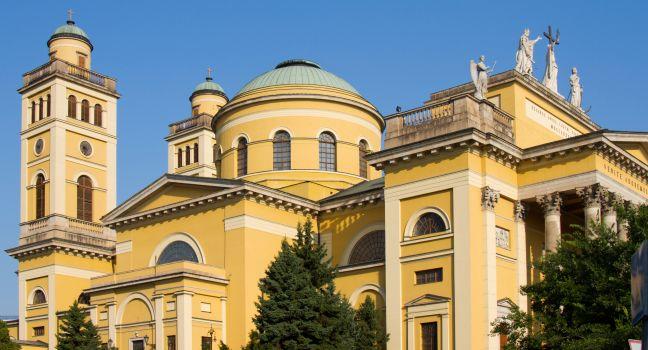
The Cathedral of Eger - this is the second largest catholic church in Hungary. It was built between 1831-1836 in classicist style.
(c) Victorua | Dreamstime.com

The grand, Neoclassical Eger Bazilika, built in the center of town early in the 19th century, is the second-largest cathedral in Hungary after Esztergom (which was built later by the same architect, József Hild). Its beautiful exterior is approached by a split stairway flanked by statues of four saints—Stephen, László, Peter, and Paul—offering views across leafy Eszterházy Square to the similarly monolithic Lyceum building. But it's the interior of the Bazilika that really takes the breath away, with its carved biblical reliefs by Italian sculptor Marco Casagrande set beneath a soaring dome. Visiting on a Sunday, June through October? Stop by for the delightful half-hour organ recital, held at 12:45 pm.

Pyrker János tér 1, 3300, Hungary
36-420--970
Sight Details
Free (suggested donation 300 HUF)

Something incorrect in this review?

Széchenyi Lánchíd

Castle District
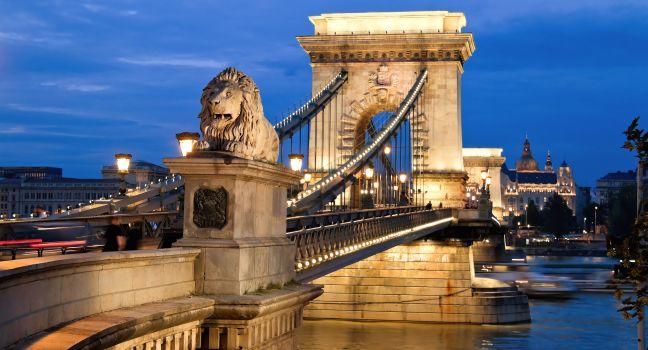
The Chain Bridge in Budapest in the evening. Sightseeing in Hungary.
Lisa S. / Shutterstock

The oldest and most elegant of the road bridges that span the Danube in Budapest—particularly when lit up at night—the Széchenyi Chain Bridge connects Víziváros on the west bank with Lipótváros on the east. Before it was built, the river could be crossed only by ferry or by pontoon bridge that had to be removed when ice blocks began floating downstream in winter. It was constructed at the initiative of the great Hungarian reformer and philanthropist Count István Széchenyi, using an 1839 design by the English civil engineer William Tierney Clark, and was finished by the Scotsman Adam Clark (no relation). After it was destroyed by the Nazis, the bridge was rebuilt in its original, classical and symmetrical form—though widened for traffic—and was reopened in 1949, on the centenary of its inauguration. At the Buda end of the Chain Bridge is Clark Ádám tér (Adam Clark Square), from which you can zip up to Castle Hill on the sikló (funicular); it's 4,000 HUF for a return ticket. The square is also home to the 0 kilométerkő (Zero Kilometer Stone), a sculpture from which all highway distance signs are measured all over the country.

Széchenyi Lánchíd, Budapest, 1051, Hungary

Something incorrect in this review?

Andrássy út

Parliament

Turn-of-the-century Andrássy út links Erzsébet Square with the Városliget and makes for one of Budapest's most pleasant walks, with lots of places to stop along the way. Modeled after Paris' Champs-Élysées, from its starting point at Bajcsy-Zsilinszky út, you can see all the way up to its end at Hősök tere. Lined with spectacular neo-Renaissance mansions and town houses featuring fine facades and interiors, but also shady green trees, it was recognized as a World Heritage Site in 2002. Today, it’s a high-end promenade filled with cafés and restaurants, embassies, and hotels. It's no accident that the city's oldest metro line goes all the way up it, with direct stops at the Opera House and other significant sites in its vicinity.

Andrássy út, Budapest, 1061, Hungary

Something incorrect in this review?

Avasi templomrom

These church ruins on the outskirts of Szigliget, right at the intersection with the road to Badacsony, are what is left of the village's oldest building. These Romanesque remains date back to the Árpád dynasty (855–1301), but the herringbone-like stones in the church walls suggest the site is even older, dating back to at least Roman times. Visit the Avas Church today to see the remaining 12th-century basalt tower with a stone spire.

Réhelyi út 67, 8264, Hungary

Something incorrect in this review?

Baba Múzeum

Supposedly the largest of its kind in Central Europe, Keszthely’s Doll Museum exhibits some 450 porcelain figurines dressed in 240 types of colorful folk dress. The building has a pastoral look, created not only by the figurines—which convey the multifarious beauty of village garb—but also by the ceiling’s huge, handcrafted wooden beams. On the two upper floors are wooden models of typical homes, churches, and ornate wooden gates representative of all regions in and near present-day Hungary that Magyars have inhabited since conquering the Carpathian basin in 896. The museum’s pièce de résistance is the life work of an elderly peasant woman from northern Hungary: a nine-yard-long model of Budapest’s Parliament building, patched together over 14 years from almost four million snail shells.

The Bálna

South Pest

Designed by architect Kas Oosterhuis and opened in 2013, this commercial and cultural hub looks pretty much like its name, which means "whale" in English. The interior is largely empty, with temporary cultural exhibits held in spaces meant for retail stores. Outside, though, trendy bars and restaurants lining its periphery make this a popular meeting point to admire the Danube, especially in the summer. The north-facing Esetleg Bisztró is the ideal location from which to catch a stunning sunset over Buda’s Gellért Hill. Just a few meters away at neighborhood hangout Nehru Park, locals play football, basketball, and practice skateboarding, but most of all they chill out with a picnic or drink, enjoying this welcome green zone next to the river. The south-facing Buda view of the Citadella is almost as gorgeous as the one of Gellért.

Barátlakások

This network of hillside caverns, carved out of the basalt rock between the 11th and 14th centuries but only rediscovered in the 20th century, was once home to a group of Greek Orthodox hermit-monks. A mix of living quarters, chapels, and dining rooms, the caves have since been restored and stabilized with columns, making them safe to visit. You'll find them on the eastern slopes of Óvár hill; follow the green hiking route through the forest from Tihany town, or park your car at the kiinduló pont (starting point) and walk 300 meters downhill to the biggest cave.

Access is via a steep woodland path, so you'll need hiking boots and should avoid visiting during or after heavy rain.

Kecskeköröm utca 28, 8237, Hungary

Something incorrect in this review?

Bécsi kapu tér

Castle District

This lovely square (well, triangle) at the northwestern end of Castle Hill is home to some fine baroque and rococo houses. It's dominated by the enormous neo-Romanesque headquarters of the Országos Levéltár (Hungarian National Archives), a cathedral-like shrine to paperwork built in the 1910s, but there are other gems here, too: check out the house at number eight, with its pink-and-white striped facade and unusual curved windows. Nearby is the medieval stone gateway (rebuilt in 1936) that marks the northern entrance to Castle Hill, and after which the square is named. Literally translated as "Vienna Gate," the archway once sat at the end of a highway that connected Buda Castle to the Austrian capital.

Budapest, 1014, Hungary

Something incorrect in this review?

Buda Arboretum

Gellérthegy

A beautiful botanical garden and park, created in the late 1800s and now part of a university campus, the Buda Arboretum is home to almost 2,000 species of trees, flowers, and plants. It's a very pleasant spot for a stroll or a jog any time of year, but particularly in autumn or spring, when the colors are beautiful. Note that, while the Lower Garden is open every day, the Upper Garden is closed on weekends.

Budai Református Templom

Castle District

Sitting on a charming little square punctuating Víziváros most strollworthy street, Fő utca, this striking, neo-Gothic church was designed by Samu Pecz and built in 1893–96. Rising above the deep-red brickwork of its facade, both its steeple and a massive dome above the main part of the church are covered with colorful tilework from the famous Zsolnay factory in Pécs.

Szilágyi Dezső tér, Budapest, 1011, Hungary

Something incorrect in this review?

Budapest Eye

Jewish Quarter

If you have limited time in the city, this 10-minute ride up and over Erzsébet tér offers lovely bird’s-eye views of the city. Open every day until late, all year-round since 2013, what was supposed to be a temporary promotion for the annual Sziget music festival has become a popular attraction of its own.

Erzsébet tér, Budapest, 1051, Hungary
70-636--0629
Sight Details
3,900 HUF

Something incorrect in this review?

Budapest-Belvárosi Nagyboldogasszony

Belváros

Located at the Pest end of the Erzsébet híd (Elizabeth Bridge), this is not only the oldest church in Budapest, but the oldest building anywhere on this side of the river; its importance is illustrated by the evasive bend in the main road beside it. The relatively understated 18th-century Baroque facade belies the long history and variety of architectural styles you'll find inside, where a medieval Gothic nave stands over the remains of the original 11th-century Romanesque basilica (complete with fragments of frescoes) and the ruins of the Roman garrison that it was built upon. You will also find frescoes from the 14th and 15th centuries, a 16th-century Islamic mihrab (prayer niche)—a holdover from the 150-year Ottoman occupation of Hungary—a 19th-century rococo pulpit, and a 20th-century high altar. The church contains the relics of Saint Gellért, the bishop who was first buried here in 1046 after pagans pushed him off a hill across the river, as well as those of 11th century Hungarian king Saint László.

Március 15 tér, Budapest, 1056, Hungary
1-318--3108
Sight Details
3,000 HUF. Free on Sun.

Something incorrect in this review?

Budapest-Tabáni templom

Tabán

This church, whose steeple is a symbol of the old Tabán neighborhood, arose between 1728 and 1736 on the site of a Turkish mosque and was subsequently expanded several times, its present facade dating from 1880-81. Its form—mustard-colored stone with a rotund, green clock tower—could be described as restrained baroque, and it is dedicated to St. Catherine of Alexandria. It is often closed on weekdays but worth noting as a truly ancient place of worship if you pass by; there has been a religious building on the site since the eleventh century.

Attila utca 11, Budapest, 1013, Hungary
Sight Details
Free
Closed Wed.

Something incorrect in this review?

Budapesti Állat-és Növénykert

City Park

Established in 1866, the Budapesti Állat-és Növénykert was one of the first urban zoos in the world. In the early days, most of the zoo's residents came from the Pannonian Basin, with only a handful of more exotic tenants. One of them was a giraffe gifted by Empress Elisabeth of Austria, who was Queen Consort of Hungary at that time. Her husband, Franz Josef, King of Hungary, sent 34 animals to the zoo from Schönbrunn. The lovingly preserved architecture, which seems to be endlessly under renovation, makes for a uniquely elegant urban zoo experience. Don't miss the Art Nouveau elephant pavilion, decorated with Zsolnay majolica and glazed ceramic animals. In the early 1900s, the elephant house had to be rebuilt at the request of the Turkish ambassador, who thought it resembled a mosque and found it offensive. The neighboring lot, once the amusement park immortalized in the classic Hungarian film about the Kádár era, A Tanú (The Witness), has been annexed by the zoo. The buildup of an enormous biodome, which would have recreated the nature and wildlife of the Pannonian Basin, was canceled halfway through construction in 2022 due to excessive costs (the building’s torso can be seen from the outside). Some of the antique relics, like the wooden roller coaster, remain on display. Note that the last tickets are sold one hour before closing, and animal houses don't open until an hour after the zoo gates.

Állatkerti körút 6–12, Budapest, 1371, Hungary
1-273--4900
Sight Details
4,500 HUF

Something incorrect in this review?

Carl Lutz Memorial

Jewish Quarter

Carl Lutz, a Swiss diplomat, is renowned for saving over 60,000 Jews during WWII. Leveraging his diplomatic status, he issued critical documents, established safe houses, and converted buildings into neutral territories, thus earning the title "Righteous Among the Nations." This striking tribute to his memory is nestled in a corner of the Jewish district, just streets away from the area's synagogues and the former ghetto. It portrays Lutz as a golden angel descending from the heavens, reaching out to rescue a victim, with an inscription that reads, "Whoever saves a life is considered to have saved an entire world."

Dob utca 12, Budapest, 1072, Hungary
Sight Details
Free

Something incorrect in this review?

Cathedral Treasury

On the Szentháromsâg square, next to the cathedral, the Archiepiscopal Treasury houses an astounding trove of precious relics, manuscripts, vestments, and other objects—many in solid gold or silver or encrusted with precious jewels—belonging to the church.
Szentháromság tér 2--3, Kalocsa, 6300, Hungary
30-575--0702
Sight Details
From 800 Ft
Apr.–Oct., Tues.–Sun 9–5

Something incorrect in this review?

Citadella

Gellérthegy

The sweeping views of Budapest from this fortress atop the hill were once valued by the Austrian army, which used it as a lookout after the 1848–49 Revolution. Some 60 cannons were housed in the citadel, and while never used on the city's resentful populace, they were briefly, ominously, pointed down towards the citizens below after the 1956 uprising. The building is closed, but you can walk around it (keep an eye out for bullet holes from the various battles it has witnessed) and the view from the hilltop still makes it a worthy visit, especially at night when the entire city and its bridges are illuminated. Avoid the tacky, overpriced tourists stalls.

Just below the southern edge of the Citadella and visible from many parts of the city, the 130-foot-high Szabadság szobor (Liberty Statue) was originally planned as a memorial to a son of Hungary's then-ruler, Miklós Horthy, whose warplane had crashed in 1942. However, by the time of its completion in 1947 (three years after Horthy was ousted), it had become a memorial to the Russian soldiers who fell in the 1944–45 siege of Budapest; and hence for decades it was associated chiefly with this.

A young girl, her hair and robe swirling in the wind, holds a palm branch high above her head. During much of the communist era, and for a couple of years after its close, she was further embellished with sculptures of giants slaying dragons, Red Army soldiers, and peasants rejoicing at the freedom that Soviet liberation promised (but failed) to bring to Hungary. Since 1992 her mood has lightened: in the Budapest city government's systematic purging of communist symbols, the Red Combat infantrymen who had flanked the Liberty Statue for decades were hacked off and carted away. A few are now on display among the other evicted statues in Szobor Park in the city's 22nd district, and what remains memorializes those who fought for Hungary's freedom.

Citadella sétány, Budapest, 1118, Hungary
Sight Details
Free

Something incorrect in this review?

Context Travel

Context is a trusted international brand, and the company's Budapest tours are known to be well curated and well informed. Specializing in walking tours that are focused on historical and architectural topics including the Jewish Quarter, Belle Époque Budapest, and Communist Budapest, the tours are led by local scholars and get high marks for the quality of their local guides.

Corvin tér

Castle District

This small square on Fő utca is a lovely, leafy place to take a break during a day's sightseeing. While home to a few monuments and a nice little café, Corvin tér is most notable for its eye-catching buildings at either end: to the north, a turn-of-the-20th-century masterpiece that contains the Hungarian Heritage House and Budai Vigadó concert hall; and to the south, a church that was converted from a Turkish mosque at the end of the 17th century and rebuilt in the romantic style in the mid-1800s.

Off Fő utca, Budapest, 1011, Hungary

Something incorrect in this review?