13 Best Sights in Hungary

Background Illustration for Sights

We've compiled the best of the best in Hungary - browse our top choices for the top things to see or do during your stay.

Esztergomi Bazilika

Fodor's Choice
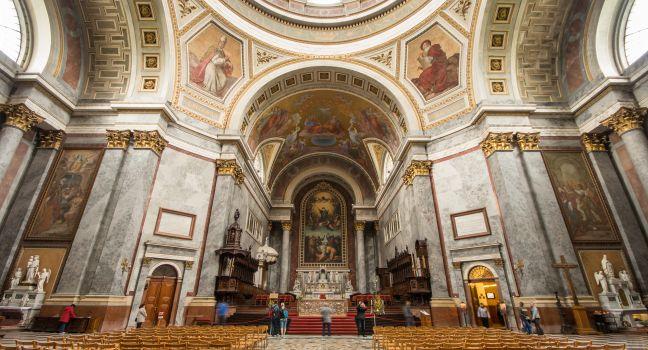
ESZTERGOM / HUNGARY - APRIL 16: Interior of Esztergom basilica on April 16, 2014 in Eger/Hungary.
(c) Asafta | Dreamstime.com

This immense basilica, the largest in the country and visible from miles around, is the seat of the cardinal primate of Hungary. Completed in 1856 on the site of a medieval cathedral and recently restored, the basilica's most wondrous feature is the Bakócz Chapel (1506). Named for a primate of Hungary who only narrowly missed out on becoming pope, the chapel—on your left as you enter—is the most beautiful work of Renaissance architecture in all of Hungary; note its red marble, magnificent carvings, and enormous altar painting. Other highlights to look for are the sacristy, which contains a valuable collection of medieval ecclesiastical art; the vast and deep crypt, where the cathedral's builders and key priests are buried; and the treasury, containing a trove of precious ecclesiastical objects. For a great view of Esztergom, climb the long, winding staircase up to the observation platform in the cathedral's cupola, or take a stroll around the back of the building to the impressive Szent István megkoronázása (St. Stephen's Coronation) sculpture. Each section of the basilica's interior requires an entrance fee, from 500 HUF to 2,000 HUF, so your best bet is to purchase the combination ticket.
Szent István Bazilika

Parliament Fodor's Choice
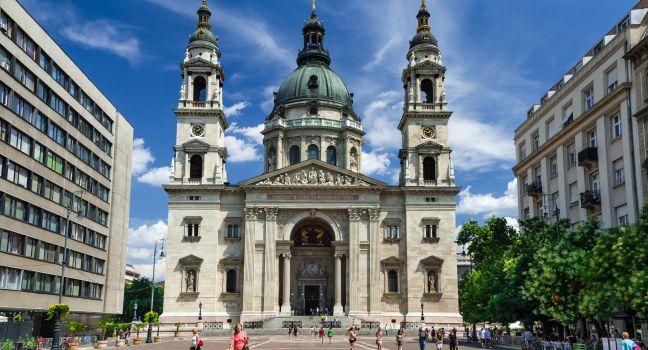
BUDAPEST, HUNGARY - 23 JULY 2013: Image with St. Stephen Swuare. Saint Stephen Basilica the lartgest Budapest cathedral, built as Roman Catholic basilica. Hungary landmark.
(c) Emicristea | Dreamstime.com

Handsome and massive, this is one of the chief landmarks of Pest and the city's largest church---it can hold 8,500 people. Its very Holy Roman front porch greets you with a tympanum bustling with statuary. The basilica's dome and the dome of Parliament are by far the most visible in the Pest skyline, and this is no accident: with the Magyar Millennium of 1896 in mind (the lavishly celebrated thousandth anniversary of the settling of the Carpathian Basin in 896), both domes were planned to be 315 feet high and to this day city codes specify that no downtown Pest building may exceed this height.

The millennium was not yet in sight when architect József Hild began building the basilica in Neoclassical style in 1851, two years after the revolution was suppressed. After Hild's death, the project was taken over in 1867 by Miklós Ybl, the architect who did the most to transform modern Pest into a monumental metropolis. Wherever he could, Ybl shifted Hild's motifs toward the neo-Renaissance mode that Ybl favored. When the dome collapsed, partly damaging the walls, he made even more drastic changes. Ybl died in 1891, five years before the 1,000-year celebration, and the basilica was completed in neo-Renaissance style by József Kauser---but not until 1905.

Below the cupola is a rich collection of late-19th-century Hungarian art: mosaics, altarpieces, and statuary (what heady days the Magyar Millennium must have meant for local talents). There are 150 kinds of marble, all from Hungary except for the Carrara in the sanctuary's centerpiece: a white statue of King (St.) Stephen I, Hungary's first king and patron saint. Stephen's mummified right hand is preserved as a relic in the Szent Jobb Kápolna (Holy Right Chapel); press a button and it will be illuminated for two minutes. You can also climb the 364 stairs (or take the elevator) to the top of the cupola for a spectacular view of the city. Extensive renovation work here has, among other things, returned the cathedral from a sooty gray to an almost bright tan. Small-group guided tours in English are offered, but must be reserved at least 72 hours in advance.

Szent István tér 1, Budapest, 1051, Hungary
1-311–0839
Sight Details
Church: 2,000 HUF; Panoramic Terrace & Treasury: 3,200 HUF; All-in-One ticket: 4,500 HUF

Something incorrect in this review?

Bencés Apátság

Fodor's Choice

On a hilltop overlooking the Old Town is this twin-spired abbey, whose foundations were laid by King András I in 1055. Today, his body lies in the 11th-century crypt, along with a replica of the abbey's charter, the oldest written source of the Hungarian language (the original is in Pannonhalma). The contrast between the simple crypt, where a small black crucifix hangs over the king's tomb, and the abbey’s lavish 18th-century baroque interior—all gold, gilded silver, and salmon—is vast. The altar, abbot’s throne, choir parapet, organ case, and pulpit were all the work of Sebestyén Stuhloff, and it's said he immortalized his doomed sweetheart as the angel kneeling on the right-hand side of the altar to the Virgin Mary. A magnificent organ, adorned by stucco cherubs, can be heard during evening concerts in summer. In a baroque house adjoining—and entered through—the abbey is the Bencés Apátsági Múzeum. The best exhibits are in the basement lapidarium: relics from Roman colonization, including mosaic floors; a relief of David from the 2nd or 3rd century; and 1,200-year-old carved stones. Get a joint ticket for the abbey and museum from the modern visitor center, where you can watch a short introductory video.

Recommended Fodor's Video

Mátyás-templom

Castle District Fodor's Choice

The ornate white steeple of the Matthias Church is the highest point on Castle Hill. It was added in the 15th century, above a 13th-century Gothic chapel. Officially the Buda Church of Our Lady, it has been known as the Matthias Church since the 15th century, in remembrance of the so-called Just King who greatly added to and embellished it during his reign (though many of these changes were lost when the Turks converted it into a mosque). The intricate white stonework, colorful mosaic roof decorations, and some of its geometric patterned columns seem to suggest Byzantium, yet it was substantially rebuilt in the neo-Baroque style 87 years after the Turkish defeat in 1686. One fortunate survivor of all the changes was perhaps the finest example of Gothic stone carving in Hungary: the Assumption of the Blessed Virgin Mary, visible above the door on the side of the church that faces Szentháromság tér.

Inside, the Trinity Chapel holds an encolpion, an enameled casket containing a miniature copy of the gospel to be worn on the chest; it belonged to the 12th-century king Béla III and his wife, Anne of Chatillon. Their burial crowns and a cross, scepter, and rings found in their excavated graves are also displayed here. The church's treasury contains Renaissance and baroque chalices, monstrances, and vestments. Climb the steps in the church's northwest corner to visit the Royal Oratory and the collection of ecclesiastical art, as well as (for an extra fee) the panoramic tower with spectacular views of the city. From here, you can also admire the baroque Trinity Column in the square opposite, erected in 1712–13 as a gesture of thanksgiving by survivors of a plague.

High mass is celebrated every Sunday at 10 am, sometimes with full orchestra and choir and often with major soloists; get here early if you want a seat. During the summer there are classical concerts on Friday (plus some Mondays and Wednesdays) at 7 pm, and organ recitals on Saturday and Sunday at 7:30 pm.

Szentháromság tér 2, Budapest, 1014, Hungary
1-355–5657
Sight Details
2,500 HUF; Tower 2,900 HUF

Something incorrect in this review?

Pécs-Belvárosi templom

Fodor's Choice

Crowning the city's main square, Széchenyi tér, this delightful 16th-century Turkish mosque-turned-church is a Pécs landmark. Dating from the years of Turkish occupation (1543–1686) when it was known as the Mosque of Pasha Qasim, the building was converted into a Catholic church in 1702; a fact you might infer from the cross that surmounts the gilded crescent atop the dome. Despite the fierce religious war raging on its walls—Christian statuary and frescoes beneath Turkish arcades and mihrabs (prayer niches)—this church remains the largest and finest relic of Turkish architecture in Hungary. Look out in particular for the enormous painting above the gallery, showing the defeat of the Turks: while triumphalist, the defeated soldiers are depicted rather sympathetically.

Széchenyi tér, 7621, Hungary
30-373–8900
Sight Details
2,400 HUF; combo ticket with Pécsi Bazilika: 4,000 HUF

Something incorrect in this review?

Bazilika

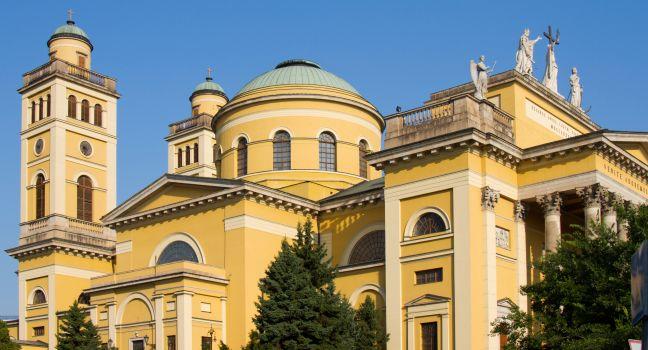
The Cathedral of Eger - this is the second largest catholic church in Hungary. It was built between 1831-1836 in classicist style.
(c) Victorua | Dreamstime.com

The grand, Neoclassical Eger Bazilika, built in the center of town early in the 19th century, is the second-largest cathedral in Hungary after Esztergom (which was built later by the same architect, József Hild). Its beautiful exterior is approached by a split stairway flanked by statues of four saints—Stephen, László, Peter, and Paul—offering views across leafy Eszterházy Square to the similarly monolithic Lyceum building. But it's the interior of the Bazilika that really takes the breath away, with its carved biblical reliefs by Italian sculptor Marco Casagrande set beneath a soaring dome. Visiting on a Sunday, June through October? Stop by for the delightful half-hour organ recital, held at 12:45 pm.

Pyrker János tér 1, 3300, Hungary
36-420--970
Sight Details
Free (suggested donation 300 HUF)

Something incorrect in this review?

Budai Református Templom

Castle District

Sitting on a charming little square punctuating Víziváros most strollworthy street, Fő utca, this striking, neo-Gothic church was designed by Samu Pecz and built in 1893–96. Rising above the deep-red brickwork of its facade, both its steeple and a massive dome above the main part of the church are covered with colorful tilework from the famous Zsolnay factory in Pécs.

Szilágyi Dezső tér, Budapest, 1011, Hungary

Something incorrect in this review?

Budapest-Belvárosi Nagyboldogasszony

Belváros

Located at the Pest end of the Erzsébet híd (Elizabeth Bridge), this is not only the oldest church in Budapest, but the oldest building anywhere on this side of the river; its importance is illustrated by the evasive bend in the main road beside it. The relatively understated 18th-century Baroque facade belies the long history and variety of architectural styles you'll find inside, where a medieval Gothic nave stands over the remains of the original 11th-century Romanesque basilica (complete with fragments of frescoes) and the ruins of the Roman garrison that it was built upon. You will also find frescoes from the 14th and 15th centuries, a 16th-century Islamic mihrab (prayer niche)—a holdover from the 150-year Ottoman occupation of Hungary—a 19th-century rococo pulpit, and a 20th-century high altar. The church contains the relics of Saint Gellért, the bishop who was first buried here in 1046 after pagans pushed him off a hill across the river, as well as those of 11th century Hungarian king Saint László.

Március 15 tér, Budapest, 1056, Hungary
1-318--3108
Sight Details
3,000 HUF. Free on Sun.

Something incorrect in this review?

Budapest-Tabáni templom

Tabán

This church, whose steeple is a symbol of the old Tabán neighborhood, arose between 1728 and 1736 on the site of a Turkish mosque and was subsequently expanded several times, its present facade dating from 1880-81. Its form—mustard-colored stone with a rotund, green clock tower—could be described as restrained baroque, and it is dedicated to St. Catherine of Alexandria. It is often closed on weekdays but worth noting as a truly ancient place of worship if you pass by; there has been a religious building on the site since the eleventh century.

Attila utca 11, Budapest, 1013, Hungary
Sight Details
Free
Closed Wed.

Something incorrect in this review?

Nagyboldogasszony-székesegyház

A short walk from Vác’s main square, this 18th-century cathedral is an outstanding example of Hungarian neoclassicism. It was built between 1763 and 1777 by Archbishop Kristóf Migazzi to the designs of the Italian architect Isidor Carnevale; the most interesting features are the murals by the Austrian Franz Anton Maulbertsch, both on the dome and behind the altar. Exquisite frescoes decorate the walls inside. Due to break-ins, you can view the interior only through a locked gate, except during the twice-daily masses.

Schuszter Konstantin tér 11, 2600, Hungary
27-814--184

Something incorrect in this review?

Pécsi Bazilika

Also known as the Cathedral of Saints Peter and Paul, though it was promoted to basilica rank after Pope John Paul II’s visit in 1991, this is one of Europe’s most magnificent churches with foundations dating back 1,000 years. At the beginning of the 19th century, Mihály Pollack directed the transformation of the exterior, changing it from Baroque to Neoclassical; its interior remained Gothic. Near the end of the 19th century, Bishop Nándor Dulánszky decided to restore the cathedral to its original, Árpád-period style—the result is a four-spired monument that has an utterly breathtaking interior frescoed from floor to ceiling in shimmering golds, silvers, and blues. It's so light and colorful that it feels brand-new. Climb the lookout tower for a beautiful view over Pécs, including the nearby city walls.

Dóm tér 2, 7621, Hungary
72-513--030
Sight Details
2,400 HUF; combo ticket with Pécs-Belvárosi templom: 4,000 HUF

Something incorrect in this review?

Szent Miklós templom

The oldest building on Kossuth tér is the Szent Miklós templom (Church of St. Nicholas), known also as the Barátság templom (Friendship Church) because of St. Nick’s role as the saint of friendship. The church, the oldest in the city, was built in Gothic style in either the 13th or 15th century (a subject of debate). What is not debated is that it was rebuilt in baroque style during the 18th century. Once you pass through the elaborate wrought-iron gate and through an attractive little courtyard out front, note the interior’s apricot hues, which are typical of many an edifice in downtown Kecskemét.

Lestár tér 2, 6000, Hungary

Something incorrect in this review?

Szent Péter és Szent Pál templom

Its pale yellow and green metal steeple being one of Óbuda's core landmarks, this church—a tad more impressive on the outside than the inside—was built by the Zichy family from 1744 to 1749 as the successor to a previous church established here by Hungary's first king, Saint Stephen, in 1010. Situated in a peaceful neighborhood a couple minutes' walk from Fő tér and behind the Aquincum Hotel, it features a red-marble altar (1774) and striking wooden statues of Christ and the church's patron saints (1884).

Lajos utca 168, 1036, Hungary
Sight Details
Free

Something incorrect in this review?